Career Stagnation Despite Learning: Building a Bridge to Influence

The 10:30 p.m. Preparation Loop at a Career Crossroads
'I am not stuck, I am preparing,' Jordan (name changed for privacy) told me when I asked what had brought her to my Toronto reading room. At thirty, she was a senior software engineer who had deliberately chosen the individual-contributor mastery track. She valued deep systems work, and she did not want people management treated as the only legitimate route upward.
At 10:30 p.m. on a Tuesday, I watched her recreate the scene she had described: a presentation outline, a half-finished self-review, and a new technical course open beside each other under the laptop's blue light. The fan hummed steadily. Reheated coffee left a bitter smell in the room, and her phone warmed one palm while she edited a sentence that was already clear.
Her performance review had praised technical depth and then asked for more visibility, influence, and stakeholder leadership. A peer's LinkedIn post had announced another lead title. A cross-team presentation had appeared on her calendar just as another certification seemed to offer a safer kind of progress. 'Why do I keep choosing mastery while worrying my career looks stalled?' she asked. 'What if being good at the work is not enough for people to notice it?'
I could see the mixed weight in her posture: pride held high in the chest, impatience tapping beneath it, and self-doubt settling into the stomach whenever the comparison loop restarted. The pressure had the texture of a browser tab playing a sound she could not locate, quiet enough to ignore while she worked and impossible to stop hearing when the room went still.
I did not hear laziness or a lack of ambition. I heard a competence-first career path whose private rewards had become tangled with the fear of public evaluation. I told Jordan that we would not use the cards to predict a title or issue a verdict about her future. We would use them as a structured mirror, then draw a practical map from the evidence already present. 'Let us make the fog legible,' I said. 'That is where our Journey to Clarity begins.'

Choosing a Compass at the Career Crossroads
I invited Jordan to put both feet on the floor, take three slow breaths, and hold the question without trying to solve it. I shuffled slowly. The breathing and the shuffle were not a supernatural test; they marked a transition from the speed of work and comparison into focused observation.
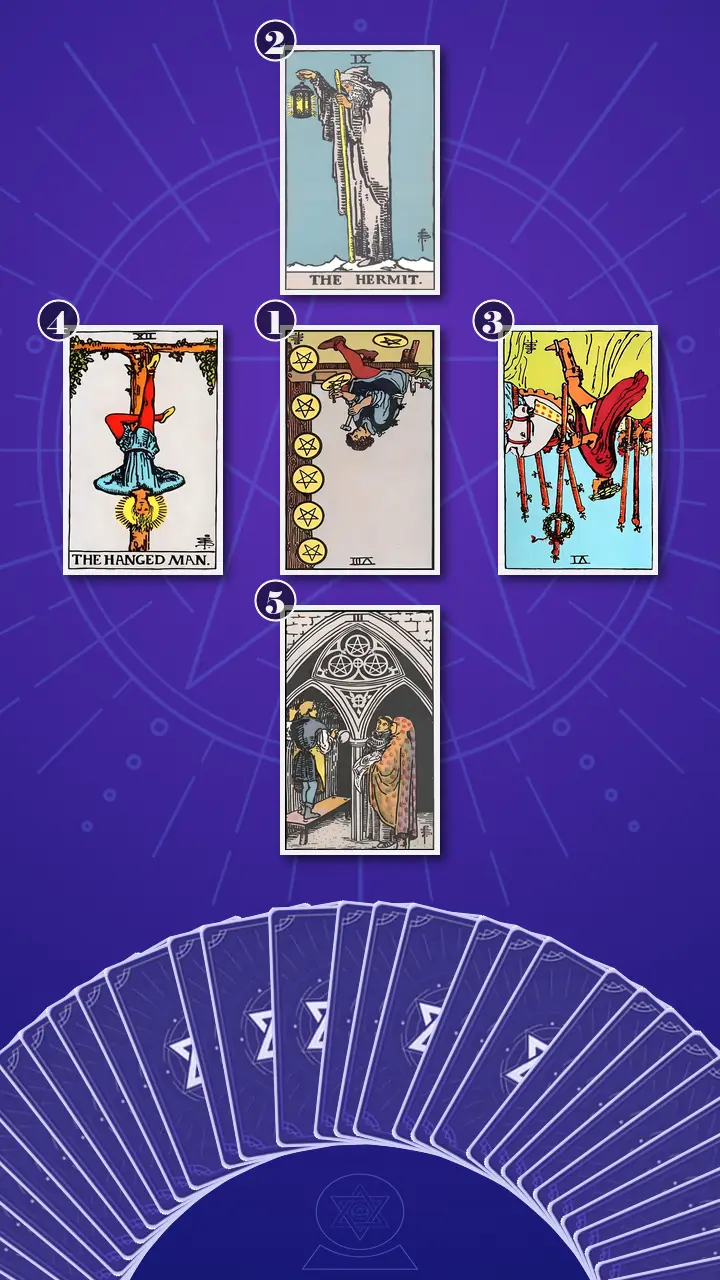
Today I used a five-card Decision Cross · Context Edition. For anyone wondering how tarot works in a career reading, this spread gives each card a defined job, so card meanings in context can be compared with real workplace evidence rather than treated as floating predictions. It suits Jordan's repeated trade-off between deeper mastery and visible career progress, while leaving room for the genuine value of an individual-contributor path.
The center would show the observable choice pattern, the repeatable behavior organizing the question. Above it, I would look at the honest value of mastery. Moving clockwise, the next card would name the visible cost of the current pattern. The card entering from the side would reveal the hidden belief sustaining delayed visibility. Finally, the card below would offer a self-authored integration and one small experiment, not an external outcome that Jordan had to obey.
This five-card Decision Cross spread is intentionally narrower than a Celtic Cross. It keeps the career crossroads in view: what is happening now, what deserves protection, what the current pattern costs, what keeps it in place, and what small act could let technical expertise become shared influence without requiring a move into management.
Reading the Map in Real Work
The Progress Bar That Never Became a Door
I began at the center with the card representing the observable choice pattern: repeated investment in another refinement cycle and the worry that Jordan's career appears stalled.
I turned over Eight of Pentacles, in reversed position. In the Rider-Waite-Smith image, the apprentice bends over one pentacle while finished pentacles line the wall behind him. I connected that single object under inspection to Jordan's already-usable presentation, the self-review she kept revising, and the course tab that promised one more measurable increment.
The reversed energy was not a lack of discipline. It was Earth energy in excess and in blockage: effort remained trapped inside repetitive practice instead of moving outward into a visible experiment. The study progress bar moved. The document gained another polished sentence. But neither action created new information about whether Jordan could frame a decision, request ownership, or help another team use her judgment.
I asked, 'When you open another course instead of sending the scope question, what relief arrives immediately, and what visible step does that relief postpone?'
Jordan did not nod. First, her breath paused and her shoulders lifted toward her ears. Then her eyes moved toward the imagined laptop tabs, as if an entire evening of edits had started replaying behind them. Finally, she gave a small, bitter laugh. 'That is too accurate,' she said. 'It is almost rude. I keep calling this preparation because that sounds better than saying I am avoiding the ask.'
I let the recognition stand without turning it into shame. 'Another course can be growth, or it can be a very respectable hiding place,' I said. 'The question is not whether you should stop learning. The question is whether this particular learning cycle is producing a new capability or protecting you from a conversation only other people can answer.'
I also named the opposite risk. Reversing the pattern did not mean abandoning useful study, volunteering for every high-visibility task, or forcing a sudden performance of confidence. The card asked for one small act of influence before another round of refinement, so that Jordan could gather evidence instead of arguing with an imagined future.
The Lantern That Was Never the Enemy
I moved upward to the card representing the honest value of mastery: what Jordan gains from depth, patience, and the individual-contributor identity before external visibility is considered.
The card was The Hermit, in upright position. I read the lantern as carefully earned technical judgment, the staff as a support built through practice, and the mountain path as the long apprenticeship Jordan had chosen rather than stumbled into. I pictured her tracing a difficult system dependency late at night until the architecture finally made sense, not because anyone was watching, but because the understanding itself mattered.
The Hermit's energy was balanced inward attention. It gave Jordan patience, depth, and an ability to see problems before they became incidents. Her solitude was not automatically avoidance. It had produced real professional value, and I wanted that truth in the room before we discussed visibility.
As I looked at the lantern, I remembered my own years of sound energy research, the notebooks filled with patterns that only became useful when I carried them out of the lab and into a listening room. I knew the difference between a quiet rhythm that restores capacity and a quiet rhythm that keeps every other instrument waiting.
'This part is not the enemy; it gave me patience, judgment, and the ability to work through complexity,' I said, leaving space for Jordan to finish the sentence in her own words.
Her fingers stopped worrying the edge of the paper cup. She looked at the card for a long moment and then said, 'My depth is real even if it is not the whole story of progress.' I told her, 'You are not behind because you value depth; the question is whether anyone can use what you know.'
Her shoulders dropped a fraction. I noticed relief before agreement, which mattered. The reading was not trying to take away the identity that had made her proud. It was asking how the lantern could reach a team decision instead of staying close to the person carrying it.
The LinkedIn Scoreboard in the Train Window
I moved clockwise to the card representing the visible cost of the current pattern: how private mastery can intensify soft-power strain and make career progress feel unrecognized.
I found Six of Wands, in reversed position. The raised wand, laurel wreath, and watching crowd became the TTC Line 1 ride home at 8:47 p.m. I translated the public scene into a LinkedIn promotion announcement arriving between stops, a performance review phrase about influence, and a meeting where Jordan waited for her expertise to speak for itself.
Reversed Fire was not the absence of achievement. It was recognition energy turned toward a scoreboard, where public proof became the measure of whether progress was real. The missing title, praise, or leadership signal began to resemble missing professional value, even though the two were not the same thing.
'Try separating two columns,' I said. 'What you have done, and what other people can currently see. Which contribution belongs in the second column but has been left for someone else to infer?'
Jordan placed her palm over her stomach. I saw the familiar drop pass across her face, followed by a restless glance toward the window as though the train were still carrying her past another promotion post. 'The incidents I prevented do not look like achievements,' she said. 'The decisions I clarified disappear into the work. I want recognition, but I do not want to turn every meeting into a personal brand exercise.'
'Wanting recognition is not a moral failure,' I said. 'A title is one signal. Ownership, collaboration, and outcomes are also movement. The card is showing a visibility gap, not proving that you lack value.'
She gave a careful exhale and uncrossed her ankles. The desire to be seen remained, but it no longer had to serve as evidence against her. I could feel the comparison loop losing some of its authority because we had named its exact ingredients: title, scope, public language, and the quieter outcomes that the feed could not display.
The Calendar Reminder That Kept Moving
I returned through the center to the card representing the hidden belief sustaining delayed gratification: the fear or protective bargain that keeps Jordan waiting to be fully ready before seeking influence.
The Hanged Man, in upright position. Its inverted body, bound foot, and calm halo showed a visual paradox. A pause can be chosen for perspective, but a chosen pause can also become a holding pattern when it no longer changes the strategy.
I connected the bound foot to the scope conversation repeatedly moved to next month. The next course, cleaner portfolio, and additional evidence had all been framed as thoughtful preparation. The Hanged Man did not call Jordan's patience a character flaw. It asked whether the pause was still buying insight or merely postponing the moment when insight would be evaluated in relationship with other people.
'I thought I was buying time,' Jordan said quietly, 'but what has time actually clarified?'
I watched a three-part shift move through her. Her hand tightened around the cup, then went still. Her eyes lost focus as she traced the calendar from one postponed reminder to the next. Finally, she breathed out through her nose and gave a small, almost disbelieving smile. 'The waiting has not made the ask safer. It has only made it older.'
'That is useful information,' I said. 'We do not have to punish the delay or make a dramatic decision. We can change what the pause is for. Instead of waiting to feel completely ready, use one small shared responsibility to learn something real about your influence.'
When the Workshop Opened into a Shared Build
The Three of Pentacles Blueprint
The room grew quiet before I reached for the final card. Even the rain against the window seemed to thin into a softer texture.
I turned to the card representing a self-authored integration and one small experiment that lets mastery become visible contribution without requiring Jordan to abandon the individual-contributor track.
The card was Three of Pentacles, in upright position. In the image, a craftsperson stands beneath an architectural plan with two collaborators. I translated the cathedral into a decision brief, a focused architecture review, a one-skill teach-in, or a cross-team build where another person could question, reuse, and extend Jordan's thinking.
This was balanced Earth returning to the spread. The answer was not a title and not applause. It was practical collaboration: letting expertise become legible because other people could build with it. I told Jordan that the individual-contributor track did not have to be defended by staying private. Like a Karate Kid training montage, the practice mattered, but its turning point came when technique entered a visible relationship with other people instead of remaining in training forever.
At this point I used my signature Tempo Misalignment Audit. I described the feeling of pushing against a wall as a disruption between psychological BPM and executive BPM. Jordan's psychological BPM sped up around readiness, proof, and the possibility of being evaluated, while her executive BPM slowed at the exact moments when she could send, ask, or own something visible. More effort went into preparation, but the system did not move forward because ambition and execution were out of sync.
The audit did not label mastery as the obstacle. It showed the friction point: mastery was moving quickly in private, while shared influence had no small, repeatable beat in the workweek. The Three of Pentacles offered that beat.
Jordan held the old bargain: if the presentation, self-review, and next course became flawless, exposure might feel safe. I watched the private relief of one polished sentence meet the public question just outside the monitor's frame: could anyone use her judgment before every edge was finished?
Mastery is not the problem. It becomes a holding pattern when it stays private long enough to protect you from being evaluated. Let what you already know enter one shared decision, explanation, or build before it feels flawless.
Stop treating another private mastery cycle as the price of being taken seriously; start turning what you already know into a shared build, like the Three of Pentacles craftsperson whose expertise becomes visible through collaboration.
For a second, Jordan's breath stopped. Her pupils seemed to widen; the monitor's pale rectangle caught in her eyes while her fingers hovered above the coffee cup. Then her gaze went unfocused, as if the last three performance reviews, unsent messages, and course tabs were replaying in a fast, silent montage. I saw recognition move from her face to her shoulders: her jaw unclenched, her fist opened against her knee, and a long breath left her chest. 'So I can be ready enough for a shared test,' she said, not brightly, but with a steadier edge. Relief arrived first; after it came a small, dizzy blankness. Without the old rule that more preparation had to come before every visible move, the next choice belonged to her. That freedom carried responsibility, and I did not rush to fill the quiet. 'Now, use this new perspective to recall whether there was a moment last week when this insight could have made you feel different?'
I then offered a contained ten-minute exercise: 'For the next 10 minutes, choose one finished skill or decision and write three lines: what it changed, who could use it, and one small way to share it. You can save it as a draft, send it, or stop there. If the exercise feels uncomfortable, pause; there is no requirement to disclose anything before you choose.'
This was the first movement from private mastery used as protection against evaluation toward grounded confidence in shared influence and individual-contributor progress beyond titles. It did not remove uncertainty. It gave uncertainty a smaller place to stand.
The One-Page Bridge to Visible Influence
When I gathered the cards into one story, I saw a clear apprenticeship arc. The reversed Eight of Pentacles showed why the pattern had become repetitive: a measurable private task offered immediate control while the scope conversation remained outside the frame. The Hermit protected the truth that Jordan's technical depth was hard-won and valuable. The reversed Six of Wands showed the cost of waiting for public proof to confirm that value. The Hanged Man revealed the hidden bargain beneath the delay: if readiness stayed just out of reach, evaluation could stay out of reach too. The Three of Pentacles supplied the bridge, where the same mastery could become useful through shared construction.
The cognitive blind spot was not simply overthinking. It was treating visible influence as a personality performance and treating titles as the cleanest evidence of movement. Jordan had been measuring the height of the staircase by looking at other people's floors while polishing the step beneath her own feet. The shift was to turn one mastered capability each week into a visible act of influence by teaching it, framing a decision, or requesting ownership of a cross-team outcome.
I used my Execution Rhythm Calibration to make the shift fit an actual workday. I looked for the friction between Jordan's ambition for broader influence and her real evening capacity, then reduced the size of the next move until it could happen without requiring a fictional, endlessly confident version of her. The goal was not hustle. It was a rhythm she could repeat.
I called the plan The Syncopation Reset, a three-day tempo adjustment experiment. Day one would create a small shared artifact. Day two would reopen one contained conversation about ownership. Day three would make one outcome and one piece of ownership legible in an ordinary team update. Each beat could be drafted, paused, revised, or withdrawn. Agency stayed with Jordan throughout.
- Make one mastered skill legible.On day one, set a 10-minute timer in your notes app. Choose one technical decision or skill you used this week and write three lines: what changed, why it mattered, and who on your team or a partner team could use the context. Share it with one relevant teammate in Slack or a decision thread, or leave it as a draft.Start with a decision that is already complete enough to explain. A draft counts, and framing the share as an invitation for feedback keeps the task collaborative rather than performative.
- Ask for one small cross-team outcome.On day two, book or request 15 minutes with your manager. Ask which upcoming cross-team outcome could benefit from your ownership of a specific technical area. Use one sentence: 'I would like to lead the technical framing for that outcome and review the scope with you after the first milestone.'Reduce the conversation to one outcome. You do not have to ask for a promotion, accept management, or prove your entire career case; one bounded responsibility can produce useful evidence.
- Name outcome plus ownership.On day three, use a five-minute timer before your next team update. Share one concrete outcome you helped create, add one sentence naming the decision, coordination, or technical framing you owned, and invite one practical follow-up, such as a short teach-in or decision note.Stop when the timer ends. The purpose is legibility, not self-promotion, and you can revise or withdraw the wording before posting.
These were actionable next steps, not a demand to solve a whole career. Jordan could remain an individual contributor, keep learning, and still let one finished capability travel beyond the workshop. The reading had not asked her to choose between mastery and advancement. It had shown her how to make mastery a bridge to shared usefulness.

A Week Later: The Quiet Proof
A Question, Not Applause
Five days later, I received a message from Jordan. 'I sent the three-line brief to the cross-team channel,' she wrote. 'A teammate asked one technical question and used part of the explanation in the milestone note. I also asked my manager about owning the technical framing for the next cross-team outcome.'
The response was a question, not a promotion announcement or a burst of public praise. That was precisely why I trusted it as evidence. Someone had used what Jordan knew, and the work had begun to travel through a shared structure.
The plan was clear enough for a full night's sleep, but morning still opened with, 'What if I am wrong?' This time, Jordan smiled, opened the draft, and sent one clarifying question.
I did not read that as a finished transformation. I read it as the first visible beat of a different rhythm: technical depth still intact, private preparation no longer carrying the entire burden of proof, and confidence growing through useful connection rather than perfect readiness.
The cards had not predicted a promotion or decided what Jordan's career should become. They helped separate evidence from comparison, mastery from its protective use, and a chosen IC path from the fear that progress only counts when a new title appears. Jordan was the person who made the decision, selected the experiment, and chose how far her knowledge would travel. That is what finding clarity looked like here: not certainty, but ownership.
Let mastery be the bridge, not the waiting room.
When you keep your jaw tight over one more course while someone else's promotion post loads on your screen, it can feel safer to remain the expert in the workshop than risk discovering whether your value carries into the room.
If one thing you already know could be allowed into a shared conversation this week, what would you be curious to let people build with?