Deferred-Life Bargain: Testing What the Commute Supports Now

The 7:12 a.m. Deferred-Life Bargain
If you are a Toronto project coordinator who checks the TTC app at 7:12 a.m., puts on a career podcast, and calls another lost morning an investment, you may be living the deferred-life bargain before work has even started. Jordan, a 29-year-old project coordinator, knew that sentence from the inside.
She joined my video consultation at 8:47 on a Tuesday evening from her small Toronto apartment. Takeout cooled beside her laptop while the refrigerator hummed behind her. Blue light edged the Notes file she had opened but not touched, and she rubbed one calf as if her legs were still absorbing the train's stop-start motion.
Jordan described gripping a cold metal pole that morning while the brake squeal cut through her headphones. Her phone had been warm against her palm, her jaw locked, and the career advice kept playing. By the time she reached home, she had enough energy to save another reference for a personal project, but not enough to begin it.
"What keeps me trading my weekdays for a future worth the commute?" she asked. "I keep thinking the next milestone will make it make sense. If I give my weekdays back, maybe I lose the future I've been working toward."
I heard the resignation in the way her last sentence fell flat, but I saw it more clearly in her body. It was as if she had been walking up a downward escalator for years: effort in every muscle, motion under both feet, and no stable landing she could point to. Longing pulled her upward; resentment and guilt kept catching at her ankles.
"We are not going to ask the cards whether you should quit or stay," I told her. "We are going to examine the exchange. Let us give this fog a map and look for evidence your ordinary weekday can actually hold."

Choosing a Ladder Above the Platform
I invited Jordan to let both feet meet the floor, release her tongue from the roof of her mouth, and take one unforced breath. I shuffled slowly while she held the question in mind. The pause was not a mystical performance; it was a clean transition from rehearsing the problem to observing it.
I chose the Four-Layer Insight Ladder · Context Edition, a four-card career reflection spread arranged like a short staircase. For anyone wondering how tarot works with a commute-heavy career question, the structure matters: this was not a simple choice between two clearly defined options. It was a self-reinforcing loop in which sacrifice had become the reason for further sacrifice.
A larger outcome-focused spread could have encouraged Jordan to search for an external verdict. This smaller spread was sufficient. The first position would show the visible weekday pattern. The second would expose the hidden bargain sustaining it. The third would reveal the transformative hinge, and the fourth would ground that insight in a practical experiment.
This is how I use tarot as a mirror. Card meanings in context can separate what is happening, what is maintaining it, and what the person might test next. The cards do not possess Jordan's timetable, budget, work contract, or right to choose. She does.
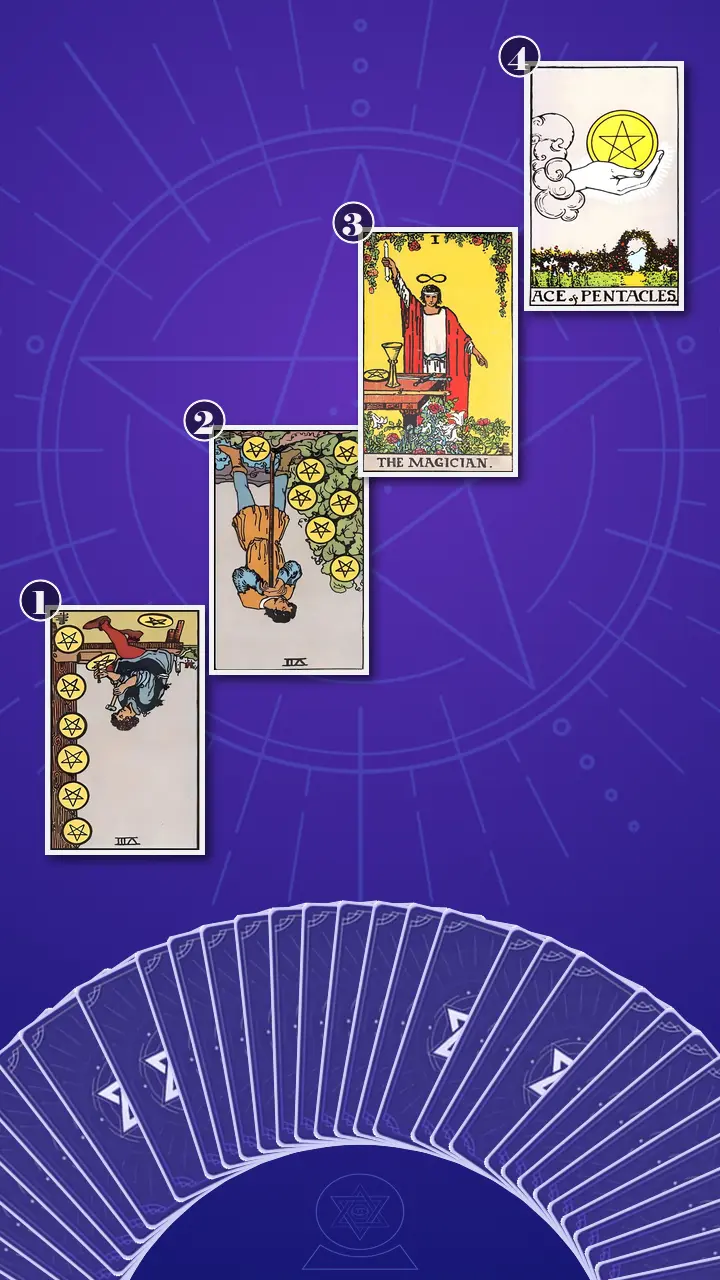
The Workbench and the Unfinished Harvest
Position 1: Effort That Has Forgotten Its Question
The card I turned over now represented the present situation and visible symptom: the concrete weekday behavior of accepting the commute, repeating the work, and postponing meaningful life. It was the Eight of Pentacles, reversed.
I pointed to the craftsperson bent over the bench, the completed pentacles displayed behind them, and the road beyond the workshop. "You can count the documents, office days, transit hours, and podcast episodes," I said. "The effort is visible. The future that effort is meant to support is still outside the room."
In Jordan's modern life, the card looked like reopening an already adequate document on the ride home, listening to another career episode, and watching another evening disappear. The visible output kept growing, but the routine was no longer teaching her whether the commute supported creative autonomy, rest, connection, or any other value she wanted that future to contain.
The reversed earth energy showed both excess and blockage: too much polish, too much proof of commitment, and too little room for feedback from lived experience. Diligence had stopped being a craft and become a defence. Another completed task provided short-term relief because it made the sacrifice look purposeful, but it also consumed the energy needed to test anything different.
For a moment, Jordan's jaw stayed set. Her eyes dropped to the card, her stomach seemed to tighten under one shallow breath, and then she gave a small, bitter laugh. "That is so accurate it feels a little brutal," she said. "I stayed late last Thursday to edit a deck that was already fine. I called it being ambitious. I cancelled coffee with a friend to do it."
"The card is not criticising your work ethic," I said. "It is asking whether your work ethic still has permission to receive new information. Competence is a resource. It does not have to become a toll you pay forever."
Position 2: The Milestone That Keeps Moving
The card I turned over next represented the underlying mechanism and root bargain: delayed gratification without a reliable review point. It was the Seven of Pentacles, reversed.
The figure leaned on a tool and looked down at a harvest that should have invited assessment. In Jordan's life, that scene became another month of commuting, another review date, and another personal goal dragged forward in Google Calendar. The waiting felt disciplined because the investment was measurable, yet no agreed standard defined what progress would look like on an ordinary Wednesday.
Reversed, patience had become blocked assessment. Instead of asking whether the harvest matched the life she wanted, Jordan extended the date. The inner logic sounded like this: "I have already given this so much, so stopping would make the past pointless." Wanting a meaningful future had quietly turned into protecting the meaning of past sacrifice.
I have lived through sixty-seven Highland seasons, and the card brought back the sight of dark ground resting after a harvest. No one standing over that field could improve it by calling endless waiting a virtue. A living cycle needs periods of effort, observation, rest, and recalibration. The memory reminded me that waiting can be chosen wisely, but it is not automatically wise because it has lasted a long time.
"What would the next milestone have to change in your actual weekday for you to call it a return?" I asked.
Jordan opened her mouth, then closed it. Her fingers tightened around her mug, her gaze drifted toward the unopened project file, and a longer breath finally left her chest. "I honestly don't know," she said. "I know the salary number. I don't know what Tuesday is supposed to feel like afterward."
"That is the missing review point," I replied. "The next milestone is a date on the calendar, not a guarantee that your life will finally begin there. Your commute can prove that you are committed without proving that the exchange is working."
When The Magician Put Wednesday on the Table
Position 3: The Future Becomes an Experiment
The refrigerator in Jordan's apartment clicked off just as I reached for the third card. The sudden quiet made the distance between our two rooms feel smaller. The card I turned over represented the transformative insight and hinge: the agency-based shift that could make her desired future testable in the present. It was The Magician, upright.
I showed her the wand, cup, sword, and pentacle arranged on the table, one hand raised toward intention and one lowered toward material life. Upright, this was not an excess of force or a shortage of preparation. It was balanced coordination: motivation, felt meaning, clear thought, and practical constraint brought into one deliberate act.
In Jordan's life, The Magician looked like a Wednesday evening when she closed the career podcast instead of opening another research tab. She could place an existing skill, a saved project idea, one precise question, and a 30-minute calendar block on the same metaphorical table. The aim would not be to prove her whole career path. It would be to produce information she could inspect.
This was where I brought in a lens I call Somatic Fatigue Diagnosis. It is not a medical diagnosis or a verdict about someone's capacity. It is my way of temporarily bypassing the mind's polished explanations and listening to the body's friction first. Jordan's mind said, "investment." Her jaw said, "constant bracing." Her calendar said, "strategic patience." Her heavy legs, shallow rush-hour breathing, and pressure behind the eyes said, "this arrangement has a present cost."
Those sensations did not command her to leave her job. They gave The Magician honest material to work with. A useful experiment had to include the body as evidence, not treat it as an inconvenient machine that would comply after one more milestone.
I returned us to the 7:12 a.m. TTC ride: the career podcast playing, the phone warm in her hand, and the commute logged as an investment while the evening it consumed was barely counted. I let that familiar accounting sit beside the card.
"Endurance proves that you have endured," I said. "It does not, by itself, prove that the exchange is working. Do not make the future earn its first weekday."
You do not have to keep trading every weekday to prove that the future is real; like The Magician arranging the wand, cup, sword, and pentacle, turn one desired value into a present experiment before asking for certainty.
Jordan's inhale stopped halfway. Her thumb froze above the rim of the mug, and her pupils widened as if the sentence had switched on a light she had not agreed to face. Irritation flashed across her expression before relief could arrive. "But doesn't that mean I have been doing it wrong this whole time?" she asked, her voice suddenly sharper. Her shoulders remained high, and one hand closed into a fist against her sleeve.
Then the question began to settle. Her gaze lost focus as she replayed months of moved deadlines, declined invitations, and unopened files. The fist loosened finger by finger. Her shoulders descended, her eyes reddened, and a trembling exhale carried one quiet "Oh." The release was not triumphant. I saw a brief dizziness in it, the vulnerable blank space that appears when a familiar justification falls away and choice returns. Clarity had given her room, but it had also handed responsibility back to her.
"No," I said. "It means the old arrangement may have protected income, stability, skills, and hopes that mattered. New evidence does not put your past on trial. We are reviewing what the bargain supports now."
"Now, with this new perspective, think back: was there a moment last week when this insight could have made you feel different?" I asked.
Jordan remembered the Wednesday text from her friend asking about a quick coffee near the station. She had replied, "Maybe after the next milestone," then spent the evening recovering alone. "I thought saying yes would prove I wasn't serious about my future," she said. "But connection is part of the future I keep saying I want."
I asked her to build a Magician's table from what she already had. For the wand, she named her ability to turn a loose idea into a workable outline. For the cup, she chose creative autonomy and weekday connection. For the sword, she wrote a precise question: "Does protecting one small value change what I notice about this commute?" For the pentacle, she chose one bounded block of time and the energy she realistically possessed, not the energy an idealised productivity routine demanded.
"I do not need the entire exit plan," she said, reading the four items back to me. "I need one test I can actually inspect."
I named the movement I could see: from resigned endurance and moving goalposts to focused agency and grounded clarity through observable weekday evidence. It was not a complete breakthrough or a career decision. It was the first crossing from sacrifice-based validation to self-trust built through evidence.
The Seed Beyond the Turnstile
Position 4: A Future Small Enough to Schedule
The card I turned over last represented action and integration: a small, grounded experiment that could evaluate the commute without asking tarot to decide whether Jordan should stay or go. It was the Ace of Pentacles, upright.
A single hand offered the pentacle above a cultivated garden. Beyond it, a path passed through an archway toward distant mountains. I read the card as a material beginning, not a promise about the destination. The path did not require Jordan to see every turn before taking care of the first seed.
In everyday terms, the Ace looked like one protected weekday block for a meaningful project, a relationship, restorative time, or a values-based career test. Jordan could schedule it, complete a modest version, and observe what happened. The resulting energy or difficulty would be information, not proof that her whole future was right or wrong.
The earth energy had returned in balance. In the first two cards, earth had been trapped in repetitive work and suspended waiting. Here, it became a container: one time, one place, one physical setup, and one review point.
I used my Organic Routine Restructuring lens to keep that container humane. Rather than forcing the experiment into the latest and most depleted part of the night because a productivity app called it available, I asked Jordan when her body offered the least friction. She chose the first 30 minutes after arriving home on Wednesday, before scrolling, with permission to stop after 10 minutes if the commute had taken more than expected.
She opened Google Calendar while we were still speaking and created a block called "Creative autonomy: evidence, not verdict." I watched her hover over Save. Her breath paused, she glanced at the cards, and then she tapped the screen. Something changed when the future became a testable appointment instead of a distant reward.
"A small experiment is information, not a verdict on your whole career," I reminded her. "You can keep the current arrangement while gathering clearer evidence. You can also question it. Both choices remain yours."
An Evidence Check for Ordinary Wednesday
I drew the four cards together into one story. Jordan had built genuine competence and a credible route toward financial independence, so her previous effort was not empty. But the reversed Eight showed that effort becoming repetitive proof of commitment. The reversed Seven exposed the hidden rule that more waiting must eventually validate the sacrifice. The Magician restored her unused resource: the ability to combine skill, value, thought, time, and bodily information into a chosen experiment. The Ace gave that experiment a physical place to exist.
The core contradiction was now visible. Jordan wanted a future worth the commute, yet she kept trading away the weekdays that could reveal whether that future contained anything she valued. It was like feeding a transit pass for a destination whose arrival time moved every month. Because stopping felt like losing the destination, each missing result became another reason to pay.
The Blind Spot Hidden Inside Commitment
Her cognitive blind spot was not ambition, caution, or the practical need for income. It was using the amount already sacrificed as evidence that the exchange must still be working. That reasoning protected the past from feeling wasted, but it prevented the present from contributing new facts.
The transformation direction was precise: replace "I must endure until the future arrives" with a weekly test that makes one part of that future tangible now. Then evaluate the commute by lived evidence, including energy, connection, time, skills, and financial benefit, rather than by sacrifice alone.
Two Small Tests for the Next Seven Days
- Plant one Wednesday future seed. Keep the 30-minute Google Calendar block named after the value, not a performance target. Before the commute ends, open the project file and choose one tiny use of an existing skill, such as drafting one paragraph. On arriving home, use my Grounding Disconnect Protocol for three minutes: place both feet firmly on the floor, look at the sky or the tree outside the window, release the jaw, shake tension from the hands, and lengthen the exhale without forcing it. Then work for 10 minutes and record only "started, stopped, noticed." Tip: The grounding is a transition cue, not another task to perfect. If 30 minutes is unrealistic, the 10-minute version fully counts.
- Run a Sunday commute evidence check. At 9:20 p.m., before the usual LinkedIn scroll, set a 10-minute timer and handwrite three headings: "What the commute gives me now," "What it costs me now," and "What would count as visible progress within seven days." Add no more than three facts under each, including money, skills, time, relationships, rest, and bodily energy. Choose one observable sign to review the following Sunday. Tip: Title the page "Evidence, not verdict." Stop when the timer ends, even if the list feels unfinished, so the review does not become another productivity audit.
I was careful to leave the major decision where it belonged. Tarot had helped us expose a pattern and create actionable next steps, but it could not calculate Jordan's rent, benefits, workplace options, health, relationships, or appetite for risk. Finding clarity meant giving her better questions and observable evidence, not replacing her judgment with mine.

Six Days Later, the Quiet Proof
Six days later, Jordan messaged me. She had closed the podcast, used her Wednesday block, and drafted 214 imperfect words. She slept through the night; in the morning, "What if this is wrong?" still arrived first. This time, she smiled and opened the file.
The TTC schedule had not changed. Her job had not suddenly become lighter, and she had not solved her career crossroads in one week. What changed was smaller and more reliable: one piece of the future had entered an ordinary weekday, and Jordan now had something lived to evaluate.
I did not see the cards create that evidence. I saw Jordan create it. Our Journey to Clarity ended without a prophecy, but with a restored authorship: she could keep, modify, question, or eventually leave the arrangement according to her own values and practical reality.
When every crowded commute leaves your jaw tight and your evenings gone, it is easy to treat exhaustion as proof of commitment, especially when stopping might expose how little of the imagined life has reached the present. Noticing that bargain does not erase what your effort protected; it simply brings your own voice back to the table.
If you placed one postponed value beside The Magician's wand, cup, sword, and pentacle, then gave it one Ace-sized space in your next ordinary weekday, what would you be curious to notice about the commute around it?