Waiting to Feel Ready Lets Assignments Pile Up: One Small Start

When Assignments Pile Up at 8:40 p.m.
“You open Canvas, read the prompt twice, create a new document, and then reorganize your notes because writing the first rough paragraph feels like exposing your competence before you have had time to protect it,” I said. “That is not a mysterious lack of motivation. It is readiness anxiety happening in real time.”
Maya (name changed for privacy) sat across from me with both hands around a coffee she had stopped drinking. At twenty-two, she was in her final year at a Toronto university, commuting between classes, a shared apartment, and a part-time junior content job. Every deadline had been visible for days. Somehow, each one still became an emergency.
I asked her to take me through the previous Wednesday. At 8:40 p.m., she had sat at the small kitchen table with Canvas open under the blue glare of her laptop. The refrigerator hummed beside her, her phone grew warm in her palm, and her shoulders crept toward her ears as she renamed files and rearranged sources around a blank Google Doc.
“I kept thinking I’d start properly when I could concentrate properly,” she told me. “Then I checked the class Discord, watched another explanation, and suddenly it was almost eleven. I know the deadline isn’t a surprise, so why does it keep becoming an emergency?”
I heard the contradiction underneath the question. Maya wanted to begin in a capable, focused state, but she feared that beginning before she felt ready would reveal that she was not capable at all. Her anticipatory anxiety was not a vague cloud; it felt like a cursor blinking directly against her ribs, each flash asking for evidence she did not yet know how to produce.
“You are not doing nothing,” I said. “You are doing everything that lets you postpone the one action that could show you what you actually know. You are not waiting for motivation; you are waiting for permission to be uncertain.”
Her fingers stopped turning the cup. I told her I was not going to predict a grade, frighten her with consequences, or hand her a new standard to fail. I wanted us to make the loop visible, separate her behaviour from her identity, and find one place where her choice could re-enter the process. “Let’s give this fog a map,” I said.

Choosing a Map for Readiness Anxiety
I invited Maya to put both feet on the floor and take one unforced breath while holding the assignment question in mind. I shuffled slowly. The small pause was not a mystical performance; it was a practical transition from living inside the pattern to looking at it together.
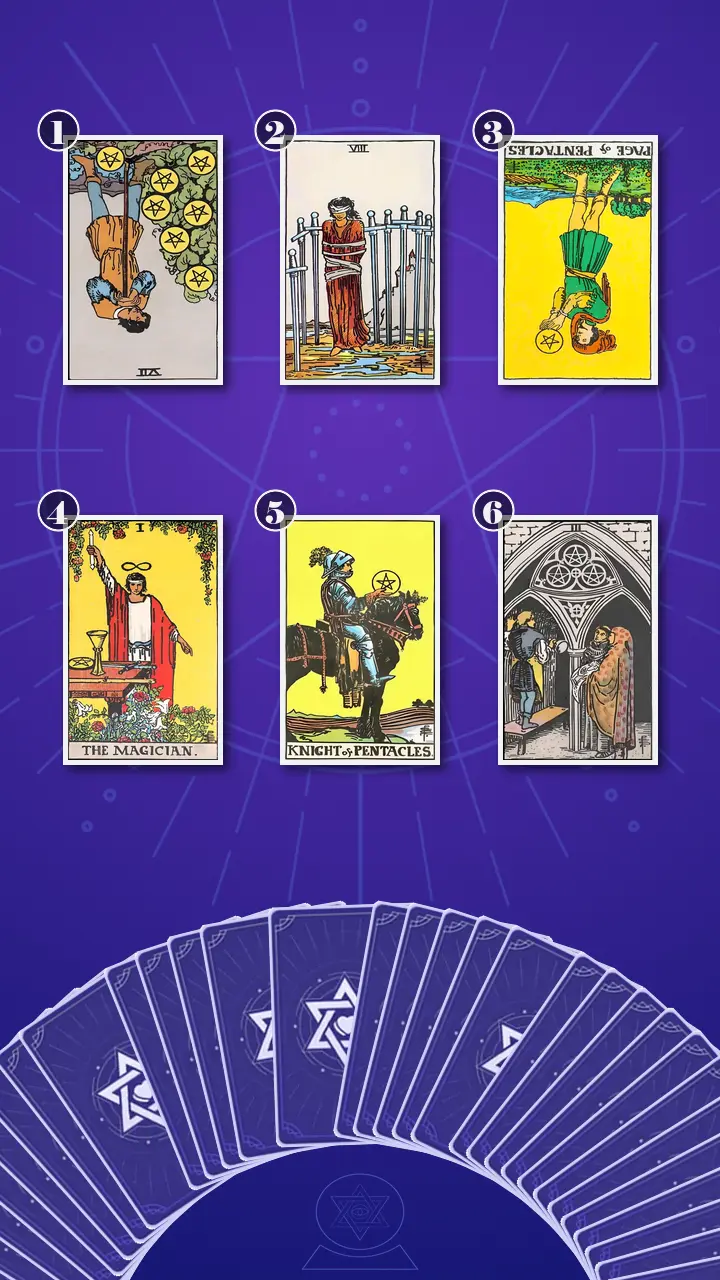
I chose the six-card Transformation Path Grid | Context Edition, a tarot spread for readiness anxiety and assignment procrastination. In my practice, this is how tarot works: the cards create an external structure for examining a problem that otherwise feels fused with the person experiencing it. Card meanings in context become prompts for observation, not commands from fate.
A Past-Present-Future spread would have forced an active loop into a timeline, while a larger Celtic Cross would have introduced more material than Maya’s focused question required. This grid was the smallest complete map I could use to connect her visible behaviour, the rule maintaining it, the fear underneath it, and a self-directed experiment that did not depend on predicting an outcome.
I arranged the cards in two rows of three. The upper row would show the current visible pattern, the immediate blockage, and the underlying root. The lower row would reveal the key trigger for transformation, a grounded action, and the learning that could develop through practice and feedback. The path would move across the crowded upper row, drop to a pivotal fourth card, and continue along a more workable route.
The Upper Row of Productive Procrastination
Position 1: Watching the Work Instead of Tending It
“Now I’m turning over the card representing your current visible pattern: what waiting for readiness looks like before urgency takes over,” I said. The card was the Seven of Pentacles, reversed.
In the traditional image, a worker leans on a hoe and evaluates the pentacles growing before him. For Maya, that scene became painfully modern: Canvas open at 8:40 p.m., the due date treated like a progress report, and the blank document examined as proof that she had not yet reached the correct state to begin. She kept assessing whether future effort would be good enough while leaving the next small act of tending undone.
The reversed earth energy showed a blockage of patient investment. Maya was not short of effort; she was placing effort into evaluation, preparation, and future promises instead of one measurable piece of the assignment. The immediate reward was relief. The cost was a shrinking time window, followed by a late-night marathon that made the next beginning feel even more punishing.
“What is the smallest piece of work you could tend for fifteen minutes before judging your readiness?” I asked. “Three rough sentences? One source summary? One question written in plain language?”
Maya gave a short laugh that held no amusement. “That’s so accurate it’s almost rude,” she said. Her thumb pressed into the cardboard sleeve of her cup, then released.
“The card is describing a strategy, not accusing you of a character flaw,” I replied. “You have been trying to avoid wasting effort or producing something weak. That protection makes sense. We also need to look honestly at what it costs.”
Position 2: The Mental Fence Around an Unclear Prompt
“Now I’m turning over the card representing the immediate blockage: the rule that turns ordinary uncertainty into a reason you are not allowed to move,” I said. The card was the Eight of Swords, upright.
The blindfolded figure stands inside a ring of swords, but the bindings are loose and the enclosure is incomplete. I did not read that image as a prediction of entrapment. I read it as a picture of narrowed perception. Maya’s sword energy had moved into excess: analysis was no longer clarifying the assignment but policing the conditions under which she could begin it.
At her desk, an unclear prompt became a mental fence. Her inner operating system offered only two settings: understand everything or do nothing. She reread the due date, opened another tutorial, checked messages, and experienced a few minutes of safety because no imperfect idea had become visible. Meanwhile, the real options remained on the desk: write what she understood, mark the unclear sentence, check one line of the rubric, or ask one specific question.
“The rule sounds like, ‘I cannot start until I know enough,’” I said. “But what if you are calling a permission problem a knowledge problem?”
Maya’s breathing paused. Her gaze moved from the blindfold to the loose bindings, then across the table as though she were inventorying her own laptop, notes, and unanswered questions. “Another tutorial feels responsible,” she said quietly. “Writing something bad feels reckless.”
“That is why the delay ritual is convincing,” I said. “It looks like preparation. But if the tutorial cannot answer a question you have not yet made specific, it gives the fear a respectable task without moving the assignment forward.”
Position 3: When a First Draft Feels Like a Final Verdict
“Now I’m turning over the card representing the underlying root: the fear that makes an ordinary beginner-stage draft feel like evidence about your worth,” I said. The card was the Page of Pentacles, reversed.
The Page is a student studying one pentacle closely. Upright, that attention can be grounded curiosity. Reversed here, the learner’s energy was blocked by the demand to look competent before learning had produced competence. Maya downloaded extra readings, rewrote headings, and built elaborate outlines because the first paragraph would reveal what she actually understood and what she did not.
I saw the deeper fear clearly: if a rough paragraph existed, someone might eventually see it; if someone saw it, they might decide she was not intelligent enough, professional enough, or worthy of being taken seriously. Delay kept that feared verdict hypothetical. It also kept feedback, revision, and real learning out of reach.
A familiar professional memory passed through me as I looked at the reversed Page. Over twenty years of conversations held above cooling coffee, I have heard capable people apologize for rough ideas before letting themselves speak a complete sentence. The apology often weighs more than the unfinished work.
“For one session, success cannot mean proving mastery,” I told Maya. “It has to mean producing a practice draft: three imperfect sentences answering only the part you understand. No editing until the timer ends.”
Her eyes shone, but she did not look relieved. “If I keep it in my head, I can still imagine it might be good,” she said. “Once it’s on the page, I have to see where I’m weak.”
“Yes,” I said. “And once it is on the page, weakness stops being a fog around your whole identity. It becomes one sentence that can be questioned, researched, revised, or removed.”
When the Magician Put Readiness on the Table
Position 4: The Tool That Turns Intention into Evidence
Outside, a streetcar bell cut once through the wet Toronto traffic. The radiator clicked and went still. In the sudden quiet, I turned to the lower row and the pivotal card in the reading.
“Now I’m turning over the card representing the key trigger for transformation: the recognition that can replace waiting for certainty with one focused use of what is already available,” I said. The card was The Magician, upright.
The Magician stands before a table holding a cup, sword, wand, and pentacle. One hand rises toward intention; the other points down toward material reality. I translated those symbols into Maya’s actual study tools: the assignment prompt, one clear question, a spark of rough wording, and the laptop, notes, or timer already within reach.
This was balanced energy rather than excess or deficiency. Thought, emotion, initiative, and practical resources did not need to become perfect before they could cooperate. Maya could stop searching for an ideal productivity system, place four ordinary tools together, and choose one action that would be visible when the timer ended. It was the difference between a productivity app that keeps demanding the perfect workflow and a plain Start button that lets the work generate its own data.
I use a diagnostic lens I call Syllabus Deconstruction: I strip a massive deadline of its emotional weather and reduce it to mechanical verbs. Compare. Define. Cite. Draft three lines. For Maya, the assignment was not yet “write two thousand polished words.” The next unit was “copy the question, underline its active verb, and answer one clause badly for ten minutes.” The Magician’s table made that deconstruction visible. I was not shrinking her ability; I was shrinking the unit of proof.
I watched Maya continue to brace against the card. She had treated every blank document like a closed-book exam on her worth: either she understood the whole assignment before touching it, or the first rough sentence would expose her. Even ten minutes sounded suspiciously small to her.
I told her, “Readiness is not a prerequisite for beginning. A small, focused action with the tools already in front of you can create the information and confidence that waiting has been trying to obtain.”
You do not need to wait for readiness to arrive; choose one tool from the Magician's table and turn a small intention into a visible first step.
I let the sentence remain between us without filling the pause.
For a beat, I saw her breath stop and her index finger remain suspended above the card. Her pupils widened; then her gaze slipped past my shoulder, as if the last few Sunday nights were replaying on the wall. Her mouth tightened before the words came. “But doesn’t that mean I’ve been doing it wrong for years?” The anger in her voice was brief, sharp, and more vulnerable than defensive. I kept my hands still. “It means postponement protected you from a feared verdict until the cost became too high. You were solving for safety with the method you had. Now you can test another method.” Her fist loosened first, then her jaw. Colour rose under her eyes. She released a long, uneven breath, and her shoulders fell so suddenly that she looked almost light-headed. The relief was not triumph; I could see the new responsibility inside it. “If panic isn’t in charge,” she whispered, “then I have to choose.” “You also get to choose when to stop,” I said. “Now, using this new perspective, think back to last week. Was there a moment when this insight might have made you feel different?” She looked down at the Magician. “Sunday. I could have written the three questions I already had.”
I named the crossing for her. This was not instant confidence. It was the first movement from anticipatory anxiety and panic-dependent procrastination toward grounded agency and practical self-trust through small, visible starts. A blank page was no longer a verdict. It was an uncollected piece of information.
A Study Pace That Panic Does Not Own
Position 5: The Knight’s Calm, Bounded Return
“Now I’m turning over the card representing the grounded action plan: a small, repeatable experiment that lets the new understanding become behaviour,” I said. The card was the Knight of Pentacles, upright.
The Knight sits on a still horse and holds one pentacle over a cultivated field. Nothing in the image rushes, yet the field shows evidence of sustained work. Its upright earth energy brought balance through reliability: a calm pace, one defined task, and a stopping point established before the session began.
For Maya, the modern version was a twenty-minute calendar block named for the exact task, not a vague event called “study.” She could write “draft three bullets for media analysis” at 6:30 p.m., put her phone on Do Not Disturb, work until the timer ended, and leave one line for her future self: “Next: add evidence to the second bullet.”
“Panic can start the engine,” I said, “but it should not have to be the whole schedule. The Knight is deliberately ordinary because repeatability matters more than intensity. The session has to fit around the TTC, your shift, your roommates, and your need to rest. It cannot become another rigid routine you use to judge yourself.”
Maya nodded, then frowned. “My brain says twenty minutes is pointless when I’m already behind.”
“That is the old rule trying to turn every start into a promise to finish,” I replied. “The experiment is smaller: can you make contact with one defined piece before adrenaline makes the choice for you? You may stop when the timer ends. Continuing is a decision, not a debt.”
Position 6: Competence Built Where Other People Can See the Plans
“Now I’m turning over the card representing integrated learning: the steadier position that can grow through visible practice, revision, and useful feedback,” I said. The final card was the Three of Pentacles, upright.
The card shows a craftsperson working while two other figures consult architectural plans. Its upright earth energy was collaborative and balanced. Competence was not being proven in private before the work began; it was being built through an unfinished object that could be reviewed, discussed, and improved.
In Maya’s life, this could be one rough paragraph checked against the rubric, one specific question brought to office hours, or one draft shared with a classmate or supervisor before it looked finished. The lesson was not that every draft would be praised. The lesson was that feedback could become information rather than a verdict.
“Competence is built in drafts, returns, and useful feedback,” I said. “You do not have to feel like an expert before behaving like a learner.”
Maya looked across the full grid: the stalled worker, the blindfolded figure, the blocked student, the table of tools, the steady Knight, and the shared building site. Her finger traced the path without touching the cards. “So the first paragraph isn’t where I prove I can do the assignment,” she said. “It’s where I find out what help the assignment needs.”
“Exactly,” I said. “And you remain the person who decides what to write, when to pause, whose feedback to seek, and what the next step will be.”
From a Stalled Field to a Workable Path
I gathered the reading into one story. Repeated late-night surges had taught Maya to associate work with emergency. In the present, she assessed readiness instead of tending a small task. The Eight of Swords revealed the rule maintaining the delay: uncertainty meant she was not permitted to begin. The reversed Page exposed the root fear that an imperfect attempt might prove personal inadequacy. The Magician restored available choice; the Knight gave that choice a repeatable pace; and the Three of Pentacles placed competence back where it belongs, inside practice, revision, and constructive exchange.
The cognitive blind spot was precise: Maya believed she needed clarity before starting, but postponement was withholding the contact and information that could create clarity. She was often treating a permission problem as a knowledge problem. The transformation was therefore not “become confident, then work.” It was “make one bounded start, observe what becomes clearer, and let evidence build practical self-trust.”
Before we chose her next steps, I used a quick Study Environment Audit. I was not judging whether her shared-apartment kitchen looked tidy enough for Instagram. I was looking for physical clutter, open notifications, and missing materials that quietly consumed the psychological bandwidth she needed for an uncertain beginning. We kept the intervention deliberately narrow.
The Two Small Starts and One Steady Return
- The Desktop Reset RitualBefore the first study session this week, set one fifteen-minute timer at the kitchen table. Clear only the working surface, put the phone out of reach, and leave four items visible: the Canvas prompt, existing notes, the open document, and a timer.Stop clearing when the alarm sounds. Do not reorganize Notion, rename files, buy an app, or redesign the semester. The reset must end by making contact with the assignment.
- The Ten-Minute Readiness ReceiptChoose one assignment and begin a ten-minute Tool-on-the-Table session. Produce one visible thing: three rough sentences, a three-point outline, or one clearly written question. When time ends, record one sentence in the task app about what became clearer.Do not rate the quality. Stopping is allowed. The receipt is simply evidence that starting happened before readiness arrived.
- The Steady Start LoopBefore the end of the week, schedule one twenty-minute return in Google Calendar and name the exact task. Work to one visible stopping point, then leave a restart note such as “Next: add evidence to bullet two” or identify one question for a teaching assistant, professor, or classmate.Keep the pace compatible with work shifts, commuting, roommates, and rest. The goal is a return you can repeat, not a marathon that makes tomorrow’s start feel punishing.
I asked Maya to treat these actions as experiments, not vows. If ten minutes felt too intense, she could make the output smaller. If the kitchen was unavailable, she could use a library desk. If the pattern continued to interfere significantly with sleep, work, or daily functioning, seeking support from an academic adviser, counsellor, or accessibility service would be a practical extension of agency, not a failure of it.

A Week Later, Three Rough Sentences
One week later, Maya messaged me from Line 1: “I wrote three awful sentences before my shift, and now I know the exact question for my TA.” She slept through that night. In the morning, “What if it’s bad?” returned; this time, she smiled and opened the draft.
I did not call that a cure or a miracle. I called it quiet proof: the Journey to Clarity had moved from an idea on my table to a choice Maya made with her own hands.
The tarot had not completed the assignment or granted her confidence. It had offered an objective mirror for the loop, language for the fear beneath it, and a structure for testing another response. Maya remained the author of every next step.
If tonight the blank page makes your shoulders climb toward your ears, waiting may feel safer because an unfinished idea can still be protected. Noticing that protection already means you are no longer fully inside the old loop; one tool from your own Magician’s table is still within reach.
If the first ten minutes were for finding out rather than proving, which tool would you place beside the blank page, and what small piece of the assignment would you let become visible?