Family Support Comes With Conditions: Separating Choice From Approval

The 8:47 PM Permission Check
If you are trying to make an adult decision between work messages and a long TTC ride, the sentence “we will help, but only if...” can turn ordinary uncertainty into boundary guilt before you have even named what you want.
Jordan described that exact moment to me. At 8:47 PM, on a northbound Line 1 train from downtown Toronto, she opened the family thread and rewrote her reply for the fourth time. The carriage lights buzzed above her, her phone felt warm against her palm, and the brakes squealed as the train pulled into the next station. She typed, “I have been thinking about what I want...” Then she replaced it with, “I really appreciate everything you are offering...” Then she deleted both.
By the time she sat with me, her jaw was still locked as if she had carried the motion of the train into the room. One inner sentence said, “I want to choose this.” The other answered, “I need to make it safe for them to approve.” Every attempt to reconcile the two left her feeling as though she were trying to thread a needle while several people she loved pulled on opposite ends of the thread.
“I want to know which part of this is actually mine,” she said. “If support has a price, am I choosing or complying?”
I did not tell her to reject the support, prove her independence, or assume that disagreement meant rejection. Having listened to people navigate family expectations across cultures, I have learned that adulthood is not measured by how little a person needs anyone else. Care, interdependence, and self-authorship can coexist, but only when their boundaries are visible.
“Needing support does not make the choice belong to the person who offered it,” I told her. “Let us separate three things that have become fused together: what you want, what help is actually being offered, and what you fear disagreement might cost. We are not asking the cards to decide for you. We are using them to draw a map through the fog.”

Choosing a Map That Separates Love from Leverage
I invited Jordan to put both feet on the floor, take one unforced breath, and hold the question without rehearsing an answer. I shuffled slowly. The pause was not a mystical test; it was a transition from reacting to observing.
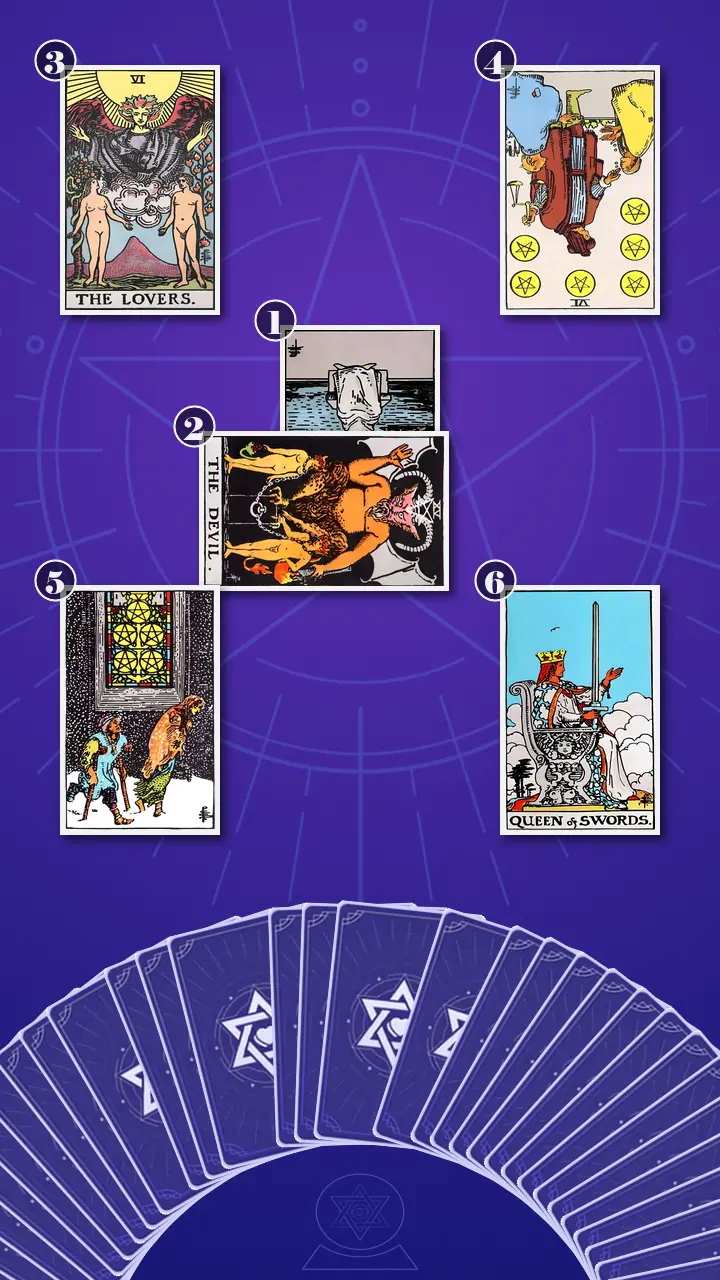
I chose the six-card Decision Cross · Context Edition. A broad spread such as the Celtic Cross would have introduced more history and prediction than this inquiry needed. Jordan had not asked which external option fate preferred. She needed a tarot spread that could distinguish personal values from conditional family support, examine the terms of the exchange, name the feared cost, and identify one self-owned next step.
That is how tarot works in my practice. I use card meanings in context as a structured psychological mirror. The images make different parts of a conflict visible at the same time, allowing intuition to offer information while reason tests it against lived facts.
The central position would show the observable stall. The crossing card would identify the bargain or attachment keeping that stall in place. Above them, two cards would separate Jordan’s authentic value from the external support conditions. Below, one card would reveal the feared loss, while the final card would translate clarity into boundary language. The layout resembled a crossroads viewed from above: pressure at the centre, values and conditions on opposite sides, then fear and agency opening beneath them.
Where the Blindfold Became a Loop
Position 1: The Two Drafts That Never Left the Train
The card I turned over first represented the current dilemma and observable stall: how Jordan’s choice became suspended when family support arrived with conditions. It was the Two of Swords, reversed.
The blindfolded figure and crossed swords looked almost painfully contemporary beside Jordan’s phone. One draft was honest. The other was carefully grateful. The two questions beneath them were not actually the same: “What do I want?” and “What will keep their support?” Yet Jordan had been treating both as requirements that had to be solved in a single flawless message.
I described the loop I could hear in her examples: “If I say it plainly, they may think I am ungrateful. If I soften it, I may erase what I want. So I will ask one more person and revise it again.” Like a Notion decision page gaining new stakeholder tabs while the original page called “My reasons” remains blank, more input had created more motion without creating authorship.
Reversed, the card showed a blockage of Air. A deliberate pause can protect reflection, but this pause had outlived its purpose. Discernment was deficient while reconsideration had become excessive. Each new opinion briefly lowered the pressure, then added another voice Jordan felt responsible for satisfying.
“Which fact or value would still matter if nobody could approve it?” I asked.
Jordan gave a small, bitter laugh. Her thumb stopped rubbing the edge of her phone, but her shoulders remained high. “That is so accurate it feels a little brutal,” she said. “I have an honest draft, a grateful draft, and literally one called least upsetting.”
I let the recognition settle before adding a caution. The card was not telling her to escape indecision by making a dramatic announcement in the middle of a tense call. That would turn self-protection into defensiveness. It was asking for separation before speed. A longer explanation is not the same thing as more authority over your own life.
Position 2: The Bargain Hidden Inside the Help
The card crossing the centre represented the felt bargain, fear, or attachment that made a self-authored choice hard to hold. I laid down The Devil, upright.
I watched Jordan’s eyes go first to the chains. In her life, this card looked like a family offer becoming a total contract: “We can help, but only if you choose the option we think is right.” Once practical assistance and approval were packaged together, accepting one seemed to mean surrendering everything else.
But the chains in the Rider-Waite-Smith image are loose. That detail prevents a fear-based reading. The card did not prove that her family was malicious, and it did not order her to walk away. It showed an excess of perceived obligation creating a blockage around consent. Some terms might be real. Others might be inferred. Both deserved examination before either was treated as destiny.
I compared it to an app permission screen. A useful feature might legitimately need access to one setting; that does not mean it should quietly take control of the entire phone. In the same way, financial or practical help could come with terms, but those terms needed to be named. They could be clarified, negotiated, accepted, or declined. An offer was not automatically a verdict on Jordan’s right to choose.
“Which condition was actually stated,” I asked, “and which consequence are you predicting because the thought of disappointing them feels dangerous?”
Jordan’s hand tightened around her mug, then loosened. “The money is real. Their preferred option is real. But the idea that they will stop loving me if I disagree... no one has actually said that.”
“That distinction does not make the fear silly,” I said. “It makes the fear visible enough to work with.”
When The Lovers Stepped Into the Open
Position 3: The Value That Existed Before Permission
The room seemed to become quieter as I moved to the card representing the authentic value beneath the decision: what belonged to Jordan before family approval was added. This was the key card and the bridge of the reading: The Lovers, upright.
I asked Jordan to look past the popular romance associations. The open figures beneath the angel speak to conscious choice, values alignment, and the willingness to be seen while making a meaningful commitment. The mountain does not promise an effortless route. It shows that difficulty can be part of an honest choice without turning that choice into a punishment.
In Jordan’s modern life, The Lovers was a blank Notes page opened before the family thread. On it, she could write: “I want this because it supports stability, creative growth, and the kind of adult relationship I want with my family.” It was like choosing the destination in a maps app before asking anyone else what they thought of the route. Support could still affect what was practical, but it would no longer define the destination by default.
The card carried balanced values energy: neither reflexive compliance nor performative independence. Jordan had been treating a flawless family response as the test of a valid choice. She could name what everyone feared, preferred, and might withdraw, yet her own value appeared only after several disclaimers. The Lovers exposed the order of operations.
A choice is not truly yours when it is shaped to preserve permission; it becomes yours when you name the value you are willing to stand behind, like The Lovers' figures choosing openly beneath the angel.
I left a pause after the sentence. Outside, a streetcar bell sounded once through the window, clean and distinct against the low traffic noise.
The choice becomes truly yours when your values come before the conditions of support. You can decide what you want, then decide which help, terms, or limits you are willing to accept; family approval can be part of the relationship without becoming the author of the decision.
I reached for a diagnostic framework I call Fear-Driven Logic Decoupling. I drew a line down the centre of a page. On one side, I wrote “Authentic desire.” On the other, I wrote “Fear-driven prediction.” I explained that the purpose was not to declare every desire wise or every fear irrational. It was to stop subconscious fear from disguising itself as evidence inside the decision matrix.
“Wanting a values-based choice belongs on the first side,” I said. “The prediction that disagreement will automatically end belonging belongs on the second until observable facts support it. Fear may still advise you, but it does not get to edit its forecast into a fact.”
Jordan’s inhale stopped halfway. Her fingers hovered above the phone as though she had forgotten what she meant to do with it. For several seconds, her gaze moved past the cards, unfocused, and I could almost see her replaying the Sunday call she had described. Her eyebrows drew together before her eyes brightened at the edges.
Then the unexpected reaction arrived. “But doesn’t that mean I have been doing it wrong?” she asked, sharper than before. “Like all those compromises were not even mine?” Her shoulders lowered, but the release left her looking briefly unsteady, as if setting down a heavy bag had made her notice how long she had been carrying it.
“No,” I said. “It means those compromises may have been protective strategies. They helped you preserve closeness when you did not yet have another structure. We can respect what they protected without requiring them to run every future decision.”
Her jaw unclenched. She released a shaky breath, looked back at The Lovers, and said, more quietly, “So I am not choosing family or choosing myself. I am choosing what is mine first, and then I am deciding what kind of support fits around it.”
“Now, using this new perspective, think back: was there a moment last week when this insight might have made you feel differently?” I asked.
Jordan returned to the Sunday call. She realized she could have heard the preferred condition as information about the offer rather than as proof that her own preference was illegitimate. For the next ten minutes, I invited her to write two headings in her Notes app: “My choice” and “Support terms.” She placed one plain sentence under the first and only exact offers or conditions under the second. I asked her not to send it or seek another opinion yet. If her body became overwhelmed, she could stop, put the phone down, and return only if and when she chose.
This was not total certainty. It was the first meaningful movement from conditional-support anxiety and permission-seeking to values-based authorship, clear boundaries, and grounded self-trust. The relationship remained unresolved, and Jordan looked briefly vulnerable in the open space that clarity created. But her value finally had a sentence of its own.
The Scales, the Window, and the Open Sky
Position 4: The Emotional Bill Attached to the Offer
The next card represented the family-support dynamic: which expectations or terms were shaping the decision and how Jordan was interpreting them. It was the Six of Pentacles, reversed.
The scales and directed coins turned the abstract pressure of The Devil into a practical exchange. I asked Jordan to imagine a split-screen budget: on one side, the exact amount or help being offered; on the other, the stated expectation attached to it. She had been adding a third, invisible column containing every emotional consequence she feared she might owe.
Reversed, the card showed an imbalance in giving and receiving. The tallying of debt had become excessive, while direct information about reciprocity and limits was deficient. Jordan reread punctuation, response timing, and phrases such as “we are only trying to help” instead of asking the factual question: “What exactly would you need from me if I accepted this help?”
Here I used my second diagnostic lens, Hidden Cost Deconstruction. I asked her to itemize the emotional bills attached to each option: the guilt invoice, the gratitude surcharge, the imagined rejection fee, and the resentment that accumulated when she agreed for immediate relief. Naming those costs did not make them mathematically precise. It stopped them from remaining invisible while controlling the calculation.
I also named the opposite risk. Jordan could reject every offer just to prove that no one owned her choice, then absorb avoidable financial pressure alone. That would still let fear set the terms. The more nuanced question was whether the specific support arrangement respected the boundary she needed.
“First decide what is yours; then decide which terms you can live with,” I said.
Jordan opened her budgeting app and stared at the number she had been using as a symbol of the entire relationship. “I have been treating the money, their opinion, and whether I am a good daughter as one line item,” she said. I watched her separate them into three.
Position 5: The Lit Window Was Not a Verdict
The fifth position showed what felt emotionally at stake if Jordan prioritized compliance or autonomy: the feared loss of support, belonging, or self-respect. I turned over the Five of Pentacles, upright.
The figures passing through snow beneath an illuminated window captured the body-level fear beneath the whole decision. Jordan told me that after a difficult message, a quiet family group chat could feel like a locked door. She could watch friends announce moves, trips, or career changes on Instagram and compare their visible confidence with the conversations they never posted. Then her hands would go cold, and independence would look less like adulthood than exile.
In this position, the card described an excess focus on scarcity and exclusion, not a guaranteed future. It showed the feared stake without predicting that the fear would come true. The lit window kept the evidence open. Family care might continue in a changed form. A particular offer might end. A conversation might remain uncomfortable. Friends, workplace resources, practical alternatives, and Jordan’s relationship with herself could also provide warmth while the family relationship was being understood imperfectly.
“Feeling outside the window is not the same as knowing the door is locked,” I told her. “What form of belonging can you offer yourself while you wait for real information?”
Her eyes filled, but she did not rush to wipe them. Her first response was not relief; it was grief for how often she had made her preference smaller to avoid testing the door. Then she named one friend who could sit with her without turning the conversation into another advice panel.
I was careful not to turn chosen support into a campaign to replace family. The work was not to prove she needed nobody. It was to widen the definition of belonging enough that one disagreement could stop carrying the weight of total exile.
Position 6: The Sentence With an Open Sky Behind It
The final card represented the self-owned next step: one boundary or communication experiment that could clarify authorship without deciding the outcome for Jordan. It was the Queen of Swords, upright.
Her raised sword, direct posture, and open sky gave the reading a practical form. In Jordan’s life, this was not an icy cutoff or a ten-paragraph closing argument. It was a concise communications brief containing the decision, the scope of the support conversation, and the limit.
“I have decided based on these values,” Jordan read from the draft we shaped together. “I am open to discussing what support is available, but I am not open to making approval a condition of the choice.”
The Queen carried balanced Air: clear without being punitive, independent without pretending relationships were irrelevant. Her energy corrected the blocked Air of the reversed Two of Swords. Jordan could state one boundary, allow a pause, and let someone understand her imperfectly without immediately producing another explanation.
Looking across the spread, I noticed how Swords and Pentacles dominated while Cups and Wands were absent. The reading was full of analysis, money, exchange, and consequences. Emotional belonging and personal desire had been left to implication. Jordan’s next step was therefore not more silent analysis. She needed to put values and care into words.
I thought of the clearest professional briefs I had seen: not the ones that anticipated every possible objection, but the ones that named the objective and the limits so everyone could respond to the same reality. “The raised sword is precision,” I said. “It is not punishment. You can discuss the support without making approval the price of the choice.”
The Choice-vs-Conditions Split
I gathered the six cards into one story. Jordan had arrived at a crossroads believing that someone else held both the map and the supplies. The reversed Two of Swords showed how she postponed authorship while trying to satisfy every possible reaction. The Devil exposed the fear-based belief that help and obedience were one inseparable package. The Lovers restored the destination by naming her values first. The reversed Six of Pentacles examined the actual exchange, while the Five of Pentacles revealed why disagreement felt like a threat to belonging. The Queen of Swords turned the whole reading into one clear, non-hostile boundary.
The cognitive blind spot was not simply overthinking. Jordan had been treating the conditions attached to support as evidence about whether her choice was legitimate. She was also treating anticipated disagreement as if it were confirmed rejection. The transformation was to separate choice from terms, fact from feared meaning, and connection from authorization.
I reminded her that actionable advice had to remain small enough to use on a crowded Monday, not only profound enough to admire during a tarot reading. We agreed on three next steps.
- Write the five-minute Values-First Note. On Monday evening, before opening the family thread, Jordan would create two headings in Notes: “My choice” and “Their conditions.” Under the first, she would write one sentence beginning “I want this because...” and name up to three personal values. Under the second, she would copy only the exact support terms that had been stated. She would then ask, “Would my values still matter if nobody approved them?” Tip: Keep any sentence beginning “but maybe I am selfish” in a separate fear section. Do not use it to edit the values sentence, and stop after five minutes if the exercise increases the pressure.
- Run one Support Terms Check. With one real family offer that week, Jordan would ask by text, “What exactly would you need from me if I accepted this help?” After recording the answer, she would add one limit beginning, “I am not willing to make this choice based on...” If appropriate, she would use the Queen of Swords script: “I have decided based on my values. I am open to discussing the support and its terms, but I am not asking you to approve the decision.” Tip: The minimum version is one factual question with no commitment during the conversation. If it becomes circular, use the exit line, “I want to pause here and come back to the practical terms later.”
- Try the 48-hour Shadow Choice Experiment on paper only. On a separate page, Jordan would write, “For the next 48 hours, I am pretending on paper that I chose the option I am most afraid to own.” She would not announce it, spend money, or act on it. She would simply record each defense that appeared, then label it “value,” “fact,” “fear,” or “borrowed voice.” At the end, she would identify what each reaction was trying to protect: money, belonging, gratitude, safety, or self-respect. Tip: In a Jungian sense, the shadow is not an instruction and it is not something bad; it is material that has not yet been given honest language. Jordan could stop the experiment at any point. Its purpose was to reveal the defense mechanism, not force the feared choice.
I told Jordan that none of these exercises required her to accept or decline the offer. They restored sequence: values first, exact terms second, boundary third. The final decision, including whether the practical costs were workable, remained hers.

A Week Later, the Reply Stayed Sent
Six days later, I received a short message from Jordan. She had completed the five-minute note, asked one factual question about the offer, and sent a two-sentence boundary. Her family did not respond with instant understanding. One person asked for time; another returned to the practical details. The relationship was still in motion.
That night, she slept through until morning. Her first thought was still, “What if I got it wrong?” She made coffee, gave the thought a tired half-smile, and did not reopen the sentence naming her values.
I considered that the quiet proof. She had not solved her life, eliminated guilt, or become invulnerable to family opinion. She had simply stopped rewriting her preference while waiting for permission to have it. The six-card Decision Cross had not made the choice for her; Jordan had used it to distinguish her own voice from the conditions surrounding it.
For me, that is the heart of a Journey to Clarity. Clarity is not always the disappearance of discomfort. Sometimes it is the moment support becomes an offer with terms rather than a verdict, and a person realizes she can remain connected without surrendering authorship.
When support arrives with a condition, I know how quickly the chest can tighten and how easily a real desire can be edited into something safer to approve. If that happens to you, remember that noticing the edit already creates a small space between your values and the fear of losing your place.
If you let your choice exist separately from the support terms for one quiet moment, what value would you want to hear in your own words before anyone else responds?