How a Blank Google Doc Became One Bounded Draft Open to Feedback

The 9:40 p.m. Group-Project Freeze
If you are a Toronto undergrad balancing classes and part-time shifts, staring at a silent group chat before a progress check, this may be coordination-dependent procrastination in ambiguous group work, not a lack of caring.
At 9:40 on a Tuesday night, Jordan (name changed for privacy) appeared in my video-call window at a small kitchen table in their Toronto apartment. The course brief glowed beside an untouched Google Doc; I could hear the fridge humming, and Jordan told me the tea at their elbow had gone cold while their phone had grown warm from a sixth group-chat refresh. I watched them type, “What format are we using?” and delete it before color-coding another source in notes nobody else could see.
“I can start as soon as someone decides what we’re actually doing,” Jordan said. “If I go first, they’ll probably change everything. But I hate that I’m sitting here doing nothing.”
I could see the contradiction before I named it: Jordan wanted to do their part, yet they were waiting for the group’s visible movement to authorize their own. Their uncertainty felt like trying to enter a song when nobody had counted in; every possible first note seemed both too early and already late. Guilt pressed their shoulders toward the keyboard, while resentment kept pulling their restless hand back to the phone.
“I’m not going to tell you that the missing structure is imaginary, because it isn’t,” I said. “I also won’t predict whether your teammates will suddenly organize themselves. Let’s use the cards to map what belongs to the group, what belongs to your fear of wasted effort, and what small move is actually available to you. The goal is clarity, not blame.”

Choosing a Map for the Waiting Loop
I asked Jordan to place both feet on the floor, take one unforced breath, and hold the question in mind while I shuffled. I treat this pause as a way to narrow attention and mark the transition into reflection, not as a test of belief or a supernatural ritual.
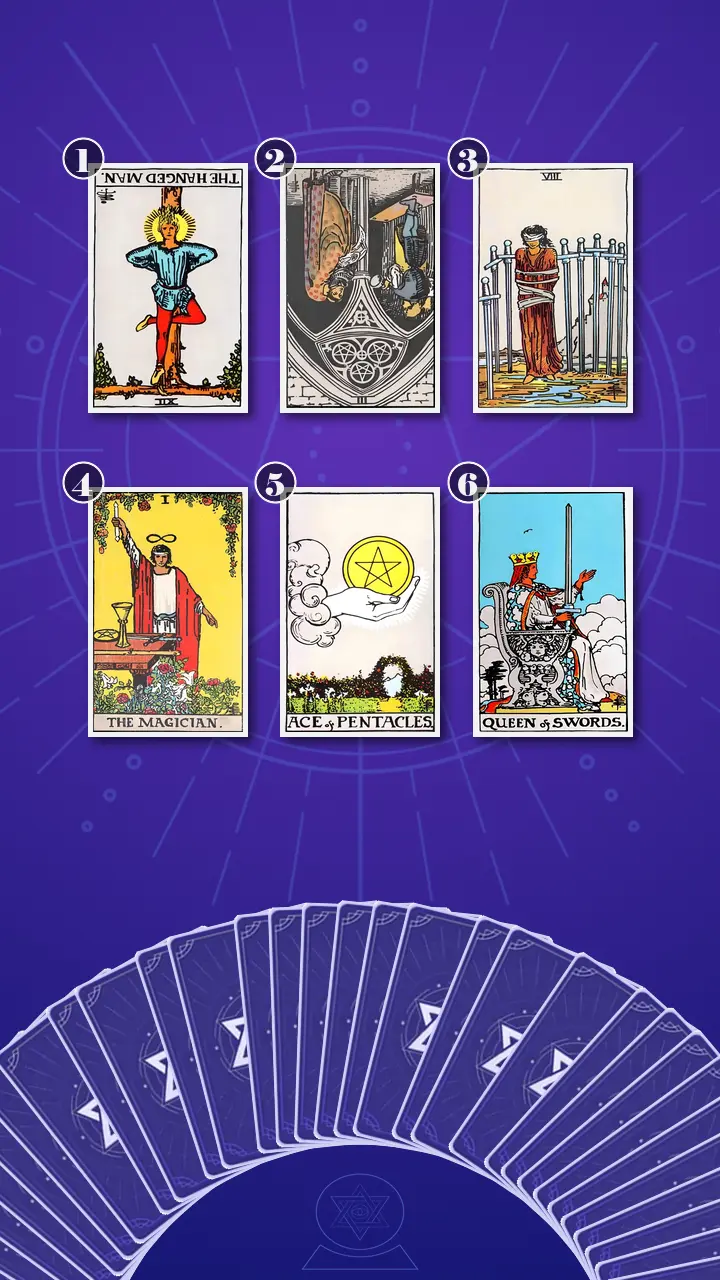
I chose a Rider-Waite-Smith six-card layout called the Transformation Path Grid · Context Edition. For me, this is how tarot works at its most useful: the images provide an external surface on which habits, assumptions, and choices can be examined without pretending that a card has seized control of the future.
I chose this spread because Jordan was not deciding between two fixed options. They were caught in a feedback loop: group ambiguity led to monitoring, monitoring kept useful work invisible, and the empty workspace then appeared to prove that nobody could move. A simple past-present-future reading would have described the sequence without separating the real collaboration problem from the internal permission rule maintaining it.
I arranged the cards in two rows of three, like a project board. The upper row would show the observable waiting pattern, the group’s missing structure, and the belief underneath the delay. The lower row would answer each condition with a catalyst, one bounded action, and a sustainable communication boundary. The layout itself would let us compare suspension with initiation, an empty collective structure with one tangible contribution, and restrictive thinking with clear judgment.
Reading the Diagnostic Row
The Hanged Man Reversed: The Sixth Refresh
The card I turned for the current behavioral knot, repeatedly monitoring the group while withholding Jordan’s own visible contribution, was The Hanged Man, reversed.
I pointed to the figure held by one ankle. Upright, the suspension can be voluntary and useful: a deliberate pause that changes perspective. Reversed, its energy was blocked. The pause had stopped producing new information, but it had no end condition. The halo around the figure’s head reminded me of the intelligent explanations that can make indefinite waiting sound like careful preparation.
“At 9:40, you opened the shared Google Doc, saw no edits, and closed it without adding anything,” I said. “Then you refreshed the chat and polished private notes. The inner line is, ‘I’m not avoiding the work; I’m just waiting until the format is clear.’ But the sixth refresh cannot answer a question the first five did not answer. Monitoring the project is not the same as moving it.”
Jordan gave a small, bitter laugh. Their fingertips stopped against the phone case. “That’s too accurate. Kind of brutal.”
“Specific doesn’t have to mean condemning,” I replied. “You were trying to protect your effort from rework. The problem is not that you paused; it’s that the pause never received a stopping rule. Ten minutes of planning can be purposeful. Repeated checking with no new question is suspension disguised as coordination.”
Three of Pentacles Reversed: Five People, No Shared Structure
The card I turned for the primary blockage, unclear roles and missing shared standards inside the group-project free-for-all, was Three of Pentacles, reversed.
In the upright image, three people gather around plans inside a structure their different skills are helping to build. Reversed, I read its Earth energy as deficient and disorganized: contributors were present, but ownership, format, and review points had not become solid enough to coordinate their work.
I described the observable scene back to Jordan. The chat held scattered ideas and a vague “Has anyone started?” while the shared file had no outline, named owners, or internal deadline. Their thought was understandable: “I could do my part if someone would just decide the thesis and format.” The coordination failure was real. Keeping their three outline points private, however, left the group with one less building block around which to coordinate.
“Which decision genuinely requires the whole group,” I asked, “and which piece could be offered provisionally without pretending the decision is final?”
Jordan’s shoulders lowered by a fraction. They looked away from the phone and back at the card. “The thesis probably needs everyone. But I could summarize the evidence I already found under the current version.”
I nodded. A blank shared document cannot give anyone something specific to respond to. That did not make Jordan responsible for repairing the entire collaboration system; it meant the system’s failure did not prohibit every bounded contribution.
Eight of Swords: The Internal View-Only Setting
The card I turned for the deeper rule beneath the procrastination, the belief that starting without group certainty would waste effort or remove control, was the Eight of Swords, upright.
I drew Jordan’s attention to the blindfold, the loose bindings, and the visible gap between the swords. The restriction was not wholly fictional; revision and disagreement were possible. Yet Air had become excessive and constricting. Thought was rehearsing every reason an early draft might be changed until risk had been translated into impossibility.
I made a plain inventory. Jordan already had the course brief, four usable sources, three outline points, a laptop, and an assigned research section. The cursor could physically enter the shared file. Their rule sounded like, “Technically I could write an evidence summary, but it doesn’t count unless the group confirms the final thesis first.” It was an internal permissions setting: the document allowed editing, but the mind had switched itself to view-only.
“‘This may need revision’ is not the same as ‘I cannot begin,’” I said. “What do you predict would happen if someone revised your first draft? Would the practical cost be ten minutes, an hour, or something else? And what meaning would you attach to being corrected?”
Jordan’s jaw held still. Their gaze lost focus as if they were replaying a previous project. “I’d feel like I should’ve known better. And I’d worry they’d decide I was the person organizing everything just because I started.”
That answer revealed the hidden false equation: visible initiative had become indistinguishable from both incompetence and total responsibility. I knew the next card needed to open a middle path between waiting and taking over.
When the Magician Counted Jordan In
The Catalyst: A Downbeat Chosen From Within
As I reached for the fourth card, the refrigerator motor on Jordan’s side of the call clicked off. The room became suddenly quiet, and a distant TTC streetcar bell sounded through their window. The card I turned for the key transformation from waiting for permission to using available resources was The Magician, upright.
The raised wand, the downward-pointing hand, and the four suit tools on the table formed the spread’s catalytic image. I read its energy as balanced, focused, and resourceful: Fire could initiate, Water could tolerate the discomfort of feedback, Air could name an assumption, and Earth could turn existing notes into one visible artifact. Jordan did not need every variable resolved. They needed to direct what was already present.
The image took me, not to a prediction, but to a mixing desk. After ten years of researching sound and rhythm, I have learned to listen for the moment when a capable person’s natural cognitive tempo falls out of sync with a task. Jordan worked well when a brief supplied a clear downbeat. This group project supplied irregular pings, vague messages, and no count-in, so they kept waiting for the entire ensemble to begin together.
I call this Cognitive Tempo Calibration. The useful question is not, “How do I force myself to feel certain?” It is, “What is the smallest beat I can set for myself without conducting everyone else?” My accompanying Focus Disruption Audit identified the dissonant chords: the warm phone, the reflexive version-history check, and the thought that a revised draft would be wasted. The Magician did not erase those sounds. It brought the brief, notes, timer, laptop, and chat into one deliberate rhythm.
I named Jordan’s immediate bind: the Google Doc was blank, their shoulders were heavy, and going first still felt like volunteering to be wrong. Their mind kept converting “I may be revised” into “I have no right to begin,” while also treating one outline as a contract to manage the whole project.
Waiting is not proof that you need more permission; make one usable draft from the tools already on the Magician's table, then let feedback refine it.
Jordan’s inhale stopped for a beat. Their thumb hovered above the dark phone screen, and their pupils widened as their eyes moved from the Magician’s table to the blank document behind our call. First came a physical freeze: shoulders still raised, lips slightly parted, fingers curled against the phone. Then their gaze drifted as if Tuesday night were replaying in reverse: the deleted message, the private outline, the untouched file. Something sharp entered their voice. “But doesn’t that mean I’ve been doing this wrong the whole time?” I kept my answer steady. “No. It means a strategy that protected you from wasted effort started costing more than it saved. Noticing that is information, not a verdict.” Their fingers slowly opened. A long breath left their chest, their eyes reddened, and their shoulders finally dropped. For a moment they looked almost unsteady, as if relief had removed a weight before they had learned how to stand without it.
I asked, “Now, using this new perspective, think back to last week. Was there a moment when this insight could have made you feel different?”
“Tuesday,” Jordan said quietly. “I could’ve posted the three headings and written, ‘This is based on the current thesis; tell me if I’m off.’ I didn’t have to decide the whole project. I could make those headings available for response.”
I put the catalyst into one practical sentence: You do not need shared momentum to make a useful move; you need one bounded draft that gives the group something real to respond to. This was the watcher-to-initiator shift: from monitoring a silent group for permission to making a bounded first move with clear ownership and openness to revision. It was not complete confidence. It was the first usable measure of self-directed collaboration.
The One Object That Opens the Path
Ace of Pentacles: Draft v0.1
The card I turned for the bounded action that could interrupt the stagnation cycle was the Ace of Pentacles, upright.
I held the card close to the camera so Jordan could see the single pentacle offered by one hand and the garden path continuing beyond it. I read the Earth energy here as constructive and appropriately limited. The card did not ask for the whole group project, a perfect thesis, or a rescued slide deck. It asked for one tangible unit that could be completed, inspected, and revised.
In Jordan’s actual project, that pentacle could become a file titled “Research Section v0.1” containing one rough paragraph, two sources, and the assumption behind the paragraph. It could also be a three-bullet outline, a source table, or slide headings marked “content pending review.” One useful object was enough for one focused session.
“Think of it like a limited pull request,” I said. “Visible, deliberately small, and expected to receive edits. Initiative can be small without being passive, and visible without becoming control.”
Jordan exhaled and tapped one of their color-coded sources. “A rough paragraph with the two strongest citations. I could do that in ten minutes. Maybe fifteen if I stop fixing the wording.”
“Then the boundary is not only what you will produce,” I said. “It is where you will stop.”
The Message That Refused to Become a Rescue Mission
Queen of Swords: Clear Ownership, Open Hand
The card I turned for integrating initiative with communication boundaries was the Queen of Swords, upright.
I paired the Queen’s upright sword with her extended hand. The sword represented exact scope, assumptions, and timing; the open hand kept communication receptive. Air, which had tightened into the Eight of Swords, was now balanced and useful. Instead of speculating about what everyone might want, Jordan could state what they were doing and invite one answerable response.
I typed the message into our call chat exactly as it could appear in the group thread: “I am drafting the research section from this outline by Thursday. Please flag scope conflicts by Tuesday at 6 p.m.; otherwise I will proceed with these assumptions.”
“That feels direct,” Jordan said. Their fingers tightened once around the mug and then released. “But not bossy, actually. I’m not assigning anybody else anything.”
“Right,” I said. “Clarity is not command. You can be clear about your part without becoming responsible for theirs. Own the contribution; do not adopt the entire project.”
I also named the overcorrection waiting often produces: the late-night swing from “I cannot start” to “Fine, I’ll rebuild the whole deck.” The Queen’s boundary protected Jordan from both extremes. They could offer a draft, keep the feedback window open, and let each teammate own whether they responded.
Finding Clarity in Three Small Beats
I gathered the six cards into one story. The Hanged Man showed a useful pause hardening into a waiting loop. The Three of Pentacles confirmed that the group’s missing structure was a genuine obstacle. The Eight of Swords showed how fear of revision turned that obstacle into an internal no-start rule. The Magician restored initiative, the Ace reduced it to one inspectable artifact, and the Queen placed a clean boundary around Jordan’s responsibility.
The group chat had been functioning like a loading screen: everyone watched it for proof of movement, but watching did not load the project. Jordan’s cognitive blind spot was a false binary. They believed they had to wait for complete alignment or take over everything. The spread revealed a third option: create one provisional object, state the assumption behind it, request specific feedback, and stop at the edge of the agreed contribution.
The direction of change was therefore precise. Jordan did not need to become fearless, guarantee that no work would be revised, or transform into the group leader. They needed to move from permission-seeking to bounded initiative, with Air reassigned from circular monitoring to clear language and Earth grounded in a small, visible draft.
The Syncopated Study Session
I adapted my Syncopated Study Session into two practical next steps. Instead of treating the assignment as one long performance that could begin only when everyone entered together, I gave Jordan a short rhythm with a firm ending: make, label, share, then step away.
- Run the ten-minute draft-before-refresh session. On one evening this week, at the kitchen table and before checking the group chat, Jordan would place the phone face down and set a ten-minute timer. The first five minutes were for turning existing notes into three bullets or one cited paragraph. The next two were for labeling the working assumption. The final three were for pasting the draft into “Research Section v0.1” and adding one specific feedback question. If three bullets feel too exposed, begin with one heading and one assumption. Stop when the timer ends; do not redesign the deck or assign anyone else’s work.
- Send one deliverable-input-review message. In the group chat, Jordan would name their proposed deliverable, current assumption, single requested input, and review time: “I’m drafting the research section from these headings by Thursday. Please flag thesis conflicts by Tuesday at 6 p.m.; otherwise I’ll proceed with the current version.” After posting, they would mute the chat for one focused twenty-minute block. Keep the message factual and skip repeated apologies. A review window protects collaboration without requiring permanent availability or unpaid project management.
“Which one will you do first?” I asked.
Jordan glanced at the empty document, then turned their phone face down. “Three bullets, one assumption, one question. Ten minutes. After that, I’m allowed to stop.”
Four Days Later: The Quiet Proof
Four days later, I received a screenshot from Jordan. The shared document was no longer blank. Under the heading “Research Section v0.1,” they had posted one rough paragraph, two citations, and a yellow note reading, “Assumption: using the current thesis unless the group flags a conflict by 6 p.m.”
A teammate had replied, “This works. Can we change the second heading and use this structure for our sections?” Jordan told me the suggested change still produced a small tightening under their ribs. They revised the heading anyway, without deleting the paragraph or volunteering to reorganize the rest of the document. Feedback had refined the contribution instead of proving the contribution was pointless.
Jordan also told me they had slept through the night. Their first thought in the pale Toronto morning was still, “What if they change more of it?” This time, they smiled, opened the comments, and decided what belonged to them.
I did not call the project fixed, because clarity is rarely the same as total certainty. I called this a credible first proof: Jordan had moved from uneasy suspension toward steadier confidence, and they had done it without carrying the whole group. The cards had not moved the project. Jordan had used the cards as a map, chosen a downbeat, and moved it themselves.
That is what I want a Journey to Clarity to return: not dependence on a reading, but a more accurate sense of where choice still lives. The six-card Transformation Path Grid gave Jordan language for the loop; their ten-minute contribution supplied the real-world evidence that another response was possible.
If everyone is waiting for everyone else, your shoulders may feel pinned above a blank document: you want to be reliable, but going first feels like handing other people the power to waste or dismiss your effort. If you can hear that internal rhythm slipping out of sync, noticing it already gives you a place to count yourself back in.
When the group chat becomes a loading screen again, what tiny, assumption-labelled v0.1 could you place in the shared document today, useful enough to invite one real response?