The Warm "Soon" That Never Became Shared Time
I knew the pattern before I turned a single card: the early-career city worker whose group chat could produce forty enthusiastic messages about dinner and still reach Friday without a date, place, or owner. It was friendship future-faking in plain sight, repeated vague friendship plans that signalled closeness but never became real shared time.
At 9:18 on a Thursday evening, Jordan joined our video consultation from the narrow kitchen of their Toronto rental. I watched them hold a warm phone in one hand while their tea cooled beside the sink. Through my speakers, I heard the kettle click off and the metallic scrape of streetcar brakes outside.
Jordan turned the phone towards the camera. Four friends had reacted with hearts to "we need to do dinner soon." Jordan had added "yes, please," but no one had proposed a day, a place, or who would book it.
"We keep proving that we care in theory," they said, "while the calendar stays empty. I don't want to turn friendship into a scheduling meeting, but I also don't want another blank Sunday."
I heard the central contradiction clearly. Jordan wanted affection to become shared time, yet another warm promise felt safer than a direct request that might expose how much reciprocity the friendship could actually hold. The wanting had the body-feel of waiting at a streetcar stop where every arrival board said "due," but nothing ever turned the corner.
"Wanting a real date does not make you needy," I told them. "And I am not going to use tarot to claim that I know what your friends secretly feel. I want us to look at what can be observed, where fear enters the loop, and what remains within your choice. Let's draw a map through this fog."

Choosing a Map That Refuses to Mind-Read
I invited Jordan to place their phone face down and take one unforced breath. I shuffled slowly while they held the question in mind. The pause was not a mystical performance; it was a clean transition from replaying the chat to examining the pattern.
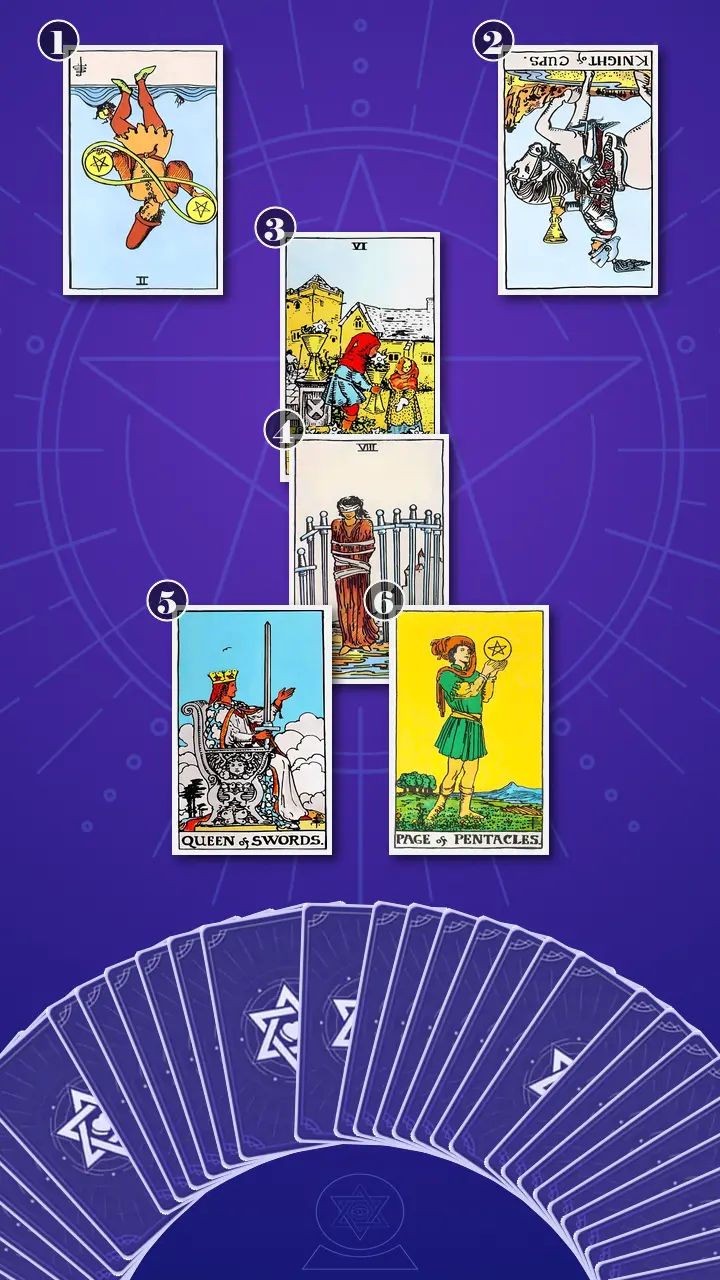
I chose the six-card Relationship Spread: Context Edition, a tarot spread for examining friendship reciprocity, communication, and follow-through. I use this spread when a relationship question depends less on predicting an outcome and more on separating visible behaviour from interpretation.
For readers wondering how tarot works in a situation like this, I treat card meanings in context as an objective reflection tool. The first two positions would show Jordan's participation and the other side's observable contribution. The centre would reveal the shared script, with the hidden blockage beneath it. The final pair would offer a resource and a conscious next step, not a prediction about whether any particular friendship was destined to last.
The Group Chat's Endless Orbit
Position One: The Infinity Loop Between Chat and Calendar
I turned the card representing Jordan's observable participation in making friendship plans. It was the Two of Pentacles, reversed.
In the Rider-Waite-Smith image, two coins move inside an infinity loop while the figure shifts their weight against a choppy sea. I saw Jordan's Thursday nights in that loop: saying they could "probably make anything work," moving a possible dinner around work deadlines, groceries, and other invitations, then reaching Saturday with three lively chat threads and no confirmed event.
The reversed earth energy showed a blockage in stability and an excess of adjustment. Flexibility had stopped serving the plan and started preventing anyone, including Jordan, from choosing one realistic option. The inner script sounded like, "I am being flexible, but somehow flexibility keeps meaning nothing gets chosen."
Jordan gave a short, bitter laugh. "That is painfully accurate. I keep every evening half-open and then act surprised when I have no actual plans." Their restless thumb became still against the edge of the phone.
"This is not the card blaming you for a pattern that several people help create," I said. "It is showing us the handle that is currently within your reach. Agency begins with noticing the difference between enthusiasm and ownership."
Position Two: The Invitation That Travels but Never Arrives
I turned the card representing the other side's observable contribution, limited strictly to behaviour Jordan could see. It was the Knight of Cups, reversed.
The knight's raised cup and slow white horse resembled an affectionate invitation travelling beautifully through a voice note without arriving at a time and place. Jordan recalled listening on the Line 2 train while the rail vibrated under their palm and burnt takeaway coffee hung in the carriage air. A friend said they missed Jordan and wanted a long brunch soon. Jordan's chest lifted. When they asked which weekend worked, the answer was another fond "soon, promise."
"That sounded sincere, so why am I still staring at an empty calendar?" I offered as the thought beneath the replay. The reversed Knight did not prove deception, selfishness, or any private motive. It showed emotional movement with insufficient practical grounding. Warmth is real. So is the missing date.
Jordan's shoulders dropped as they looked from the Knight to their silent phone. I asked them to notice the observable distinction: choosing an option, offering an alternative, or rescheduling specifically would all be concrete responses. More affectionate language without a time would still be warmth, but it would not yet be a plan.
Position Three: The Old In-Joke That Feels Like Movement
I turned the card representing the familiar shared script that kept bringing both sides back into the same exchange. It was the Six of Cups, upright.
One child offers another a cup filled with flowers. I connected that sweet gesture to Jordan and a long-time friend reviving an old joke about their favourite Toronto patio and saying, "We have to do that again." For a few minutes, remembered closeness felt like present movement: "This feels like us, so maybe it still counts as progress."
The upright water energy held genuine affection in balance. The history did matter. The difficulty began when familiar warmth was asked to provide evidence about current reciprocity that only present behaviour could supply. Nostalgia could explain why the loop felt comforting without guaranteeing another shared afternoon.
Jordan traced the edge of the flower-filled cup with one fingertip. Their expression softened first, then tightened with a quieter sadness. I could see that the reading had made room for both truths: the friendship's history did not have to be fake, and the current plan could still be missing.
"A vague maybe can protect belonging for one more day," I said, "but it cannot create shared time."
Position Four: The Question Deleted at 10:46
I turned the card representing the hidden constraint behind the co-rumination. It was the Eight of Swords, upright.
The blindfold, bindings, and ring of swords translated into untested predictions: "They will think I am needy." "I will make it awkward." "A vague maybe is safer than a clear no." Jordan told me about lying in bed at 10:46 on a Tuesday, the room lit blue-white by their screen, typing "Are we actually going to make this happen?" and deleting it. The phone grew hot in their palm. They screenshot the thread for a close friend, and forty minutes of analysis produced a generous explanation but no invitation.
Here, air had become both excessive and blocked. Thought was moving constantly without opening a route forward. The frightening part was not calendar admin; it was the possibility that a concrete answer might disturb the sense of belonging the vague promise had briefly supplied.
I asked, "When you imagine offering Thursday or Sunday, what consequence appears first?"
Jordan's breathing paused. Their eyes lost focus as if an old message were replaying behind them, and their fingers closed around the phone before slowly loosening. "That they will say no without giving me another nice reason to keep hoping," they said.
When the Queen Made Room to Breathe
Position Five: A Boundary With an Open Hand
The radiator behind Jordan gave one last click and went quiet as I moved to the resource and transformation position. A single streetcar bell sounded outside. I turned the Queen of Swords, upright, the reading's key card and its antidote.
Her sword stood straight, but her other hand remained open. I read that posture as respectful directness: one honest wish, two realistic options, and no apology paragraph or accusation. In Jordan's life, the card became a clean message: "I'd genuinely like to see you. Are you free next Saturday or the following Tuesday?"
During fifteen years as a perfumer, I learned that even a beautiful note can overwhelm a room when it has no space in which to diffuse. The association arrived immediately. I call this a Boundary Permeability Diagnosis: not a diagnosis of Jordan's friends, but an examination of what had been allowed to bleed into Jordan's space. A plan with no date was occupying real evenings, real attention, and real nervous-system bandwidth.
Jordan did not need to seal themselves off or become colder. They needed a more breathable boundary between a pleasant idea and a commitment. The Queen's sword worked like a perfumer's blotter strip, separating the notes so each could be identified: affection, availability, action, and interpretation. Clarity is not an accusation; it is an invitation to reality.
Thursday night, the group chat could fill with hearts and "absolutely," while Sunday still arrived without a time or place. Jordan had been treating the decoding of "soon" as safer than discovering whether anyone was prepared to meet them in lived time.
Do not keep treating another warm promise as proof that the friendship is moving forward; let the Queen of Swords' raised blade turn the next conversation into a concrete request and an honest boundary.
I let the sentence remain in the quiet. Then I translated the blade into its simplest message: You do not have to decode "soon." One clear invitation lets follow-through, rather than hopeful interpretation, show you where the friendship can meet you in real time.
Jordan's breath stopped halfway in. Their pupils widened, and their fingers hung above the dark phone screen as though the next movement required permission. Then their brows drew together. "But doesn't that mean I've been wrong this whole time?" they asked, their voice suddenly sharper. "Like I made all that warmth mean more than it did?"
I let the resistance have room before answering. "No. You used ambiguity to protect something important: hope and belonging. That strategy gave short-term relief, and now it is costing you too much space." Jordan's gaze went distant as memories replayed; then their shoulders lowered, their hand opened, and their eyes reddened. "Oh," they breathed, the word trembling between relief and the slight dizziness of having a real choice. I asked, "Using this new perspective, was there a moment last week when this insight could have changed how you felt?" Jordan remembered declining a responsive coworker's Friday coffee because a vague Saturday walk was still floating.
I named the crossing I had just witnessed: from co-ruminating over vague friendship promises to grounded clarity through direct communication and observable reciprocity. It was not certainty about anyone else's heart. It was Jordan beginning to trust that an answer could be information without becoming a verdict on their worth.
Position Six: One Small Beta Test in Real Time
I turned the card representing the conscious next step. It was the Page of Pentacles, upright.
The Page studies one pentacle in a fertile field. I saw one friend, one realistic invitation, and one mutually agreed entry in Google Calendar. Jordan could offer a Thursday coffee or a Sunday walk. If either option was accepted, it would be scheduled. If the reply stayed vague, Jordan could notice that outcome without chasing three more promises or declaring the entire friendship meaningless.
The Page brought balanced earth back into a spread that had begun with unstable logistics. I described it as a small beta test, not a launch announcement for a completely redesigned social life. The inner script became, "I do not need to solve adult friendship tonight. I can make one realistic offer and notice what happens."
Jordan looked at the Page, then opened their calendar rather than the group chat. I watched the problem shrink on their face from an entire friendship crisis into one manageable experiment.
The Space Calibration Ritual
When I gathered the spread into one story, its logic was clean. Genuine shared history had made the repeated promise emotionally rewarding. In the present, endless flexibility and feeling-rich messages kept affection circulating without a practical container. Underneath, Jordan feared that directness might expose unequal belonging. The available strength was neither withdrawal nor confrontation; it was the Queen's clear language followed by the Page's grounded experiment.
The cognitive blind spot was the belief that asking for a date would make friendship transactional, while enthusiastic language could safely be treated as commitment. The transformation direction was to replace repeated interpretation with one specific invitation, then observe whether it was met with a choice, an alternative, or continued vagueness.
"It still sounds a little like calendar admin," Jordan admitted.
"Scheduling is not the friendship," I said. "It simply gives affection somewhere real to land."
I shaped the next steps through my Space Calibration Ritual: one digital blank space after a direct message and one physical or calendar blank space around any plan that had not been confirmed. The purpose was not to become guarded. It was to stop hypothetical plans from filling every available corner of Jordan's week.
- Offer one wish and two dates. Before Thursday evening, choose one friend and identify two 60-to-90-minute windows you genuinely want to offer. Set a ten-minute timer and draft: "I'd like to catch up. Are you free Thursday after 6 or Sunday around 2? If neither works, feel free to suggest a time that does." Minimum version: save only the two times in Notes. Sending is optional, and an invitation is not a demand.
- Create digital and calendar breathing room. After sending, place the phone face down for 15 minutes and complete one ordinary task instead of forwarding the message for analysis. Add a plan to Google Calendar only after both people agree to a time. If no concrete response arrives by a private deadline, release the window for another friend, a solo cafe visit, or rest. Keep the observation behavioural and neutral. One response does not define a whole friendship, and if tracking increases rumination, delete the note.
This was not a reciprocity scorecard. Jordan remained free to value affection, history, and limited-capacity friendships in whatever proportion felt right. The ritual simply protected enough air for present evidence to exist beside hope. Let follow-through answer the question that overthinking cannot.

Six Days Later, One Square of Real Time
Six days later, I received Jordan's message: they had sent the two-date invitation. Their friend could do neither, but offered Wednesday at 7. Jordan booked it, slept through the night, and still woke thinking, "Was that too much?" This time, they laughed.
I did not see tarot create that Wednesday plan. The cards helped separate a blurred pattern into visible parts; Jordan supplied the courage, the words, and the calendar space. Their Journey to Clarity was not a journey towards perfect certainty. It was a first move from hypothetical closeness towards warmth with observable follow-through.
I would leave the same gentle truth with anyone who recognises this loop: when a warm "soon" lifts your chest and the later silence tightens your jaw, the hardest part may not be the empty calendar. It may be wondering whether asking for real time will cost you the belonging that the promise briefly gave you. Noticing that fear already creates a little breathing room around it.
If one clear invitation did not have to mean anything about your worth, what small square of real time would you be curious to offer, and where could you leave enough blank space to hear the answer?
This story is adapted from psychological research, written so that those in a similar struggle can see their own pattern in it — and find their next step clearly.These insights are not a substitute for professional psychological, medical, legal, or financial advice.
Learn more about our Journey to Clarity.
How did this insight land for you?
🫂 This Resonates Deeply
🌀 Living This Story
✨ Now I See Clearly
🌱 Seeing New Possibilities
🧰 Useful Framework
🔮 The Confirmation I Needed
💪 Feeling Empowered
🚀 Ready for My Next Step
Author Profile
 AI
AI“As a perfumer for fifteen years, I’ve learned to perceive human boundaries through the delicate metaphor of scent. Relationships need the right amount of space to breathe, and I've seen too many kind souls exhaust themselves trying to please everyone. I’m here with warmth and understanding—not to teach you to be guarded, but to help you gently clear the air and rediscover the comforting, safe boundaries that are rightfully yours.”
In this Friendship Tarot Reading :
Core Expertise
- Boundary Permeability Diagnosis: Identifying friends whose lack of limits is metaphorically 'bleeding into your space' and causing emotional suffocation.
- Vibe Contamination Auditing: Recognizing when a highly sensitive or negative friend is unconsciously polluting your personal psychological atmosphere.
Service Features
- The Space Calibration Ritual: A behavioral directive to implement specific 'digital and physical blank spaces', preventing enmeshment and restoring breathable boundaries.
Also specializes in :
Explore Related Patterns:
Rejection SensitivityAt 10:46, Jordan types the question that could clarify the plan and deletes it after imagining that friends will see them as needy or awkward. Even after a friend responds to the later two-date invitation by offering Wednesday, Jordan wakes wondering whether asking was "too much." When you are braced for rejection, an availability question can start to feel like a test of your place in the relationship. That sensitivity encourages you to preserve a warm maybe because it postpones the possibility of a painful answer. The pattern becomes easier to audit when you separate a person's response to one invitation from a global verdict on your worth or belonging.
Safety Behavior LoopJordan keeps evenings half-open, deletes a direct question, and allows each affectionate "soon" to remain active without a date. These actions do more than delay scheduling: they prevent the concrete response that could test how much present-day reciprocity the friendship can hold. When you use ambiguity this way, it functions as a safety behavior. Hope and belonging receive immediate protection because no explicit rejection has occurred, but the protection also preserves the uncertainty that keeps you checking, interpreting, and waiting. The loop becomes self-reinforcing because the behavior that reduces discomfort in the moment also blocks the evidence that could resolve it.
Analysis ParalysisJordan spends forty minutes analysing the thread, develops a generous account of why everyone may be vague, and still sends no invitation. The same cognitive motion appears when the direct question is typed and deleted: thought remains highly active while the behavior that could produce new information is suspended. When you analyse in order to eliminate every relational risk before acting, thinking becomes a defensive holding pattern. Each interpretation promises more certainty, yet none can answer the practical question that only a response can answer. Analysis Paralysis names the point where reflection stops preparing you for action and starts protecting you from the uncertainty built into action.
Mind ReadingBefore Jordan offers specific dates, they predict that friends will think they are needy and that the request will make things awkward. Those predictions shape behavior before anyone has responded, and the same interpretive habit returns after the invitation succeeds when Jordan wonders whether it was still "too much." When you treat an anticipated judgment as if it were observed feedback, another person's imagined reaction begins making decisions for you. Mind Reading turns uncertainty into a negative conclusion that feels safer than testing reality because it appears to provide advance protection. The story exposes the gap clearly: the predicted criticism never arrives, while the observable response is a workable alternative date.
Nostalgia LoopA long-time friend revives an old joke about a favourite Toronto patio and says, "We have to do that again." For a few minutes, the remembered afternoon makes the current exchange feel active even though nobody has chosen a new date. When you draw on genuine shared history, nostalgia can preserve continuity and remind you why the friendship matters. The loop forms when that emotional continuity is also used as evidence of present follow-through. Nostalgia Loop does not mean the old closeness was false; it means remembered connection is temporarily doing the psychological work that current reciprocal action has not yet done.
Reality TestingFour friends react with hearts to "we need to do dinner soon," yet the chat still contains no day, place, or owner. Later, one friend cannot make Jordan's proposed dates but offers Wednesday at 7, giving Jordan a concrete behavior to evaluate instead of another phrase to decode. When you use Reality Testing in a relational gray area, you do not have to declare the warmth insincere or pretend that it is already a plan. You let observable follow-through sit beside emotional language and give each the weight it has earned. That shift restores clarity because availability, alternatives, and rescheduling can answer a question that speculation about private feelings cannot.
Boundary DiscernmentJordan offers one genuine wish and two realistic dates, waits for an agreed response before using calendar space, and remains willing to release the window if the answer stays vague. These actions separate affection from availability and availability from commitment without dismissing any of them. When you practise Boundary Discernment, a warm idea no longer receives the same access to your time as a mutual plan. The boundary is not a punishment or a demand for perfect reciprocity; it is a way of keeping your own choices visible while another person makes theirs. That distinction lets you remain open to connection without allowing every hypothetical meeting to occupy a real evening.
Explore Related Struggles:
Ambiguity-Promise FusionFour friends react with hearts to "we need to do dinner soon," and Jordan adds "yes, please," but the exchange ends without a date, place, or person taking ownership. A similarly warm brunch message lifts Jordan's chest, and another "soon, promise" is carried forward as though the meeting has moved closer. When affectionate possibility starts functioning like a promise, your attention and calendar respond to a commitment that has not actually been made. You do not have to dismiss the warmth as false to separate it from availability. The distinction restores your ability to let a plan become real only when someone chooses a time, offers an alternative, or follows through with a concrete next step.
Clarity-Exposure SplitAt 10:46, Jordan types "Are we actually going to make this happen?" and deletes it. The question could open a route to real shared time, but it could also expose whether anyone is prepared to choose a date, suggest an alternative, or let the invitation end without another comforting promise. When you need clarity from the same relationship in which ambiguity is protecting belonging, asking becomes more than calendar administration. It places your wish for connection beside evidence that may not match it. The struggle lies in letting an answer become usable information while refusing to make that answer a verdict on your importance or worth.
Low-Maintenance Worth LockJordan deletes a direct question after predicting that their friends will think they are needy or that the exchange will become awkward. Even after one friend responds constructively by offering Wednesday at seven, Jordan wakes wondering whether presenting two dates was "too much." When asking for very little becomes part of how you remain acceptable in a friendship, your actual wish for shared time has to compete with the need to appear easy and undemanding. That leaves you waiting for others to convert warmth into action without revealing how much the outcome matters. A clear invitation gives your need an honest shape while allowing the response to describe current capacity rather than your worth.
Affection-Workability SplitThe group chat produces forty enthusiastic messages, four heart reactions, and repeated declarations that dinner should happen soon, yet no one supplies a date, place, or owner. A friend can sincerely say they miss Jordan and still answer a weekend question with another affectionate "soon," leaving warmth in motion while the calendar remains still. When you receive care that never acquires a workable form, you are left holding two valid but incompatible pieces of evidence. The affection may be genuine, and the friendship may still lack the practical capacity required for shared time. Seeing that split allows you to value what is expressed without asking it to prove a level of availability that only follow-through can show.
Freedom-Structure ConflictJordan repeatedly says they can "probably make anything work," shifts possible dinners around work and other invitations, and keeps multiple evenings half-open. The effort is meant to make friendship easier, but every added option removes the pressure to choose one, so flexibility expands while the chance of an actual meeting contracts. When you want friendship to remain spontaneous and unforced, even a simple scheduling boundary can feel more formal than the relationship should require. Yet complete openness gives affection no stable place to land. You remain free in theory while your week becomes unavailable in practice, caught between protecting the friendship's ease and creating enough structure for it to exist offline.
Boundary Ambiguity LockJordan keeps every evening half-open and declines a responsive coworker's Friday coffee because a vague Saturday walk is still floating. No shared time has been confirmed, yet the possible plan already occupies real calendar space and influences which other connections Jordan allows themselves to accept. When an unconfirmed idea receives the same access to your week as a commitment, ambiguity stops being neutral. It begins organizing your choices while giving you no reliable event in return. A more breathable boundary lets you appreciate an invitation as a possibility without reserving time for it until both people have agreed on what will actually happen.
Explore Related Emotions:
Ambiguity DreadJordan replays affectionate messages, screenshots the thread, and spends forty minutes constructing generous explanations while the invitation itself remains unmade. Hearts, old jokes, and promises provide many signals to interpret but no concrete answer about present availability. When you stay inside that interpretive gap, uncertainty becomes both a shelter and a source of pressure. Ambiguity Dread describes the heavy suspension of not knowing, especially when obtaining clearer evidence could disturb the meaning you have been using to preserve the relationship.
Borrowed Warmth AcheFour friends react with hearts to dinner "soon," and a friend's fond voice note makes Jordan's chest lift before another missing date tightens their jaw. The warmth is observable and may be sincere, but it exists as language and screen contact rather than shared time. When you use each affectionate promise to restore a sense of closeness, that comfort lasts only until the calendar remains empty again. Borrowed Warmth Ache names the tender pain of receiving enough care to keep hoping, but not enough grounded participation to feel securely met.
Cautious Self-TrustSix days after sending the invitation, Jordan has a Wednesday plan, sleeps through the night, and still wakes wondering whether asking was too much. This time the question does not make them retract the request or reinterpret the response; they can notice it and laugh. You do not need perfect confidence before trusting your own wish for reciprocal time. Cautious Self-Trust describes the emerging ability to let doubt remain present without giving it authority over your choices or allowing another person's availability to define your value.
Conditional Belonging FearJordan says that a clear no might remove the nice reason they still have to keep hoping, and an unconfirmed Saturday walk is allowed to displace a responsive Friday invitation. The vague promise temporarily protects the sense that the friendship is intact, even while it prevents Jordan from seeing what the relationship can currently hold. When you experience belonging as something a direct question might revoke, ambiguity can feel protective despite its cost. Conditional Belonging Fear names the deeper concern that asking for reciprocal time will not merely reveal availability, but will deliver a verdict about whether there is still a place for you.
Grounded AgencyJordan opens the calendar instead of another group-chat thread, chooses one friend, and offers two realistic windows. When neither works, the friend proposes Wednesday, and Jordan can book the plan without needing to solve the meaning of every previous "soon." You regain a grounded sense of influence when your next move is concrete, proportionate, and fully within your choice. Grounded Agency does not promise control over another person's response; it is the steadier feeling of knowing you can ask clearly, observe what happens, and decide how much space the result deserves.
Mutuality HungerJordan says they want affection to become shared time, not another scheduling debate, and repeatedly looks for a date that someone else will help own. What remains missing is not proof that the friends feel nothing; it is observable participation in bringing the friendship into the same room. When you receive warmth without reciprocal movement, the unmet need is larger than dinner itself. Mutuality Hunger names the longing to feel another person choose, suggest, reschedule, and protect time with you, so connection is carried by both people rather than sustained by your interpretation alone.
Need Exposure DreadJordan types a direct question at 10:46, deletes it, and sends the thread to another friend for forty minutes of analysis. The avoided action is small in practical terms, but it would openly reveal that shared time matters and that another vague promise is no longer enough. When you believe a clear request could make you look needy, naming an ordinary preference can feel like exposing an unprotected part of yourself. Need Exposure Dread captures the tension of wanting to be met while fearing that the visibility of your wanting could alter how securely you belong.
Standby Mode AnxietyJordan keeps every evening half-open, moves possible dinners around work and errands, and even declines a responsive coworker's coffee because a vague Saturday walk is still floating. The calendar appears available, but real attention has already been assigned to plans that nobody has confirmed. When you organise your week around hypothetical closeness, waiting stops being passive and becomes a constant state of readiness. Standby Mode Anxiety names the strain of being unable to commit elsewhere while never receiving enough information to settle into the plan you are holding space for.
Clarity ReliefJordan's restless thumb becomes still as affection, availability, action, and interpretation are separated into distinct pieces. Their shoulders lower when they realise that warmth can be genuine and still remain insufficient evidence of a plan. When you no longer have to decode "soon" or convert every response into a judgment of your worth, attention becomes available for what can actually be observed. Clarity Relief is the release that follows a cleaner distinction: caring language may matter, and follow-through is the separate evidence that shows where the relationship can meet you.
Empty Calendar AnxietyForty enthusiastic messages reach Friday without a date, place, or owner, and Jordan is left anticipating another blank Sunday. The visual emptiness of the calendar keeps contradicting the lively evidence of affection on the phone. When you repeatedly hear that connection is coming but cannot locate it in real time, the unfilled space begins to carry its own pressure. Empty Calendar Anxiety captures the unease of seeing social possibility everywhere while having no confirmed moment in which you will actually be with someone.
Reciprocal WarmthJordan's friend cannot make either proposed date but offers Wednesday at 7 instead, and the plan enters the calendar. The response preserves warmth while adding a concrete contribution, so affection no longer has to travel through vague promises alone. When you are met with an alternative rather than another "soon," closeness gains a form both people can participate in. Reciprocal Warmth is the felt difference between being fondly reassured and being actively met, even through one modest act of follow-through.
Explore Related Contexts:
Friendship Reciprocity GapJordan asks which weekend works after a friend's affectionate brunch message and receives another "soon, promise"; elsewhere, four heart reactions produce no date, place, or owner. The relevant evidence is not whether anyone cares, but how little present-time coordination the visible exchange contains. Affection and reciprocal participation are therefore travelling on different tracks. You can preserve the friendship's history without treating it as current proof, then use choices, alternatives, and specific rescheduling to see how much present-day reciprocity the relationship can practically support.
Group Chat Follow-Through GapJordan reaches Saturday with three lively chat threads, several evenings held half-open, and no confirmed event. The group can generate forty messages about dinner while leaving the date, venue, and booking responsibility unclaimed. The chat is functioning well as a channel for affection but poorly as a coordination structure. You are looking at a gap between visible social activity and practical follow-through: until someone supplies ownership and a concrete option, more messages can make the friendship look active without creating shared time.
Bounded Commitment TrialJordan declines a responsive coworker's Friday coffee because a vague Saturday walk is still floating over the weekend. An unconfirmed idea has therefore acquired the practical power of a commitment even though no one has agreed to a time. The new boundary limits that power: only a mutually agreed plan enters the calendar, and an unanswered window can be released after a private deadline. You can remain open to connection while protecting real time from indefinite claims, giving affection room to become action without letting possibility occupy the entire week.
Direct Communication TrialJordan moves from adding "yes, please" to a vague group thread to sending one friend a clear wish with two realistic dates. The friend cannot make either option, offers Wednesday at 7 instead, and Jordan books it. The direct request creates a social route that neither assumes agreement nor demands it. You do not need clarity to guarantee a yes; its practical value is that it gives the other person something concrete to accept, counter, or decline, allowing visible participation to replace prolonged interpretation.
Measured Reciprocity TrialJordan's friend cannot do either proposed date but responds with Wednesday at 7, and Jordan places it in the calendar. Each person contributes one practical move, so the exchange produces a real point of contact rather than another round of reassurance. That small sequence makes reciprocity observable without turning friendship into a scorecard. You can treat a choice, counterproposal, or specific reschedule as information about current capacity while refusing to make one answer define the entire relationship or your social worth.