When a Group Project Has No Plan: From Chat Checks to Draft v0.1

The 10:40 p.m. Tab Loop in a Leaderless Group Project
I recognised the pattern before Jordan finished describing it: a capable undergraduate can work fast once a task has an owner, yet a leaderless group project can leave them rereading WhatsApp instead of drafting. In Jordan's case, this was ambiguity-driven procrastination, not a lack of effort.
At 10:40 p.m. on a wet Tuesday in London, I could see four tabs reflected in Jordan's glasses during our video session: the assignment brief, the WhatsApp thread, the shared Google Doc, and a blank personal draft. A bus exhaled against the pavement below their bedroom window. Blue-white laptop light caught the rim of a cold mug, and Jordan lifted their phone with a tired half-smile. “It's actually warm from how many times I've checked it.”
A new message appeared: “Could we change the whole angle?” I watched Jordan's shoulders rise towards their ears. Their fingers moved restlessly over the trackpad, but the draft stayed untouched.
“I can do my part,” Jordan said. “I just need to know what it connects to. Every time I start, the group changes direction. Why do I keep delaying my part when the group project has no plan?”
I heard the contradiction clearly. Jordan wanted to make a fair, useful contribution, but they were waiting for a complete group plan that did not exist. The waiting was meant to prevent wasted work, yet it was quietly consuming the time that could have made imperfect work easier to revise. Their unease felt like a Tube train held at the platform until someone could guarantee the entire route, even though the next stop was already known: the power was running, the doors were closed, and nothing moved.
“I don't think the cards need to tell us whether you're capable,” I said. “You already know you can write. I want us to separate what is genuinely blocked from what can begin under a stated assumption. Let's use tarot as a map of the workflow, then find one point where your choice can change it.”

Choosing a Map for the Moving Target
I asked Jordan to put both feet on the floor, close the group chat for a moment, and take one unforced breath. I shuffled slowly while they held the question in mind. I use this pause as a focusing transition, not a mystical test; it gives the nervous system a few seconds to stop reacting to the latest notification.
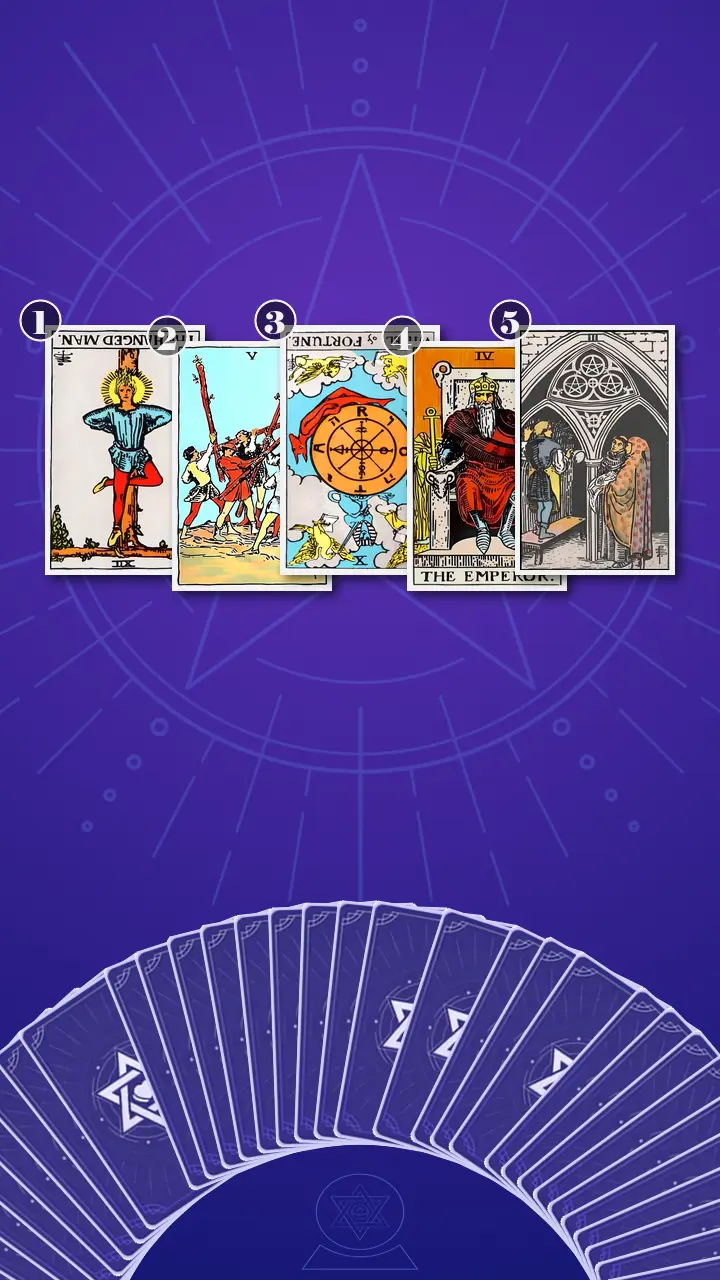
I chose the Problem-Solution Spread · Context Edition, a five-card tarot spread for group-project procrastination and boundary-setting. This was not a two-option decision, so a choice spread would have been too narrow. A ten-card Celtic Cross would have added more information than the problem required. I needed the shortest structure that could show the observable delay, the external friction, the repeated mechanism beneath it, the intervention, and the way that intervention might enter ordinary collaboration.
This is how tarot works in my practice: each position holds one analytical question, and each card gives us a symbolic lens through which to examine behaviour. The cards do not predict Jordan's grade or guarantee that the group will cooperate. They help us make a messy pattern visible enough to evaluate.
I placed five cards in a horizontal line. The first would show the observable diagnosis: what the delay looked like before Jordan explained it. The centre card would expose the mechanism that kept repeating. The fourth would identify the bounded response capable of changing the loop, and the fifth would explore integration rather than promise an outcome.
Reading the Loop from Left to Right
Position 1: The Pause That Stopped Producing Insight
I turned over the card representing the observable diagnosis: Jordan's repeated checking, partial outlining, and suspended drafting whenever no group plan existed. It was The Hanged Man, reversed.
Upright, the suspended figure can represent a deliberate pause that creates a new perspective. Reversed here, that energy had become blocked. Jordan had already gained the available insight, but the posture of reflection continued after reflection stopped producing anything new.
The card reproduced the 10:40 p.m. scene with uncomfortable precision. Jordan kept the brief, WhatsApp thread, shared Google Doc, and blank draft open across four tabs. They reread the same messages, improved the colour-coding in their notes, and waited for one more reply to reveal the correct starting point. When another unconfirmed idea appeared, they closed the draft even though one provisional paragraph could have been written beneath a labelled assumption.
“I am not avoiding the work,” Jordan said, voicing the sentence they usually told themselves. “I'm just waiting until the structure is confirmed.”
I asked, “What genuinely new information did the last three checks give you?”
Jordan looked at the blank document, released a short laugh, and rubbed the heel of one hand across their forehead. “Nothing. That's so accurate it's almost rude.”
“Then we don't need to call you lazy or pretend the group is organised,” I replied. “We can make a cleaner distinction. Responsible reflection gathers information. Actionless waiting keeps refreshing a browser tab for a status update nobody has scheduled to send. Waiting for consensus can look responsible while quietly spending your revision time.”
Position 2: Five Messages, No Decision
I turned over the card representing the external trigger: competing suggestions, absent task ownership, and no agreed sequence. It was the Five of Wands, upright.
The five staffs crossed without a common target. This was active Fire in excess: plenty of movement, little direction. The missing function was Air, the concise sentence that converts discussion into a decision.
I translated the image into Jordan's WhatsApp thread. One teammate proposed a case study. Another shared an unrelated source. A third changed the section order. Two people added reactions, but nobody named an owner, an internal deadline, or the next decision. The thread looked busy while the shared document retained provisional headings and a blank section beneath Jordan's name.
“An active group chat is not the same thing as an organised project,” I said. “It can feel like one of the overlapping kitchen call-outs in The Bear: everyone is moving, but movement becomes hard to use when nobody is following the same immediate sequence.”
I did not use the card to excuse Jordan's delay. The disorder was real, but not every disagreement was a genuine dependency. I asked which decision actually had to be settled before they could write one paragraph.
Jordan's fingers stopped circling the mug. Their gaze moved from the card to the document. “The final case study matters for the middle section,” they said slowly. “But I could draft the opening definition without it. I keep treating both as equally blocked.”
That was the first distinction with practical weight: one unresolved decision affected later scope, while another had become a blanket stop signal.
Position 3: The Algorithm Trained by One More Check
I turned over the central card representing the psychological mechanism: the belief that useful work could not begin until every dependency was settled, followed by the short-term relief that made waiting easier to repeat. It was the Wheel of Fortune, reversed.
Its energy was not simply deficient. It was caught in a blocked cycle. Jordan could not control the group's changing suggestions, but each leaderless assignment activated the same personal sequence: monitor, wait, substitute an easier task, rush near the deadline, and conclude that chaotic groups made an early start impossible.
I ran the pattern back as a quick montage. New module, new classmates, same four browser tabs. New topic, same abandoned outlines. Same sentence about beginning after confirmation. Same late-night sprint with too little time left for calm feedback. The project details changed while the response remained familiar.
It worked like a recommendation algorithm trained by repeated clicks. Every time uncertainty led Jordan back to WhatsApp, the internal system learned that “check again” was the safest next action. The relief lasted a few minutes, but the algorithm became more confident while the draft lost revision time.
Jordan's breath paused. One finger stayed suspended above the cold tea, then their eyes lost focus as if several previous deadlines were replaying behind them. A few seconds later, their chest released a low, reluctant exhale and the finger came down against the table.
“This group always makes me do this,” they said, then corrected themselves before I could. “No. This kind of situation keeps triggering the response I already know.”
“Exactly,” I said. “That doesn't make the group's disorder your fault. It shows us where you still have leverage. The pattern is repeated, not inevitable.”
I remembered the trading floors where I had spent years watching people confuse market volatility with their reaction to volatility. Uncertainty was external; the response rule was still a decision. Waiting for all risk to disappear was never risk management. It only surrendered timing. The same principle applied here in gentler form: Jordan did not need a guaranteed route, only a preselected response to the first ambiguous message.
When The Emperor Built One Workable Boundary
Position 4: Authority Over One Contribution
The room seemed quieter when I turned over the card representing the key transformation: creating a minimum viable structure, naming assumptions, and beginning one bounded task without accepting responsibility for the entire group. It was The Emperor, upright.
The square stone throne did not ask Jordan to dominate their classmates. The upright card held practical authority in balance: a start point, a limit, an owner, and a review time. Its shadow would have been overcorrection, taking over the project and chasing every teammate. Its useful energy was narrower and more sustainable: ownership of one contribution.
I asked Jordan to hold the original scene in mind. At 10:40 p.m., the brief, WhatsApp thread, shared Google Doc, and blank draft were open. Another unconfirmed idea landed; their shoulders rose, the draft closed, and waiting briefly felt more responsible than risking the wrong paragraph.
“You do not need control of the whole project to create one clear boundary around the part you can begin,” I said.
Waiting for perfect consensus is not responsible planning; build one workable boundary and first step, as The Emperor turns open ground into a structure others can respond to.
For one beat, Jordan did not move. Their lips parted, but no sound came out. Their pupils widened slightly, then their gaze slipped past the cards as if returning to every moment when they had deleted a useful start. Their eyes reddened at the edges. The shoulders that had been held high began to drop, and the fist around the phone loosened one finger at a time. The first sound was not relief but a sharp, unsteady breath. Then their jaw tightened again.
“But doesn't that mean I've been doing this wrong the whole time?” Jordan asked. The words came out more forcefully than anything they had said earlier. “The groups really were a mess. I wasn't imagining that.”
I let the anger have room before answering. “You were not wrong about the disorder. Your waiting strategy protected you from misalignment in the short term, and that made sense. We are only asking whether it still gives you a useful return. Finding a better response now does not turn your past self into the problem.”
I watched the tension move through a second sequence: Jordan's brow stayed furrowed, their eyes returned to the Emperor's throne, and then both feet shifted flat onto the floor. The next exhale was longer. It carried relief, but also the slight dizziness of realising that a clear next step comes with responsibility for taking it.
“Now, using that new perspective, can you think of a moment last week when this insight might have made the situation feel different?” I asked.
Jordan described sitting beneath the buzzing lights in the university library. They had written three headings, received a message proposing a different structure, and deleted everything. “I could have labelled them provisional,” they said. “I didn't need to pretend they were final.”
I brought in one of my core analytical tools, Academic ROI Auditing, and reduced it to the next 25 minutes. I drew two columns on a page. In the first, I wrote “one more full chat review.” In the second, I wrote “one paragraph under a stated assumption.” Then I asked Jordan to compare the likely strategic yield.
Unless a real decision had landed, another review produced almost no new information. A provisional paragraph produced evidence: it could expose overlap, reveal the next genuine dependency, or remain useful after revision. It was also reversible. This was not a demand for constant productivity. It was a way to protect Jordan from unnecessary friction by choosing the smallest investment that could improve the information available to everyone.
“You need a boundary around your part, not control of the whole project,” I said. “Post a three-line provisional sequence if that feels appropriate, state the assumption behind your own section, name when you will upload the first draft, and give the group a time to flag overlap. Then work for 25 minutes before checking the chat again.”
This was the spread's emotional turning point: from ambiguity-driven suspended effort to bounded self-direction. Jordan was not becoming certain. They were becoming able to act inside uncertainty without confusing a revisable boundary with a permanent commitment.
Position 5: A Draft the Group Can Actually Respond To
I turned over the final card representing cognitive and behavioural integration: an early individual draft entering a visible cycle of planning, feedback, and revision. It was the Three of Pentacles, upright.
I treated this position as a reflective possibility, not a prediction that the group would suddenly become organised. The card's grounded Earth energy was balanced: the craftsperson worked while two collaborators consulted a visible plan. Individual skill and collective feedback happened at the same time.
I asked Jordan to imagine a Google Doc containing an early section titled “Draft v0.1,” two labelled working assumptions, and one narrow question for a teammate: “Does this overlap with your section, or can I continue with this scope?” A comment could then attach to an actual paragraph instead of becoming another broad WhatsApp opinion about hypothetical work.
“They can respond to this version,” Jordan said. “I don't have to predict every response before I make it.”
Their smile was small and not entirely reassured. I preferred that honesty to a dramatic promise of confidence. A rough draft gives the group something real to coordinate around, but sharing one can still make the stomach tighten. The point was not to eliminate that reaction. It was to keep the reaction from owning the workflow.
I could now see the complete movement across the line of cards: a body hanging in suspension, scattered figures crossing one another, a wheel repeating its circuit, a ruler seated within clear limits, and finally a craftsperson contributing to a visible design. The body language of the spread moved from suspension to grounded authority to participation.
The Minimum Viable Group Plan
I gathered the five cards into one concise story. The Hanged Man reversed showed preparation continuing after it stopped producing insight. The Five of Wands confirmed that Jordan was responding to genuine external disorder, not inventing it. The reversed Wheel revealed why different groups kept producing the same personal delay: waiting brought immediate relief, which reinforced the next round of checking. The Emperor introduced one boundary Jordan could control, and the Three of Pentacles showed how visible work could turn abstract discussion into focused feedback.
The cognitive blind spot was simple but consequential: Jordan had been treating every unresolved group question as a dependency. They believed clarity had to arrive before useful work could begin, when a small, labelled draft could actually generate the clarity they were waiting for.
I also adapted The Research Sunk-Cost Audit for this stalled project. Jordan had already spent hours reading, sorting, and preparing, which created pressure to justify that time by finding the perfect plan. The audit asked a cleaner question: not “How do I make the past checking worthwhile?” but “Which next, reversible action has the highest chance of producing usable information?” The answer was a working assumption and a visible draft block, not another lap through the same messages.
I gave Jordan three bounded experiments. None required them to become the group leader, assign work without consent, or guarantee that the draft would survive unchanged.
- Run the eight-minute dependency check. Before the next study session, open a blank note and create two headings: “Must be agreed” and “Can be assumed for now.” Add no more than three project questions. Choose one item from the second list and write a one-sentence working assumption beneath it. If eight minutes feels too heavy, write only the two headings and one assumption. The goal is distinction, not a complete project plan.
- Send the three-line coordination nudge. In the group WhatsApp before the next work block, propose: “Suggested sequence: agree headings, draft sections, combine and edit. I'll draft [specific section] using [working assumption] and upload it by [time]. Please flag overlap or changes by [time].” Frame it as a revisable proposal. If the full sequence feels intrusive, post only your task, assumption, and next update.
- Protect a 25-minute draft-before-chat boundary. Create one calendar block titled “My section only.” Put the phone on Do Not Disturb, keep only the brief and personal draft visible, save the file as “Section draft v0.1,” and write before reopening WhatsApp. Upload an early block when ready and ask one narrow question about scope or overlap. Use the five-minute version when needed: one heading, one assumption sentence, and three rough bullet points. A temporary mute is an attention boundary, not a refusal to collaborate.
I told Jordan to judge the experiment by evidence, not by whether it felt perfectly comfortable. Did the draft reveal a real overlap? Did a labelled assumption make feedback easier? Did 25 minutes away from the chat produce something the group could use? Jordan could keep, modify, or discard the method based on those results. The cards had identified a leverage point; the decision to test it remained theirs.

A Week Later, Draft v0.1
Six days later, I received a message from Jordan. At 4:56 p.m. in a crowded café near campus, with rain streaking the window and the milk steamer shrieking behind them, they had written 180 words beneath a heading labelled “Working assumption.” They uploaded it as “Draft v0.1” and asked one teammate whether the scope overlapped with theirs.
The teammate commented on a specific sentence. The group direction was still provisional, but Jordan no longer had to debate an imaginary version of every possible conflict. There was something concrete to keep, change, or confirm.
Jordan also told me they slept through that night, then woke with, “What if the angle changes again?” The doubt had not vanished. This time, they opened Draft v0.1 before WhatsApp and smiled at the difference.
I did not see tarot organise the group, rescue the assessment, or hand Jordan certainty. I saw a five-card Problem-Solution spread make a behavioural loop objective enough to examine. Jordan supplied the boundary, wrote the assumption, and created the first visible contribution. That was the journey from waiting for perfect consensus to owning one revisable next step.
I know the exact weight of a chat that keeps moving while no decision lands: restless hands above a blank document, a jaw held tight, and the fear that starting might prove there was never control to begin with. If that is where you are tonight, remember the Emperor's limited throne. You do not need authority over the whole landscape. Noticing the difference between a real dependency and an assumed one already means you are no longer fully suspended.
So, if your part did not need a perfect group plan to be useful, what is the smallest working assumption you would feel comfortable naming inside one clear boundary before you write a single rough paragraph?