Rubric-Dependent Procrastination: From Blank Draft to Focused Feedback
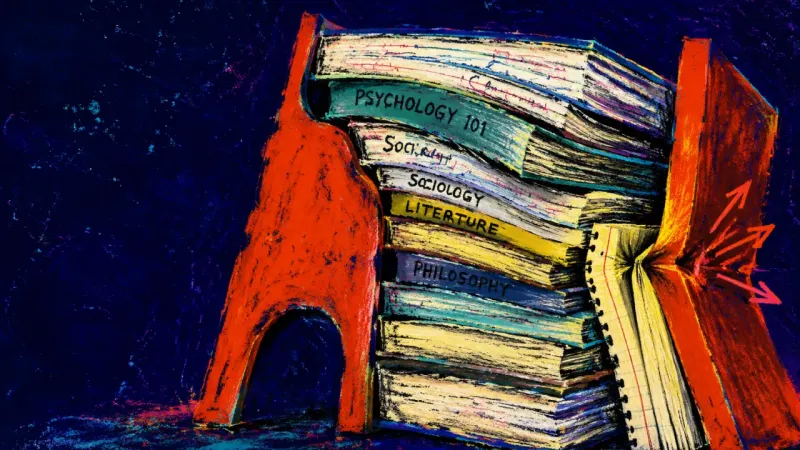
Finding Clarity in the 10:40 p.m. Rubric Loop
I knew the pattern before Jordan finished explaining it. They were the final-year student who could analyse every word in an open-ended assignment brief yet still had an almost empty draft. The prompt asked for an "original critical position," but offered no concrete model of what original or critical should look like. With the grade tied, at least emotionally, to postgraduate study and early-career options, an ordinary assignment had begun to feel like a career crossroads.
At 10:40 p.m., Jordan joined our video consultation from a small desk in their Toronto apartment bedroom. Quercus was open beside a blank Google Doc, a WhatsApp class chat, a polished Notion planning table, and enough browser tabs to make each one unreadably narrow. I heard the laptop fan through the microphone. Jordan lifted a mug, smelled the cold coffee, winced, and pushed it away. Blue screen light made their restless hands look pale as they added another colour-coded column instead of writing the paragraph they had intended to start.
"I can start as soon as I know what they actually want," Jordan said. Then they glanced at the blank document and added, more quietly, "I keep calling this research, but nothing is becoming a paragraph."
I watched their shoulders rise until they nearly touched their ears. Their apprehension seemed to sit across the back of their neck like a damp winter coat they had forgotten they were still wearing: heavy, cold, and difficult to move inside. They wanted to begin now, but beginning without a clearer rubric would expose an independent judgment, and that judgment might be evaluated before Jordan felt ready to defend it.
"Waiting makes sense when it is protecting something important," I told them. "So I am not going to call this laziness, and I am not going to predict your grade. I want us to find out what the waiting is protecting, where it has stopped helping, and what kind of movement would feel intellectually honest rather than reckless. Let us draw a map through this fog."

Choosing the Compass: A Five-Card Shadow Spread
I asked Jordan to close the course portal and place both feet on the floor. I invited one slow breath while I shuffled, not as a mystical performance, but as a clean transition from compulsive checking to deliberate attention.
I chose the five-card Shadow Spread. For anyone wondering how tarot works in a consultation like this, I use it as a structured cognitive mirror, not a machine for announcing fixed outcomes. The images help me separate a tangled problem into observable behaviour, concealed fear, protective function, available capacity, and a grounded next action. Card meanings in context matter more than dramatic prediction.
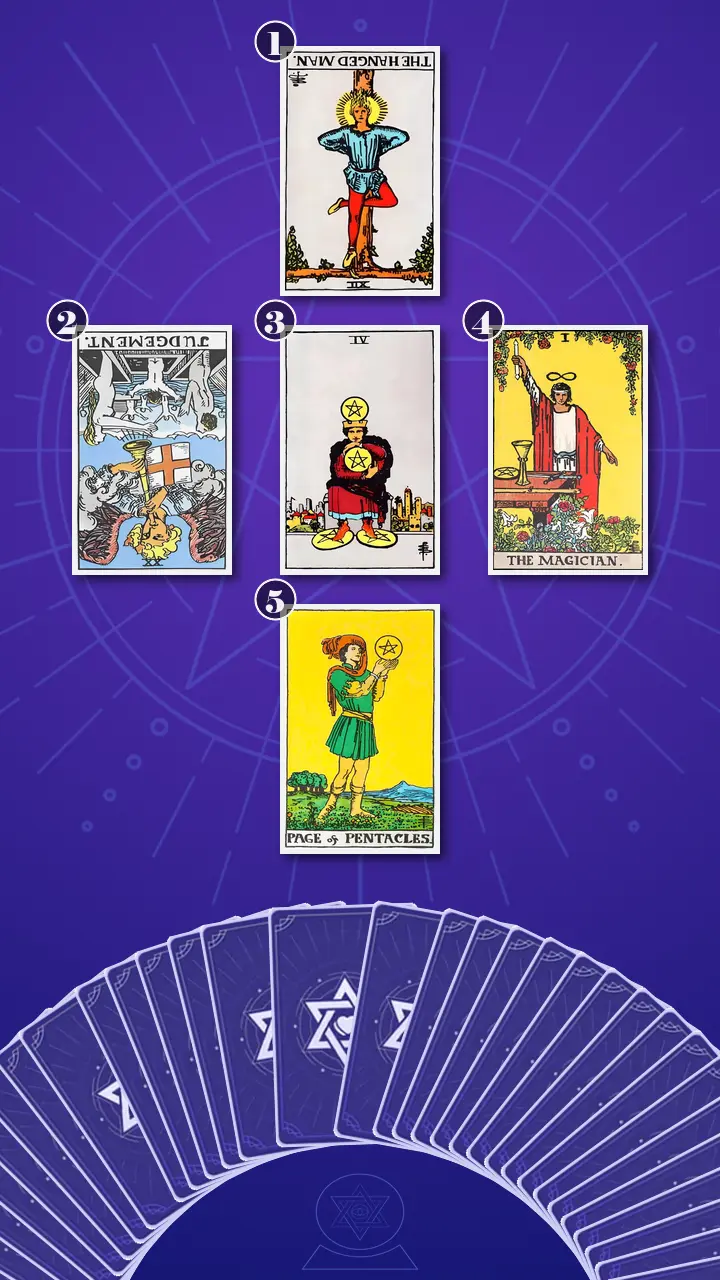
I arranged the cards as a compact cross. The first card, above the centre, would show the visible pattern of repeated rubric checking and suspended drafting. The card on the left would uncover the fear beneath it. The centre would reveal what the delay protected. On the right, I would look for the capacity Jordan could reclaim, and the final card below would turn the reading into a practical draft-and-feedback cycle.
The structure suited Jordan's question because "What am I avoiding?" is not primarily a request for a future forecast. It asks us to follow a chain: what the behaviour looks like, why it feels necessary, what it costs, and how to interrupt it without demanding instant confidence. A larger spread would have added noise. This five-position map was enough.
When Preparation Stops Producing Movement
Position 1: The Pause That Became a Loop
I turned the card representing the visible shadow behaviour: Jordan's repeated rubric checking, note reorganisation, and suspended drafting. It was The Hanged Man, reversed.
In the Rider-Waite-Smith image, a figure hangs by one ankle beneath a golden halo. Upright, the suspension can create a genuinely different perspective. Reversed here, the reflective energy had become blocked. The pose still looked thoughtful, but no new perspective was arriving. It was the academic equivalent of a loading spinner that kept moving without ever delivering the page.
I brought the card directly back to Jordan's desk. The brief was open. The same phrases had been highlighted again. Their research notes had been arranged into a cleaner system for the third time. The pause might once have helped them think, but it was no longer producing a new fact, sentence, or decision. Research becomes avoidance when nothing is allowed to become a sentence.
"What did your most recent hour of rubric analysis genuinely teach you that you did not know before?" I asked.
Jordan gave a short laugh that landed somewhere between recognition and annoyance. "Nothing. That is so accurate it is almost rude." Their mouth kept the shape of a smile, but their fingers stopped moving over the trackpad. After a moment, they folded both hands in their lap.
I let the bitter humour have its place. "Then we do not need to shame the pause. We only need to stop crediting it with insight it is no longer producing. The Hanged Man reversed shows a blockage, not a character flaw. Its question is simple: is this waiting still changing your understanding, or is it only delaying exposure?"
Position 2: The Verdict That Arrived Before the Draft
I turned the card representing the hidden fear beneath the delay: exposing a self-authored judgment and treating the response as proof of personal inadequacy. It was Judgement, reversed.
The traditional image shows an angel sounding a trumpet while figures rise with open arms. It is a call into visibility. Reversed, that call had turned inward and harsh. Jordan was mentally hearing the marker's verdict before there was enough evidence for any verdict at all. They had already described writing two tentative sentences, imagining a disappointing grade, and deleting both before a tutor or peer could respond to the actual idea.
"If this argument is weak, what will that supposedly prove about me?" I said, giving words to the private escalation I could hear underneath their account.
Jordan's eyes moved away from the card and settled on the dark window. Their breath paused. For several seconds, their face looked unfocused, as though they were replaying every time a comment such as "needs development" had expanded into something much larger inside them. Then they exhaled through their nose.
"That I have somehow made it to final year without actually being good enough," they said. "That everyone else understands how to think at this level and I am still trying to find the hidden instructions."
I kept my voice steady. "That is the distortion this reversed card exposes. Feedback on one paragraph is information about one paragraph. It is not a referendum on your intelligence, your future, or whether you belong here. A rough draft is evidence to revise, not evidence of your worth."
The energy of Judgement was not absent; it was blocked by shame-tinged self-doubt and redirected into negative rehearsal. Jordan was trying to survive a final assessment that had not happened by preventing an early experiment that could actually produce useful information. The rubric was partial information, not permission to think.
Position 3: The Grip at the Centre of the Cross
I turned the central card, representing the protective function of waiting: preserving control, keeping every interpretation open, and preventing an imperfect choice from becoming visible. It was the Four of Pentacles, upright.
The seated figure pressed one pentacle against the chest while two more pinned the feet to the ground. The card did not tell me that Jordan's need for control was wrong. It showed control in excess. The same grip that protected something valuable was also making movement impossible.
When I asked about unfinished directions, Jordan admitted that four possible theses were sitting in separate Google Docs. Each file had a clean name and detailed notes. None contained a committed central claim. Every interpretation remained technically possible, which meant none could yet be disproved, criticised, or improved.
Seeing that image, I flashed back to my years on Wall Street. On a trading desk, preserving optionality can be useful, but options lose value as time passes. A deadline makes indefinite non-choice expensive. I was careful not to turn Jordan into a balance sheet; their worth was not being audited. The strategy was. Refusing to select a provisional thesis was already a decision, and its cost was a draft starved of evidence and feedback.
"If you chose one direction tonight and left the other three untouched, what would you lose?" I asked.
Jordan pressed their thumb into the centre of their palm. "The ability to tell myself one of the other versions might have been the good one."
"Exactly. Waiting protects possibility, but it also keeps possibility hypothetical. Start with a claim you can test, not a verdict you have to defend."
When the Magician Put the Tools on the Table
Position 4: The Capacity Hidden in Plain Sight
A streetcar bell sounded faintly beyond Jordan's window just as I reached for the card on the right. The room seemed to grow quieter around that single clear note. I turned the card representing the capacity Jordan could reclaim: using available information to create provisional criteria and begin without asking the rubric to eliminate uncertainty.
It was The Magician, upright.
The Magician raised a wand with one hand and pointed toward the ground with the other. On the table lay a cup, sword, wand, and pentacle. Nothing was clutched against the body. Every tool was visible and available for use. I contrasted it with the Four of Pentacles: first the resource was pressed defensively against the chest; now it had been placed on a workbench beside feeling, thought, initiative, and practical skill.
At Jordan's Toronto desk, those tools were already present. They had the brief, the readings, their evidence, the ability to reason, and a bounded amount of time. The Magician did not guarantee a high mark. It represented focused, balanced agency: enough coordination to make a visible experiment. A first paragraph could function like a small software commit or an early Figma prototype. It would not be the finished product, but it would make the next question possible.
I watched the familiar loop pull at Jordan one more time: another colour-coded column could create a clean click of control, while the blank document waited and the laptop fan hummed. Preparation felt responsible. Choosing felt exposing. Their internal conflict had become clear: I already have enough to make a testable choice, but choosing makes me visible.
This was where I used my Academic ROI Auditing lens. I asked Jordan to measure the strategic yield of the next ten minutes, not the prestige of the final outcome. Another ten minutes checking Quercus might generate zero new sentences and zero answerable questions. Ten minutes drafting could generate one provisional claim, one visible assumption, and one focused request for feedback. The return was not certainty. The return was better information.
I gave them the central distinction: the clearer rubric they were waiting for could not replace the independent judgment that starting was asking them to practise. Then I put it in the Magician's language.
You do not need certainty to prove that you are ready; use the tools already on the Magician's table to turn one provisional judgment into a draft.
For one beat, Jordan went completely still. Their breath stopped halfway in, and their fingers hovered above the desk as if they had forgotten what they were reaching for. Then their gaze slipped past the cards and lost focus. I could almost see the previous week replaying behind their eyes: the deleted sentences, the four thesis files, the confident class chat, the private forecast of failure. Their pupils widened, and their jaw tightened.
"But does that mean I have been doing this wrong for weeks?" they asked. The first edge in their voice was anger, not relief. "I thought I was being careful."
"You were being careful," I said. "The strategy gave you short-term protection when the work felt connected to your whole future. That does not make the past foolish. It only means the protection now costs more than it returns."
Their fist loosened one finger at a time. Their shoulders dropped, followed by a long breath and a small, unsteady "Oh." Relief arrived, but it brought a moment of vertigo with it. If the rubric could not take responsibility for the first judgment, Jordan would have to choose. Clarity had not removed responsibility; it had returned responsibility to the right person.
"Now, with that new perspective, think back to last week," I said. "Was there a moment when this insight might have made you feel different?"
Jordan nodded slowly. "Thursday at the library. I had a sentence I actually believed, but I opened Zotero instead. If I had treated the sentence as a test, I might not have needed to know whether it was the final thesis."
I named the shift I had just witnessed. This was not instant confidence. It was the first movement from waiting for external permission and fearing a global verdict toward provisional self-trust. Jordan did not need to feel certain before acting. They needed enough willingness to make one judgment visible and let evidence refine it.
The Page's 300-Word Lab Sample
Position 5: Learning From Something Tangible
I turned the final card, representing the integration action: produce one small section, ask for feedback on a specific criterion, and use the response to revise rather than judge personal worth. It was the Page of Pentacles, upright.
The Page held one pentacle at eye level in a workable green landscape, with distant mountains marking a longer path. The card brought the spread into grounded balance. The Page was not trying to master the whole terrain at once. Their attention rested on one tangible object that could be studied carefully.
For Jordan, that object was a 300-word prototype. They could make one narrow claim, support it with one piece of evidence, and attach one answerable question: "Does this paragraph show a critical position, or does it remain mostly summary?" That was far more useful than asking a class chat to decode the entire assignment.
"So the paragraph is more like a lab sample than a miniature final essay," Jordan said.
"Exactly. The Page of Pentacles treats competence as something built through attentive practice. The paragraph's job is not to certify that you are capable. Its job is to give you something specific to inspect, question, and revise. Clarity can arrive through visible work, not only before it."
I looked once more across the spread. The Hanged Man reversed had shown preparation frozen into suspension. Judgement reversed had exposed an imagined verdict arriving before the evidence. The Four of Pentacles had revealed the temporary safety of keeping every option open. The Magician had placed the resources on the table, and the Page had lifted one small piece of work into focused study.
From a Clenched Pentacle to a Working Standard
I read the full spread back to Jordan as one coherent story. The vague rubric had triggered repeated analysis, but missing information was only the surface problem. Beneath it, Jordan feared that an imperfect self-authored argument would be treated as evidence of inadequate ability. Waiting protected them by keeping every possible thesis alive and every judgment hypothetical. That protection brought brief control, then left them with no draft to test, no precise feedback to receive, and less contact with why the topic mattered.
The cognitive blind spot was the assumption that a complete rubric could remove the vulnerability of independent judgment. It could not. Even an excellent rubric would still require Jordan to decide what evidence mattered, what claim they could support, and what interpretation they were willing to test. Their transformation direction was therefore specific: stop treating criteria as permission, create a small provisional standard, draft against it, and let focused feedback improve both the paragraph and the standard.
I told Jordan that actionable advice should reduce friction without pretending the work was emotionally neutral. I gave them three bounded experiments. Each one could remain private, and none required them to continue if the exercise became too activating.
The Research Sunk-Cost Audit and the Next 48 Hours
- Run the Research Sunk-Cost Audit. Once this week, before opening another rubric guide, spend two minutes asking whether the previous study session produced a genuinely new fact, sentence, or decision. If the answer is no, close Quercus and the group chat, set a 25-minute timer at a desk or library table, and draft one paragraph from your current understanding. Underline one possible claim and circle one assumption that still needs checking. Tip: The audit evaluates the return on the strategy, not your intelligence or the value of past effort. If 25 minutes feels too heavy, write five rough sentences and stop. Use square brackets for uncertainty instead of opening another tab.
- Build a three-criterion provisional rubric. On a plain note, copy three words already present in the brief, such as argument, evidence, and context. Turn each into one observable question. Set a 10-minute timer, write 100 to 150 words under one working claim, and place unresolved assumptions in brackets. Use the final two minutes to write one focused feedback question. Tip: Label the criteria provisional so the exercise does not become another perfect planning system. The paragraph may stay private, be shared later, or be deleted. The timer is a boundary, not an obligation to continue.
- Turn one paragraph into a feedback-ready prototype. Before the end of the week, expand one narrow claim to roughly 300 words and send it only to a chosen tutor, teaching assistant, writing-centre adviser, or trusted peer. Ask about one criterion, such as which sentence needs a clearer link to the evidence, instead of asking whether the whole interpretation is correct. Tip: I call this Institutional Resource Leverage: make the existing university network easier to use by bringing a concrete object and an answerable question. You control who sees the work, what you disclose, and which feedback you accept.
"The first draft is not a grade," I reminded Jordan. "It is a question you can finally ask. The cards have not chosen your argument, and neither have I. You are choosing a small experiment that will give your own judgment better evidence."
A Week Later: Evidence, Not a Verdict
Six days later, I received a message from Jordan. They had run the audit, closed Quercus, and written 143 words using three provisional criteria. The next afternoon, they expanded the passage to 307 words and sent it to a teaching assistant with one question about whether the paragraph moved beyond summary.
The response did not pronounce the whole assignment good or bad. It identified one sentence where Jordan's claim was already visible and one place where the evidence needed a clearer explanation. Jordan revised those two places. No prophecy had resolved the assignment. A concrete feedback loop had simply replaced the imagined verdict.
Jordan told me they slept through that night. Their first thought in the morning was still, "What if it is wrong?" Then they smiled, opened the draft instead of Quercus, and revised one sentence.
I considered that the quiet proof of our Journey to Clarity. Jordan had not transformed into someone who never doubted a first attempt. They had become someone who could notice the doubt, keep it from impersonating a final judgment, and use visible work to discover a next step. The power belonged to Jordan; the spread had only helped them see where to place it.
When a blank document locks your shoulders and sends your hands toward another tab, waiting for a perfect standard can feel safer than allowing one imperfect judgment to reveal how much being evaluated matters to you. Noticing that protection does not mean you have failed. It means the fog has thinned enough for you to see the difference between guarding your worth and developing your work.
If one rough paragraph could become the Page's pentacle, a small object held at eye level and studied rather than a verdict about you, which uncertain sentence might you feel curious enough to look at for ten minutes?