The All-Caps Subject Line That Turns Your Stomach
If you opened your inbox and saw an all-caps subject line that basically screamed consequences—ACADEMIC PROBATION / ACTION REQUIRED—and your stomach dropped before you even clicked it, you already know the kind of night this becomes.
When Jordan booked a last-minute reading with me, it was 8:47 p.m. for them in downtown Toronto and early morning for me in Tokyo. They were in a coffee shop near campus, shoulders curled toward their ears like they were trying to make themselves smaller. Their laptop was open to the student portal, the probation email, and a blank advisor draft. The espresso machine hissed behind them; the screen glare made their eyes look dry and a little red. Every few seconds, I heard the soft, frantic rhythm of trackpad clicks—refresh, refresh—like the next reload might change reality.
“I know it’s just an email,” they said, voice low, like they didn’t want the word probation to hear itself out loud. “But it feels like a verdict.”
I watched their hand go to their chest—two fingers pressing lightly through their hoodie, a small attempt to manage a tightness they didn’t want to name. Underneath everything, I could hear the contradiction clearly: they wanted to recover and move forward, fast… but they were terrified that asking for help, or being seen struggling, would confirm some private fear that they weren’t capable.
Shame has a very specific texture in the body. On Jordan, it looked like a drop in the stomach that pulled everything downward, like their insides were trying to sink below the table and disappear under the latte napkins.
“We can work with this,” I told them. “Not by pretending it doesn’t hurt—but by turning it into something we can navigate. Let’s make a map and find one clear next step. This is a Journey to Clarity, not a trial.”

Choosing the Compass: The Celtic Cross · Context Edition
I asked Jordan to take one slow breath in through the nose, out through the mouth—nothing mystical, just a clean transition from panic to presence. While I shuffled, I invited them to hold one sentence in mind: “What core story shapes my next step?”
Today, I told them, I’d use a spread called the Celtic Cross · Context Edition. It’s my go-to when someone is stuck at a career crossroads-style moment in school—when an external system (policies, deadlines, requirements) collides with an internal story (worth, identity, fear of being seen).
And for anyone reading this who’s ever wondered how tarot works in a practical way: a spread like this isn’t about predicting a single outcome. It’s a structured diagnostic. It shows the present trigger, the blockage, the deeper driver, and then—crucially—the most workable direction for actionable advice and next steps.
In this version, position 1 is the “inbox moment now.” Position 2 is what’s actively blocking the next step. Position 9 names the core story lens—the meaning you’re projecting onto the email. And position 10 is integration: not a fixed prophecy, but the healthiest, most repeatable direction forward.
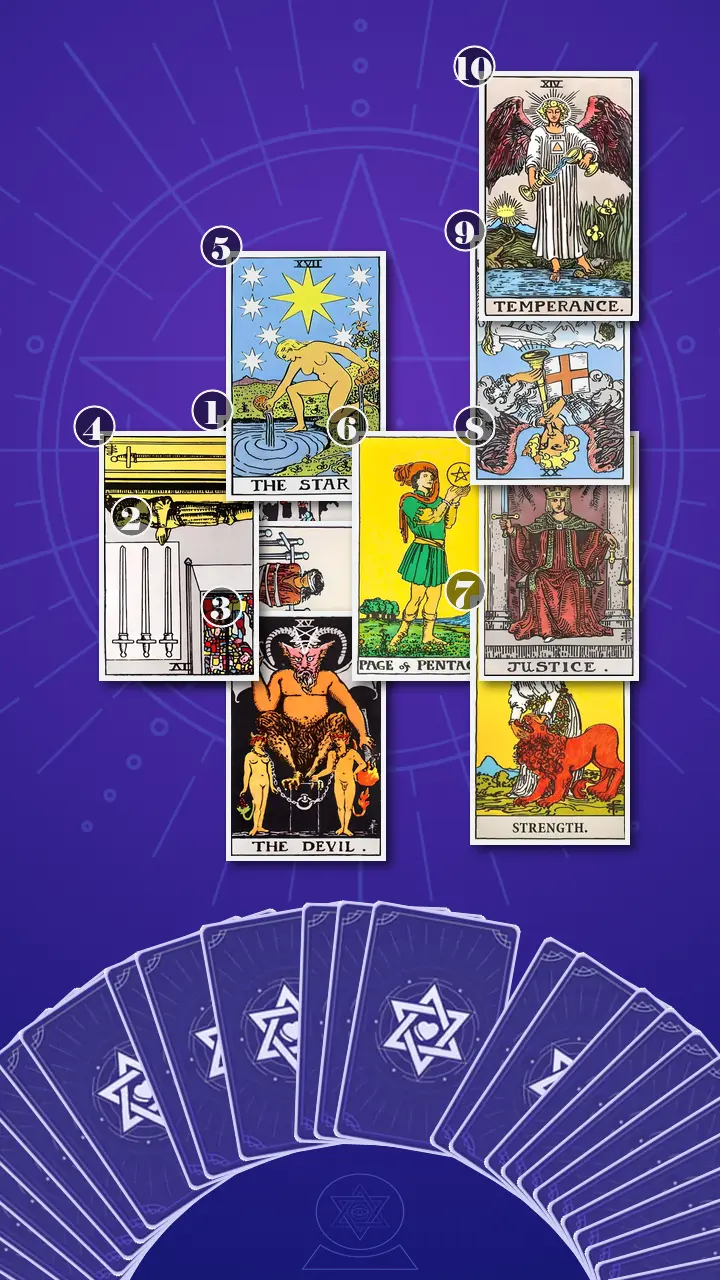
Reading the Map: Card Meanings in Context for an Academic Probation Email
Position 1 — The inbox moment now: The Tower (upright)
“Now we’re looking at the card that represents the inbox moment now—the immediate impact of the probation email on your current state and behavior,” I said, and turned over The Tower, upright.
This one doesn’t whisper. The lightning strike, the falling crown—it’s the exact feeling of reading a single message that instantly changes the emotional temperature of your whole week. In modern terms: it’s that second your portal loads and you realize you can’t keep telling yourself, I’m fine, I’m fine, because the system is now sending a loud notification.
Energy-wise, The Tower is disruption that forces reality into focus. It doesn’t mean you’re doomed. It means the old structure—habits, assumptions, support systems, sleep routines—stopped holding.
Jordan let out a small laugh that wasn’t humor. It had edges. “That’s… too accurate. It’s almost mean.” Their eyes flicked away from the screen like it was bright enough to burn.
“It’s blunt,” I agreed, keeping my voice steady. “But it’s not moral. A smoke alarm is loud so you respond—not because you’re a bad person.”
Position 2 — What’s blocking the next step: Eight of Swords (upright)
“Now we’re looking at the card that represents what’s actively blocking the next step—the exact bind that keeps you frozen,” I said, turning over the Eight of Swords, upright.
In student-life language, this is like having 17 tabs open—policy PDFs, grade calculators, course outlines—and believing the right tab will magically remove the problem. The modern snapshot is painfully specific: the advisor-email draft cursor blinking like a metronome while you micro-edit the subject line. You call it “being responsible,” but it’s actually a cage made of assumptions.
The Eight of Swords is restriction, but usually not because you have no options—because your perspective is narrowed. The energy here is blocked: motion is available, but the mind says, not yet, not until it’s perfect.
I leaned in slightly. “Let’s name the rule you’re obeying,” I said. “Finish this sentence: ‘If I send this and sound confused, then ____.’”
Jordan swallowed. “Then they’ll know I’m… not cut out for this.”
“That’s the rule you never agreed to,” I said gently. “And it’s costing you clarity.”
Their shoulders dropped a fraction—small, but real—like their body recognized the loop without having to be shamed for it.
Position 3 — The deep driver underneath: The Devil (upright)
“Now we’re looking at the card that represents the deep driver underneath your reaction—the fear or attachment that makes this email feel identity-defining,” I said, and revealed The Devil, upright.
This isn’t about you being “bad.” It’s about an inner contract that says, my worth is chained to outcomes. The Devil is the part of you that treats GPA like an app rating that decides whether you deserve basic kindness. It’s the subscription you never agreed to—perform perfectly or lose your value—and forgetting you can cancel.
The energy here is excess pressure. It creates the loop: pressure → avoidance → self-blame → more pressure. And probation doesn’t just trigger logistics; it triggers exposure. Like: If I need help, I’m not worthy of being here.
I watched Jordan’s jaw tighten, then release. “I hate how true that is,” they said. “I don’t even let myself email until I’ve ‘made up for it’ somehow.”
“You don’t have to earn support by being flawless first,” I said, and I meant it as a fact, not a pep talk.
Position 4 — The lead-up pattern: Four of Swords (reversed)
“Now we’re looking at the card that represents the lead-up pattern—what’s been draining your capacity in the recent past,” I said, flipping Four of Swords, reversed.
This is restless recovery: lying in bed with your laptop open, scrolling course pages and rereading instructions, telling yourself you’re ‘planning,’ but never actually feeling restored enough to begin. Breaks that don’t restore. Sleep that doesn’t land.
Energy-wise, this is a deficiency of real reset. Your nervous system has been running hot, so when The Tower hits—when the official email arrives—it doesn’t land on stable ground. It lands on exhaustion, and everything feels louder than it is. Even a normal Canvas notification can sound like a siren.
Jordan nodded once, slowly. Their eyes went unfocused for a second, as if replaying late nights. “I’ve been ‘resting’ by doom-scrolling,” they admitted. “And it never works.”
Position 5 — What you want to reach for: The Star (upright)
“Now we’re looking at the card that represents what you consciously want to believe or reach for—your guiding intention,” I said, and turned over The Star, upright.
After a Tower moment, The Star is the part of you that still wants to heal. Not in a dramatic montage way—more like: I want to feel emotionally steady again. I want to trust myself.
The Star’s energy is balance: gentle, consistent, and real. It’s you wanting a plan that supports both performance and wellbeing, not a punishment schedule you can’t sustain.
“That’s the thing,” Jordan said, quieter now. “I don’t just want the email to go away. I want to stop feeling… contaminated by it.”
“That’s an incredibly honest aim,” I said. “And it matters.”
Position 6 — The first realistic opening: Page of Pentacles (upright)
“Now we’re looking at the card that represents the first realistic opening—near-term energy that supports a practical next step,” I said, and revealed the Page of Pentacles, upright.
This card is the antidote to spiraling. It’s student energy in the best way: beginner-friendly traction. It’s like sending a short, clear email to book a meeting, then writing down three questions instead of trying to ‘sound perfect’ for a full page.
The Page’s energy is grounded. One thing at a time. Curious, not punishing. In your situation, it says: stop trying to fix your entire life at 1 a.m. and start with the smallest lever that creates real information.
I gave Jordan a concrete contrast: “Researching policies feels like movement, but it often keeps you alone. Creating an appointment is movement that brings support.”
They exhaled, and I saw their hand drift toward their phone—not to scroll, but to open their calendar. That was the shift the Page brings: I can do one thing.
Position 7 — Your role and agency: Strength (upright)
“Now we’re looking at the card that represents your role and agency—the inner stance that makes the next step easier,” I said, turning over Strength, upright.
Strength is not hype. It’s gentle discipline. It’s what a good coach sounds like: firm, kind, process-focused. The energy here is balanced power—not self-attack, not collapse.
I told Jordan, “This card is you learning to sit next to discomfort without letting it drive. You can feel the shame spike and still send the email.”
They looked down at the table, then back at the screen. “I don’t talk to myself like that,” they said.
“Then this is your practice,” I replied. “Not becoming ‘perfect.’ Becoming consistent.”
Position 8 — The outer container: Justice (upright)
“Now we’re looking at the card that represents your environment—policies, advisors, expectations, and support available around you,” I said, and turned over Justice, upright.
This is the institutional vibe: criteria, timelines, meetings, documentation. And here’s the relief hidden inside it—Justice is not personal. It’s a system that responds to clear information. Probation procedures are scary when you treat them like mind-reading; they’re workable when you treat them like a checklist.
Energy-wise, Justice is structure. “Clarity is a form of self-respect,” I told them. “Not because you have to prove yourself. Because written expectations mean you don’t have to guess.”
I saw Jordan’s face soften in a specific way—less like defeat, more like curiosity. They were starting to separate authority from attack.
Position 9 — Core story lens: Judgement (reversed)
“Now we’re looking at the card that represents your core story lens—the narrative you’re projecting onto this email,” I said, and revealed Judgement, reversed.
This is the card of awakening turned inward into self-sentencing. It’s the difference between a system review and a personal verdict. In student terms: the portal is a dashboard, not a judge. But Judgement reversed makes it feel like you’re in court every time you open the page.
I said it plainly, because Jordan needed it plainly: “A system status isn’t a personality diagnosis.”
They reacted in a chain—first a tiny freeze (their breath caught), then the heat in their face rose up their neck, then their throat worked like they were swallowing something sharp. “Yeah,” they said, almost annoyed. “I’ve been acting like this is… my whole character.”
“Right,” I said. “This is ‘system review’ versus ‘self-sentencing.’ Your job is to move the story from: ‘I’m not meant for this’ to: ‘I’m in a status that has steps.’”
When Temperance Spoke: Finding Clarity by Blending Two Cups
Position 10 — Integration and next step: Temperance (upright)
I let the shuffle slow down before the last card, the way I do at the planetarium right before the dome lights dim and the first star appears. The room—my small office behind the Tokyo star projector—was quiet enough that I could hear the building’s air system breathe. On Jordan’s side of the call, the coffee shop noise blurred, like the world stepped back to listen.
“We’re turning over the most important card for your question,” I told them. “The card that represents integration and next step—the healthiest direction you can take without needing a guaranteed outcome.”
Temperance, upright.
Temperance is the angel pouring between two cups: steady mixing, pacing, moderation, the middle path. Modern translation? It’s like building a playlist you can actually replay daily, not a one-time ‘new life’ montage. It’s meal prep. It’s boring in a way that saves you.
Setup (what you’re stuck inside): You know that moment in a Toronto coffee shop when your laptop’s open to the portal, the probation email, and a half-written message—then you keep refreshing tabs like the next reload might change reality, while your stomach drops every time the subject line reappears.
Delivery (the sentence that needs to land):
Stop treating probation like a final verdict; start blending a workable plan—like Temperance pouring between two cups—so consistency replaces panic.
I didn’t rush after saying it. I let the words sit in the air the way a planetarium narrator lets the night sky settle into your eyes.
Reinforcement (what happens in your body when the story changes): Jordan’s fingers stopped tapping the trackpad. For a beat, their hand hovered above the keyboard like it forgot what it was supposed to do. That was the freeze. Then their eyes unfocused—not blank, more like they were rewinding a week of tab-hopping and subject-line tweaking. That was the cognition seeping in. Finally, their shoulders sank, and they let out a shaky breath through the nose, like they’d been holding it since the email arrived.
“But if it’s not a verdict…” they started, and there was a flash of anger in it, not at me—at the whole humiliating situation. “Does that mean I made it all up? Like I overreacted?”
“No,” I said immediately. “It means your nervous system reacted to a loud alarm. That’s not fake. The pivot is what you do next. Probation isn’t your identity—it’s a system status. Your power move is to build a small, repeatable mix of support + effort + rest that you can actually keep doing when your emotions spike.”
I gave them a micro-practice on the spot, because Temperance only becomes real when it’s actionable.
“Set a 10-minute timer. Open a blank note titled ‘Probation = system steps.’ Write only three bullets: (1) one fact from the email (no adjectives), (2) one question you need answered, (3) one tiny action you can complete today (e.g., send a 4-sentence email). If you feel your chest tighten or you start rewriting—pause, stand up, and take 6 slow breaths. You can stop at any point; ‘done for now’ counts.”
Jordan’s eyes were glossy, but not in a breaking way—more like a pressure valve finally released. “Okay,” they said. “That… feels doable. Like, weirdly doable.”
“Now,” I added, “use this new perspective and look back at last week. Was there a moment when you refreshed the portal or rewrote the subject line, and this idea—system steps, not verdict—could have made you feel different?”
They nodded once, slow and certain. “Yesterday. I spent forty minutes rewriting ‘Request for Meeting’ because I thought it sounded pathetic.”
“That’s Judgement reversed,” I said softly. “And Temperance is the exit.”
In my own head, I flashed to a line I use in my planetarium tours when I explain orbital periods: planets don’t ‘feel ready’ to complete a loop. They complete it because rhythm is a structure. Temperance is rhythm. It’s you choosing a system that holds you when emotions spike.
This was the emotional transformation made visible: Jordan moving from flashing red alarm panel to a steadier dashboard—shifting from “This email defines me” to “This email describes a system status, and my next step is one small, verifiable action inside that system.”
The Two-Week Temperance Mix: Actionable Advice You Can Start in 24 Hours
I pulled the whole spread together for Jordan in one clean storyline: The Tower showed the shock—an old, unstable structure finally collapsing under stress. The Eight of Swords showed the freeze—the perfectionistic rule that says you must sound smart and solve it alone before you’re allowed to ask for help. The Devil showed why it sticks—self-worth chained to outcomes. Four of Swords reversed showed the depleted capacity underneath it all. The Star proved they still want healing. The Page of Pentacles offered traction. Strength offered the tone—gentle discipline. Justice reminded us the environment is process, not punishment. Judgement reversed named the core story lens—self-sentencing. And Temperance gave the direction: a repeatable system that mixes support, effort, and rest until it becomes stable.
The cognitive blind spot was clear: Jordan was treating an administrative status like an identity label, then trying to think their way back into worth before taking any system-based action. The transformation direction was equally clear: sequence over shame. Engage the system. Get clarity in writing. Build a two-week rhythm you can actually keep.
“I’m going to give you three steps,” I said. “Small enough that your brain can’t turn them into a ‘fix my life’ fantasy.” Then I used one of my own tools—my Planetary Memory Palace strategy—to make it easier: one central ‘Sun’ document, with ‘planets’ orbiting it (email, meetings, deadlines, each course). When your mind tries to spin into 17 tabs, you come back to the solar system. One center. Clear orbits.
- Send the 4-sentence advisor email (Meeting-First Momentum)Open a new email to your academic advisor. Write exactly four sentences: (1) name the probation email you received, (2) state one fact (program/term), (3) ask one clear question, (4) request a meeting time or a next-step checklist. Then hit send.Use the one-reread rule: read it once for typos, then send. Remind yourself: “Stop hunting for the perfect message. Send the message that gets the meeting.”
- Build your “Probation—Requirements + Dates” Sun doc (Justice clarity)Create one document titled “Probation—Requirements + Dates.” Copy/paste the exact requirements and deadlines from official sources (email, portal, handbook). No interpretation. Then put the key date(s) into Google Calendar as tasks.Keep everything in one folder. Clarity protects you from mind-reading, and it keeps you out of late-night portal spirals.
- Try the Two-Week Temperance Mix (support + effort + rest)For the next two weeks (not forever), schedule: 3 Pomodoro study blocks (25 minutes), 1 support touchpoint (office hours/advising), and 1 real reset (walk/shower/eyes-closed rest) on each study day. Do a 5-minute phone-free reset before the first block.Temperance works when it’s boring. If you miss a day, you don’t “start over.” You return to the mix. Panic makes big plans. Temperance makes repeatable ones.
When Jordan hesitated—“But I don’t even have time, I work part-time and everything’s stacked”—I didn’t argue with their reality. I adjusted the orbit. “Then your mix is smaller,” I said. “One block. One meeting. One reset. The win is consistency, not volume.”

A Week Later: The Quiet Proof
A week later, Jordan messaged me from the TTC, a screenshot attached. It was their sent email—four sentences, imperfect, alive. Under it, a calendar invite: Academic Advising — 30 minutes. “I did it before I could talk myself out of it,” they wrote. “My hands were shaking, but it’s scheduled.”
They didn’t sound euphoric. They sounded steadier. Like someone who slept a full night and still woke up with the thought, What if I mess this up?—but this time, they could answer themselves: Then I come back to the next step.
That’s what I love about this kind of tarot reading for academic stress: it doesn’t promise a perfect outcome. It gives you a clean reframe and a workable rhythm—so you can move from decision fatigue and shame spirals into clarity, support-seeking, and follow-through.
When an official email hits your inbox and your stomach drops, it’s easy to mistake a system status for a statement about your worth—and then hide until you feel “fixed,” even though hiding is what keeps you stuck.
If you treated this as a checkpoint with steps (not a verdict), what’s the smallest, most verifiable action you could take in the next 24 hours to make the situation clearer?
This story is adapted from psychological research, written so that those in a similar struggle can see their own pattern in it — and find their next step clearly.These insights are not a substitute for professional psychological, medical, legal, or financial advice.
Learn more about our Journey to Clarity.
How did this insight land for you?
🫂 This Resonates Deeply
🌀 Living This Story
✨ Now I See Clearly
🌱 Seeing New Possibilities
🧰 Useful Framework
🔮 The Confirmation I Needed
💪 Feeling Empowered
🚀 Ready for My Next Step
Author Profile
 AI
AI“After a decade of guiding people through the stars, I’ve come to see life much like the orbits of planets: everything has its inevitable cycles. When you feel lost, please don't blame yourself; you might just be in a natural low tide. I’m here to sit under the night sky with you, offering a gentle cosmic perspective to distinguish temporary pain from the beautiful breakthroughs just around the corner.”
In this Study Tarot Reading :
Core Expertise
Service Features
Also specializes in :
Explore Related Patterns:
Achievement FusionJordan's stomach drops before they even click the all-caps probation email, and the message immediately starts acting less like information and more like a verdict. The story repeatedly shows the same conversion: an academic status becomes a statement about capability, belonging, and whether they deserve basic kindness. That is why Achievement Fusion is the central mechanism here. The mind fuses outcome with identity, so a GPA issue is no longer just a solvable system problem; it becomes proof that the self is defective. From that place, even asking for help feels dangerous because visibility seems to confirm the private fear that You are not cut out for this. The next step changes when that fusion is interrupted. Once probation is treated as a system status with requirements, dates, and support channels, You can move from self-sentencing into concrete action: one fact, one question, one email, one meeting. The pattern is not broken by pretending the email does not hurt; it is broken by refusing to let the email define the whole self.
Self-Judgment LoopJordan does not just read the probation notice; they put themself on trial every time the portal opens. The advisor email, the status label, and the blinking draft all become evidence in an internal case where the conclusion has already started forming: maybe this proves You are not meant for this. Self-Judgment Loop fits because the story shows a closed circuit of interpretation and punishment. The system gives a status, Jordan turns it into a verdict, the verdict creates shame, shame delays action, and the delay becomes more evidence for the verdict. The loop keeps feeding itself even though the practical path forward is available. The useful shift is not forced positivity. It is the precise reframe from 'my whole character is being judged' to 'I am in a status that has steps.' When You can see the loop as a mechanism rather than a truth, the next step becomes smaller, cleaner, and less contaminated by self-attack.
Shame BindingJordan's body reacts before the plan can form: the stomach drop, the hand pressed to the chest, the breath catching, the heat rising in their face. The probation email does not only trigger concern about requirements; it triggers exposure, as if being seen struggling would confirm something humiliating about who they are. Shame Binding is the mechanism because the practical issue gets tied to identity contamination. The story shows Jordan wanting to recover and move forward, but also fearing that asking for help will make the struggle visible. That bind turns support into threat and keeps the self trapped inside the feeling of being already condemned. The release begins when the email is named as a loud alarm rather than a moral sentence. You do not have to wait until shame disappears before acting; You only need enough separation to send the imperfect message, book the meeting, and let support enter the system. That is how shame loses its authority over the next step.
Strategic VulnerabilityJordan's breakthrough is not a dramatic confession; it is a four-sentence email sent before they can talk themself out of it. The message is imperfect, but it creates a real advising appointment and turns private panic into a supported next step. Strategic Vulnerability fits because the story shows visibility being used with boundaries and purpose. Jordan is not oversharing or performing distress; they are letting the right person see enough of the problem to provide structure. That kind of vulnerability is not collapse. It is a deliberate contact point with support. The pattern matters because the core question is about the next step. You move forward by making the struggle visible in a contained, actionable format: one fact, one question, one request for a meeting. That is how support becomes a system, not a judgment.
Avoidance CopingJordan sits with the student portal, the probation email, and a blank advisor draft open at the same time, but the action that would create real clarity keeps getting postponed. Refreshing, rereading, and rewriting feel responsible in the moment, yet they keep Jordan alone with the alarm. Avoidance Coping fits because the behavior is not random delay; it is a defensive strategy for managing shame and uncertainty. By staying in preparation mode, Jordan can feel temporarily safer from exposure, but the cost is that the system remains unengaged and the anxiety has more room to grow. The story's intervention works because it redirects coping from hiding to contact. A four-sentence email, one reread, and a scheduled advising meeting turn the same fear into a bounded action. You are not asked to feel confident first; You are asked to stop using avoidance as the gatekeeper for support.
Imposter SyndromeJordan's unfinished advisor draft carries a specific fear: if the message sounds confused, the advisor will know they are not cut out for this. The problem is not only the email; it is the imagined exposure behind the email. Imposter Syndrome fits because normal struggle gets interpreted as evidence of illegitimacy. The probation status becomes a spotlight on belonging, and support-seeking feels like revealing that the acceptance, enrollment, or effort up to this point may have been a mistake. That is why the draft can stay blank even when help is the obvious next step. The pattern loosens when capability is no longer treated as a prerequisite for support. You do not have to prove You belong before asking a procedural question. Sending the imperfect email becomes a reality check: the system can respond to information, not to the private fear that You are secretly unqualified.
PerfectionismJordan's advisor email does not remain a simple request for a meeting. It becomes something they must earn the right to send, something that has to sound smart enough, composed enough, and not too pathetic. Even the subject line gets rewritten for forty minutes because imperfect wording feels like exposure. Perfectionism fits because the story shows precision being used as emotional armor. The goal is not merely to write well; it is to prevent the advisor from seeing confusion and to avoid confirming the fear of being incapable. In that state, perfection stops being a standard and becomes a defensive ritual. The healthier version of competence appears when Jordan is allowed to send a message that is clear rather than flawless. You can still care about doing things properly, but the task changes from performing capability to creating contact. That distinction is what lets action restart.
Emotional RegulationJordan's shift starts with very small regulation cues: one slow breath, one blank note, three bullets, and permission to stop at 'done for now.' These details matter because the story does not ask them to overpower panic; it gives their nervous system a structure it can actually follow. Emotional Regulation fits because Jordan learns to separate the feeling spike from the action sequence. Chest tightness, rewriting urges, and shame can appear without being allowed to drive the whole response. The strategy is practical: pause, breathe, name facts without adjectives, and take one bounded step. This pattern is the repair side of the story. You do not need a perfect emotional state to make a clear move. You need a repeatable process that lets You stay present enough to send the email, attend the meeting, and return to the next step when the fear comes back.
Explore Related Struggles:
Clarity-Exposure SplitJordan keeps the advisor draft open while the cursor blinks, because the clear next step also makes their confusion visible. They want to recover quickly, but sending the request feels like handing someone evidence that they are not capable. The split is not between action and laziness; it is between clarity and exposure. You can see the door to support, yet crossing it seems to risk confirming the private fear the email activated. The next step becomes possible when visibility stops being treated as a loss of competence. Asking a direct question does not make you less worthy of guidance; it gives the situation a shared map instead of leaving you alone with assumptions.
Identity Verdict LockJordan opens an all-caps probation notice and the body reacts before any plan exists; the portal stops looking like a dashboard and starts feeling like a court record. They say it feels like a verdict, then later name the exact distortion: they have been acting like the email is their whole character. That lock forms when an external status gets pulled inward as a sentence on the self. You are no longer only deciding what to do next; you are trying to act while carrying the burden of proving that the notice has not defined you. The workable shift is not denial. It is separating system review from self-sentencing so the next step can become procedural again: one fact, one question, one action that returns the email to its real size.
Grade-Identity FusionJordan hears the deeper contract under the email: GPA starts to function like an app rating for basic worth, and probation feels like proof that they may not deserve to be there. Even support gets delayed until they have somehow earned it by being flawless first. That fusion makes every academic signal carry too much identity weight. You are not just responding to a grade-related status; you are trying to rescue your sense of value through the same metric that triggered the collapse. The pressure loosens when performance becomes information again rather than a verdict on personhood. A plan can still be serious, but it no longer has to double as a trial of whether you deserve care.
Perfect Readiness TrapJordan spends forty minutes rewriting "Request for Meeting" because an imperfect message feels pathetic before it is even sent. The subject line becomes the place where the whole fear of being seen as unqualified gets compressed. The trap works by making readiness a moving target. You can always polish one more sentence, reread one more policy page, or wait until you have "made up for it," but each refinement delays the contact that would produce real information. Your next step does not need to prove composure. It only needs to be clear enough to create the meeting, because traction comes from contact with the system, not from perfecting the doorway into it.
Monitoring-Safety FusionJordan keeps refreshing the portal like the next reload might change reality, with policy PDFs, grade calculators, and course outlines multiplying around the unsent advisor email. The screen is full of information, but none of it creates the meeting. The fusion happens when monitoring starts to feel like protection. You stay close to the data because distance feels dangerous, yet the checking loop keeps you alone with the same unanswered questions. Safety returns when information is connected to an action that changes the situation. One written requirement, one question, and one appointment do more for clarity than another hour of watching the dashboard.
Explore Related Emotions:
Cautious Self-TrustAfter the reframe lands, Jordan does not suddenly become fearless. Their hands still shake when they send the email, and a week later the thought of messing up can still appear when they wake. What changes is the relationship to that thought. Jordan can answer it with a next step instead of treating it as proof that they should hide until they feel fixed. Cautious Self-Trust names this quiet internal repair. You can see it in the shift from needing to be flawless before asking for help to recognizing that consistency, support, and small actions can hold them even when confidence is not fully available.
Clarity ReliefJordan’s fingers stop tapping the trackpad when the frame changes from verdict to system steps. The same email is still there, but it starts to behave differently in the mind: less like a sentence, more like a set of requirements that can be named, copied, scheduled, and clarified. The relief comes from separation. Academic probation remains serious, but it no longer has to carry the whole meaning of Jordan’s worth, future, or identity. Clarity Relief names the release that arrives when a vague personal threat becomes a navigable structure. You can see it in the softened face, the steadier breath, and the final shift from “this email defines me” to “this email describes a system status, and my next step is one small, verifiable action.”
Grounded AgencyJordan’s movement becomes smaller and more real. Instead of trying to fix an entire academic life at once, they open a calendar, send a four-sentence email, and let a meeting invite turn fear into contact. This agency is not grand confidence. It is the practical power of acting before the self-attack can rewrite the message for forty more minutes, and of using a repeatable structure when emotions spike. Grounded Agency fits because Jordan’s next step comes back into their hands without pretending the situation is easy. You can see it in the one-reread rule, the scheduled advising meeting, and the two-week rhythm that mixes support, effort, and rest instead of demanding a total personality overhaul.
Imposter Exposure FearJordan’s fear sharpens around the moment of being seen. They do not simply worry that the advisor will read the email; they worry that asking for help will confirm a private suspicion that they are not capable enough to belong in the program. The probation notice becomes threatening because it seems to expose something hidden. Instead of reading the email as a status with requirements, Jordan reads it as evidence that the capable version of themselves was never solid. Imposter Exposure Fear captures that specific inner weather: the fear that one official message will reveal the self-doubt underneath the performance. You can hear it when Jordan says they are not cut out for this, and later when they admit they have been acting like the status is their whole character.
Performance FreezeJordan has the advisor draft open, but the message does not move. The cursor becomes a metronome for delay, while policy tabs, course pages, and subject-line edits create the appearance of responsibility without crossing the threshold into contact. The block forms because the next step is being treated like a performance review. Jordan feels they must sound smart, composed, and already repaired before they are allowed to ask for the meeting that would help them get oriented. Performance Freeze names the locked feeling of needing to prove capability before taking action. In this story, the freeze shows up as blank drafting, repeated refreshing, and the painful rule that help can only be requested after they have somehow made up for needing it.
Shame SpiralJordan keeps circling the same material: the portal, the probation email, the blank draft, the course pages, the subject line. Each pass looks like preparation from the outside, but inside it tightens the loop between pressure, avoidance, and self-blame. The painful logic is that Jordan feels they must repair their worth before they can ask for support. Delaying the email then becomes new evidence against them, which makes the next attempt feel even more loaded. Shame Spiral fits because the feeling feeds on its own leftovers. The more Jordan tries to earn the right to be helped, the more stuck they become, and the more the academic status feels like proof of personal failure rather than a problem with steps.
Verdict DreadJordan opens the student portal and the all-caps probation email hits their body before the details even register. Their stomach drops, their hand presses into their chest, and the word probation gets spoken quietly, as if saying it too clearly would make the judgment more real. That bodily drop matters because Jordan is not only reacting to an administrative status. The email becomes a lens that turns policy language into personal sentencing, making the portal feel like a court record rather than a dashboard with next steps. Verdict Dread names the feeling of being evaluated at the level of worth instead of circumstance. You can see it when Jordan says the email feels like a verdict, when they treat the status as their whole character, and when relief begins only after the story shifts from self-sentencing to system steps.
Cognitive OverwhelmJordan’s screen is crowded with the portal, the probation email, a blank advisor draft, course pages, grade calculators, and policy language. The trackpad rhythm keeps repeating, refresh after refresh, as though one more piece of information might finally make the situation feel less threatening. The problem is that the information is not becoming orientation. It keeps circulating through tabs and rereads, filling the mental space without creating a clean action path. Cognitive Overwhelm fits the crowded, buzzing quality of this moment. You can feel it in the 17-tab snapshot and in the way Jordan keeps trying to think their way into safety when the real relief comes from one clear meeting request.
Survival Mode FatigueBefore the probation email lands, Jordan has already been lying in bed with the laptop open, rereading instructions and calling it planning. Their breaks do not restore, sleep does not seem to land, and even ordinary course notifications start to sound louder than they should. That depleted baseline changes the whole inbox moment. A message that would be stressful on a stable day hits a system that has been running hot for too long, leaving very little room for perspective, pacing, or recovery. Survival Mode Fatigue names the worn-down state underneath the crisis response. You can see it in the restless rest, the doom-scrolling that never resets anything, and the way every next step feels bigger because Jordan has no clean place to exhale.
Explore Related Contexts:
Academic Recovery WindowJordan's shift becomes concrete when the next step shrinks from fixing an entire academic life to sending a four-sentence advisor email, creating a requirements document, and scheduling a two-week rhythm of support, effort, and rest. The story gives You a recovery structure that is small enough to repeat and official enough to matter. The window opens because the resources are already inside the environment: advising, written requirements, deadlines, calendar tasks, office hours, and support touchpoints. Once Jordan stops treating private overthinking as the main tool, the institution becomes something to engage rather than only something to fear. Academic Recovery Window fits because the situation is still in progress. Nothing in the story claims the academic issue is solved, but the available pathway becomes visible through one sent email, one scheduled meeting, and one repeatable plan that can hold under pressure.
Advisor Outreach ParalysisJordan's laptop is open to a blank advisor draft, and the unsent message carries more weight than its four sentences should. The issue is not whether advising exists; it clearly does. The issue is that contacting the advisor feels like becoming visible at the exact moment Jordan wants to disappear. That makes the external support system feel like a test before it can function as support. You are asked to step into a relationship with an institution while already carrying the fear that confusion will be read as incapability. Advisor Outreach Paralysis fits because the story turns on a specific access point: sending the email that creates the meeting. When Jordan finally sends the imperfect message and receives the Academic Advising calendar invite, the stuck point becomes visible as a support-access bottleneck, not a lack of intelligence or effort.
Model Student Performance TrapJordan rewrites a meeting request for forty minutes because the subject line might sound pathetic, and they admit they do not let themselves email until they have made up for it somehow. The academic task has been pulled into a performance script where even asking for help must be done in a way that proves competence. The external pressure is carried by GPA, portal status, probation language, and the implied hierarchy of who looks capable inside the program. You are not just responding to requirements; You are managing the risk of being seen as the wrong kind of student. Model Student Performance Trap fits because the story repeatedly shows academic standing being treated as proof of personal value. The path out is not to perform a flawless recovery, but to use the available system while still imperfect, visible, and in motion.
Academic Planning ParalysisJordan has the portal open, policy information nearby, a grade calculator available, and an advisor draft waiting on the screen, yet the action keeps collapsing into refreshing, rereading, and revising. The story shows a student doing work around the next step while avoiding the one action that would make the next step real. The structure is not a lack of effort. It is an information loop where every new tab creates another reason to delay contact with the system. You can look highly responsible from the outside while the actual exchange of support, clarification, and accountability remains frozen. Academic Planning Paralysis fits because the blockage is built out of planning materials themselves. The portal, PDFs, course pages, and email draft become a holding pattern, and the practical pivot is to move from more private preparation into one verifiable action.