Three Deleted Holiday Answers—And the One Sentence That Stayed True

When Family Holidays Make You Question Who You Are
I met Jordan, a 28-year-old junior communications coordinator in Toronto who could present other people's ideas clearly at work but stumbled whenever a relative asked what she wanted next. Holiday Belonging Pressure had made an ordinary question about work feel like a test of whether she had become someone definite.
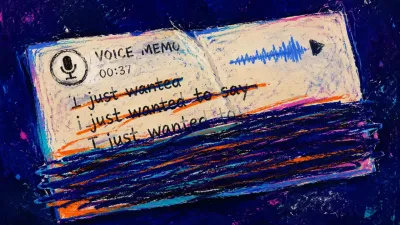
At 9:16 PM on the evening before a family holiday, Jordan had typed three possible answers about work into her Notes app, deleted each one, and watched the blue screen glow against her dark kitchen. She told me the phone had warmed her palm while the radiator hissed behind her, and that her chest tightened whenever she imagined a relative's face evaluating the answer.
She set her hands in her lap and said, "I want to feel at home with my family, but every holiday I polish a version of my life that leaves me less sure who I am. By the time I have explained my life, I no longer know whether I believe the explanation."
I could see the effort in her body: her jaw held firm, her shoulders lifted, and her stomach seemed to brace before each sentence. Her self-doubt felt like a job-interview answer rehearsed so many times that the speaker could no longer hear her own voice beneath the polish. She wanted belonging, but she was trying to purchase it with a finished identity.
I said, "You are not only worried about what they will ask; you are already editing what the answer is allowed to reveal. We do not have to decide tonight whether your family means to evaluate you. We can look at the pattern you experience, understand what keeps it running, and draw a small map back to your own values. That is our Journey to Clarity."

Choosing the Compass: The Four-Layer Insight Ladder
I asked Jordan to place her phone face down, take one slow breath, and hold one question in mind: "Who am I performing for when family holidays make me question myself?" I shuffled slowly while she listened to the cards move. The pause was practical, not supernatural; it gave her nervous system a clean edge between replaying the last gathering and observing it.
For anyone wondering how tarot works in a question like this, I use the cards as an objective cognitive tool. Their images create a structured way to examine behaviour, hidden assumptions, inner resources, and next steps without pretending to predict another person's motives or fix the future. Today I chose the Four-Layer Insight Ladder, a four-card inner-excavation spread designed for family holiday identity performance, its hidden belonging contract, private values, and honest boundaries.
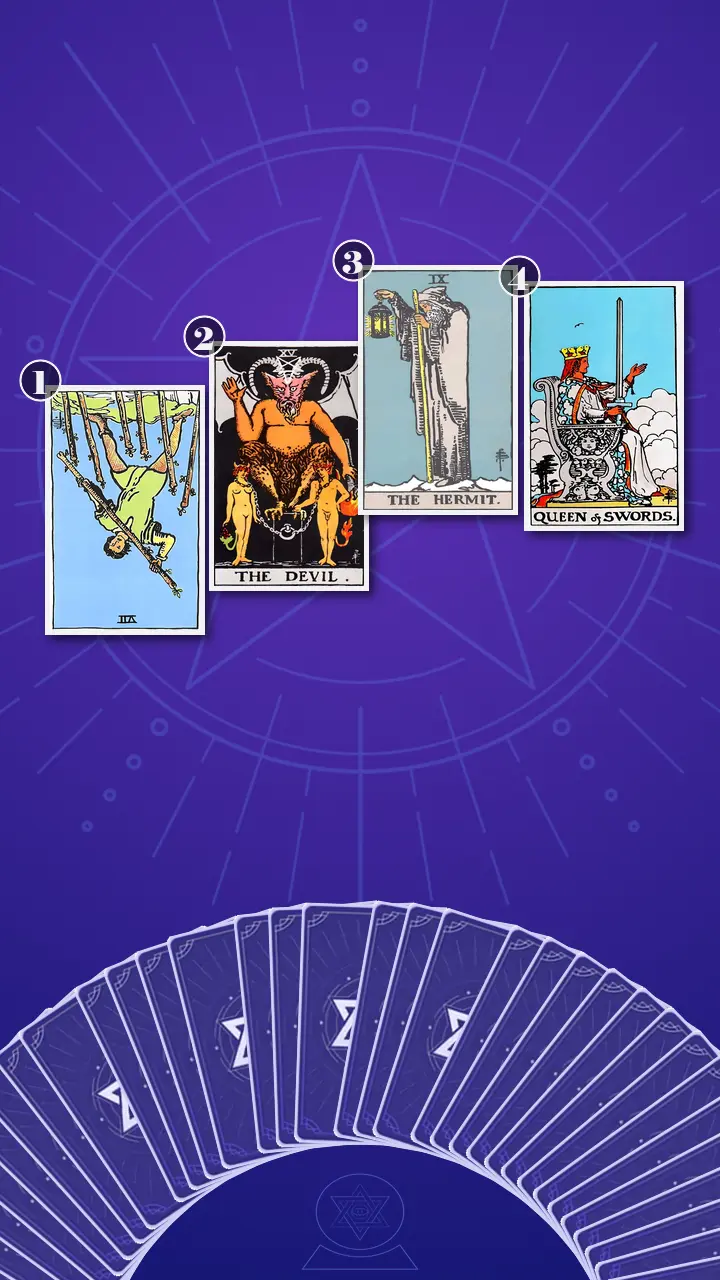
The spread suits Jordan because this is not really a choice between two external options. It is an Inner Conflict that repeats in a familiar setting. The first position shows the Presenting shadow, the visible holiday behaviour in which she rehearses, overexplains, or defends herself. The second reveals the Root pattern, the hidden attachment that makes belonging feel conditional. The third is the Transforming perspective, where she can consult her own values without an audience. The fourth offers Grounded integration: one clear response or boundary she can carry into daily life.
I placed the cards in a gently rising line, like a short staircase from defensive Fire toward clear Air. The arrangement gave us a sequence rather than a verdict: current issue, root pattern, self-guided clarity, and a practical way to remain connected without submitting a complete progress report.
Reading the Map Beneath the Family Questions
I turned the cards one at a time, keeping each card meaning in context. Jordan did not need a grand explanation of herself; she needed enough distance to notice which parts of the story were lived truth and which parts had been added to manage an imagined reaction.
The High Ground That Would Not Hold
Now I turned over the card representing the Presenting shadow: the observable holiday behaviour in which Jordan rehearses, overexplains, or defends a version of herself while questioning it. It was the Seven of Wands, in reversed position. Its standard meaning in this place is the current visible issue, the surface expression of the shadow pattern.
The modern scene was almost exact. At 9:16 PM in her Toronto apartment, Jordan drafted three versions of an answer about work before the family holiday. At the table, she gave the safest version, watched everyone's faces, added proof, and left feeling oddly less certain. The uneven high ground on the card became the imagined social position she kept trying to defend; the six rising wands looked like every question, comparison, pause, and eyebrow lift she had decided might count as evidence.
Reversed, the card showed Fire in a contracted and depleted state. Jordan's energy was not moving toward a chosen value; it was being spent holding a position that did not feel rooted. The effort produced short-term relief because a polished answer could end the moment, but the long-term cost was distance from the person who had actually answered. The card also warned against an overcorrection: becoming agreeable, self-deprecating, silent, or quick to change the subject would still let the imagined audience decide what could be said.
Jordan gave a short laugh. "That is exactly it," she said. "It feels a little cruel." First, her thumb stopped moving against the rim of her mug; then her eyes drifted toward the window as though replaying the last dinner; finally, she let out a breath and lowered her shoulders by a fraction.
I told her I did not hear weakness in the Seven of Wands. I heard a protection strategy that had been asked to work overtime. "You do not need to submit a closing argument every time someone asks a normal question," I said. "Try answering one personal question in two honest sentences and stopping. The honest answer can end before the explanation begins." The aim was not to expose her or force a confrontation. It was to let her experiment with a self-story that did not require evidence of its validity.
The Invisible Pass Mark
Now I turned over the card representing the Root pattern: the Inner Conflict and perceived belonging contract that make family holiday questions feel like evaluations of identity and worth. It was The Devil, in upright position. Its standard meaning here is the hidden attachment, underlying belief, or unconscious pattern sustaining the visible problem.
I asked Jordan to picture the Scarborough dining room from the last holiday. A relative had asked whether communications was still the plan. Jordan had smiled, changed the wording, mentioned a recent project, and added three reasons that her uncertainty was strategic. Nobody had explicitly demanded a five-year plan, yet her inner monologue had supplied one: "If I make this sound purposeful, I can stay safe here."
The small chains around the two figures became an invisible family pass mark, the felt condition that belonging would stay secure only if Jordan presented a certain, progressing, emotionally manageable self. The Devil was not a condemnation of her family, and it was not a prediction about what anyone intended. It showed an internalised bargain: connection on one side, proof on the other. Fear kept renewing the terms and conditions even when nobody had asked her to sign them.
"Belonging is not a performance review," I said. "Which part of this bargain is actually chosen, and which part are you repeating automatically? When a relative asks about work or dating, are you answering the question, or are you answering the hidden pass mark you imagine behind it?"
Jordan's smile disappeared. Her fingers curled around the mug, her gaze fixed on the dark centre of The Devil, and then she looked up with a tired recognition that was not quite relief. She named the question she had treated most like an evaluation: "What is next?" For a moment, the room seemed to hold that sentence between us. Outside, a bus sighed at the curb and moved on, leaving the glass briefly quiet.
When the Hermit Lit a Smaller Room
The Lantern Before the Explanation
The room quieted as I reached the card at the centre and highest point of the line. I turned over the card representing the Transforming perspective: the insight, inner resource, or change in viewpoint that allows Jordan to pause the performance, consult her own values, and treat uncertainty as information rather than failure. It was The Hermit, in upright position.
The Hermit's standard meaning is inward reflection, patient self-trust, and wisdom found by narrowing the field of attention. In Jordan's life, the card looked like a five-minute walk after dinner with her phone on Do Not Disturb. Away from the warm dining room, the family group chat, and the imagined scorecard, she could ask, "What was true before I checked their faces?" The point was not to disappear from family. It was to hear a self-authored signal before speaking again.
The lantern did not illuminate an entire career or reveal a guaranteed identity. It showed only the next few steps that were genuinely hers. The staff suggested support; the mountain ridge suggested that clarity could require patience. The Hermit's energy grounded the frantic Fire of the reversed Seven of Wands and loosened The Devil's attachment by making private observation possible.
At this point I used one of my diagnostic lenses, Internal Monologue Auditing. I listened for the destructive genre of Jordan's subconscious thoughts. Her inner script was not a neutral documentary; it was a courtroom drama in which every pause became evidence, every unfinished plan became a plot twist, and every relative's neutral expression could be edited into a verdict. The jokes and extra explanations were not random. They were lines written to keep the scene from becoming dangerous.
I also recognised Persona Fatigue. Jordan was competent at maintaining the social character of the purposeful young professional, the person who could make any choice sound strategic. But the character had become heavy. As an artist, I know that when a life feels stuck, it can be because someone has stayed in a painful scene long enough to mistake the scene's costume for their own skin. I wanted to help her change the cut, not deny what the scene had cost.
At 9:16 PM on the evening before a holiday, you type three possible answers about work into your Notes app, delete them, and listen to the radiator hiss while your phone warms your palm. Tomorrow's question will sound ordinary, but your body already treats it like an audition. I let that image settle before I spoke again.
The belief that belonging requires a finished performance can be set down; The Hermit's lantern invites you to test one honest value in your own light before explaining it to anyone else.
Jordan went still. First, her breath paused halfway in and her pupils widened; her fingers tightened around the mug and then slowly opened. Next, her eyes left the card and fixed on the radiator, as if an old conversation were replaying in the metal hiss. Finally, a sound rose from her chest, not quite a laugh and not quite a sob. Her shoulders lowered, her jaw unclenched, and her eyes brightened without spilling over. When she spoke, her voice was thin but steadier: "I can be unfinished without making it a confession." The relief carried a brief dizziness with it. A clear path meant she could no longer hide behind the demand to find a perfect one, and that responsibility felt both lighter and newly real. I did not rush to fill the silence; I let her feel that the lantern belonged to her.
I asked, "Now, use this new perspective to think back: was there a moment last week when this insight could have made you feel different?"
Within ten minutes, I suggested, Jordan could write two private sentences in Notes: "Right now, I value..." and "I am still figuring out..." She would read them once without editing, adding achievements, or turning them into a family update. If the exercise felt too exposing, she could pause, stop, or choose a neutral activity. Self-knowledge was an invitation, not another assignment she could fail.
This was the first meaningful shift in the emotional transformation: from rehearsing a polished identity for family approval to trusting self-authored values, allowing an unfinished identity, and holding calm boundaries. She had not solved her career direction or guaranteed a painless holiday. She had simply stopped treating uncertainty as proof that she lacked a self.
The Sentence That Kept the Door Open
The Queen of Swords at Brunch
Now I turned over the card representing Grounded integration: the practical form of private self-knowledge that can become one clear response, privacy boundary, or value-led action during the next family interaction. It was the Queen of Swords, in upright position. Her standard meaning is clear perception, direct communication, discernment, and boundaries shaped by experience rather than by the need to please.
The modern scene was a holiday brunch. A family member asked Jordan what was next, and Jordan answered, "I am still exploring what fits, and I am getting clearer about the kind of work I want." Then she let the silence sit. She did not attach a five-year plan, a recent achievement, or a joke to make the unfinished sentence easier for someone else to accept. If a question became too personal, she could say, "I would rather not get into that today," and change the subject without apologising for having a boundary.
The upright sword was precise language cutting away the defensive paragraph. The open left hand kept the gesture warm; the butterfly motifs on the throne allowed identity to remain in motion. This was clear Air, but not coldness. A boundary could protect privacy without becoming emotional withdrawal, and directness could preserve connection without controlling every interpretation of her life.
Jordan repeated the sentence under her breath. I watched the familiar urge arrive in her face: the quick lift of her eyebrows, the small intake of breath, the almost invisible preparation of a second paragraph. She caught it, closed her lips, and smiled with a little embarrassment. "A boundary can be one clear sentence, not a closing argument," I said. Her hand relaxed on the table. The answer did not make her completely comfortable, but it sounded owned.
The One-Page Map Back to Yourself
When I placed the four cards together, the story became clear. The reversed Seven of Wands showed the depleted defence: Jordan tried to hold an imagined high ground by making every update sound intentional. The Devil revealed why the effort repeated: an internal contract had linked belonging to certainty, progress, and emotional manageability. The Hermit offered a private reference point, and the Queen of Swords gave that reference point a form that could survive an ordinary family conversation.
The question was not necessarily, "Which relative am I performing for?" It was more precise: "Which internalised audience am I obeying when I turn connection into proof?" No Cups card appeared in the spread, and that absence mattered. Belonging had first been debated as a social performance rather than experienced as a freely felt emotional connection. The cards did not ask Jordan to abandon family warmth. They asked her to stop confusing warmth with compliance.
Jordan's cognitive blind spot was treating a coherent explanation as evidence of a coherent identity. She believed that if she could make a career choice, relationship status, or future plan sound intentional, she would finally feel like the person in the explanation. In practice, the performance kept moving the goalposts. The more polished the update became, the less she could tell whether the life underneath it belonged to her.
I brought her back to the image of a film in production. A difficult scene can be real without being the whole film, and an unfinished draft can still have an author. "The cards are not writing your next act," I said. "They are helping you see the old script clearly enough to choose the next line. You are the person holding the pen."
Before we chose her next steps, I taught Jordan my Director's Cut of Self-Compassion. When the inner voice said, "That answer sounded ridiculous," she could pause the spiral and recut the narration from a punitive judge to an objective, supportive observer: "I noticed my chest brace when the question came up. What value was I trying to protect?" This was not forced positivity or a demand to forgive anyone. It was a mental editing technique that made room for accurate observation, kindness, and choice.
I gave her three small experiments. Each one was designed to produce information, not to create a perfect holiday performance.
- The Two-Sentence TruthBefore the next family interaction, open Notes and save one sentence about what is true now and one sentence about what you are still exploring. When someone asks about work, relationships, or direction, give the answer, take one full breath, and stop unless more information is genuinely wanted. Drafting takes about two minutes.Tip: Draft it before opening the family group chat, and decide in advance that a pause or subject change is allowed.
- The Hidden Contract CheckOn a Notes page titled "The holiday pass mark," spend five minutes writing the question you fear, the answer you think would be approved, and the value or truth you would answer from without performing. Circle what was actually requested and underline what you added to manage an imagined judgment. Keep one unrequested detail private.Tip: Treat this as an observation exercise, not a verdict about your relatives. Stop if it turns into a catalogue of grievances.
- The Lantern Value WalkAfter one holiday conversation, walk for five minutes from the apartment, dinner table, or subway stop with your phone on Do Not Disturb. Record one voice memo answering, "What value was present in the answer that felt like me?" Notice whether that value appears in one ordinary choice during the week.Tip: Leave Instagram and LinkedIn closed. One word is enough, and no answer is also information.
I reminded Jordan that these next steps were optional tools, not tests of progress. She could adapt the wording, keep the value private, or decide that a particular conversation was not the right place for honesty. The goal was connection without overexposure: a self-authored value expressed in a manageable form, with the power to continue or stop remaining hers.

A Week Later, the Draft Stayed Unfinished
Six days later, Jordan messaged me from a cafe after a family brunch. "They asked what is next," she wrote. "I said, 'I am still exploring what fits, and I am getting clearer about the kind of work I want.' Then I stopped. My chest was still tight, but I did not feel like I had to rescue the sentence."
She told me a relative moved the conversation elsewhere, though she did not treat that as proof that everything was fixed. The important change had happened before anyone responded: Jordan had answered from the present instead of submitting a polished life report. On the TTC ride home, she took the five-minute value walk, kept her phone closed, and recorded one word: curiosity.
That night, she slept through the night, then woke with the old thought: "What if I am wrong?" It still arrived. She wrote "curiosity" in Notes, made coffee, and waited ten minutes before opening LinkedIn.
I saw relief and gentler curiosity beginning to share the same room. The Journey to Clarity had not handed Jordan a final identity. It had helped her notice that an unfinished life could still be genuinely hers, and that a calm boundary could protect belonging rather than threaten it.
When a holiday question tightens your chest and sets your jaw, you can want your family's warmth and still fear that an unfinished life will be read as proof you do not belong. But when the audience falls quiet, clarity can be the small light of a value you recognise as yours, even before the rest of the story knows its shape.
I leave the last rung of the Four-Layer Insight Ladder open: if the family audience went quiet for one minute, what value in your current life might The Hermit's lantern let you notice, and what one sentence could you keep private or say without explaining it?