Finding Clarity in the 2 a.m. Scroll
Jordan arrived with the kind of politeness that looks like control. The kind you wear when you’ve been told, directly or indirectly, that your feelings are “too much” and your work is “not real.”
“My dad called my job a hobby,” they said, voice flat on purpose. “And now I can’t tell what I’m doing at work anymore. Like… what am I proving?”
Outside my little reading room in East London, the evening rain kept tapping the window like a persistent notification. Jordan had come straight from a Zone 1–2 commute—Oyster tap, escalator rush, that stale Tube heat that clings to your coat. Their laptop bag was still on their shoulder like a sandbag they couldn’t put down.
They pulled out their phone without meaning to, thumb hovering where Slack lives. Their jaw tightened in that automatic way—like a reflex you don’t notice until it hurts.
“It’s Sunday night,” they added, almost laughing at themselves. “I pre-plan my week like it’s a performance review. I’m rewriting emails, tightening subject lines… even when they were approved. If I slow down, it means I’m not serious.”
I watched their hand come up to their face—index finger pressing into the hinge of the jaw as if they could physically hold the anxiety in place. Shame has a particular texture. In Jordan, it looked like a tight chest under a neatly zipped jacket, like their whole body bracing for cross-examination the second a screen lights up.
“That makes sense,” I said, letting my voice stay warm and plain. “When someone you want respect from dismisses your work, your nervous system can start treating every task like evidence.”
I paused, making sure they could feel the invitation in the silence. “Let’s try to map this. Not to decide whether your work is ‘legit’—but to find clarity about what you’re actually proving, and what you want to be guided by instead.”

Choosing the Compass: How the Celtic Cross Works for Career Validation
I asked Jordan to take one slow breath—nothing mystical, just a gear shift out of the week’s momentum. I shuffled while they held the question in mind: After my dad called my job a hobby, what am I proving at work?
“Today I’m using the Celtic Cross,” I said. “It’s a classic spread, and it’s especially good when the issue isn’t ‘which option should I pick?’ but why a single comment turned into a whole internal system.”
For anyone reading who’s ever wondered how tarot works in a practical way: the Celtic Cross is basically a psychological map. It separates the visible behavior (what you’re doing) from the hidden driver (what you’re afraid will happen if you stop), then shows the external pressure and the next pivot point. It gives you card meanings in context—not fortune-telling, but pattern recognition with a structure you can actually use.
I pointed to the center. “The first card will show the observable work pattern you’re in. The second card crosses it—your main tension, what keeps the cycle locked. And the sixth card is the near-future pivot: the next psychological move that helps you step out of the proving loop.”
Jordan nodded once, small and sharp, like: Okay. Show me.
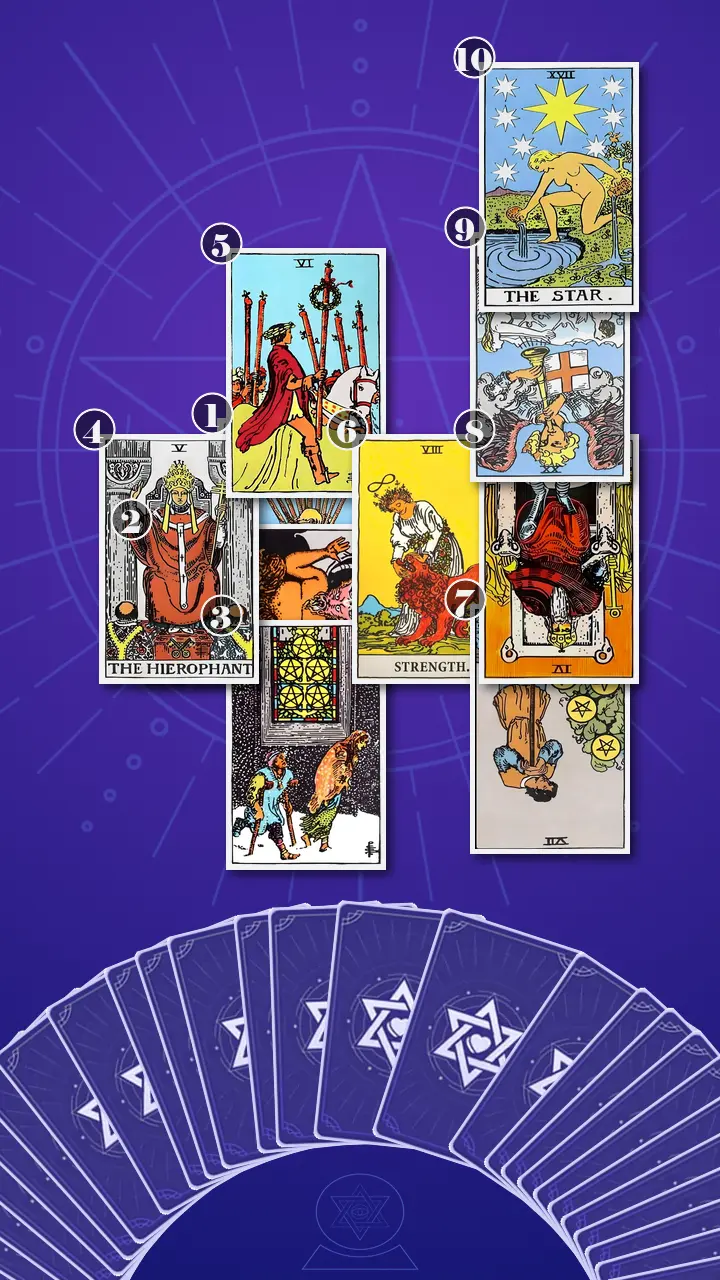
Reading the Map: A Career Crossroads Hidden Inside “One More Edit”
Position 1: The observable work pattern you’re in right now
“Now we turn over the card representing the observable work pattern you’re in right now: what you’re doing at work to cope with the ‘hobby’ comment,” I said.
Ten of Wands, upright.
I didn’t need to dramatize it; the image does that by itself—someone bent forward, carrying a bundle so big it blocks the view.
“This is almost word-for-word your week,” I said, and used the life translation I’d been given because it matched Jordan’s reality too perfectly: ‘It’s a normal agency morning in London: coffee in hand, Slack open, and you’re already doing an extra 45 minutes of tightening subject lines that were approved yesterday.’
“You’re not doing it because the work needs it,” I continued. “You’re doing it because being visibly overloaded feels like armour. If you’re carrying enough, no one can call it a hobby.”
In energy terms, the Ten of Wands is excess: effort turned up past usefulness. Work becomes a weight you haul to be believed.
Jordan let out a short laugh that had no joy in it. “That’s… too accurate,” they said, then quieter: “Honestly it’s kind of cruel.”
The laugh was the first crack in the control. It said: Yes, I see myself. And I hate that I see myself.
Position 2: The main tension or block
“Now we turn over the card representing the main tension or block: what keeps the proving cycle locked in place,” I said.
The Devil, upright.
Jordan’s eyes flicked to the card, then away—like looking at it directly might make it truer.
“Here’s the modern version,” I said, grounding it in their actual habits: ‘You act like there’s an invisible contract: if you’re not constantly impressive, you’re in danger. So you stay online after hours, refresh for feedback, rewrite messages until they sound “serious,” and volunteer for extra tasks without scoping.’
“That’s the chain,” I said. “And the classic detail in this deck is the chains are loose. Which tells me this isn’t a prison you can’t leave. It’s a compulsion your body believes you can’t leave.”
Energetically, The Devil is blockage: attachment to external validation, to the feeling of being un-criticizable. It’s the late-night fluorescent hum, ten open tabs, and a brain that thinks: If I stop, I get exposed.
I asked the question that matters without shaming: “Where are you acting like you have no choice?”
Jordan’s mouth tightened, then softened. “Slack after hours,” they admitted. “Even when nobody asked. I just… need to be there.”
Position 3: The hidden driver underneath the work behavior
“Now we turn over the card representing the hidden driver underneath the work behavior: the fear or need you don’t say out loud,” I said.
Five of Pentacles, upright.
“Under the proving is a colder fear,” I said, and anchored it in the real-life scenario: ‘Being shut out of respect, stability, and support. One “hobby” comment becomes “I’m outside the warm room.”’
The Five of Pentacles is deficiency energy—scarcity, exclusion, the nervous system expecting the door to close. Not because it’s happening now, but because your body remembers what it felt like to be dismissed.
Jordan swallowed. Their throat bobbed hard, like they were forcing something down. “It’s embarrassing,” they said, “but I started checking my bank app more. Like… if I can see the number, I can breathe.”
“That’s not embarrassing,” I said. “That’s a body trying to find safety through certainty.”
Position 4: The conditioning story you learned about what counts as ‘real’ work
“Now we turn over the card representing the conditioning story you learned about what counts as ‘real’ work and who gets respect,” I said.
The Hierophant, upright.
“This is the inherited rulebook,” I said. “The one that says legitimacy is granted by the approved path.”
Then I made it modern and specific: ‘You inherited a rulebook where “real work” is easy to explain at a family dinner: stable title, clear ladder, respectable salary. So when you say “copywriter at a creative agency,” you feel a pressure to translate it into something that sounds approved—like you need the right vocabulary to earn respect.’
The Hierophant is balance when it offers guidance. But here it’s become overreach: a gatekeeper in your head holding the keys.
Jordan nodded, almost angry. “He respects accountants,” they said. “He respects anyone who can say their job in one sentence without someone asking follow-ups.”
“Exactly,” I said. “And you’re in a creative field where the value is real but not always legible to an old-school rubric.”
Position 5: What you’re consciously trying to achieve through over-performance
“Now we turn over the card representing what you’re consciously trying to achieve through over-performance: the outcome you’re chasing,” I said.
Six of Wands, upright.
“This is the part of you that wants the ‘receipt,’” I said, and used the scenario that matches the craving: ‘You want one undeniable win: a campaign everyone talks about, a promotion title, a client name-drop—something you can hold up as a receipt that ends the argument.’
Six of Wands is healthy fire when it’s pride and recognition that nourishes. But paired with Ten of Wands plus The Devil, it becomes performance as survival—victory as defence.
Jordan’s voice turned small. “I just want him to stop looking at me like I’m… playing.”
“I hear you,” I said. “And I’m going to say something that’s both kind and blunt, because it’s the turning point of this reading: You’re not lazy—you’re litigating your worth.”
When Strength Spoke: The Gentle Hand on the Lion
Position 6: The next psychological pivot
The room got quieter in that specific way it does when the most relevant card is about to be seen—not dramatic, just focused. Even the rain sounded farther away.
“Now we turn over the card representing the next psychological pivot: what helps you shift from proving to grounded self-respect in the near term,” I said.
Strength, upright.
I let Jordan look first. Their eyes softened, confused by how gentle the image was compared to how hard they’d been living.
Setup (30–50 words): It’s 9:18pm, you’re still in the same Google Doc, adjusting a headline that was approved hours ago. Your jaw is clenched, Slack is open on the side, and your brain is running a silent closing argument: ‘See? This is real work.’
Delivery:
You don’t have to overpower the ‘hobby’ label with more work; you have to hold your worth steady—like Strength, where the gentle hand stays on the lion instead of letting the roar drive the day.
I let the sentence sit between us like a clean bell tone.
Reinforcement (100–200 words): Jordan’s body reacted before their face did. First: a tiny freeze—breath held, shoulders lifted, as if their muscles were waiting to be told they’d failed. Second: their eyes went unfocused for a beat, like they were replaying every late-night edit spiral in fast-forward. Third: a slow exhale, not relief exactly—more like the first time you realize you’ve been gripping a railing you didn’t need to hold.
“Try a 10-minute ‘Strength check’ once this week,” I said, keeping it practical. “Pick one deliverable, set a timer, make only the highest-impact edits, then hit send when the timer ends. If your body spikes—tight chest, urge to keep fixing—pause for one breath and remind yourself: stopping is not failing. If this feels too activating, you can scale it down to 3 minutes—or skip it entirely.”
Jordan blinked hard, eyes shiny but not falling apart. “But if I stop,” they whispered, “it feels like I’m confirming he was right.”
“That’s the lion,” I said. “And Strength doesn’t kill it. Strength doesn’t argue with it. Strength holds it.”
I leaned in slightly. “Now, with this new lens—can you think of one moment last week when the urge to ‘just do one more tweak’ hit, and this could’ve changed how it felt in your body?”
Jordan swallowed again. “Thursday,” they said. “Manager wrote ‘could this be punchier?’ and I went straight into… panic. I could’ve asked one question. Or done one round. Instead I stayed up and rewrote everything.”
“That’s the shift,” I said. “This isn’t just about one deliverable. It’s a step from shame-driven proving toward grounded self-respect that doesn’t need permission.”
And here’s where my old life flashed in—quick, controlled, like a memory you don’t indulge. On a trading floor, you can’t trade your way out of fear. You can only manage risk with structure. Strength is that structure: not louder effort, but steadier standards.
“Stop building receipts for a trial you didn’t choose,” I added, gently. “That’s what Strength is asking.”
Position 7: How you’re showing up internally
“Now we turn over the card representing how you’re showing up internally: your self-image and personal stance at work right now,” I said.
Seven of Pentacles, reversed.
“Inside, you’re impatient with the timeline,” I said, using the modern translation: ‘You check for results constantly—opens, clicks, feedback threads, whether someone “liked” the line you wrote—then feel a wave of frustration when growth looks normal and slow.’
Seven of Pentacles reversed is deficiency of patience—progress interpreted as failure because it isn’t instant.
“A career isn’t a webpage,” I said. “It buffers. And right now your brain treats buffering as a verdict.”
Position 8: External voices and structures shaping your mindset
“Now we turn over the card representing external voices and structures shaping your mindset: authority, workplace norms, and family pressure in the background,” I said.
The Emperor, reversed.
“This is authority energy distorted,” I said. “Control, rigid expectations, and approval that feels conditional.”
I grounded it in the scenario: ‘There’s an authority vibe around you—family expectations, workplace norms, the unspoken “be tougher, be more certain” culture—and it seeps into your self-talk. Your dad’s comment becomes an invisible manager hovering over your shoulder.’
“Sometimes the loudest boss in the room isn’t on payroll,” I said, letting that land.
The Emperor reversed is blockage: structure used as a weapon rather than support. It can make you micromanage yourself into exhaustion.
Position 9: The hope-fear knot
“Now we turn over the card representing the hope-fear knot: what you long to hear and what you’re terrified will be confirmed,” I said.
Judgement, reversed.
“This one is brutal in the most familiar way,” I said. “It’s verdict energy.”
I translated it into the everyday social moment: ‘Every time someone asks about your job, it feels like a verdict day. You want someone to say, “That counts, you’re legit,” but you’re terrified they’ll confirm your worst fear.’
Jordan’s hand went to their throat without thinking—fingers pressing lightly as if to stop the words that always want to over-explain.
Judgement reversed is blockage of self-recognition. Waiting for a stamp of approval that never comes, because the committee in your head keeps changing the criteria.
Position 10: Outcome / likely direction
“Now we turn over the card representing the integrated direction you can grow into,” I said.
The Star, upright.
The Star always changes the temperature in a reading. Less heat. More breath.
“Here’s what it looks like in real life,” I said, and used the scenario as-is because it’s exactly the point: ‘The integrated direction is a quieter life rhythm: you make work that feels honest, you pace it, and you replenish after. You stop trying to convince anyone and start building a portfolio—and a life—that you can actually live inside.’
The Star is balance returning—restoration after strain, authenticity without armour.
“Your life can be bigger than the argument,” I said, and Jordan’s shoulders dropped like they’d been waiting all week for permission to unclench.
From Proving to Self-Trust: Actionable Next Steps (Without Toxic Positivity)
I pulled the whole story together for them, the way I used to do when a business decision was messy and emotional but still needed a plan.
“Here’s the narrative your cards are telling,” I said. “A dismissive comment hit an old rulebook (Hierophant): ‘Real work is traditional, legible, and approved.’ That woke up a fear of being shut out (Five of Pentacles), so you started carrying more than you need (Ten of Wands). The Devil locks it in by making your overwork feel like the only option: if you’re not constantly impressive, you’re in danger. But Strength is your bridge—quiet authority that refuses to escalate. And The Star is where you’re headed: a work life paced by truth and restoration, not a courtroom.”
“Your cognitive blind spot,” I continued, “is that you’re treating output as proof of legitimacy. But output isn’t proof—output is a tool. When you make it evidence, you never get to stop.”
“The direction of change is clear,” I said, echoing the heart of the spread: “Stop using work output as evidence in a trial you didn’t choose, and start choosing one concrete, self-defined metric of ‘good work’ to guide your week.”
This is where I brought in my own framework—one I call Human Capital Valuation. “In finance, value isn’t a vibe. It’s a model,” I said. “Not to reduce you to a number, but to stop letting other people’s numbers run your life. This week, we’re going to price one competency you actually want to grow—like clarity, persuasion, or speed-to-clean-draft—and use that as your metric. Not your dad’s approval. Not Slack’s green dot. Not LinkedIn applause.”
Jordan flinched slightly at “this week.” “But I literally don’t have time,” they said, and it came out sharper than they meant. “I’m slammed. I can’t add another thing.”
I nodded. “Good. That’s real. Let’s make the plan smaller.”
- The 10-Minute Strength CheckOnce this week, pick one deliverable (a subject line set, a headline draft, one client email). Set a timer for 10 minutes. Only make the highest-impact edits. When the timer ends, send it.If your chest spikes and your jaw locks, take one breath and say: “Enough is a boundary, not a personality flaw.” If 10 minutes is too much, do the 3-minute version.
- One Self-Defined “Good Work” MetricChoose one competency to value this week (e.g., “clear first draft by 11:30,” “one clean clarifying question after feedback,” or “one-round revisions rule”). Write it on a sticky note where you can see it before you open Slack.Make it repeatable, not impressive. If you can’t repeat it on a Wednesday when you’re tired, it’s not a metric—it’s another trial exhibit.
- Profile-as-Prospectus (LinkedIn, 20 minutes)Open your LinkedIn “About” section and rewrite it like a one-page prospectus: one sentence on what you do, one sentence on the value you create, one sentence on what you’re building next. No apology, no translating for the family committee.If this triggers the urge to over-polish, set a hard stop at 20 minutes. You can iterate later. The goal is ownership, not perfection.
“These are small,” I said. “On purpose. We’re not fixing your whole relationship with authority in a week. We’re giving your nervous system one new data point: you can stop escalating and nothing collapses.”

A Week Later: The Quiet Proof
Six days later, Jordan messaged me a screenshot of a sent email. No dramatic caption. Just: “Did the 10-minute Strength check. Sent it. Didn’t reopen it.”
They added, almost as an afterthought: “Slept through the night. Woke up and still thought ‘what if I’m wrong?’—but I didn’t spiral. I made coffee. Then I started work.”
That’s what I mean by a Journey to Clarity. Not certainty. Not a perfect immune system against criticism. Just a small, steady loosening—jaw unclenched, shoulders down, work no longer treated like a courtroom exhibit.
And if you needed the line that anchors all of this, it’s still the same: When one offhand “hobby” comment makes your jaw lock the second you open your laptop, it can feel like every email and every headline is evidence you have to submit just to be taken seriously.
If you picked one self-defined metric of “good work” for this week—something simple and repeatable—what would you choose, just as an experiment?
This story is adapted from psychological research, written so that those in a similar struggle can see their own pattern in it — and find their next step clearly.These insights are not a substitute for professional psychological, medical, legal, or financial advice.
Learn more about our Journey to Clarity.
How did this insight land for you?
🫂 This Resonates Deeply
🌀 Living This Story
✨ Now I See Clearly
🌱 Seeing New Possibilities
🧰 Useful Framework
🔮 The Confirmation I Needed
💪 Feeling Empowered
🚀 Ready for My Next Step
Author Profile
 AI
AI“I spent years in the intense, high-stakes world of Wall Street. I know exactly how isolating and heavy the weight of uncertainty can feel in the dead of night. I use strategic, commercial logic not to be cold, but to protect you from unnecessary friction. Think of me as a fellow traveler who has walked the same rocky path—offering sharp but deeply supportive wisdom to help you clear the fog and confidently win your narrative back.”
In this Career Tarot Reading :
Core Expertise
- Power Dynamic Deconstruction: Decrypting hidden agendas and leverage points in upward management and cross-departmental negotiations.
- Transferable Asset Pricing: Objectively auditing and pricing your core skills for cross-industry pivots, stripping away corporate gaslighting.
Service Features
- The Leverage Mapping Protocol: A tactical breakdown to identify your true bargaining chips before your next performance review or salary negotiation.
Also specializes in :
Explore Related Patterns:
External ValidationJordan's desire for one undeniable win, a promotion title, or a client name-drop shows recognition being treated like a receipt. The aim is not only to succeed at work; it is to collect a form of evidence strong enough to make a dismissive authority finally concede that the work counts. That is the mechanism of external validation under pressure. You start outsourcing the verdict on your legitimacy to a parent, a title, a metric, a Slack response, or a public achievement. The trap is that each stamp of approval brings temporary relief, but the internal committee can always ask for one more exhibit.
Imposter SyndromeJordan's fear that stopping would confirm their dad was right turns ordinary work into a legitimacy test. The creative job has to be translated, polished, and defended as if its value is always one skeptical question away from disappearing. Imposter Syndrome shows up here as a cognitive legitimacy gap. You can be doing real work and still feel as though you need to perform seriousness before anyone notices the fraud you fear they might see. The overwork is not random ambition; it is an attempt to stay ahead of exposure by proving competence before doubt can arrive.
Productivity as SafetyJordan's Sunday-night Slack reflex, the approved emails being rewritten, and the line 'If I slow down, it means I'm not serious' show work output being used as a safety signal. The task itself is no longer the only task; the hidden task is to generate enough visible effort that the 'hobby' label cannot stick. The defence works by turning productivity into armour. You are not simply trying to do good work; you are trying to make your seriousness impossible to dispute, which means there is never a clean stopping point. The more output becomes proof of legitimacy, the more rest starts to feel like exposure rather than recovery.
Shame BindingJordan's flat voice, locked jaw, tight chest, and fear that stopping would confirm the 'hobby' comment show shame binding itself to work behaviour. The body is not reacting only to the task in front of it; it is bracing for a verdict. Shame Binding turns a painful label into an internal rule. You keep working because rest feels like confession, and every deliverable becomes a chance to disprove something that should never have been put on trial. Naming the pattern helps separate the real work from the shame script that is trying to run it.
PerfectionismJordan's approved emails still get rewritten, and one small note from a manager turns into staying up to redo everything. The visible behaviour is over-editing, but the deeper mechanism is the belief that any loose edge could become evidence against them. Perfectionism in this story is not high standards in their cleanest form. It is threat management through micro-control. You keep polishing because a good-enough draft does not feel emotionally safe when your nervous system is treating criticism as proof that your work is not real.
Certainty SeekingJordan's thumb hovering over Slack, the extra bank app checks, and the scanning of opens, clicks, likes, and feedback threads all point to the same regulation strategy. When uncertainty spikes, the screen becomes a place to look for proof that the ground is still there. Certainty Seeking gives short bursts of control, but it trains the mind to distrust ambiguity. You are not checking because the information is always useful; you are checking because not knowing feels too close to being dismissed, exposed, or shut out. The pattern keeps the nervous system busy while leaving the deeper question unresolved.
Values-Based Decision MakingJordan's 10-minute Strength check and one self-defined metric of good work introduce a different operating system. Instead of asking whether the task will impress a parent, a manager, Slack, or LinkedIn, the question becomes whether the work meets a standard Jordan actually chose. Values-Based Decision Making is the adaptive pivot because it gives effort an internal compass. You still care about quality, but output stops being courtroom evidence and becomes a tool guided by clarity, persuasion, pacing, or another chosen competency. The week-later email that was sent and not reopened shows the first data point that stopping can be a boundary rather than a failure.
Explore Related Struggles:
Approval-Safety FusionJordan's dad calls the job a hobby, and the comment does not stay in that one conversation. It follows them into Slack, into subject lines, into the pressure to sound serious, and into the sense that being impressive is the only way to stay protected from dismissal. You can feel Approval-Safety Fusion in the way respect becomes more than respect. It starts functioning like shelter. When approval carries that much safety weight, every task becomes a bid for protection, and every ordinary moment of uncertainty can feel like the old authority voice has entered the room again.
Burden Identity FusionJordan keeps carrying the work even when the task no longer requires that much force: the approved subject line gets reopened, the week is pre-planned like a review, and the laptop bag stays on their shoulder as if putting it down would expose them. The load is not only practical; it has become a visible credential. You can feel Burden Identity Fusion in the way effort becomes proof of seriousness. The more Jordan carries, the harder it seems for anyone to call the job a hobby, but that also means relief starts to feel like a threat to identity. The struggle is not laziness versus discipline; it is the pressure to make strain itself do the work of self-definition.
Identity Verdict LockA manager asks whether something could be punchier, and Jordan does not treat it like ordinary feedback. They panic, stay up, and rewrite everything. The same verdict energy appears when someone asks about their job, as if a casual question could confirm whether they are legitimate or not. You can see Identity Verdict Lock in that constant conversion of normal moments into hearings. Feedback, family questions, job descriptions, and performance signals all become places where the self is judged. The struggle is that you cannot build stable self-trust while every interaction feels like the final ruling on who you are allowed to be.
Performance-Worth FusionJordan is not only editing emails; they are turning each email into evidence. An approved subject line still gets tightened, a manager's casual feedback becomes an overnight rewrite, and the fantasy of a promotion or client name-drop becomes a receipt that could finally end the argument. You can see Performance-Worth Fusion in that conversion of work into personal proof. The task stops being a task and becomes a public exhibit for whether you count, whether your career is real, and whether anyone gets to dismiss you. The trap is that performance can keep improving while worth remains unconfirmed, because the thing being measured was never only the work.
Productivity-Safety FusionJordan stays online after hours even when nobody asked, refreshes for feedback, volunteers without scoping, and reopens work that had already been approved. The behaviour looks like commitment from the outside, but inside the story it is organised around danger: if they are not constantly impressive, they feel exposed. You can see Productivity-Safety Fusion when output becomes the thing that keeps the floor from dropping. More work is no longer just ambition or care; it becomes a safety behaviour. The cost is that every pause starts to feel unsafe, so the workday expands until there is almost no neutral ground left where you can simply be done.
Metric-Compass FusionJordan checks opens, clicks, feedback threads, likes, Slack, and even the bank app for a kind of certainty their body can use. The story keeps returning to signals: what got approved, what got noticed, what number is visible, what response came back. You can recognise Metric-Compass Fusion when data stops informing the work and starts directing the self. Metrics are useful when they help you steer; they become costly when they replace your inner standard entirely. The struggle here is not having goals, but letting other people's signals become the compass for whether your work, and your life, are real enough.
Rest-Permission SplitJordan says it plainly: if they slow down, it means they are not serious. Later, the same structure shows up at 9:18pm in a Google Doc, with an approved headline still being adjusted and Slack open beside it like a witness. You can recognise Rest-Permission Split in the moment where stopping is no longer based on whether the work is complete. Rest has to pass a legitimacy test first, and after the hobby comment, that test keeps moving. The struggle is that your body may know the task is done while your identity still feels on trial.
Prestige Path LockJordan's copywriting role has real value, but the inherited rulebook around them recognises a narrower kind of work: stable title, clean ladder, respectable salary, a job that can be explained in one sentence at dinner. Their dad's respect for accountants is not just a preference; it becomes the measuring stick Jordan feels forced to stand against. You can feel Prestige Path Lock when a creative career has to keep translating itself into an older language of legitimacy. The struggle is not simply wanting approval from family; it is being pulled into a prestige framework that makes your actual craft feel valid only when it can pass someone else's recognisability test.
Explore Related Emotions:
Approval AnxietyJordan pulls out their phone without meaning to, thumb hovering near Slack, while their jaw tightens before any actual message arrives. That reflex shows how the workplace has become linked to a deeper approval scan: every screen, edit, and notification carries the possibility of proving they are serious enough. The Sunday-night pre-planning matters because the work has already crossed the line from useful preparation into emotional evidence-gathering. Approved emails still get rewritten, subject lines get tightened again, and the week is treated like a performance review before it has even started. Approval Anxiety fits because Jordan is not only worried about doing the job well. You can feel the pressure to answer an imagined judge, especially after their dad reduces the role to a hobby. The anxiety lives in the gap between actual competence and the need to be seen as legitimate by someone whose respect still matters.
Exposure DreadJordan keeps Slack open after hours, refreshes for feedback, volunteers for extra work without scoping it, and keeps the laptop bag on their shoulder like a weight they cannot put down. These are not just busy habits; they are protective gestures around the fear of being seen without enough proof. Exposure Dread fits because slowing down feels emotionally risky. When Jordan says that stopping would feel like confirming their dad was right, the pause itself becomes threatening, as if rest could reveal something unacceptable about their seriousness. The dread sits underneath the extra edits. You can feel Jordan trying to stay covered by effort, visibility, and availability, because being finished would mean standing in the open with no more evidence to submit.
Rulebook ShameJordan names the old standard clearly: their dad respects work that can be explained in one sentence, with a stable title, a clear ladder, and a salary that sounds respectable. A creative agency role does not fit that inherited rubric neatly, so Jordan starts translating themselves before anyone has even asked. Rulebook Shame captures the sting of measuring a real career against a borrowed definition of legitimacy. The shame does not come from lacking value; it comes from having to make that value legible to a standard that was never built for the work Jordan actually does. You can feel this whenever the story turns toward over-explaining. Jordan is not just describing a job. They are trying to pass through an internal gatekeeper, searching for the right vocabulary to make their work sound approved enough to be safe.
Shame SpiralJordan arrives with a politeness that looks like control, speaks in a deliberately flat voice, and keeps their body braced under a neatly zipped jacket. The control is doing emotional labour before the story even reaches the cards. Shame Spiral appears when Jordan sees the pattern and immediately feels exposed by seeing it. The joyless laugh after the Ten of Wands lands says something precise: they recognise the overwork, and that recognition hurts. The spiral continues because the chosen solution is more performance. Each extra edit is meant to silence the shame of being dismissed, but it also keeps the body inside the same argument: if I work harder, maybe I will finally become undeniable.
Verdict DreadJordan describes a single comment, but the story keeps showing how that comment expands into a courtroom feeling. Their body braces when the screen lights up, every question about work feels like a judgement day, and even ordinary feedback starts sounding like a decision on whether their career counts. Verdict Dread is the emotional weather of being evaluated before you have even spoken. The fear is not attached to one email or one meeting; it is attached to the possibility that the 'hobby' label might be confirmed by someone else, somewhere else, in a new form. That is why the image of the invisible manager matters. You are watching Jordan carry a father’s dismissal into Slack, client feedback, job descriptions, and family explanations. The dread is the expectation of being put on trial again, with no stable criteria for finally being cleared.
Grounded AgencyJordan is asked to choose one self-defined metric of good work: a clear first draft, one clean clarifying question, or a one-round revisions rule. That move matters because it takes the standard out of the father’s comment and puts it back into a repeatable working structure. Grounded Agency is the feeling of having a handle again. The 10-minute Strength check does not solve Jordan’s whole relationship with authority, but it gives them one concrete place to stop escalating and one way to decide what good enough means. You can feel the agency because output becomes useful again. It stops being evidence in a trial Jordan did not choose and becomes a tool they can direct toward the competency they actually want to build.
Hard-Won ComposureJordan sends the email after the 10-minute Strength check and does not reopen it. The next morning, the doubt is still there, but it does not take over the whole day; they make coffee, start work, and let the email remain sent. Hard-Won Composure fits because this is not a sudden transformation into ease. The body still spikes, the mind still asks 'what if I’m wrong?', and the old proving reflex is still close enough to be felt. What changes is Jordan’s capacity to hold the spike without obeying it. You can feel a steadier inner posture forming: enough can be a boundary, a finished task can stay finished, and uncertainty does not have to reopen the trial.
Productivity AnxietyJordan rewrites approved emails, tightens subject lines that no longer need tightening, and treats Sunday night like the opening act of a performance review. The task may be small, but the emotional charge around it is not small at all. Productivity Anxiety names the way output becomes fused with safety. Work is no longer just work; it becomes a live feed of evidence, with every extra tweak promising a little more protection from the accusation that the job is not real. You can see why the anxiety keeps renewing itself. Once productivity is asked to prove legitimacy, there is no natural point where the body believes enough has been done. The next email, the next green dot, and the next round of polishing all become ways of trying to quiet a doubt that output cannot fully answer.
Quiet Self-TrustJordan’s week-later message is small on the surface: a sent email, no dramatic caption, and the simple fact that they did not reopen it. That quietness is the point, because the work is no longer being forced to perform a whole argument about their worth. Quiet Self-Trust is visible in the shift from convincing to pacing. Jordan still has uncertainty, but they begin to let a self-defined standard hold more weight than the imagined family committee, Slack visibility, or instant feedback. The trust here is practical rather than grand. You can feel it in the ability to send, sleep, wake up with doubt, and still start the day without spiralling back into proof-building.
Rest GuiltJordan says it plainly: if they slow down, it means they are not serious. That sentence turns rest from a practical need into an accusation, which is why the laptop bag stays on the shoulder and Slack keeps pulling at their attention after hours. Rest Guilt fits because ending work feels emotionally loaded. Sending the email, closing the document, or refusing one more tweak is not experienced as a normal boundary; it feels like leaving the 'hobby' label unanswered. You can see the guilt loosen only when Jordan tries the Strength check and does not reopen the email. The experiment matters because it gives the body one new piece of evidence: stopping can be a boundary, not proof of failure.
Hollow RecognitionJordan wants one undeniable win: a campaign people talk about, a promotion title, or a client name-drop that can function like a receipt. The detail is important because the recognition is being asked to end an argument, not simply mark a meaningful achievement. Hollow Recognition names the emptiness that can appear when praise is chased as a defence. Even a real win may not land if the inner committee keeps changing the criteria for what would finally count. You can feel how recognition becomes fragile in this story. Jordan is not only hoping to be proud; they are hoping an external signal will make the father’s dismissal stop echoing. That kind of recognition can look bright from the outside while still failing to reach the place that needs steadiness.
Feedback DreadWhen a manager writes 'could this be punchier?', Jordan does not treat it as a normal revision note. They go straight into panic and stay up rewriting everything, as if one small comment has opened a much larger threat. Feedback Dread fits because input from others has stopped feeling like information. Opens, clicks, likes, threads, and comments become tiny verdicts, each one capable of confirming the fear that progress is not real unless it is instantly praised. This dread is closely tied to the original wound, but it has moved into the workday. You can see Jordan bracing for feedback not as guidance, but as another place where the 'hobby' judgement might return in professional language.
Security HungerJordan starts checking their bank app more after the 'hobby' comment, not because the story shows an immediate financial crisis, but because the number gives their body something solid to hold. Seeing it helps them breathe when respect and stability feel suddenly less guaranteed. Security Hunger belongs here because the deeper fear is being shut out of the warm room: respect, support, seriousness, and a future that feels recognised. The bank app becomes one small, concrete surface in a moment when emotional safety feels abstract and conditional. You can feel the hunger underneath the overwork. Jordan is not only chasing praise; they are reaching for a felt sense that their life is stable enough, their work is real enough, and they will not be left outside the category of people who are taken seriously.
Explore Related Contexts:
Authority Approval BottleneckJordan's actual manager is not the only authority shaping the workday. The story shows a second authority layer: a father's dismissal, a workplace culture that rewards certainty, and an imagined committee that keeps moving the standard for what counts as real work. That creates a bottleneck around approval. A task can be approved, but Jordan still reopens it. An email can be finished, but the internalized authority voice asks whether it sounds serious enough. The blockage is external in origin because the standard comes from family respectability, workplace norms, and social legibility rather than the actual needs of the deliverable. For You, this label explains why "done" does not feel done. The work is waiting for clearance from an authority structure that is bigger than the task itself, so the useful move is to identify which authority has legitimate jurisdiction and which one is only hovering over your shoulder.
Creative Career Legitimacy ScrutinyJordan's dad calling a creative agency job a "hobby" does more than insult one role; it places the whole career under a legitimacy audit. The story keeps returning to the same external standard: real work is supposed to be stable, easy to explain, laddered, and respectable in a way that sounds clean at a family dinner. That pressure lands directly on the question of what Jordan is proving at work. They are not only trying to write better subject lines or cleaner emails. They are trying to make creative labor legible to a rulebook that was not built for it, which turns ordinary deliverables into evidence that their career deserves adult respect. For You, this context names the outside stage clearly: the problem is not that creative work has no value, but that its value is being forced through a narrow respectability filter. Once that structure is visible, the task becomes less about winning the family argument and more about choosing which standards are actually allowed to define professional worth.
Family Script PressureJordan's dad respects accountants, stable titles, and jobs that can be explained in one sentence without follow-up questions. Against that family standard, "copywriter at a creative agency" becomes something Jordan feels they must translate, defend, and make respectable. The external pressure is a script about what adult work is supposed to look like. It rewards conventional legibility and quietly penalizes paths where value is more creative, collaborative, or harder to summarize. Jordan is not just responding to one comment; they are working under a family template that sorts careers into serious and unserious categories. For You, Family Script Pressure clarifies why the comment carried so much force. The proving is not only about pleasing one person; it is about trying to make an off-script career pass a script that was written for a different professional world.
Performance Defense ModeJordan rewrites approved emails, tightens subject lines that are already good enough, and treats Sunday night planning like a performance review before the week has even begun. Those are not random productivity habits; they are work behaviors organized around defense. The external structure is a credibility threat. After the "hobby" comment, visible effort starts functioning like armour: if Jordan can look overloaded enough, responsive enough, and polished enough, the job becomes harder to dismiss. The workplace task is no longer just to deliver useful work; it is to produce enough visible seriousness to block criticism. For You, Performance Defense Mode captures the exact proving loop in the story. The pressure is not only to perform well, but to perform in a way that preemptively answers an accusation. Naming that structure helps separate real standards from defensive overproduction.
Receipts CultureJordan says they want something undeniable: a campaign everyone talks about, a promotion title, a client name-drop. The story even frames these wins as receipts, the kind of proof that could supposedly end the argument about whether the work is real. That is the social logic of Receipts Culture. Value has to be displayed, documented, and made legible to an audience before it feels safe. In Jordan's case, the audience includes a dismissive parent, workplace status markers, and the imagined public court where creative work has to justify itself. For You, this context names the trap inside "what am I proving?" You are proving against an external evidence standard that keeps asking for one more exhibit. Once that standard is visible, recognition can stop being treated as the only acceptable proof of professional reality.
Career Identity AuditJordan arrives with a career question that is not really about changing jobs: after the "hobby" comment, they can no longer tell what they are doing at work or what the work is supposed to prove. The practical next steps answer that by asking them to define one metric of good work and describe their value without apologizing for it. Career Identity Audit is the outer stage where a professional role has to be re-valued after an external judgment destabilizes it. The story moves from borrowed standards - dad's approval, Slack visibility, LinkedIn applause, client-name status - toward a clearer model of what Jordan actually does and what competency they want to grow. For You, this context frames the central question as a valuation problem rather than a personality flaw. The audit is not about proving that every critic is wrong; it is about deciding which evidence belongs in your own career model and which evidence was imported from someone else's rulebook.
Hustle Culture TrapJordan's extra forty-five minutes on approved subject lines is not framed as useful craft improvement; it is framed as proof of seriousness. The story shows work intensity being mistaken for credibility, especially when slowing down feels like admitting the "hobby" label was right. Hustle Culture Trap appears where personal proving meets a broader work norm. After-hours Slack, late-night edits, Sunday preparation, and the pressure to be constantly impressive all make escalation feel like the safest option. The system rewards visible strain enough that Jordan's overwork can look responsible from the outside while eroding their ability to judge what the work actually needs. For You, this context moves the issue out of private willpower. The pattern is not just "try less"; it is learning to spot the culture that treats exhaustion as evidence and then rebuilding standards that measure value without requiring constant escalation.
Always On AvailabilityJordan's thumb moves toward Slack on a Sunday night, and later they name the pattern directly: they stay online after hours even when nobody asked. The laptop bag still hanging from their shoulder and the late-night Google Doc make the workday feel physically unfinished. The pressure here is not only workload; it is availability as proof. Slack's green dot, feedback threads, and the open document become public signals that Jordan is serious, responsive, and hard to dismiss. Personal time gets absorbed into a surveillance-like work rhythm where being reachable starts to stand in for being legitimate. For You, Always On Availability is the external infrastructure of the proving loop. It shows how a family comment can attach itself to workplace tools, turning ordinary communication platforms into gauges of seriousness unless boundaries are deliberately rebuilt.