The 10:47 p.m. Advisor Email Rewrite Loop
Jordan (name changed for privacy) was a 24-year-old first-year master's student in Toronto, and their advisor email had been finished for three days, except they were still switching one ordinary sentence back and forth. It was perfectionism-driven procrastination in its most academic form.
At 10:47 p.m., Jordan joined our video session from their small apartment. Three sample-email tabs cast a blue-white glow across their face. I could hear the radiator clicking behind them and the thin hum of a laptop fan. Their palm rested on a warm trackpad while the cursor hovered near Send.
"I changed 'I was hoping to ask' to 'I would like to ask,'" Jordan told me. "Then I changed it back. The draft is finished, but sending it feels like a different task."
I watched their shoulders rise as they reopened the message from the subject line. What Jordan called apprehension felt like a single high note held far beyond a comfortable breath: jaw locked, neck rigid, fingers moving, but no release. They wanted a normal conversation with their advisor, yet every attempt to secure the perfect tone kept that conversation from starting.
"I know what I need to ask," they said. "I just can't make it sound right. I want to look prepared before I admit I need guidance."
"That makes sense," I said. "Being read has started to feel much bigger than sending six sentences. I am not going to predict your advisor's reaction or tell you to force yourself through it. I want us to identify what the rewriting is doing for you, then find a next step that still leaves the decision in your hands. Let's draw a map of this fog."

Choosing the Four-Card Shadow Spread
I asked Jordan to let their hands leave the keyboard, take one unforced breath, and hold a simple question in mind: "What keeps me rewriting my advisor email instead of sending it?" I shuffled slowly. I use this pause as a change of focus, not as a performance of mystery.
I chose a four-card Shadow Spread because the question had four clear layers: a visible editing loop, the fear beneath it, the short-term protection created by delay, and the action that could integrate what we found. A larger spread, such as a Celtic Cross, would have created more information than this focused pattern required.
I treat tarot as a structured reflection tool. The cards would not tell us what Jordan's advisor thought or dictate whether the email should be sent. They would give us distinct angles from which to examine behavior that had become difficult to see from inside the loop.
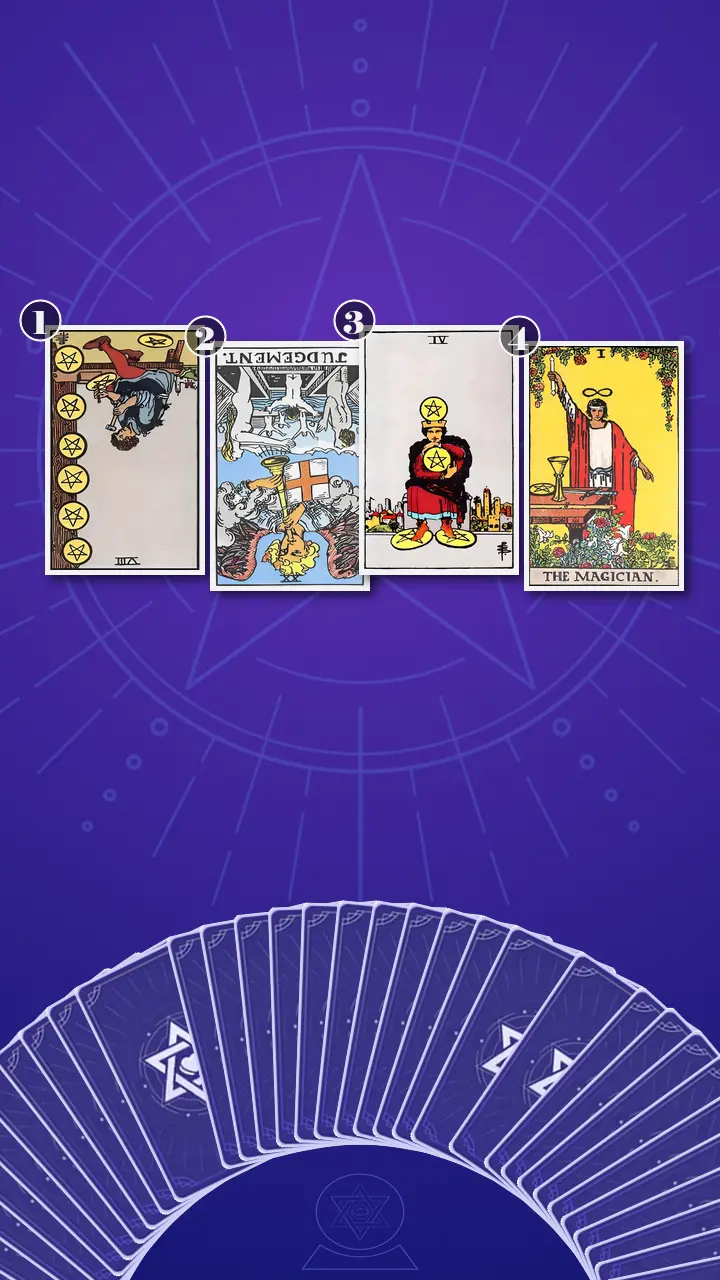
I placed the cards in a horizontal line. The first would show the visible loop. The second would reveal the hidden standard Jordan was trying to satisfy. The third would name the protective payoff of keeping the message in Drafts. The fourth would show an integration move, a way to shift from private preparation into chosen action.
Reading the Loop Without Blaming the Writer
Position 1: The Eight of Pentacles Reversed and the Sixth Edit
Now I turned over the card representing the visible loop: the Eight of Pentacles, reversed.
I pointed to the artisan bent closely over one pentacle while completed pieces accumulated beside him. "This is careful work that has lost its stopping point," I said. "The reversal does not mean you lack discipline. It shows an excess of refinement and a blockage around completion."
I brought the image directly back to Jordan's screen. At 10:47 p.m., the email already contained its purpose, context, and request. Yet three etiquette guides remained open while Jordan swapped "hoping" for "would like," adjusted the sign-off, and reread all six sentences. The changes were possible, but they were no longer helping the advisor understand or answer the question.
"At some point, you are no longer fixing the email; you are postponing being read," I said. "The last time you reopened it, which words did you change, and did the change make your request easier to answer?"
Jordan gave a short laugh that carried more sting than humor. "That's so accurate it's almost rude," they said. Their fingers tightened around their mug, then loosened. "No. The question stayed exactly the same."
"Then the editing was still serving a purpose," I replied. "It just was not the email's purpose. It was helping you delay the moment when control would pass to another person. We can respect why that felt useful without pretending it moved the conversation forward."
Position 2: Judgement Reversed and the Imagined Examiner
Now I turned over the card representing the hidden standard: Judgement, reversed.
The angel's trumpet ordinarily calls the figures below to rise and participate. Reversed, I read that call as obstructed by punitive self-assessment. The energy of reflection had tipped into excess. Instead of supporting honest review, it had become an internal examination with no passing grade.
I asked Jordan how the email sounded when they reread it. They admitted they silently performed every line in their advisor's sternest possible voice. The private logic ran like this: "If they notice that I am uncertain, they might conclude that I am unprepared, and that would mean I do not deserve to be in this program."
As I set the card down, the radiator behind Jordan went quiet. For a few seconds, the laptop fan was the only sound between us.
"The advisor is receiving a request, not conducting an oral exam on your worth," I said. "Judgement reversed is not evidence that your advisor will judge you. It is showing us how much imagined meaning has been attached to an ordinary act of participation."
Jordan's breathing paused. Their eyes drifted away from the cards as if they were replaying several old drafts at once. Then their shoulders dropped by a fraction.
"I do make the email longer whenever the question makes me look unsure," they said quietly. "I add background so they can see I have done the work."
"And the background may be accurate," I said. "The distinction is whether it helps the advisor answer or whether it is being asked to defend your right to ask."
Position 3: The Four of Pentacles and the Safety of Drafts
Now I turned over the card representing the protective payoff: the Four of Pentacles, upright.
I traced the figure clutching one pentacle against his chest while two more were pinned beneath his feet. Here, stable Earth energy had become excessive containment. The message was secure, but it could not travel. The distant city on the card looked like the professional relationship waiting beyond that grip.
"As long as the email stays in Drafts, every word remains editable," I said. "No reply can arrive. No part of the interaction can surprise you. You retain control over the wording, timing, and every hypothetical interpretation."
I did not frame that protection as irrational. Avoidance often persists because it works in the short term. Saving the draft lowered Jordan's discomfort for a few minutes, even while it left the research question unresolved and made the next attempt feel more consequential.
Jordan released a long breath and rubbed their thumb along the mug's rim. "One more edit feels easier than dealing with a reply," they said. "And if I haven't sent it, I can still prevent them from misunderstanding me."
"Exactly," I said. "A draft can be complete while the discomfort is still unfinished. But the email cannot offer both total control and real contact. Control ends at Send; communication starts there."
When The Magician Changed the Email's Job
Position 4: The Magician Upright and the Tools Already Present
The final card was the one I had been waiting to see. A streetcar bell sounded faintly through Jordan's window as I turned over the card representing the integration move: The Magician, upright.
The four suit tools rested openly on the Magician's table. I saw Jordan's equivalents immediately: the relevant research context, a clear question, an available calendar, and an email client. The balanced energy of this card did not ask Jordan to acquire perfect confidence. It asked them to coordinate resources they already had and use them for one observable purpose.
At position four, the modern version of The Magician was simple: Jordan would reduce the existing email to purpose, context, and one direct request; check the advisor's name, dates, links, and research details once; then stop editing low-impact tone choices. The draft would become a tool for initiating contact instead of an exhibit of competence.
Ten years of sound-energy research have trained me to listen for the rhythm underneath a stuck process. Through a lens I call Cognitive Tempo Calibration, I heard a severe mismatch: this task needed three clean beats, clarify, verify, choose, but pressure had turned it into an endless remix. Jordan was trying to complete the emotional uncertainty through wording, so the track could never feel finished enough to release.
I named the exact loop in front of us: three sample-email tabs beside a finished draft, Jordan's jaw set, "I was hoping to ask" changing back to "I would like to ask," and the cursor retreating from Send. Discomfort had been mistaken for evidence that the task itself remained incomplete.
I gave The Magician's message in two clean beats.
The email does not need to prove you are ready. It only needs to carry one clear request from Drafts into a real conversation.
Stop treating the draft as a test of worth; use the words already on your table to make one clear request, as The Magician turns available tools into action.
I left the words in the quiet for a moment.
Jordan's breath stopped first. Their fingers remained suspended above the trackpad, and their eyes widened before losing focus, as though an old week of drafts were scrolling behind them. Their eyebrows drew together. "But doesn't that mean I made this into a huge thing for no reason?" they asked, their voice suddenly sharper. "Were all those edits just pointless?"
"No," I said. "They protected you from a moment that felt exposing. That protection was real, even when its cost became too high. Seeing the pattern now does not make your earlier self foolish. It gives your present self another option."
The tension around Jordan's mouth softened. Their hand settled flat beside the laptop, and their shoulders lowered as they released a wavering breath. Their eyes shone, but the relief was not uncomplicated. For a few seconds, they looked almost unmoored by the responsibility that came with clarity. "So I don't have to feel ready," they said. "But I do have to decide what I want the email to do."
"Now, using this new perspective, think back to last week," I said. "Was there a moment when this insight could have made you feel different?"
Jordan remembered opening the draft on Line 1 after a classmate posted about a supervisor meeting in the cohort chat. They had added an entire paragraph of background. "The email didn't need that paragraph," they said. "I was reacting to the comparison, not improving the request."
I named the change I had just witnessed: this was one small crossing from contracted apprehension and fear of being judged to pragmatic self-trust in ordinary professional communication. It did not require the discomfort to vanish. It required Jordan to stop appointing that discomfort as the email's editor.
The Syncopated Route from Draft to Dialogue
I gathered the four cards into one coherent sequence. The Eight of Pentacles reversed showed care circling after the practical work was done. Judgement reversed revealed why every minor phrase felt consequential: Jordan had turned an advisor request into a verdict on belonging. The Four of Pentacles showed the immediate relief supplied by holding the draft. The Magician preserved the care but changed its function, directing it toward contact.
The core image was a key polished until it gleamed but never placed in the lock. Jordan's blind spot was not a lack of communication skill. It was the belief that a surge of discomfort near Send meant the message still needed work. The transformation was from making the email prove competence to letting it perform one limited job.
I also conducted a brief Focus Disruption Audit. The dissonant chords were specific: the three etiquette tabs, Grammarly acting like an unofficial permission check, the imagined advisor voice, and the cohort chat becoming an invisible progress scoreboard. None of those inputs had to be banned. They simply needed to be removed from the final review window so Jordan could hear the actual request.
I turned my Syncopated Study Session into two small experiments. I emphasized that Jordan could stop, modify the word limit, or choose not to send. Tarot had clarified the pattern; it had not taken ownership of the decision.
- Separate the verdict from the request. Before opening Gmail, use a private phone note and write two unpolished lines: "Feared verdict: they will think I am unprepared" and "Actual request: I need guidance on which research direction to pursue." Stop after one sentence in each line; the exercise should take less than two minutes. If naming the feared verdict feels too exposing, write only the actual request. The goal is separation, not another polished assignment.
- Run the eight-minute Syncopated Study Session. Work only from the current draft. Beat one: label each sentence Purpose, Context, or Request. Beat two: remove only sentences that serve none of those jobs and aim for 120 words, or 160 if that is more workable. Beat three: check the advisor's name, dates, links, and research details once. Beat four: read the direct request in a neutral voice, then choose Send or a ten-minute scheduled send. Close Gmail afterward and take a ten-minute walk or tea break. Do not open another template during the timer. If eight minutes feels like too much, identify the one request sentence and stop there; that minimum version still counts.
I asked Jordan to notice the structure: the factual review had a boundary, the tone-polishing loop lost its unlimited access, and the final choice remained theirs. That was The Magician's agency in practical form, not certainty about the response, but the ability to use available tools deliberately.

A Week Later, the Quiet Proof
Three days later, I received a message from Jordan: "Sent at 2:30 after seminar. I used scheduled send, made tea, and didn't cancel it. It still felt weird, but now I'm thinking about the conversation instead of the greeting."
The advisor had not replied yet. I was glad Jordan mentioned that, because the value of the experiment did not depend on a perfectly reassuring response. The observable change was smaller and more durable: Jordan had completed one factual review, tolerated an unfinished feeling, and allowed the email to begin doing its job.
The next morning, their first thought was, "What if the tone was wrong?" Jordan told me they smiled at the familiar rhythm, left the Sent folder closed, and went to class. Clarity had not made them invulnerable. It had made the old loop recognizable before it could take over the entire morning.
I think of that as the honest shape of a Journey to Clarity. The cards did not press Send; Jordan did. Tarot offered an external map of the pattern, but the decision, timing, boundaries, and capacity for change remained with them.
When a six-sentence email makes your jaw tighten and your hand retreat from Send, the painful part is how quickly being read starts to feel like a verdict on whether you deserve to be here. If you notice that shift, you are already hearing the difference between the practical task and the louder internal track laid over it.
I leave you with the question at the center of Jordan's reading: if the draft on your screen were no longer a thesis-defence exhibit but one usable tool on The Magician's table, what is the smallest clear request you can imagine letting it carry from Drafts into dialogue?
Every reading at AceTarot is a journey to connect with inner wisdom and empower the path ahead. This reading shared here is a psychological mirror, not a private record—crafted to reflect universal emotional loops and help restore personal clarity. Please note that these insights do not replace professional psychological, medical, legal, or financial advice, and should not serve as the sole basis for major life decisions.
Learn more about our Journey to Clarity.
How did this insight land for you?
🫂 This Resonates Deeply
🌀 Living This Story
✨ Now I See Clearly
🌱 Seeing New Possibilities
🧰 Useful Framework
🔮 The Confirmation I Needed
💪 Feeling Empowered
🚀 Ready for My Next Step
Author Profile
 AI
AI Alison Melody
996 readings | 597 reviews
“Through ten years of sound energy research, I’ve found that when we struggle, it's usually just our internal rhythm falling out of sync under pressure. I know firsthand the frustrating helplessness of wanting to move forward but feeling paralyzed. Without overwhelming theories, I want to be the soothing background track that helps you recalibrate, turning your heavy burdens back into a light, effortless, and harmonious melody.”
In this Study Tarot Reading :
Core Expertise
- Cognitive Tempo Calibration: Diagnosing study burnout as a severe mismatch between task demands and your natural neurological rhythm.
- Focus Disruption Auditing: Pinpointing the specific 'dissonant chords' (internal or external) that continuously shatter your deep-work flow state.
Service Features
- The Syncopated Study Session: A customized rhythm protocol that breaks overwhelming academic tasks into harmonious, frictionless micro-beats.
Also specializes in :
Explore Related Patterns:
Control CopingJordan explains that one more edit feels easier than dealing with a reply and that an unsent message can still be protected from misunderstanding. While the email remains in Drafts, every word is editable, no response can arrive, and the advisor cannot introduce an interpretation Jordan did not anticipate. Rewriting therefore preserves a closed environment in which uncertainty appears manageable. The protection works briefly, which is why the loop can persist even while the research question remains unresolved. When you try to control another person's future reading through increasingly exact wording, communication becomes impossible to complete because interpretation can never be fully owned from the sender's side. Control Coping identifies the protective payoff of delay without dismissing it as irrational. The strategy reduces exposure in the short term while blocking the real contact the email was meant to initiate.
Shame-Driven DelayJordan's private reasoning moves from being seen as uncertain to being judged unprepared and then to not deserving a place in the program. Sending therefore exposes more than a request in Jordan's internal narrative. It appears to expose a potentially disqualifying version of the self, so returning to the draft postpones that identity-level risk. The delay offers real short-term protection because an unsent email cannot yet be interpreted by anyone else. When you polish or lengthen a message to avoid the possibility that a need will reveal inadequacy, delay becomes a defence against shame rather than a simple time-management problem. Shame-Driven Delay captures why practical readiness does not produce action and why recognizing the protective function can create a choice without blaming the person who needed that protection.
Achievement-Based Self-WorthJordan explicitly links one visible uncertainty to appearing unprepared and then to not deserving a place in the master's program. That chain turns a routine request for guidance into an evaluation of personal worth. The email is no longer being asked only to communicate a research question. It is also being asked to prove that Jordan has earned the right to ask it. When you make belonging conditional on displaying competence, ordinary learning needs can feel like evidence against you. Extra background and highly controlled tone then become attempts to protect self-worth through performance. Achievement-Based Self-Worth names the deeper schema because the stakes of sending come from what the message is imagined to establish about your value, not from the six sentences themselves.
Authority HypervigilanceJordan silently performs every line in the advisor's sternest possible voice and monitors each phrase for evidence of being unprepared. Nothing in the case establishes that the advisor is actually reading the message this way. The anticipated authority response has entered the private editing process before the advisor has received anything. When you mentally rehearse the harshest possible reading from someone with evaluative power, ordinary wording begins to feel professionally dangerous. Attention narrows toward etiquette, tone, and competence signals while the clear request becomes secondary. Authority Hypervigilance names this threat-monitoring process because the imagined examiner, rather than the email's actual purpose, is setting the standard for when the message is safe enough to send.
Emotional ReasoningJordan's jaw tightens, shoulders rise, and hand retreats from Send even though the draft already contains everything the advisor needs. That internal surge is treated as evidence that the wording remains wrong, so the message is reopened and another low-impact phrase is changed. A feeling of incompleteness has been substituted for an objective test of whether the request is complete. The same tone worry returns the morning after the email has been sent, showing that more editing could never guarantee the feeling's disappearance. When you interpret discomfort as proof that a task still needs work, emotion acquires authority over the stopping rule. Emotional Reasoning explains why the rewrite loop feels rational from inside it while factual evidence keeps saying that the email is already ready to do its limited job.
Perfectionism-Driven AvoidanceJordan's six-sentence email remains in Drafts for three days while one ordinary sentence moves back and forth between two equivalent versions. The request, context, and purpose are already present, but the cursor retreats from Send and care continues after it has stopped improving communication. The revisions therefore protect Jordan from being read rather than fixing a practical defect in the message. Each extra edit offers a brief sense that exposure can still be prevented if the wording becomes precise enough. When you use refinement this way, the absence of a perfect stopping feeling becomes permission to continue indefinitely, and the completed task remains psychologically unfinished. Perfectionism-Driven Avoidance captures this loop because high standards are functioning as a delay mechanism at the threshold of visibility.
Uncertainty ToleranceJordan sends the email through scheduled send, makes tea, and does not cancel it even though the experience still feels strange. The action does not come from achieving perfect confidence. It comes from allowing unresolved discomfort to coexist with a bounded, personally chosen decision. The next morning, the familiar question about whether the tone was wrong returns, but Jordan leaves the Sent folder closed and goes to class. When you can notice uncertainty without reopening the task it attaches itself to, the feeling stops functioning as a command. Uncertainty Tolerance means retaining agency while an outcome remains unknown, not forcing yourself to feel calm or assuming the response will be reassuring.
Defensive OverexplainingJordan says the email becomes longer whenever the question makes them look unsure, and they remember adding an entire paragraph after seeing a classmate mention a supervisor meeting. The added background may be factually accurate, but Jordan recognizes that it does not help the advisor answer. Its psychological job is to display preparation before the request exposes a need for guidance. When you explain beyond what the conversation requires, extra context can become a shield against an anticipated negative interpretation. The message starts defending your right to ask instead of simply carrying the question. Defensive Overexplaining captures that function because the added detail is not random verbosity. It is a pre-emptive attempt to manage how uncertainty will be judged.
Explore Related Struggles:
Competence-Connection SplitJordan wants a normal conversation with their advisor and already knows which research question to ask. Yet whenever the question makes them look uncertain, they lengthen the email so the surrounding detail can prove that they have done enough work. The message is therefore carrying two jobs that interfere with each other. It needs to request guidance, but it is also being asked to establish that guidance should not have been necessary. When you make visible competence the admission price for support, the effort to look prepared can keep the useful conversation from beginning. This split locates the friction between proving and connecting. You can preserve the care behind your preparation while allowing a direct request to be an ordinary form of academic participation rather than a failure of self-sufficiency.
Completion-Exposure BindJordan's email has been finished for three days, yet the cursor retreats from Send while one ordinary sentence keeps changing. The practical task has reached its endpoint, but acting on that completion would move the message from a private workspace into another person's view. When you can continue refining indefinitely, preparation remains under your control and exposure remains optional. That makes the final edit feel safer than the final action, even when the edit no longer improves what the recipient can understand or answer. The bind is not evidence that the email needs more work. It marks the point where careful preparation and visible participation begin asking different things of you, leaving you to choose what the completed message is now meant to do.
Control LockAs long as Jordan's email stays in Drafts, every word remains editable, no reply can arrive, and every imagined interpretation can still be managed. Reopening the subject line and consulting another template preserve a closed environment in which the interaction belongs entirely to the writer. Real communication changes that arrangement. When you press Send, the wording stops moving and another person gains the freedom to read, answer, delay, or misunderstand. The editing loop keeps that transfer from occurring, so its protective value is real even while it blocks the guidance the message was created to seek. Control Lock names the point at which retaining every option removes the option that matters: actual contact. Recognizing that exchange makes the next decision clearer without requiring certainty about the response.
Performance-Worth FusionJordan rereads every line in the advisor's sternest possible voice and follows a specific chain: visible uncertainty could look like poor preparation, and poor preparation could become evidence that they do not deserve to be in the program. An ordinary request is consequently staged as an examination with no dependable passing grade. When you make the email longer to prove that you have done the work, wording starts carrying responsibility for your standing as well as your question. No six-sentence message can conclusively establish both, so each revision exposes another detail that appears to require a defense. The locked structure is the fusion of a limited performance with a global verdict on worth. Separating those scales allows the email to remain evidence of one practical need, not a final ruling on your competence or belonging.
Tone-Truth FusionJordan knows exactly what they need to ask, but keeps exchanging 'I was hoping to ask' for 'I would like to ask' while the underlying question stays unchanged. Three templates and repeated tone checks make small wording differences carry more weight than the actual request. Once tone is asked to prevent every possible misunderstanding, the sentence can never become conclusively right. You are no longer reviewing whether the message communicates clearly; you are trying to make language control how another person will read your uncertainty, something no phrasing can fully guarantee. The workable distinction lies between what the email says and what Jordan hopes its tone will secure. Seeing those as separate restores a stopping point: the request can be clear even while its reception remains outside the writer's control.
Explore Related Emotions:
Cautious Self-TrustJordan used scheduled send, made tea, and chose not to cancel the message even though sending still felt strange. The next morning, the familiar question about tone returned, but Jordan left the Sent folder closed and went to class. This is not confidence produced by eliminating every uncertain feeling. You make a bounded factual check, choose what the communication needs to do, and allow that choice to stand while discomfort remains present. Cautious Self-Trust captures the restrained but durable sense that your judgement can guide action without first becoming perfectly certain.
Imposter Exposure FearJordan's private reasoning moved rapidly from looking uncertain, to appearing unprepared, to not deserving a place in the master's program. The email consequently took on the job of proving competence, as though an ordinary request for guidance were a miniature defence of academic legitimacy. When one imperfect interaction seems able to reveal that you never truly belonged, you may try to remove every trace of uncertainty before anyone can see it. Imposter Exposure Fear names that identity-level apprehension. The threat is not merely that a sentence will sound awkward, but that the sentence will disclose something supposedly disqualifying about you.
Need Exposure DreadJordan knew exactly what guidance they needed, yet they kept adding background whenever the question made them look unsure. The extra explanation did not help the advisor answer; it was being asked to defend Jordan's right to ask in the first place. A direct request reveals the gap between what you know and what you still need from another person. When that gap feels exposing, preparation can become protective cover, and the message grows around the vulnerable sentence at its centre. Need Exposure Dread captures the wish for support colliding with the discomfort of being visibly in need of it.
Verdict DreadJordan silently performed every sentence in the advisor's sternest possible voice and imagined that visible uncertainty could become evidence that they did not deserve to be in the program. Six sentences stopped functioning as a request and became an internal examination with no reliable passing grade. Once being read feels equivalent to being judged as a whole person, you are no longer editing only for clarity. You are trying to prevent a verdict through wording, which makes even small choices feel capable of protecting or exposing your worth. Verdict Dread names the heavy anticipation created by that imagined evaluation.
Reply AnxietyJordan said that one more edit felt easier than dealing with a reply. While the message remained in Drafts, every word stayed editable, no response could arrive, and no part of the interaction could move outside Jordan's control. Sending makes room for another person's timing, interpretation, and answer. If that open space feels difficult to hold, you can keep working on the message because revision postpones the relational uncertainty that follows it. Reply Anxiety names the charged anticipation beneath the editing loop, where the next response feels harder to face than the next revision.
Completion AnxietyThe email had been complete for three days, but one ordinary sentence kept changing while the request itself stayed exactly the same. The cursor could approach Send only to retreat into another round of editing, making emotional unease look like unfinished practical work. When a task crosses from private preparation into irreversible contact, you can lose access to any stopping point that facts alone would justify. Completion Anxiety names the unsettled threshold where the work is objectively done but does not yet feel safe enough to release, leaving every remaining sensation available as a reason to revise.
Clarity AmbivalenceJordan's shoulders lowered when the rewriting loop became visible, but their voice then sharpened as they asked whether all those edits had been pointless. A moment later, they recognised that they did not need to feel ready, while also seeing that the decision about the email's purpose now belonged to them. Clearer understanding can loosen confusion without making the next choice emotionally simple. You gain another option, but you also lose the temporary shelter of believing that more polishing is required. Clarity Ambivalence names that mixed inner weather, where recognition brings release and responsibility at the same time.
Pattern Recognition CalmThe morning after sending, Jordan noticed the familiar thought that the tone might have been wrong. They smiled at its recognisable rhythm, kept the Sent folder closed, and continued to class instead of turning the thought into another checking session. Once you can identify a loop as it arrives, the thought no longer has to define the condition of the task or dictate your next move. Pattern Recognition Calm names the quieter space created by that distinction. The old signal is still audible, but it can be observed without being appointed as the editor of the rest of your morning.
Explore Related Contexts:
Advisor Outreach ParalysisJordan's six-sentence email has been complete for three days, yet three etiquette tabs remain open, one ordinary phrase keeps changing, and the cursor repeatedly retreats from Send. The edits no longer alter the research question or make it easier for the advisor to answer. This places Jordan at a specific institutional threshold: advisor guidance is available through direct contact, but that channel cannot function while every act of completion reopens another tone review. The practical problem is no longer writing the message. It is that a finished request remains unable to enter the academic relationship where the unresolved research direction can actually be discussed. When you can identify this threshold as an outreach bottleneck, you gain a more precise question than whether the wording is perfect. You can separate the factual work the email still needs from the moment when control must pass into a real conversation, while keeping the timing and final decision in your hands.
Model Student Performance TrapJordan says they want to look prepared before admitting that they need guidance. They lengthen the email whenever the question exposes uncertainty, and after a classmate mentions a supervisor meeting in the cohort chat, they add an entire paragraph that does not help the advisor answer the request. The email is therefore carrying an unofficial performance contract alongside its practical purpose. Instead of simply presenting a student's research question, it is being asked to display enough prior work to justify asking at all. That turns ordinary participation in graduate supervision into a test of whether Jordan can maintain the appearance of the fully prepared student. When your request is being made to prove that you deserve to make it, refinement has no natural endpoint. Recognizing the performance demand lets you audit which details support the advisor conversation and which details are serving as exhibits of competence, without surrendering your standards or your right to choose how you communicate.