When Starting Felt Like Exposure: Turning a Paragraph Into Evidence
The 9:40 p.m. Hidden-Curriculum Spiral
“I keep preparing to study instead of studying.” That was the first thing Alex (name changed for privacy) told me when they joined our video call from a small London flat. At twenty-four, in the first term of a postgraduate programme, they had begun to wonder whether their hidden-curriculum study procrastination meant they lacked discipline, direction, or some unnamed quality everyone else had quietly acquired.
It was 9:40 p.m. The laptop fan hummed loudly enough for me to hear it through my headphones, and a radiator clicked behind Alex like an impatient metronome. On their screen, an assigned article sat behind a colour-coded planning board; beside it, an assessment brief asked for “critical engagement” without showing what that should look like. Alex renamed three module folders, checked the course WhatsApp, then rested both hands on the desk without opening the article.
The warm rectangle of their phone lit one side of their face. Their shoulders remained raised, as if beginning the reading meant taking hold of a door handle that might trigger an alarm. “Everyone seems to know the rules except me,” they said. “I don’t know whether I’m stuck on the work or on the point of doing it. What am I avoiding by delaying study in a system no one explained?”
I let the question settle. “You’re not doing nothing,” I said. “You’re doing everything that postpones the moment when the work might tell you what you don’t yet know. That makes sense as protection, even if it’s no longer helping. Let’s use the cards to draw a map of the fog, not to issue a verdict about you.”

Choosing a Ladder Through the Fog
I asked Alex to place their phone face down, breathe once without trying to make the breath impressive, and say the question again in its simplest form. I shuffled slowly. I treat this small ritual as a transition of attention, not as theatre: it marks the point when circling the problem gives way to examining it.
I chose the Four-Layer Insight Ladder, a four-card tarot spread designed to move from a visible pattern to its protective root, then to a transforming stance and a grounded action. I was not forecasting Alex’s grades, career, or future. I was using tarot as an objective cognitive tool, one that could separate behaviours, assumptions, emotions, and available choices that had become compressed into the single sentence, “I can’t start.”
For anyone wondering how tarot works in a question about study procrastination, the spread was deliberately small. A ten-card Celtic Cross would have produced more information than this problem needed, while a decision spread would have falsely framed the issue as a simple choice between studying and not studying. Alex needed four distinct layers: what happens at the desk, what the delay protects, what stance could loosen the pattern, and how that stance could become a practical next step.
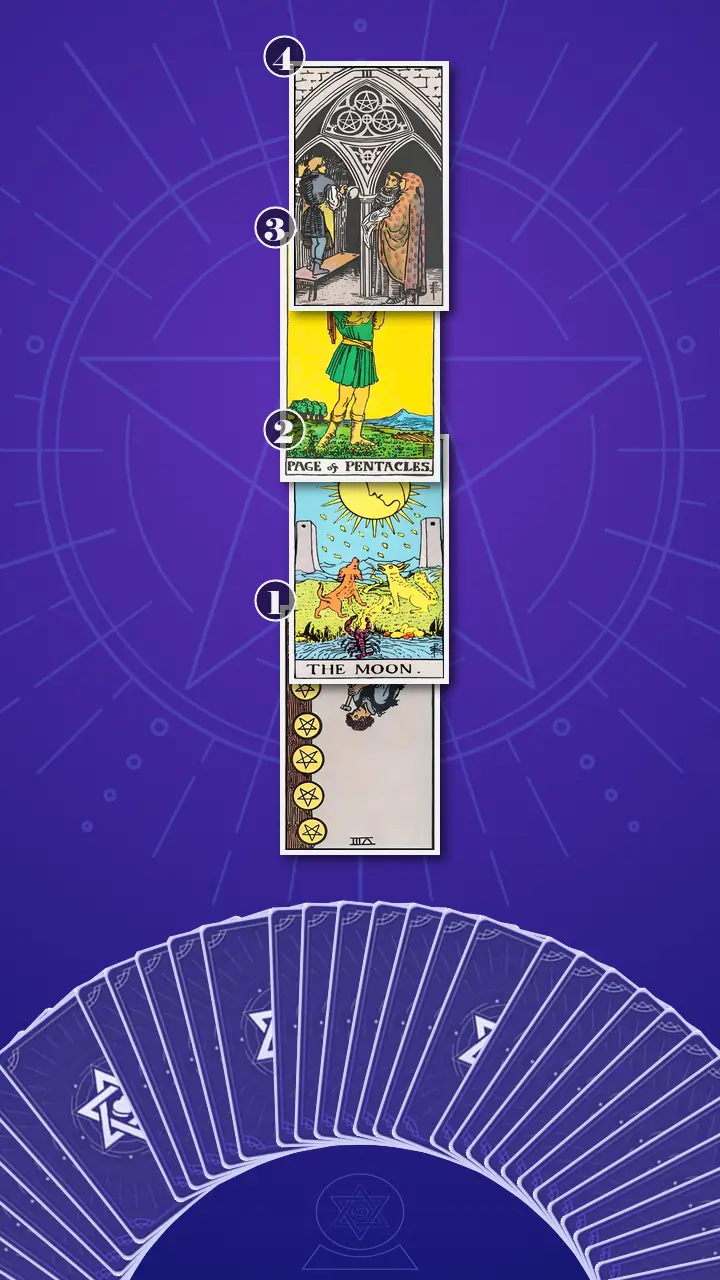
I arranged the cards vertically like a short ladder. The first would show the surface behaviour. The second would uncover what beginning felt likely to expose. The third would identify the bridge from fear to participation. The fourth would show how a hidden academic expectation could become visible through real work and feedback.
Reading the Workshop That Never Opens
Position One: Work Around the Work
I began with the card representing the surface pattern: the observable study behaviours through which procrastination and loss of direction currently appeared. I turned it over. It was the Eight of Pentacles, reversed.
In the Rider-Waite-Smith image, a craftsperson sits at a bench with a sequence of pentacles arranged around him. Upright, the card carries the rhythm of repetition, attention, and competence built through practice. Reversed, I read its earth energy as blocked. Effort remains present, but it has been redirected away from the craft and into the appearance of a well-managed workshop.
I pointed from the ordered pentacles to the planning board behind Alex. “This is your polished Notion workspace, your colour-coded calendar, and your folders named for every module. At 9:40 p.m., you adjust the labels, check another productivity guide, and read only the abstract. The organisation is real. So is the effort. But the craft itself has been displaced into preparation.”
I heard an old internal rule inside the card: If I can perfect the system first, I won’t have to find out whether I can do the task. That was why I told Alex, plainly, “A study system is not evidence of studying.”
Their fingers stopped beside the trackpad. Their eyes stayed on the reversed card for several seconds, then they gave a short laugh with no amusement in it. “That’s too accurate,” they said. “Honestly, it feels a bit brutal.”
“Then I want to slow it down,” I replied. “This card is not calling you lazy, and neither am I. It shows that you’ve built a sophisticated protection strategy. The important question is not why you haven’t tried harder. It’s what direct practice has come to mean to you.”
I asked what usually happened in the first ten minutes after they opened a vague assignment. Alex listed it quickly: search for model essays, check whether classmates had discussed the brief, compare annotation methods, rebuild the week, feel behind, close the reading. I could see their shoulders grow heavier as the sequence became audible. The card had not discovered a secret fate. It had made an existing loop visible enough for Alex to interrupt.
Position Two: The Path Under Partial Light
I moved to the card representing the protective root: what delaying study prevented Alex from having to feel, test, or discover about the unexplained system and their direction within it. I turned over The Moon, upright.
I traced the narrow path between the two towers. The path exists, but the moonlight does not reveal its ending. “This card doesn’t tell me that your fear is imaginary,” I said. “The assessment brief really is vague. ‘Critical engagement’ is not a usable instruction when no one shows you where it becomes visible in a paragraph. The institution has left part of the route unmarked.”
What The Moon revealed was the second layer. Late on Sunday, Alex would read the broad criterion and mentally convert the missing example into an invisible standard that everyone else already understood. One rough draft no longer meant I am testing an interpretation. It meant I may expose that I don’t belong here. A genuine information gap became the starting point for a much darker prediction.
I read the Moon’s water as an excess of uncontained uncertainty. Without a boundary, one unclear rubric phrase spread into doubts about competence, belonging, control, and the meaning of the whole programme. It was like being dropped into a software onboarding flow that assumed the settings were obvious, then blaming yourself for searching every menu. The design problem was real; the conclusion that struggling with it proved personal inadequacy was not established evidence.
Years spent among Cambridge libraries and archaeological trenches have taught me to notice bottlenecks without treating them as character flaws. I call this Research Bottleneck Analysis: when work stops, I ask what missing evidence, undefined standard, or overburdened question is blocking movement. Alex’s bottleneck contained two different things that had fused together: “The brief does not specify what this means” and “If I ask, I will reveal that I should not be here.”
“Starting feels like volunteering to find out what you missed,” I said.
Alex’s jaw tightened first. Then their gaze moved away from the cards, as if they were replaying a seminar in which classmates had casually talked about “situating the discourse.” Finally, their hands loosened on the edge of the desk. “That’s exactly it,” they said. “I’m not waiting because I think studying will be boring. I’m waiting because the first bad paragraph feels like evidence.”
“Evidence of what?” I asked.
“That everyone else learned the private style guide and I didn’t.”
I nodded. “The missing style guide is a fair criticism of the system. The prediction that one imperfect paragraph will settle your worth, belonging, or future is the Moon filling incomplete information with its most alarming interpretation. We can respect the real gap without surrendering to the added verdict.”
When the Page Held One Thing Steady
Position Three: The Apprentice’s Test Trench
The room seemed to quiet when I reached the card representing the key transformation: the specific stance that could loosen the need to understand every hidden rule before beginning. Even the radiator stopped clicking for a moment. I turned over the Page of Pentacles, upright.
The Page holds one pentacle at eye level. The mountains remain in the distance, but the Page is not trying to climb them all before lunch. The card’s earth energy is balanced and concentrated: seriousness without the performance of expertise, curiosity anchored to one tangible object, and self-trust built through evidence rather than reassurance.
I asked Alex to picture the same 9:40 p.m. desk. The folders were perfect, the group chat was open, and the article was still untouched. Their shoulders were heavy because beginning felt less like learning and more like volunteering to discover what they had missed.
This was where my archaeological instincts came forward. I use Academic Stratigraphy to stop fragmented questions from collapsing into one overwhelming mass. On a dig, I do not claim to understand an entire site before opening a bounded trench. I identify the visible layer, preserve the context, examine one find, and let that evidence produce the next responsible question.
I showed Alex the four layers in their own case. The surface layer was the folder-renaming. Beneath it sat a genuinely vague academic standard. Beneath that lay the prediction that asking for help would expose them. The usable evidence layer had not yet formed because no paragraph had been attempted. “Your planning isn’t worthless,” I said. “It simply cannot answer the question that only contact with the text can answer. One paragraph is your test trench.”
You are not required to prove that you already understand the hidden curriculum; examine one real piece of work, ask what it teaches you, and hold it as steadily as the Page holds the pentacle.
I stopped speaking.
Alex’s breathing paused. Their fingers hovered above the laptop as if the next movement had briefly disappeared from the script. Then their eyes lost focus, and I watched recognition travel across their face while they replayed an evening of opening twenty tabs around one untouched article. Their brow drew tight before their eyes reddened slightly. “But doesn’t that mean I’ve been doing all of this wrong?” they asked, with a flash of anger that sounded partly directed at the course and partly at themselves. I told them no: the planning had protected them from an experience that felt unsafe, and the university’s ambiguity was still real. The new insight simply gave the protection a smaller job. Alex looked back at the Page. Their fist relaxed, finger by finger; their shoulders lowered; and a long breath left their chest with a quiet, unsteady “Oh.” Relief arrived first, followed by the slight dizziness of recognising that a clearer path would also require a choice.
“Now, with this new perspective, think back,” I said. “Was there a moment last week when this insight might have made you feel different?”
Alex considered it. “Sunday. I spent forty-eight minutes looking for model essays. If I’d read one paragraph, I might at least have known what I was confused about.”
That answer marked the real turn. I was watching the beginning of a shift from braced uncertainty and fear of exposure to grounded beginner curiosity and supported participation. It did not erase the hidden curriculum. It changed the role of the first attempt. The paragraph could become evidence about the system rather than a verdict about Alex.
I asked them to imagine bringing one browser tab into focus, setting a bounded timer, highlighting one claim, and writing a rough interpretation before searching for another method. The Page did not promise that the whole programme would suddenly make sense. It offered something more credible: three questions generated by the material itself. The inner demand, I need the full map, could become, I can inspect the next visible piece.
“You do not need the whole map to inspect the next piece of ground,” I said. “And you remain in charge of the pace. Ten minutes is enough to gather evidence. You can stop when the timer ends. Choosing to stop does not invalidate what you learned.”
Position Four: The Rubric Becomes a Shared Plan
I turned to the card representing the grounded integration: a practical way to make hidden expectations visible through real work, precise questions, and collaborative feedback. The final card was the Three of Pentacles, upright.
In the image, a craftsperson stands with two collaborators beneath an architectural plan. I read its earth energy as stable and relational. Skill is not developed by privately guessing every standard. It grows when a real piece of work enters a shared structure and another person can point to what is already functioning, what is missing, and what should happen next.
I translated the scene into Alex’s week: one unfinished paragraph in a Google Doc, the assessment rubric beside it, and one office-hours conversation. Instead of asking the enormous question, “How do I write a good essay?”, Alex could ask, “In this paragraph, where would you expect critical engagement to become visible: in the source comparison, my interpretation, or the connection to the question?”
The hidden curriculum becomes less hidden when a real question meets a real person. I stressed that asking did not transfer all responsibility onto Alex. Tutors and programmes have a role in making their standards accessible. The card simply showed where Alex still had agency: they could bring a small work sample into a conversation instead of waiting alone for complete fluency.
Alex glanced at the unsent tutor message still open on their phone. “What if the paragraph is embarrassingly rough?”
“Then label it accurately,” I said. “Call it a rough attempt made to clarify one criterion. You are not submitting it for judgment. You are giving another person something concrete enough to respond to. If sending it tonight feels too activating, draft two sentences and save them. Participation remains a choice, not a punishment.”
I saw Alex nod once, slowly. The Page had narrowed the field to one object. The Three of Pentacles reopened it into relationship. Private uncertainty had become something that could be spoken, examined, and revised.
The Thesis Stratigraphy Framework
I laid the four cards back into their ladder. The story they formed was coherent. Accumulated exposure to vague briefs, fast seminars, and apparently fluent classmates had taught Alex to treat academic work like a building with unlabeled doors. At the surface, the reversed Eight of Pentacles showed them studying the floor plan instead of testing a handle. Beneath it, The Moon showed why: engagement might expose not only an information gap, but also a feared lack of competence, belonging, control, or personal direction.
The Page of Pentacles introduced the overlooked resource. Alex did not need a dramatic burst of motivation or another complete productivity system. They needed the teachability to examine one real piece of work. The Three of Pentacles then placed that evidence inside a collaborative structure, where a rubric and a responsive person could make one implicit standard more visible.
I named the cognitive blind spot directly: Alex had been treating prior certainty as the entry requirement for learning. They had also treated a precise question as evidence of incompetence, even though questions are one of the primary ways academic conventions become visible. The transformation was not from confusion to perfect certainty. It was from waiting outside the whole system to gathering evidence inside one bounded part of it.
I adapted my Thesis Stratigraphy Framework into two small actions. In its full form, the framework rebuilds an essay by separating intellectual clutter from the central claim and the evidence that can support it. For Alex, the same principle could make the next study session narrow enough to enter.
“But I honestly don’t know if I can face twenty-five minutes tomorrow,” Alex said.
“Then we don’t turn twenty-five into a moral test,” I replied. “Use ten. The purpose is to generate information, not to prove endurance.”
- Open one 25-minute test trench. Before opening StudyTok, Reddit, the course WhatsApp, or another productivity guide, choose one assigned article at your usual desk. Leave the folders and timetable untouched. Set a 25-minute timer, read one section, underline one claim, write one rough response, and capture three questions. Finish with: “What I can say so far is...” If twenty-five minutes feels too activating, use ten. Keep the field physically narrow: one article, one paragraph, and one document. Stopping when the timer ends is allowed.
- Build one rough-paragraph feedback bridge. Before the next seminar or office hour, place one paragraph from the study block beside the rubric in Google Docs. Send it to a tutor, seminar leader, study partner, or trusted peer with one precise question about a single criterion. Record the reply as one revision principle, not as a complete judgment of the draft. Bring unfinished work deliberately. If sending it feels too exposed, draft a two-sentence message and save it until you choose to send. Ask about one criterion only.
I reminded Alex that these were experiments, not commandments. A tarot reading could expose the structure of a pattern and offer actionable advice, but it could not decide whether the programme remained meaningful to them. That larger question deserved attention too. It simply did not have to be solved at 9:40 p.m. before one paragraph could be read.
Six Days Later, One Sent Message
Six days later, I received a message from Alex. They had started with the ten-minute version, highlighted one claim, and written three questions. The timer ended before the article did. They chose to continue for another fifteen minutes, then placed a rough paragraph beside the rubric and sent the tutor the question we had shaped together.
The tutor’s reply did not decode the entire programme. It identified one sentence where Alex was already interpreting rather than summarising, then suggested adding a contrasting source to make the critical engagement more visible. Alex recorded that as a revision principle. One part of the private style guide had become discussable.
“I still woke up thinking, ‘What if I’m doing it wrong?’” Alex wrote. “But this time I had an actual paragraph to look at, so the thought didn’t get the whole room.”
I recognised the bittersweet proof in that sentence. Clarity had not arrived as permanent confidence. It had arrived as enough space around the old fear for curiosity to survive beside it.
I thought back to the Page holding one pentacle steady. The cards had not opened the article, written the rough response, or sent the message. Alex had done those things. Tarot had served as the map and the excavation tool; the authority to choose, test, pause, ask, and continue had remained with them throughout.
If tonight you are sitting rigid at a desk, reorganising everything except the reading, I want you to remember what that posture may be protecting: starting can feel like handing an unlabeled system the power to turn uncertainty into a verdict about your competence and direction. Noticing that distinction already places your hand on a different door.
If one imperfect paragraph could become evidence about the system rather than a verdict about you, what is the next visible piece of ground you feel curious enough to inspect?