One More Edit at 11:20, Then Three Criteria Led to an Upload Receipt

The 11:20 p.m. Portal Loop
If you are a Toronto doctoral candidate squeezing research between TA hours, and the final journal confirmation button somehow triggers another citation check, you may be dealing with revise-and-resubmit anxiety rather than an unfinished paper.
At 11:20 p.m. on a Tuesday, Maya joined my private video consultation from the kitchen table of her shared apartment. The laptop fan hummed through her microphone. Behind her, a refrigerator clicked on, pans shifted somewhere beyond the camera, and she told me the room still smelled faintly of reheated curry. Word filled one side of her screen; Editorial Manager waited on the other.
I watched her move the cursor toward the upload tab, then back to a sentence covered in Track Changes. The blue-white light sharpened the tiredness around her eyes. Her shoulders sat almost level with her ears, and one side of her jaw flexed each time she reread the same paragraph.
“I keep telling myself it only needs one more pass,” she said. “The major reviewer comments are done. The response letter is done. But then I see one sentence that could sound smoother, or I wonder whether a citation is formatted exactly right. I close the portal, and suddenly it is an hour later.”
Her problem was not a lack of effort. She wanted to resubmit the paper and move forward, but stopping without complete certainty felt like leaving a window unlatched before a storm. Each tiny edit produced a quick pulse of control, then another night ended without a submission receipt. Perfectionism had disguised itself as productive procrastination so convincingly that diligence and avoidance were sharing the same keyboard.
“If I submit and they still reject it,” she said, lowering her voice, “I will have no excuse left. What if it means I am not as capable as I thought? I cannot tell whether the manuscript is unfinished or whether I am scared to be done.”
I did not tell her to “just submit it.” That would have ignored the physical weight of the final confirmation button and the real career stakes attached to the paper. I told her, “Editing can be real work and still be the way you avoid the final decision. I am not here to predict the journal’s answer or pressure you into sending anything tonight. Let us build a map of the loop, separate evidence from exposure, and see whether clarity can give you a fair choice.”

Choosing a Map for the Moving Finish Line
I asked Maya to take her hand off the trackpad, place both feet on the floor, and let one breath leave without trying to make it especially deep or calm. I shuffled slowly under the table camera while she held one question in mind: “Why do I keep revising the same paper instead of resubmitting it?” The small pause was not a mystical performance. I use it to help attention move from compulsive action into observation.
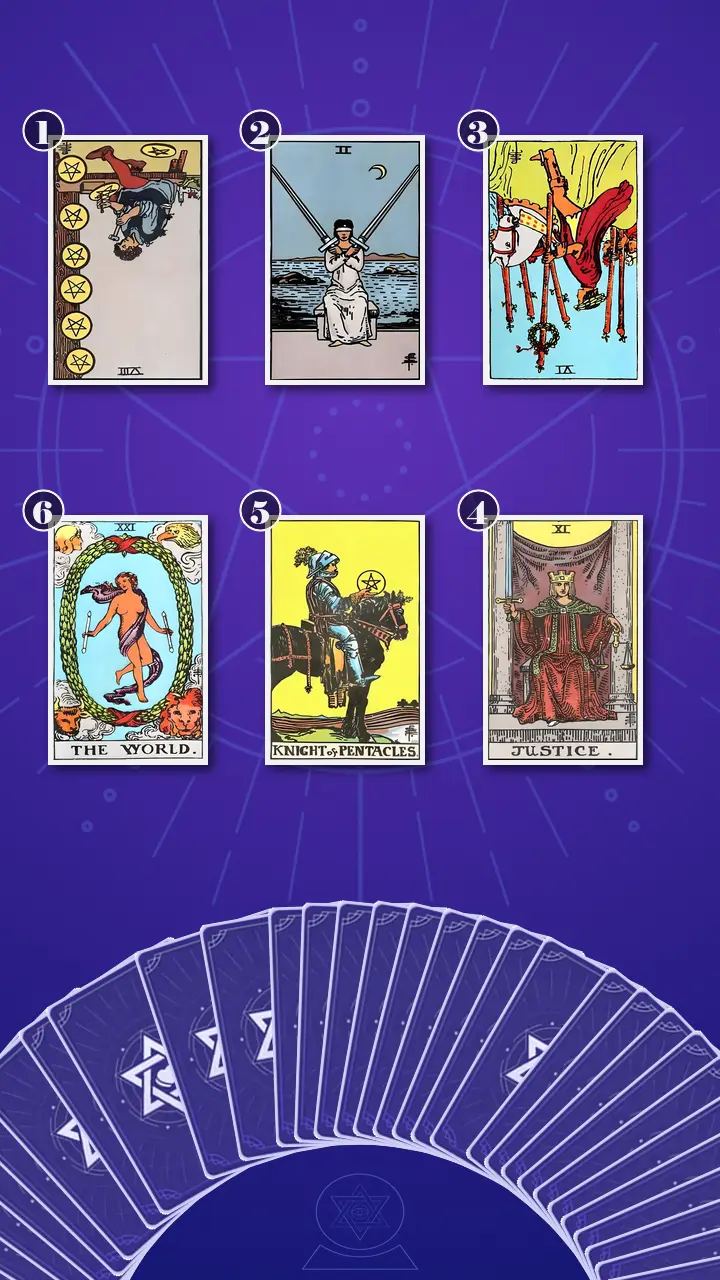
I chose the Transformation Path Grid · Context Edition, a six-card tarot spread arranged in two rows. For anyone wondering how tarot works in a consultation like this, I use the cards as a structured reflective tool. Their images make patterns visible; they do not issue verdicts, diagnose a person, or dictate an outcome.
I chose this spread because Maya was not weighing two genuinely equal options. A decision spread could have implied that indefinite revision and resubmission were parallel paths with equal evidence behind them. What she had described was a self-reinforcing system: another edit brought short-term control, delayed the upload, raised the emotional stakes, and made the next edit feel even more necessary. The Transformation Path Grid was compact enough to trace that whole mechanism without turning one bounded problem into a sprawling life forecast.
I placed the first three cards across the upper row: observable behaviour, immediate blockage, and the fear underneath it. The fourth card would sit below the root and show the leverage point capable of changing the pattern. The fifth would translate that insight into practical action. The sixth would define integration and completion without pretending to know how the journal would respond. The cards formed an S-shaped path, entering through repeated revision and exiting beneath it through a closed cycle.
“I will explain every card meaning in context,” I told her. “If something does not fit, we do not force it. You remain the author of both the manuscript and the decision.”
How Work Became a Place to Hide
Position 1: The Craftsperson Who Could Not Leave the Bench
The card I turned over first represented the observable present-state behaviour: Maya repeatedly performing low-impact edits instead of uploading the revised paper. It was the Eight of Pentacles, reversed.
I angled the card toward the camera. In the Rider-Waite-Smith image, a craftsperson works on one pentacle while a row of completed pieces hangs nearby. Reversed, the scene can show skill becoming overworked, perspective narrowing, or repetition continuing after it has stopped serving the deliverable.
“This is your 11:20 p.m. scene,” I said. “Every major reviewer request has been addressed, but you close the journal portal and spend another ninety minutes changing synonyms, citation punctuation, and paragraph order. The tracked changes make the evening look productive, but no unmet requirement is resolved. The manuscript stays on the private workbench.”
I described the energy as blocked earth with an excess of repetition. The craftsmanship was real; the direction had been lost. Maya was not avoiding work. She was using work to avoid the moment when work could no longer control the response. It was the academic equivalent of reorganising a Notion dashboard for a project whose only remaining task was “send.”
Maya gave one short laugh, but there was no amusement in it. Her mouth pulled to one side while her fingers tightened around the cold mug beside her. “That is so accurate it is a little brutal,” she said.
I let the comment land before answering. “Brutal would be dismissing all the real revision you have done. I am making a narrower distinction. Diligence and avoidance can be true at the same time. The question is not whether an edit requires effort. The question is what function it serves now.”
I asked her to name the last three changes she had made. She listed a synonym swap, a punctuation check, and a reordered sentence. Then I asked which one answered a reviewer request or repaired the central argument.
Her eyes moved away from the screen. “None of them,” she said. Her shoulders did not drop yet, but her grip on the mug loosened. She had not been accused of laziness; she had recognised a recent evening with enough precision to see where responsible craft had crossed into comfort editing.
Position 2: Two Tabs, Neither Allowed to Win
The card I turned over next represented the immediate mechanism maintaining the stagnation lock: postponing the decision about when the paper was ready enough to send. It was the Two of Swords, upright.
I pointed to the blindfolded figure and the two swords crossed defensively over the chest. “In your life, these swords look like Word and Editorial Manager open side by side. If you revise, you do not have to submit yet. If you submit, you lose the option to fix the flaw you have not found. Keeping both tabs open preserves a temporary sense of safety.”
This was air energy in blockage: thought protecting itself through suspended judgment. Maya had treated readiness as a feeling that must arrive before she could choose. Yet every return to the manuscript generated another possible concern, which made certainty less available rather than more.
“Ready is a criterion, not a feeling you have to wait for,” I said. “A feeling can matter without being the only evidence. When you closed the portal last Thursday, could you identify one unmet reviewer request?”
Her breathing paused. Her gaze held on the blindfold, then shifted toward the two tabs still visible on her shared screen. Finally, she exhaled through her nose. “No. I just thought, if I still felt this unsure, the paper could not be ready.”
I nodded. “That is the hidden decision. You were not discovering new information. You were waiting for your body to stop registering exposure before authorising the upload. The Two of Swords asks whether uncertainty is being mistaken for missing evidence.”
Position 3: The LinkedIn Procession on Line 2
The third card represented the deeper fear beneath the obstruction: that criticism or rejection could be interpreted as evidence of inadequate professional worth. I turned over the Six of Wands, reversed.
The upright card carries the imagery of recognition: a laurel-wreathed rider moving through a watching crowd. Reversed in this position, the fire of visible achievement had turned inward. I read it as blocked fire, with a deficiency of self-recognition and an excess of dependence on imagined applause or disapproval.
“You told me about the TTC ride,” I said. “You were between stations when a colleague’s LinkedIn post appeared: ‘Thrilled to share that my paper has been published.’ You congratulated them, then opened your own manuscript from cloud storage and searched for weaknesses in sections you had already settled.”
Maya looked down. The refrigerator clicked off, leaving the laptop fan suddenly prominent between us.
I continued carefully. “There were two sentences operating at once. The visible one was, ‘Good for them.’ Underneath it was, ‘What if their progress proves I do not belong here?’ The card is not criticising your desire for recognition. Publication has professional and financial meaning. It is showing what happens when this one paper is asked to function as both research and a permanent five-star performance review of your worth.”
Her thumb rubbed the seam of her mug in a slow circle. Her jaw tightened, her eyes lost focus as if the train carriage had returned around her, and then she released a breath that sounded heavier than the others.
“I hate that I do that,” she said. “I really am happy for people. But there is always this second voice saying everyone else is moving and I am proving I cannot finish.”
“Both reactions can coexist,” I replied. “Someone else’s publication is not evidence about your manuscript. But comparison can make it feel as if an audience has entered the room and raised the submission standard. Resubmitting then stops being one professional action and becomes a referendum on whether you belong.”
I asked her to finish one sentence: “If the reviewers criticise the revision again, I am afraid I will make it mean...”
“That I have been faking competence,” she said.
I noticed something else in the spread. Pentacles, Swords, and Wands were present, but no Cups had appeared. I did not interpret that absence as a lack of feeling. I read it as a clue that emotional exposure had been translated into practical labour and mental analysis. Instead of saying, “I feel exposed,” Maya checked citations. Instead of naming shame, she reorganised paragraphs. The missing water prevented me from reducing the problem to time management: the workflow was carrying feelings that had never been given their ordinary names.
When Justice Drew a Fair Finish Line
Position 4: The Scales Beside the Laptop
The room changed when I reached the fourth position. Maya’s refrigerator and the distant traffic both fell quiet for a moment, and the card caught a clean strip of light from my desk lamp. The card I turned over now represented the key transformation from felt certainty to fair written criteria and a definite stopping boundary. It was Justice, upright.
I showed Maya the evenly balanced scales, the upright sword, and the figure facing forward between two pillars. The imagery answered the blindfolded Two of Swords directly. The earlier card held two possibilities against the body and waited. Justice separated judgment from defence: one hand weighed relevant evidence; the other established a boundary.
Having travelled across cultures, I have spent enough time in departure halls to know the quiet intelligence of a preflight checklist. A checklist does not promise a flight without turbulence. It verifies the defined conditions for departure. Looking at Justice, I thought of that distinction: fairness is not immunity from uncertainty; it is a proportionate structure for acting within it.
I brought Maya back to the exact setup that had repeated all month: 11:20 p.m., the portal open, the file ready, shoulders lifted, one sentence looking slightly awkward. Her mind had turned that sentence into permission to close the upload tab and restart the entire revision cycle.
The paper does not need to become immune to judgment; let Justice's scales replace moving goalposts with a fair checklist, and let the upright sword mark the deadline for resubmission.
I stopped speaking. I wanted the sentence to remain in the space between us long enough to become more than advice.
Then I gave her its most direct translation: The paper does not need to be criticism-proof. It needs a fair finish line that does not move whenever being seen feels uncomfortable.
For one beat, Maya did not move. Her inhale stopped halfway, and two fingers remained suspended above the mug handle. Then her pupils widened slightly and her gaze drifted beyond the screen, as if she were replaying every Sunday deadline she had moved and every settled paragraph she had reopened. Her fingers curled into her palm, released, and flattened slowly against the table. A flush moved up her neck. Her eyes brightened, but the first emotion to reach her voice was not relief.
“But does that not mean I have been doing all of this wrong?” she asked, sharper than before. “I have lost weeks.”
I heard anger, grief, and recognition arrive together. “No,” I said. “It means the strategy made sense as protection and has become too expensive. You used revision to create control when evaluation felt personal. Seeing that now does not turn your past effort into a mistake. It lets you choose a different function for the next hour.”
Her mouth tightened once more, then softened. Both shoulders lowered by a few centimetres. She let out a wavering breath and whispered, “Oh. I can still feel exposed and make a fair decision.” The relief was followed by a brief, almost dizzy blankness: if anxiety was no longer authorised to move the finish line, she would have to decide where it belonged.
“Now, using this new perspective, think back to last week,” I invited. “Was there a moment when this insight could have made the evening feel different?”
She returned to Thursday in her campus TA office: the radiator clicking, stale coffee on her tongue, the cursor waiting over “Proceed.” “I could not name anything missing,” she said. “If I had a checklist already written, I might have recognised that the tightness in my chest was not a reviewer comment.”
This was where I used a lens I call Draft Paralysis Deconstruction. Through a Jungian psychological frame, I did not cast her perfectionism as an enemy. I treated it as a protective inner figure trying to prevent academic criticism by making the draft endlessly improvable. Its intention was safety; its method was paralysis. Once Maya could see that distinction, she could thank the protector for noticing exposure without giving it unlimited editing access.
I paired that lens with Performance Anxiety Decoupling. I drew three invisible layers in the air with my finger: the reviewer requests, the quality of the current response, and Maya’s worth as a researcher. “The first two can be evaluated,” I said. “The third is not contained in this manuscript. A reviewer may find a weakness in an argument. That does not give them a measurement instrument for your core worth.”
Justice was in balanced energy: neither harsh self-judgment nor careless submission, but proportionate assessment. I asked Maya to set an eight-minute timer without reopening Word. On a blank phone note, she wrote three lines: “Reviewer requests answered or explicitly addressed,” “central argument supported and internally consistent,” and “journal files meet the stated requirements.”
I asked her to mark each line yes, no, or “needs one named task.” If one line was no, she would define only the relevant task rather than authorising a new full-manuscript pass. If all three were yes, she could choose an upload appointment while accepting that discomfort might remain. She retained complete authority to pause for a genuine requirement, privacy concern, accessibility need, technical problem, or simply because the exercise felt too intense.
All three lines received a yes. Maya stared at the note, then gave a small, uncertain smile. This was not instant confidence or a promise that the paper would be accepted. It was the first movement from apprehensive, control-seeking revision toward grounded confidence in completing the upload without controlling the editorial outcome. The cards had not granted permission. They had helped Maya see the evidence with which she could authorise her own decision.
One Pentacle, One Appointment, One Ending
Position 5: The Hour With a Fixed Job
The fifth card represented the practical sequence that would apply Justice’s new standard: one final criteria-based pass, preparation of the files, and a scheduled upload appointment. I turned over the Knight of Pentacles, upright.
The Knight held one pentacle steadily above cultivated ground. I contrasted that single deliverable with the many repeated work units in the reversed Eight of Pentacles. The first card scattered attention across every possible edit. The Knight reduced the field to one concrete responsibility and followed an established route.
I described the card as balanced, constructive earth energy. It did not demand a burst of courage, an all-night productivity sprint, or the perfect mood. It supported reliable follow-through: files named in advance, a portal link in the calendar event, the manuscript read-only after the checklist, and each upload step completed in order.
“Picture Thursday from 4:00 to 4:45,” I said. “The manuscript, response letter, cover letter, figures, and declarations are already in one folder. Tea is going cold beside the keyboard. Your job during that hour is to follow the sequence, not to generate a better mood. There is no new editing window afterward.”
Maya opened her calendar while I spoke. The movement was quiet and practical. She did not announce a life-changing decision. She created an event called “Resubmission Appointment,” pasted the portal link into it, and set it for Thursday at 4:00 p.m.
“That title feels weirdly serious,” she said.
“Serious, but bounded,” I replied. “A deadline is not a verdict; it is the edge of the task. You can change it for new evidence or a real constraint. The purpose is to stop discomfort from silently renaming an upload appointment as another editing session.”
Position 6: The World Beyond the Working Draft
The final card represented the integrated perspective available after the action was practised: completion would mean resubmitting the paper and releasing control over the response, not guaranteeing approval. I turned over The World, upright.
I traced the oval wreath around the central figure. Its boundary did not isolate the figure; it allowed a cycle to become whole while remaining connected to a wider world. In Maya’s context, the manuscript could leave private preparation and enter the professional conversation without promising applause.
The World carried integrated, balanced energy. I described a possible ordinary scene rather than a prediction: the submission receipt appears with a timestamp; Maya records the date, closes Word, archives the revision folder, and turns to the next day’s teaching plan. The journal’s decision remains open, but her responsibility in this cycle has a real edge.
“So completion is not them accepting it,” Maya said. Her tone had become slower and more deliberate. “Completion is me sending the response I can fairly stand behind.”
“Exactly,” I said. “Your part can be complete before the outcome is known. Future feedback may ask for another response, and some feedback may be useful, unfair, mixed, or simply different from what you hoped. None of that automatically invalidates the standard you applied today.”
She looked again at the receipt-shaped space inside the wreath. Her jaw was no longer locked, though one hand still rested protectively near the trackpad. I trusted that small contradiction more than a dramatic declaration. Clarity had arrived, but it had not erased vulnerability. It had given vulnerability a proportionate place in the decision.
From Six Cards to One Coherent Pattern
I gathered the spread into a single story. The reversed Eight of Pentacles showed how genuine craft had become repetitive shelter. The Two of Swords revealed that the apparent editing problem was maintaining a suspended decision. The Six of Wands reversed uncovered the fear that public criticism might be converted into a private verdict on belonging. Justice replaced the imagined crowd with relevant evidence. The Knight of Pentacles turned that evidence into a finite procedure. The World defined completion as finishing Maya’s part rather than controlling the journal’s answer.
The whole pattern reminded me of polishing the same doorknob while refusing to open the door. Maya’s blind spot was not that she lacked discipline. It was that she had been treating physical discomfort as evidence of manuscript unreadiness, while treating every act of editing as evidence of responsibility. She had also fused three different questions: “Have I answered the reviewers?” “Will the journal approve?” and “Am I capable?” Only the first was available for a bounded decision that week.
The transformation direction was therefore precise: move from complete certainty as the finish line to one fair checklist, one protected stopping boundary, and one scheduled upload sequence. The point was not to silence every internal objection. It was to prevent the objections from adding invisible requirements after the actual task had been met.
The Fair Finish Line for the Next 48 Hours
I gave Maya two next steps. I kept them deliberately small because a complicated productivity system would have offered perfectionism another object to redesign.
- Use the Inner-Critic Mute Protocol before opening Word On Monday or at the start of the final pass, set an eight-minute timer and keep the manuscript closed. Write, “A reviewer can evaluate this response; they cannot measure my worth.” Then mark the three Justice criteria once: reviewer requests addressed, central argument supported, and journal requirements met. During the following 60-minute pass, label each proposed change “reviewer-required,” “clarifies the argument,” or “comfort edit,” and make only the first two categories. Tip: If a criterion is no, name one bounded task and schedule only that task. If all three are yes, save or photograph the checklist so the standard cannot quietly expand later that evening.
- Keep a 45-minute Resubmission Appointment Before Thursday at 4:00 p.m., place the final manuscript, response letter, cover letter, figures, and declarations in one clearly named folder. During the appointment, keep the manuscript read-only and follow a written sequence: sign in, upload, verify file order and metadata, review the generated proof once, and complete the confirmation step. If useful, tell one consenting colleague, “I plan to finish the portal steps at 4:30; I will message when the receipt arrives.” Tip: Pause for a concrete unmet requirement, privacy issue, accessibility need, or technical failure. Discomfort can be acknowledged without automatically reopening every section.
“Criticism-proof is not a valid submission standard,” I told her. “But your three criteria are not universal laws either. You decide whether they are fair for this paper, and you decide whether and when to submit. The structure is there to protect your judgment from moving goalposts, not to replace your judgment.”
The Receipt That Promised Nothing
Four days later, Maya sent me a screenshot of the submission receipt. She had slept through the night. Her first thought on waking was, “What if I missed something?” She told me she laughed, made coffee, and opened her teaching plan instead of Word.
I did not read the receipt as proof that tarot had changed her fate. Maya had changed one behaviour because she could finally distinguish the paper’s condition from the verdict she feared. The journal’s answer was still unknown. Her part of that revision cycle was complete, and her attention had begun to return to the rest of her life.
I think of this Journey to Clarity as a movement from private overwork toward process completion. The change was not certainty replacing fear. It was Maya discovering that evidence-based self-trust could coexist with a tight chest, an imperfect sentence, and an outcome she could not control.
If tonight your jaw tightens over one more sentence, I want you to remember what Justice placed beside Maya’s laptop: noticing the pull between responsible revision and the wish to remain unseen already means you are no longer completely inside the loop. The effort can be real, the exposure can be real, and neither has to become a verdict on your ability.
If “ready enough” came from three fair lines beside your laptop instead of a perfectly certain feeling, what small sign would let you recognise that your side of the scales is complete?