After the Ring-Light Pause: From Positive Mask to Grounded Self-Trust

When the Positivity Mask Slipped Under the Ring Light
You can write a perfect wellness-brand caption before your first coffee, but when someone asks what you genuinely want, your mind fogs and your jaw tightens. Personal brand burnout has nowhere private to go.
I first understood the scale of that split when Maya, a 28-year-old social media manager in London, described her 11:40 p.m. ritual. Rain ticked against the window of her rented flat. The fridge hummed. Her unfinished journal lay open beside her while her phone warmed her palm, blue light catching the fixed smile she still had not allowed to fall.
She was editing a caption about “trusting the process.” Each time she typed, “I feel directionless,” she deleted it, replaced it with a gratitude line, and refreshed the engagement on her previous post. Earlier that day, a guest on a public video had asked, “What are you personally excited about right now?” Maya had lost her answer under the hot ring light, swallowed into the live mic, and ended the session early. Within twenty minutes, she was in Canva building a bright carousel about unexpected redirection.
“If I can make this look like growth, maybe no one will notice that I have no answer,” she told me when she appeared on my screen. Her voice was composed, but every few sentences her shoulders lifted and her jaw reset. “I know how to make it sound meaningful. I just don't know if I believe it. What am I hiding behind positivity when my public mask slips?”
When she called the feeling beneath her sternum “emptiness,” I did not picture a dramatic abyss. I pictured a brightly lit museum gallery after closing: every display professionally arranged, every label legible, and no living person left inside to respond. The more convincingly she performed meaning, the less clearly she could hear what mattered to her.
“A positive frame can be true and still arrive too early,” I said. “I am not here to take hope away from you or declare your public self fake. I want us to examine what happens in the few minutes before hope becomes reputation management. We can make a map of that interval and see whether the feeling underneath contains usable information.”
Choosing the Compass: The Five-Card Shadow Spread
I asked Maya to place both feet on the floor, take one unforced breath, and hold the livestream question in mind. I shuffled slowly. The pause was not a mystical performance; it was a deliberate transition from managing the incident to observing it.
I chose a classic five-card Rider-Waite-Smith Shadow Spread. For anyone wondering how tarot works in a consultation like this, I use the cards as structured cognitive prompts, not verdicts about a hidden fate. Each position separates one part of a tangled experience so that imagery, memory, bodily evidence, and rational context can be compared. Maya remained free to question or reject every interpretation.
This spread was the right size because her question was focused. We did not need the predictive and environmental layers of a ten-card Celtic Cross. We needed to examine five connected functions: the public persona, the feeling concealed beneath it, the defence protecting that feeling, the truth revealed when the defence fails, and a grounded method of integration.
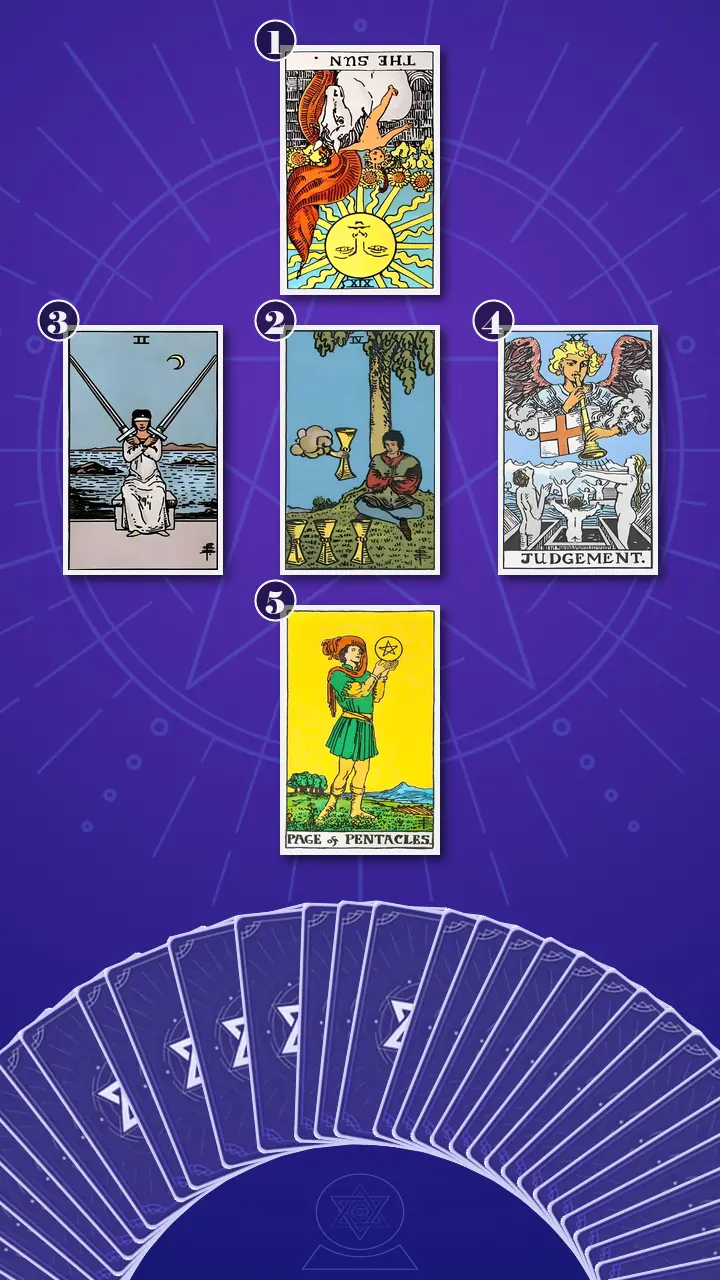
I arranged the cards in a cross. The first sat at the top as the visible mask. The second rested in the centre as the concealed emotional core. The third lay to the left as the protective structure, while the fourth faced it from the right as the answering truth. The fifth sat below them, where insight would have to meet ordinary life. To me, the layout looked like a mask lowering towards a mirror and then settling onto solid ground.
Reading the Mask as a Map
Position One: The Brightness That Arrives Too Fast
I began by turning over the card representing the observable positivity performance Maya used to restore her public mask after it slipped. It was The Sun, reversed.
In its upright form, The Sun carries open vitality, joy, visibility, and clarity. Reversed in this position, its fire was obstructed. There was still plenty of visible brightness, even an excess of it, but the warmth was no longer circulating into Maya's private experience. The enormous sun became the hot ring light. The raised red banner became the polished caption lifted immediately after a wobble. The exposed child reflected how vulnerable Maya felt when spontaneous confidence failed in front of an audience.
I connected the card to the scene she had described. After losing her train of thought during the wellness-brand video, she had not first asked why the question felt impossible. She had opened Canva, built an upbeat carousel about growth, and watched the engagement count while her jaw stayed tight. The positivity looked convincing, but its immediate function was to repair visibility rather than express vitality.
“This is close to the social logic in Black Mirror's Nosedive,” I said. “Visible cheerfulness becomes tangled with ratings and belonging, so one unscripted pause feels more dangerous than it is. The problem is not that the cheerful language must be false. The problem is that it arrives before your own reaction has been heard.”
Maya's lips formed the beginning of her familiar reassuring smile. Then she gave a tight, bitter laugh, lowered her eyes to the card, and released the edge of her sleeve from her fingers. “That is too accurate,” she said. “Honestly, a little brutal. I posted because I couldn't stand the idea of people remembering the pause.”
“That makes sense as a protective move,” I replied. “It reduced the social exposure for a moment. I am only asking us to notice the cost: the image recovered before you learned what had interrupted the script.”
Position Two: The Win That Never Reached Her Body
I turned over the card representing the dissatisfaction, numbness, or unmet need concealed beneath Maya's positive presentation. It was Four of Cups, upright.
The seated figure stared at three familiar cups with crossed arms while a fourth cup waited nearby. The water energy here was stagnant. Emotional engagement was not absent because Maya had failed to practise gratitude; it was blocked because familiar sources of validation were no longer reaching her in the same way.
I treated the three cups as three recognisable parts of her life: the successful campaign, the completed wellness routine, and the dependable role of being the encouraging friend. Maya had recently closed an analytics dashboard full of green metrics, received congratulations in Slack, and felt no lift once the laptop shut. She had immediately called the project a privilege and told herself she should be grateful.
“Four of Cups is not accusing you of being negative or ungrateful,” I said. “It is asking a more precise question: when the campaign, the self-care routine, or the supportive social role is complete and you are alone afterwards, what specifically no longer reaches you?”
Maya stopped rubbing her thumb across the side of her mug. Her gaze moved away from the screen as though she were looking back at the silent flat after a campaign launch. “I know I should feel grateful, so why does none of it reach me?” she said. After a pause, she added, “I don't hate the job. I just don't feel curious anymore. I finish something, and my first thought is how to package it, not whether I want to do it again.”
I heard the distinction clearly. The concealed material was not a dramatic demand to destroy her life. It was the quieter recognition that familiar achievements, routines, and explanations were no longer producing meaning or direction. The fourth cup did not have to represent a perfect new career. It could begin as the unmet need for private curiosity, a place where experience did not have to become content.
“The mask slips where the script stops working,” I told her. “Your flatness may be feedback about the script, not a verdict against everything you have built.”
Position Three: Two Polished Columns and No Next Move
I next turned over the card identifying how positive reframing protected Maya from acknowledging the hidden material and why the cycle continued. It was Two of Swords, upright.
The blindfolded figure held two swords across her chest while unsettled water moved behind her. Swords are associated with thought, language, and discrimination, but here the air energy had become excessive and blocked. Reasoning was being used as a barricade. The ideas sounded balanced, yet they prevented emotional information from becoming a usable choice.
Maya had already shown me the modern version. In Notion, she had created two elegant columns. One explained why stability, London rent, and the visibility of her role required her to stay exactly where she was. The other described the uncertainty as a meaningful growth season. Because both stories sounded intelligent and hopeful, she treated the stalemate as wisdom and never wrote the plainer observation: “This work may no longer feel meaningful.”
“Both columns can contain real facts,” I said. “But if their combined effect is permanent suspension, they are not yet giving you clarity. They are keeping twenty browser tabs open so that closing one can never reveal which task matters. Balanced language has become airplane mode for the feeling: everything appears controlled, but no new information gets through.”
I wrote two prompts where she could see them: “The positive interpretation is...” and “The feeling this interpretation interrupts is...”
Her breath became shallow. Her eyes scanned the prompts twice, and her jaw tightened before she spoke. “The positive interpretation is that I am in transition,” she said. “The feeling it interrupts is that I might not want the life I keep saying I am building.”
She immediately added, “But both explanations are reasonable.”
“Yes,” I said. “A defence does not have to be irrational to function as a defence. London rent is real. Professional visibility is real. The question is whether those constraints have quietly expanded into the claim that you are not allowed to investigate any part of your dissatisfaction.”
I then named the maintenance loop the cards had made visible: public exposure triggered a rapid positive reframe; the reframe brought brief social relief; the original feeling remained unnamed; personal direction became less clear; and the resulting flatness created pressure for even more positivity. This was toxic positivity masking emotional numbness through timing and function, not evidence that Maya's hopeful side had always been fraudulent.
When Judgement Made the Pause Audible
Position Four: The Truth Inside the Failed Script
The room seemed to change before I turned over the fourth card. Rain that had been stippling my window softened to an occasional tap, and the small electronic noise of our call suddenly felt very clear. I turned over the card representing what Maya's exposed inner experience was asking her to recognise before she created another positive interpretation. It was Judgement, upright, the catalyst of the reading.
The angel's trumpet dominated the image. Below it, figures rose from grey coffins with open arms. Unlike The Sun's emphasis on being visibly radiant, Judgement worked through sound: a call had to be heard and answered. Its energy restored honest recognition where recognition had been deficient. The card did not demand a dramatic confession, public comeback, or career resignation. It asked Maya to listen to the interruption before improving its appearance.
“Would it help to hear thirty seconds of the recording once,” I asked, “or would you rather work from memory? You do not owe this process a replay if hearing it would feel punishing.”
She chose to play it once. Through her phone speaker, I heard the interviewer ask, “What are you personally excited about right now?” Then came the dry sound of Maya swallowing, a long pause, and the beginning of her recovery script about embracing transition.
“What if that pause was not a PR failure?” I asked. “What if it was the moment your usual answer stopped being true?”
I used the diagnostic framework I call Cognitive Stratigraphy. On an archaeological site, a surface artifact matters, but it cannot explain the whole settlement. I treated Maya's stalled answer as the surface artifact. Directly beneath it lay the urge to repair the footage with a bright caption. Beneath that was the fear of losing credibility and connection. At the deepest layer we could safely identify sat an older rule: if she could not offer perspective, she would have less worth.
As I looked at Judgement, I remembered clearing compacted soil from a broken wall line on a dig. The fracture had not erased the structure; it had made the different building phases visible. Maya's mask-slip moment could be approached in the same way. It was evidence about an obsolete rule, not proof that the entire person above it was false. We did not need to excavate further than she wanted, and we did not need to turn the discovery into a dramatic origin story.
At 11:40 p.m., her journal had remained blank while the bright caption received a fourth edit. She had deleted “I feel directionless,” added gratitude, and refreshed the old post, hoping a cleaner story would quiet the hollow pressure behind her sternum.
You do not have to make emptiness inspiring to keep your worth; let it become honest information, then allow it to change one small choice.
The slipping mask is not proof that you failed at positivity; it is your cue to answer Judgement's trumpet by naming the truth you have kept muted and responding with one grounded action.
I left the words alone for a moment.
Maya's inhale stopped halfway. Her right hand, which had been circling the mug, froze with two fingers above the rim. For several seconds she looked past the screen rather than at me, as though the livestream pause were replaying somewhere behind her eyes. Her pupils widened; then her brow pulled tight and colour rose along her cheeks. “But doesn't that mean I was wrong about all of it?” she said. The words landed sharper than anything she had said so far. Anger came first, then grief: her mouth pressed into a line, her eyes shone, and her shoulders remained rigid even as both hands opened on her lap. Finally, her jaw released. A breath left her with a small tremor. The relief was real, but so was the blankness that followed it, the slight dizziness of seeing a clearer path and realising she would have to choose whether to walk it. “I don't know who I am without the lesson,” she said more quietly.
“It does not mean you were wrong about all of it,” I replied. “Your positivity may have been sincere, useful, protective, and incomplete at the same time. We are not putting your whole identity on trial. We are revising one old rule that says connection depends on compulsory certainty.”
This was where I drew on Ruins Restoration Thinking. In restoration, I do not bulldoze every surviving wall because one section has cracked, and I do not paint over the fracture to make the structure look untouched. I identify what still bears weight, what was a later addition, and what now needs support. Maya could keep her warmth, creativity, and ability to find perspective. What she did not have to preserve was the requirement to produce perspective before she had felt anything.
The Wizard of Oz curtain came to mind. When the grand projection collapses, the revelation is not a monster or an absence of value. It is an ordinary human being whose power must become more honest and accountable. Maya's unscripted pause had revealed a person, not a fraud.
“Now, with that new lens, think back to last week,” I said. “Was there a moment when this insight might have let you feel differently?”
She remembered a friend asking, “How are you? No, really?” Maya had answered that she was in a growth phase and escaped to the pub bathroom. “I thought the second question meant she had caught me failing,” she said. “Maybe she was actually offering me somewhere not to perform.”
I watched her hold both possibilities without rushing to make the second one uplifting. That was the breakthrough: a first movement from performed positivity and identity-protective avoidance towards honest self-recognition, beginner-minded curiosity, and grounded self-trust. It was not complete clarity. It was the uncomfortable permission to let recognition come before redemption, explanation, or a public comeback.
“Emptiness is information, not a credibility crisis,” I said. “Information can be partial. You are allowed to examine it before deciding what it means.”
The Apprentice Studies One Real Signal
Position Five: Direction Before It Becomes a Decision
I turned over the final card, representing the private, practical experiment through which Maya could integrate what she had recognised without creating a new performance. It was Page of Pentacles, upright.
The Page held one golden pentacle at eye level while standing in a cultivated field, with a distant mountain still visible. Earth became the balanced container the spread had been missing. The obstructed fire of The Sun had produced compulsory brightness. Cups water had pooled into disengagement. Swords air had frozen the feeling inside elegant explanations. The Page introduced patient observation, a tangible subject, and a step small enough to test.
I translated the card into Maya's life. Instead of announcing a total reinvention, she could create a private seven-day phone note and record one work task, conversation, or environment each day as more engaging, more depleting, or neutral. At the end of the week, she would choose one repeated condition for a twenty-minute experiment.
“The Page is not asking you to know your purpose tonight,” I said. “It is asking you to study one ordinary day. You might record a strategy session, an hour checking analytics, lunch with brand content still open, or a conversation in which you did not have to be the encouraging one. One line is enough.”
Maya's shoulders lowered. She looked at the pentacle and gave a smaller smile, one that did not seem to require maintenance. “So I don't have to make a dramatic career pivot or become someone who hates social media?”
“No. London rent remains real, and the cards do not get to resign from your job for you. Page of Pentacles replaces the demand for a complete direction with beginner attention. Direction can begin as data before it becomes a decision.”
She nodded slowly. “I think I can be a student of it. I am tired of acting like I should already be the guide.”
I treated that sentence as the Page's first practical offering. Tarot had not revealed an order she had to obey. It had given her five distinct places to examine her own evidence: performance, hidden feeling, defence, recognition, and experiment. The authority to interpret that evidence remained hers.
Restoring the Ruins Without Rebuilding the Facade
I drew the five cards into one coherent account. The background Maya had already given me was a career built inside an economy of visibility, combined with a social role in which other people expected her to find the lesson. The Sun reversed showed how that strength had become compulsory brightness. Four of Cups revealed what the spotlight concealed: not secret cynicism, but a loss of engagement with achievements and routines that still looked successful. Two of Swords explained why the feeling stayed static: Maya converted it into balanced, hopeful language before it could inform a choice.
Judgement interrupted that circuit by making the failed script audible, and Page of Pentacles gave the recognition somewhere ordinary to go. The larger image was the one Maya had described without initially recognising it: she had kept a spotlight trained on the stage after the performer had left, hoping brighter light would restore the missing sense of direction. The cards suggested turning down the light long enough to hear what had changed backstage.
I named the central cognitive blind spot directly. Maya had fused two separate ideas: “I cannot irresponsibly abandon my livelihood” and “I am not allowed to question whether any part of this life still fits.” The first was a legitimate constraint. The second was an identity rule. Recognising the difference created room for experimentation without demanding a resignation, public disclosure, or total rebrand.
The transformation direction was equally specific: positivity could remain, but it would follow emotional recognition instead of replacing it. The key shift was a ten-minute pause before converting discomfort into a lesson, followed by one plain sentence naming what felt disappointing, empty, or uncertain.
When I suggested the pause, Maya immediately raised a practical obstacle. “But that ten minutes is often when I am supposed to be fixing the post or getting back into Slack,” she said.
“Then do not begin with a required brand deliverable,” I replied. “Choose one non-urgent personal caption, and use the sixty-second version if ten minutes is unrealistic. An exercise that ignores your actual working conditions is not actionable advice. It is another standard to fail.”
The Trigger Excavation Plan
I gave her two deliberately small next steps. Neither required her to disclose private feelings, replay the recording, leave her job, or publish a correction.
- The Ten-Minute Trigger Excavation. Before one non-urgent personal post this week, open a private note titled “No lesson yet” and set a timer for no more than ten minutes. Use my Trigger Excavation Exercise to record four layers: the surface artifact, meaning what happened; the body cue; the immediate image-repair impulse; and the older rule the impulse seems to activate. Then finish one sentence: “What I do not want to turn into a lesson yet is...” Leave it unedited and underline one concrete need, condition, or choice. Tip: Keep the note private. The minimum version is sixty seconds and three words, such as “I feel flat.” Stop at any point, and do not replay a distressing recording merely to complete the exercise.
- The Private Apprentice Log. At the end of each weekday, label one task, conversation or environment “more engaged,” “more depleted,” or “neutral,” and add one body cue such as “jaw tight” or “breath easy.” After seven days, circle one repeated condition and run one twenty-minute experiment, such as doing strategy work before opening analytics or taking lunch away from brand content. Tip: Keep each entry to one line and treat missing days as neutral. This is one-variable research, not a new Notion performance dashboard. Three entries across the week are enough to begin.
“You do not need a comeback,” I told her. “You need one unedited sentence and one observable experiment. Those actions will not solve your whole direction, but they can produce evidence that belongs to you rather than to an audience.”
The plan was not an instruction from fate. It was a way for Maya to test whether recognition before reframing changed the quality of her choices. She would remain the person deciding what stayed private, what deserved further attention, and what, if anything, eventually needed to change.
A Week Later: The Quiet Proof
A week later, Maya sent me a message. Before posting a personal caption about being “in her next growth era,” she had opened the private note instead. Her surface artifact was the urge to publish immediately after a flat Sunday evening. Her body cue was a locked jaw. The image-repair impulse was to sound purposeful. The older rule was, “If I don't have perspective, people will stop seeing me as grounded.”
Her unedited sentence was simpler: “I feel flat about being seen as inspiring all the time.” She underlined the need for “somewhere private not to know.” She left the caption in drafts overnight and ultimately chose not to post it. No public collapse followed. One friend still sent her a normal message about dinner plans.
Her Apprentice Log did not reveal a perfect vocation. It showed something smaller and more useful: early strategy work often left her breath easy, while checking metrics immediately after publishing tightened her jaw and scattered her attention. Her first twenty-minute experiment was to complete one strategy task before opening analytics.
She slept through the night after choosing the experiment. Her first thought the next morning was, “What if I am making this bigger than it is?” Then she smiled at the thought, logged “jaw loose,” and made coffee.
I did not read that as a finished transformation. The doubt had not vanished, and Maya had not solved her career in seven days. What had changed was her relationship to uncertainty. She could notice the doubtful thought without immediately recruiting an affirmation to silence it. The clarity was still vulnerable, but it was hers.
That was the quiet proof of our Journey to Clarity. The cards did not rescue Maya, expose a destiny, or make the decision on her behalf. They helped separate a fused experience into parts she could examine. I offered a map; she chose where to place her feet. Her movement from performed composure towards grounded self-trust began with the authorship of one private sentence.
If the bright answer reaches your mouth before your next full breath, while your jaw and chest are telling a less polished story, I hope you remember what Maya discovered: noticing that split is already recognition, and recognition does not cancel your worth.
If you let one unedited sentence remain private beneath Judgement's trumpet for ten minutes, what single Page-of-Pentacles experiment might you become curious enough to test?