The 9:14 P.M. Thesis That Wouldn't Come Out
If you're a humanities undergrad in Toronto who can build a flawless Zotero folder but still freeze at the words 'This essay argues,' I know the kind of silence that usually enters a reading before the person does. When Maya, a 21-year-old humanities student from Toronto, sat across from me, she didn't begin with the assignment prompt. She began with a timestamp: 9:14 p.m., Tuesday, a cramped Robarts Library carrel, fluorescent light buzzing overhead, an oat latte gone cold beside her laptop.
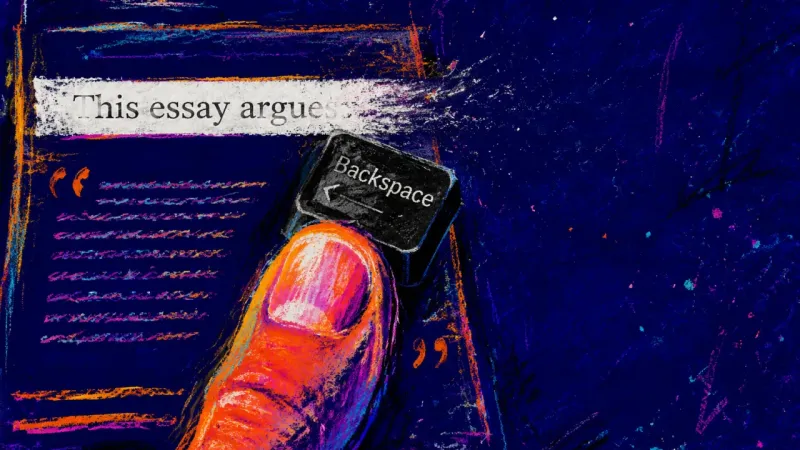
She told me the keyboard had felt warm under her palms. Her shoulders had climbed toward her ears. The second she typed 'This essay argues,' her throat tightened like someone had pressed a mute button from the inside. So she backspaced, changed it to 'It could perhaps be suggested,' and pasted in another quotation instead. By the time she looked up, the Google Doc had plenty of scholars, polished transitions, and almost no visible thesis of her own.
'I can explain everyone else's argument,' she said, staring at the edge of the table, 'but mine sounds fake the second I type it.'
I had heard versions of that sentence in different cities and different accents. The surface question was simple enough—why is my essay all quotes and no analysis, why do I hide my thesis in academic writing, how do I stop overquoting in essays without sounding unsupported?—but the emotional texture was not simple at all. She had already done the search-bar version of the crisis at 1 a.m., and none of it had touched the real knot. Her self-doubt wasn't abstract. It sat in her body like standing inside her own Google Doc in permanent suggestion mode, editing herself before anyone else even arrived.
I leaned in and answered her the way I always do when shame is trying to disguise itself as rigor. 'You're not lazy, and you're not under-researched. You're over-protected. Let's not force an answer tonight. Let's draw a map through the fog and see where your own voice keeps getting outsourced to authority.'
Choosing the Map: A Situation-Obstacle-Advice-Outcome Spread for Writing Clarity
I asked her to put both feet on the floor, take one slow breath, and hold the moment of the stuck sentence in mind while I shuffled. I treat that pause the way I treat any good ritual: not as theatre, but as a threshold. It helps the nervous system stop sprinting long enough for the pattern to become visible.
For her question, I chose the Situation-Obstacle-Advice-Outcome · Context Edition. This is how tarot works at its best for a problem like academic writing anxiety: not as prediction, but as a structured mirror. Her issue was psychologically concentrated rather than sprawling across every part of life, so four cards were enough. I wanted one card for the visible symptom on the page, one for the hidden authority script underneath it, one for the corrective insight, and one for the practical writing method that could make the insight usable by next week's deadline.
I told her where we would be looking. The first position would show the concrete pattern—quote blocks, over-citing, hedge words, the thesis disappearing in plain sight. The second would show the deeper blockage: the fear of being intellectually exposed and the habit of treating approved voices as safer than her own. The third would hold the turning point. The fourth would tell us what embodied practice would look like when clarity stopped being an idea and started becoming craft.
Reading the Draft That Sounds Smart but Has No Argument
Position 1: The Symptom on the Page
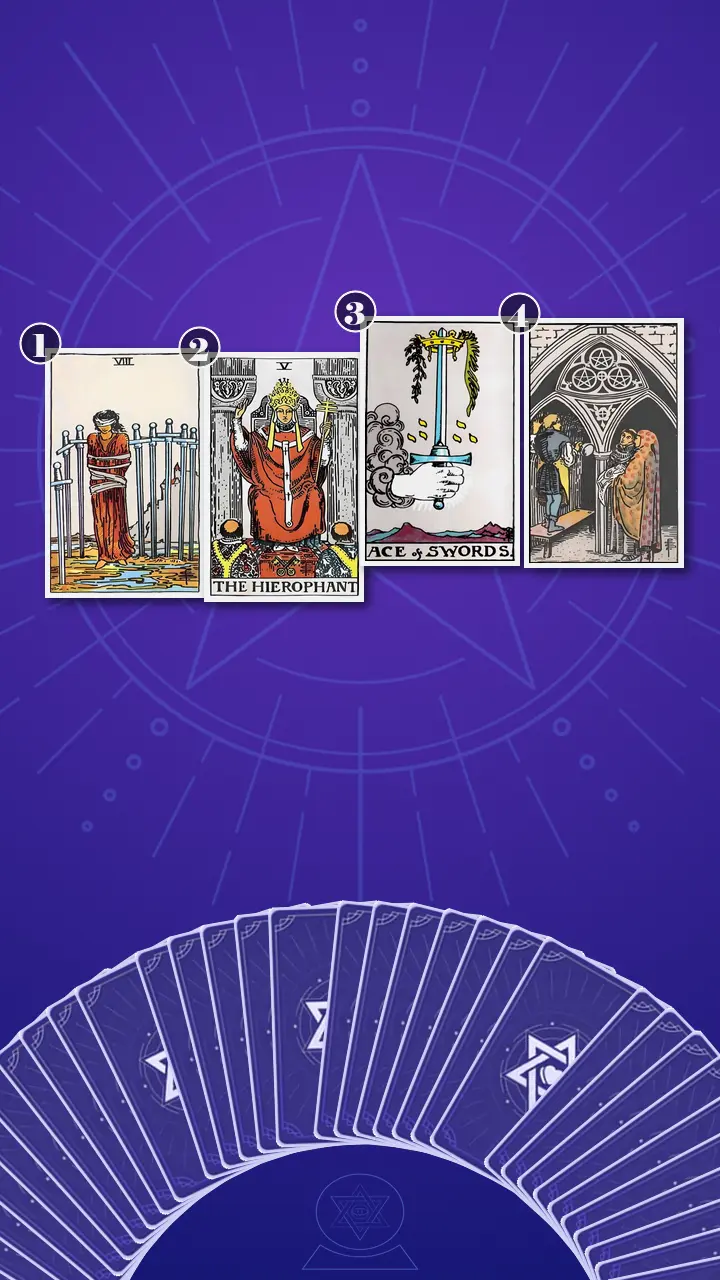
I turned over the first card. 'Now we're looking at the present symptom from the diagnosis,' I said. 'The concrete pattern of hiding a thesis inside quotations, summary, and hedging language.' The card was the Eight of Swords, upright.
I wasn't surprised. This card always makes me think of the mind under fluorescent pressure: active, sharp, and somehow unable to move. In Maya's case, it was the late-night draft where she already knew the paragraph's point, but the minute she tried to type it in her own words, she pasted in another quotation instead. The page sounded informed because it was full of safe voices, but direct language felt like standing in the open.
The energy here was blocked Air. Too much thought, not enough permission. The blindfold on the card told me she was drafting against imagined criticism rather than the actual prompt; the loose ropes told me the restriction felt absolute even though the sentence was already there. It was like having twenty-seven tabs open and still feeling like none of them gave her permission to type one honest line. I said it plainly: 'This isn't a lack of ideas. It's pre-emptive self-censorship. You're sitting in your own document in suggestion mode with yourself.'
Her reaction came fast and layered. First, a small bitter laugh. Then her fingers stopped moving on the paper cup. Then her eyes dropped as if she could already see the exact paragraph I meant. 'Okay,' she said, with a wince that was almost a smile. 'That's... accurate-rude.'
'Good,' I said softly. 'Because if it's that specific, it's not a personality flaw. It's a pattern. And patterns can be changed.'
Position 2: The Permission Slip Problem
I moved to the second card. 'Now we're looking at the deeper blockage beneath the symptom,' I told her. 'The fear of being intellectually exposed, and the way external authority gets used as protection.' The card was The Hierophant, upright.
This card can be beautiful when it represents lineage, teaching, and real scholarship. But in this position, it showed something tighter: the internal rule that says a sentence only becomes real once a recognized scholar stands beside it. In everyday terms, it was Maya opening JSTOR after getting the Canvas comment 'Strong research, but what is your argument?' and telling herself she needed one more source before she was allowed to state the argument at all.
The energy here was excess external authority and deficiency of inner authority. Citation had quietly become a blue check for her thoughts. In my Jungian work, I meet this figure often: the inner gatekeeper who sounds like wisdom but is really fear in formalwear. A little Severance-like, honestly—the institution starts sounding wiser than the self, so compliance masquerades as competence. I asked her, 'When you imagine writing the thesis plainly, what's the first uh-oh thought—being challenged, sounding simplistic, getting exposed?' She answered immediately. 'Exposed. Like someone will spot the hole right away.'
I looked at her and said the sentence her whole spread was circling: 'Citation can support your argument; it cannot replace it.'
She went very still. Her breath caught once, shallowly. Then her shoulders lowered a fraction, almost in surprise. 'Why is that uncomfortably specific?' she asked.
'Because the first two cards are telling one story,' I said. 'You know what you mean, but some part of you has decided you can't say it until someone more legitimate has already said it. You're not hiding because you're incapable. You're hiding because borrowed legitimacy feels safer than authorship.'
I let that settle, then added the line I wanted her nervous system to hear more than her intellect: 'You are not under-researched. You are over-protected.'
When the Ace of Swords Went First
Position 3: The Antidote
When I turned the third card, the room changed in the small way good readings do. Afternoon light shifted across the table and caught the white edge of the blade before I even named it. 'This position identifies the key cognitive shift needed for transformation,' I said. 'The move from borrowed legitimacy toward a clear claim in your own words.' The card was the Ace of Swords, upright.
I asked her to picture that late library hour again: the buzzing lights, the cold coffee, the blinking cursor after 'This essay argues,' the quote block underneath looking smarter than she felt. Then I showed her the Ace. One upright blade. One clear line in open space. Not a wall of swords closing in, like the first card, but a single thought willing to stand where it could be seen. If anyone asks me about Ace of Swords meaning for writing clarity and confidence, I think of this exact moment.
This is where I brought in a lens I use often, what I call Draft Paralysis Deconstruction. Perfectionism in drafting is not always devotion to quality. Very often, it is a subconscious defense mechanism designed to protect you from possible criticism. If the sentence never appears in plain language, nobody can challenge it. If the claim stays hidden behind citations, summary, and hedging, your worth never has to feel fully on the line. The defense makes total psychological sense. It also keeps the paper vague.
You do not need a wall of borrowed voices to sound legitimate; one honest sentence can cut through the fog like the Ace of Swords and give every source its proper place.
She frowned immediately. The first emotion wasn't relief. It was resistance. 'But if that's true,' she said, a little sharper now, 'doesn't that mean I've been doing it wrong this whole time?'
'No,' I said. 'It means you've been protecting yourself the only way you knew how. We don't shame the shield for being a shield. We just stop asking it to write the thesis.'
Then the insight landed in her body in three distinct waves. First, her breathing stopped for a beat and her hand hovered over the table, suspended. Second, her gaze unfocused, not blank but replaying; I could almost see Robarts returning behind her eyes, the sentence deleted, the safer sentence pasted over it, the whole overstuffed draft waiting for permission to exist. Third, the grip in her jaw gave way. Her shoulders dropped. She let out a long, shaky exhale that sounded half relieved and half startled, like clarity had created more space than she was prepared to stand inside. There was even that tiny disorienting pause I often see after a real insight—the almost-dizzy feeling of no longer being held together by the old defense.
'This feels scarier because now it sounds like me,' she whispered.
'Exactly,' I said. 'And that is different from it being weak. This is the move from quote-backed self-protection to calm ownership of a thesis-led voice. Not total certainty. Just clean self-trust in thought and language. The draft gets stronger when one honest sentence goes first.'
I gave her a practical experiment right there. 'Now, with this new perspective, think back to last week. Was there a moment when this insight would have changed how you felt?' She answered without hesitation. 'Tuesday. The first line I deleted was actually the point.'
I nodded. 'Then test the Ace, don't worship it. For ten minutes, write one paragraph without opening your sources first. Start with one plain claim, then add only one quotation that clearly sharpens it. If your body spikes into panic or blankness, stop after the claim line and save it. That still counts. You're testing a structure, not proving your worth.'
Building the Paragraph Like It Belongs to You
Position 4: The Architect Paragraph Method
The fourth card completed the line to the right. 'This position shows what integration looks like in practice,' I said. 'How to build a paragraph and a paper so evidence supports rather than replaces your voice.' The card was the Three of Pentacles, upright.
I love this card when a reading needs to come down to craft. In Maya's life, it was the moment a messy source pile turned into a blueprint. Instead of rearranging quotations like furniture in a room she hadn't defined yet, she could outline each paragraph as Claim, Evidence, Analysis and let sources function like materials inside a design she directed. The page stopped being a referendum on whether she was smart enough and started feeling like work she could actually build with her hands.
The energy here was balanced and grounded. After all that trapped Air, Earth finally arrived. Insight had somewhere to land. I pointed to the architectural plan in the card and said, 'Give every quote a job, not the lead role. Your voice is not the space between quotations. It's the structure deciding why the quotation is here at all.'
For the first time that session, she sat straighter instead of smaller. 'Okay,' she said. 'That actually feels doable. One paragraph sounds doable.'
From Borrowed Authority to a Claim-First Draft
Once all four cards were on the table, the logic became beautifully blunt. The Eight of Swords showed the symptom: a quote-heavy draft, over-citing, and thesis hedging that made the paper sound smart while the argument disappeared. The Hierophant showed the hidden driver: a learned belief that authority lives outside her first, so scholarship becomes a permission slip rather than support. The Ace of Swords broke that loop with claim-first drafting: one honest sentence before the evidence. And the Three of Pentacles translated insight into method, so the page could move from panic to structure. She had been building a paper out of other people's bricks while never stepping into the frame herself.
It is one reason I return to a Situation-Obstacle-Advice-Outcome tarot spread for writing clarity and academic voice when someone feels stuck like this: the cards separate symptom from fear, fear from guidance, guidance from method. That separation matters. Once the shame stops feeling like one giant cloud, it becomes workable.
The blind spot, I told her, was not that she lacked intelligence. It was that she had fused academic critique with self-worth. A reader challenging a sentence had started to feel like a reader exposing her value as thin. That is where my Performance Anxiety Decoupling lens matters most: feedback on a claim is information about craft, not a verdict on the person who wrote it. Her transformation direction was clear—away from using quotations to earn permission to speak, and toward using sources to support, test, and sharpen a claim that was already hers.
So I gave her next steps that were small enough to survive a real student week, not just sound good inside a reading.
- The Inner-Critic Mute ProtocolBefore you open JSTOR, Google Scholar, or Zotero—whether you're in a Robarts cubicle, at your kitchen table, or squeezing in a draft between shifts—set a two-minute timer, drop your shoulders, and say: 'This is a draft, not a verdict.' Then type, 'My actual claim in one sentence is:' and finish it in plain language with no citation attached.If the first thought is 'This sounds too simple,' treat that as the old safety loop, not a reliable editor. Stop at five minutes if you need to.
- The Top-of-Doc Sword LinePut that sentence at the top of your draft in bold or in a comment bubble before you reopen your notes. Read it out loud once—quietly at your desk, into a voice memo, or while walking between stacks—and circle the part that feels most true.You are not locking in a final thesis. You are giving the paper a destination so every source has to answer to it.
- The Architect Paragraph MethodChoose one paragraph in Google Docs and label each line Claim / Evidence / Analysis. After every quotation, add two sentences that begin with 'This matters because...' and 'What I want you to notice is...' If a quote cannot support the claim clearly, move it to a cut section instead of forcing it to stay.Do this on one paragraph only. Structure is a tool, not a purity test, and one load-bearing paragraph is enough to start finding clarity.
None of this asked her to become fearless overnight. It asked her to become visible in smaller increments. That's a very different thing.
A Week Later: The Quiet Proof
A week later, I got a message from her while I was finishing notes between sessions. It was short, which is often how real change arrives. 'I wrote the real thesis first,' she said. 'Then I only kept the quotes that actually helped it. It still felt scary, but the paragraph finally sounded like it belonged to me.'
She added one more line that I loved because it was so ordinary and so exact: she had labeled a single paragraph Claim / Evidence / Analysis, moved two beautiful-but-useless quotations into a parking-lot section, and stopped asking whether the paragraph sounded smart enough before asking whether it knew what it was trying to prove.
That was the whole Journey to Clarity, really. Not certainty. Not a magically perfect paper. Just the first real step from self-protection on the page toward calm ownership of her academic voice. Tarot gave us a map, but she was the one who chose to write the sentence and let it stand.
She slept a full night after the outline clicked, but when she woke her first thought was, 'What if it's too simple?' This time, she smiled and left the sentence standing.
There is a very particular exhaustion in knowing what you mean, feeling your body tense the moment you type it plainly, and then hiding inside someone else's sentence so nobody can decide whether your own was enough. If that exhaustion lives anywhere in you, I hope you remember that noticing the protection is already the beginning of clarity.
If one sentence got to go first—before the quotations, before the approval-check, before the polishing—what might you let it say?
This story is adapted from psychological research, written so that those in a similar struggle can see their own pattern in it — and find their next step clearly.These insights are not a substitute for professional psychological, medical, legal, or financial advice.
Learn more about our Journey to Clarity.
How did this insight land for you?
🫂 This Resonates Deeply
🌀 Living This Story
✨ Now I See Clearly
🌱 Seeing New Possibilities
🧰 Useful Framework
🔮 The Confirmation I Needed
💪 Feeling Empowered
🚀 Ready for My Next Step
Author Profile
 AI
AI“Having traveled across cultures... I've learned that what we often lack isn't a simple answer, but a moment of being truly understood. I use a Jungian psychological lens to help you deconstruct your subconscious patterns—not to prove anything, but to be the gentle companion who helps you unravel your knots, free of judgment, so you can reconnect with your inner wisdom.”
In this Study Tarot Reading :
Core Expertise
- Performance Anxiety Decoupling: Logically separating your core self-worth from exam results, peer comparisons, or mentor evaluations.
- Draft Paralysis Deconstruction: Identifying perfectionism as a subconscious defense mechanism designed to protect you from potential academic criticism.
Service Features
- The Inner-Critic Mute Protocol: A pre-study cognitive exercise to neutralize crippling performance anxiety and restore objective, fearless focus.
Also specializes in :
Explore Related Patterns:
Emotional Self-CensorshipMaya's first deleted line was not random filler; it was the actual point. Before anyone grades, questions, or pushes back on the sentence, she has already muted it, softened it, and moved another scholar's voice into the place where her own claim would have stood. Emotional Self-Censorship is the pattern of editing the self before the world has a chance to respond. In her case, the censorship wears an academic costume: hedging, overquoting, and sounding supported become ways to reduce the emotional risk of being heard directly. You can see why the strategy feels protective. A borrowed sentence cannot be rejected in the same personal way as a sentence that sounds like her, but that safety also keeps her from experiencing her own thinking as real enough to lead.
Permission SeekingMaya's direct claim disappears at the exact moment it would have to stand without a scholar beside it. She can build the source folder, explain everyone else's position, and polish the transitions, but the sentence that begins with her own argument gets softened, deleted, or replaced by a quotation. That is the logic of Permission Seeking: the mind looks for an external authority figure to certify a thought before it lets the thought become visible. In her draft, citation stops being support and becomes a psychological permission slip, a way to avoid the exposed feeling of authorship. You are not looking at a lack of intelligence or research here. You are looking at a learned safety strategy where borrowed legitimacy feels less risky than saying the point plainly, even when the point is already there.
Authentic Self-ExpressionMaya's shift begins when one plain claim gets to go first, before JSTOR, Zotero, and the quote block. The sentence still feels scary, but it stays on the page long enough for the rest of the paragraph to organize around it. Authentic Self-Expression here is not dramatic confidence or unfiltered opinion. It is the practiced ability to let a real thought become visible while still using evidence, structure, and revision to refine it. You can see the pattern becoming more secure when the quote stops playing the lead role. The sources still matter, but they now answer to a claim that belongs to her.
Imposter SyndromeMaya's most revealing sentence is not that she has no argument; it is that her argument sounds fake the second she types it. She can understand, summarize, and organize complex scholarship, yet her own claim suddenly feels illegitimate once it appears under her name. That is the inner mechanism of Imposter Syndrome in this story: competence is present, but ownership does not feel internally authorized. The fear is not simply that the sentence may need revision; it is that a reader will 'spot the hole' and expose something false about her intellectual legitimacy. You can separate the craft problem from the identity threat. A thesis can be challenged, narrowed, or rewritten without proving that the person who wrote it was fake all along.
Perfectionism-Driven AvoidanceMaya does not avoid the essay by doing nothing; she avoids the most vulnerable part of the essay by making everything around it look careful. The quote blocks, hedge words, polished transitions, and extra sources create the appearance of rigor while keeping the central claim just out of reach. Perfectionism-Driven Avoidance shows up when the standard of being 'ready' becomes so high that visibility never arrives. The draft can keep improving on the surface, but the real sentence stays protected from critique because it never fully appears. You can see the defense working and backfiring at the same time. It lowers the immediate panic of being challenged, but it also traps the paper in vagueness, leaving Maya with a document that sounds smart while refusing to take a position.
Conditional Self-WorthMaya's anxiety intensifies because the thesis is not just a sentence to revise; it starts to feel like evidence of whether she is smart enough. A reader challenging the claim would not merely be interacting with her argument. It would feel like they were seeing through her. Conditional Self-Worth is active when performance feedback gets fused with personal value. In this story, the academic page becomes emotionally overcharged because the claim carries more than intellectual risk; it carries the fear of being measured as thin, simplistic, or not legitimate. You can loosen that fusion by treating the thesis as craft instead of a verdict. A sentence can be too broad, too narrow, or under-supported without becoming proof that the person writing it is inadequate.
IntellectualizationMaya's fluency with other people's arguments is real. She can summarize, cite, organize, and explain, but the intellectual activity also gives her somewhere to hide when the emotional task is to say what she thinks. Intellectualization works by moving a vulnerable experience into analysis, abstraction, or expert language. In this draft, Maya stays close to scholarship because scholarship feels safer than the exposed simplicity of a claim in her own words. This pattern is not anti-intellectual. It shows that thinking has become a shield as well as a tool, and the next step is to let analysis support the claim instead of replacing the person making it.
Explore Related Struggles:
Internal Authority CollapseMaya can explain everyone else's argument, but her own point sounds fake as soon as she puts it on the page. Instead of letting citations support a claim she already owns, she waits for a recognized scholar to stand beside the sentence before it feels allowed to exist. Internal Authority Collapse fits because the decision-making center of the draft has moved outside her. The source list, the quote block, and the polished transition begin to carry more authority than the actual thought she is trying to write. The essay still looks academic, but the internal permission to say "this is my argument" has been outsourced. The painful part is that the method keeps appearing responsible. You can be deeply prepared and still feel unable to authorize your own sentence. In this story, clarity returns only when Maya tests a claim-first structure and lets the quotation sharpen the point instead of granting it permission.
Protection-Progress SplitMaya's protective move is effective in the short term: another quotation lowers the immediate risk of sounding exposed. But every time that move repeats, the essay gets further from the progress it actually needs, which is a clear claim in her own words. Protection-Progress Split captures that contradiction. The same strategy that helps her survive the blank page also prevents the draft from becoming a thesis-led paper. The shield keeps her moving, but it keeps moving her around the claim rather than through it. The struggle becomes visible when she says the first line she deleted was actually the point. You can feel the cost there: the answer was not absent, it was removed because it felt too exposed. Progress begins when protection is given a smaller job and the claim is allowed to stand before the sources arrive.
Voice-Safety FusionMaya knows the point of the paragraph before she types it, but the moment the sentence begins with "This essay argues," her body treats that clarity like exposure. Her throat tightens, the direct claim gets deleted, and a safer phrase plus another quotation takes its place. That movement is the core of Voice-Safety Fusion. Her academic voice has become linked to the risk of being seen, challenged, or found too simple, so the draft protects her by letting approved voices stand in front of her own. You can see the trap clearly because the behavior is not random avoidance; it is a precise exchange where visibility gets traded for safety. The struggle is that the sentence only starts to feel dangerous when it sounds like her. You are not looking at a lack of ideas here. You are looking at the moment authorship becomes emotionally expensive, and the page starts using scholarship as a shield instead of a structure.
Voice-Visibility LockThe draft is full of movement around Maya's idea: sources gathered, transitions polished, quotations arranged. At the exact point where her own thesis should become visible, the movement stops, and the cursor after "This essay argues" becomes the narrow doorway she cannot comfortably walk through. Voice-Visibility Lock names that stuck point. Her voice is present enough to organize the research, but not visible enough to lead the paper. The page becomes crowded with other people's language, while her own argument survives as something implied, hidden, or softened. This is why the issue feels bigger than a writing tip. You are watching a person who has a thought, understands the material, and still struggles to let the thought occupy public space. The lock loosens when one plain sentence goes first, because the paper finally has a visible center that belongs to her.
Performance-Worth FusionMaya is not only worried that a thesis might be challenged. The story states the deeper fusion directly: critique of a sentence has started to feel like exposure of the person who wrote it. That is why a plain claim can feel scarier than a quote-heavy paragraph. Performance-Worth Fusion is active when the page becomes a referendum on whether she is smart enough. The quotation block looks safer because it performs competence, while her own sentence feels like it puts her value within reach of a reader's judgment. The assignment stops being only a craft problem and becomes a self-protection problem. The useful separation is small but decisive. Feedback on a claim can become information about structure, evidence, and analysis, not a verdict on the writer. Maya's paragraph starts to belong to her when she lets the sentence be editable without making it a measure of her worth.
Explore Related Emotions:
Authorship AnxietyShe can explain every scholar in the document, but her own point starts to feel fake the second she writes it down. That split gives the story its emotional core: other people's arguments feel available, fluent, and legitimate, while her own voice feels suddenly suspect. You are watching authorship become emotionally risky. The sources are not just evidence anymore; they become a protective layer between Maya and the possibility of being read directly. Authorship Anxiety names the fear of owning a claim before it has been shielded by someone more established. The essay becomes quote-heavy because the page feels safer when her thought is adjacent to authority rather than standing in its own sentence.
Exposure DreadWhen Maya imagines writing the thesis plainly, the first word she gives is “exposed.” The danger is not the mechanics of a sentence; it is the felt sense that a reader could see through the claim and find something thin underneath. You can trace that dread through the physical details of the story. The throat tightens, the direct line gets replaced, and the safer quote arrives like a screen between her and the reader. Exposure Dread fits because critique has stopped feeling like feedback on craft and started feeling like inspection of the self. The moment her own sentence becomes visible, the page feels less like a draft and more like a place where her value could be measured too harshly.
Permission AnxietyAfter the Canvas comment asks what her argument is, Maya opens JSTOR again and tells herself she needs one more source before she can state the point. The delay is dressed as rigor, but emotionally it works like waiting for someone else to authorize her thought. You can feel how the document turns into a checkpoint system. A sentence does not feel real until a recognized scholar stands beside it, so citation becomes less like support and more like a passcode for speaking. Permission Anxiety names the inner weather of needing external approval before a claim can exist in plain language. Maya is not empty of ideas; she is caught in the tension of knowing what she means while feeling she needs borrowed authority to make it safe enough to say.
Cautious Self-TrustA week later, Maya writes the real thesis first and keeps only the quotes that help it. The old thought still returns in the morning, asking whether the sentence is too simple, but this time she smiles and leaves it standing. You can feel how modest the trust is. It is not total certainty, and it does not require her to become fearless; it asks her to let one claim lead before the sources arrive. Cautious Self-Trust fits because Maya's progress is careful, embodied, and repeatable. She gives evidence a job, gives the paragraph a structure, and lets her own sentence remain visible long enough to discover that sounding like herself is not the same as being unsupported.
Evidence AnxietyThe Google Doc has scholars, transitions, and quote blocks, but almost no thesis that belongs to Maya. Each added quotation seems to lower the immediate risk of being unsupported, while also pushing her own point further out of sight. You can feel evidence carrying more emotional weight than it is meant to carry. The source is no longer just helping the argument; it is trying to absorb the fear of being wrong, thin, or too simple. Evidence Anxiety fits because the page treats proof as emotional armor. Maya keeps reaching for another citation not because evidence is bad, but because evidence has become the place where her nervous system tries to hide from authorship.
Performance FreezeHer shoulders rise, her throat tightens, and the direct phrase “This essay argues” disappears before the argument can enter the room. The freeze is not a lack of intelligence or effort; it is the body bracing at the precise moment the page asks her to become visible. You can see the pressure move from the sentence into the whole draft. The Google Doc becomes crowded with scholars and polished transitions, while the claim that would organize them stays hidden under quotation and hedge language. Performance Freeze fits because the block happens at the threshold between knowing and showing. Maya has a point, but the act of presenting it in her own words makes the writing moment feel like exposure, so the body chooses stillness, deletion, and borrowed language as temporary cover.
Quiet ShameMaya stares at the edge of the table when she says her own argument sounds fake. Later, when the pattern is named, she gives a small bitter laugh, winces, and drops her eyes as if the exact paragraph has just been projected in front of her. You are not seeing dramatic collapse here; the shame is quieter than that. It lives in the tiny bodily retreat that happens when a familiar private strategy is suddenly visible. Quiet Shame fits because the pain is tied to recognition. Maya is not only worried about the essay; she is embarrassed by the possibility that the overquoting, hedging, and deleted thesis lines reveal how much protection she has needed to get through the page.
Clarity ShockHer breathing stops for a beat, her hand hovers over the table, and then her jaw releases when the old pattern becomes visible. The insight does not soothe her immediately; it opens space faster than she is ready to occupy. You can see the shock in the moment she realizes the first line she deleted was actually the point. The protection that made the draft feel safer also kept her own argument out of the frame. Clarity Shock fits because the truth arrives with a jolt, not a soft glow. Maya suddenly sees that the sentence she feared was not weak by default; it was simply hers, and that recognition changes the emotional architecture of the page.
Grounded AgencyFor the first time in the session, Maya sits straighter and says one paragraph feels doable. The shift is small, but it matters because the problem has moved from a vague cloud of shame into a structure she can actually work with. You can see agency becoming grounded through the Claim, Evidence, Analysis method. The page stops asking whether she is smart enough and starts becoming something she can build line by line. Grounded Agency fits because the insight lands in craft rather than abstraction. Maya gains a way to direct the sources, assign each quote a role, and treat the paragraph as a designed space where her own voice holds the frame.
Explore Related Contexts:
Authority Approval BottleneckThe draft opens with the line that should carry the essay, but the second she tries to own it, the sentence backs away into 'It could perhaps be suggested' and another quotation slides in front of it. You can see the permission structure in that move: the thesis is not allowed to stand until a recognized voice is already beside it. When citation becomes a blue check for thought, your own line stops behaving like an argument and starts behaving like a request for validation. That is why the page fills with borrowed legitimacy before it ever shows a direct claim from you. The issue is not missing research; it is a writing setup where authority gets treated as the thing that makes a sentence real.
Academic Hoarding LoopThe Google Doc is crowded with scholars, polished transitions, and quote blocks, while the actual thesis keeps shrinking out of sight. A flawless Zotero folder shows that the research work is happening, but the page is still organized around collection rather than claim. You can spend an hour adding more sources and still end up with a draft that looks busy but has no sentence taking responsibility for the point. That is the loop here: accumulation creates the feeling of progress, while the structure stays in collection mode instead of becoming an argument.