Six Career Tabs, No Usable Draft: Coursework Becomes Evidence

The Perfect Heading: Purpose-Driven Procrastination in a Directionless Degree
I recognize purpose-driven assignment procrastination the moment Career Pivot Anxiety enters a study session: the assignment is open, the heading is immaculate, and six tabs about graduate jobs appear before the first usable paragraph. At 9:40 p.m. in a small bedroom in a shared Toronto rental, Alex rewrote the heading, checked the rubric for a fourth time, opened a classmate's LinkedIn profile, added another task to tomorrow's Notion schedule, and closed the document. The laptop fan warmed their wrists; traffic hissed over wet pavement; their shoulders held themselves as if bracing for impact.
Alex asked me, Why do I keep delaying assignments when my degree feels directionless?
Then they said, I keep asking what the degree is for instead of doing the degree.
They wanted to complete the assignments and find direction through the degree, but feared that effort without a clear destination was an investment in the wrong future. Frustration sat in their body like wet sand, while guilt and dread kept moving underneath it.
I told Alex that I did not hear laziness. I heard someone trying to make one paragraph guarantee an entire life plan, which was far too much weight for a paragraph to carry. This was the purpose-driven assignment procrastination loop: the search for meaning was creating the delay that kept the work from offering useful evidence. We could look at the pattern without judging it and use the cards as a cognitive mirror rather than a verdict. Our Journey to Clarity would begin by giving the fog a shape, then finding one visible step inside it.

Choosing a Ladder Instead of a Forecast
I asked Alex to take one slow breath and name the question without trying to solve it. I shuffled at an ordinary pace, treating the ritual as a transition from scrolling and comparison into deliberate attention rather than a performance of mystery.
I chose the Four-Layer Insight Ladder, a vertical ladder of four cards. I explained to Alex, and to anyone reading along, that this spread suits a degree that feels directionless because the delay is maintained by a limiting belief, a control-based fear, and a research-heavy defense pattern, not by a simple two-option decision. Four positions preserve the smallest useful chain: symptom, root, transformation, and action. A Celtic Cross would add predictive and environmental layers that were unnecessary for answering why the work was not beginning. In this reading, how tarot works is straightforward: card meanings in context become a structured way to observe behaviour, not proof of a predetermined future.
I placed the cards as a ladder from the stalled workspace upward. The present layer would show what the delay looked like on the screen; the root layer would name the belief beneath it; the transformation layer would identify an inner resource; and the action layer would turn that resource into an experiment. I wanted the route to stay grounded in agency, finding clarity, and practical next steps.
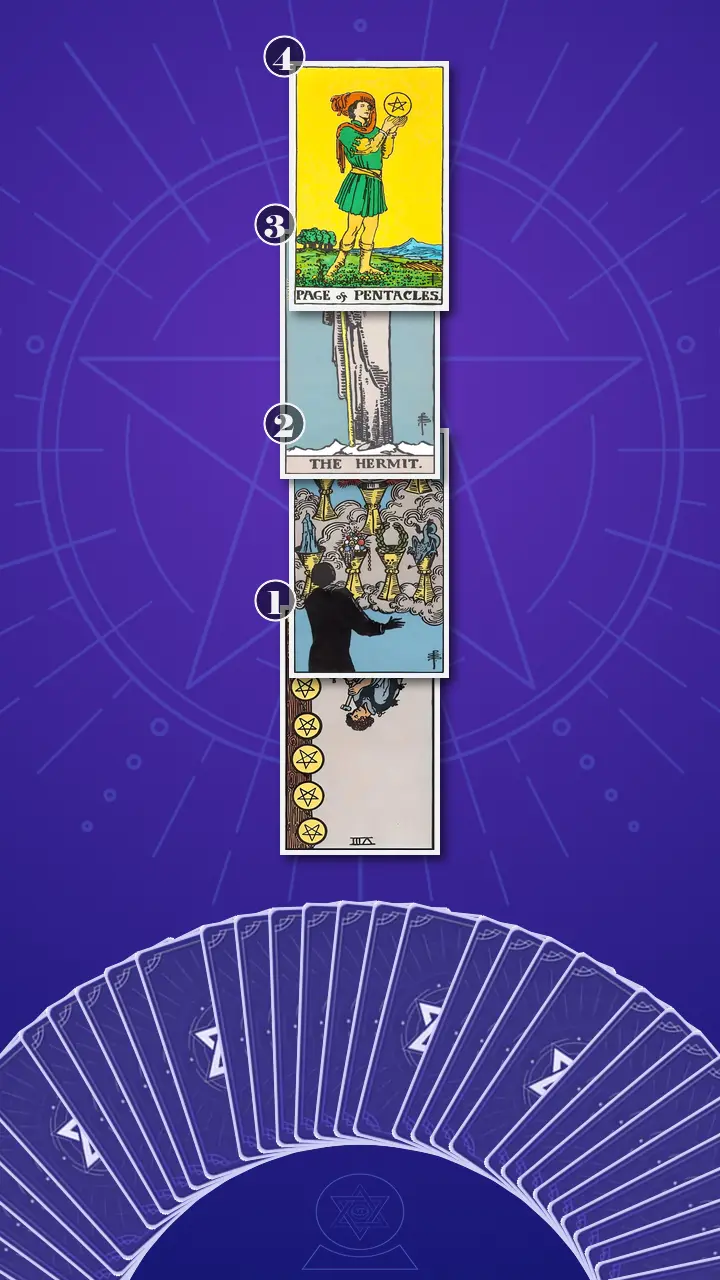
When the Workbench Refused to Become a Future
The Reversed Eight of Pentacles: Looking Busy, Making Nothing
I began with Position 1, whose role was the present layer: the concrete assignment-delay pattern of opening the work, substituting planning or career research, and waiting for deadline pressure. Now turned over, I found the Eight of Pentacles, reversed.
The craftsperson at the workbench made the scene almost uncomfortably literal. At 9:40, Alex had corrected the heading, checked the rubric, colour-coded tomorrow, and opened a career quiz. The academic rituals were all there, but no usable paragraph existed. It reminded me of polishing a checkout page without putting anything in the basket: the container improves while the actual draft remains empty.
In its upright form, the Eight of Pentacles speaks of sustained practice, apprenticeship, and attention to craft. Reversed, its Earth energy was blocked. It did not mean Alex lacked discipline; it meant effort had become disconnected from felt purpose, and perfectionistic preparation was protecting them from the exposure of an imperfect first attempt. I asked Alex to name the internal script: I am technically working, but nothing exists yet.
The card also warned against the overcorrection Alex knew well: a midnight sprint that produced polished exhaustion, shallow learning, and another reason to believe university work was punishing.
Alex gave a short laugh, but it carried a bitter edge. I watched their breath pause, their eyes fix on the perfectly formatted heading as if replaying the last Sunday night, and then their fingers loosen around the mug. They said, That is what I call studying when I cannot make myself draft.
I answered, I would call it a protective work ritual, not a moral failure.
For one week, I suggested rough production before career research: twenty minutes of contact with the assignment before the browser could offer another imagined future. Alex looked away, still unconvinced, but the shame had less room to speak.
The Seven of Cups: Seven Futures With No Evidence
I moved to Position 2, the root layer: the belief that academic effort is meaningful only when it confirms a clear future, together with the fear of losing control over that future. The card was the Seven of Cups, upright.
I set the two crowded fields beside each other in words: repeated assignment components on the desk, and a browser full of job titles, salary pages, graduate schemes, and day-in-my-life videos. The seven cloud-borne cups became seven polished identities: policy analyst, marketer, researcher, designer, consultant, teacher, and something creative. Like Netflix browse mode applied to careers, every option had an appealing trailer, but comparing every preview had replaced the experience of trying one thing.
The Seven of Cups carries the energy of possibility, projection, and choice overload. Here, that Water was abundant but uncontained. It flooded the blocked Earth of the first card. After reading a brief that seemed disconnected from any desired job, Alex opened several career pages and imagined the complete lifestyle behind each title. Every tab created another possible self to evaluate, so keeping all options mentally available felt safer than testing one. Forty minutes later, the futures were more vivid, but Alex had less evidence about what they actually enjoyed.
I asked Alex the root question: When a brief feels unrelated to your future, what is the exact unless sentence in your head?
They looked at the phone, then said, Unless I know what this is building toward, I am wasting my only evening. Before I write this paragraph, I just need to know which future makes it worth writing.
That sentence exposed the loop. Career research offered temporary relief from work that felt pointless, but more research made the possibilities brighter and the present task less testable. I said, You are not short of options; you are asking every option to prove itself in advance.
Keeping every route open felt safe, yet it prevented any route from generating lived evidence.
Alex went quiet. Their chest tightened for a moment; their thumb hovered over a LinkedIn tab; then they closed it and let the phone rest face down. I could see the first distinction forming: an imagined career could be attractive without being a preference, and a preference needed some contact with real work before it could become trustworthy.
From Seven Possible Futures to One Visible Step
The Hermit: A Lantern, Not a Satellite Map
The room seemed to narrow when I reached Position 3, the transformation layer: the capacity to interrupt comparison and future-proofing through values-led discernment focused on the next visible step. This was The Hermit, upright, and it was the bridge of the reading.
Traditionally, The Hermit represents deliberate reflection, inner guidance, and perspective gained by stepping away from external noise. Its lantern did not illuminate a full career route. It lit a small circle of ground. I asked Alex to imagine closing LinkedIn, Indeed, the class group chat, and the career quiz, then writing one honest criterion above the blank draft: I want to test whether I enjoy explaining complex ideas.
One paragraph could test that quality. The assignment did not have to become a calling to become useful evidence.
Here I used my signature lens, Draft Paralysis Deconstruction. I asked what perfectionism was protecting rather than treating it as a character flaw. For Alex, it was a subconscious defense against academic criticism and the frightening possibility that a finished degree might still not produce a clear answer. I also used Performance Anxiety Decoupling: an assignment result, peer comparison, or tutor evaluation could report on one piece of work without becoming a measurement of Alex's worth or control over the future.
I have learned, in my own work across cultures, that people often ask for a map when what they first need is a place to stand. The Hermit's lantern gave Alex that place. I shifted the interpretation from the bright clutter of LinkedIn, job boards, and career quizzes to a quieter desk with one document open. I asked Alex to repeat, I do not need the right answer tonight; I need one criterion that is honestly mine.
The radiator clicked; outside, a streetlight drew a narrow gold rectangle across the floor, and the room's bright screen clutter suddenly looked less authoritative.
At 9:40 p.m., the assignment had sat beside six career tabs. Alex had corrected the heading, checked a classmate's internship post, and felt their shoulders lock around the question: why begin when no destination was visible? Starting felt like endorsing a future they had not chosen.
You do not need a career map to make this assignment meaningful; the work can be evidence, not an endorsement of one future.
I let the silence stay. Then I added the sentence I wanted the lantern to carry: You do not need a complete career map before beginning; choose the next honest step you can see, as the Hermit's lantern lights only the ground immediately ahead.
For a beat, Alex's face went still and their pupils widened. Their first response was not relief but resistance: But doesn't that mean I have been doing it wrong?
I said no; it meant the strategy had been understandable and costly, built to protect them from an uncertain future. Their eyes lost focus as if scanning the six tabs again; one hand tightened, then opened. A long breath left their chest. The shoulders that had been lifted toward the ears lowered by a fraction, and their mouth trembled before settling. When they finally spoke, their voice began low and thin, then warmed around a shaky exhale. They reread the central line and gave a small, startled laugh. The relief was real, but it brought a brief dizziness, the blankness that can arrive when a familiar rule stops commanding the room. I asked, Now, using this view, can you remember a moment last week when beginning could have been an inquiry rather than a commitment?
Alex named the assignment on the wet Tuesday night and saw it differently: not a vote for a career, but one way to learn what held their attention. I named this first crossing carefully: from frustrated stagnation and future-control anxiety to values-led curiosity and grounded confidence through completed experiments. It was not a promise that direction would appear instantly. It was permission to gather evidence while still uncertain.
The Page of Pentacles: Let the Task Report Back
I turned to Position 4, the action layer: the practical practice through which discernment becomes a bounded assignment experiment that can reveal interests, skills, and dislikes. The Page of Pentacles, upright, looked directly at one pentacle.
The Page's standard meaning is beginner-minded study, practical curiosity, and patient skill development. Its Earth was no longer blocked. The concentrated gaze became one draft section, while the green field and distant mountains allowed today's learning and an unfinished route to coexist. I told Alex to set a twenty-five-minute timer, make three argument bullets or one rough paragraph, and then write: I was engaged by...; I was drained by...; I practised....
The point was not to extract a career revelation; it was to let the task report back.
I asked Alex to use the card's beginner-minded language: For this block, I am only finding out what happens when I work on this part.
Alex reached for their phone, then stopped. I saw the old reflex meet a smaller instruction. They said, I can try that. I do not have to decide what it means before I do it.
The statement sounded tentative, which was precisely why I trusted it.
The One-Lantern Work Block
When I placed all four cards together, the story was coherent. Alex's past pattern was not a mysterious lack of motivation: repeated comparison, tuition, part-time work, and the cost of scarce evenings had made every assignment feel like a financial and identity-level referendum. The present showed blocked craft. Underneath it, the Seven of Cups multiplied imagined futures until career research felt safer than a rough paragraph. The Hermit supplied a private criterion; the Page returned that criterion to practical study. From seven possible futures to one visible step was the whole movement.
I pointed to the cognitive blind spot: Alex had been treating uncertainty as evidence that action was irresponsible. The deeper control loop said, I must know the route before I can take the next step.
The cards suggested the reverse. The transformation direction was from demanding that every assignment confirm a destination to completing bounded experiments and allowing evidence to shape the next question. Starting the assignment is not signing a lifetime contract. Direction can be evidence you collect, not certainty you wait for.
I introduced The Inner-Critic Mute Protocol, my pre-study cognitive exercise for separating the critic's alarm from the task itself. It gave the insight a physical boundary instead of asking Alex to feel confident first.
- Mute the future verdictBefore one study session this week, at the desk and before opening any career tab, write one temporary work quality at the top of the brief, such as analysis, creativity, independence, explanation, or practical impact. Under it, write the critic's sentence:
If this does not lead to a career, it is wasted.
Answer:For this block, I am collecting evidence, not choosing a life.
If the full exercise feels too large, choose one value and write for five minutes. A temporary criterion is not a final identity. - Use the career-tab exit boundaryOn Tuesday or the next available study evening, close LinkedIn, Indeed, job boards, career quizzes, and class group chats for one twenty-five-minute block. Keep only the assignment brief, source material, and draft visible. Before any polishing or research, use the first eight minutes to make one rough paragraph, three argument bullets, five source notes, or a spoken outline.When the timer ends, stop, take a break, or choose one more bounded block. Do not turn a small experiment into an all-night catch-up session.
- Keep an assignment-as-evidence logImmediately after the block, add three lines in the document or phone:
I was engaged by...
I was drained by...
I practised...
At the end of the week, review only completed blocks and circle one repeated interest, strength, or dislike without forcing it to name a career.A result ofnothing notable yet
still counts as data. The log belongs to you and does not need to be shared with tutors, friends, family, or employers.
I told Alex that if the exercise competed with an urgent need, they could leave it and return only when they chose. A bounded experiment was not another performance test. The goal was not to finish the degree, choose a career, or obey the cards; it was to make one honest observation that belonged to Alex. This is the practical heart of the Four-Layer Insight Ladder: symptom to root to transformation to action, with the querent, not the spread, as the author of the next move. That is how actionable advice stays kind and how finding clarity remains usable.

A Week Later, the Quiet Proof
Five days later, I received a message from Alex: I did the eight-minute rough start before opening Indeed. I still woke up thinking, What if I am wrong? Then I wrote three bullets anyway.
They had slept a full night, but the morning doubt was still there. The difference was that it no longer held the keyboard hostage.
I smiled at the modesty of the update. One rough artifact had not solved a degree, revealed a perfect career, or erased uncertainty. It had done something more reliable: it created one piece of lived evidence and let Alex notice their own response to the work. The cards had not chosen a destination. Alex had used them to recover the authority to investigate.
I told Alex that this was the Journey to Clarity in its honest form: not a sudden answer, but a little more room between the inner critic and the next action. Direction could now be built through completed experiments, manageable deadlines, and grounded confidence rather than demanded in advance.
I would leave the reader with this: when the assignment tab is open and your shoulders turn to stone, writing one paragraph can feel less like coursework and more like admitting that you cannot guarantee where your life is going. I do not see that pressure as a verdict. I see the possibility of a lantern, a rough draft, and one honest piece of evidence. If this assignment did not have to prove your future, what is one small thing you would be curious to let it show you?