Three Open Videos, One Seven-Day Test, and a New Way to Choose
The 11:40 p.m. Self-Help Spiral
“You can explain five productivity methods before your first coffee, but on Sunday night you are still crossing out the routine you made on Wednesday.” I wrote that line in my notes after Maya, a 27-year-old junior product designer in London, settled into the chair opposite me and showed me a photo from the previous evening.
At 11:40 p.m., she had been sitting at the kitchen table in her shared flat with three productivity videos open on her laptop, a half-finished habit tracker beside a mug of cold tea, and another saved reading list glowing on her phone. The laptop fan whined into the quiet. The phone felt warm in her palm as she crossed out a morning routine she had designed only four days earlier.
“I can explain five methods,” she said, pressing her tongue against a tight jaw. “I just can’t choose one without checking again. I opened all that advice to feel more certain. I closed it with more rules and less trust.”
Her confusion had a physical shape. It was like trying to hear one local voice in a room where every podcast in her Spotify queue was playing at once: career coaching from one corner, nervous-system advice from another, a “non-negotiable” morning routine shouting over an anti-hustle manifesto. Her shoulders stayed slightly raised, and each pause in our conversation seemed to pull her hand towards her phone.
“Why do I keep consuming self-help advice but trust myself less?” she asked. “And what if ignoring one of those tips is the reason I stay stuck?”
I recognised the self-improvement information trap immediately: self-help burnout, productivity advice overload, and decision paralysis disguised as research. I also understood why the pattern had been difficult to interrupt. Research gave Maya short-term relief. It turned uncertainty into tabs, notes, and comparison tables, which looked and felt productive. The cost only appeared later, when no single idea had remained in contact with her life long enough to teach her anything.
“It makes sense that you keep reaching for guidance,” I told her. “You care about making thoughtful choices, and your work rewards curiosity. I’m not going to tell you that learning is the problem, or that the cards possess a perfect answer you’ve somehow missed. I want us to map the moment useful guidance becomes borrowed authority. Then we can find a place where your own experience is allowed back into the conversation.”
I placed the deck between us. “Our journey to clarity isn’t about making you certain. It’s about helping you become the person who can choose, observe, revise, and still respect herself.”
A Six-Card Map Through the Noise
I invited Maya to put both feet on the floor, let one exhale run a little longer than the inhale, and hold her question without trying to improve its wording. I shuffled slowly. The pause was not a mystical test or a performance of certainty; it was simply a transition from consuming answers to examining the pattern that made those answers feel compulsory.
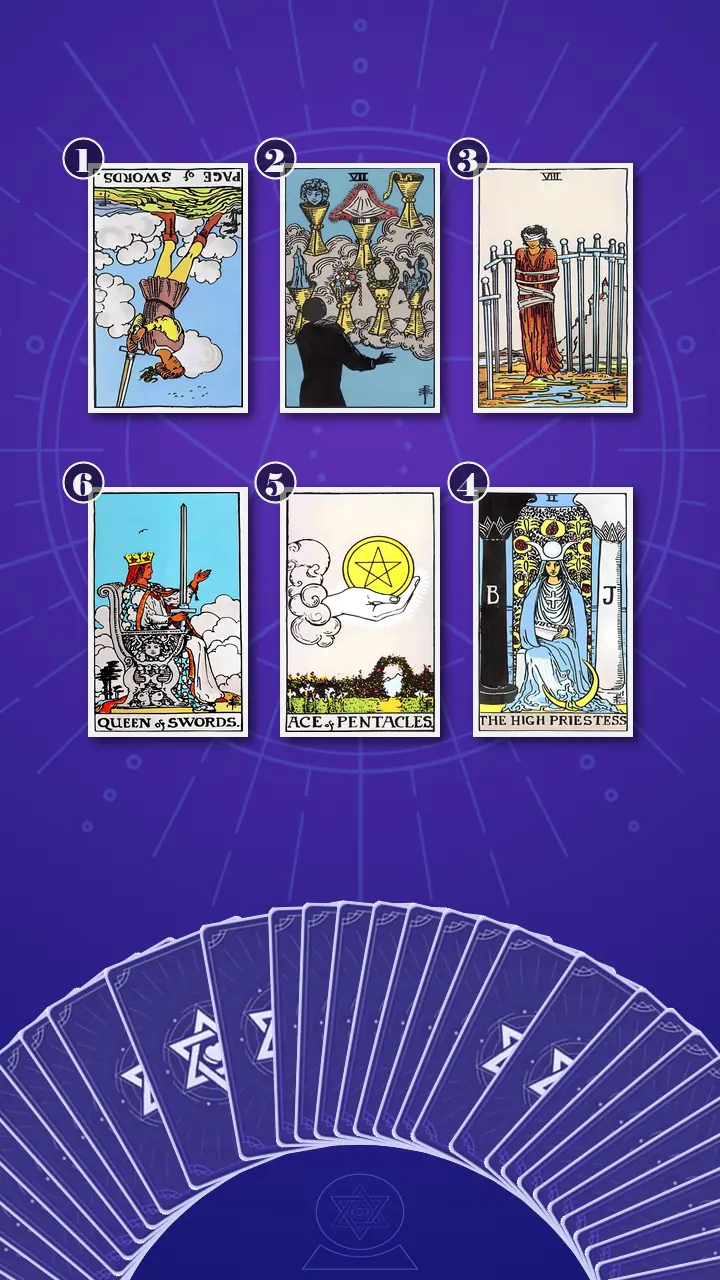
I chose the Transformation Path Grid · Context Edition, a six-card tarot spread arranged in two rows of three. For readers wondering how tarot works in a consultation like this, I use the cards as structured visual prompts. They help separate a tangled experience into observable behaviour, active blockage, underlying belief, changed perspective, practical action, and integration. The cards do not remove choice. They make the parts of a choice easier to see.
This spread suited Maya’s question because her difficulty was not one isolated habit. It was a self-reinforcing system: uncertainty led to more advice, more advice multiplied the standards she felt obliged to satisfy, and the resulting paralysis appeared to confirm that she lacked enough judgment to decide. A six-position grid could hold that entire sequence without adding irrelevant complexity.
I laid the first three cards from left to right across the top row. These would show the visible advice-consumption loop, the immediate friction created by competing frameworks, and the deeper fear beneath her analysis paralysis. I placed the fourth card directly beneath the third as the hinge of the reading: the perspective capable of interrupting the loop. The fifth would turn that perspective into action, and the sixth would show the form of self-trust Maya could practise over time.
The mirrored pairs mattered. Positions one and six would contrast scattered information gathering with mature discernment. Positions two and five would contrast many imagined futures with one grounded experiment. Positions three and four would place perceived restriction directly above a quieter form of inner authority. The layout folded back on itself like a path through the same landscape, suggesting that Maya did not need to become a different person. She needed a different relationship with curiosity, uncertainty, and evidence.
Reading the Map While the Tabs Were Still Open
Position One: The Student Who Never Gets to Practise
I turned the card representing Maya’s observable current loop: the repeated gathering, saving, and comparing of self-help advice without sustaining one experiment. It was the Page of Swords, in reversed position.
In the Rider-Waite-Smith image, the Page holds a sword high while looking backwards into turbulent weather. I asked Maya to imagine the raised sword as the phone she kept ready for the next corrective notification. The backward glance was the reflex to check what another creator had said before attending to the unfinished choice directly in front of her.
I brought us back to 11:40 on Sunday night. Maya had started with one practical question about her morning routine. Then she noticed a creator claiming that her current approach was wrong, opened three videos, two newsletters, and a Reddit thread, and saved screenshots of their contradictions. The four-day experiment she had already begun received no further attention. The search created the sensation of diligence while leaving her own observation unfinished.
“The Page’s curiosity is not the enemy,” I said. “But reversed, that Air energy is operating in excess. Alertness has become constant monitoring. Information is abundant, while integration is deficient. The mind keeps lifting the sword, but no question stays still long enough for the sword to be used with precision.”
I named the loop I heard beneath her browsing: “One more source, then I can decide.” The promise produced a small burst of relief. Twenty minutes later, the line changed to: “Why am I even less sure now?”
Maya gave a short, bitter laugh. “That is so accurate it is almost cruel.”
I let the laugh land before answering. “Then we won’t use accuracy as a weapon. This card is describing a behaviour loop, not conducting a character review. Your curiosity is still a strength. We’re looking at what happens when it never gets the chance to become tested knowledge.”
Her fingers stopped rubbing the edge of her phone. She placed it face down beside her chair, not dramatically, but deliberately.
Position Two: Seven Versions of a Better Life
I turned the card representing the immediate blockage: the abundance of competing frameworks and idealised future selves obscuring Maya’s actual priorities. It was the Seven of Cups, upright.
The image showed seven cups suspended in a cloud before a stationary figure. Each cup held a different promise or warning. In Maya’s life, the cloud looked like an algorithmic feed offering a strict 5 a.m. routine, intuitive planning, a career-acceleration course, a digital detox, and an anti-productivity philosophy in rapid succession.
Each suggestion made sense in isolation. Together, they became an excess of diffuse Water energy: possibility without enough contact with consequence. Discernment was not absent, but it was diluted across too many projected lives. Maya was no longer choosing between tools. She felt she was choosing between identities: disciplined high performer, intuitive creative, perfectly regulated adult, ambitious designer, or anti-hustle minimalist.
“If I choose this,” I said, giving voice to the conflict, “am I giving up that other version of me?”
Maya looked at the cups and nodded once. “That’s exactly it. If I don’t do the strict routine, I’m scared I’m undisciplined. If I do it, I’m scared I’m ignoring my body. Somehow both choices turn into evidence against me.”
I use a diagnostic lens called Persona Fatigue Diagnosis when advice has stopped offering tools and started demanding performances. I explained that Maya was paying the psychological cost of auditioning for several incompatible social characters at once. The issue was not that ambition, rest, discipline, or intuition were fake. The exhaustion came from treating each polished identity as a full role she might be required to maintain.
“Your feed is functioning like a streaming-service home screen,” I told her. “You can spend the entire evening browsing possible lives and never begin an episode. The practical question is smaller: which option addresses a current, observable need in your actual week, with your commute, energy, budget, and shared-flat reality?”
Her mouth tightened before relaxing. She looked down at the dark figure beneath the cups and said, “I keep choosing the most impressive identity, not the thing I actually need.”
Position Three: When an Imperfect Choice Becomes a Verdict
I turned the card representing the psychological root: Maya’s fear that making an imperfect independent choice might expose her judgment, competence, or worth as inadequate. It was the Eight of Swords, upright.
I pointed to the blindfold, the loose bindings, and the incomplete enclosure of swords. The image did not deny pressure. Maya worked in an industry crowded with frameworks, senior opinions, public case studies, and rapid professional-development content. Those swords were real. But the enclosure contained gaps, and the bindings were not as final as the figure believed.
Maya described a moment from the previous week. Before sending a reversible design recommendation, she had enough evidence to explain her preference clearly. Then she reopened a Slack thread, checked three articles shared by senior colleagues, and requested another opinion. Her cursor hovered over Send. Her shoulders rose, her breath became shallow, and a normal product-design decision began to feel like a referendum on whether she deserved professional trust.
I placed the two thoughts side by side: “I might choose imperfectly” and “An imperfect choice will prove I cannot be trusted.”
“The first is a realistic possibility,” I said. “The second is a closed argument about your worth. That is the blockage in this card. Air has stopped circulating and formed a cage made from conclusions. Agency feels deficient because uncertainty has been misread as a prohibition against movement.”
Being wrong can be feedback without becoming a verdict.
Maya’s breath paused. Her eyes moved away from the card as if replaying the Slack thread. Then she pressed both palms flat against her knees and let out a slow breath from somewhere low in her chest.
“So I’m the one doing this to myself?” she asked, with a flash of irritation. “That doesn’t exactly make me feel better.”
“I wouldn’t frame it as blame,” I replied. “The Eight of Swords shows a restriction maintained partly by perception, not a person choosing to suffer. You learned that more checking could reduce risk, and sometimes it genuinely can. The problem is that the strategy spread into low-risk, reversible choices where another round of approval no longer protects you. Recognising your part in the loop is not an accusation. It is the reason change is available without waiting for every external pressure to disappear.”
Her jaw remained tense, but the anger had become more focused. “So the gap is a small choice I can undo.”
“Exactly,” I said. “Not a leap without evidence. A move that creates evidence.”
When the High Priestess Lowered the Volume
Position Four: The Answer Draft Already Running Locally
The room seemed to become quieter before I turned the card representing the catalyst: the shift from external authority to internal observation, where Maya’s values and lived evidence could be heard before additional input entered. A bus sighed on the wet street outside, then pulled away. The card was The High Priestess, upright.
She sat between black and white pillars with a partially concealed scroll resting in her lap. She did not rush to display everything she knew. Her stillness offered a direct counterweight to the Page’s vigilance and the Eight’s enclosed argument. This was receptive energy in balance: not passivity, not magical certainty, but the ability to hold an unanswered question without immediately surrendering it to the loudest teacher.
I translated the image into Maya’s life. Before searching “best way to fix my morning routine,” she could close her feeds and write what she had already observed: she concentrated better after eight, resented 5 a.m. starts, and followed plans longer when they contained one change rather than six. She would not be claiming perfect intuition. She would simply let lived evidence speak before another confident voice entered.
At first, Maya heard silence as another task she might fail. I saw the familiar script tighten behind her eyes: if she stopped searching, she might miss the rule that could finally fix her. The crossed-out routine still looked, to her, like evidence that an unfinished personal answer could not be trusted.
This was where I used Internal Monologue Auditing, my way of identifying the destructive genre assigned to a person’s subconscious narration. Maya’s private voice had turned ordinary decisions into a courtroom thriller. Every choice was filmed as potential evidence. Every missed habit became a hostile witness. Every confident creator entered the scene sounding more qualified than the person who had actually lived the week under review.
“The High Priestess does not give that inner film a happier ending by pretending nothing can go wrong,” I said. “She changes the genre. She takes us out of the courtroom and into an observational documentary. Instead of asking, ‘What does this failure prove about me?’ she asks, ‘What happened, under what conditions, and what can I notice now?’”
I thought of an editing room, its timeline crowded with dramatic cuts that made one ordinary mistake look like the climax of an entire life. As an artist, I know how easily music, pacing, and selective footage can turn a neutral scene into horror. Maya did not need to destroy the footage. She needed to see how it had been edited.
Then I gave her the sentence at the centre of the reading.
More input is not the same as more truth; pause between the High Priestess's pillars, name what your own experience says, and only then choose what advice enters.
I left a few seconds of quiet around it.
Maya’s inhale stopped first. Her fingers froze halfway towards the phone, suspended above the table. Then her gaze went slightly out of focus, and I watched recognition move across her face as though she were replaying the Sunday-night kitchen scene without its usual soundtrack. Her pupils widened. The muscles beside her mouth tightened, released, and tightened again. Her eyes grew bright, but she did not look away. Finally, her shoulders dropped by a visible inch and her hand opened flat on the table.
“But doesn’t that mean I was wrong all this time?” she asked. The anger in her voice arrived before the relief. “I’ve spent years trying to become better at making decisions, and maybe I’ve been training myself not to make them.”
“It means the strategy had a cost you can see now,” I said. “That is different from declaring your past self wrong. She was trying to protect your worth from the possibility of a mistake. We can appreciate the intention without keeping the method.”
Maya released a shaky breath. Relief softened her face, followed by a brief, almost dizzy blankness. I could see the new vulnerability beneath the insight: if no final authority could exercise discernment on her behalf, then a small portion of responsibility was returning to her hands.
“Self-trust is not hidden in the next answer; it grows when your own experience is allowed to count as evidence,” I told her. “Your experience is data, not an interruption.”
I invited her back into a real moment. “Now, with this new perspective, think about last week. Was there a point when this insight might have made you feel different?”
She returned to the design recommendation hovering in Slack. “I could have written what I already knew before reopening the thread,” she said. “I had user feedback, I knew the constraint, and I already had a reason. I didn’t know everything, but I wasn’t starting from nothing.”
I asked whether she wanted to try the High Priestess pause in the room. Maya put her phone on Do Not Disturb and opened a blank note with two headings: “what I was told” and “what I have noticed.” Under the second, she wrote three sentences about her morning routine. No incense, no claim of infallible intuition, no demand that the answer be final. Just her own evidence entering before the external literature review.
That was the pivotal movement from compulsive uncertainty towards grounded clarity. It was modest and incomplete, but it mattered: Maya was no longer treating her perspective as automatically unqualified.
One Coin, One Week, One Clear-Eyed Editor
Position Five: A Practice Small Enough to Touch
I turned the card representing the practical action that could give the High Priestess pause a concrete form. It was the Ace of Pentacles, upright.
A hand offered one pentacle above a cultivated garden, with a path passing through a flowered arch. After the Seven of Cups had presented an entire feed of possible selves, this card offered one solid object close enough to receive. The spread’s energy shifted into Earth. Grounding, previously deficient, became available through a bounded action rather than another burst of motivation.
“This is one small usability test, not a debate between five design philosophies,” I said. “Advice becomes a hypothesis. Your life supplies the test conditions.”
We chose one suggestion already sitting in Maya’s saved queue: leaving her phone outside the bedroom. She could define a seven-night trial, record only her approximate sleep time and morning energy, and change no related habits where practical. She was not adopting an entire digital-wellness identity or signing a software licence in full. She was placing one suggestion into actual conditions and observing what happened.
Test one idea before adopting an identity.
“I’m not choosing a philosophy,” Maya said slowly. “I’m collecting one week of evidence.”
Then her brow creased. “But I know what I’ll do. I’ll miss night three, call the whole thing inconsistent, and build a stricter tracker.”
“Then night three belongs in the evidence,” I replied. “A missed day can tell you about friction, context, or the design of the experiment. It does not automatically invalidate the other days, and it definitely does not grade your character. Three days can be the minimum version if seven starts to become another performance.”
She looked at the single pentacle again. “One variable. One note. No new dashboard.”
“Exactly.”
Position Six: The Queen Who Decides What Enters
I turned the final card, representing cognitive integration: explicit information boundaries and the ability to use outside advice as optional input rather than a verdict on competence. It was the Queen of Swords, upright.
The Queen faced forward beneath a clearing sky. She held her sword vertically and extended her other hand with an open palm. I saw balanced Air where the spread had begun with distorted Air. Her sword was a clear standard, not a weapon against herself. Her open hand remained receptive to relevant expertise, but receptivity no longer meant submission.
I described a possible Friday scene. Maya would review her seven-day note and choose one of three labels: keep, adapt, or drop. She might mute an account that repeatedly manufactured urgency, retain one source that addressed a current problem, and explain her next choice using criteria grounded in her own circumstances. Advice would remain available. It simply would not arrive as a verdict on her competence.
“Useful input can enter,” I said. “Urgency does not get automatic authority.”
The Page and Queen bookended the reading with the same suit at different levels of maturity. The Page raised a sword while looking backwards into turbulent weather. The Queen faced the question directly, held the sword steadily, and stayed open to information without handing it control of the scene.
I told Maya, “Your goal is not to become impossible to influence. It is to become an active editor. You can keep what works, adapt what partly fits, and release what does not. You can also seek professional or specialist advice when the situation genuinely calls for it. Self-trust includes knowing when another person’s expertise is relevant.”
Stay teachable without giving away authorship.
Maya glanced at her phone, still face down beside the cards. “That sounds less like confidence as a feeling,” she said, “and more like having a process I can respect.”
“That is exactly how I read the Queen here,” I replied. “She does not promise that every judgment will be correct. She shows a mind that can make an evidence-based choice and remain open to revision without collapsing into shame.”
The Story Hidden Inside the Six Cards
I gathered the reading into one continuous sequence. Maya’s pattern had begun with a reasonable wish to learn. When uncertainty appeared, the Page of Swords reversed went searching, and the search produced short-term relief. The Seven of Cups then multiplied advice into incompatible identities, so choosing a tool felt like sacrificing a possible self. The Eight of Swords turned that pressure into a closed conclusion: if Maya chose without enough approval and the result was imperfect, the mistake might expose something defective about her judgment or worth.
The High Priestess interrupted that sequence without asking Maya to reject teachers, content, or expertise. She restored a quiet interval in which personal observation could become part of the evidence base. The Ace of Pentacles converted one idea into a time-limited experiment, and the Queen of Swords used the result to form revisable standards and information boundaries.
I noticed something else in the elemental story: there were no Wands. Maya did not lack ambition, inspiration, or motivational intensity. Adding another energising podcast to the morning commute would only add four more goals before Old Street. What had been missing was selection, grounded practice, and enough silence for one experience to finish becoming information.
As I looked across the spread, I returned to the way I understand a life: a film currently in production. Maya had been watching trailers for seven possible futures, hiring a new director every few days, and cutting away from each scene before it produced usable footage. The cards did not prescribe the ending. They showed her where she could stop replacing the script and shoot one small, reversible scene.
Her cognitive blind spot was the assumption that continued uncertainty meant she needed more input. In reality, the missing information often could not be found in another post. It could only be produced by contact between one idea and her actual life.
The transformation direction was therefore precise: move from collecting advice as authority to testing one piece of advice as a time-limited hypothesis. Self-trust would not mean believing every first instinct. It would mean allowing a personal observation to exist, taking a bounded action, evaluating the result honestly, and revising without turning the revision into punishment.
The Director’s Cut for the Next Seven Days
When I proposed a short plan, Maya raised a practical concern. “What if even this becomes another routine I’m supposed to perform perfectly?”
“Then the plan must include the imperfect footage,” I said. “We’ll keep it small enough to generate information, and we’ll build in a way to respond when the punitive narrator appears.”
- Use the Own-Answer-First Pause.The next time a low-risk self-help question appears, open Apple Notes or Google Keep before opening a browser, podcast, Reddit thread, or group chat. Set a seven-minute timer and complete two lines: “What I already notice is...” and “What matters in my actual circumstances is...” Then wait 24 hours before adding new advice unless genuinely time-sensitive information is needed.If seven minutes feels heavy, write one sentence or record a 30-second voice note. The answer may be incomplete. Its purpose is to make your current view visible, not final.
- Run one One-Advice Seven-Day Trial.Choose one low-risk suggestion already in the saved queue. Maya chose leaving her phone outside the bedroom. Put the trial’s start and end dates in the calendar, change only that variable where practical, and record one observable effect each day, such as approximate sleep time or morning energy from one to five.Do not build a new dashboard. One line in a phone note is enough. If seven days becomes burdensome, use a three-day minimum version, and stop early if the practice is costly, unsafe, or clearly unsuitable.
- Make a Keep-Adapt-Drop Director’s Cut.At the end of the trial, spend ten minutes at the kitchen table and label the idea “keep,” “adapt,” or “drop.” If the thought “I failed this” begins, use my Director’s Cut of Self-Compassion: pause the punitive edit and write, as an objective and supportive observer, “What happened?” “What did the conditions affect?” and “What will I change in the next cut?”Judge the usefulness of the advice, not your worth. An uneven result is still data. After reviewing it, mute one source for seven days if it creates urgency without adding value.
I reminded Maya that these boundaries applied to ordinary, reversible self-help choices. They were not a substitute for qualified medical, legal, financial, mental-health, or safety guidance. Becoming the editor of incoming information includes recognising when specialist knowledge belongs in the room.
“The cards are not asking you to trust yourself because you will always be right,” I said. “They are asking whether you can build trust by watching yourself choose, learn, and revise. You remain the author of what happens next.”
A Week Later: The Quiet Proof
Seven days later, I received a message from Maya. She had left her phone outside the bedroom on four of the seven nights. Her morning-energy score rose slightly on three of them, but sharing the hallway charger with her flatmate had made the arrangement awkward. She labelled the result “adapt” and decided to place the phone on the far side of her room instead.
“I nearly called four nights a failure,” she wrote. “Then I did the Director’s Cut questions. The experiment wasn’t perfect, but it told me something. Also, I didn’t download a sleep-tracking app, which honestly feels historic.”
That morning, she had slept through, but her first thought was, “What if the data is too messy?” She smiled, kept the note, and made coffee before opening Instagram.
I did not read her message as evidence that a tarot session had solved her relationship with self-help. I read it as the first modest proof of a changed process. She had taken one suggestion out of the cloud, tested it in the material conditions of her own life, and revised it without making the result a verdict on her character.
That was Maya’s Journey to Clarity: not compulsive uncertainty transformed into permanent confidence, but reassurance-seeking beginning to give way to grounded observation, selective judgment, and steadier self-respect. The cards had provided the map. Maya had generated the evidence and chosen the next direction.
I know how familiar the tight jaw and hovering thumb can feel when guidance is supposed to make life steadier, yet one unverified choice seems capable of exposing us as less competent or worthy than we hoped. If that moment finds you tonight, remember that noticing the urge to open another tab is already an edit. Clarity may be the instant the noise drops enough for your own rough cut to become audible; it does not have to be the final film.
If your own experience were allowed into the evidence column, what tiny, reversible seven-day scene would you choose to shoot before asking another voice how the story should go?