The Real Contract Brief: From Draft Folder to Concrete Evidence

The 10:40 p.m. Split Screen: When Approval-Seeking Looks Like Due Diligence
If you can explain the respectable next step in perfect detail but feel your jaw lock when someone asks what you would choose without defending it, I suspect you will recognize the question Jordan brought into my reading room. At 28, they were a Toronto operations analyst facing a promotion-versus-portfolio career crossroads. I recognized the pattern immediately: approval-seeking and career-change overanalysis that keep a personally meaningful path untested.
At 10:40 p.m. the previous Tuesday, Jordan had sat in their rented apartment with a promotion application open on the left side of the laptop and a short contract brief connected to portfolio work on the right. They told me the laptop fan hummed beneath the blue light, which flashed across a half-full water glass. Their phone had grown warm in their palm as they scrolled through LinkedIn promotions, certificates, and polished career pivots.
Jordan had polished the promotion statement, moved the meaningful brief into a folder called later, and kept scrolling until midnight. Their jaw tightened while the choice was still open. Their shoulders dropped when they returned to the expected route, bringing a few minutes of relief and the heavier feeling that their life had become slightly less their own.
“I can explain the sensible option perfectly,” they told me. “Which may be the problem. I don't want to blow up my life just to prove it's mine.”
Apprehension seemed to sit around their ribs like a spreadsheet column narrowed until every value displayed as ####: the real information was still there, but pressure had made it unreadable. Beneath it, I could hear longing, guilt about wanting more, and resentment at needing the choice to make sense to an audience that was not paying Toronto rent on Jordan's behalf.
I keep calling it research, but I am really waiting for permission.
I let that sentence settle before I responded. “You are not confused about what matters; you are trying to make one choice carry zero risk and zero disapproval. Those are different problems. I am not here to tell you to quit, stay, or trust a prediction. I want us to make a clear map of what is material, what is imagined, and what can be tested without blowing up anything.”
That became the purpose of our Journey to Clarity: not finding a choice nobody could criticize, but discovering what fear kept making the expected path feel like the only legitimate one.

Choosing the Compass: The Five-Card Shadow Spread
I invited Jordan to put both feet on the floor, take one unforced breath, and hold the question in plain language: What fear keeps me choosing the expected path over my own? I shuffled slowly, using the movement as a transition from the noise of comparison into focused attention. Nothing about the ritual required supernatural certainty; it simply gave us a boundary around the question.
I chose The Shadow Spread, a five-card shadow-work tarot spread designed to trace a recurring behavior through its root fear, protective purpose, long-term cost, and possible integration. For anyone wondering how tarot works in a career reading, this was not a prediction of which job would succeed. It was a structured way to make Jordan's decision pattern visible enough to examine without shame.
I placed the first card at the center to reveal the active pattern behind the familiar choice. The second went below it, identifying the fear about belonging or stability underneath that pattern. The third went to the left, showing how comparison and control tried to protect Jordan. The fourth went to the right, revealing the cost of postponing direct experience. The fifth rose above the center, offering a conscious way to carry the fear without letting it make the decision.
The cross looked like a compass. Its southern point held the buried fear; its northern point held a personally chosen direction. The structure suited Jordan's question because we did not need the additional future and environmental layers of a Celtic Cross. We needed the smallest complete map of why the loop persisted.
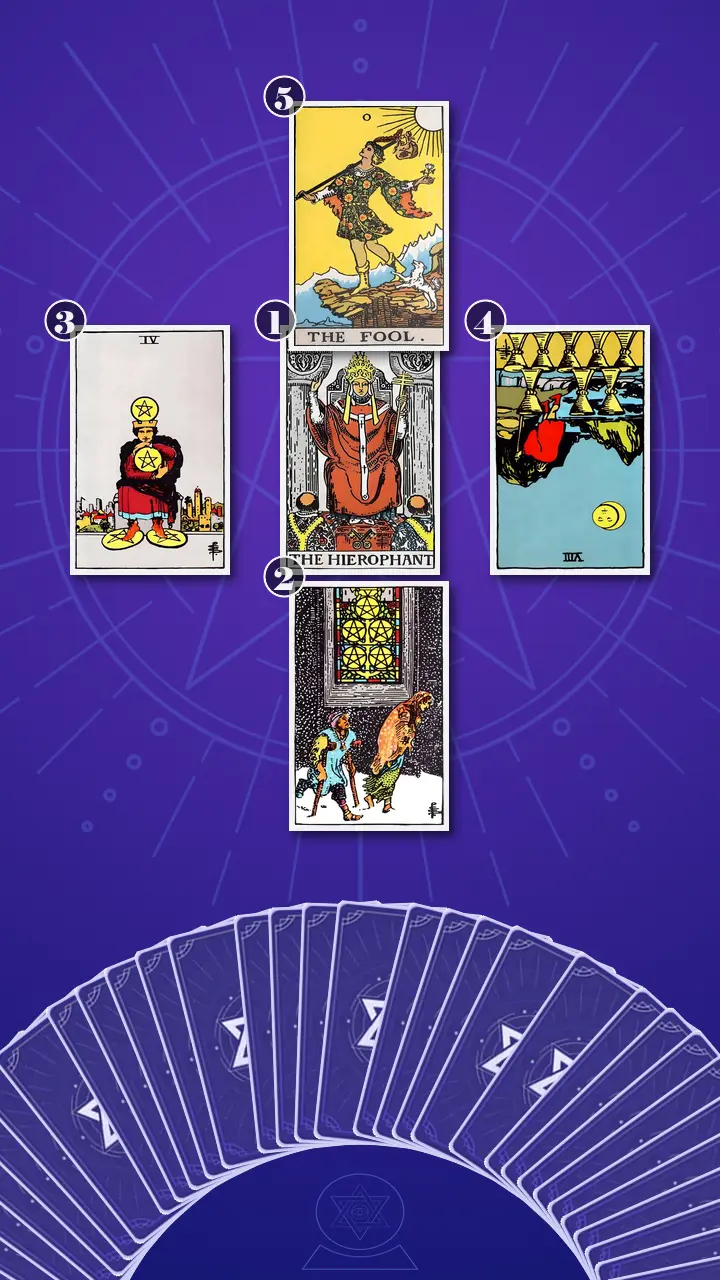
The Keys, the Window, and the Grip
Position 1: The Keys to a Legible Life
Now I turned over the card representing the active pattern behind Jordan's habit of choosing the familiar, expected route instead of testing a personally meaningful alternative. It was The Hierophant, upright.
I pointed to the two acolytes kneeling before an authorized figure, the raised hand of formal blessing, and the crossed keys resting at the Hierophant's feet. I saw a precise image of legitimacy being granted from above: a manager approving a promotion, a credential validating a skill, or an applicant-tracking system deciding whether an ambition contained the correct keywords.
In Jordan's modern life, the card appeared at 9:15 on a Monday morning. They opened the internal promotion framework before opening the short contract brief they had bookmarked. The recognized title, credential ladder, manager approval, and LinkedIn-friendly explanation made the promotion feel valid before Jordan had checked whether it felt meaningful. The crossed keys became the qualifications they believed had to unlock permission to begin.
I read the Hierophant's energy as an Excess of external authorization. Structure itself was not the problem. Jordan had gained real skills, income, and professional support through established systems. The excess appeared when other people's ability to understand a choice became the main proof that the choice was responsible.
“Listen to the rule running underneath the comparison,” I said. “If the system can explain it, then it must be responsible. If people approve it, then it must be valid. But when you describe the portfolio direction, your jaw tightens before anyone has even objected. Which outside standard currently gets to decide whether your desire is credible?”
Jordan gave a short laugh that carried no amusement. Their thumb pressed into the edge of their water glass. “That is so accurate it feels a little cruel.”
I stayed with the resistance rather than smoothing it over. “It would be cruel if I were telling you that conventional work is empty or that you have failed by valuing stability. I am saying something narrower: the promotion framework has become a verification badge for your whole life. We are checking whether it deserves that much authority.”
Their thumb released the glass. They did not nod yet, but they looked back at the crossed keys.
Position 2: The Fear Outside the Warm Window
Now I turned over the card representing the underlying fear about belonging, approval, and stability that made departure from expectations feel disproportionately dangerous. It was the Five of Pentacles, upright.
I held Jordan's attention on the two figures walking through snow beneath an illuminated stained-glass window. One figure leaned on a crutch; both appeared to move past warmth that might or might not be accessible. The card did not tell me that Jordan would lose money or support. It showed me the image their fear was using to represent a different career path: standing outside the room where secure, recognizable adults seemed to belong.
I returned to Jordan's Sunday night budget scene. At 9:47 p.m., they had typed rent, benefits, savings, and hypothetical portfolio income into a Google Sheet while the radiator clicked beside unopened takeout. They calculated three worst-case scenarios even though no resignation, debt, or major spending decision was on the table. In that moment, one small contract had become a fantasy of losing income, health coverage, professional credibility, and social membership all at once.
I read this as a Blockage in the perception of available support, intensified by an excess of downside forecasting. Fear made only the snow visible. The warm window, current salary, savings, transferable experience, and right to run a small test remained in the image, but Jordan's attention could not reach them while trying to prevent every possible loss.
“There are two questions here,” I said. “What material consequence is likely, and what conversation would merely be painful? Rent is material. Benefits are material. Available time is material. A friend's raised eyebrow may hurt, but it does not automatically cancel your lease, skills, or place in the professional world.”
Jordan's fingers stopped moving. Their gaze shifted from the stained glass to the table, as though the card had replayed a private forecast frame by frame. “The thought is basically, if I leave the recognized route, I lose the room where I belong,” they said quietly. “I know one sample project cannot do that. My body reacts like it already has.”
I nodded. “That reaction deserves respect, not obedience. We can protect what is genuinely at stake without treating social discomfort as a total financial disaster.”
Position 3: The Spreadsheet Grip
Now I turned over the card representing the protective purpose served by comparison, reassurance seeking, and preservation of the familiar route. It was the Four of Pentacles, upright.
The figure held one coin against the chest and pinned two more beneath both feet, with the city kept at a distance. I translated the three visible coins into salary, professional credibility, and a coherent identity. The posture kept those resources close, but it also made movement nearly impossible.
I described the Queen West cafe where Jordan had recently opened a short contract brief beside the promotion application. Espresso and wet pavement drifted through the doorway while they added columns for salary, benefits, credentials, reputation, and exit risk. When the first comparison did not produce certainty, they added more columns. Their fingers pressed hard into the trackpad, and the one task that could generate evidence remained untouched.
I read the Four's energy as an Excess of preservation. The pattern provided a real short-term benefit: completing another spreadsheet or resume revision restored control for a few hours. The card was not condemning that need. It was showing how resources intended to create safety had been placed in spreadsheet freeze-frame, where none could circulate toward even a low-risk experiment.
“What immediate relief do you get when you make another matrix?” I asked.
“I get to feel like I am doing something responsible,” Jordan said. Their shoulders rose and remained there. “And I don't have to find out whether I am any good at the other work.”
That answer exposed the protection clearly: I am protecting my stability, and I am also protecting myself from finding out what I can do.
“A stable path can be a resource without becoming the authority on who you are allowed to become,” I said. “The question is not whether you should throw the coins away. It is whether one of them can support movement instead of being used to pin your feet down.”
Position 4: The Draft Folder of Almost-Departures
Now I turned over the card representing the long-term cost of repeatedly postponing direct experiments with the self-chosen path. It was the Eight of Cups, reversed.
I pointed to the deliberate gap in the stacked cups and the figure who, upright, would walk toward the dark mountains. In reversal, that departure had become blocked, internalized, and repeatedly withdrawn. I did not read it as a command to abandon Jordan's job. I read it as a browser tab that loaded possibility, reached the threshold of action, and returned to the promotion page before reality could provide an answer.
The card appeared in Jordan's Notion dashboard and draft folder: a course page opened and abandoned, a short contract almost answered, and a portfolio sample polished until it felt ready for judgment but never shared. The current route was not empty, just incomplete. Jordan repeatedly noticed the gap, approached an alternative, felt the discomfort of transition, and interpreted that discomfort as evidence that returning was the responsible choice.
I read the reversal as a Blockage of Water's movement. Emotional information was present; Jordan knew something felt unfinished. But the information could not become action, so it circulated as envy, guilt, and resentment instead. Each retreat brought temporary relief and removed another chance to gather direct evidence about interest, skill, market response, or tolerable risk.
“After another week on the expected route, what remains untested?” I asked. “Your ability to do the work? Your ability to find paid opportunities? Or your ability to survive other people's questions?”
Jordan's shoulders lowered, but their mouth tightened. “All of it. I keep treating the lack of evidence as proof that the portfolio path is unrealistic, even though I am the one making sure no evidence gets collected.”
I laid one finger between the Four and the reversed Eight. Together, they formed what I think of as an Earth-Water lock. The Five anticipated disruption, the Four consolidated resources to prevent it, and the reversed Eight kept emotional knowledge from becoming movement. No Swords or Wands appeared in the suited sequence, so Jordan's clear personal language and direct initiative had not yet entered the loop. The missing response was not a dramatic exit. It was one honest criterion and one observable action.
When The Fool Faced the Unmapped Horizon
As I reached for the card above the center, a streetcar bell sounded beyond the window. The winter cloud cover thinned just enough to cast a pale yellow strip across the table, echoing the open sky in the image I was about to reveal. The room seemed to become quieter around the final card.
Position 5: A Beginning With a Stop Option
Now I turned over the card representing the mindset and practical mode of engagement that could integrate Jordan's fear without allowing it to make the decision. It was The Fool, upright, the key card and bridge of the reading.
I framed the Fool's small travelling bundle against the yellow sky, the cliff edge, and the white dog moving beside the traveller. The bundle held only what the next step required, not a complete career architecture. The cliff kept practical caution visible. The dog became feedback: the information available only when an idea makes contact with the world.
In Jordan's life, The Fool was one short contract, one sample assignment, one course exercise, one collaboration conversation, or one application treated as a genuine experiment. It did not require them to resign, announce a new identity, or guarantee future income. It invited them to discover what happened during a contained encounter with the work.
I read The Fool as a movement toward Balance. Jordan had an abundance of Earth-based caution and a blockage of emotional movement; beginner energy, clear personal language, and direct initiative were underused. The Fool did not erase caution. It gave caution a smaller and more accurate job: define the boundary, watch the edge, and allow curiosity to take one step inside it.
This was where I used my Decision Timing Calibration. I thought of the years I had spent marking planetary stations and recurring cycles in ephemeris pages. Timing never removes agency, but conditions affect what a decision can accurately measure. A 10:40 p.m. verdict made after a full workday, a LinkedIn comparison spiral, and a clenched-jaw worst-case forecast was not structurally optimal for a high-stakes choice. That low-tide state was real, but it was a temporary environment, not a final truth about Jordan's capacity.
I paired that with Cyclical Variable Filtering. Together, we separated the variables likely to affect Jordan's long-term orbit from the weather passing through a single evening. Rent, benefits, available time, energy, skill gaps, and evidence of demand belonged in the structural column. A peer's promotion post, an imagined group-chat reaction, one exhausted night, and the wish to sound coherent at dinner belonged in the temporary-friction column. I did not discard those reactions. I stopped them from impersonating permanent facts.
I brought us back to 10:40 p.m.: the polished promotion statement, the unopened brief, the warm phone, and the fan's small mechanical hum. Jordan had been treating immediate relief as proof while asking one career decision to be perfectly defensible before the work had even been touched.
I said, “Your path does not need to be proven in advance before you take one small, reversible step toward it. The missing guarantee is not evidence that the desire is irresponsible; it is a reason to gather direct evidence carefully.”
The absence of a guaranteed map does not make your desire irresponsible; take one bounded first step, like The Fool travelling lightly toward an unmapped horizon.
I stopped speaking and let the sentence remain between us.
First, Jordan's breath froze halfway in. Their right index finger hovered above the card without touching it, and the muscles along their jaw sharpened. Then their gaze lost focus, as though the split laptop, the closed brief, and five years of carefully defensible choices were replaying somewhere behind my shoulder. Their eyes brightened, but the first feeling to reach their voice was anger. “But doesn't that mean I have been wrong this whole time?” they asked. The last word came out thinner than the rest.
“No,” I said. “It means a strategy that protected your rent, benefits, belonging, and early career became too expensive when it started blocking every form of direct evidence. You were not foolish for building stability. You are allowed to update the strategy now that you can see its full cost.” Finally, Jordan's fist opened against their knee. Their shoulders lowered on a long exhale, and their face softened, but the relief left a moment of visible dizziness behind it: clarity had returned the responsibility for the next step to them.
I asked, “Now, with this new perspective, think back: was there a moment last week when this insight could have made you feel different?”
Jordan looked again at The Fool. “When I opened the contract brief on Tuesday. I thought I had to decide whether it could become my whole career. I could have answered the first question in the brief and learned something.”
I invited them to complete the sentence in The Fool's voice: “I do not have to know the whole route; I only have to notice what happens when I take this contained step.” Then I gave the idea a body: a 10-minute timer, one real prompt, and one visible action. No resignation, public announcement, or spending was required. Jordan retained the right to stop if the task produced more strain than useful information.
I named the deeper movement I had witnessed: from contracted apprehension and borrowed approval to grounded self-trust through direct evidence. It was not the completion of that transformation. It was the first crossing, from demanding certainty before action to allowing carefully bounded action to create clarity.
The One-Honest-Evidence Plan
I gathered the five cards into one coherent story. The Hierophant had issued the socially legible train ticket. The Five of Pentacles had made every other destination look like exile. The Four had gripped salary, status, and identity to prevent that imagined loss. The reversed Eight of Cups had kept Jordan checking the departures board without boarding even a local test route. The Fool did not tear up the safe ticket; it showed that one reversible journey could be taken before a permanent destination was chosen.
Jordan's cognitive blind spot was the assumption that unfamiliarity, social exposure, and material danger were the same category. Because the alternative lacked evidence, it looked irresponsible. Yet comparison and reassurance seeking were the very behaviors preventing that evidence from existing. The transformation direction was precise: replace the demand for a fully defensible life decision with one bounded, reversible experiment on the self-chosen path this week.
I translated the reading into two pieces of actionable advice. Both preserved Jordan's autonomy and financial floor. Neither required the promotion path to become an enemy.
- The 72-Hour Orbital Pause. When a LinkedIn post, Sunday-night forecast, or difficult conversation creates pressure to make a high-stakes choice immediately, Jordan will delay any reversible-deadline decision for up to 72 hours. At the start of the pause, they will create two headings in a private note: practical constraints I choose to protect and reactions I am trying to prevent other people from having. They will place at least three concerns under the correct heading, using actual details such as monthly rent, benefits, available hours, a friend's imagined judgment, or discomfort with an unfamiliar title. On the second day, they may ask one trusted friend to reflect the distinction back, without giving a career verdict. Tip: The Orbital Pause is not permission to miss a firm deadline or postpone forever. If less than 72 hours are available, use the time that exists. A two-minute voice memo counts, and Jordan can say, “I am sorting constraint from approval, not asking you to decide for me.”
- The 90-Minute Reality Check. By the next Wednesday at 7:00 p.m., Jordan will choose one real contract brief, sample assignment, course task, or collaboration opportunity connected to the portfolio direction. They will work on it for one uninterrupted 90-minute block at the Toronto Reference Library, a coworking desk, or their kitchen table, with LinkedIn closed and a phone timer running. Before stopping, they will record three observations in Notes: what held their attention, what felt difficult, and which practical constraint was actually present. Submitting the result is optional; completing the sample still produces evidence. Tip: Allow no more than 20 minutes of preliminary research, and put new questions in a parking-lot note instead of opening more tabs. If 90 minutes feels too exposed, begin with 10. No resignation is required for a first step to count.
I called this a boundary-first career experiment. Jordan was not being asked to prove independence through a reckless leap. They were using stability as a floor, filtering temporary friction, and collecting one honest piece of evidence that another comparison sheet could not provide.

A Week Later: Doubt Without Admin Access
Six days later, I received a message from Jordan. They had taken the contract brief to the Toronto Reference Library, set the 10-minute starter timer, and continued for the full 90 minutes. Their message read: “I finished the sample. I didn't hate being a beginner. I actually lost track of time for twenty minutes.”
The evidence was not uniformly flattering, which made it more useful. Jordan had noticed a software skill gap, discovered that tired Tuesday evenings were a poor work window, and found that Saturday mornings felt sustainable. They had not resigned or announced a career pivot. The promotion application was still available. The difference was that the portfolio direction was no longer made entirely of bookmarks, forecasts, and other people's reactions.
That night, Jordan slept through until morning. Their first thought in the thin winter light was, What if I'm wrong? They told me they smiled, opened the three observations, and got out of bed. The doubt remained; it no longer had admin access.
I saw the quiet proof of our Journey to Clarity there. Tarot had not selected Jordan's future or magically removed risk. The cards had provided an objective mirror, but Jordan had turned the reflection into evidence. The authorship belonged to them.
When the promotion tab is polished and the meaningful brief is still unopened, I know the chest can tighten around the fear that choosing what is yours will cost you belonging. Recognizing that one concern belongs to rent and another belongs to permission does not solve an entire life, but it means the split screen is no longer invisible.
If you did not need your choice to look responsible to anyone tonight, what is one small detail of your own unopened brief that you would let yourself notice for ten honest minutes?