Permission-Seeking Choice Paralysis: Preference Before Polling
The 11:40 p.m. Search for Permission
I recognize permission-seeking choice paralysis by its after-hours choreography: asking friends, colleagues, and online communities what they would do before saying what you want, reopening the spreadsheet, and thinking, "I know what I want until someone asks me to justify it."
Maya, a 29-year-old product marketing specialist in Toronto, joined our video consultation from her condo kitchen at 11:40 on a Sunday night. A cold mug of tea sat beside her laptop. Three browser windows held a promotion brief, a part-time creative strategy course, and a job listing with a less impressive title but work she kept returning to. The laptop fan hummed beneath our voices, and her phone looked warm from being held too long.
I watched her add another weighted column to a Google Sheet already scoring salary, status, risk, commute, growth, and something she had labelled "long-term credibility." Two friends' voice notes waited on her screen. An unsent memo titled What I Actually Want remained unopened.
"The promotion is the sensible move," she told me. "Better title, predictable raise, easy to explain. The course is interesting, but I don't know where it leads. And the other job sounds exciting, which somehow makes me trust it less."
She rubbed the base of her throat. Her shoulders had risen almost to her ears. She described the feeling as if she were strapped into a presentation she had never agreed to give, with every imagined face waiting for the slide titled Why This Was Sensible. That was her anticipatory anxiety in physical form: a tight chest, a polished argument, and a private preference being cross-examined before it was even allowed to speak.
"I keep calling it research," she said, "but I am really waiting for permission. Why do I choose the approved path at every crossroads?"
I told her, "You are not indecisive about everything. You are waiting for a private choice to become publicly defensible."
I also made an important distinction. Toronto rent, financial security, and career consequences were not imaginary. Practical research mattered. I was not going to tell her to ignore useful advice, romanticize risk, or blow up a stable life to prove she was independent. Our task was narrower and more honest: to understand why choosing freely felt unsafe unless the choice came with recognizable approval.
"Tarot will not choose one of those browser tabs for you," I said. "It can show us the decision-making architecture underneath them. Let us draw a map of the fog, separate facts from applause, and return the final authority to you."

Choosing the Hinge in the Fog
Why I Chose the Five-Card Shadow Spread
I asked Maya to put her phone face down, let one breath reach below her collarbones, and hold the question without trying to improve it. I shuffled slowly. The pause was not a mystical performance; it was a deliberate change of pace, giving her attention somewhere to land after hours of tabs, scores, and competing voices.
I chose The Shadow Spread, a five-card layout shaped like a cross. For anyone wondering how tarot works in a decision reading, I use a spread like this as a structured inquiry, not a prediction machine. Card meanings in context help us distinguish the behavior someone can already see from the belief protecting it, the fear beneath it, the resource being neglected, and the grounded practice that could change the pattern.
This question called for inner excavation because Maya was not asking which career path was guaranteed to succeed. She was asking why the same approval-dependent process appeared at every career crossroads. A simple past-present-future spread would not adequately separate her need for recognition from her fear that independent judgment might expose a lack of worth. A larger spread would add noise to a mechanism that was already precise.
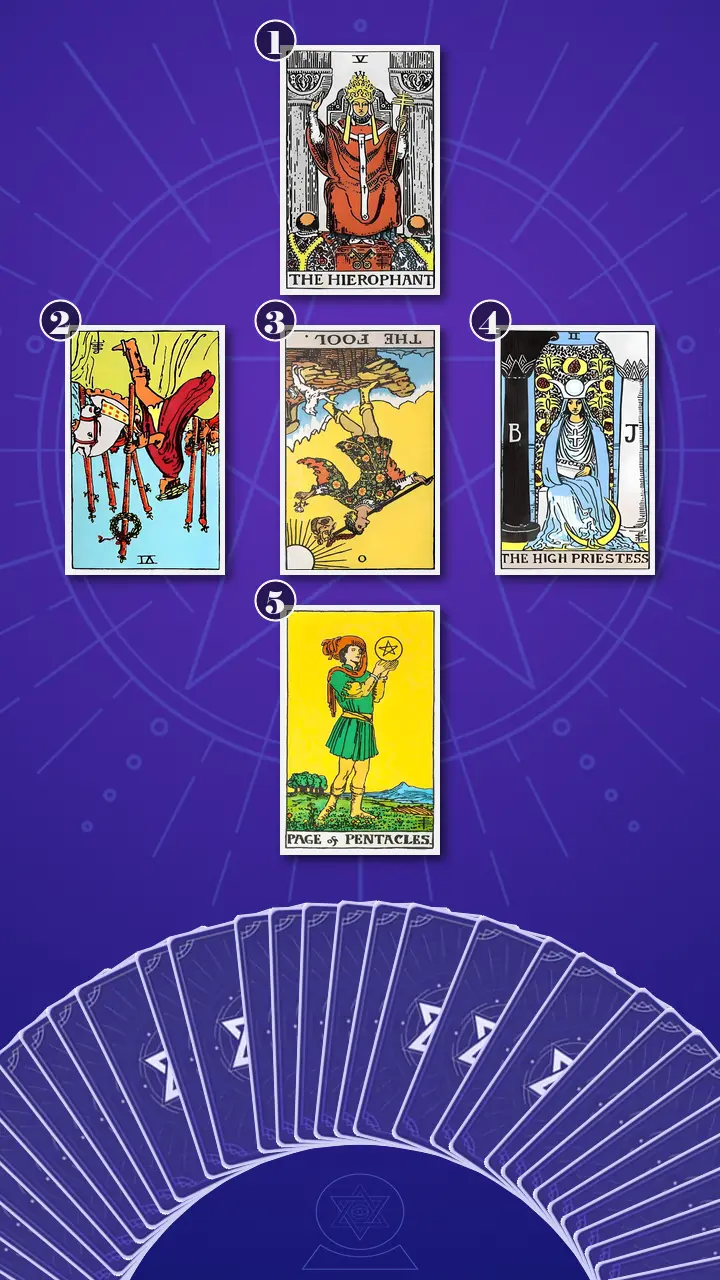
I placed the first card at the top to reveal the visible, publicly defensible behavior. The second went below and left to identify the protective belief sustaining it. The third occupied the center, where it would expose the fear turning an experiment into a threat. The fourth mirrored the root on the right and represented the inner resource Maya could reclaim. The fifth rested below the center as the practical integration step.
The layout resembled a hinge. The central fear was the pivot; the card on the right could open another source of authority; the lower card would stop the insight from remaining a beautiful idea with no execution. That last point mattered to me. I had spent too many years around polished strategies that sounded convincing but could not survive contact with reality.
The Rules Sitting at the Head of the Table
Position One: The Rulebook With Her Name on It
I turned over the card representing the diagnosis-level behavior Maya could already observe: defaulting to the path that appeared established, recognizable, and publicly defensible. It was The Hierophant, upright.
I pointed to the central teacher between the stone pillars and the two acolytes kneeling before him. "This is the moment you open a personal decision as if it were an application to a respected institution," I said. "Before asking whether the promotion, course, relationship, or job fits your lived criteria, you ask whether managers, friends, family, or a LinkedIn audience would recognize it as credible."
The crossed keys at the Hierophant's feet looked like access codes to a respectable future. In Maya's pattern, someone else seemed to control those codes. Her preference had to meet the terms of service for a sensible life before she could trust it.
I read the Hierophant's energy here as excess, not as evidence that structure or tradition was bad. Mentors, institutions, salary data, and established pathways can offer valuable knowledge. The distortion began when public legibility expanded beyond its proper role and became the test of whether a choice was valid at all. Guidance had moved from adviser to gatekeeper.
"It is a bit like Severance," I said. "There is the polished work self who can present a clean narrative, and there is the quieter self living with the actual consequences. Your polished self is currently authorized to speak for both."
I asked, "With your last major decision, which option did you describe as the most sensible before admitting which one actually held your attention?"
Maya did not nod. She gave one short laugh, bitter at the edges, and looked away from the screen. "That is so accurate it feels a little brutal."
I let the laugh settle. "Accurate does not have to mean condemning," I said. "This system probably protected you from criticism and helped you succeed in environments where clear standards were rewarded. We are identifying where a useful strategy became overextended. You do not need to shame it in order to update it."
Her fingers stopped moving over the trackpad. The spreadsheet remained open, but she no longer added another column.
Position Two: The Applause That Expired by Morning
I turned over the card representing the belief sustaining Maya's limiting cycle: external recognition was being used as evidence that a choice was safe and that she remained worthy. It was the Six of Wands, in the reversed position.
Upright, the card shows a laurel-crowned rider moving through a crowd. Reversed, the crowd's response becomes unstable or disproportionately important. The rider keeps checking whether the applause is still there.
Maya had already given me the modern version. On a recent Monday morning, she had been riding TTC Line 1 toward downtown when a former colleague posted an "Excited to announce..." promotion and relocation update. The train brakes squealed. Fluorescent light flickered across the window. Maya refreshed LinkedIn, replayed her friends' messages at 1.5x speed, and quietly downgraded the course they had called "hard to explain."
"I remember thinking, 'If people I respect do not understand it, maybe it is not a real option,'" she told me.
The reversed Wands energy showed a blockage. Fire that could have supported initiative was being redirected into monitoring an audience. The quickest congratulations produced a lift, but the lift faded because recognition could not answer questions about fit, curiosity, attention, or what Maya wanted her ordinary Tuesday to feel like.
"A fast yes from the crowd can be reassurance without being information," I said.
I drew a line on my notepad and separated feedback into two categories. On one side were facts: compensation, schedule, manager quality, workload, visa implications, debt, benefits, and practical constraints. On the other were reactions: excitement, confusion, prestige, disappointment, or how easily someone could imagine announcing the choice online. Facts could alter the decision. Reactions might still matter emotionally, but they did not automatically deserve veto power.
I asked, "Whose face appears first when you imagine choosing the less approved option, and what do you hope their approval would prove?"
Her breath paused. Her gaze drifted past the screen as if she were replaying several conversations at once. Then her shoulders lowered by a fraction.
"That I am not being irresponsible," she said. "Maybe that I am still the person who makes good decisions."
I heard the deeper equation beneath the words: if a choice went badly after receiving approval, the outcome could be blamed on reasonable uncertainty. If an unapproved choice went badly, Maya feared it would become evidence about her worth. Approval did not only promise success. It offered protection from personal responsibility.
"That explains why the relief is so short," I said. "You receive a social safety signal, but you do not receive firsthand evidence that the choice fits. When the applause stops, the original uncertainty is still waiting."
Position Three: The Draft Folder at the Cliff Edge
I turned over the card representing the fear Maya had difficulty acknowledging: an unapproved step might feel reckless, irreversible, and capable of proving that her judgment was defective. It was The Fool, in the reversed position.
I centered our attention on the traveler's foot near the cliff and the small white dog beside it. In reversal, Maya was not necessarily being warned that the unfamiliar option was dangerous. The image showed her freezing before a manageable experiment because her mind had enlarged it into a permanent leap.
I asked about a draft application she had mentioned. Maya described sitting in the kitchen on a Wednesday evening with the cursor hovering over Submit. The refrigerator clicked on behind her. The role required only a small initial application and would not force her to resign from anything, yet she imagined explaining a future failure to everyone who had questioned the move.
"The application became a courtroom verdict," I said. "Your mind skipped the pilot and jumped directly to the post-mortem."
The reversed Fool held both deficiency and blockage: too little permission to learn through direct experience, and too much imagined meaning attached to the first step. A two-hour class, one honest conversation, or one unconventional application was being treated like a public product launch with Maya's entire reputation attached to every metric.
I also named the overcorrection risk. "Reclaiming your judgment does not mean abruptly rejecting every opinion or making a dramatic leap to prove you are independent. That would still let the audience control the choice, only in reverse. The useful contrast is not conformity versus recklessness. It is an irreversible identity claim versus a reversible test."
I asked, "When did a small experiment become permanent proof of whether you are a careful person?"
Maya pressed her fingertips together and stared at the card. "Probably when I started believing that changing my mind meant I had chosen badly."
"Revision can also mean the test worked," I said. "You gathered information you could not obtain from another evening of comparison."
The laptop fan rose again, then quieted. In that brief silence, the draft application no longer felt like the whole cliff. It looked more like the patch of ground directly beneath the Fool's next foot.
When the High Priestess Closed the Group Chat
Position Four: The Knowledge That Was Real Before It Was Public
The room seemed to become quieter before I turned the fourth card. Even through the screen, I noticed the visual field narrow: the phone was face down, the spreadsheet had stopped changing, and Maya's attention was no longer jumping between tabs.
I turned over the card representing the resource required for her transformation: the capacity to notice and record private knowledge before seeking an external verdict. This was the reading's key card and antidote, The High Priestess, upright.
I pointed to the partially concealed scroll held close to her body. It was not being displayed, defended, or converted into content. The image mirrored Maya's unopened voice memo. Knowledge was already present, but she had hidden it beneath explanations designed for public consumption.
"This card does not tell you that intuition is infallible," I said. "It says your preference is valid evidence. It deserves to enter the decision before the group chat, the spreadsheet, or the status calculation edits it."
The High Priestess brought balance: quiet self-trust without grandiosity, tolerance for ambiguity without passivity, and an ability to hold private information without demanding immediate proof. She did not destroy the Hierophant's external knowledge. She redistributed authority so inherited standards and personal discernment could inform each other.
My mind flashed back to the trading desk, where an early signal could be meaningful without being sufficient, and where an untestable conviction was only a story. That distinction shaped one of my signature tools, the Potential Actionability Assessment. I use it to move an insight through three gates: identify the signal, define a reversible action, and specify the observation that could confirm, complicate, or change the view.
For Maya, the signal was not a mystical command to quit her job. It was repeated attention: the course page she kept reopening, the creative work that gave her more energy to describe, and the contraction she felt when she erased those preferences for a cleaner public narrative. The reversible action could be a sample lesson. The useful observations would concern the actual tasks, schedule, cost, and quality of her attention while doing them.
I could see the old equation still running: if her preference could not survive cross-examination, it did not deserve a place in the decision. The unsent memo held what she wanted, but she was treating privacy as weakness and public fluency as truth.
You do not need another audience to certify your preference; pause long enough to read it, as the High Priestess guards knowledge that is real before it is public.
I stopped speaking. Outside Maya's window, a streetcar bell sounded once and disappeared into the wet Toronto night.
For a beat, Maya's inhale stopped. Her fingers hovered above the phone without touching it. Then her eyes lost focus, as if she were watching every group-chat poll and polished explanation replay behind the screen. Her jaw tightened before her face softened. "But doesn't that mean I have been doing this wrong for years?" she asked, with more anger than relief. I let the resistance have room. "It means the strategy protected you from blame until the protection began costing you contact with yourself," I said. Her eyes shone, and she looked down. One fist loosened, finger by finger. A long breath left her chest, followed by a smaller, unsteady laugh. "So I do not have to know for certain," she said. "I just have to hear myself before everyone edits me." Her shoulders finally dropped. The release left a brief blankness in its wake: without the committee carrying the verdict, her agency felt freeing and newly tender at the same time.
I asked, "Now, with this new perspective, think back: was there a moment last week when this insight might have made you feel different?"
Maya returned to the Wednesday-night application. "I might have noticed that I wanted to submit it before I started imagining the explanations," she said. "I could have treated that as information, even if I later decided not to apply."
That was the crucial crossing: from permission-seeking anxiety and defensible-choice second-guessing toward grounded self-trust informed by private preference, useful feedback, and direct experience. It was not certainty. It was the first redistribution of decision authority.
I offered the High Priestess practice in its smallest form. I asked Maya to set a ten-minute timer and write one sentence beginning, "I privately prefer..." followed by one personal criterion. Then she could name one experiment of no more than two hours that might teach her something. She did not have to share the note, complete the experiment, or continue if it felt intrusive. One sentence and a calendar placeholder were enough.
She opened the unsent memo at last. "I privately prefer exploring the course before accepting the promotion because I want to know whether creative strategy can hold my attention when nobody is applauding," she read.
I did not call that her answer. I called it data that had finally been admitted into the room.
One Pentacle, Not an Entire Future
Position Five: The Test That Could Fit Inside a Saturday
I turned over the card representing the integration practice: testing one personally meaningful option at a reversible, practical scale and learning from direct evidence. It was the Page of Pentacles, upright.
The Page held one pentacle at eye level while standing in a workable landscape. The distant mountains remained distant. The card did not demand a complete map, a new identity, or a career-pivot announcement. It asked Maya to study one tangible opportunity closely enough to learn from it.
In ordinary life, this meant attending one sample lesson, scheduling one informational conversation, drafting one application, or spending part of a weekend on the kind of task the unfamiliar role would actually involve. The single pentacle became one bounded object of study rather than an entire future that needed to be justified at once.
The Page's Earth energy was in balance: curiosity with a start time, self-trust with observable evidence, and ambition sized to the information available. I also noticed the absence of Swords in the spread. Maya's mental life already contained more than enough comparison, explanation, and negative rehearsal. Another framework, podcast, Reddit thread, or perfectly formatted Notion dashboard was not the missing resource. The missing resource was contact with reality.
"Do not prove the whole path; test one honest step," I said.
I asked what she could learn in less than two hours. Maya chose a sample module from the course and one short conversation with an alumnus. Her questions were practical: Did she enjoy the actual work rather than the idea of it? Could the schedule coexist with her job? What constraint would appear only after she tried the material?
She began to explain how she might present the experiment to her friends, caught herself, and smiled with visible embarrassment.
"That is the old launch plan," I said. "This is a private beta. It does not need an announcement."
For the first time that evening, Maya closed the LinkedIn tab rather than minimizing it.
The Private-Evidence Ledger
Why the Pattern Kept Repeating
I read the five cards as one coherent chain. The Hierophant showed a learned respect for recognized paths that had become an internal permission system. The reversed Six of Wands revealed the emotional reward keeping that system alive: approval briefly relieved the fear of being judged. The reversed Fool exposed the cost, turning every unscripted first step into a permanent verdict. The High Priestess restored Maya's private preference as evidence, and the Page of Pentacles gave that evidence somewhere practical to go.
The invisible board meeting was the core metaphor. Every time Maya's inner compass moved, she convened a committee, presented the case, and waited for a vote. The committee could contribute real information, but she had quietly given it control of the agenda, the approval process, and the final signature.
Her cognitive blind spot was not simply that she cared what people thought. It was that she mistook the speed of recognition for the quality of fit. The option that needed the least explanation seemed safer because it generated faster social relief. More research then felt responsible even when it was producing reassurance rather than new facts.
The transformation direction was precise: before requesting anyone's opinion, Maya would record one personal preference and define one reversible experiment. Later feedback could add facts, reveal constraints, and challenge assumptions, but it would function as information rather than permission. Advice could have influence without having veto power.
I did not want that realization to become another saved self-help quote with no execution. My Evolution KPI Framework is a 30-day discipline for turning philosophical insight into visible behavior. For Maya, I stripped it down to two metrics. The framework would be strict about whether the action happened and gentle about the outcome. She did not need a streak, a public update, or a dramatic life change.
- KPI One: Preference Before Polling During the next 30 days, create four private entries before asking for advice on a non-urgent decision. In a phone note or 60-second voice memo, complete: "I want...", "The personal criterion that matters is...", and "I am afraid people will say..." Keep the exercise under ten minutes. If outside input is still useful, state your current preference first and ask one person one factual question. Tip: Keep the note private until your own view is recorded. Do not use a no-poll pause for urgent medical, legal, financial, or safety decisions, and choose advisers who respect your autonomy.
- KPI Two: The Two-Hour Permissionless Pilot Put one personally meaningful test on the calendar within the next seven days, with a clear start and stop time. Maya's version was one sample course module followed by three learning questions: "Do I enjoy the actual tasks?", "What practical constraint appears?", and "What would I need to learn next?" Within ten minutes of finishing, record direct observations without posting the experiment for validation. Tip: Label the result "evidence from one trial," not "proof I should change my life." If two hours feels too large, reduce the pilot to a ten-minute sample lesson, three drafted questions, or one unsent application outline.
I asked Maya to measure only execution and learning: Did she record her preference before polling? Did she run one bounded test? What fact did the test produce? The KPI was not courage, confidence, or whether she chose the unconventional path. Those would be impossible to score honestly and too easy to perform for another audience.
"The goal is not to win an argument against the safe option," I said. "The goal is to make sure your own criteria, practical feedback, and firsthand experience are all present before you decide. You remain free to choose the promotion. You also remain free to test the course, revise your view, or decide that neither option fits."
That was the actionable advice hidden inside the spread: preference before polling, a reversible experiment, and feedback without veto. Tarot had made the mechanism visible. Maya would create the evidence.

A Week Later, One Calendar Invite
Seven days later, I received a message from Maya. She had gone to a cafe near Ossington, put her phone on airplane mode, and recorded the one-minute memo before meeting a friend. Then she completed a sample course lesson and booked a short conversation with an alumnus.
"I kept wanting to send the group chat a screenshot," she wrote. "I did not. The lesson was more technical than I expected, which was useful. I also lost track of time during the exercise, which feels like useful data too."
She had not resigned, rejected the promotion, or solved her entire career crossroads. She had learned that the course held her attention and that its schedule might create a real constraint. One signal supported the option; another required investigation. That was clearer than either applause or fear.
She slept through the night after leaving the second pilot on her calendar. In the morning, her first thought was, "What if I am wrong?" She smiled, left the invite in place, and made coffee.
I saw the quiet proof of our Journey to Clarity in that unchanged calendar entry. The cards had not handed Maya a destiny. They had helped her see the approval loop objectively enough to interrupt it, and she had used her own attention and action to build grounded self-trust.
I have learned that clarity rarely arrives as total certainty. Sometimes it begins when a chest that has been braced for cross-examination loosens just enough for an unpolished sentence to be heard. The approval that calms you for an hour may still leave you wondering where you went; a private preference, carefully tested, can begin showing you where you are.
If your preference could sit beside the High Priestess's concealed scroll as one piece of evidence rather than a verdict you must defend before the committee, what small, reversible choice would you notice yourself wanting to look at again?