Preselecting Exam Question 3a: Feedback Became a Map, Not a Verdict

The 8:15 p.m. Question One Escape
I recognized the Toronto student with a flawless revision plan and an untouched Question One when Maya joined my video table on a Tuesday evening.
At 8:15 p.m., her laptop fan hummed beside cold coffee, and her phone sat warm in her restless hand. She had written half an answer on the open practice paper before her shoulders rose and the class WhatsApp appeared.
I heard her say, “I keep planning the work because planning doesn’t tell me what I’ve forgotten. I care so much that opening the notes feels dangerous.” Wanting to prepare for an exam that mattered, while repeatedly avoiding the preparation itself, had become the loop.
Her apprehension looked like a smoke alarm wired to a blank answer box: one uncertain line, and her hands searched for an exit. I told her, “You may be avoiding the exam because it feels like it means everything, not because it means nothing. Let’s map the fog without turning it into another verdict.”

Choosing the Compass Beneath the Study Plan
I asked Maya to place both feet on the floor, let one breath run its full length, and hold a single question in mind: “Why do I keep avoiding exam prep when I know it matters to me?” I shuffled slowly, using the pause as a transition from reacting to observing. Nothing supernatural was required of her.
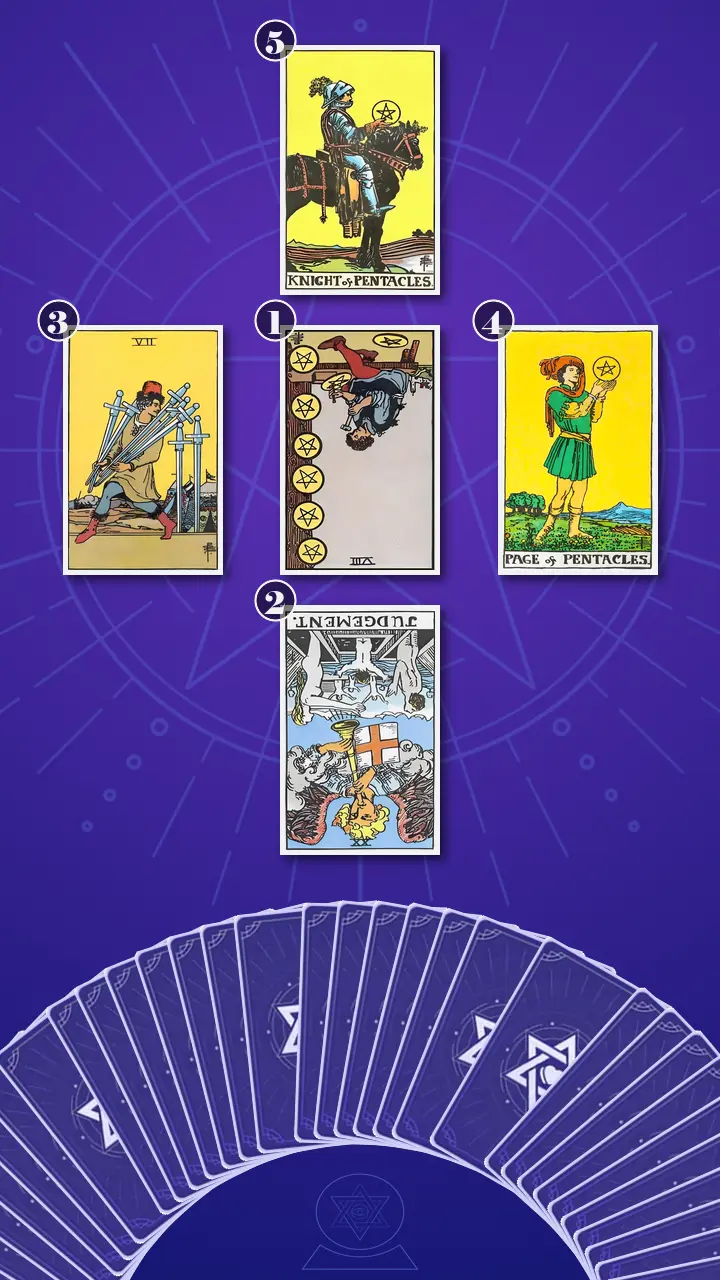
I chose The Shadow Spread, a five-card tarot layout designed to examine a visible pattern, the fear beneath it, the protection it provides, the resource hidden inside it, and the practical way to integrate that resource. Maya was asking why a valued task kept triggering an escape response. She was not asking me to predict her grade, and I would not pretend the cards could do that.
I explained the layout to her and, through the camera, to anyone who has wondered how tarot works as a reflective tool. The centre card would show the observable study-avoidance pattern. The card below it would uncover the buried belief turning practice into danger. The card on the left would reveal the protective detour; the card on the right, the perspective Maya could reclaim. The final card above the centre would turn that perspective into a repeatable study structure.
I arranged the cards as a cross with a staircase hidden inside it: first descending beneath the behaviour, then climbing toward grounded action. This is where card meanings in context matter. I was not looking for a fixed fate. I was looking for a coherent chain of cause, protection, choice, and consequence that Maya could inspect for herself.
The Workbench with Everything Except the Work
Position 1: Eight of Pentacles Reversed
I turned the card representing Maya’s observable exam-prep avoidance pattern: the Eight of Pentacles, reversed.
In the traditional image, a craftsperson sits at a workbench repeating the same practical task. The tools are present, completed pentacles line the wall, and a distant town waits beyond the workspace. Reversed, that rhythm is interrupted. I saw blocked Earth energy: not an absence of effort, but effort diverted away from the practice through which skill is actually built.
I brought the image back to 8:15 p.m. Maya had the laptop, practice paper, colour-coded plan, highlighters, and course resources arranged within reach. She rewrote the first heading, checked whether tomorrow’s study blocks looked balanced, answered half of Question One, then reached for her phone. The setup demonstrated intention. The unfinished answer revealed that perfectionism had separated her from the ordinary apprenticeship of getting something wrong, examining it, and trying again.
“What were you telling yourself when you opened WhatsApp?” I asked.
“That I was technically still studying,” she said. “I just needed to check what everyone else was doing so I could organize properly.”
Then she gave a small, bitter laugh. Her fingers tightened around the cold coffee before releasing it. “That is so accurate it’s almost rude. My Notion dashboard has had more revision than my actual course.”
I let the humour soften the recognition without minimizing it. “This card is not calling you lazy. It is showing us the exact moment useful structure becomes a shelter from direct feedback. Your system is working very hard. We need to ask what job it has quietly started doing.”
I thought of the polished StudyTok desk resets and productivity reels that can make visible organisation look identical to learning. Maya’s revision system had become like an old app with impressive engagement statistics and poor real-world output: she kept maintaining it because maintenance felt controllable.
Planning can look like studying while protecting you from finding out what you do not know.
Position 2: Judgement Reversed
I turned the card below the centre, representing the underlying fear that a knowledge gap could become a verdict on personal worth: Judgement, reversed.
The upright image contains a trumpet call and figures rising to answer it. Reversed, I read that call as turned inward and distorted into relentless self-appraisal. The energy of honest assessment was blocked by an excess of premature judgment. Maya was not hearing, “Here is a topic to revisit.” She was hearing, “Here is the announcement of who you really are.”
In everyday terms, she would open a low-stakes past paper, fail to recall one step, and jump immediately from “I need to review this topic” to “Maybe I am not capable enough for this course.” Before continuing, she would check old marks, calculate possible grades, and mentally rehearse the worst outcome. It was like receiving a final grade notification before the work had even been submitted.
I asked her to complete the sentence without polishing it: “If I cannot answer this now, then maybe what about me is true?”
Her breath stopped. Her eyes moved away from the cards and held on some point beyond her screen, as if she were replaying every red mark she had ever received. When she answered, her voice was smaller. “Maybe I’m not actually good enough to be here. Maybe everyone else can tell.”
Her shoulders remained high, but her hands became still. I could see that the wrong answer had been carrying far more emotional weight than the question itself.
On Wall Street, I had watched red metrics flash across risk dashboards. A red number could matter enormously, but it still described a position at a moment in time; it did not describe the human being looking at it. Judgement reversed gave me the same professional warning. Data becomes dangerous when someone forces it to carry an identity it was never designed to measure.
“The cards are not saying you will fail,” I told her. “They are showing that you have been experiencing diagnostic feedback as if failure has already been declared. Those are different events.”
A practice question is data, not a character reference.
Position 3: The Polished Detour of the Seven of Swords
I moved to the card on the left, representing the protective strategy of replacing practice with planning, scrolling, resource gathering, or tidying: the Seven of Swords, upright.
In the image, a figure carries five swords away while leaving two planted behind. I did not interpret this as dishonesty in a moral sense. I saw tactical intelligence directed toward immediate escape. Strategic energy had become excessive and evasive: clever enough to reduce discomfort now, but disconnected from the longer-term goal it was meant to serve.
I described the modern scene back to Maya. A hard question creates a flash of exposure. She downloads three explainer videos, asks the class chat how far everyone has progressed, wipes the desk, and moves the topic into tomorrow’s schedule. She never openly decides to stop studying. She simply leaves the risky part through a sequence of responsible-looking exits.
Like the figure carrying five swords, she ends the evening carrying a polished timetable, saved videos, and reassurance from classmates. The two swords left behind are the unanswered question and the honest feedback it could have provided.
“Which exit do you use first?” I asked. “The chat, the schedule, another resource, or the suddenly urgent need to clean something?”
“The chat,” she said immediately. A notification lit her phone as if the room had decided to underline her answer. She turned it face down. “Then I see somebody’s completed mock exam, feel worse, and start rebuilding the schedule.”
I watched her jaw tighten, then ease. The relief was not cheerful. It was the relief of discovering that a behaviour she had treated as a character defect had a recognizable sequence.
“The Seven of Swords is not accusing you,” I said. “It is revealing the protection. Not confronting the material gives you a few minutes of relief from possible inadequacy. Then the untouched work returns with extra guilt attached. Once you can see the exit route, you can interrupt it before it carries you away.”
She looked back at the card. “I always think, ‘I did a lot tonight, so why is the one thing that mattered still untouched?’”
“Because the detour was designed to look productive,” I said. “It protected you precisely by borrowing the appearance of the work you care about.”
When the Page Made the Exam Smaller
Position 4: Page of Pentacles Upright
The room seemed to quiet as I crossed from the defensive strategy to the card representing the resource Maya could reclaim. Rain traced the Toronto window behind her, and a distant streetcar bell landed cleanly in the pause.
I turned the Page of Pentacles, upright.
The Page holds one pentacle at eye level. The field and mountain have not disappeared, but they are allowed to remain in the background. The Page does not claim mastery of the whole landscape. The Page studies what is actually in hand.
I read this as balanced Earth energy: grounded curiosity, beginner’s permission, and self-trust built through direct learning. In Maya’s life, it looked like closing every tab except one past-paper question, starting a private twenty-minute timer, and attempting the question with incomplete knowledge. If she became stuck, she could write “review conditional probability” instead of calculating a predicted grade or asking what the mistake proved about her.
At 8:15 p.m., the paper was open, the new revision plan looked immaculate, and one uncertain half-answer had already sent Maya’s hand toward her phone. She cared deeply about the exam. That was exactly why the page felt so exposing.
You do not need proof that you are already good enough before you begin; become the Page who studies the pentacle in hand, one concrete question at a time.
I left the sentence between us for several seconds.
You do not need to prove that you are ready before you practise; the honest attempt is what shows you what readiness needs next.
Maya’s breathing stopped first. Her thumb hovered over the seam of her phone case, and her eyes widened slightly before losing focus. I watched the idea move past intellectual agreement and into memory: the abandoned Sunday block, the half-answer on Tuesday, the usable twenty minutes she had dismissed on the TTC because it was not a “proper” session. Her mouth tightened.
“But doesn’t that mean I’ve been doing this wrong the whole time?” she said. The question arrived with a quick edge of anger, then cracked into something more vulnerable. “I’ve wasted so many evenings making plans.”
I did not rush to turn that sting into positivity. “It means the strategy protected you and charged a high price. Recognizing that now does not make your earlier self foolish. It gives your present self better information.”
Her shoulders descended by a fraction. One fist slowly opened on the desk. Her eyes shone, and she released a breath that sounded almost like a laugh but did not quite become one. The relief was followed by a brief, unsteady blankness: if readiness did not need to come first, then she could no longer wait for it to grant permission. The path was kinder than the old one, but it also returned the next choice to her.
I asked, “Now, using this new perspective, think back to last week. Was there a moment when this insight could have changed how you felt?”
“Thursday after my shift,” she said. “I had about twenty minutes on campus before the library closed. I decided it was pointless because I couldn’t do a full chapter. I could have tried one question.”
That answer marked the key movement in the reading: from apprehensive paralysis and self-worth-based judgment toward grounded confidence built through curious, repeatable learning. It was not confidence in a guaranteed exam result. It was the first trace of trust that she could meet specific gaps without turning them into a definition of herself.
An Academic ROI Audit of Twenty Minutes
I used one of my own analytical tools, Academic ROI Auditing, which I normally apply to expensive degree choices, major pivots, or high-investment research directions. I was careful to define the asset under review: not Maya’s worth, intelligence, or future, but the strategic learning yield of what she did with one available study window.
Twenty minutes spent perfecting a revision dashboard could produce temporary control, but almost no new information about the exam material. Twenty minutes spent attempting one selected question could reveal the exact step she knew, the exact step she did not, and the next topic worth reviewing. Even an incomplete attempt could generate higher learning yield and reduce the decision cost of the next session.
“This is not about squeezing maximum productivity out of every tired minute,” I told her. “It is about refusing to judge a small block by whether it can repair the entire backlog. The relevant return is one honest point of contact with the material.”
The Page’s question became practical: What can this single attempt teach me that another hour of preparation cannot?
I asked Maya to picture one past-paper question occupying the entire laptop screen, with the class chat, Notion dashboard, StudyTok clips, and grade calculator closed. She nodded slowly. “I don’t need to know the whole topic to find out what this question can teach me.”
I gave the insight a humane boundary. Within the next study block, she could place the phone beyond arm’s reach, choose one past-paper question, and start a twenty-minute timer before reviewing or reorganizing anything. When the timer ended, she would write only, “The next gap is ___.” She did not have to finish, score, or share the attempt. If twenty minutes felt too exposing, she could stop, shorten it to five, or return later. The aim was contact, not forced endurance.
Position 5: The Knight Who Did Not Need to Sprint
I turned the final card, representing the repeatable structure that could convert beginner curiosity into measurable preparation: the Knight of Pentacles, upright.
The horse is still. The Knight holds one pentacle steadily, and cultivated fields stretch behind him. I told Maya the apparent lack of speed was the point. This was balanced Earth energy expressed as patience, method, and return. It offered no dramatic academic-comeback montage and no heroic promise to recover an entire semester in one weekend.
In daily life, the Knight looked like two preselected twenty-minute blocks after class or a café shift. Each calendar event would already name the question, removing the opening decision. Maya would log only whether she showed up, what she attempted, and which topic came next. A missed block would not create a punishing double session.
The spread contained very little Water or Fire. I did not see emotional certainty or a sudden burst of motivation as the prerequisite for change. The Page and Knight returned us to Earth: one question, one timer, one named gap, one realistic return.
“It doesn’t have to repay the whole backlog,” Maya said, testing the sentence aloud. “It only has to be the block I said I’d return to.”
I saw her sit farther back from the screen for the first time. Her shoulders were not completely loose, and I did not need them to be. She looked grounded rather than hyped.
Consistency is returning to the task, not never leaving it.
The One-Question Route Out of the Fog
I drew the five cards into one story. Maya had the tools and intention, but perfectionistic standards interrupted the rhythm of practice. Under that interruption sat Judgement reversed: the belief that a knowledge gap could expose a defect in her worth. The Seven of Swords showed how her quick mind protected her through planning, scrolling, reassurance seeking, and resource gathering. The Page reclaimed that intelligence for inquiry, and the Knight converted inquiry into a routine capable of surviving real classes, commutes, café shifts, and tired evenings.
The core pattern resembled standing on a TTC platform perfecting the route while an ordinary train capable of moving one stop kept departing. Maya had assumed she needed total confidence before boarding. The spread showed that readiness would be built through the ride itself.
I named the cognitive blind spot plainly: she had been treating the discomfort of discovering a gap as evidence that she was not ready to practise. In reality, discovering the gap was one of practice’s primary functions. The shift was not from “unmotivated” to “perfectly disciplined.” It was from waiting to feel confident enough to study to completing one defined twenty-minute task before evaluating performance.
The Research Sunk-Cost Audit, Rebuilt for Revision
I then adapted my Research Sunk-Cost Audit, a framework I use when someone must decide whether to persevere with or pivot from a stalled academic project. Maya’s lost evenings, abandoned plans, and missed weekend blocks were sunk time. They could inform the next choice, but they could not be recovered through guilt, sleep deprivation, or a punishing six-hour catch-up session.
The audit asks a forward-looking question: given the time, energy, and information available now, which next action has a realistic learning return? It does not ask which action would make the past look less wasteful. For Maya, that meant protecting sleep, work shifts, meals, and recovery while choosing a task small enough to survive an ordinary week.
“But what if I genuinely don’t have twenty minutes after a shift?” she asked. “Some nights I get home and my brain is gone.”
“Then five minutes is the valid version, or that night is not the right block,” I said. “The routine should fit your life. Your life does not have to be punished into fitting the routine. We are designing evidence that you can return, not another system that can fail you.”
I offered three actionable next steps, and Maya chose the versions that respected her actual timetable:
- Preselect the Pentacle in Hand.Before the next study window, Maya would choose one specific past-paper item, such as Question 3a, and put that number inside the calendar event. She could use her campus library block after class or the kitchen table after an earlier café shift. No task selection would be required when the block began.Tip: If the question feels too large, preselect one sub-part or one worked-example step. Smaller is still direct contact.
- Run the Twenty-Minute Before-You-Judge Block.At the start, Maya would put her phone beyond arm’s reach, close the class chat and extra resource tabs, and attempt the selected question before reviewing notes. When the timer ended, she would write, “This attempt showed me I need to review ___.” The blank would contain a topic, not an identity label or predicted grade.Tip: Stop when the timer ends, even mid-question. Use an open-book pass or a five-minute minimum if a private, unscored attempt still feels too exposing.
- Return Without Repayment.Maya would attach two modest blocks to existing cues that week: arriving on campus before class and getting home after one earlier shift. Her log would record only “showed up / task attempted / next gap.” Missing one block would not create study debt or require a doubled session.Tip: Keep a backup location, such as the library lobby or kitchen table, and protect sleep, meals, work, and recovery. The routine succeeds by remaining returnable.
I reminded her that these were experiments, not commandments. The cards had helped us make an invisible mechanism observable. Maya retained the authority to shorten, change, or reject any step based on what she learned. Tarot had supplied a map; it had not taken the wheel.

Three Days Later: A Small Mark in the Margin
Three days later, I received a message from Maya. She had placed “Question 3a” inside a calendar block before leaving for her café shift. At home, she put her phone across the kitchen, attempted the question for twenty minutes, and stopped when the timer sounded. She did not finish it.
In the margin, she wrote: “The next gap is conditional probability.”
She told me her first impulse had still been to calculate what the mistake might mean for the exam. The impulse passed more quickly once she had a topic name in front of her. She reviewed that one gap during her next campus window instead of rebuilding the week.
That night she slept through. Her first thought the next morning was still, “What if I get it wrong?” This time, she smiled at the thought, opened the preselected question, and began before answering it.
I did not treat that message as proof that Maya had solved exam procrastination or guaranteed a result. It was something more credible: the first evidence that she could feel discomfort, make direct contact with the material, and remain on her own side. The cards had not studied for her. She had used their images to recover a choice that fear had been disguising.
That was the quiet centre of our Journey to Clarity: practice feedback could become a map instead of a verdict, and grounded self-trust could be built through what Maya repeatedly chose to do next.
I have seen how one unfinished answer can lift your shoulders as though the exam has already decided who you are. Caring deeply and opening the page can start to feel like opposite demands. If that is your desk tonight, noticing the conflict means the fog has already begun to thin.
If your next study block did not have to prove anything about you, which single “pentacle in hand” question could you preselect, meet for twenty minutes, and let become a map rather than a verdict?