The 11:47 p.m. Status-Comparison Loop
I began by saying to Maya, "You are a 29-year-old tech professional in London who can turn one former colleague's LinkedIn promotion into a three-tab career plan before the Northern line reaches the next stop: career comparison anxiety has become part of the commute."
Maya sat across from me with her phone face down, though her fingers kept brushing its edge. At 11:47 p.m. the night before, she had seen a former colleague's promotion on LinkedIn, opened her promotion-planning document, added three new goals, and drafted a message volunteering for the next all-hands meeting. The laptop fan had hummed beside cold tea; blue light had caught the unopened congratulatory card on her desk while her chest tightened and her restless hands switched between tabs.
"Why do I keep chasing status that never makes me feel enough?" she asked. "I know I am doing well, but it never feels like I am doing well enough. The relief lasts until I open LinkedIn again."
I heard the central contradiction clearly: she wanted public success to deliver the private feeling of being enough, while fearing that no title, promotion, or visible win could ever do the job. Her inadequacy had the texture of a treadmill whose belt sped up every time she reached the next milestone. I told her that I did not hear vanity or weakness in the pattern. I heard a real need for steadiness being assigned to a tool that could only provide temporary information. "We do not have to shame your ambition," I said. "We can map the loop, find where it pulls hardest, and make room for a choice that belongs to you."

Choosing a Compass for Career Comparison Anxiety
I asked Maya to place both feet on the floor, take one ordinary breath, and hold the question without trying to solve it immediately. I shuffled slowly, using the movement as a practical transition from reacting to observing rather than as a supernatural test.
"I am using the six-card Transformation Path Grid, Context Edition," I explained. "This is how tarot works in this reading: the cards give us a structured visual language for the trigger, the maintaining force, the deeper belief, the interruption point, the next experiment, and the emotional capacity that can grow through practice. They do not predict a fixed future or make the decision for you."
I chose this spread because Maya was not asking for a date, a verdict, or a prediction. She was asking why the same pursuit returned after every achievement. The grid was compact enough to map the full status-comparison loop without burying the question under unnecessary timelines. The top row would show the visible behaviour, the immediate blockage, and the scarcity belief underneath it. The lower row would show the catalyst, the practical response, and the integration direction.
"The first card will show what this looks like on the surface," I said. "The second will show what keeps feeding it. The third will take us beneath the visible comparison. Then we will look for the leverage point, one behaviour that can be tested in daily work, and a way to hold ambition without making it prove your worth."
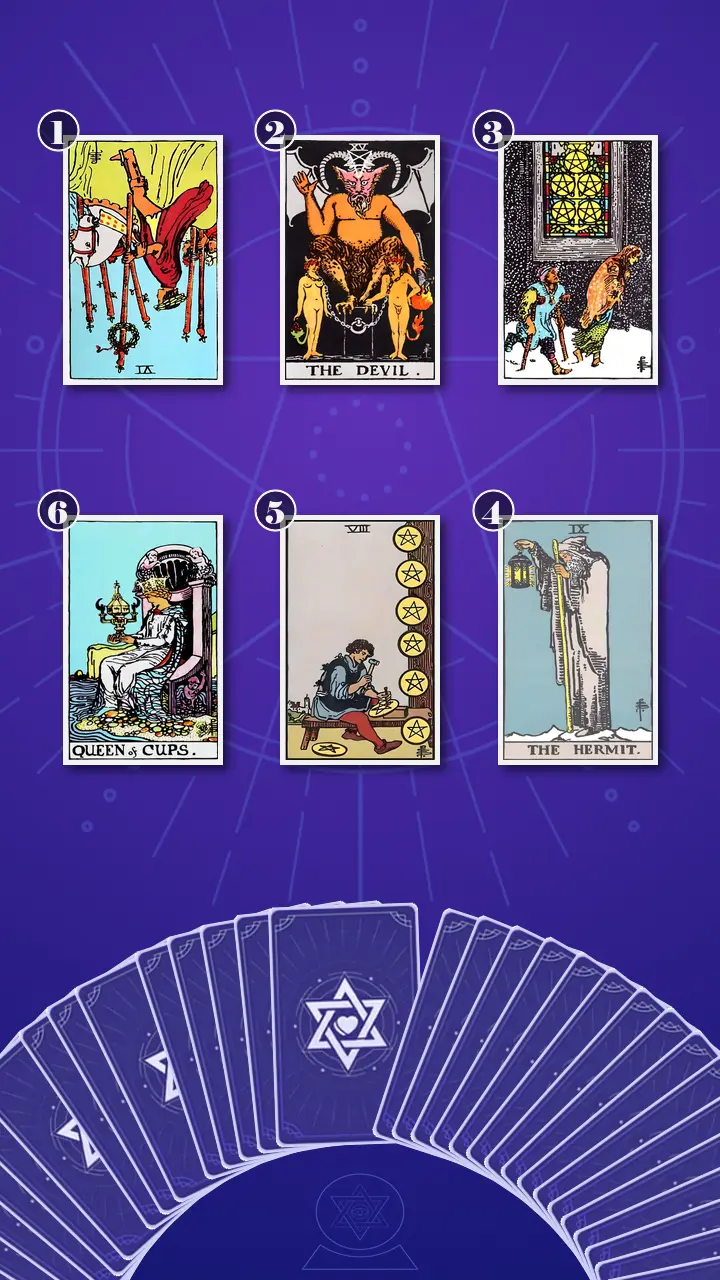
Reading the Map Behind the Achievement Cycle
Position 1: When Applause Evaporates
Now I turned over the card representing the observable status-chasing behaviour, blocked satisfaction, and chaotic inadequacy described in the diagnosis. It was the Six of Wands, reversed.
The upright Six of Wands carries victory, recognition, and public acclaim. Reversed, its Fire was blocked: praise could arrive, but Maya's inner standard refused to let it settle. I connected the card to the launch she had described. Her director had praised the work in Slack, colleagues had reacted enthusiastically, and for a few minutes she had felt the warm lift of being seen. Ten minutes later, a former colleague's promotion appeared on LinkedIn. Maya compared titles, reaction counts, and public reach, then began planning a more visible project before her own achievement had registered.
"This is the laurel wreath that cannot become confidence," I said. "The surrounding crowd has become LinkedIn, Slack reactions, profile views, and every public signal you consult before allowing yourself to feel proud. You have recognition. What is missing is not evidence of competence; it is the ability to receive evidence without immediately handing the verdict to someone else."
I asked her to complete the sentence that usually appeared after praise: "I know this went well, but it only counts if..." She looked at the card and finished quietly, "...if it looks more impressive than what everyone else is doing." I told her, "The relief is real; it is just too brief to become a home."
Maya did not nod. First, her breath stopped and her thumb hovered above the phone as if she might check the exact Slack thread. Then her eyes moved away from the card and seemed to replay the launch praise, the promotion announcement, and the three new goals in sequence. Finally, a short, humourless laugh left her chest, her shoulders lowered by a fraction, and she said, "That is uncomfortably specific." The small release was not agreement with everything; it was recognition that the problem was not an absence of achievement.
Position 2: The Loose Chain of Visibility
Now I turned over the card representing the immediate feedback mechanism that turns comparison and brief relief into another round of status pursuit. It was The Devil, upright.
I did not frame the Devil as an outside force or a punishment. I pointed to the loose chains around the two figures. Maya had recently been invited to lead another high-profile presentation while her calendar was already full. She knew the assignment would displace rest and deeper skill work, but declining felt equivalent to disappearing from consideration. She accepted, and the immediate relief was unmistakable: for a few minutes, she no longer had to wonder whether she was still competitive.
"The bargain is powerful because it works briefly," I said. "You trade time, attention, and choice for a signal that you still matter in the hierarchy. The problem is not that ambition exists. The problem is that visibility has become the price of emotional safety."
I imagined the loose chain as the hand hovering over the Send button. The message was not a command from fate. A delayed reply, a workload check, or a boundary remained possible, even if each option felt heavier than it looked. "A loose chain can still feel heavy before you test the space inside it," I told her.
Maya's jaw tightened. "But if I say no, people might stop thinking of me," she said. "What if the next person gets the opportunity and I become forgettable?" I answered carefully: "That fear deserves facts, not obedience. We can check what the opportunity actually offers, what it costs, and whether one delayed answer truly changes your professional standing. You do not have to force yourself into a dramatic refusal to prove independence." She looked down at her calendar, exhaled through her nose, and rested her hand flat beside it. The chain still felt real, but it was no longer invisible.
Position 3: The Room She Was Already In
Now I turned over the card representing the worth-based fear underneath the Repetition Compulsion, especially the belief that being less visible means being less valuable or less included. It was the Five of Pentacles, upright.
The Five of Pentacles speaks to scarcity, exclusion, and the experience of standing outside warmth or support. I brought Maya back to a Friday night in a Soho basement bar after an industry event. She had been invited. People greeted her by name. Her finances were stable. Yet while friends compared salaries, job titles, neighbourhoods, and access to the next room, she had checked her bank balance beneath the table. The room smelled of citrus cleaner and spilled lager; bass vibrated through the bench beneath her, and her stomach dropped as if the conversation had announced that she did not belong.
"The facts say I belong here," I invited her to say. "The feeling says..."
She swallowed. "The feeling says everyone else has been admitted properly, and I am somehow getting away with being here."
I drew her attention to the illuminated window in the card. Support and evidence were present, but the figures in the snow remained focused on the cold path beneath them. "This is London rent logic applied to worth," I said. "Because the market keeps escalating, enough begins to feel structurally unavailable. A colleague's more senior title becomes more than a fact; it becomes proof that your own place is temporary."
Maya's fingers pressed into the paper beneath the spread. She looked briefly embarrassed, then gave a tired half-smile. I told her that the status chase was protecting her from felt exclusion and ordinariness, not merely asking for professional advancement. The distinction mattered. If the wound was being treated as an inadequate résumé, she would keep polishing the résumé while missing the fear that gave every comparison its force.
When the Hermit Lit Only the Next Turn
Position 4: The Lantern Before the Audience
The room grew quieter when I reached the card representing the leverage point that could interrupt the automatic sequence between a status trigger and the next achievement bid. It was The Hermit, upright, and it was the key card of the reading.
The Hermit's lantern did not ask Maya to abandon ambition, leave her work, or retreat from people. It offered only enough light for the next turn. I connected it to a simple modern scene: before replying to a prestigious speaking invitation, Maya closes LinkedIn and Slack, takes a notebook to a quiet cafe, and evaluates the opportunity through learning, interest, workload, and personal meaning before she considers how impressive it will look.
After a decade of guiding people through cycles, I have learned to notice the difference between a dead end and a turning point that feels motionless. I used my Cognitive Spiral Mapping here. I mapped Maya's sequence as status cue, upward ranking, visible bid, brief relief, and renewed emptiness. The stuck feeling was not proof that she lacked drive; it was the tension of an old loop gathering enough pressure to become visible. Sometimes that tension is an orbital slingshot phase before a more honest intellectual breakthrough.
I also named the Gravity Well Identification at work. The gravity well was not Maya herself. It was the combined pull of notification-filled professional feeds, reaction counts, promotion dashboards, public ownership politics, and the inherited rule that slowing down meant becoming ordinary. Those habits and environments had been useful data sources, but they had become obsolete managers of her self-worth. The lantern could not redesign her whole career tonight. It could illuminate one private criterion before the hierarchy spoke.
I watched her try to solve the fear of being ordinary by producing a more impressive future. She was treating the next milestone as if it could certify the last one, while the quiet question of meaning remained outside the room.
The crowd can report that you succeeded, but it cannot decide that you are enough; let private meaning choose the next step, and let that bounded step count before the feed responds.
For a moment, Maya's thumb stopped above the notebook and her breath caught. Then her eyes lost focus as she replayed the launch praise, the LinkedIn announcement, and the promotion plan as if the sequence were running on a loop. Her jaw tightened. "But does that mean I built all of this for the wrong reason?" she asked. I did not rush to make the question positive. I said, "It means fear and ambition have been sharing a desk. We can separate them without shaming either one." Her fingers, clenched around the pen, slowly opened. She looked back at the card, and her gaze settled on the lantern rather than the crowd. A shaky breath came first, followed by a deeper one; her shoulders lowered, though the new space left her briefly light-headed. Her eyes brightened. She gave a small, disbelieving laugh and whispered, "I could choose something because it matters to me." I asked, "Now, using this new view, can you remember a moment last week when this insight might have made you feel or act differently?"
Maya remembered the all-hands invitation. She had wanted the learning opportunity, but she had also accepted it to quiet the fear of disappearing. I told her that this was the first movement from restless inadequacy and compulsive status comparison toward grounded pride, self-authored ambition, and emotional steadiness. It was not a final identity or a promise that comparison would never return. It was a pause in which she could choose.
From Private Meaning to Bounded Craft
Position 5: One Tile of the Mosaic
Now I turned over the card representing the practical action or behavioural response that could give the catalytic insight a repeatable form. It was the Eight of Pentacles, upright.
The card showed a craftsperson working on one pentacle while completed pieces remained visible nearby. I connected it to a protected hour in Maya's week: one defined messaging exercise, one paragraph rewritten for three audiences, or the first two minutes of a presentation rehearsed with a timer. The task could matter even if it never became a portfolio post, a promotion argument, or a public story.
"This is Earth used differently," I said. "The earlier cards linked value to rank and scarcity. This card returns repetition to the work itself. Craft can carry ambition without putting your worth on trial." I also warned her about the shadow risk. A meaningful practice could become another performance metric if she worked past the boundary, shared it for approval, or treated exhaustion as proof that the session counted.
I asked her to finish the sentence, "This session can count because I practised..., even if..." She wrote, "...even if nobody knows I did it." I suggested that the timer ending should be part of the practice. She smiled at the difficulty of that instruction, then closed her notebook as if stopping on time might be more challenging than beginning.
Position 6: The Cup That Can Hold the Sting
Now I turned over the card representing the intended cognitive and emotional integration of ambition with enoughness, offered as a reflective direction rather than a fixed outcome. It was the Queen of Cups, upright.
The Queen studied an ornate, closed cup instead of looking toward a crowd. I connected that image to the next promotion notification Maya would see. She might feel envy, admiration, pride for the other person, disappointment about her own pace, and a wish for reassurance. The Queen did not require any of those feelings to disappear. She asked Maya to hold them long enough to understand them before turning one of them into another career goal.
"I can want recognition and still wait before making a move," Maya said. "I can notice the sting without letting it write the plan."
I explained that emotional steadiness did not mean becoming indifferent or pretending that status had no practical consequences. It meant allowing feeling to inform a choice without automatically becoming a command. The absent Swords suit also mattered: Maya already had plenty of analysis. More matrices, market research, and five-year plans would not answer a question about worth when analysis was being used to avoid envy, uncertainty, or desire.
I watched her shoulders soften. She did not look delighted; she looked less ashamed. That was more useful. Enoughness was beginning to appear not as permanent satisfaction, but as the capacity to let pride, envy, ambition, disappointment, and rest remain in the same emotional container without demanding that another achievement remove them.
The Private Lantern and the One-Block Reset
When I placed the six cards together, the story became clear. The Six of Wands reversed showed a genuine achievement failing to become grounded pride because Maya's attention immediately moved to the next person in the crowd. The Devil showed why the chase repeated: another visible assignment offered brief relief from the fear of becoming irrelevant. The Five of Pentacles revealed the deeper equation beneath it, where being less visible became evidence of being less valuable or less welcome, even when the facts showed competence, invitation, and stability.
The Hermit supplied the interruption. The Eight of Pentacles gave that interruption a bounded form. The Queen of Cups made the new form emotionally sustainable. The core contradiction was not ambition versus laziness, nor success versus failure. It was the longing to feel enough through status alongside the fear that no amount of status would ever create that feeling.
I named Maya's cognitive blind spot plainly: she had been treating the failure of praise to create enoughness as proof that the achievement was too small. She had also been treating planning as proof of movement, even when the planning was a way to avoid feeling the sting of comparison. The shift was from public recognition as evidence of worth to one bounded weekly action chosen by private values and craft-based criteria, followed by a review of its effect before checking other people's reactions.
The Orbit Expansion Strategy
I used my Orbit Expansion Strategy as a practical macro-perspective exercise. I asked Maya to draw three rings in a private note. In the first ring, she would name the gravity well: the trigger, the old conclusion, and the short-term payoff. In the second, she would mark the trajectory she actually wanted: one private value and one cost she refused to ignore. In the third, she would choose the smallest amount of momentum that could move her without requiring a complete new identity.
"This is not a command to leave the orbit of ambition," I said. "It is a way to see which force is steering. Your next step needs private meaning, not a larger audience."
- The Private Lantern CheckBefore sharing one completed work task this week, open a private note and write three success criteria that would matter even if nobody reacted, such as a clear message, honest evidence, and completion within scope. Wait twenty-four hours before checking engagement or comparing the result with anyone else's work.If twenty-four hours feels too exposed, begin with one minute and one private criterion. Pausing does not obligate Maya to decline the opportunity or explain the exercise to anyone.
- The Fact-Versus-Conclusion NoteWhen a promotion post or public work win triggers comparison, place the phone face down and set a five-minute timer. In Notes, write two lines: "What happened" and "What I concluded about myself." Stop after one sentence in each column and make no career decision during the exercise.The minimum version is one observable fact and one conclusion. The aim is not to eliminate the feeling; it is to separate the event from the verdict attached to it.
- The One-Block Mastery ExperimentBook one forty-five- to sixty-minute calendar block named after a skill, such as "Messaging practice," rather than an outcome like "Become promotion-ready." Choose one small unit of craft, use a timer, stop when it rings, and record three private lines: what you practised, what changed, and what you will try next.Protect the end time as firmly as the start time. Do not post the session or check how it compares with someone else's work for twenty-four hours; the boundary is part of the experiment.

A Smaller Light, Still Moving
Six days later, I received a message from Maya. "I waited until morning before replying to the speaking invitation," she wrote. "I used learning, interest, workload, and meaning as my criteria. I said yes because the learning mattered, capped the preparation time, and did not open LinkedIn afterward. It still looks impressive, but that was not the reason I chose it."
On Saturday morning, she completed a one-hour messaging practice block, closed the laptop when the timer rang, and sat with her coffee. The first thought was, "What if stopping means I am falling behind?" She still smiled; the question remained, but it no longer held the steering wheel.
I did not read that as a solved life. I read it as the first visible evidence of grounded pride: Maya had allowed achievement to be one form of expression rather than a verdict on her value. The cards had not awarded her enoughness. They had helped her see the mechanism, test a different response, and reclaim authorship of the next move.
When somebody else's promotion makes your chest tighten and your hand reach for the next plan, the hardest part is not simply wanting more. It is fearing that if you stop proving yourself for even a moment, everyone might see you as ordinary and therefore easier to forget. I have learned to meet that fear with respect, but not obedience.
If your own lantern only had to illuminate one small choice this week, which private value might you let it reveal before checking how the choice will look?
This story is adapted from psychological research, written so that those in a similar struggle can see their own pattern in it — and find their next step clearly.These insights are not a substitute for professional psychological, medical, legal, or financial advice.
Learn more about our Journey to Clarity.
How did this insight land for you?
🫂 This Resonates Deeply
🌀 Living This Story
✨ Now I See Clearly
🌱 Seeing New Possibilities
🧰 Useful Framework
🔮 The Confirmation I Needed
💪 Feeling Empowered
🚀 Ready for My Next Step
Author Profile
 AI
AI“After a decade of guiding people through the stars, I’ve come to see life much like the orbits of planets: everything has its inevitable cycles. When you feel lost, please don't blame yourself; you might just be in a natural low tide. I’m here to sit under the night sky with you, offering a gentle cosmic perspective to distinguish temporary pain from the beautiful breakthroughs just around the corner.”
In this Personal Growth Tarot Reading :
Core Expertise
- Cognitive Spiral Mapping: Validating that feeling 'stuck' is often just a necessary orbital slingshot phase before a major intellectual breakthrough.
- Gravity Well Identification: Diagnosing the obsolete habits or environments exerting a downward pull on your personal evolution.
Service Features
- The Orbit Expansion Strategy: A macro-perspective exercise to map the precise trajectory and momentum needed to escape your current cognitive gravity well.
Also specializes in :
Explore Related Patterns:
Achievement-Based Self-WorthMaya accepts a high-profile presentation despite knowing it will displace rest and deeper skill work, because declining feels equivalent to becoming professionally invisible. Titles and visible assignments are therefore doing more than advancing her career; they are being asked to certify that she matters. When you make achievement responsible for proving your worth, every success arrives with an impossible job. It may create real relief, but the relief remains conditional on the next ranking signal, so another promotion post can reopen the verdict almost immediately. The chase persists because the underlying question is not simply whether you are succeeding, but whether success can finally make your value feel secure.
Productivity as SafetyMaya accepts another high-profile presentation while her calendar is already full, even though she knows it will displace rest and deeper skill work. The immediate payoff is not only career exposure; for a few minutes, she no longer has to wonder whether she is still competitive. When you use visible productivity to secure emotional safety, activity becomes a reassurance ritual. The work temporarily protects you from feeling irrelevant or forgettable, but that protection depends on remaining continuously useful and seen. Because the relief comes from the signal of demand rather than the substance of the work, the next period of quiet can reactivate the same threat.
Upward Social ComparisonA former colleague's promotion sends Maya into a three-tab career plan, and a second promotion interrupts the satisfaction of her own successful launch within ten minutes. Each time she looks upward, another person's title becomes the new reference point for deciding whether her progress counts. When you repeatedly compare yourself with people who appear further ahead, the benchmark moves faster than your achievements can register. Selective attention magnifies titles, salaries, reaction counts, and access while filtering out praise, competence, invitation, and stability. Comparison then stops functioning as neutral information and becomes a recurring mechanism for manufacturing insufficiency.
Compulsive Self-ImprovementAt 11:47 p.m., Maya sees a promotion, adds three goals, and drafts a volunteering message before the comparison discomfort has had time to settle. After her own launch is praised, she responds to the next status cue by planning an even more visible project instead of allowing the completed achievement to register. When you convert every sting of inadequacy into another improvement project, planning becomes an overcompensating defense. It restores agency and reduces discomfort in the short term, but it also implies that your present self must be corrected before it can count. Growth becomes compulsive when it is repeatedly used to escape the feeling that you are already behind.
Emotional ReasoningMaya can state that the facts show she belongs, yet the feeling in the room tells her that everyone else was admitted properly and she was not. The same felt threat makes declining a presentation seem equivalent to disappearing, despite clear evidence of competence and professional inclusion. When you treat a feeling as proof, internal discomfort acquires more authority than contradictory facts. The conclusion shifts from "I feel insecure after seeing this promotion" to "this promotion shows that my position is insecure." That cognitive shortcut makes another achievement feel necessary because the emotional signal is being interpreted as an objective deficit that must be corrected.
Boundary DiscernmentMaya waits until morning before replying to the speaking invitation, checks learning and workload, and caps the preparation time. She also treats the timer ending as part of her skill practice, even though stopping activates the fear that she may be falling behind. When you distinguish a meaningful yes from unlimited availability, a boundary stops being synonymous with withdrawal or failure. You can participate, remain visible, and pursue growth without surrendering all available time to the opportunity. The important shift is not a dramatic refusal of ambition, but a clearer separation between what the work requires and what insecurity demands.
CatastrophizingMaya predicts that declining one visible opportunity could cause people to stop thinking of her, give the next opening to someone else, and make her forgettable. Even stopping a one-hour practice session activates the conclusion that she may be falling behind. When you escalate an ordinary boundary into a threat of professional disappearance, a possible consequence is treated as an imminent identity-level loss. That forecast makes overcommitment feel rational because saying yes appears to prevent a much larger danger. Examining the missing steps between one limit and total irrelevance can expose how fear has been compressing possibility into certainty.
Imposter SyndromeAt the Soho industry event, Maya has been invited, people greet her by name, and the available facts indicate that she belongs. Yet she experiences everyone else as properly admitted and herself as somehow getting away with being in the room. When you cannot internalize evidence of competence and inclusion, belonging remains provisional. A more senior colleague does not merely represent a different career stage; their visibility can feel like evidence that your own place is less legitimate. This pattern keeps status attractive because the next achievement appears capable of proving that you deserve the position you already occupy, even though earlier evidence has not settled the question.
Internal ValidationMaya completes a one-hour messaging practice block, closes the laptop when the timer rings, and allows the work to remain private. She also defines success through criteria such as clarity, honest evidence, learning, and completion within scope before checking whether anyone reacts. When you let privately chosen evidence count, self-evaluation is no longer entirely outsourced to the professional crowd. This does not require pretending that recognition is irrelevant; it means giving your own standards a legitimate place in the verdict. Repeated practice can help achievement become information about what you did rather than a referendum on who you are.
Values-Based Decision MakingBefore answering the speaking invitation, Maya closes the professional feeds and evaluates learning, interest, workload, and meaning. She eventually says yes because the learning matters, caps the preparation time, and does not use LinkedIn to confirm that the decision looks impressive. When you place private values before status optics, ambition can remain active without being forced to regulate your worth. The opportunity may still carry recognition, but recognition is no longer the sole author of the choice. This creates a more differentiated decision process in which fear can provide information without receiving automatic obedience.
Explore Related Struggles:
Metric-Compass FusionBefore answering the prestigious speaking invitation, your calendar is already full, but the first question is how visible the opportunity will be. Only later do learning, interest, workload, and meaning become criteria that could have guided the choice. LinkedIn, Slack reactions, profile views, promotion dashboards, and public ownership politics have been supplying the compass before your own values get a turn. When metrics choose the direction, status chasing can look like ambition while quietly outsourcing the reason for the next move. A private criterion does not diminish the opportunity; it restores authorship to the decision.
Moving Finish Line TrapAt 11:47 p.m., one promotion post becomes three new goals and a message volunteering for the next all-hands; later, launch praise is followed by another LinkedIn comparison. The sequence keeps converting a completed milestone into instructions for the next bid before the present result can count. That is why more progress does not produce a finish line. Each visible win is used as temporary clearance to keep moving, and the relief expires as soon as a higher comparison appears. Ambition can remain part of the picture, but the chase becomes structurally costly when stopping is interpreted as falling behind.
Performance-Worth FusionWhen your director's Slack praise is followed ten minutes later by a former colleague's promotion, the achievement is not allowed to remain an achievement. You compare titles, reaction counts, and public reach, then open a promotion plan before the warm lift has registered. Public success is being asked to certify a private verdict about your value, so every new signal becomes responsible for settling a question that the previous signal could not answer. The praise, invitations, and evidence of competence remain real, but they keep functioning as temporary receipts rather than a foundation you can stand on.
Status-Belonging FusionAt the Soho bar, you have been invited, greeted by name, and are financially stable, yet salary, title, neighborhood, and access comparisons make the room feel conditionally occupied. The same pattern appears when another person's promotion turns your own place into something you must re-earn. Status has become an admission marker, so an ordinary pace can look like evidence that you are less valuable or less welcome even when the facts show competence and access. The chase is trying to secure a place in the room, but no public rank can permanently settle a question of belonging that is reopened by the next comparison.
Status-Safety FusionWhen your calendar is already full, you accept another high-profile presentation because saying no might make people stop thinking of you. The invitation gives brief relief from wondering whether you are still competitive, while its cost is paid in rest, deeper skill work, and room to choose. Status is doing the job of emotional safety here. Visibility is not just an outcome you want; it becomes the condition that lets you feel secure in the professional field, so a delayed answer or a bounded refusal carries the weight of disappearance. Seeing that exchange separates a real career opportunity from the fear attached to its public signal.
Explore Related Emotions:
Conditional Belonging FearAt the Soho bar, Maya has been invited, people greet her by name, and her finances are stable. She still checks her bank balance beneath the table and feels as though everyone else was admitted properly while she is somehow getting away with being there. The facts of inclusion cannot settle because belonging has become conditional on keeping pace with other people's salaries, titles, neighbourhoods, and access. Conditional Belonging Fear is the resulting vigilance: you can be visibly inside the room while privately bracing for your place to be questioned. Separating observable inclusion from the comparison-based conclusion gives you a clearer basis for deciding what actually secures connection.
Fear of Being ForgottenMaya accepts another high-profile presentation even though her calendar is already full and the work will displace rest and deeper skill development. Her stated concern is not simply missing the assignment; it is that somebody else will receive the opportunity and she will become forgettable. When visibility functions as proof that you still matter, saying no can feel less like a workload decision and more like consenting to your own disappearance. Fear of Being Forgotten names the vulnerable feeling beneath the quick acceptance: the sense that attention, inclusion, and professional memory may fade the moment you stop performing in public.
Hollow RecognitionMaya's director praises her launch, colleagues respond enthusiastically, and she briefly feels the warmth of being seen. Within ten minutes, another person's promotion has displaced that moment; the congratulatory card remains unopened while she plans a more visible project beside cold tea. Recognition reaches you, but an inner standard immediately transfers the verdict to the next audience and the next comparison. Hollow Recognition captures the emptiness left when applause is factually present yet cannot become a durable sense that your work counted. The missing element is not more proof of competence, but enough time and private authority to receive the proof already there.
Ordinariness ShameMaya says that stopping could allow other people to see her as ordinary and therefore easier to forget. When the reading connects status pursuit with exclusion rather than vanity, she looks embarrassed before recognising how strongly that rule has shaped her choices. Achievement is carrying the burden of protecting your identity from an exposed, lesser feeling attached to being ordinary. Ordinariness Shame captures that private contraction: the suspicion that being unexceptional would make you less valuable, less welcome, or less worthy of attention. Seeing this feeling clearly allows ambition to remain a desire for growth rather than a compulsory defence of your worth.
Scarcity AnxietyIn the Soho conversation, salaries, job titles, neighbourhoods, and access to the next room become a shared ranking system. Maya's stable finances and existing invitation do not hold; another person's advantage makes her stomach drop as though her own place has become less secure. When value is experienced as a scarce position, someone else's gain can feel like evidence of your shrinking share. Scarcity Anxiety names the inner contraction produced by that moving threshold: enough remains unavailable because every stable fact is measured against an escalating external field. Identifying the threshold as movable makes it possible to question its authority over your worth.
Status AnxietyAt 11:47 p.m., Maya sees a former colleague's promotion, opens her planning document, adds three goals, and drafts a message volunteering for another public assignment. Ten minutes after receiving praise for her own launch, she is already comparing titles, reactions, and reach. When every status cue restarts the ranking process before your previous achievement can register, professional information acquires the power to unsettle your whole position. Status Anxiety is the resulting inner weather: a persistent sense that where you stand must be checked, defended, and publicly renewed, even when the available evidence already says you are doing well.
Not-Enough PanicA promotion post tightens Maya's chest and sends her restless hands across three tabs before her own recent achievement has settled. She adds goals and offers herself for greater visibility as though immediate movement could close the gap that comparison has opened. Each milestone is being asked to provide temporary permission to feel adequate, so the next benchmark becomes emotionally urgent rather than merely aspirational. Not-Enough Panic describes the bodily and psychological alarm that appears when pausing feels dangerous and achievement must keep accelerating to prevent an internal verdict of insufficiency.
Cautious Self-TrustBefore replying to the speaking invitation, Maya closes the professional feeds and evaluates learning, interest, workload, and personal meaning. She eventually says yes, but she limits the preparation cost and leaves LinkedIn closed afterward. Each pause gives your own criteria a real turn in the decision instead of asking comparison to speak first. Cautious Self-Trust fits because the old question about falling behind still appears, yet it no longer receives automatic control. Trust grows here through tested choices and kept boundaries, not through pretending uncertainty has disappeared.
Hard-Won ComposureMaya's breath initially stops, her jaw tightens, and her fingers clench around the pen as the achievement loop becomes visible. The release arrives gradually: her fingers open, her breath deepens, and she considers allowing envy, admiration, disappointment, pride, and desire to remain present before making another plan. Composure does not require you to become indifferent to recognition or unaffected by comparison. Hard-Won Composure describes the steadiness created when a feeling can sting without immediately commanding a career move. The quiet space, delayed reply, and protected stopping point make that steadiness possible while preserving your freedom to act later.
Quiet PrideSix days later, Maya waits until morning before answering the speaking invitation, chooses it because the learning matters, and caps the preparation time. She also completes a one-hour practice block, closes the laptop when the timer rings, and does not seek an immediate LinkedIn comparison. Those choices allow your work to count before an audience reacts, without requiring you to reject recognition or ambition. Quiet Pride is the contained warmth that develops when achievement becomes an expression of skill and meaning rather than a verdict on personal value. It remains private enough to settle and sturdy enough to coexist with somebody else's success.
Comparison FatigueThe ranking loop appears on Maya's commute, at 11:47 p.m., ten minutes after launch praise, during a social evening, and whenever another visible assignment is offered. Her chest, hands, jaw, calendar, and attention are repeatedly recruited into the same sequence. Because comparison keeps reopening the question of where you stand, there is no clean completion point where effort can replenish you. Comparison Fatigue is the accumulated weariness of having achievement, connection, and rest repeatedly interrupted by another public benchmark. Naming that exhaustion clarifies why more tracking can deepen the depletion even when it promises useful information.
Explore Related Contexts:
External Scorecard PressureHer director praised the launch, colleagues reacted enthusiastically, and Maya still moved to titles, reaction counts, public reach, salaries, neighborhoods, and access to the next room. Those are concrete public measures, but in the story they become a gate through which each achievement must pass before it is allowed to count. You are dealing with an external scoring environment when visibility keeps deciding whether a contribution looks legitimate, competitive, or forgettable. A private success criterion and a capped practice block create a separate basis for choosing, so professional recognition can remain useful evidence without becoming the authority that assigns your worth.
Status Anxiety CircleAt 11:47 p.m., Maya saw a former colleague's LinkedIn promotion, opened her promotion plan, added three goals, and volunteered for the next all-hands. When Slack praise for her own launch lasted only minutes before titles, reaction counts, and public reach became the next comparison, professional standing was functioning as a moving social scoreboard rather than a settled position. You can recognize the same circle at the Soho industry event, where invitations and name recognition were present but salaries, neighborhoods, and access to the next room reset the ranking. The external hierarchy keeps supplying new proof tests, so the next title appears to offer closure while actually reopening comparison; mapping that sequence lets you separate a real career opportunity from a demand to remain visible.
LinkedIn Performance LoopAt 11:47 p.m., the promotion announcement moved Maya from a completed workday into a new planning document, three added goals, and a volunteer message before the phone had left her hand. The launch praise in Slack, the LinkedIn post, and the later impulse to check reactions turned professional feeds into an always-available feedback circuit that redirected attention before achievement could be registered. You can treat the feed as a source of information without allowing its timing to set the next career move. Closing LinkedIn and Slack before evaluating the speaking invitation gave Maya a private interval to compare learning, interest, workload, and meaning, showing where agency can re-enter an externally triggered career cycle.
Post-Achievement PlateauAfter her director praised the launch and colleagues responded enthusiastically, Maya had only a few minutes before a former colleague's promotion redirected her into comparison and three new goals. The completed work remained publicly validated, yet the social scene had already moved the standard forward, leaving each milestone positioned as a waiting room for the next one. You can read that sequence as an external stage after recognition, where the audience's next signal arrives before the previous result has settled into a stable career position. A bounded craft session that counts when nobody sees it gives achievement a place outside the next public ranking and makes the following choice easier to examine.
Prestige TrapMaya was invited to lead a high-profile presentation while her calendar was already full, and she accepted because declining felt equivalent to disappearing from consideration. The assignment offered a visible place in the hierarchy, but its immediate exchange rate was time, attention, and reduced room for rest or deeper skill work. You may know an opportunity is valuable and still need to inspect the price being charged for its prestige. Waiting until morning, choosing the invitation for its learning value, and capping preparation time let Maya keep the professional opening without allowing visibility alone to set the terms.