Finding Clarity on the TTC at 8:58 a.m.
If you’re a late-20s city person who replies to group chats like it’s a timed exam—then spends the next hour rereading your message for tone, welcome to people-pleasing FOMO.
Jordan met me on a video call from Toronto, but I could almost hear her commute in the background when she described it: 8:58 a.m. on a Monday, packed on TTC Line 1 near Bloor–Yonge. One hand on the pole, one hand on her phone. A new iMessage group chat pops up—“Girls trip planning”—and the screen glow feels too bright against the grey of the carriage. The train squeals into the station, and her chest tightens like she just got assigned homework.
“I type ‘I’m so down!!’ before the doors even open,” she told me, rubbing her thumb against the side of her phone like she could sand off the nerves. “And then I spend the whole ride thinking, what if I sounded weird?”
Her hands didn’t stop moving. They hovered, tapped, retreated, reached again—like her phone had a gravity field and her fingers were caught in its orbit. The anxiety wasn’t an abstract feeling; it was a tight band across her sternum and a restless electricity in her wrists.
I nodded, slow and steady, the way I do when I’m guiding planetarium visitors through a dark dome and I need them to trust the next step. “A group chat invite isn’t a test—your nervous system just treats it like one.”
Jordan swallowed and said the line that carried the whole contradiction in it: “I don’t want to be the difficult one. But I’m exhausted from managing the vibe.”
“Okay,” I said. “Let’s draw you a map through this. Not to make you care less—just to help you find clarity, so connection doesn’t cost you your nervous system.”

Choosing the Compass: A Celtic Cross for Group-Chat FOMO
I asked Jordan to take one breath with me—nothing mystical, just a clean handoff from scrolling brain to present-moment brain. On my side of the screen, I was sitting in a quiet staff room at the Tokyo planetarium after the last show, with a faint mechanical hum in the building that always reminds me of distant, steady machinery in space.
As she focused on the question—Why does every group chat invite trigger people-pleasing, and what boundary actually works?—I shuffled slowly. The point of the ritual isn’t magic; it’s attention. It’s a way of letting the mind stop sprinting long enough to see what it’s doing.
“Today we’ll use the Celtic Cross,” I said. “It’s a classic spread, but it’s perfect when you’re dealing with a repeatable reflex: a clear trigger on the surface, and something deeper underneath.”
For anyone reading who’s wondered how tarot works in a practical way: a spread like this doesn’t predict whether your friends will be mad. It maps the mechanism—what happens in your body, what story you tell yourself, what you do next, and what that costs you—so you can interrupt it with a real next step.
“The first two cards show the observable moment: the instant your phone buzzes and you go ‘auto-yes,’” I explained. “Card three shows the deeper driver under the reflex. And in the near-future position, we look for the turning point—what kind of boundary becomes doable in real life, in iMessage/WhatsApp speed.”
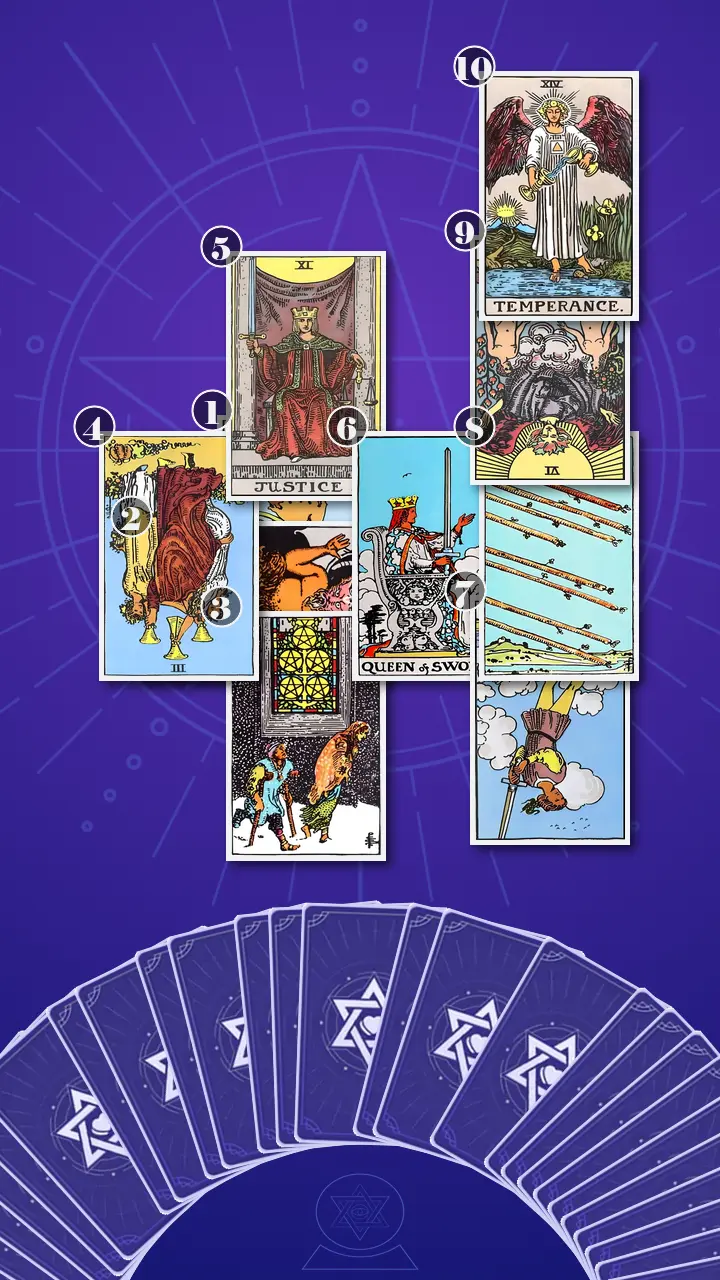
Reading the Cross: The Reflex, the Chain, the Cold Window
Position 1: Your current pattern the moment the invite lands
“Now flipped over,” I said, “is the card representing your current pattern in the moment a group chat invite lands—the observable reflex.”
Two of Pentacles, reversed.
I pointed to the image: the juggling figure, the infinity loop, the rough sea behind him. “This is like getting added to a new iMessage or WhatsApp group chat during a work break and replying ‘I’m in!’ while half-reading—then immediately juggling Google Calendar, commute time, work deadlines, and dread because you committed before you actually decided.”
Reversed, this energy isn’t balance; it’s overload—too many spinning plates, and the body trying to compensate by spinning faster. “It’s not that you can’t manage your life,” I told her. “It’s that your first move is juggling, not choosing.”
Jordan let out a short laugh that had no joy in it. “That’s… painfully accurate,” she said. “Like, I hate that it’s accurate.”
“I know,” I said softly. “And the stormy water in the background matters. Real life—sleep, work, the TTC, your actual capacity—doesn’t calm down just because the chat is moving fast.”
Position 2: What blocks you from a clean boundary
“Now we’re looking at what blocks you from a clean boundary—the main entanglement or pressure.”
The Devil, upright.
“Here’s the trap,” I said, keeping my voice plain because this card can feel dramatic if you let it. “A tag in the group chat hits like a hook. You feel socially obligated to be the easy, available one. You answer fast to avoid discomfort, and then you stay online monitoring read receipts and reactions—like approval is required for access to the friend group, even though the ‘chain’ is mostly in your head.”
I let the image do its work: the loose chains, the figures who could step away but don’t. “The Devil is a compulsion loop,” I continued. “And I want to name it in three lines, because that’s how it runs.”
“One: If I hesitate, I’ll be deprioritized. Two: you comply instantly—cheerful yes, extra friendliness. Three: you get a tiny hit of relief… and then you start monitoring, like you’re waiting for a verdict.”
Jordan winced and nodded, once, like the truth landed in her ribs. “It feels like I’m on-call for a job I never applied for,” she said. “And I’m refreshing like it’s… I don’t know… a stock price?”
“Exactly,” I said. “Except the stock is your social safety.”
Position 3: The deeper driver under the reflex
“Now flipped,” I said, “is the card representing the deeper driver under the reflex—the core fear that fuels the urge to please.”
Five of Pentacles, upright.
“This is the ‘outside the warm window’ feeling,” I told her. “Watching plans form in real time—inside jokes, quick confirmations—and your body reacts like you’re about to be left outside in the cold. Even silence feels risky, so you try to buy belonging with instant enthusiasm and availability.”
In this card, the cold is physical. “It’s the nervous system saying: get back inside, now. Not because anyone has actually locked the door—but because your body learned that exclusion is dangerous.”
Jordan’s eyes went unfocused for a second, like she was replaying a Sunday night in bed, heat humming, phone warm in her palm, refreshing twice. Her shoulders rose, then dropped a millimeter. “So it’s not… just me being dramatic,” she said.
“No,” I said. “It’s a learned alarm.”
Position 4: What recently shaped this sensitivity
“Now we’re looking at what recently shaped this sensitivity—the group dynamics that trained your nervous system.”
Three of Cups, reversed.
“Recent group dynamics have trained you to read the room constantly,” I said. “Who’s closest, who reacts fastest, who gets the most laughs. A playful thread feels like coded judgment, so you over-contribute—logistics, extra friendliness—to secure your spot, then feel small when the vibe shifts without you.”
Reversed, the celebratory circle becomes an invisible measuring stick: am I in the circle or orbiting it? I watched Jordan’s mouth press into a line. She didn’t argue—she recognized it.
Position 5: What you think you should do (your conscious ideal)
“Now we flip the card for what you think you should do—your conscious ideal of the ‘right’ way to handle it.”
Justice, upright.
“This is you drafting a legally-defensible no,” I said gently. “You start writing a long apology, then stop and think: what’s actually fair here? Justice is you choosing accuracy—matching your words to your real time, energy, and budget—without putting yourself on trial.”
I saw the first loosening in her face. Not relief exactly—more like permission. She exhaled through her nose, small and surprised. “Oh,” she said. “I’m allowed to be reasonable.”
My own mind flashed to celestial mechanics—how planets don’t ‘owe’ speed to anything. They keep their orbit by obeying structure, not mood. Justice is structure. “Fair means your words match your reality,” I added. “Not the chat’s velocity.”
When the Queen of Swords Spoke
Position 6: The next step energy available to you
I slowed down before turning the next card. “We’re flipping what I consider the turning point,” I said. “The next step energy available to you—how boundary-setting can begin to feel doable.”
Queen of Swords, upright.
“This is the boundary style,” I said. “One calm sentence that names your capacity—‘I’m not free this weekend, but hope it’s fun’—and then you close the app instead of staying online to manage everyone’s reaction. Firm, human, not a negotiation.”
I saw Jordan brace anyway. Her chin lifted a fraction, like she was preparing for impact. This was the moment she always tried to skip: the micro-silence after you say the truth.
And here is where I used my own tool—something I’ve taught anxious visitors under the planetarium dome when the stars make them feel small in the wrong way. “Before we go further,” I said, “I want to give you a timing practice I use called Pulsar Breathing.”
“Pulsars are stars that send out steady pulses—like cosmic metronomes. Your phone pings try to set your rhythm. Pulsar Breathing is you taking it back.” I held my hand up, palm open, like the Queen’s inviting hand. “When the invite lands, do four steady pulses: inhale for four counts, exhale for four. Four times. Sixteen seconds. That’s enough to create a deliberate pause.”
Jordan blinked. Then she laughed, nervous. “Sixteen seconds feels… doable,” she said, like she’d been offered a smaller cliff.
She was still stuck in the old mental loop, though—the one that says the right boundary is the one that prevents anyone from having a feeling.
Stop auditioning for approval; speak one clean truth like the Queen of Swords holding her upright blade.
There was a brief hush on the call—like the room itself leaned in.
Jordan’s reaction came in layers, fast but distinct: first a tiny freeze in her breath, her lips parting without sound. Then her eyes shifted away from the camera, as if she was watching herself type those long paragraphs in her Notes app. Then her shoulders dropped—two centimeters, not dramatic, but real—and her hands finally stopped moving.
“But if I’m that direct…” she started, and I watched the old anger flash up behind the fear. Her brows pulled together. “Doesn’t that mean I’ve been doing it wrong this whole time?”
“No,” I said immediately. “It means you’ve been doing what worked for survival. The Queen of Swords isn’t here to shame you. She’s here to update the method.”
I let her sit with it, and then I gave her the line that makes this card operational, not aspirational: “A boundary works when it’s clear, brief, and not negotiated in advance to manage everyone’s reaction.”
Jordan swallowed again, but this time it wasn’t panic—it was recognition. She nodded, slower. “So the discomfort is… not controlling how it lands.”
“Yes,” I said. “And that discomfort is the bridge from your starting state—replying before you decide and then trying to control the social outcome—to your desired state: clarity, kindness, and self-trust. This is you moving from hypervigilant scanning to grounded communication.”
I asked her, “Now, with this lens—one clean truth—can you think of a moment last week when you could’ve used it?”
Jordan looked down, then back up. “Friday drinks,” she said. “I wrote a paragraph. I could’ve just said… ‘I can’t this week. Have fun.’ And lived.” Her voice cracked on the last word, half-laugh, half-grief.
Position 7: How you see yourself in the dynamic
We returned to the staff—the ladder portion of the Celtic Cross—because insight has to survive the environment.
“Now we’re looking at how you see yourself in the dynamic—the identity role you play in groups.”
Page of Swords, reversed.
“This is keeping the chat open in the background like it’s live commentary on your likability,” I said. “Refreshing, rereading, scanning for tone, drafting follow-ups to fix imagined subtext.”
I offered her a simple sorting tool, because Air energy needs structure: “Facts: what they asked. Truth: what you can do. Stories: everything else.”
Jordan’s eyes softened with that particular kind of embarrassment that’s also relief. “I do live A/B testing on my personality,” she admitted. “In real time.”
“That’s the Page reversed,” I said. “Same element as the Queen—Air—but jittery instead of grounded.”
Position 8: The social environment that amplifies the reflex
“Now flipped is the social environment and messaging pace that amplifies the reflex.”
Eight of Wands, upright.
“This is group-chat speed,” I said. “Twenty-five messages in ten minutes. Plans changing live. The conversation racing ahead. The pace itself pressures you into quick replies—like if you don’t answer now, you’ll miss your chance to belong.”
“So it’s not just my personality,” Jordan said. “It’s the medium.”
“Exactly,” I replied. “Speed compresses choice. A pause expands it.”
Position 9: What you secretly hope for and fear at the same time
“Now we look at what you secretly hope for and fear at the same time—belonging versus rejection.”
The Lovers, reversed.
“You want genuine closeness,” I said, “but you fear honesty will cost you inclusion—so you choose harmony over alignment. You say yes to match the vibe, then feel weirdly lonely afterward because your real limits never got to exist in the relationship.”
Jordan’s gaze dropped to her lap. “I can’t tell if I’m being kind or just scared,” she whispered.
“That’s the exact question,” I said. “And it’s not a moral test. It’s a values check.”
Position 10: The integration lesson if you practice the shift
“Last card,” I said. “This represents the integration lesson—what changes if you practice the shift.”
Temperance, upright.
Even without the missing-perfect-life fantasy, this card is gorgeous in its realism. “Temperance is moderation,” I told her. “It’s staying in the chat, responding when you’re actually available, and letting friendships build over time instead of through constant instant replies. Connection as a steady pour, not an all-or-nothing dump.”
Jordan nodded, and the nod looked less like agreement and more like relief settling into her bones. “So I don’t have to disappear to be safe,” she said. “I just have to… stop performing availability.”
“Yes,” I said, and I made sure she heard it clearly: “You can stay connected without making your availability the price of admission.”
The Temperance Rhythm: Actionable Advice for Your Next 48 Hours
I pulled the whole story together for her, the way I’d narrate a constellation: not separate stars, but a pattern you can actually navigate by.
“Here’s the chain,” I said. “Your nervous system gets the ping and goes straight into the Two of Pentacles reversed: juggling, committing before deciding. The Devil crosses it: you treat approval like survival, so the juggling feels non-optional. Underneath is the Five of Pentacles—fear of being outside the warm window. You’ve had some Three of Cups reversed energy lately—subtle social uncertainty—so your system is on high alert. Justice is your conscious wish to be fair. The Queen of Swords is the antidote: one clean sentence. And Temperance is what comes after: a rhythm you can sustain.”
“The blind spot,” I added, “is thinking your boundary has to pre-handle everyone’s feelings. That’s why you over-explain. The transformation direction is simpler: shift from auto-yes to a deliberate pause, then name one clean boundary sentence that matches your real capacity.”
I kept the next steps small on purpose—because this isn’t about becoming fearless overnight. It’s about giving your nervous system new proof.
- The 20-Minute Pause RuleWhen a new group chat invite or tag lands, start a timer and wait 20 minutes before replying. Use that time to do four rounds of Pulsar Breathing (inhale 4, exhale 4) so you’re not answering from urgency.If 20 minutes feels impossible, do a 5-minute version first. Practice beats perfection.
- The 30-Second Capacity CheckBefore you type anything, open your calendar and scan the next 48 hours. Decide yes/no/maybe based on reality (work deadlines, sleep, commute), not vibe.Say out loud: “Accuracy is kindness.” It helps your brain stop treating this like a courtroom.
- One Clean Boundary Line + Close the AppWrite one reusable line in Notes and copy/paste it when needed (e.g., “I’m not free this weekend, but hope it’s fun.” / “Can’t commit right now—I’ll confirm by tomorrow at noon.”). Send it, then close the app.One sentence is still a full answer. If you need warmth, add one warm clause—not five.
- The 30-Minute No-Checking TimerAfter you send your boundary, set a 30-minute timer and do one offline task (shower, dishes, a short walk). If you need a sensory anchor, let a steady background sound (even a washing machine) become “cosmic meditation”—a reminder that not everything needs your immediate response.If you relapse and check, don’t punish yourself. Restart the timer. We’re building rhythm, not proving worth.
Jordan stared at the list like it was permission in bullet points. “I can do that,” she said, cautious but real. “I can do sixteen seconds. I can do one sentence.”

A Week Later: Ownership, Not Certainty
Eight days later, I got a message from Jordan: “Got added to a new chat. I waited five minutes. Checked my calendar. Sent: ‘I’m not free Friday, but hope it’s fun.’ Then I put my phone face down and made pasta.”
She added, “I still thought about it after. I won’t lie. But I didn’t spiral. I didn’t write the apology essay.”
In my head, I saw Temperance—not a dramatic transformation, just a steadier pour. She didn’t leave her friends. She didn’t become a different person. She changed the tempo.
When a simple group chat invite makes your chest tighten and your thumbs race, it’s not because you’re “too sensitive”—it’s because part of you learned that staying included means staying easy, even when you’re running out of yourself.
If you didn’t have to buy belonging with instant availability, what would one small, honest sentence sound like the next time the invite lands?
This story is adapted from psychological research, written so that those in a similar struggle can see their own pattern in it — and find their next step clearly.These insights are not a substitute for professional psychological, medical, legal, or financial advice.
Learn more about our Journey to Clarity.
How did this insight land for you?
🫂 This Resonates Deeply
🌀 Living This Story
✨ Now I See Clearly
🌱 Seeing New Possibilities
🧰 Useful Framework
🔮 The Confirmation I Needed
💪 Feeling Empowered
🚀 Ready for My Next Step
Author Profile
 AI
AI“After a decade of guiding people through the stars, I’ve come to see life much like the orbits of planets: everything has its inevitable cycles. When you feel lost, please don't blame yourself; you might just be in a natural low tide. I’m here to sit under the night sky with you, offering a gentle cosmic perspective to distinguish temporary pain from the beautiful breakthroughs just around the corner.”
In this Personal Growth Tarot Reading :
Core Expertise
- Cognitive Spiral Mapping: Validating that feeling 'stuck' is often just a necessary orbital slingshot phase before a major intellectual breakthrough.
- Gravity Well Identification: Diagnosing the obsolete habits or environments exerting a downward pull on your personal evolution.
Service Features
- The Orbit Expansion Strategy: A macro-perspective exercise to map the precise trajectory and momentum needed to escape your current cognitive gravity well.
Also specializes in :
Explore Related Patterns:
Boundary DiffusionJordan’s group chat boundary collapses at the exact moment she mistakes speed for obligation. Instead of checking her calendar, commute, sleep, budget, or desire, she answers from the pressure of being easy to include. Her own capacity becomes background data while the chat’s vibe becomes the main command. Boundary Diffusion is the pattern because the story shows her taking responsibility for emotional outcomes that are not fully hers to control. A simple “I’m not free Friday” starts feeling like it has to be wrapped in apology, warmth, reassurance, and pre-emptive damage control. The clean boundary works because it restores the self/other line: her job is to state her real capacity clearly and kindly, not to manage everyone’s possible reaction before it happens. You can stay connected without making instant availability the price of admission.
Boundary DiscernmentJordan’s turning point is not becoming colder or caring less; it is learning to answer from reality. She pauses, checks her calendar, names her capacity, and sends one clear sentence instead of performing availability at the speed of the chat. Boundary Discernment fits because the new pattern creates a clean distinction between kindness and self-erasure. She can remain warm toward her friends while refusing to treat every invitation as a test she must pass immediately. This is the practical boundary the story points toward: brief, accurate, and not negotiated in advance to manage everyone’s reaction. You stay in connection, but your availability stops being the admission fee.
Defensive OverexplainingJordan’s instinct is to turn a simple no into a long, legally defensible explanation. The story names this directly: she writes apology essays because part of her believes the boundary has to pre-handle everyone’s feelings before it is allowed to exist. Defensive Overexplaining fits because the extra language is not mainly about clarity; it is a safety behavior. The apology, justification, warmth, and backup reasoning are attempts to reduce the discomfort of being direct and to prevent a negative reaction in advance. The Queen of Swords boundary works because it removes the false bargain. One clean sentence is still a full answer, and you do not have to negotiate your limit before anyone has even responded to it.
HypervigilanceJordan does not just reply to the group chat and move on; she keeps watching the thread as if it contains live evidence about her social safety. Read receipts, reaction timing, tone, and who gets the most laughs become data points in a private audit of whether she is still accepted. Hypervigilance fits because her attention narrows around threat detection inside a low-stakes social medium. The story does not show her evaluating only logistics; it shows her nervous system scanning for micro-signals of exclusion, deprioritization, or judgment. This pattern explains why a boundary feels so hard after the message is sent. The difficult part is not only saying the clean sentence; it is tolerating the micro-silence afterward without turning the chat into a surveillance feed for your worth.
People-PleasingJordan’s first response to the group chat invite is not a decision; it is a reflexive performance of availability. She types “I’m so down!!” before the train doors even open, then spends the ride rereading for tone, which shows the full people-pleasing loop: comply quickly, feel a tiny hit of relief, then monitor whether the performance landed safely. The mechanism is not simple kindness. Her line, “I don’t want to be the difficult one. But I’m exhausted from managing the vibe,” reveals a defensive strategy where group harmony becomes more urgent than internal accuracy. You can see the cognitive dissonance clearly: she wants genuine connection, but the method she uses to secure it requires overriding her own capacity. People-Pleasing fits because the story repeatedly shows Jordan using cheerfulness, speed, extra friendliness, and emotional labor to lower the perceived risk of exclusion. The boundary that works is therefore not a bigger explanation; it is a cleaner separation between what she can actually do and what she imagines she must perform to stay included.
Rejection SensitivityJordan describes the group chat invite like a doorway she might be shut out of if she hesitates. Plans forming in real time, inside jokes, and quick confirmations create the “outside the warm window” feeling, where her body reacts as if belonging is about to be revoked. Rejection Sensitivity fits because the threat is not only missing a trip or a Friday drink; it is the feared meaning attached to not responding fast enough. Delay starts to feel like social danger, so instant enthusiasm becomes a way to reduce the perceived risk of being left out. This is why the boundary has to be both behavioral and nervous-system based. A clean sentence helps, but the deeper repair is learning that a pause, a no, or a delayed reply does not automatically equal exclusion.
Urgency BiasJordan’s auto-yes happens at group-chat speed: the invite lands, the thread moves, and her reply goes out before she has made a real decision. The medium creates urgency, and urgency makes compliance feel like the safest option. Urgency Bias fits because the story shows speed distorting judgment. The faster the chat moves, the more immediate response feels necessary, even when the actual decision requires checking her calendar, commute, work deadlines, energy, and desire. The boundary that works begins by changing the tempo. A five-minute or twenty-minute pause is not avoidance; it is a cognitive reset that lets accuracy return before the group’s pace writes the answer for her.
Mind ReadingJordan’s thought, “what if I sounded weird?” arrives before there is any clear evidence that anyone judged her. A playful group thread starts to feel like coded feedback, and neutral silence becomes something she has to interpret, correct, or outrun. Mind Reading fits because the story repeatedly shows missing information being filled with threat-based assumptions. Instead of separating facts from stories, Jordan treats imagined subtext as if it already carries social consequences. The practical boundary depends on breaking this inference chain. “Facts: what they asked. Truth: what you can do. Stories: everything else” works because it stops the mind from turning unknown reactions into a verdict on belonging.
RuminationJordan’s message does not end when she sends it. She rereads, refreshes, scans for tone, and keeps the chat open like a live test of her personality, which turns one small social exchange into an extended mental loop. Rumination fits because the mind keeps returning to the same material without producing new clarity. The repeated checking feels like problem-solving, but it actually keeps the nervous system attached to the uncertainty it is trying to resolve. The useful interruption is not to think harder about the perfect wording. It is to send the accurate sentence, close the app, and let the body learn that connection can survive without continuous post-message analysis.
Explore Related Struggles:
Belonging-Authenticity SplitJordan says she does not want to be the difficult one, but she is exhausted from managing the vibe. Later, the same conflict sharpens: she wants genuine closeness, yet honesty feels like it might cost her inclusion. That is the split running underneath the group chat trigger. One side wants to belong inside the circle, respond warmly, and stay part of the plan. The other side needs her actual limits to be visible, even when those limits interrupt the mood of the thread. Belonging-Authenticity Split captures why a simple invite can feel so loaded. You are not only deciding whether to go; you are facing the old equation that says being real might make you less welcome. The workable boundary begins when connection no longer requires editing your capacity out of the relationship.
Boundary CollapseJordan types 'I'm so down!!' before the train doors even open, then spends the ride rereading for tone. The boundary moment arrives, but it does not get treated as a decision; it gets overwritten by speed, friendliness, and the need to keep the vibe smooth. The collapse happens before anyone argues with her. Her real capacity only appears after the yes has already been sent, so she has to carry the mismatch in her body, her calendar, and the next hour of checking. You can see the cost in the way her hands keep returning to the phone, as if the message still needs to be managed after it has left her. Boundary Collapse names the point where staying connected starts to require disappearing from your own limits. You are not failing to care about the group; you are letting the group interaction outrun the small pause where your own yes, no, or maybe would have been allowed to exist.
Read Receipt Worth LockJordan keeps the chat open in the background like live commentary on her likability. Read receipts, reactions, silence, and tone become things to refresh and interpret, almost like a stock price for social safety. The message does not end when she sends it. Her attention stays attached to the interface, waiting for proof that the group still accepts her. Because the feedback is tiny, delayed, and ambiguous, it can never settle the question for long; every small sign creates the need for the next sign. Read Receipt Worth Lock describes that transfer of self-assessment onto digital signals. You are not simply checking your phone; you are letting the platform's smallest social indicators stand in for a much bigger question about whether you are still wanted.
Utility-Belonging FusionThe group chat tag lands like a hook, and Jordan feels socially obligated to be the easy, available one. She describes it as being on call for a job she never applied for, with approval functioning like access to the friend group. The invite stops being a neutral plan and turns into a test of usefulness. Fast replies, extra friendliness, logistics, and cheerful agreement become the currency she uses to stay close. You can hear the bind in the final line of the reading: staying included has started to mean staying easy, even when she is running out of herself. Utility-Belonging Fusion names the moment belonging gets tied to what you provide. You are not just afraid of missing the trip; you are afraid that a slower answer, a smaller answer, or an honest no will make you less valuable to the group.
Capacity MisalignmentJordan replies while half-reading, then immediately starts juggling Google Calendar, commute time, work deadlines, and dread. The yes happens first; the reality check arrives after. That sequence creates the mismatch. Her words present availability, while her actual life is still unmeasured. Justice in the story names the correction: accuracy means matching the answer to real time, energy, budget, sleep, and capacity rather than to the chat's velocity. Capacity Misalignment is the struggle of committing from social pressure and then asking your life to absorb the cost. You are not looking for a harsher boundary; you are looking for a boundary that lets reality speak before the performance of availability takes over.
Social Acceleration StrainThe chat moves fast: tags, live plan changes, twenty-five messages in ten minutes, and the sense that the conversation will race ahead without her. Jordan's phone ping tries to set the rhythm before her own judgment can arrive. Speed compresses choice. Instead of asking what she can actually do, she starts answering the tempo itself. The faster the thread moves, the more a pause feels like disappearance, so the reply becomes a reflex built for keeping up rather than a sentence built from capacity. Social Acceleration Strain captures the pressure created when digital pace becomes social pressure. You are not only reacting to friends; you are reacting to a medium that rewards immediacy and makes slower self-trust feel risky.
Explore Related Emotions:
Approval AnxietyJordan sends an enthusiastic yes before deciding, then watches read receipts and reactions as though the group is about to grade her response. The first reply does not settle the interaction because the real objective has become securing confirmation that she is still liked. You can comply quickly and still remain emotionally suspended when approval is carrying the weight of social safety. The anxiety persists because no perfectly friendly message can permanently control how other people respond, and seeing that limit is the beginning of recovering your own standard for a sufficient answer.
Belonging AmbivalenceJordan wants genuine closeness, yet she suspects that allowing her real limits into the conversation could cost her inclusion. She moves toward the group through agreement while privately questioning whether that agreement represents kindness or fear. You can long to belong and still recoil from the conditions under which belonging seems available. That ambivalence leaves connection emotionally unstable, because the relationship is desired while the self-editing used to preserve it makes full participation feel unsafe.
Boundary GuiltJordan turns a simple decline into a long, defensible apology and braces when she imagines sending one direct sentence. She treats a friend's possible disappointment as evidence that she may have crossed a moral line by naming an ordinary limit. When you believe a good boundary must prevent everyone else from having feelings, accuracy can feel unkind even when it is respectful. The guilt reflects an inflated sense of responsibility for the reaction, not proof that the boundary itself is unfair.
Cautious AutonomyEight days later, Jordan waits five minutes, checks her calendar, declines Friday, puts the phone face down, and makes pasta. She still thinks about the message afterward, but the remaining uncertainty no longer takes control of her behaviour or erases the rest of her evening. You do not need complete confidence to act from your own capacity. Cautious autonomy is the felt experience of choosing while discomfort is still present, allowing you to remain connected without making instant availability the price of admission.
Clarity ReliefJordan's hands become still when the decision is reduced to what was asked, what she can actually do, and what she is only imagining. Checking the calendar and forming one accurate sentence replaces a cloud of possible judgments with information she can verify. You feel relief when clarity removes responsibilities that were never yours, including predicting every reaction and drafting against every imagined misunderstanding. The boundary works because it gives your real capacity a place in the conversation without requiring certainty about how the answer will land.
Hypervigilant AnxietyJordan keeps the chat open in the background, refreshes reactions, rereads tone, and drafts repairs for subtext nobody has stated. Her attention moves from one social signal to another, continually checking whether the emotional conditions have changed. You remain on alert when every pause, joke, and read receipt can become evidence about your position in the group. The anxiety is sustained by monitoring rather than resolved by it, because each new signal creates another interpretation to inspect instead of returning you to a stable sense of where you stand.
Self-Betrayal AcheJordan commits before checking her calendar, then discovers that work, sleep, commute time, energy, and budget were excluded from the decision. Her public answer protects the group's momentum while the life she actually has is pushed into the background. You may secure a place in the plan and still feel an internal ache when your own reality was not allowed to participate in the choice. That pain marks the distance between the answer you performed and the answer your capacity would have given, making the boundary question a matter of self-trust as well as scheduling.
Social Exclusion DreadJordan watches plans, jokes, and confirmations gather momentum and experiences herself as potentially stranded outside a warm window. No one has removed her from the group, yet even a short silence feels capable of changing whether she remains inside the circle. When you expect belonging to disappear unless you act immediately, an invitation can carry the chill of possible exclusion alongside the promise of connection. That dread explains why a cheerful yes can feel compulsory even before your actual desire or capacity has been consulted.
Message DreadAt 8:58 a.m. on Line 1, a new group chat lights up Jordan's phone and her body responds before she has evaluated the invitation. Her chest tightens, her thumbs accelerate, and an ordinary message takes on the weight of a timed social test. When a notification feels like a demand for immediate proof that you belong, the dread attaches to the message before its actual content can be considered. Naming that reaction creates room to separate the invitation itself from the private verdict your mind expects it to contain.
Performative LonelinessJordan says yes to match the vibe and then feels lonely because her real limits never entered the relationship. The group receives enthusiasm and availability, but the person carrying work, fatigue, budget constraints, and mixed desire remains partly unseen. You can be included in every visible sense and still feel absent when belonging depends on presenting an edited version of yourself. The loneliness comes from being socially present without being honestly represented, which is why more agreement cannot provide the closeness you were trying to protect.
Social BurnoutJordan says she is exhausted from managing the vibe and compares the role to being on-call for a job she never accepted. Every interaction asks for more than a response because she also supplies enthusiasm, logistics, reassurance, and ongoing attention to the group's temperature. You become depleted when connection repeatedly requires emotional labour that nobody explicitly requested but you do not feel free to stop providing. The exhaustion is a signal that your social presence has expanded into continuous maintenance, leaving too little energy for participation that is voluntary and sustainable.
Low-Maintenance ShameJordan says she does not want to be the difficult one, and a brief no expands into a carefully defended apology. Her availability has become evidence that she is easy to include, while needing time or declining a plan risks feeling like a character flaw. When you have learned to make yourself low-maintenance, an ordinary preference can produce shame simply because it makes you visible as a person with limits. The shame does not establish that you are difficult; it shows how narrowly acceptability has been defined inside your own social role.
Hard-Won ComposureJordan braces when directness is introduced, then her breath slows, her shoulders lower, and her hands finally stop moving. Later, she can send the boundary, close the app, and continue with an ordinary offline task even though part of her still wants to check. Your composure becomes meaningful when it is built inside the exact silence you previously tried to eliminate. It is not emotional numbness or perfect certainty; it is the steadier experience of allowing a reaction to exist elsewhere without immediately reorganising yourself around it.
Explore Related Contexts:
Always On AvailabilityJordan calls it being on-call for a job she never applied for: the friend group can reach her, tag her, and receive an instant cheerful answer before she has checked her actual life. The external role being assigned is constant access. The cost shows up when availability becomes the price of admission. You are not only managing whether you can go; you are managing whether a delay, a no, or a shorter answer will lower your standing in the group. A real boundary has to challenge the access rule itself. Closing the app after one clear sentence turns friendship back into mutual connection instead of a live availability test.
Designated Peacekeeper BurdenJordan says she is exhausted from managing the vibe, and the reading keeps returning to the same labor: over-contributing, drafting long explanations, scanning reactions, and trying to make sure no one has a feeling about her boundary. The invite becomes emotional coordination work. The burden is social, not just personal. You are being pulled into an unofficial peacekeeper role where your job is to keep the group smooth, upbeat, and unbothered, even when the cost is your own time and capacity. A clean boundary works because it resigns from that unpaid role. It gives information without taking responsibility for processing everyone's reaction in advance.
Friendship Boundary CreepJordan's yes goes out before the calendar check, before the commute math, before the work deadlines, sleep, and budget are brought into the decision. The friendship boundary has already moved by the time real life gets a vote. That is how the creep works: one fast answer at a time, your availability expands past your actual capacity. You do not need a dramatic conflict for a boundary to erode; a series of cheerful premature yeses can do the job quietly. The reset has to make capacity visible before agreement. Checking the next forty-eight hours, answering from reality, and closing the app rebuild the line between connection and overextension.
Friendship Boundary ResetEight days later, Jordan waits five minutes, checks her calendar, sends 'I'm not free Friday, but hope it's fun,' and puts the phone face down to make pasta. The friendship is still there, but the old response contract has changed. This reset works because it does not require disappearing, becoming cold, or proving total confidence. You stay in the relationship while making your actual capacity legible, which gives the friendship a cleaner structure to meet you in. The useful boundary is therefore practical, not grand: delay, check reality, send one accurate line, and leave the reaction alone for a while. That sequence lets connection continue without making instant availability the entry fee.
Group Chat FirehoseJordan is packed on TTC Line 1 when a new group chat lands, then later names the pace clearly: twenty-five messages in ten minutes, plans changing live, the conversation racing ahead. The external pressure is not just the invitation; it is the speed of the channel, where silence starts to look like falling behind. That pace compresses choice. You are asked to decide about a trip, a drink, or a weekend plan while also processing commute time, work deadlines, sleep, and budget, so the first answer becomes a speed response instead of a capacity response. The boundary that works here has to change the tempo before it changes the wording. A pause, a calendar check, and one delayed reply give you back enough room to choose instead of letting the group chat set the terms of participation.
Low-Maintenance Friendship PressureJordan's line, 'I don't want to be the difficult one,' sets the social bargain underneath the whole story. She is not simply deciding about a girls trip or Friday drinks; she is trying to remain the easy friend who does not slow the vibe down. That pressure makes honest limits look like social friction. You end up padding the answer with enthusiasm, logistics, and apology energy because the group role you are protecting is low-maintenance, not necessarily truthful. The boundary that works is brief because it refuses the performance contract. One kind, accurate sentence lets you stay warm without proving that you are endlessly flexible.
Social Performance LoopAfter Jordan sends 'I'm so down!!', the real work starts: rereading for tone, watching read receipts, checking reactions, and keeping the chat open like live commentary on her likability. The message thread turns into a performance surface. That surface gives you constant micro-data without giving you actual clarity. A laugh reaction, a delayed reply, or a sudden vibe shift can start to look like a ranking system, so you keep adjusting your presentation instead of simply participating. The boundary here is not only saying no. It is refusing the aftercare loop: send the accurate answer, close the app, and stop letting the platform become a live audit of your social worth.
Unspoken Social RulesRecent group dynamics have trained Jordan to notice who reacts fastest, who gets the most laughs, who seems closest, and whether she is inside the circle or orbiting it. Nobody has to announce a rule for the rule to shape behavior. The pressure comes from ambiguity. You are trying to decode a social system where speed, warmth, jokes, and availability all seem to count, but the scoring is never stated plainly enough to challenge. A workable boundary gives you a stated rule to use where the group has only implied ones. Facts, truth, and one clean answer become your replacement structure when the chat's invisible expectations start running the room.
Notification GuiltAt 8:58 a.m., the invite appears on Jordan's phone and she types 'I'm so down!!' before the train doors open. A normal notification is carrying more than information; it arrives with an implied demand to prove warmth immediately. The guilt is socially produced by the alert, the tag, read receipts, and the visible timing of everyone else's replies. You are not responding only to a plan; you are responding to the pressure of being seen as slow, cold, or difficult. A useful boundary separates the ping from the obligation. Waiting five or twenty minutes does not reject the friendship; it breaks the automatic conversion of a notification into a yes.