The Friday-Night Ping That Tilted the Room
If a Friday-night 'you around?' text can tilt your whole evening before you even unlock the screen, I already know the shape of the wound. Jordan came in from a wet Toronto night, rain still on her coat, her phone face-up on my table like it had already started the argument. The heater clicked, a streetcar hissed outside, and every time the screen lit up her thumb hovered over it before she even opened the message.
'I want friendships that feel mutual,' she said, 'but the second a late text lands, I turn into the easy yes.' Her anxiety felt like a seatbelt locking across her chest while the car was still parked — small, mechanical, and suddenly impossible to ignore. I told her I wanted to map the fog, because the point was not to blame the message; it was to see where the story began and where the facts actually ended. A fast reply is not a free yes.

Choosing the Relationship Spread
I asked Jordan to put the phone face down, take one slow breath, and let the question sit without performing for it. Then I shuffled until the room felt quieter, because for a one-sided friendship that keeps presenting itself as casual timing, I wanted a spread that could show the whole loop, not just the last text in isolation.
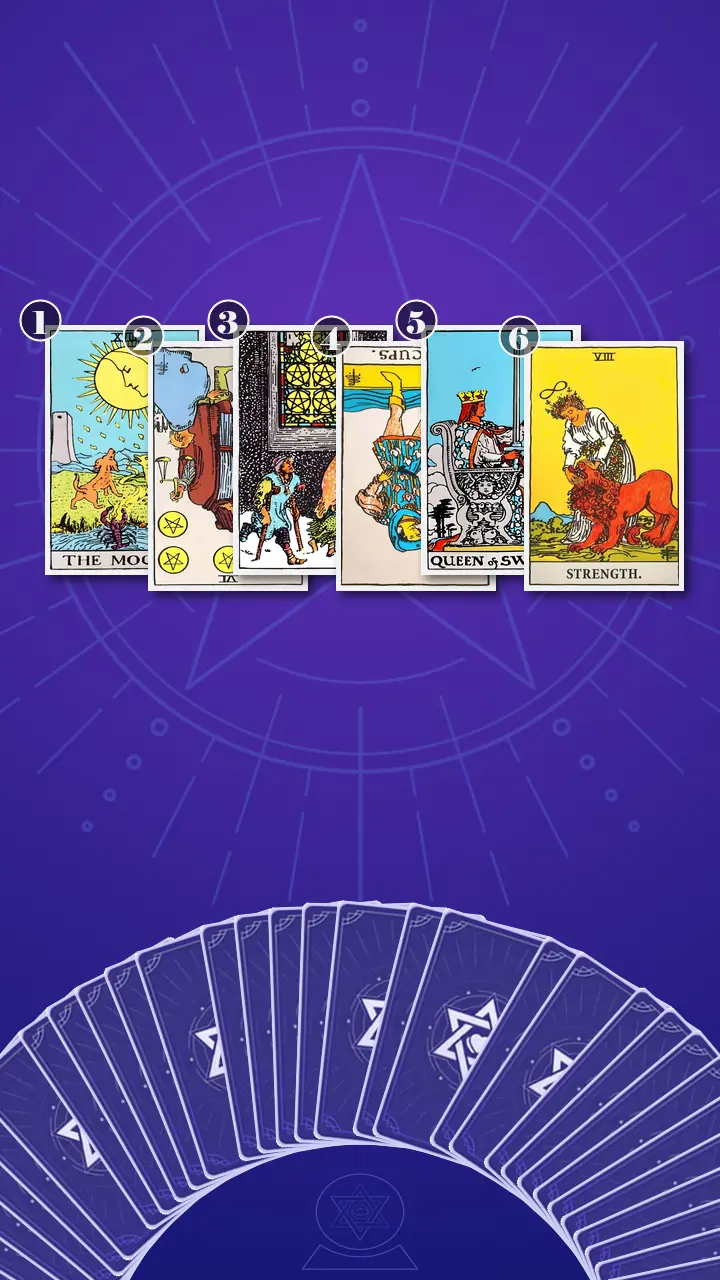
I used the Relationship Spread · Context Edition. This is how tarot works here: it turns a live pattern into visible steps, so the reply is no longer just a feeling in your chest. A six-card line is enough to show the trigger, the reflex, the belonging fear, the exchange pattern, the boundary pivot, and the new stance without drowning the issue in extra symbols.
The first three cards would show the fog and the old reflex. The fifth card would mark the turn in the road. And the sixth would show what steady, warm self-respect looks like once the dust settles.
The Moon on a Phone Screen
Position 1 — The Story Your Body Writes First
Now I turned over the card for the immediate trigger, and it was The Moon, upright. The modern-life image was almost too on the nose: a vague 'are you around?' text on a train ride home, the screen glowing in the dark while the mind starts filling in blanks before there are facts.
The Moon here is not saying the friend is hiding some dramatic secret. It is showing excess projection: the nervous system takes a small message and builds a whole movie around it. The path is half-lit, so the body starts scanning for danger, and then the scan becomes the story. In practice, that means timing, punctuation, and even the absence of an emoji start to feel loaded.
A fast reply is not a free yes, and The Moon is what makes it feel like one. My old market brain always notices this kind of thing. On a trading desk, a rumor can move faster than a report; in a nervous system, fear can do the same. The Moon is the rumor phase of the heart.
Jordan gave a short, bitter laugh and looked down at the card. 'That is... annoyingly accurate,' she said, and then went quiet, thumb rubbing the side of her phone as if she could smooth the message flat. I could almost hear the subway rhythm in the room.
The Social Tax That Keeps Coming Back
Position 2 — The Habit Loop
The second card, for the automatic response, was Six of Pentacles reversed. In everyday language, it is the friend who only makes time when their original plan falls through, the group chat where you are the one who keeps moving dinner, and the social tax that always seems to come out of your pocket first.
Reversed, the energy is an excess of giving that stops feeling like generosity and starts feeling like compliance. The scales are still there, but they are tipping in the same direction every time. In Jordan's pattern, the quick yes buys a tiny burst of relief, because it keeps the connection from feeling awkward for another night. The cost comes later, when she realizes her plans were the only ones that moved.
She tucked her chin slightly, and I saw the jaw set. 'Yeah,' she said. 'I hate how fast I become available when the message is casual.' That small, resentful laugh was the first sign that the pattern had started to name itself.
The Warm Cafe You Think You Might Be Locked Out Of
Position 3 — The Belonging Fear
Five of Pentacles upright is the deeper sting. It is the thought that if you do not answer fast, you will be the person standing outside the warm cafe, watching the door close while everyone else keeps talking under the lights.
That is why the boundary feels bigger than a boundary. It is not just 'Can I make it tonight?' It is 'If I say no, will they remember me less?' The fear is exclusion, scarcity, the old ache of being on the sidewalk while the life you want is happening just behind glass.
Jordan's shoulders rose a notch. She stared at the card for a long second, then exhaled through her nose. 'If I make it too hard, they will just stop asking,' she said, and for a moment the room felt colder, as if the window had opened a crack.
The Friendly Message That Still Leaves You On Call
Position 4 — The Shape of the Exchange
The fourth card was Page of Cups reversed, and it described the interaction itself: a voice note full of feeling and zero specifics, a heart emoji where an actual plan should be, a soft-launch friendship stuck in draft mode.
Reversed, the Page has softness without structure. The invitation feels sweet, but it is too vague to be solid. That is how someone can keep you emotionally available without offering enough clarity for you to feel safe. It is tender contact with no container.
I asked Jordan, 'Do you feel invited into real connection, or kept on standby?' She made a face that was half rueful, half offended, then said, 'That is exactly it. Pleasant, but weirdly load-bearing.' There it was: the tone was kind, but the shape was not.
When the Sword Cut Through the Fog
Position 5 — The Boundary Pivot
When I turned over the fifth card, the room went noticeably still. Jordan had been sitting in the kind of polite tension that tries to make itself small; her hands were folded, then unfolded, then folded again, like she was trying to decide whether a clear line would cost her the whole connection.
My Network ROI Analytics lens kicked in immediately. I do not mean that I reduce friendship to a spreadsheet; I mean I notice when a connection keeps asking for high output and returning low yield. If every late text pulls you into instant availability, rearranged plans, and quiet resentment, while the other person keeps offering only convenience, the ledger is already telling the truth.
You do not need to be instantly available to stay important; the Queen of Swords asks you to answer with clear limits and clean language instead of automatic yeses.
I let that line hang there for a beat.
You can care about someone without making yourself instantly available.
At first, she did not relax. She went still, then her eyes flicked to the sword, then to her phone, as if checking whether the screen had secretly changed shape. Her jaw held for a second, then released. I watched the shoulders that had been riding up near her ears drop one notch, then another, and the hand around the phone loosen its grip. The resistance came first — a quick flash of irritation, almost grief: 'So I have been teaching people I am always available?' she asked. Then the thought landed more cleanly, and the room seemed to make room for it. Her breath went deeper, slower; the next inhale reached the ribs instead of stopping at the throat. She looked a little dizzy, like someone setting down a heavy bag and realizing the floor is still there. That was the shift from hyper-alert, guilt-driven over-accommodation to calm, self-respecting reciprocity. Now, use this new lens to think back: was there a moment last week when this would have changed how you felt?
When Warmth Held Its Shape
Position 6 — The Steadier Body
Strength was the final card, and it did exactly what Strength does when it is working well: it made the boundary feel embodied instead of brittle. The woman and the lion in the image looked less like conquest and more like cooperation — instinct learning it does not have to drive every choice.
The modern-life version is simple: keep Do Not Disturb on for ten minutes, keep your shoulders down, and let the reply come from a body that has caught up with the decision. Warmth does not disappear here; it just stops leaking everywhere.
That is the end point of the reading: not a colder friend, not a harder mouth, but calm, self-respecting reciprocity. The connection no longer runs on urgency. It runs on choice.
The One-Page Reply That Keeps Your Evening Yours
The spread tells one clean story. The Moon shows the fog that lands before the facts; Six of Pentacles reversed shows how the quick yes keeps the exchange uneven; Five of Pentacles names the fear that a boundary will exile you; Page of Cups reversed shows a message that is sweet but unstructured; Queen of Swords gives you the turning point; Strength teaches you how to hold it without hardening.
The blind spot is assuming that flexibility is the same as belonging. It is not. Flexibility without reciprocity turns you into the backup friend, and backup-friend mode always costs more than it looks like it costs. The transformation is from hyper-alert, guilt-driven over-accommodation to calm, self-respecting reciprocity — and that is the beginning of finding clarity.
I gave Jordan three next steps, each small enough to try on a weeknight without turning it into a project.
- The 10-Minute Reply GapWhen a late text lands, put the phone face down for 10 minutes, check your calendar first, then decide whether the ask fits your actual evening.If 10 minutes feels impossible, start with 2. If your palm is buzzing over the screen, treat that as your handshake energy exchange cue to pause, not to rush.
- The Queen of Swords ReplyUse one clear sentence: 'I can't tonight, but I can do Thursday after 7.' If needed, make it a three-beat cocktail party algorithm: acknowledge, name your timing, offer one real option.Trim away apology padding until the line is kind but not slippery. Clear is kinder than slippery.
- The Reciprocity PauseOver the next week, notice who initiates twice in a row and whether the same friend respects a no the way they respect a yes.Do not turn it into surveillance. One or two data points is enough to see the pattern.

A Softer Kind of Proof
Three days later, Jordan sent me a message from a coffee shop near King and Bay: 'I waited ten minutes, checked my calendar, and sent the one-line version.' She added that the reply came back normal, not dramatic, which somehow felt more surprising than praise would have.
A week later she sent the clean reply and sat alone with a cortado while the thread stayed quiet; the relief arrived first, and the tiny ache of not being instantly needed arrived right beside it. That was enough. The phone was still in her hand, but it was no longer steering the night.
That was my read on the whole journey: the ping did not disappear, but it lost its power to rewrite her evening. When a late text lands, your chest tightens and your thumb starts bargaining with the notification, because saying no can feel like risking the one thing you were trying to protect: belonging.
If you gave yourself one extra breath before answering, what would you want that first honest sentence to be?
This story is adapted from psychological research, written so that those in a similar struggle can see their own pattern in it — and find their next step clearly.These insights are not a substitute for professional psychological, medical, legal, or financial advice.
Learn more about our Journey to Clarity.
How did this insight land for you?
🫂 This Resonates Deeply
🌀 Living This Story
✨ Now I See Clearly
🌱 Seeing New Possibilities
🧰 Useful Framework
🔮 The Confirmation I Needed
💪 Feeling Empowered
🚀 Ready for My Next Step
Author Profile
 AI
AI“I spent years in the intense, high-stakes world of Wall Street. I know exactly how isolating and heavy the weight of uncertainty can feel in the dead of night. I use strategic, commercial logic not to be cold, but to protect you from unnecessary friction. Think of me as a fellow traveler who has walked the same rocky path—offering sharp but deeply supportive wisdom to help you clear the fog and confidently win your narrative back.”
In this Friendship Tarot Reading :
Core Expertise
- Reciprocity ROI Analysis: Objectively measuring the emotional give-and-take in your core friendships to identify asymmetrical, high-drain relationships.
- Sunk-Cost Decoupling in Loyalty: Separating the 'ten years of history' from the current reality of a one-sided, demanding friendship.
Service Features
- The Friendship Downgrade Strategy: A calculated tactical approach to gradually and decently de-escalate a toxic friendship into a low-maintenance acquaintance without triggering dramatic conflict.
Also specializes in :
Explore Related Patterns:
Boundary DiffusionThe 'you around?' text offers contact without a clear container, and Jordan's response starts forming before she has checked her own evening. The boundary between an invitation and an obligation gets blurry, so a casual ping begins to function like a claim on her time. Boundary diffusion shows up when your limits exist in theory but dissolve under relational pressure. You can care about the friend and still need a sharper line between their convenience and your consent. Without that line, warmth leaks into standby mode.
Friendship Role RegressionThe last-minute text pulls Jordan into a familiar role: the available backup friend who absorbs vague timing and makes the evening adjustable. The trigger is small, but it activates a full relational script where being easy to reach feels safer than risking a clean boundary. You may recognize the regression in the way choice shrinks. Instead of asking whether the invitation fits, the body acts like it has been assigned a place in the hierarchy. Friendship role regression names that snapback into an old social position, and the exit begins when the phone stops being allowed to define your rank in the connection.
Guilt-Driven People-PleasingJordan says the second a late text lands, she turns into the easy yes, even when she wants friendships that feel mutual. The quick yes lowers the immediate social threat: no awkward pause, no moment of wondering whether she still belongs, no chance to be seen as difficult. That relief is the defensive payoff, and it is why the answer can feel automatic before the decision is real. You can see the cost in the uneven exchange: her plans move, the other person offers convenience, and resentment arrives after the connection has been protected for one more night. Guilt-driven people-pleasing is not generosity; it is compliance used as emotional insurance. The work is noticing when a yes is serving fear rather than desire.
Rejection SensitivityThe warm-cafe image captures Jordan's real fear: saying no could mean being left outside while everyone else keeps talking. Her sentence, 'If I make it too hard, they will just stop asking,' turns a boundary into a prediction of social disappearance. That is rejection sensitivity working through ambiguity. The message is vague, but the nervous system reads it as a test of whether you are still wanted. Once that test is active, a fast yes can feel like proof of belonging, even though it only proves availability.
Intermittent ReinforcementThe exchange is not consistently mutual; it arrives as late contact, backup timing, soft affection, and just enough warmth to make staying available feel worth it. A tiny burst of relief follows the quick yes because the connection stays alive for another night. Intermittent reinforcement is powerful because the reward is unpredictable. You are not responding only to the text; you are responding to the possibility that this time the contact might become real reciprocity. That possibility keeps the loop sticky even when the pattern has already shown its cost.
Boundary DiscernmentJordan's shift begins when she puts the phone face down, waits, checks her calendar, and sends one clear line instead of an automatic yes. The new behavior does not make her colder; it separates care from instant access. Boundary discernment is the ability to read the difference between a real invitation and a pressure cue. You still allow warmth, but the final answer comes from choice, timing, and reciprocity. That is why the phone can stay in your hand without steering the night.
Urgency BiasJordan's thumb hovers over the phone before the message is even opened, and the body treats the screen lighting up as if a decision is already overdue. The timing of the ping creates pressure that is stronger than the actual content of the text. Urgency bias compresses the gap between stimulus and choice. You answer to stop the internal alarm, not because the request has been evaluated. The ten-minute reply gap works because it gives the decision back to the part of you that can check facts, plans, and desire.
Explore Related Struggles:
Boundary CollapseJordan's thumb hovers before she opens the message, her shoulders rise, and the phone starts steering the room. The boundary exists somewhere in principle, but the moment contact arrives, the other person's timing floods the decision. That is the collapse point: the question is not allowed to stay small enough to evaluate. A vague text becomes an immediate demand on her body, her calendar, and her place in the friendship all at once. You can care about someone and still need a line that holds its shape under pressure. The hard part is that the line feels less like scheduling and more like keeping yourself intact while connection is pulling on you.
Low-Maintenance Worth LockThe late 'you around?' text lands, and Jordan becomes the easy yes before she has checked her actual evening. The moment is small on the surface, but it carries a larger equation: if she stays low-friction, she stays askable. The friction is not that she cares too much or that she should become colder. The stuck point is that availability starts acting like proof of value, so any preference, delay, or clear no feels like it could make her too inconvenient to keep around. That is why the ping can pull so hard. You are not just deciding whether to go out; you are facing the felt risk that being less available might make you less remembered.
Reciprocity DeficitThe friend makes time when their original plan falls through, while Jordan is the one moving dinner, shifting her evening, and paying the social tax first. The exchange keeps sounding casual, but the effort keeps landing on the same side. The quick yes gives her a brief hit of relief because the connection does not have to feel awkward tonight. Then the cost returns later, when she realizes her plans were the only ones that became flexible. You are not counting favors for the sake of being petty. You are noticing when warmth has stopped circulating both ways, and your own time has quietly become the adjustable part of the friendship.
All-or-Nothing BelongingThe warm cafe image hits because Jordan is not only weighing a Friday-night invite. She is picturing the door closing, everyone else still talking inside, and herself becoming easier to forget if she does not answer fast enough. That turns belonging into a binary field: be available and stay inside, or set a limit and risk being left outside. A boundary that should be ordinary starts carrying the weight of social exile. You get pulled back because the text activates scarcity math. One missed opening can feel like it might cost the whole room, even when the actual message is only asking whether you are around tonight.
Urgency-Compass FusionThe screen lights up, Jordan's chest tightens, and her thumb starts bargaining with the notification before the message is even open. Timing, punctuation, and silence rush in as evidence before the facts have arrived. Urgency becomes the compass. The ping supplies the tempo, and her own calendar, preference, and actual desire have to fight for room after the decision has already started moving. That is why the ten-minute pause matters in the story. It separates signal from decision, giving you back the small but crucial space where a response can come from choice instead of speed.
Vulnerability Without ContainmentThe message is soft: a voice note full of feeling, a heart emoji, a pleasant tone where a clear plan should be. Jordan can feel the warmth, but she cannot locate the structure that would make the invitation solid. That is the specific bind of tender contact with no container. You are not rejecting warmth; you are noticing that warmth without clarity asks you to hold the whole shape of the connection alone. The last-minute text pulls because it offers just enough closeness to feel meaningful, but not enough definition to know where you stand. It keeps you emotionally available while leaving the actual terms of the friendship blurry.
Explore Related Emotions:
Boundary GuiltJordan's hands fold and unfold when the reading names a clear limit, as if one clean sentence might cost the entire connection. The question that hits her is not only whether she can say no, but whether she has trained people to expect yes. Boundary Guilt appears when a reasonable limit feels like a personal failing. You can know the exchange is uneven and still feel a small internal charge when you stop over-accommodating, because the old reflex has been using availability as proof that you care.
Conditional Belonging FearThe warm cafe image gives the wound its clearest shape: if Jordan does not answer fast, she imagines herself outside the glass while everyone else keeps talking under the lights. Her own sentence makes it sharper: if she makes it too hard, they will just stop asking. Conditional Belonging Fear lives in that narrow bargain. You keep the door open by becoming easier to reach, easier to reschedule, easier to absorb vague plans, because part of you has learned to treat belonging as something that can be withdrawn if you require too much clarity.
Mutuality HungerJordan names the clean desire at the start: she wants friendships that feel mutual. The reading keeps returning to that standard through the tilted scales, the vague invitation, and the final practice of noticing who initiates and whether a no is respected like a yes. Mutuality Hunger is the ache for warmth that also has structure. You are not asking for constant attention; you are asking for a friendship where effort travels both ways, where you do not have to buy closeness with instant availability or prove your place by moving first every time.
Standby Mode AnxietyThe late 'you around?' text lands before Jordan has even unlocked the screen, and her thumb is already hovering. Her chest tightens, the evening tilts, and the reply begins to form before the invitation has become specific. That is the logic of Standby Mode Anxiety: the phone does not just ask for availability; it makes your body feel already on call. You are not responding to a clear plan so much as managing the pressure of being kept reachable, where delay feels risky and instant access starts to masquerade as closeness.
Mixed Signal DreadThe message is casual, the timing is late, and the screen glows in the dark while Jordan's mind starts filling in what the text does not say. Later, the same pattern shows up as a voice note full of feeling, a heart emoji where an actual plan should be, and contact that feels sweet without becoming solid. Mixed Signal Dread comes from being asked to emotionally respond to something too vague to stand on. You are not reacting to one text; you are reacting to the unstable container around it, where softness creates hope but the lack of specifics makes every choice feel loaded.
Grounded AgencyThe new rhythm is concrete: phone face down, ten minutes of space, calendar checked first, then one sentence with real timing. By the end, the connection no longer runs on urgency; it runs on choice. Grounded Agency is what appears when care and self-respect occupy the same body. You do not have to become cold to stop leaking warmth everywhere; you answer from a steadier place, where your availability is something you choose rather than something the ping extracts from you.
Clarity ReliefWhen the pattern finally names itself, Jordan's grip loosens, her shoulders drop, and her breath reaches lower in her body. Three days later, the clean one-line reply comes back normal, which surprises her more than a dramatic response would have. Clarity Relief arrives when the room stops being run by projection. You still care about the connection, and the tiny ache may still sit nearby, but the facts have more authority than the notification; the phone remains in your hand without being allowed to rewrite the whole evening.
Hidden ResentmentThe social tax keeps coming out of Jordan's side: she moves dinner, becomes available fast, and later notices her plans were the ones that shifted. Her small resentful laugh shows the cost before she fully argues for herself. Hidden Resentment builds when kindness keeps getting used as flexibility. You may still want the connection, but each vague invitation leaves a residue because your evening, your calendar, and your ease keep absorbing the imbalance while the other person offers convenience instead of reciprocity.
Explore Related Contexts:
BreadcrumbingThe interaction is described as a voice note full of feeling and zero specifics, a heart emoji where an actual plan should be, and a soft-launch friendship stuck in draft mode. The contact feels warm, but it does not give Jordan enough structure to know what is actually being offered. That kind of partial signal keeps You emotionally available without requiring the other person to make a clear plan. The message gives just enough attention to restart the loop, while the missing details leave You doing the work of interpretation. Breadcrumbing fits because Jordan is not responding to a solid invitation; she is responding to fragments that imply connection while withholding clarity. The friendship stays active through small signals, but the actual exchange remains underbuilt.
Conditional Belonging PressureJordan says, 'If I make it too hard, they will just stop asking.' That sentence turns a simple reply into a social access question: whether saying no will quietly move her further from the group, the plan, or the friendship itself. The pressure is structural because belonging appears to depend on ease. Jordan is not only deciding whether she is free tonight; she is weighing whether a boundary will make her less memorable, less included, or less worth inviting next time. Conditional Belonging Pressure names the social bargain underneath the late text. You are being pulled back into backup-friend mode because the friendship has trained availability to feel like the price of staying in the room.
Emotional Labor ImbalanceJordan's quick yes buys a tiny burst of relief because it keeps the connection from feeling awkward for another night. The cost comes later, when she notices that her plans were the ones that moved while the other person's convenience stayed protected. The imbalance is practical as much as emotional. Jordan is not only replying; she is managing the tone, absorbing the uncertainty, rearranging her evening, and keeping the friendship from having to name its own unevenness. Emotional Labor Imbalance captures the external exchange pattern behind the backup-friend mode. You are being pulled into the invisible work of preserving warmth and access, while the other side can keep the ask casual, vague, and low-commitment.
Friendship Boundary CreepA Friday-night 'you around?' text tilts Jordan's whole evening before she even unlocks the screen. The ask is small on the surface, but it reaches into her time before she has checked her calendar, her plans, or her actual willingness. That is how boundary creep works in a friendship: not through one huge violation, but through repeated tiny access points that make instant availability feel normal. The phone lighting up becomes a social doorway, and Jordan's hesitation gets compressed into a reflexive yes. Friendship Boundary Creep is the right context because the story is about a boundary being crossed by casualness rather than force. You are not dealing with a dramatic confrontation; You are dealing with the slow expansion of someone else's convenience into space that was supposed to remain yours.
Friendship Boundary ResetJordan eventually waits ten minutes, checks her calendar, and sends the one-line version instead of answering from automatic availability. The friendship does not disappear in that moment; the exchange gains a clearer container. The reset is built through small external structures: Do Not Disturb, a reply gap, and one concrete alternative instead of apology padding. Those tools protect the space between a notification and a decision, which is where choice returns. Friendship Boundary Reset fits because the story is not asking You to withdraw from care. It shows a practical way to stay warm while making your time legible, finite, and available by choice rather than reflex.
Low-Maintenance Friendship PressureJordan says she wants friendships that feel mutual, but the second a late text lands, she turns into the easy yes. The pressure is not coming from a formal demand; it is carried by the casual timing, the vague ask, and the social rule that being low-maintenance keeps the connection easy for everyone else. That makes the friendship feel less like a shared plan and more like a test of how little friction You can create. Your time becomes valuable mainly when it can absorb someone else's convenience, and the cost shows up when your own evening is the only thing that keeps moving. Low-Maintenance Friendship Pressure fits because the story centers on availability being treated as proof of belonging. The real pivot is not becoming colder; it is seeing that a friendship can be warm without requiring You to be instantly reachable, endlessly flexible, or socially inexpensive.