Finding Clarity in the 11:30 p.m. Loop
If you’re a student with a part-time job in a city like Toronto and your “plan” is basically caffeine + calendar Tetris + hoping your shifts don’t change last-minute… welcome to high-functioning burnout.
Maya showed up to our session on a Tuesday night, camera angled from the corner of her small bedroom. The laptop glow made everything look a little underwater. Somewhere behind her, a radiator clicked like it was counting down. Her phone kept lighting up on the desk—warm from constant unlocking—and each buzz made her shoulders flinch like she’d been tapped on the collarbone.
“I’m tired,” she said, and the word came out flat, like a receipt she’d already read too many times. “But I also can’t stop.”
She told me about the rhythm: classes, a part-time job with weekly schedules that sometimes changed on short notice, friends close enough for spontaneous plans, and group chats that peaked after 10 p.m. like a second shift. Around 11:30, she’d finally open her laptop for the assignment she postponed because she was wiped—and she’d keep a chat open “just in case,” checking her work scheduling app between paragraphs like it was an IV drip.
“I keep telling myself, ‘I’ll sleep after this one thing,’” she admitted. “And then it’s 1:20 a.m. and I’m… bargaining with bedtime like it’s negotiable.”
The feeling in her voice was the kind that has a body: a tight jaw, a neck that won’t drop its guard, a wired-at-night fatigue that makes you want to lie down and sprint at the same time. Overwhelm, yes—but with an undertow of FOMO and guilt that keeps tugging you back toward the screen.
I nodded slowly, letting her hear that I believed her without making it a lecture. “That’s not a character flaw,” I said. “That’s a pattern. And patterns are readable. Let’s try to draw a map through the fog—something that gives you clarity and next steps, not just a vibe.”
Choosing the Compass: The Celtic Cross · Context Edition
I asked Maya to take one slow breath and do something very un-mystical: notice her body before her story. Shoulders up? Jaw clenched? Stomach tight? She swallowed, then let her shoulders drop a fraction—like a backpack strap finally loosened.
I shuffled while she held the question in plain language: Classes, work, friends, no sleep—what burnout pattern am I in? Not “How do I fix my life?” Just: what is this loop, and where’s the lever?
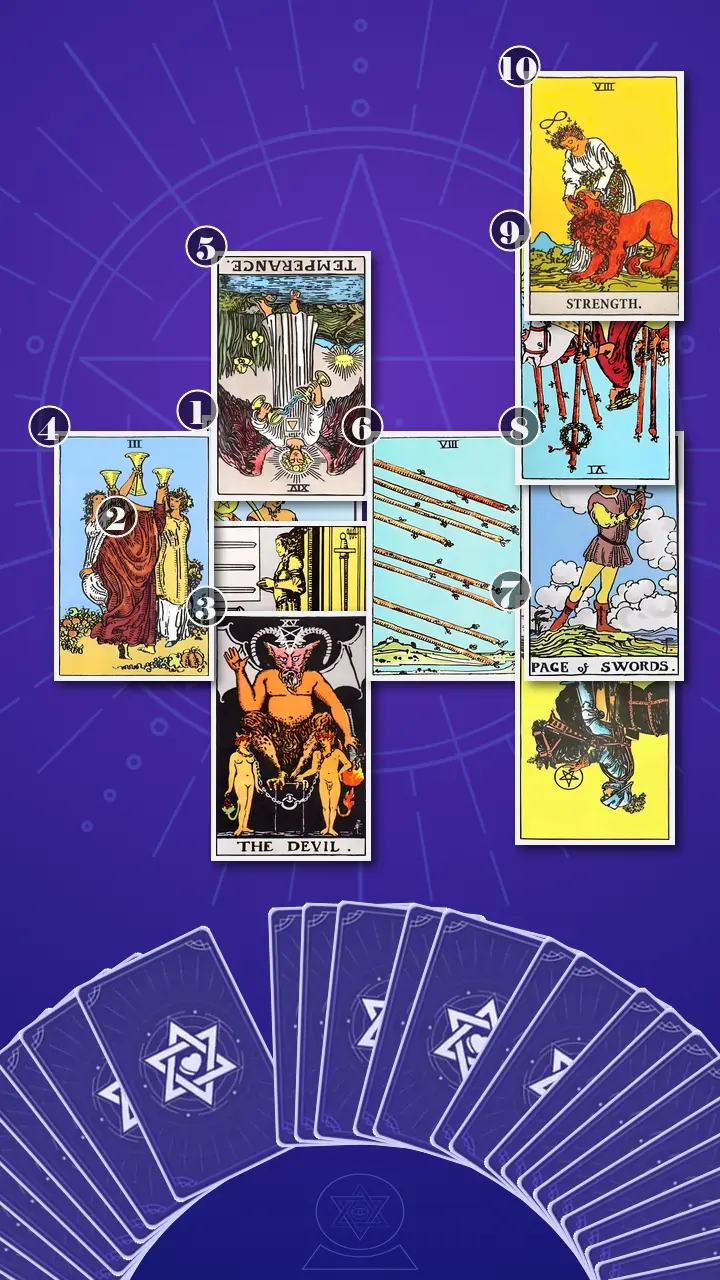
“Today we’ll use a spread called the Celtic Cross · Context Edition,” I told her. “It’s based on the classic Celtic Cross, but with one adjustment: the last card isn’t a fixed ‘outcome.’ It’s an integration focus—what you can practice so the pattern actually changes.”
For readers who wonder how tarot works in a real-life burnout question: this spread is a systems map. It shows the visible rhythm (what your days actually look like), the crossing pressure (what blocks recovery), the root driver (the fear/attachment fueling the pace), and the environmental architecture (notifications, schedules, social culture). When you can see the feedback loop, you stop blaming yourself for “not managing time” and start making targeted changes that your nervous system can tolerate.
I previewed the three cards I most wanted us to pay attention to: the center card (your day-to-day burnout rhythm), the crossing card (the specific thing that prevents sleep and recovery from landing), and the final integration card (the practical skill that breaks the loop without blowing up your life).
Reading the Map: Card Meanings in Context
Position 1: The visible rhythm you’re living
“Now flipping over,” I said, “is the card that represents your current burnout pattern as lived day-to-day—the visible rhythm of classes, work, friends, and sleep.”
Two of Pentacles, upright.
I angled the card toward the camera. The figure juggles two coins wrapped in an infinity-shaped loop while waves rise and fall behind him. “This is the classic juggling card,” I said. “But the detail that matters is that infinity loop. This isn’t ‘busy this week.’ This is repeating the same week on a loop with no real finish line.”
“It’s like your Google Calendar is color-coded and it looks like control,” I continued, “but your day still feels like waves hitting from every direction. You keep everything moving, but only by never fully landing.”
Maya let out a small, tense laugh—half disbelief, half relief. “That’s… yeah,” she said. “It’s accurate in a way that’s kind of brutal.”
“Brutal, but useful,” I replied gently. “Because the Two of Pentacles isn’t asking you to juggle better. It’s asking: which two areas are you trying to keep perfectly equal—even when your body is clearly asking for a third priority, like rest?”
Position 2: The blocker that keeps recovery from landing
“Now flipping over,” I said, “is the card that represents the primary blocker—what specifically prevents recovery and sleep from taking hold.”
Four of Swords, reversed.
I didn’t rush this one. “Your body is begging for a pause; your brain keeps negotiating like it’s optional,” I said, letting the line sit between us.
In the upright Four of Swords, there’s a stillness—rest as an actual sanctuary. Reversed, the sanctuary exists in theory, but you can’t access it in practice. “This is the ‘body horizontal, brain on shift’ card,” I explained, because I wanted her to feel how precise it was.
I described the montage I could almost see through her webcam: the laptop glow washing the sheets, a charger cable snaking across the bed, cold leftover coffee abandoned on the desk, Spotify “deep focus” still playing at midnight. And the inner monologue underneath it all: If I sleep now, I’ll wake up behind.
Maya’s hand went to her jaw without her noticing. Her fingers pressed, then loosened. “Yeah…” she exhaled. “That’s exactly my nights.”
“Four of Swords reversed isn’t fixed by a motivational quote,” I said. “It’s fixed by a re-entry: rest has to land in practice, not just in your intentions.”
Position 3: The deeper attachment that keeps you locked in
“Now flipping over,” I said, “is the card that represents the underlying driver—the deeper fear or attachment that keeps you locked into the pace.”
The Devil, upright.
I watched Maya’s eyes narrow slightly—like she braced for judgment. “This isn’t the universe calling you bad,” I said immediately. “The Devil in a burnout reading is about where choices stop feeling like choices.”
I pointed to the loose chains around the figures’ necks. “They’re not welded. They’re just… persuasive.”
Then I gave her the two-column inner dialogue I hear constantly from high-functioning burnout clients:
I could say no. / But then I’ll be the flaky one.
I could sleep. / But then I’ll fall behind and people will forget me.
Her throat moved like she swallowed something hard. “I don’t think anyone is forcing me,” she said quietly. “It’s more like… I volunteer before anyone even asks.”
“Exactly,” I said. “The Devil here is the attachment to being impressive, reliable, always up for it—because it feels like safety and belonging. Rest threatens that identity, so your system treats rest like danger.”
Position 4: What recently reinforced the pattern
“Now flipping over,” I said, “is the card that represents the recent contributor—what recently increased the load or reinforced the pattern.”
Three of Cups, upright.
This card is the warm part of the story: friendship, community, shared plans. “This isn’t blaming your friends,” I told her. “It’s showing that connection has been a real priority lately—and it’s also been a real drain on bandwidth, because good things still cost energy.”
I pictured the Toronto version of this card: a group chat lighting up with “we’re meeting in 30,” someone’s birthday thing on a Thursday, spontaneous patio envy on Instagram. “The Three of Cups is nourishment,” I said. “But if it turns into ‘I must keep up,’ it becomes another recurring commitment in an already full load.”
Maya nodded, almost reluctantly. “I love them,” she said. “And then I’m mad at myself for being tired.”
“That’s an important distinction,” I said. “Love doesn’t cancel physics.”
Position 5: The story you’re consciously telling yourself
“Now flipping over,” I said, “is the card that represents your conscious story—what you think you should be doing about burnout and balance right now.”
Temperance, reversed.
Temperance is the integrator: the angel pouring water between two cups, building a steady mix. Reversed, the pour gets messy. “You already know you’re out of sync,” I said. “Your week is segmented into harsh extremes: intense productivity sprint, then collapse. No middle gear.”
“This is where people try to fix burnout with quick hacks,” I added, “while the structure stays extreme—like changing your phone wallpaper to ‘hustle’ and calling it a system.”
Maya gave a short laugh that sounded too close to tears. “I’ve literally watched productivity TikToks at midnight,” she admitted, “like that would somehow… save me.”
“Temperance reversed is your own wisdom saying: you don’t need a glow-up,” I said. “You need one anchor habit that blends your roles into one sustainable rhythm.”
Position 6: The near-term pace if nothing changes first
“Now flipping over,” I said, “is the card that represents near-term momentum—what the immediate stretch ahead looks like if nothing changes first.”
Eight of Wands, upright.
Eight wands fly through open sky like they were fired from a single bow. “This is speed,” I said. “Fast turnarounds. Rapid communication. Things arriving before you’ve recovered from the last thing.”
I translated it the way her nervous system would recognize: notifications, mini-deadlines, a professor posting a new assignment, a shift update, a friend texting “are you coming tonight?” while you’re on the TTC with an iced coffee sweating through the cup. “This card isn’t doom,” I told her. “It’s a clarity check: the environment may keep moving whether you’re rested or not.”
“So the question becomes,” I continued, “what do you simplify in advance—what stops needing a same-day response?”
Position 7: Your coping style under pressure
“Now flipping over,” I said, “is the card that represents your coping style—how you respond to pressure, and how that response helps or harms.”
Knight of Pentacles, reversed.
This one is quietly brutal in a way I respect. The Knight of Pentacles upright is steady, responsible effort. Reversed, the steadiness turns into stuckness: grind without renewal, duty without breath.
“You’re not lazy—you’re overclocked,” I said, because I needed her to hear the difference. “It’s like running too many browser tabs plus Spotify plus a Zoom call: the system doesn’t crash immediately, it just gets laggy and hot.”
Maya blinked hard, like the sentence landed somewhere in her chest. “I keep thinking I need to be more disciplined,” she said, “but the more disciplined I am, the worse I feel.”
“That’s the reversed Knight,” I replied. “You’ve been equating ‘steady’ with ‘never stopping.’ And it quietly reduces focus, learning, mood—everything you’re trying to protect.”
Position 8: The environment that keeps your system on
“Now flipping over,” I said, “is the card that represents external factors—what your environment demands of you.”
Page of Swords, upright.
The Page stands with a raised sword, scanning the horizon in wind that never seems to settle. “This is your messaging culture,” I said. “Your brain on alert. Your thumb unlocking your phone without you deciding.”
I turned notifications into weather, because that’s how it feels: pings like gusts of wind. “Silence feels unsafe,” I said. “Constant checking feels like safety—even though it burns you out.”
Maya stared at the card, then at her phone, like she’d just realized it was an object with power. “Wait,” she said slowly. “It’s not only workload. It’s… my inputs.”
“That’s the lever,” I told her. “The Page of Swords is where you can intervene quickly. You don’t need to change your whole life this week. You need to change what your attention is exposed to.”
“I can mute one chat,” she said, half-questioning, half-relieved.
“Exactly,” I said. “Make it concrete. Write one reply window on a sticky note—something your future-tired self can follow.”
Position 9: The hope/fear engine under the overcommitment
“Now flipping over,” I said, “is the card that represents your hopes and fears—the emotional engine that fuels the loop.”
Six of Wands, reversed.
Upright, this is public recognition. Reversed, it’s shaky validation—feeling like you have to keep earning your place. “This is the pressure to stay visible,” I said. “Grades, shifts, social presence. If you’re not visibly performing, you fear you’ll fade from attention and feel replaceable.”
Maya’s lips pressed together. Her eyes flicked down and away, the way people look when they recognize an uncomfortable truth but don’t want to give it a microphone.
“If it costs your sleep, it’s not sustainable—no matter how impressive it looks,” I said, not as a scold, but as a clean metric. Something she could use when her brain started bargaining at midnight.
She whispered, “I hate that I care.”
“Of course you care,” I said. “You’re human in a fast city. The goal isn’t to stop caring. It’s to stop letting that fear run your schedule.”
When Strength Spoke: From ‘Push Harder’ to ‘Lead Gently’
Position 10: The integration focus—the antidote you can practice
I paused before turning the final card. The radiator clicked again—louder this time, like the room wanted to be included. Maya’s phone buzzed, and she didn’t reach for it. That tiny moment of not-reaching felt like a hinge.
“Now flipping over,” I said, “is the card that represents the most empowering way to break the burnout pattern through a sustainable inner skill and next-step practice.”
Strength, upright.
On the card, a woman holds a lion—not by force, but by calm hands that don’t tremble. Above her head, the infinity symbol appears again. The same endless-loop energy from your juggling card—but transformed.
Setup: If you’ve ever opened your laptop at 11:30 p.m. telling yourself “just one more thing,” while your group chat keeps popping off and your work schedule might change overnight… you already know the weird combo of being exhausted and unable to stop. You’ve been trying to solve that feeling with more willpower. More pushing. More “discipline.”
Delivery:
Not “I’ll rest after I earn it,” but “I’ll lead my intensity gently,” like Strength’s calm hands on the lion turning raw drive into a pace you can keep.
The sentence hung there. Even through a screen, you can feel when a truth lands in someone’s body before it lands in their brain.
Reinforcement: Maya’s breath stopped for a beat—like her nervous system froze to assess whether this was safe. Her eyes went slightly unfocused, as if she was replaying last night: blanket, phone inches from her face, refreshing without reading, jaw tight enough to ache. Then her shoulders lowered in a slow, almost unwilling release. Her mouth opened, closed, then opened again.
“But… if I stop,” she said, and there was a flash of anger in it—small but real—“doesn’t that mean I’ve been doing it wrong? Like I made myself suffer for no reason?”
I let that reaction be valid. “It means you did what worked until it didn’t,” I said. “And that you’re smart enough to update the system. Strength isn’t a verdict. It’s a skill.”
She blinked, fast. Her eyes shone, not with collapse, but with that weird dizziness that comes when your brain realizes a door was never locked. “So it’s not ‘be tougher,’” she murmured. “It’s… be consistent.”
“Yes,” I said. “Boundaries aren’t a personality trait. They’re a practice.”
Then I brought in my own way of making practice feel doable—one of my favorite tools from studying master artists and scientists: Einstein’s thought experiments. “Let’s run a tiny experiment,” I told her. “Not a lifestyle overhaul. Just a controlled test. What happens to your anxiety if you protect one boundary for 20 minutes? We observe, we adjust. No moral score.”
I guided her into a 10-minute exercise I call a Strength boundary draft—because Strength isn’t ‘push harder.’ It’s ‘choose one kind boundary and keep it.’ That’s how your life stops running on emergency mode without you disappearing from it.
The 10-minute “Strength Boundary Draft” (do it once, then you can stop)
“Open Notes,” I said, “not your calendar. Title it: Tonight’s Cutoff.”
“Write one line: At __:__ pm I stop school/work tasks. Pick a time you can actually keep tonight—even if it’s later than ideal. We’re building credibility with your body, not chasing perfection.”
“Then write two lines:
If someone texts after cutoff, I will reply tomorrow at __.
If I get anxious, I will write the task down instead of doing it.”
“Now,” I added, “put your phone on Do Not Disturb for 20 minutes to test the boundary.”
Maya swallowed again. Her hand hovered over her phone. This was the three-step chain in real time: (1) the freeze—fingers suspended; (2) the cognitive infiltration—eyes flicking to the chat previews, imagining consequences; (3) the emotional release—her exhale, shaky but real, as she tapped the setting.
“My heart is doing that stupid thing,” she admitted.
“That’s not stupid,” I said. “That’s withdrawal from the ‘prove I’m reliable’ reflex. If turning on DND spikes your anxiety, scale it down—mute one group chat or silence notifications for 10 minutes. You’re practicing, not proving anything.”
I asked her the question I always ask after Strength shows up: “Now, with this new lens—leading your intensity gently—think back to last week. Was there a moment when this would’ve changed how you felt?”
Maya stared at the corner of her room, at nothing and everything. “Sunday night,” she said. “I kept moving blocks around in my calendar like Tetris. If I’d just… picked a cutoff and stopped… I think I would’ve slept.” She laughed once, softer. “I would’ve hated it. But I would’ve slept.”
“That’s the shift,” I told her. “Not from ambition to laziness—from emergency mode to regulated stamina. From overwhelm to a first slice of self-trust.”
From Insight to Action: A Few Next Steps You Can Actually Keep
I leaned back and let the whole spread resolve into one coherent story—because tarot is most practical when it becomes a narrative you can act on.
The Two of Pentacles showed the weekly infinity loop: constant juggling that looks like competence but feels like never landing. The Four of Swords reversed revealed the core blockage: rest exists, but your nervous system won’t let it “take,” so your body lies down while your mind stays on shift. The Devil at the root named why: you’re chained to the identity of being impressive and reliably available, and the chains are loose—but persuasive. The Three of Cups and Page of Swords showed how the city’s social momentum and notification weather keep feeding the loop. And the Six of Wands reversed clarified the emotional fuel: fear of not measuring up unless you’re visibly performing. Then Strength arrived as the antidote: kind, consistent boundaries that protect sleep and turn drive into a pace you can sustain.
The cognitive blind spot here is subtle but common: you’ve been treating sleep as a reward you get after finishing everything, instead of treating sleep as infrastructure that makes finishing anything possible. The transformation direction is just as clear: shift from proving you can handle everything to deliberately choosing a sustainable pace by protecting sleep and making a few clear “no” decisions each week.
Here are your low-friction next steps—actionable advice that fits a real student schedule, not an imaginary life:
- The Hard-Landing AlarmPick one nightly cutoff time for school/work tasks (even if it’s late, like 12:15 a.m.). Set a repeating alarm labeled “Hard landing.” When it goes off, write your top 3 carryover items on paper (not your phone), then close the laptop.Expect resistance—your brain will say “this is irresponsible.” Treat that as a withdrawal symptom, not a truth. Aim for a cutoff you can keep 4 nights out of 7.
- The Reply-Window RuleCreate one daily reply window for group chats (for example, 12:30–12:50 p.m.). Mute the group chats outside that window. Keep school/work essentials on if needed, but remove the constant social pings from your nervous system’s airspace.Make it visible: write your reply window on a sticky note on your laptop or set it as your lock screen. Don’t rely on willpower when you’re tired.
- One Clean “No,” With an AlternativeDecline one optional plan this week using a simple text that sounds like you: “I can’t tonight, but I’d love to catch up for coffee this weekend.” Keep one social plan you genuinely want, and treat the rest of the week as recovery-supportive (no double-booking).If guilt spikes, name it: “That’s my ‘prove I’m reliable’ reflex.” Naming lowers the heat. Start with a low-stakes no.
Maya hesitated. “But I can’t do the cutoff every night,” she said quickly. “My job sometimes posts shifts late, and my friends… they plan last-minute. And if I go silent, I feel like I’m missing something.”
“That’s exactly why we’re not aiming for perfect,” I said. “We’re aiming for sustainable. Strength doesn’t demand a personality transplant. It asks for one boundary you can repeat.”
I also offered one optional tool from my studio-world—the kind of strategy that makes boundaries feel less like deprivation and more like design. “If you want,” I said, “use my Manuscript Mindmaps trick once this week. Write your cutoff plan in mirror writing for 60 seconds—messy is fine. It forces your attention to slow down. It turns ‘I should’ into something your body can feel. Think of it like stepping out of a frantic montage and into a single still frame.”
She smiled, surprised. “That’s weird,” she said. “But… I kind of like it.”
A Week Later: Ownership, Not Certainty
Six days later, I got a message from Maya that was only two sentences long.
“I did the hard-landing alarm,” she wrote. “I hated it the first night. The second night I muted one group chat and nothing exploded.”
She added, almost like an afterthought: “I still woke up thinking, ‘What if I’m falling behind?’ But I didn’t reach for my phone right away. I just… lay there. It felt quiet. A little lonely. But quiet.”
That’s the kind of proof I trust: not a miracle, not a makeover—just a small, repeatable shift from emergency mode to a first draft of regulated resilience.
In this Journey to Clarity, the cards didn’t tell Maya to vanish from her life. They showed her what her burnout pattern actually is—juggling plus speed plus notification weather, chained to the fear of being forgettable—and then offered an antidote she could practice: Strength’s kind, consistent boundaries.
When you’re running on 4–6 hours of sleep and still answering like you’re on call, it’s not that you “can’t manage time”—it’s that slowing down feels like risking your place in people’s lives and your own sense of worth.
If you didn’t have to prove anything for the next seven days, what’s one small boundary—your own version of that calm hand on the lion—that would let your body finally believe it’s allowed to power down?
This story is adapted from psychological research, written so that those in a similar struggle can see their own pattern in it — and find their next step clearly.These insights are not a substitute for professional psychological, medical, legal, or financial advice.
Learn more about our Journey to Clarity.
How did this insight land for you?
🫂 This Resonates Deeply
🌀 Living This Story
✨ Now I See Clearly
🌱 Seeing New Possibilities
🧰 Useful Framework
🔮 The Confirmation I Needed
💪 Feeling Empowered
🚀 Ready for My Next Step
Author Profile
 AI
AI“I’ve always felt our lives are films currently in production. As an artist, I know that when you feel stuck, it’s often because you’ve bravely stayed in a painful scene for just a little too long. I’m not here to coldly analyze you. I want to sit closely with you, look at those difficult moments with profound empathy, and gently hand you the pen so you have the courage to write your next beautiful act.”
In this Study Tarot Reading :
Core Expertise
Service Features
Also specializes in :
Explore Related Patterns:
Boundary DiffusionMaya's 11:30 p.m. setup - assignment open, chat left open 'just in case,' scheduling app checked between paragraphs - shows a boundary that exists in theory but not in practice. Work, school, friends, and notifications can all enter the same exhausted hour, so her attention has no protected edge. The mechanism is not a lack of care. It is a porous self-protection strategy. By staying reachable, you reduce the immediate anxiety of disappointing someone or missing a change, but the cost is that other people's possible needs start managing your sleep before they have even asked. Boundary Diffusion fits because the burnout loop is held together by open channels, not by one single task.
Defensive OverfunctioningMaya says, 'I volunteer before anyone even asks,' while also juggling classes, shifting work schedules, friends, assignments, and late-night recovery debt. The behavior looks responsible from the outside, but inside the loop it works like a defense: if everything keeps moving, she can feel less at risk of being flaky, forgotten, or replaceable. Defensive Overfunctioning fits because the pressure is not only external workload. You can see a system using extra effort to regulate belonging. The more uncertain the week feels, the more the mind reaches for doing, replying, fixing, and showing up. That strategy can preserve control for a while, but it eventually turns responsibility into a state of being permanently on call.
Achievement FusionMaya's fear is not only that she has too much to do. The deeper line is, 'If you're not visibly performing, you fear you'll fade from attention and feel replaceable.' Grades, shifts, replies, and social presence become more than responsibilities; they become evidence that she still has a place. Achievement Fusion fits because competence has fused with identity. You are not simply trying to do well; the mind starts treating visible performance as proof of worth and belonging. That is why rest feels threatening rather than neutral. Pausing does not just mean stopping work - it feels like interrupting the signal that says you are reliable, impressive, and still wanted.
Compulsive CheckingMaya keeps the chat open 'just in case' and checks the work scheduling app between assignment paragraphs, while each phone buzz makes her shoulders flinch. The screen is not just a distraction here. It has become a safety object, something she checks to make sure nothing has changed without her noticing. Compulsive Checking fits because the behavior briefly lowers uncertainty while quietly increasing arousal. You get a moment of control, then the system learns that checking is how safety is maintained. That is why silence starts to feel unsafe and why rest cannot land: the mind has trained itself to scan for updates instead of trusting that some inputs can wait.
FOMOMaya's friends are not framed as the problem; the group chats, spontaneous plans, and late-night social momentum are part of what she genuinely values. The pressure begins when connection turns into 'I must keep up,' especially after 10 p.m. when her body needs to stand down. FOMO fits because the fear is relational and time-sensitive. You are not only afraid of missing information; you are afraid of missing your place in the group. That makes rest feel socially risky. The phone stays close because checking promises continued belonging, even while it pushes sleep further out of reach.
Urgency BiasMaya's environment keeps sending fast signals: a shift update, a professor posting something new, a friend asking if she is coming tonight, a chat moving after 10 p.m. The issue is not just the number of inputs. It is that each new input gets processed as if it may need a same-day response. Urgency Bias fits because attention starts confusing arrival with importance. When something appears, the nervous system treats it as something to handle now, even if waiting would be reasonable. That bias keeps Maya in emergency mode: every notification becomes a possible command, and the day never receives a clean ending.
Explore Related Struggles:
Approval-Safety FusionMaya says she could say no, but then she would be 'the flaky one,' and she admits she volunteers before anyone even asks. The pressure is not only to finish tasks; it is to remain impressive, reliable, visible, and easy to count on. You can hear the deeper bargain underneath the pace: belonging feels safer when it is continually earned. Rest becomes threatening because it interrupts the performance that seems to keep school, work, and friendships stable. Approval-Safety Fusion fits because the story ties safety to being approved of in real time. The visible achievement and availability are doing emotional labor, and the cost shows up as a schedule that cannot make room for the person carrying it.
Boundary CollapseMaya's bedroom holds the laptop glow, the group chat, the work scheduling app, the charger cable, and the bed all at once. The place meant to let her come offline becomes another control room for staying reachable. You can feel the boundary collapse in the absence of a clean edge. A message after cutoff, a shift update, or a last-minute plan can enter the same space as rest, so the night never fully becomes hers. Boundary Collapse fits because the struggle is not that Maya lacks good intentions. The practical lines between study, work, friendship, and recovery have become so porous that every role can make a claim on her at the moment her body needs protected space.
Monitoring-Safety FusionMaya's phone keeps lighting up on the desk, and each buzz makes her shoulders flinch before she checks the scheduling app again between assignment paragraphs. The checking is not random distraction; it has become a way to scan for danger in a life where shifts, chats, and deadlines can move without warning. You can see how monitoring starts to impersonate safety. Keeping the app open, keeping the chat nearby, and keeping the phone within reach all promise control, but they also keep the body in alert mode long after the actual task should be over. Monitoring-Safety Fusion fits because the struggle is not just screen time. It is the binding of reassurance to constant surveillance, where silence feels risky and attention cannot power down without first proving nothing has changed.
Rest-Permission SplitMaya keeps telling herself, 'I'll sleep after this one thing,' then finds herself at 1:20 a.m. bargaining with bedtime. Her body is asking for a pause while her mind treats rest as something that must be justified first. You are looking at a loop where sleep is no longer a basic condition for functioning; it has been turned into a reward that comes only after enough proving. The harder the week gets, the more rest starts to feel like falling behind. Rest-Permission Split names that exact internal divide. One part of the system knows shutdown is necessary, while another part withholds permission until the inbox, assignment, chat, or schedule feels safe enough to release.
Energy Distribution StrainMaya's week is built from classes, short-notice shifts, spontaneous friend plans, and assignments that finally open at 11:30 p.m. The schedule looks movable from the outside, but every block she shifts pushes pressure somewhere else. You can feel the friction in the way she keeps everything in motion only by never fully landing. School, work, friendship, and sleep are not simply competing tasks; they become different claims on the same limited body. Energy Distribution Strain fits because the struggle is not ordinary busyness. It is the structural problem of trying to give equal weight to roles that do not have equal recovery costs, until rest becomes the silent category that keeps getting underfunded.
Social Acceleration StrainMaya's group chats peak after 10 p.m., friends make spontaneous plans, professors post new work, and the job schedule can change with little warning. Inputs arrive faster than her body can convert them into choices. You are not just seeing a busy social life; you are seeing a relational field with speed built into it. Connection stays real and desirable, but the tempo keeps pulling her back into response mode before she has recovered from the previous demand. Social Acceleration Strain fits because the pressure comes from pace as much as volume. The city, the chats, the shifts, and the friendship culture keep moving, while Maya's need for sleep requires a slower rhythm that the environment does not naturally provide.
Explore Related Emotions:
Boundary GuiltDuring the boundary draft, Maya's hand hovers over her phone and her eyes flick to the chat previews before she taps Do Not Disturb. The small act of not being reachable for 20 minutes has enough charge to make her body hesitate. Boundary Guilt names the feeling that a normal limit might make her less reliable, less kind, or less worth keeping around. You can see it in the way she volunteers before anyone asks and in the inner dialogue where saying no instantly becomes being flaky. The guilt is useful data, not a verdict. It shows exactly where her sense of responsibility has outgrown her actual capacity, and where one small, repeatable no can begin to separate care from constant availability.
Fear of Being ForgottenMaya says she could sleep, but then she might fall behind and people might forget her. The same thread appears later in the pressure to stay visible through grades, shifts, replies, and social presence, as if being out of sight could make her replaceable. Fear of Being Forgotten names the relational charge underneath the burnout loop. You are not just seeing a student with too much to do; you are seeing someone whose availability has become tied to belonging, so disappearing for rest can feel like risking her place in people's lives. That fear explains why even good friendships can become hard to metabolize. The group chat is warm, but it also becomes a stage where absence feels loaded, and the phone starts carrying more emotional weight than it should.
Hypervigilant AnxietyThe phone keeps lighting up on Maya's desk, and each buzz makes her shoulders react before she decides anything. Later she describes checking the scheduling app between paragraphs, keeping a chat open just in case, and unlocking her phone almost without choosing. Hypervigilant Anxiety is the inner weather of living as if every message might require immediate response. You can see how silence starts to feel unsafe, because the screen has become the place where school changes, work shifts, and social belonging might all move without warning. The anxiety is not random; it is attached to an input system that never fully goes quiet. Naming it gives you a cleaner lever: the issue is not only how much is on the calendar, but how often the outside world is allowed to enter your attention.
Chronic OverwhelmMaya opens her laptop around 11:30 p.m. after classes, a part-time job, shifting schedules, and friend messages have already filled the day. She keeps a chat open just in case and checks the work app between paragraphs, so the assignment is never just an assignment; it sits inside a stack of unfinished demands. Chronic Overwhelm fits because the pressure spreads across school, work, friendship, sleep, and the phone itself. You are watching a system where every role keeps asking for a same-night response, and the body can keep moving only by never fully landing.
Rest GuiltMaya tells herself she will sleep after one thing, then finds herself at 1:20 a.m. bargaining with bedtime as if it were negotiable. Under the scene is the line she already knows: if she sleeps now, she will wake up behind. Rest Guilt fits because sleep has been placed behind performance, replies, and catch-up work in the inner order of importance. You can hear the conflict: the body is asking to power down, but the mind treats stopping as a breach of responsibility. That guilt keeps rest from landing even when she is physically in bed. It turns recovery into something she has to earn, which is why the cutoff practice matters as an emotional reframe as much as a schedule change.
Survival Mode FatigueHer first sentence is flat: she is tired, but she also cannot stop. The room reinforces it with underwater laptop light, the radiator clicking like a countdown, and a phone warm from constant unlocking while her shoulders flinch at every buzz. Survival Mode Fatigue names the worn-out alertness underneath that scene. You are not looking at simple busyness; you are looking at a body trying to power through classes, work, friendships, and late-night tasks while treating rest as something it must negotiate for later.
Social BurnoutHer friends are close enough for spontaneous plans, and the group chats peak after 10 p.m. like a second shift. She loves them, but she is also mad at herself for being tired, because connection has become another recurring demand inside an already crowded week. Social Burnout fits the specific texture of wanting people and needing distance at the same time. You can feel how warmth turns costly when every invitation, birthday plan, or last-minute message asks for energy that has already been spent elsewhere. The story does not blame the friendships. It shows the bandwidth problem: even nourishing connection can start to feel heavy when there is no protected space for the body to come back to itself.
Cautious Self-TrustSix days later, Maya has tried the hard-landing alarm, hated it the first night, muted one group chat the second night, and learned that nothing exploded. She still wakes up thinking she might be falling behind, but she does not reach for the phone right away. Cautious Self-Trust fits because the shift is small, tested, and not yet fully comfortable. You are watching her body gather evidence that a boundary can hold without making her vanish from school, work, or friendship. The feeling is quiet and a little lonely, but it is also clean. It marks the first draft of trusting her own limits enough to stay still, even while the old impulse to prove reliability is still making noise.
Explore Related Contexts:
Always On AvailabilityMaya keeps a chat open while doing assignments and checks her work scheduling app between paragraphs because shifts can change on short notice. Her phone is warm from constant unlocking, and each buzz interrupts the room like a new demand entering before the last one has been processed. Always On Availability captures the environment around her burnout pattern: school, work, and friendships all remain live channels late into the night. The issue is not just workload; it is the absence of a clear off-switch across the systems that can reach her. When availability becomes the default, recovery has to compete with the possibility of a schedule update, a friend texting, or a social plan forming without her. Naming this context gives you a practical lever: the problem has an attention architecture, which means boundaries like reply windows, notification silencing, and cutoff rules can change the shape of the loop.
Attention Economy Study TrapMaya opens assignments late, keeps chat nearby, checks a scheduling app between paragraphs, and has even watched productivity TikToks at midnight as if more input could rescue the night. Her study time is not protected; it is surrounded by apps designed to keep her switching. Attention Economy Study Trap fits because the academic task is happening inside a digital environment that keeps monetizing and redirecting attention. The issue is not a lack of caring about school; it is that study time has been placed inside a noisy attention market. For your question, this label identifies one of the levers in the burnout pattern. If schoolwork only begins after the day has been fragmented by work updates, social pings, and self-optimization content, the assignment becomes heavier than its actual word count because you are also fighting the architecture around it.
Group Chat FirehoseMaya's group chats peak after 10 p.m., right when her schoolwork and sleep are already fighting for space. The chats are tied to real friendship, spontaneous plans, birthdays, and belonging, but their timing and volume turn connection into another stream she has to monitor. Group Chat Firehose fits because the social pressure is not one dramatic conflict; it is a constant flow of small signals that make going quiet feel socially expensive. You can love your friends and still be overloaded by the pace at which the group expects attention. The firehose matters in this story because it keeps the burnout loop socially reinforced. Every unread message or late-night plan asks for a response, and the cost of rest starts to look like exclusion, flakiness, or missing out.
Hustle Culture TrapMaya tries to answer exhaustion with more discipline: productivity TikToks at midnight, calendar Tetris, one more task before sleep, one more proof that she can handle it. The more responsible she tries to be, the more the structure rewards constant output instead of recovery. Hustle Culture Trap fits because the story shows a productivity frame that treats rest as something to earn after performance. Grades, shifts, social presence, and responsiveness become proof of value, even when that proof is costing the sleep and focus needed to function. This context is useful because it moves the burnout question away from personal weakness and toward a social script. You are operating inside a culture that praises being impressive and available, so the real intervention is not pushing harder; it is redesigning the terms under which your effort counts.
Notification GuiltMaya does not reach for her phone only because it buzzes; she reaches because the buzz carries social and work consequences. She keeps chat open just in case, checks scheduling updates mid-assignment, and imagines that going quiet might make her flaky, behind, or forgotten. Notification Guilt names the pressure layer where a device becomes a small accountability machine. The pings are external, but the obligation they create is relational: reply fast, stay visible, prove you are still reliable. This context is central to the burnout pattern because it explains why simple rest advice would not be enough. You are dealing with a feedback loop where silence feels unsafe, so the first practical shift is not a whole-life overhaul; it is changing what your attention is exposed to and when people get access to you.
Sleep Debt LoopMaya keeps promising herself she will sleep after one more thing, then finds herself at 1:20 a.m. still bargaining with bedtime. The laptop glow, the charger across the bed, the phone inches from her face, and the repeated late-night cutoff failures make sleep debt a recurring structure rather than a single rough night. Sleep Debt Loop is the cleanest label for the part of the story where recovery keeps getting postponed until it becomes the resource funding everything else. Assignments, shifting work schedules, group chats, and the fear of waking up behind all press into the same nighttime window. This context matters because the question is not only whether you are tired; it is why rest cannot land even when you know you need it. The external loop teaches your body that powering down is risky, so sleep becomes negotiable instead of infrastructural.
Social Overcommitment SpiralMaya's friends are close, active, and genuinely important to her, but spontaneous plans and late-night chats keep entering a week already packed with classes and shifts. She says she volunteers before anyone asks, which turns optional connection into another recurring commitment. Social Overcommitment Spiral fits because the pressure is relational and cumulative. No single plan has to be wrong for the overall pattern to become unsustainable; the drain appears when every social opening is treated as something she should accept, answer, or keep up with. This context clarifies why rest feels like a social risk. You are not only choosing between sleep and a hangout; you are negotiating belonging, visibility, and the fear of being the person who lets people down.
Status Anxiety CircleMaya's burnout is powered by visibility pressure across several arenas at once: grades, shifts, social presence, and quick replies. She worries that if she sleeps, says no, or goes quiet, she will fall behind or fade from attention. Status Anxiety Circle fits because her environment makes performance feel like the price of keeping her place. The pressure is not limited to ambition; it is distributed through school metrics, work reliability, and friend-group visibility. This label matters because it explains why the loop keeps regenerating even after she recognizes it. When being seen as reliable becomes tied to belonging, rest can feel like a reputational risk, which is why the work begins with small boundaries that let you stay connected without performing nonstop availability.
Work Life Study JuggleMaya is moving through classes, a part-time job, spontaneous friend plans, late group chats, and assignments that only get opened around 11:30 p.m. The schedule looks organized from the outside, but every role is competing for the same evening hours, the same attention, and the same recovery bandwidth. Work Life Study Juggle fits because the pressure is not coming from one bad task; it is coming from the collision of several legitimate life roles inside one compressed week. You are not simply managing time badly when school, shifts, messages, and social belonging all ask for same-day access to you. The pattern becomes especially clear in the constant switching: writing paragraphs while checking the work scheduling app, keeping chat open just in case, and delaying sleep until one more obligation is handled. This context names the external stage where your burnout loop forms: a student-worker life structure that rewards keeping everything in motion while giving you almost no protected landing zone.
Strategic Pause WindowMaya does not solve the whole week at once; she tests one cutoff, one reply window, and one short Do Not Disturb block. Six days later, she has muted one group chat and nothing has exploded, which turns the idea of rest into a small repeatable structure. Strategic Pause Window fits as the constructive edge of the story because there is a real opening inside the burnout system. The external demands are still there, but a bounded pause creates a pocket where school, work, and friends no longer have instant access to her attention. This context gives the pattern a lever rather than just a label. You can begin by protecting one narrow window, observing what happens, and building credibility with your body through a boundary that is small enough to keep.