Third Sick Day and Still Checking Slack: Burnout Triage on a Third Sick Day
Third sick day and you still open Slack “just to check”—because being unresponsive feels like a character flaw (hello, Sunday Scaries but on a Wednesday).
Taylor said it like a confession, but their thumb was already doing it anyway—screen up, Slack half-loaded, the little spinning wheel acting like a metronome for panic. They were 29, in Toronto, propped against pillows in a condo bedroom where gray light leaked through the blinds and a humidifier rattled softly like it was trying to keep up with them.
The laptop sat balanced on the duvet. The glow made their eyes sting. Their phone was warm from scrolling. Their limbs had that sandbag heaviness—each movement slow, delayed—yet their chest kept spiking sharp and fast whenever they imagined their inbox.
“It’s my third sick day,” they said. “Work is piling up, my money situation is already tight, and my partner keeps texting ‘How are you?’ which… should be sweet, but it lands like another thing I have to do right. I just need one clean reset, but I don’t know which part of my life gets it first.”
I watched the way their gaze ping-ponged between the laptop and the phone—like their nervous system was trying to keep four plates spinning while their body was actively shutting the power down.
Overwhelm, for Taylor, wasn’t an abstract feeling. It was like trying to keep thirty browser tabs open while the battery sat at 2%—and still attempting a video call with the brightness on max.
“Okay,” I said, gently. “We’re not here to punish you into productivity. We’re here to find clarity: what to stabilize first, so everything else becomes solvable in smaller, cleaner moves. Let’s draw a map through the fog.”

Choosing the Compass: How the Energy Diagnostic Map Works
I asked Taylor to take one slow breath—not as a mystical ritual, just a gear shift. A way to move from doom-scrolling brain to decision-making brain. While they exhaled, I shuffled slowly, keeping their question simple and specific: Third sick day—work, money, love, health: what do I reset first?
“Today we’ll use a spread I call the Energy Diagnostic Map (7) · Context Edition,” I told them. “It’s a circular layout. We circle the problem, name the knot at the center, then walk out with one grounded next step.”
For you reading this: this is why this spread fits burnout triage. The question isn’t binary—health or work. It’s a low-capacity system trying to manage multiple domains at once: symptoms, inner conflict, external pressure, the root belief holding it all together, then resources, transformation, and a next step. Seven cards is enough to cover the whole ecosystem without overwhelming someone who’s already running on fumes.
“A quick preview,” I said. “The first card shows what the third sick day is revealing on the surface—your observable behavior. The center card shows the core blockage, the belief-bond that keeps the loop running. And the sixth card—the transformation position—shows the reset principle that reorders everything without an all-or-nothing crash.”
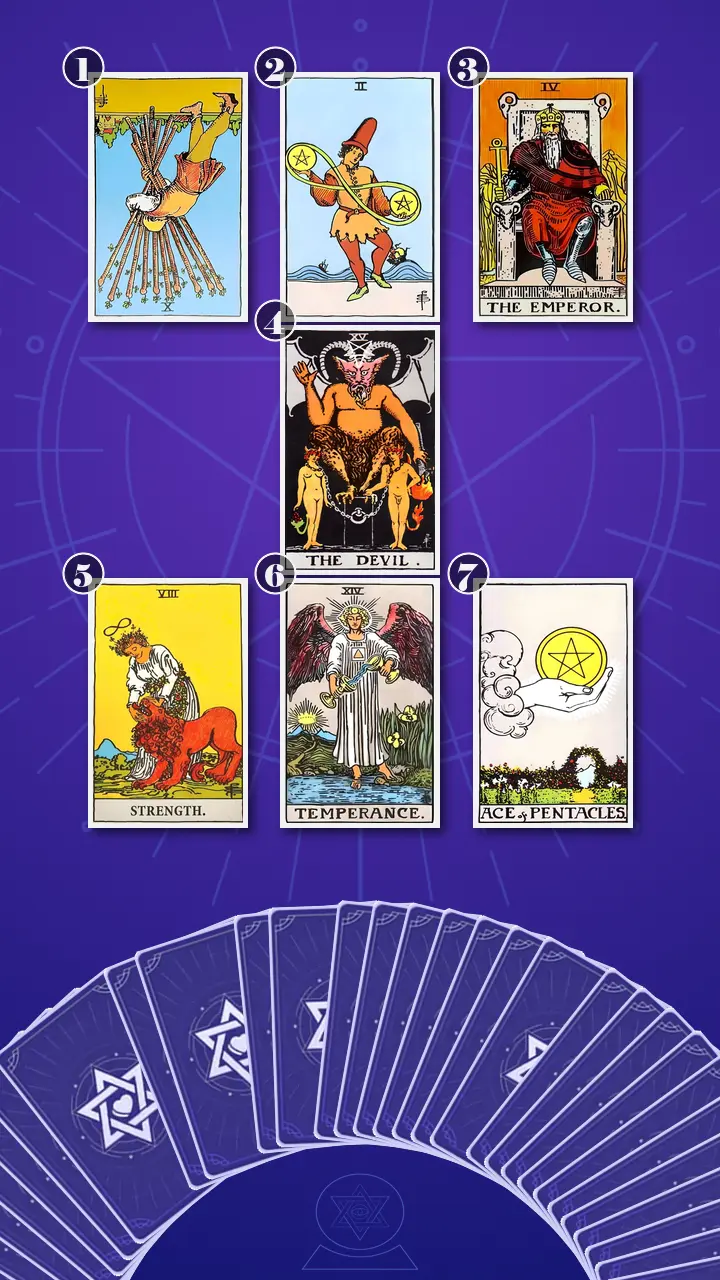
Reading the Map: Card Meanings in Context
Position 1 — Surface symptoms: what the third sick day is showing
“Now the card we turn over is for surface symptoms: what the ‘third sick day’ is showing in observable behavior and energy right now.”
Ten of Wands, reversed.
In modern life, this looks exactly like the scene you already described: it’s 8:30 a.m. and you’re carrying four invisible backpacks—Slack expectations, rent math, relationship responsiveness, and the guilt of being sick. You answer one message from bed, then immediately feel you owe three more so nobody tags you as “unreliable.” Your body throws up a hard stop—fog, heaviness, that weighted-limb gravity—and you interpret the boundary as personal failure instead of… a boundary.
Reversed, the Ten of Wands is overload reaching a limit. The energy here isn’t “more responsibility.” It’s blockage and collapse: too much being carried, too little being set down. The image matters—the wands stacked so high the figure can’t see. That’s what half-working from bed does: it blocks your line of sight until everything is equally urgent.
I mirrored the scene back to them—laptop on duvet, phone warming their palm, eyes darting between Slack and bank balance—then I gave the inner monologue its two clashing scripts: “If I just do one more thing, I’ll earn rest… / If I stop, I’ll look unreliable.”
Taylor let out a short laugh that had a bitter edge to it. “That’s… painfully accurate. Like, rude,” they said, then immediately softened. “But yeah. That’s me.”
“It’s not rude,” I said. “It’s precise. And precision is useful. Your body is already enforcing a boundary. The question is whether you’ll make it intentional—by choosing one burden to put down for seven days—so it doesn’t become a collapse.”
Position 2 — Inner tug-of-war: the juggling pattern and its cost
“Now the card we turn over is for the inner tug-of-war: how work/money/love/health are being juggled and what it’s costing internally.”
Two of Pentacles, upright.
Late morning, you’re toggling like it’s a reflex: Slack → banking app → grocery cart → partner’s text → back to Slack. Nothing gets completed, but the switching itself feels like you’re staying afloat. By evening, you’re exhausted and still feel behind, because juggling isn’t prioritizing—it’s just preventing you from landing anywhere long enough to feel stable.
Upright, the Two of Pentacles is balance under pressure, but in this context it’s balance that’s become a performance. The energy is excess motion. That infinity loop around the juggler’s hands? That’s the “just one more look” muscle memory. It creates the illusion of control while draining the last of your capacity.
“If you had to name the two things you’re juggling every ten minutes,” I asked, “what are they?”
They didn’t hesitate. “Work and money. And then—randomly—my partner’s feelings. Like I’m trying to keep everyone’s dashboard green.”
“Right,” I said. “And your body is the only tab you keep minimizing.”
Position 3 — External pressure: structures that push your priorities
“Now the card we turn over is for external pressure: what structures, expectations, or constraints are pushing the prioritization dilemma.”
The Emperor, upright.
You’re not just sick—you’re also trying to be “solid.” You imagine your manager reading your response time like it’s your work ethic. So you draft a message that sounds composed, efficient, and apologetic all at once. The Emperor is the invisible policy you’re following: be available, be dependable, don’t be messy. Like Severance, where the work-self is expected to keep running even when the real self is very much not okay.
Upright, The Emperor can be helpful structure. Here, the energy is over-identified authority: rules you didn’t consciously choose are deciding your priorities. This is where I get very practical: “Which rule is real—a concrete deadline—and which is assumed—constant availability?” If you can’t point to evidence, it’s likely fear in a blazer.
Taylor stared at the card, then at their laptop. “No one said I had to be online,” they admitted. “But it feels like… everyone is.”
“That feeling is powerful,” I said, “and it’s not the same as a requirement.”
Position 4 — Core blockage: the belief-bond keeping the loop alive
“Now the card we turn over is for the core blockage: the belief-bond or compulsion that keeps the loop going even when your body says stop.”
The Devil, upright.
This is the moment you realize the chain isn’t your job or your bills—it’s the bargain: “If I keep producing, I stay safe. If I rest, I become replaceable.” So you keep half-working while sick, not to get ahead, but to quiet the panic. You refresh your bank balance for reassurance, reread your sent messages for tone, and treat your partner’s care like another requirement. The Devil isn’t saying you’re doing something wrong; it’s naming what’s running the system.
Upright, The Devil is attachment and compulsion. The energy here is bonded fear: a loop that tightens the more you try to escape it through checking. I pointed at the detail people miss—the chains are loose. The figures could remove them. Choice exists, even if it doesn’t feel convenient.
Then I gave Taylor a “receipt list,” gently, like laying artifacts on a table: reopening the inbox two minutes later, rewriting the same sick-day message five times, rereading a manager’s tone, checking rent autopay, checking the credit card, checking Slack again. “Notice the pattern,” I said. “This isn’t rest. It’s negotiation.”
You’re not resting—you’re negotiating for safety.
Taylor went still in a three-beat sequence I’ve come to recognize: first their breath caught—like a tiny freeze. Then their eyes unfocused, as if replaying the last 72 hours in fast-forward. Then a quiet, involuntary “oh” escaped them, and their shoulders dropped a fraction, like a strap sliding off.
“Yeah,” they said. “That’s exactly it. I’m not trying to get ahead. I’m trying not to get… erased.”
My mind flashed, uninvited, to excavation sites: the way a settlement’s decline rarely announces itself with one dramatic event. It’s usually small system failures repeating—water access disrupted, storage mismanaged, trade routes stressed—until people start making desperate, short-term decisions that accelerate the collapse. The Devil isn’t the collapse. It’s the bargain that keeps picking short-term fear over long-term viability.
“If you’re replaceable the moment you get sick,” I said carefully, “was that ever stability—or just constant proof-of-worth?”
Position 5 — Usable resource: what you can access in low capacity
“Now the card we turn over is for usable resource: an internal strength or supportive quality you can access while low-capacity.”
Strength, upright.
Instead of forcing productivity out of a body that’s asking for recovery, you practice a different kind of discipline: you speak to yourself like someone worth taking care of. You set one small boundary (“I’ll check messages once at 12:30”) and notice the world doesn’t end. Strength looks like water, soup, and sleep—plus the quiet courage to let “being dependable” include being offline when you’re unwell.
Upright Strength is balanced power: not adrenaline, not self-threats—just steadiness. The lion here is your alarm system: the chest-tightening, the urge to fix everything at once. Strength doesn’t kill the lion. It keeps a gentle hand on it.
“What would it look like,” I asked, “to treat yourself exactly how you’d treat a friend on day three of being sick? One sentence. One action.”
They swallowed. “I’d tell them… ‘Stop. You’re sick.’ And I’d bring them soup.”
“Good,” I said. “That’s not indulgence. That’s leadership.”
When Temperance Poured Between Two Cups: Finding Clarity Without the Dramatic Reset
Position 6 — Key transformation: the reset principle that changes the order
As we moved to the sixth card, the room felt quieter—not in a mystical way, but in that human way where attention gathers. Even the humidifier’s rattle seemed to recede behind the moment.
“Now the card we turn over is for key transformation: the reset principle that reorders priorities without all-or-nothing thinking.”
Temperance, upright.
Temperance in modern life is the opposite of the one-day overhaul fantasy. It says: your first reset isn’t work, money, or love—it’s your baseline. Sleep, hydration, simple food, meds, a calmer schedule your body can actually sustain. Then—only then—you choose repeatable doses: one contained work boundary, one money snapshot (minimums and dates only), and one honest relationship check-in—then you stop. Balance becomes a practice, not a performance.
Upright, Temperance is integration and pacing. Here, the energy is balance—not “perfect equilibrium,” but measured pouring. One foot on land, one in water: reality and feeling, admin and care, duty and recovery, held at the same time without drowning in either.
And this is where my academic brain offers something useful. I call it Historical Case Matching: comparing a personal crossroads to the kinds of crossroads civilizations face. When a city’s foundation systems—water, food storage, basic governance—are offline, every problem feels existential. Leaders start chasing fires instead of rebuilding capacity. The wise move is almost always unglamorous: get the aqueduct running, secure grain, stabilize the routine. Only then do trade and culture flourish again. Your body is your aqueduct. Your baseline is the infrastructure.
Aha Moment (Setup)
Third sick day: you’re on the duvet with Slack half-open, your banking app in the background, and a “sorry I’m still sick” draft you keep rewriting—like your whole life is waiting for a reply. You’re trapped in the logic that if you can just pick the “right” category to fix first, you’ll finally earn permission to rest.
Aha Moment (Delivery)
Stop chasing a perfect reset in one dramatic swing; start mixing small, repeatable doses—like Temperance pouring between two cups—until your life feels livable again.
I let the sentence sit for a beat.
Aha Moment (Reinforcement)
Taylor’s face changed in layers. First: a tiny widening of the eyes, like someone opening a window in a stuffy room. Then their jaw—tight enough to look painful—loosened, and they exhaled in a way that sounded almost surprised, as if they’d been holding their breath for days without noticing. Their hands, which had been clenched around the phone, slowly uncurlled; the phone slid to the duvet like it had become heavier than it deserved to be. Their shoulders dropped, and then—because relief is rarely pure when you’re exhausted—there was a flicker of dizziness in their expression, that brief wobble that comes when you realize the thing you’ve been doing for safety has also been hurting you.
“So… I don’t have to decide between my job and my body,” they said, voice quieter now. “I decide on baseline first. And then I contain everything else.”
“Exactly,” I said. “If everything feels urgent, it’s usually because your baseline isn’t online yet.”
I slid the card a little closer. “Now, use this new lens and look back at last week: was there a moment—one Slack ping, one bank refresh, one text from your partner—where this could have changed how you moved?”
Taylor stared at the ceiling for a second, eyes tracking memory. “Monday,” they said. “I was sick then too. I still tried to ‘catch up’ at night. I could’ve just… sent one contained message and stopped.”
“That’s the path,” I said. “Not dramatic. Repeatable.”
Position 7 — Next grounded step: one tangible seed
“Now the card we turn over is for next grounded step: one practical action that supports recovery and reduces pressure this week.”
Ace of Pentacles, upright.
You don’t need a full financial plan or a total life reset while you’re sick. You need one practical seed: place an easy grocery order (soup, electrolytes, something you’ll eat), confirm minimum payments, or create a ‘sick week’ note with dates and essentials. The Ace is the kind of action you can physically point to afterward—without costing your recovery—so your nervous system stops treating your life like an emergency.
Upright, the Ace of Pentacles is supportive Earth. The energy is balanced and available: one small stabilizer that reduces pressure without requiring you to become a new person by tomorrow.
Contain the Week. Don’t Conquer It: Actionable Advice for the Next 48 Hours
I leaned back and stitched the cards into one clean story, the way you’d reconstruct a timeline from layers of soil.
“Here’s what your map says,” I told Taylor. “On the surface, your body has forced a stop, but you’re still trying to carry everything (Ten of Wands reversed). Inside, you’re juggling categories so fast it feels like progress, but it’s really just burning what’s left of your battery (Two of Pentacles). Outside, an Emperor-script—responsiveness as character—pushes you to perform professionalism even from bed. At the center, The Devil names the bargain: worth traded for output, rest treated as danger. Strength is the resource that gets you out: gentle self-leadership. And Temperance is the turning point: baseline first, then measured doses. The Ace says: make it tangible—one small seed.”
“Your cognitive blind spot,” I added, “is thinking the most urgent-looking thing is the most important. That’s the Emperor and the Devil teaming up: urgency-as-proof. The transformation direction is the opposite: choose the minimum recovery-and-baseline actions that make every other reset possible.”
I use a strategy I call the Time Stratigraphy Method: separate what is an impulse layer (fear, urgency, reputation management) from what is a foundation layer (baseline and long-term value). In archaeology, you don’t rebuild a site by panicking at the newest debris. You stabilize the layer that holds everything.
Then I offered Taylor a simple, navigable plan—my Voyage Log Technique, adapted for sick-week reality: short entries, fixed check-ins, no heroic detours.
- The Two-Sentence Work ContainmentWrite and send one Slack update: (1) “Out sick today; low capacity.” (2) “Next check-in: tomorrow at 12:30 p.m. with status.” Post it once, then mute notifications until your chosen window.If you start rewriting it to sound “acceptable,” you’re in Devil territory. Use a saved template. One channel, one update, one next time.
- Baseline Before Admin (Temperance First Pour)Before you open any app: drink water + eat one salty/protein-ish thing (toast, soup, yogurt). Then put screens face-down for 10 minutes—eyes closed counts.Lower the bar. This is not a wellness routine; it’s turning the baseline “online.” If your brain bargains (“one email first”), return to water/food.
- One Money Snapshot, Seven Days OnlyOpen your banking app once and check only the next 7 days: confirm rent date + minimum card payment date. Write those two dates in a note titled “Sick Week Dashboard.” Close the app.No deep budgeting today. If you feel the spiral start, set a 5-minute timer and stop when it ends—even mid-thought.
- One Honest Love TouchpointSend your partner: “Still wiped. I care about you. I’m going offline to recover. A heart emoji back helps.”Keep it low-demand and true. You’re not performing wellness; you’re communicating capacity.
Taylor blinked at the list, then frowned slightly. “But I can’t even fit five minutes without something pinging,” they said. The practical obstacle wasn’t dramatic; it was real.
“Then we make the container smaller,” I replied. “Two minutes counts. The point is not to win. The point is to stop feeding the loop. Contain the week. Don’t conquer it.”

A Week Later: The Quiet Proof of a Baseline-First Reset
Six days later, I got a message from Taylor. Not a paragraph. Just two lines: “Did the Sick Week Dashboard. Sent the two-sentence Slack update and muted everything. Paid the minimum. Ordered soup.”
They added, almost as an afterthought: “Slept for four hours straight. Woke up and still thought ‘what if I’m screwing this up?’—but it didn’t spike my chest the way it did before. I just… did the next dose.”
That’s the journey to clarity I trust most: not a perfect ending, but a simpler dashboard—one anchor, one snapshot, one touchpoint—chosen on purpose. From overwhelm-and-guilt-driven half-working while sick to baseline-first self-trust and calmer, sustainable momentum.
When you’re sick and still half-working, it’s not because you don’t know how to rest—it’s because a part of you is terrified that the moment you pause, you’ll be seen as replaceable.
If you treated your baseline like the thing that makes everything else possible, what’s one small “dose” you’d choose for the next 24 hours—work, money, or love—that doesn’t cost your recovery?
This story is adapted from psychological research, written so that those in a similar struggle can see their own pattern in it — and find their next step clearly.These insights are not a substitute for professional psychological, medical, legal, or financial advice.
Learn more about our Journey to Clarity.
How did this insight land for you?
🫂 This Resonates Deeply
🌀 Living This Story
✨ Now I See Clearly
🌱 Seeing New Possibilities
🧰 Useful Framework
🔮 The Confirmation I Needed
💪 Feeling Empowered
🚀 Ready for My Next Step
Author Profile
 AI
AI“Having spent a lifetime at Cambridge and on archaeological digs, I’ve witnessed the rise and fall of countless civilizations. Please know that your current struggles are not a permanent fate, but merely a necessary fracture before rebuilding. I won't lecture you; instead, I invite you to sit with me in the ruins, using a patient, historical perspective to gently dust off the true, enduring value hidden beneath your temporary doubts.”
In this Choice Tarot Reading :
Core Expertise
- Historical Crossroad Matching: Contextualizing your dilemma by comparing it to macro-historical turning points, providing an objective bird's-eye view.
- Enduring Value Assessment: Evaluating competing options based on what will survive the test of time versus what is merely a short-term impulse.
Service Features
- The Time Stratigraphy Exercise: A mental time-travel protocol evaluating your current dilemma strictly from the perspective of your 10-year future self, instantly dissolving trivial anxieties.
Also specializes in :
Explore Related Patterns:
Boundary DiffusionTaylor's sick room has no clean boundary between recovery and performance: the laptop is on the duvet, Slack is half-loaded, the banking app is nearby, and a caring text from a partner lands like another task. Every domain crosses into the same small space where the body is trying to stop. The mechanism is boundary diffusion under pressure. Instead of separating what belongs to work, money, love, and health, Taylor's mind merges them into one emergency field, which makes even gentle contact feel like a demand and even rest feel like negligence. You can read this as Boundary Diffusion because the story keeps showing dissolved edges rather than clear choices. The baseline-first reset works because it redraws the field: one work container, one money snapshot, one love touchpoint, and recovery protected as the foundation rather than treated as leftover time.
Boundary DiscernmentTaylor's two-sentence Slack update changes the shape of the day: one channel, one status, one next check-in. The same discernment appears in the money snapshot and the partner message, where each domain gets a small container instead of unlimited access to Taylor's attention. The mechanism is boundary differentiation under low capacity. Taylor is not rejecting work, money, or love; they are sorting each demand into the smallest honest unit that protects recovery. That distinction matters because a boundary becomes usable when it is specific enough to follow while tired. You can read this as Boundary Discernment because the story's transformation depends on separating true requirements from assumed availability. The reset first restores the baseline, then lets every other responsibility take its measured place.
Compulsive CheckingTaylor's thumb opening Slack on a third sick day is not framed as curiosity; it is a reflexive safety scan. The same pattern shows up in the bank refreshes, reread messages, and constant movement between apps, where each check promises relief but only resets the panic metronome. The psychological mechanism is a short-term regulation loop: uncertainty spikes, checking lowers it for a moment, then the absence of lasting reassurance makes another check feel necessary. Because the body is already low capacity, the behavior becomes especially costly; the act meant to create control consumes the energy Taylor needs to recover. You can read this as Compulsive Checking because the story repeatedly shows verification replacing restoration. The issue is not that you care about work, money, or love; it is that your nervous system has started treating every unknown as something that must be monitored before you are allowed to rest.
Self-AbandonmentTaylor's body is giving clear stop signals: heavy limbs, stinging eyes, chest spikes, and the third sick day itself. Yet the story shows attention moving outward toward Slack, money, and someone else's possible emotional reaction before Taylor's own baseline gets treated as real. The mechanism is a self-erasing compliance loop. Needs are not absent; they are deprioritized because being responsive feels safer than being honest about capacity. Even care from a partner becomes another place where Taylor feels they must perform the right version of themselves. You can read this as Self-Abandonment because the story repeatedly shows Taylor leaving their own body out of the decision hierarchy. The baseline-first reset matters because it puts the self back into the system as a legitimate priority, not as an inconvenience to manage after everyone else is reassured.
Achievement FusionTaylor's line about trying not to get erased turns the sick-day behavior into something deeper than ordinary workload stress. The laptop on the duvet, the apologetic professional tone, and the fear of seeming unreliable all point to a fused equation: visible output equals safety. That fusion turns rest into evidence against the self. Instead of reading illness as a legitimate boundary, the mind reads non-responsiveness as a character flaw, so productivity becomes a defensive proof-of-worth ritual. The more fragile the body feels, the more urgent the proof becomes. You can read this as Achievement Fusion because the story shows achievement and availability carrying identity-level weight. The reset does not start with doing more; it starts with separating your value from the performance signal your nervous system has been using to feel secure.
Control CopingTaylor's repeated refreshes are not presented as useful information gathering; they are attempts to make uncertainty feel smaller. Slack, bank balances, message tone, and partner responsiveness become control panels for a nervous system that is trying to feel safe while the body is offline. The defense mechanism is control through monitoring. Instead of tolerating a limited amount of unknown, Taylor tries to reduce panic by collecting more signals, but each signal opens another possible threat to manage. Control becomes a coping strategy that quietly expands the problem. You can read this as Control Coping because the behavior is organized around reducing uncertainty, not solving one concrete task. The healthier move in the story is not total control; it is a contained dose: one update, one snapshot, one touchpoint, then a deliberate stop.
Productivity as SafetyTaylor's half-working from bed is explicitly named as an attempt to quiet panic, not to get ahead. The bargain underneath it is sharp: if I keep producing, I stay safe; if I rest, I become replaceable. That makes productivity function like a safety behavior. Output, Slack responsiveness, and polished availability become ways to manage perceived threat, even though the body is already signaling that the strategy has passed its limit. The more Taylor produces for safety, the less safe their system actually feels. You can read this as Productivity as Safety because the story ties work behavior to existential security rather than simple ambition. The baseline-first reset breaks the bargain by proving that a contained pause can protect long-term viability better than another round of fear-driven output.
Urgency BiasTaylor's attention keeps snapping to whatever looks most immediate: Slack, banking, groceries, the partner's text, then Slack again. The switching feels like staying afloat, but the story makes clear that movement is not the same as prioritization. The cognitive mechanism is urgency bias: the loudest or newest signal gets mistaken for the most important one. In Taylor's case, this makes baseline recovery look secondary even though it is the infrastructure that would make work, money, and relationship decisions more manageable. You can read this as Urgency Bias because the central question is not really which life category deserves panic first. The pattern shows how urgency hijacks sequence, and the useful reset is to stabilize the foundation before responding to every flashing dashboard light.
Analysis ParalysisTaylor's question asks for one clean reset, but the story shows four domains crowding the same mental screen: work, money, love, and health. The more Taylor tries to identify the perfect first move, the more they toggle without landing anywhere long enough to stabilize. The cognitive mechanism is overload through over-selection. Because each option feels consequential, choosing becomes fused with the fear of choosing wrong, and the mind substitutes scanning for deciding. That keeps the system active while preventing the low-capacity action that would actually help. You can read this as Analysis Paralysis because the story centers a decision bottleneck: Taylor does not lack options; they lack a sequence that their nervous system can tolerate. The baseline-first frame resolves the paralysis by making recovery the first layer, then shrinking work, money, and love into contained next doses.
Emotional RegulationTaylor's slow breath is introduced as a gear shift, not a ritual: a small move from doom-scrolling brain toward decision-making brain. Later, the same regulating principle appears in the fixed Slack check-in, the seven-day money snapshot, and the low-demand partner message. The mechanism is nervous-system containment. Instead of obeying every spike of panic, Taylor creates enough pause and structure to let the alarm signal exist without turning it into twenty new actions. Regulation here is not calm as an aesthetic; it is the ability to choose the next dose while activated. You can read this as Emotional Regulation because the story shows Taylor learning to work with the chest-tightening and urgency rather than being driven by them. The reset begins when the body is treated as part of the decision system, not as an obstacle to override.
Competence TheaterTaylor's sick-day message has to sound composed, efficient, and apologetic all at once. That detail matters because the story is not only about being ill; it is about staging competence while ill, as if the appearance of control must be maintained even from bed. The defense is impression management under threat. Taylor imagines authority reading response time and tone as character data, so the performance of professionalism becomes a shield against being seen as unreliable. The cost is that honest capacity gets edited out before anyone else even responds. You can read this as Competence Theater because the story shows functionality being performed beyond actual capacity. The two-sentence work containment interrupts the theater by replacing polished overexplanation with a clear boundary and a next check-in time.
Explore Related Struggles:
Monitoring-Safety FusionTaylor's thumb moves through Slack, the banking app, the grocery cart, a partner's text, and back to Slack. Nothing is completed, but the checking loop keeps offering the brief sensation that something is being held together. You are using monitoring as a safety ritual when the real issue is capacity. Each refresh promises a little certainty, then hands you a new signal to interpret: response time, bank balance, tone, timing, the next possible problem. The trap is that checking cannot produce the kind of safety you are asking from it. It keeps the system awake, keeps the body on alert, and turns every app into another checkpoint instead of a container.
Performance-Worth FusionTaylor keeps reopening Slack from bed, not because one message will truly fix the workload, but because being absent feels like evidence against their character. The story makes the bargain explicit: producing feels like safety, while rest carries the fear of becoming replaceable. You are not only managing tasks here. You are carrying a structure where output has become the receipt for worth, and every pause threatens to erase that receipt. The body asks for recovery, but the work-self keeps trying to prove it still deserves space. That fusion turns a sick day into a worth audit. The more you perform competence from a depleted place, the harder it becomes to see that your value was never supposed to depend on staying available while your baseline is offline.
Rest-Permission SplitTaylor is on a third sick day with Slack still half-loaded, a laptop on the duvet, and a body moving with sandbag heaviness. The body has already issued a boundary, but the mind keeps looking for one more message, one more proof, one more reason that rest will be allowed. You get caught where recovery needs permission from the very systems that are draining it. Rest is no longer a basic response to being unwell; it becomes something that must be earned through tone control, availability, and signs that you are still dependable. This is why the reset has to begin with baseline rather than performance. The split keeps you negotiating for the right to stop, and every negotiation spends the energy that recovery was supposed to restore.
Urgency-Compass FusionTaylor's gaze keeps ping-ponging between the laptop and the phone while the body is still trying to shut the power down. Slack, rent math, relationship responsiveness, and health all arrive as signals, but the loudest signal keeps pretending to be the truest one. You do not lack priorities; you lack a stable compass while urgency is wearing the costume of importance. A message, a bank refresh, or a partner's check-in can hijack the next move because each one feels like it might be the thing that proves you are still okay. The struggle is the collapse of sorting power. When urgency becomes the compass, baseline care looks optional, assumed expectations look like rules, and the next ping gets to decide what your life is about for the next ten minutes.
System Reset OverloadTaylor names four domains in the same breath: work piling up, money already tight, a partner texting for reassurance, and a body that is still sick on day three. The question asks for one clean reset, but the scene shows a whole system trying to run from a drained baseline. You are not simply choosing between work, money, love, and health. You are trying to make a single priority decision while each area borrows pressure from the others, so every option feels like the one that could collapse the rest. The struggle is the overload of reset logic itself. Until the baseline is restored enough to sort signals, the system keeps presenting every category as equally urgent, which makes clarity feel like another task you are too depleted to complete.
Explore Related Emotions:
Chronic OverwhelmTaylor is on a third sick day with Slack half-loaded, the laptop balanced on the duvet, the banking app hovering in the background, and a partner's check-in waiting for the right response. Their attention keeps bouncing across work, money, love, and health while their body is already moving through fog, heaviness, and shutdown. That split creates the exact shape of Chronic Overwhelm: too many domains are demanding executive control from a system that has no spare capacity left. Nothing in the scene is isolated enough to solve cleanly, so every small notification starts to feel like proof that the whole life dashboard is flashing red. You are not looking at simple busyness here. You are watching a low-capacity nervous system try to triage four pressure zones at once, which is why the reset question matters so much: clarity has to begin with stabilizing the baseline before any other life category can become manageable.
Replaceability DreadTaylor says the quiet part directly: they are not trying to get ahead, they are trying not to get erased. That sentence changes the Slack checking from a productivity habit into a fear signal, because every refresh is an attempt to stay visible enough to feel safe. Replaceability Dread lives in the bargain that if Taylor keeps producing, they remain protected, and if they rest, they become disposable. Work responsiveness starts carrying emotional weight far beyond the actual task, turning absence into a threat to belonging, value, and continuity. You can see why the body cannot fully rest while the mind is scanning for proof of continued usefulness. The dread is not about one message; it is about what Taylor imagines silence might say about their place in the system.
Cautious Self-TrustTaylor's shoulders drop when they realize the checking loop has been a negotiation for safety. Six days later, the evidence is small and concrete: a muted Slack thread, a minimum payment, soup ordered, and four hours of uninterrupted sleep. Cautious Self-Trust fits because the story does not erase uncertainty. Taylor still wakes with the thought that they might be screwing it up, but the thought no longer hijacks the body in the same sharp way. You can feel trust returning as a modest, repeatable capacity rather than a grand declaration. It is the ability to take the next measured dose, stop, and let the system learn that containment can hold.
Clarity ReliefTaylor says, quietly, that they do not have to decide between their job and their body. The map gives the pressure a sequence: baseline first, then work, money, and love in measured doses. Clarity Relief appears when the problem stops being a foggy demand to fix everything and becomes a navigable order of operations. The relief is not escapism; it comes from seeing which layer actually holds the others. You can feel the room change around that realization. The question becomes less about finding the perfect reset and more about choosing the first stabilizing move that makes the next move possible.
Grounded AgencyTaylor's next steps are deliberately small: one Slack update, one money snapshot, one honest love touchpoint, then stop. Each action has an edge, a time window, and a point where it is allowed to be complete. Grounded Agency is the feeling of getting traction back through bounded choices. The story does not ask Taylor to conquer the week or become endlessly optimized; it gives them a way to act without feeding the loop. You can see agency return when assumed availability is separated from real requirements. Taylor is no longer obeying every urgent-looking signal; they are choosing the container that lets recovery and responsibility coexist.
Guilt-Free RestTaylor sends the two-sentence Slack update, mutes notifications, pays the minimum, orders soup, and finally sleeps for four hours straight. The rest is not vague or passive; it is protected by a small structure that stops every ping from becoming a command. Guilt-Free Rest emerges when recovery is allowed to be useful without having to be proven heroic. The baseline-first reset gives Taylor a way to be offline with intention, not disappearance, so care for the body becomes part of the plan instead of a betrayal of the plan. You can feel the shift in the quieter follow-up message. Taylor still has a worried thought on waking, but it does not take over the body in the same way, because rest now has a container strong enough to hold it.
Productivity GuiltTaylor opens Slack from bed on the third sick day because being unresponsive feels like a character flaw. Even the partner's caring text lands with a subtle demand attached, as if every form of attention now requires a correct performance. Productivity Guilt forms where rest is treated as something that must be earned through one more update, one more apology, one more proof that Taylor is still dependable. The sick body has already made a boundary visible, but the inner script keeps translating that boundary into failure. You can feel the guilt in the way the scene keeps returning to composed messages, rewritten drafts, and the fear of looking unreliable. The emotional knot is not a lack of discipline; it is the belief that stopping must be justified before care can be allowed.
Rest GuiltTaylor is visibly sick, propped against pillows with heavy limbs and stinging eyes, yet the laptop stays on the duvet and Slack stays within reach. The body has already issued a hard stop, but the mind keeps trying to negotiate the terms of that stop. Rest Guilt appears when recovery is no longer received as a basic need but treated like a permission slip. The inner script says that one more message might finally make rest acceptable, while stopping too soon might expose Taylor as unreliable. You are seeing rest become emotionally expensive. The reset cannot begin with another act of proving; it has to begin by recognizing that the body does not need to win an argument before it is allowed to recover.
Scarcity AnxietyTaylor's banking app sits in the same loop as Slack, groceries, and partner texts. Money is already tight, and each refresh offers a short-lived sense that the next seven days can be scanned into safety. Scarcity Anxiety gathers when limited money, limited energy, limited attention, and limited recovery time all start competing in the same mental space. The pressure is not only financial; it is the feeling that any choice of focus might leave another part of life unprotected. You can feel this in the question itself: what gets reset first, work, money, love, or health? The anxiety comes from treating each category like it might collapse if it is not watched, when the real stabilizer is a smaller container that gives the whole system breathing room.
Explore Related Contexts:
Always On AvailabilityTaylor is on a third sick day with Slack half-loaded from bed, a laptop balanced on the duvet, and a phone already warm from checking. The pressure is not coming from a clear written order; it comes from an ambient work norm where response time gets read as reliability and silence starts to feel like professional risk. That makes the sick day less like protected time and more like an unofficial availability test. You can see the structure in the way Taylor imagines a manager reading their response speed as work ethic, drafts messages that sound composed and apologetic, and keeps scanning the inbox even while their body is already enforcing a stop. Always On Availability fits because the external problem is not simply having work to do. It is the workplace expectation that digital reachability should continue even when capacity is visibly low, forcing You to spend recovery time managing reputation instead of stabilizing the baseline that makes every other reset possible.
Hustle Culture TrapTaylor keeps trying to earn rest through output: one more Slack check, one more carefully worded update, one more proof that being sick has not made them unreliable. The story makes the bargain explicit when Taylor names the fear underneath it: if they stop, they might be seen as replaceable. That is the trap: productivity becomes a safety ritual even when productivity is the thing draining the remaining capacity. Sick time is supposed to reduce demand, but in this structure it becomes another stage for proving discipline, professionalism, and worth. Hustle Culture Trap fits because the external script rewards visible output while disguising overextension as dependability. You are not just managing tasks; You are trying to survive a culture where rest feels like a reputational liability, so the reset has to start by separating real obligations from proof-of-worth performance.
Work Life Boundary CreepThe laptop on Taylor's duvet turns the bedroom into a mixed-use zone: sick room, office, finance desk, and relationship inbox all at once. Slack is not just an app in the scene; it is the work role crossing into the one space that should be helping Taylor recover. This boundary creep matters because the problem is not a single bad decision to check a message. The story shows a repeated pattern of half-working from bed, rewriting sick-day communication, checking Slack again, and letting work occupy the same channel as rest, money, food, and partner contact. Work Life Boundary Creep names the external setup where the boundary between being off and being available has become porous. You are not choosing between work and health in a clean way; You are dealing with a work structure that has already leaked into recovery time, making the first reset a containment problem before it can become a productivity problem.
Cost-of-Living PressureTaylor says the money situation is already tight while work is piling up, then keeps checking the banking app, rent timing, and credit card minimums from the same sick-day bed. Money is not a separate spreadsheet problem here; it is one of the pressures making rest feel unsafe. The financial facts stay within everyday pressure rather than acute crisis, but they still shape the whole reset question. Rent dates and minimum payments make the body-level need to recover compete with the practical need to keep the next seven days covered. Cost-of-Living Pressure fits because Taylor's capacity is being squeezed by ordinary urban expenses arriving at the same time as illness and work expectations. You are not asking which domain matters first because You lack discipline; the external cost structure has made work, health, and money interdependent under low capacity.
Life Admin Deadline Pile-UpTaylor keeps moving from Slack to the banking app to the grocery cart to a partner's text and back to Slack, but the switching does not create completion. It creates a crowded control panel where every category looks urgent and none of them gets enough space to become manageable. The story gives the pile-up concrete edges: rent autopay, minimum card payment, soup or groceries, a sick-day update, muted notifications, and a partner touchpoint all appear inside the same low-capacity week. These are small tasks individually, but together they become a structural load because Taylor is trying to triage them while already unwell. Life Admin Deadline Pile-Up fits because the external pressure is the collision of routine obligations under reduced capacity. You do not need a total life overhaul first; You need a way to separate foundation tasks from impulse checks so the week can be contained instead of conquered.
Private Recovery WindowTaylor's body has already forced a stop, and the practical plan narrows the week to a few accessible supports: water, simple food, soup, sleep, one Slack update, and muted notifications. The recovery window becomes real only when it gets protected from constant checking. This is not a fantasy of disappearing from responsibility. The story keeps the next steps tangible: a two-sentence work update, a defined check-in time, a grocery order, and a short money snapshot. Those containers make recovery operational rather than vague. Private Recovery Window fits because the useful external condition is a protected low-capacity interval. You are not being asked to solve every domain from bed; You are building enough boundary around recovery that work, money, and love can be handled in smaller doses without consuming the whole sick day.
Routine Reset TrialTaylor's reset becomes workable when it stops being a dramatic choice between work, money, love, and health. The new sequence is baseline first, then one contained work boundary, one seven-day money snapshot, and one honest relationship touchpoint. The story shows this routine being tested rather than declared complete. Taylor sends the two-sentence Slack update, mutes notifications, pays the minimum, orders soup, and later reports that the next dose was easier to take than the old cycle of checking everything at once. Routine Reset Trial fits because the external structure is a small repeatable system under real pressure. You are not rebuilding an entire life in one sick week; You are testing a cleaner order of operations so each domain gets handled without dragging the whole dashboard back into emergency mode.