Holding the Announcement: From Launch Pressure to a Measured Release

The 8:12 A.M. Launch That Could Not Carry Its Own Attention
I met Jordan, a twenty-nine-year-old independent product designer in London who worked alone across design, marketing, and operations, so a public release looked like progress even when her private Notion board said the process was not ready.
At 8:12 on launch morning, she joined our call from a Shoreditch coworking space and refreshed the landing page again. I could hear the coffee machine hissing behind her and buses groaning outside. Her fingers kept switching between Figma, ConvertKit, and an onboarding workflow still filled with half-written notes.
She shifted her phone from one palm to the other. "It is actually warm from how much I have been checking everything," she said. The page was ready enough to be seen; the process was not ready enough to support being seen. Her launch email was scheduled, but customer support routing and feedback collection were unfinished.
"Why do I keep rushing launches before my process is ready?" she asked. "I know what will happen, but I still think, 'I can fix it once it is live.'"
Each shallow breath seemed to pull her closer to Publish, as if she were holding a kettle at full boil and the launch button were the only available switch. I told her I was not there to lecture her about moving too fast. "Let us work out what the speed is doing for you, then give your momentum a structure that can carry it. We are not looking for a verdict today. We are drawing a map through the fog."

Choosing the Six-Panel Launch Runway
I asked Jordan to close LinkedIn, place both feet on the floor, and take one unforced breath while holding the question in mind. I shuffled slowly, using the pause as a transition from reacting to observing, not as a mystical performance.
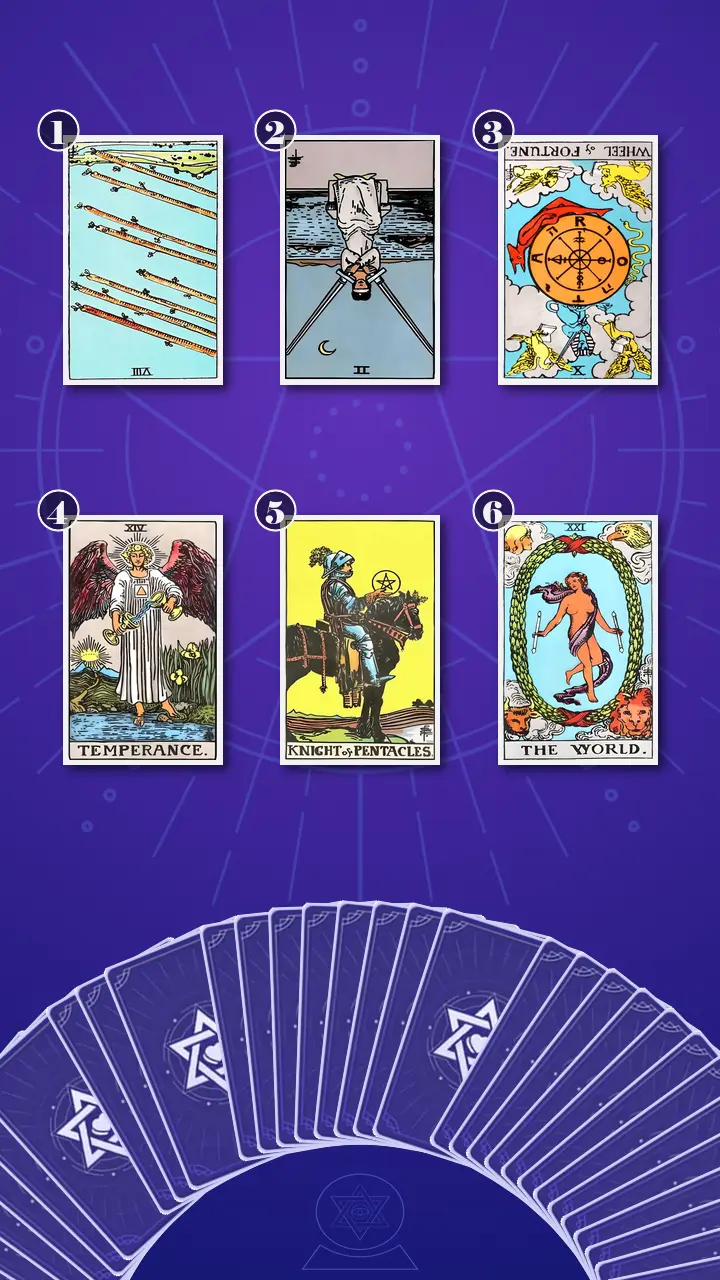
I chose the Transformation Path Grid (6) - Context Edition, a six-card tarot spread for premature launch pressure and process readiness. I placed the cards in a two-by-three grid, like a launch runway with a deliberate turn between diagnosis and intervention.
For anyone wondering how tarot works in a practical consultation, I do not use the cards to predict whether a product will succeed. I use their images to separate parts of an experience that have become compressed into one activated moment. In this spread, the top row would show the visible behaviour, the inner blockage, and the condition keeping the cycle alive. The bottom row would reveal the catalyst, the repeatable practice, and the integrated state.
The first position would examine the instant visible movement outran operational readiness. The second would name the trade-off hidden beneath the early go signal. The fourth, our catalyst position, would show how momentum and preparation might coexist without either one defeating the other. This causal structure was why I chose the Transformation Path Grid over a simple launch-or-delay reading: Jordan was not facing one isolated decision. She was trying to understand why the same decision kept returning.
Reading the Top Row: Where Speed Lost Direction
Position 1: The Messages Already in Flight
I turned over the card representing what was happening in Jordan's repeated launch behaviour: the observable moment when she pushed a release live before the supporting process was ready.
It was the Eight of Wands, reversed.
I drew her attention to the eight wands suspended in open air, angled towards the ground without a visible person guiding them. In Jordan's life, they looked remarkably like scheduled emails, launch posts, and customer notifications already travelling while onboarding, support routing, and feedback collection remained scattered across Notion pages, Slack threads, and private notes.
At 8:12 that morning, the polished landing page had been ready to move. The operating process had not. Once the announcement entered subscribers' inboxes, the visible part would accelerate while Jordan manually caught whatever landed badly. It was the launch-day equivalent of the ticket printer in The Bear: one public signal suddenly generating more operational demand than the system could hold.
I described the reversed Wands energy as an excess of outward velocity combined with a deficiency of direction. The card was not criticising speed. Strategic shipping can produce valuable learning. It was asking whether this particular burst of speed served the product, or merely provided short-term relief from the pressure of waiting.
Jordan gave a small, bitter laugh. "That is so accurate it feels a bit brutal. The visible part is moving, so I assume the rest will somehow catch up." Her fingers stopped switching tabs, though one hand remained wrapped tightly around the phone.
"Accuracy does not have to become an accusation," I said. "The question is not whether you are a real founder because you ship quickly. It is which single readiness step would let the next movement travel further without requiring you to chase it."
Position 2: The Decision That Ended the Discomfort
I turned over the card representing the inner conflict that interrupted process readiness and converted uncertainty into a premature go signal.
It was the Two of Swords, reversed.
I asked Jordan about the previous night. She described sitting in her Hackney flat at 11:48 with two plans open side by side: a full public launch that protected the date, and a limited beta that protected the unfinished workflow. The radiator had clicked behind her, the laptop fan had hummed, and stale coffee had sat untouched while her shoulders rose towards her ears.
"One voice said, 'If I wait, I lose momentum,'" she told me. "The other said, 'If I launch, I inherit all the gaps.' I scheduled the earliest date because I could not keep holding both."
The crossed swords mirrored those two plans held over the chest. The blindfold did not suggest a lack of intelligence. It suggested a blockage of named criteria: Jordan had not written down what evidence would make either plan viable, so speed became a way to terminate the tension.
"Urgency can end the debate without answering the question," I said.
Her breathing paused. Her eyes left the card and settled somewhere beyond her screen, as if she were replaying the moment her cursor had hovered over the schedule button. Then her jaw softened by a fraction.
I asked, "When you chose the earlier date, what became quieter?"
"The feeling that I was failing to decide," she said. "For about ten minutes, I felt completely in control."
I told her that distinction mattered. Publication was not only a business action in that moment; it was regulating the discomfort of being divided. That did not make the launch irrational or shameful. It simply meant the go signal could not, by itself, be treated as evidence that the process was ready.
Position 3: The Same Workflow in a New Launch Graphic
I turned over the card representing the repetition compulsion beneath the rushed launch cycle, including the hope that another fast release would restore control without changing the process.
It was the Wheel of Fortune, reversed.
I asked Jordan to describe the previous Sunday. At 4:36, she had opened notes from her last two launches at the kitchen table. Rain had tapped the window. Her coffee had gone cold. The same missed onboarding step had been highlighted in both retrospectives, but instead of changing it, she had closed the notes and opened a fresh Figma file for the next announcement.
"I told myself this launch would be different because the product was different," she said.
I traced the turning figures around the Wheel with one finger. A new product name, visual identity, or date could change the surface without changing the underlying sequence: announcement, relief, scramble, frustration, and another announcement. The reversed energy showed blocked integration. Experience had occurred, but its lesson had not yet entered the workflow.
I was careful to tell her that the Wheel was not predicting bad luck. It was doing something more useful: making one repeated condition visible enough for her to alter it. Awareness created a point of choice.
"You are not failing to learn," I said. "You are launching before the lesson becomes a process."
Jordan's fingers curled against the edge of her laptop, held there for a moment, and then released. "I keep learning the same lesson at launch speed," she said quietly. The sentence carried recognition, but also a trace of grief for the hours she had spent solving familiar emergencies.
When Temperance Changed What Moving Meant
Position 4: Two Cups and One Measured Release
I turned over the card representing what could interrupt the loop and reconcile Jordan's need to launch with her need for a process capable of supporting the release.
It was Temperance, upright.
At that moment, the coffee machine behind Jordan fell silent. The sudden quiet gave the card's water an almost audible presence. I pointed to the angel transferring liquid steadily between two cups, with one foot on land and the other in water. Nothing in the image was frozen, but nothing was being flung forward either.
In Jordan's working life, Temperance looked like holding the public announcement for twenty-four hours, inviting five users into a limited release, and testing one onboarding step alongside one feedback question. One cup held the legitimate need for movement. The other held the equally legitimate need for a supportable process. The upright energy was balance through calibrated exchange, not passive delay.
Years spent on archaeological digs have taught me to read a collapse layer without treating it as a moral failure. A fractured structure records the point at which an old design could no longer carry the life built above it. Looking at Temperance, I understood Jordan's repeated scramble in the same way: not as proof that she lacked discipline, but as evidence that an obsolete governing idea was reaching the end of its era.
I call this Cognitive Paradigm Excavation. Beneath Jordan's launch anxiety, the buried law was simple: Progress is real only when other people can see it, and control is real only when I can make something move now. Temperance exposed the limitation of that law without asking her to abandon ambition.
Then I applied what I call Core Philosophy Stratigraphy. We separated what deserved to survive into her next chapter from what could remain in the past. Her willingness to ship, tolerance for imperfection, and desire to learn from real users belonged in the foundation. The belief that public visibility was the only valid proof of momentum did not.
I asked her to return to the Sunday afternoon when the same missed onboarding step appeared in two launch notes. Her fingers had already been moving towards a fresh Figma file, and the next release had begun to feel like a reset before the old lesson had altered anything.
Stop treating a rushed launch as proof of momentum; combine one ready process step with one measured release, like Temperance blending two cups, so progress becomes integration rather than reaction.
You do not need an early launch to prove progress is real; a measured pause that produces evidence is progress too.
For a second, Jordan did not breathe. Her right hand froze above the trackpad, and her eyes widened before losing focus, as though several launch mornings were replaying behind them at once. Then resistance arrived. Her eyebrows drew together and her voice sharpened. "But does that mean all those launches were mistakes? Have I just been calling panic momentum?" She sat back, folded her arms, and stared at Temperance with a flash of anger that seemed easier to hold than regret. A few seconds later, her arms loosened. She looked down at the unfinished onboarding task, then back at the two cups. Her eyes grew wet without spilling over. A breath left her in a low, unsteady rush, and her shoulders dropped. The release was visible, but so was the new vulnerability beneath it: if a smaller experiment counted as progress, she could no longer use the public date to avoid choosing what progress was for.
"No," I said. "Those launches gave you evidence. The issue is that the evidence was not given a protected place to change the next process. A pause is not lost momentum when it produces evidence."
I invited her back into the question. "Now, using this new perspective, think back to last week. Was there a moment when this insight could have made you feel different?"
"When I saw the same onboarding note for the second time," she said. "I could have tested the welcome flow with five people instead of designing another public post. The project would still have been moving. I would just have changed what the movement was for."
I set a ten-minute timer. Jordan opened her current checklist and wrote two headings: "Ready now" and "Not ready yet." I asked her to list only facts she could already see, without fixing, expanding, or defending them. Before the timer ended, she chose one unfinished onboarding item to test. When the ten minutes were up, I asked her to stop, even though several lines remained open. The exercise was evidence gathering, not a disguised demand for perfection.
I named the shift as I saw it: this was the first movement from pressure-driven publishing and repeated launch scramble towards evidence-based pacing and grounded trust in a complete launch cycle. Jordan had not eliminated urgency. She had begun to remove it from the role of decision-maker.
Position 5: The Five-Line Field
I turned over the card representing the small, observable practice that could create process readiness without requiring perfect certainty.
It was the Knight of Pentacles, upright.
I showed Jordan the still horse, the single pentacle held steadily in front of the knight, and the cultivated field behind him. The contrast with the airborne wands was exact. Where the first card scattered eight moving tasks across open space, the Knight protected one repeatable piece of work long enough for it to become trustworthy.
In practice, this meant creating a five-line launch readiness checklist in the tool she already used. The lines would cover delivery, onboarding, support, feedback, and review. Each needed only one of three answers: yes, no, or intentionally deferred. After one small release, she would record what worked without intervention and what required improvisation, then change only one recurring step.
The Knight's earth energy was balanced and sufficient. He did not demand a flawless operating manual. He made readiness observable through routine, documentation, and evidence. I told her, "Ready enough needs criteria, not a mood."
Jordan opened a blank Notion block while I was still speaking. "Five lines," she said, with a cautious half-smile. "Not a new operating system for my entire life."
"Exactly," I replied. "One process you can trust slightly more next week than you do today."
Position 6: The Wreath Around the Whole Cycle
I turned over the card representing an integrated relationship to launching, where preparation, release, review, and revision could coexist without publication becoming a test of personal control.
It was The World, upright.
I focused on the central dancer held within the wreath and the four figures occupying the corners. To me, they resembled four functions contained within one system: preparation, release, feedback, and revision. Publication mattered, but it was one movement inside the cycle, not the whole definition of completion.
In Jordan's life, The World meant closing a launch only after she had documented what worked, named what remained unsupported, and carried one revised step into the next workflow. Its energy was integration: not certainty about the outcome, but the capacity to let experience alter future practice.
"A launch is public before it is complete," I said. "The announcement is a threshold, not the finish line."
Jordan looked across the entire spread, from the airborne wands to the enclosing wreath. "Then I have been starting the next cycle before the previous one closed," she said.
I nodded. "And that is something you can change. The World is not promising you a perfect release. It is asking what evidence would show that one launch cycle has been completed rather than merely made visible."
The New Governing Laws of Ready Enough
I drew the six cards into one continuous account. Jordan's legitimate desire for movement had become scattered at the Eight of Wands because her public message travelled before the process could support attention. The Two of Swords revealed why: choosing the earliest date ended the physical strain of holding an unresolved trade-off. The reversed Wheel showed the consequence of skipping review, with each fresh launch carrying the same condition forward. Temperance preserved her fire but gave it a smaller container. The Knight turned that principle into a routine, and The World expanded completion beyond publication.
The cognitive blind spot was not that Jordan failed to understand process. She understood it very well. The blind spot was treating visible publication as the only progress powerful enough to protect, while treating preparation as a loss of control. She was like a runner sprinting onto the track while still tying her shoes: the speed was real, but the supporting sequence could not yet carry it.
The transformation direction was therefore precise. She did not need to replace speed with endless preparation. She needed to replace the reflex to announce with a short readiness experiment and a review of evidence from the previous release. To make that shift concrete, I introduced my Paradigm Shift Manifesto, a brief exercise for writing the governing laws of the next chapter before the old ones quietly resume control.
- Write the ten-minute Paradigm Shift Manifesto.On one morning this week, open the current launch checklist in Notion and create two headings: "Ready now" and "Not ready yet." Move each open item under one heading without solving it. At the bottom, write the old law, "Progress is real only when I publish," and a new working law, "Progress is real when movement produces evidence the process can use." Choose one unfinished item to test.Stop when ten minutes ends. Keep the page private, and do not turn it into a full business manifesto. The minimum version is two headings, two laws, and one test.
- Run the Two-Cup measured release.Before posting the next public announcement, place a twenty-four-hour hold in the calendar. Use that window to complete three named follow-up steps: onboarding, feedback collection, and customer support routing. Then send a private link to five invited users and write one process question you want the test to answer.If twenty-four hours is too costly, use a two-hour version or test one follow-up step. Jordan, not the cards, decides the release size, privacy boundary, acceptable risk, and whether the original date still fits the evidence.
- Close the launch cycle before naming the next one.Create a five-line checklist covering delivery, onboarding, support, feedback, and review, with each line marked yes, no, or intentionally deferred. After the next small release, spend ten minutes recording three facts: what worked without intervention, what required improvisation, and what single step should change before another public date is set.Cap the checklist at five lines and carry forward exactly one revision. Readiness is a chosen threshold, not total completion, and one intentionally accepted risk is more useful than a vague claim that everything is ready.
I reminded Jordan that these were experiments, not commandments. She retained the right to launch on the original date, reduce the scope, stop the beta, keep her evidence private, or accept a known gap. Tarot had helped us make the mechanism objective enough to examine. It had not taken ownership of the decision from her.

Three Days Later: Evidence Before Announcement
Three days later, Jordan messaged me. She had kept the public announcement in drafts, sent a private link to five users, and caught an outdated welcome page before it reached everyone. She slept through the night; on waking, she still thought, "What if I slowed too much?" Then she smiled.
One tester had also asked a question Jordan had previously answered manually in DMs. This time, she added the answer to the onboarding flow before widening the release. The project had not stopped. Its movement had produced evidence instead of an emergency support shift.
I did not regard this as a solved life or a permanently calm launch process. I regarded it as the quiet proof that Jordan could feel the old surge, pause without surrendering her ambition, and choose a ready-enough threshold from information she trusted.
The cards had offered an external surface on which to see the pattern, but Temperance had not changed Jordan's launch for her. She had changed what counted as movement. That was the heart of our Journey to Clarity: not certainty, but ownership of the next experiment.
I know that when the launch button is open and your chest tightens, moving now can feel like the only way to stay in control, even while another part of you knows the process cannot carry the attention you are asking it to hold. If that is where you are, simply noticing the two cups in your own decision means you are no longer at the beginning.
So I leave you with the question I left beside Jordan's six-card Transformation Path Grid: if progress did not need to be proved by publishing today, what small piece of evidence would you place in Temperance's second cup before choosing your next release?