Explore how temporary workarounds become permanent workload, the tarot cards that mirror this cycle, and related reading insights.
Process Debt Cycle
What is this situation?
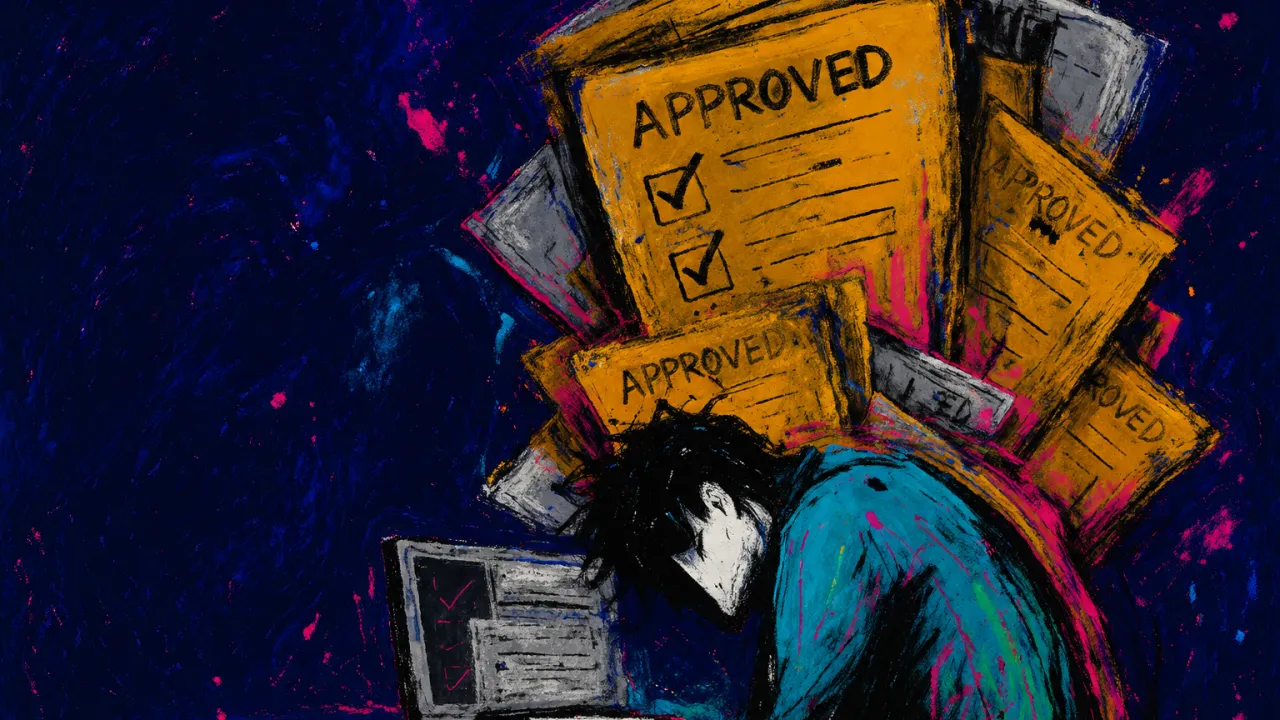
Process Debt Cycle — you open what should be a ten-minute task and find it now requires a spreadsheet, an old ticket, two dashboards, and approval from someone who no longer owns the decision. The extra steps usually began as temporary fixes: a manual check added after one mistake, a copied tracker created because systems did not connect, or a meeting scheduled when handoffs failed. None was retired when the immediate issue passed. Instead, deadlines stayed fixed, ownership blurred, and each new problem was handled by adding another form, channel, checkpoint, or workaround. Managers ask why delivery is slow while the workflow itself makes speed nearly impossible; the people doing the work are expected to remember exceptions that were never documented and reconcile data that should match automatically. You spend the day switching tabs, re-entering the same details, waiting for permissions, and chasing sign-off, with your shoulders tightening each time a “quick” request loops back for one more step. Because no one is given the time or authority to rebuild the process, the backlog created by old fixes becomes the reason another quick fix is chosen. By the end of the week, more effort has gone into moving work through the system than completing it, much like the figure on the Ten of Wands, bent forward as a bundled load fills the path ahead.
Why it's not you?
This is not a failure of focus or efficiency on your part. A workflow built from unretired fixes, duplicate records, unclear ownership, and layered approvals creates delay through its structure; the cycle belongs to the process around you.
Process Debt Cycle in Tarot Cards
In a Process Debt Cycle, the same temporary workarounds that keep work moving also return as extra steps, duplicate records, and layered approvals. The tightening in your shoulders after another task loops back is a physical encounter with an environmental burden, a structural bottleneck, and a repeating workplace dynamic. The cards below hold up a visual mirror to that crowded path without deciding what you should do next. These Tarot Cards reflect the contours of the process surrounding you.
The ram-headed throne, armor, stone seat, and rigid frontal posture make authority visible; reversed, that authority has become a control layer without a working command structure. Permissions and sign-offs accumulate because governance protects the checkpoint instead of keeping ownership current. You may be held responsible for movement without being granted the authority to remove obsolete steps or redefine the route. The reversed throne shows how a manager can ask for speed while the system preserves layers that nobody has both the mandate and the time to redesign.
The robed hierophant sits between twin pillars while two acolytes face him and crossed keys rest below. Reversed, the ceremonial setting becomes inherited procedure: formal steps are preserved as proof of compliance even after the original risk, system, or owner has changed. You spend work hours performing the ritual of the process, collecting permissions and repeating information that should already be available. The reversed institution shows how a rule can remain socially legitimate inside a company while becoming operationally disconnected from the work it was meant to protect.
An enormous wheel turns beneath the fixed figures at its edges, while the four winged creatures keep their books around the cycle. Reversed, the wheel depicts a delivery rhythm that keeps returning to the same delay: new fixes enter the loop, but no one gets a clean reset point. When you ask whether to wait or escalate, both choices are absorbed by the same mechanism because the underlying workflow has not changed. The reversed rotation separates calendar movement from operational movement, making visible how a deadline can advance while the work remains caught in inherited handoffs.
The seated figure holds a sword in one hand and scales in the other, but reversed the instruments no longer create a level line. The image names records that disagree, criteria that outlive their purpose, and approvals that remain attached to an authority who no longer owns the decision. You are asked to reconcile the imbalance before anyone can act, so evidence gathering becomes a second job layered onto the first. The reversed position does not describe a personal failure of judgment; it shows a workplace standard whose formal appearance no longer matches its operating reality.
One leg is tied to the living tree while the figure hangs between branches, suspended above the ordinary route. The upright image mirrors work waiting for permission or a decision: time is being spent, but the blocked step cannot be advanced by more effort. The suspended position is not a sign that the work has disappeared; it shows a live task held in an abnormal state by one connection. You can keep preparing, checking, and following up, but the timing of delivery remains controlled by an approval path that lacks a current owner.
Two figures stand chained to the horned figure's pedestal, with the links visibly attaching each person to the same structure. The upright chain gives process debt its clearest cycle: a temporary workaround becomes a dependency, and each new exception tightens the workflow's connection to the old one. You can see how no single form is the whole problem, yet every local addition keeps the larger system in place. The card makes the organizational mechanism visible without reducing it to personal weakness: participation continues because the workflow offers no supported route for retiring what has accumulated.
Inside the cathedral, the craftsperson looks toward the two figures holding the plan and authority, while the unfinished structure sits between them. Reversed, the shared build becomes a handoff map with missing ownership: each person can add a checkpoint, but no one can align the whole route or retire a failed one. You are pulled into translating between tickets, dashboards, and approvers because coordination is treated as extra labor rather than a designed capability. The visible output may be yours, but the delay is produced by a collaboration structure that cannot keep its records, decisions, and responsibilities in one place.
A craftsperson sits at a bench with finished pentacles lined along the wall and another piece under active attention. Reversed, the same repetitive setup reads as labor diverted into rework: every added check produces another surface to update, while the actual deliverable waits behind the bench. You can demonstrate effort in every tab and tracker, yet the output remains hard to recognize because the process rewards visible handling over finished work. The bottleneck is not concentration; it is a production system that has turned craftsmanship into repeated reconciliation.
Eight swords form a narrow enclosure around a blindfolded, bound figure, with open ground and a castle visible beyond it. The upright image maps permissions, dashboards, forms, and escalations into external constraints that make a short job hard to reach, even when the goal remains visible. The bindings and waterlogged ground show a route whose difficulty is built into the surrounding conditions. The structure keeps the focus on the system around you: a work task can require chasing people and reconciling tools before any substantive progress begins, without that delay proving anything about your capability.
An arched figure bends forward beneath a bundle of wands, with the town visible only beyond the load. Each wand can stand for an unretired check, duplicate tracker, approval, or undocumented exception; the path is present, but the carried bundle makes a short delivery route slow and physically costly. You are still moving work, but your effort is spent transporting the workflow's history rather than completing the request. Because the upright image keeps the figure on his feet and headed somewhere, the structure contains enough continuity to deliver, yet it makes speed depend on how much invisible process weight you can carry.
No cards available for this filter.
Process Debt Cycle in Tarot Card Reading Insights
When routine work is repeatedly slowed by duplicate tools, unclear ownership, and one more approval, others have brought that same Process Debt Cycle into their readings. The articles below gather Tarot Reading Insights from those sessions.