A Split-Screen Career Reset Led to a Four-Week Evidence Pilot

The 11:47 p.m. Reset at an Off-Script Career Crossroads
I often begin with a simple recognition test: if you can handle freelance uncertainty until a Sunday-night LinkedIn promotion makes your own path look unserious, you may be dealing with normality-triggered path abandonment rather than a simple lack of commitment.
Alex sat across from me with their phone face-down between us, although its residual warmth still seemed to occupy the room. They were twenty-nine, living in London, and building an independent UX design practice after leaving a permanent agency role. The work itself could absorb them for hours. The trouble began whenever the work stopped fitting into a title that other people instantly understood.
They described the previous Sunday at exactly 11:47 p.m. A client proposal glowed on the left side of their laptop, while a salaried UX application waited on the right. A bus hissed along the wet street below. The radiator clicked in the flat, and the laptop pressed its dry heat into their restless palms. After seeing a former colleague announce a promotion on LinkedIn, Alex minimized the proposal and rewrote their CV headline for the fourth time.
Nothing about the proposal had changed. No client had rejected it. No financial calculation had produced new evidence. The work had simply become harder to explain beside someone else’s clean title and polished career update, and Alex’s body treated that exposure like a verdict.
“I can handle uncertainty until someone asks what my plan is,” they told me. Their jaw tightened before they added, “If I can’t explain the path in one sentence, I assume it isn’t real.”
I watched one thumb rub repeatedly along the edge of the other. The unease beneath their words felt less like ordinary indecision and more like a turnstile locking behind the sternum: each comparison narrowed the available space until the familiar route seemed to be the only route with an exit sign.
“Then I don’t think our question today is simply whether you should freelance or return to salaried work,” I said. “Either could be a sound choice. I want us to examine what happens in the moment before you abandon a path. We’ll separate changed evidence from the sudden need to make your life look normal again. Let’s draw a map of that fog without asking the cards to choose your career for you.”

Choosing the Cross That Maps a Repeating Career Pattern
I invited Alex to take one slow breath and hold a precise question in mind: “What takes control between the moment my path becomes hard to explain and the moment I reset it?” I shuffled slowly, using the physical rhythm as a transition from replaying the problem to observing it. There was no performance of mystery involved. The point was attention.
I chose the Five-Card Cross · Context Edition. For anyone wondering how tarot works in a career reading, I use a spread like this as a structured cognitive map, not a prediction engine. Each position asks a different kind of question, allowing card meanings in context to expose relationships among behavior, pressure, reward, capacity, and action.
The Celtic Cross would have introduced ten layers when Alex’s problem needed a more economical systems view. This five-card career Cross was the smallest spread capable of tracing the whole loop: an off-script phase triggers a belonging threat, a conventional reset produces immediate relief, and the interrupted experiment never survives long enough to generate useful evidence. The missing evidence then appears to confirm that the unconventional path was never viable.
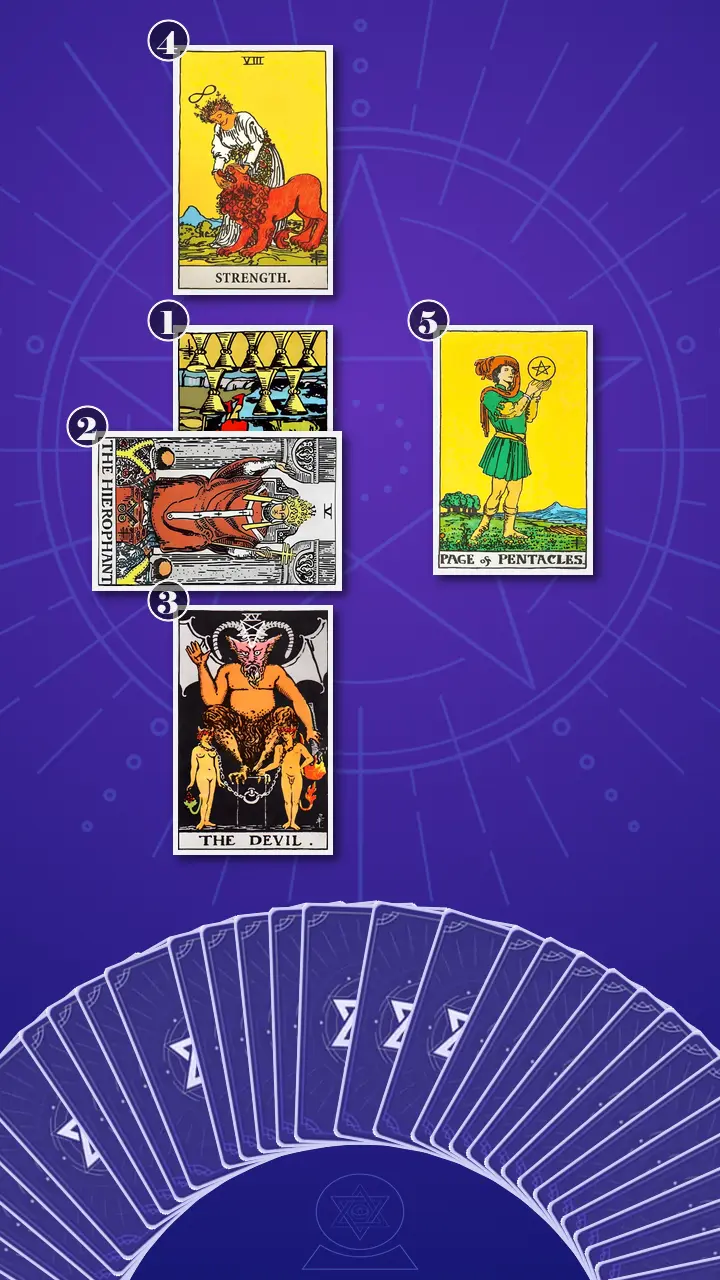
I placed the first card vertically at the center to show the repeating behavior. The second crossed it to identify the normality trigger. The third sat below as the hidden foundation and short-term reward. Above the center, the fourth would reveal the capacity that could interrupt the loop. The fifth waited to the right, where insight would have to become one practical, testable direction.
The layout resembled a signpost whose center had been crossed out. I told Alex that we would first study the obstruction, then descend to what reinforced it, rise toward the available inner resource, and finally move outward through a bounded experiment. The spread could illuminate the decision process. Alex would remain responsible for the decision itself.
Reading the Loop Before It Rewrites the Future
Position 1: The Departure Interrupted Mid-Step
I turned the card representing the behavior organizing Alex’s present situation: repeatedly interrupting a self-authored path and returning to conventional options before enough evidence has been gathered.
The card was the Eight of Cups, reversed.
I pointed to the red-cloaked traveller, whose departure from the ordered cups becomes unstable in reversal. In its traditional upright movement, this card can describe leaving an established arrangement to search for something more meaningful. Reversed here, its Water energy was blocked. Alex could begin the departure, but the emotional movement circled back whenever the unknown became socially uncomfortable.
“This is your split-screen laptop,” I said. “At 11:47, the promising proposal is on the left and the salaried application is on the right. A promotion post appears, your cursor moves away from the proposal, and the reset starts before the project has had time to produce meaningful information.”
I named the inner monologue I could hear in the sequence: “I was engaged until this became socially awkward; now I’m calling escape practicality.” The Eight of Cups reversed did not tell Alex to stay. It asked them to notice the exact point at which thoughtful reconsideration became a reflexive retreat.
Alex gave a short laugh, but there was no amusement in it. Their shoulders rose, their eyes dropped to the card, and one hand closed around the cuff of their sleeve.
“That is uncomfortably specific,” they said. “Honestly, it’s a bit brutal.”
“Specific, yes,” I replied. “But not a verdict against changing direction. Leaving can be intelligent. Returning to salaried work can be intelligent. The question is whether you are responding to relevant evidence or trying to end the exposed feeling as quickly as possible.”
I asked what had changed about the client proposal after the promotion appeared. Alex looked towards the window for several seconds before answering.
“Nothing,” they said. “Only how embarrassed I suddenly felt about not knowing where mine was going.”
I thought of the threshold in The Truman Show: stepping beyond a coherent set does not produce a ready-made script on the other side. The Eight of Cups reversed showed Alex repeatedly reaching that exposed threshold, finding no signpost, and returning to the familiar set before the new terrain could become knowable. The card was not demanding that they keep walking forever. It was asking them to distinguish an evidence-based exit from an exit made solely to restore a recognizable backdrop.
Position 2: The Title Field with No Honest Dropdown Option
I turned the crossing card, representing the normality trigger: the unfamiliar timeline, awkward explanation, or missing institutional milestone that activated the urge to abandon the path.
The card was The Hierophant, upright.
I drew Alex’s attention to the formal grey pillars, the two kneeling acolytes, and the crossed keys beneath an authorised teacher. In this position, the Hierophant placed conventional systems, recognised credentials, and institutional legitimacy directly across the interrupted departure.
“At a networking event, someone asks for your long-term plan,” I said. “You try to compress freelance consulting, a self-directed product, and portfolio work into one polished sentence. When the answer does not resemble a familiar promotion ladder, a salaried title begins to feel like official proof that your life is on track.”
I compared it to a LinkedIn profile form that offers neat titles but no honest field for a portfolio career still under construction. When the menu cannot describe the work, Alex has been treating the missing option as evidence that the work itself is invalid.
The Hierophant’s energy was not inherently harmful. Alex needed structure, professional standards, mentoring, predictable income, and a clear view of London housing costs. The imbalance was an excess of authorisation: useful systems had been granted the power to decide which life counted as credible. Supportive structure had hardened into borrowed permission.
“Which part of the five-year-plan question feels hardest to say?” I asked.
Alex’s chest visibly lifted and held. Their fingers stopped moving. “That I don’t know what title this becomes,” they said. “I can describe what I’m building, but not what box it ends in.”
“A path can be hard to explain and still be concrete enough to test,” I said. “Structure can support the work without serving as a court that approves your identity.”
The breath Alex had been holding left slowly through their nose. I saw recognition arrive with a little grief attached to it. They wanted dates, standards, and financial boundaries because those things were genuinely useful. They had also been asking conventional milestones to settle a more painful question: whether people would still recognise them as serious while the new career remained unfinished.
The Loose Chain Beneath the Job-Board Tab
Position 3: The Relief That Masqueraded as Proof
I turned the foundation card, representing the hidden belief and immediate reward beneath the repetition: that social legibility was required for belonging, and that restoring it quickly made the reset feel necessary.
The card was The Devil, upright.
I made my boundaries clear before interpreting it. I do not use the Devil to frighten people, predict disaster, or imply moral failure. In this reading, the most important details were the visibly loose chains around the two figures. The pattern had real force because it delivered a reliable reward, not because Alex was permanently captive or lacked agency.
“This is the moment after you reopen a saved job search,” I said. “Your shoulders drop. The browser is familiar. Within seconds, you can picture a title, salary band, manager, promotion cycle, and one-line answer for dinner. You feel calmer, even though no new evidence has arrived about the viability of your independent work.”
The Devil revealed an excess of reactive Fire: the urgent drive to stop shame and uncertainty before they could be examined. Alex exchanged experimentation and continuity for an identity that became easier to explain within minutes. That transaction did not prove a conventional role would be wrong for them. It showed why the timing of the decision needed closer scrutiny.
I placed a fingertip beside the loose chain. “Freeze the scene between clicking the job-board bookmark and deciding to archive the current project. During those ten seconds, what changes first: the project’s evidence, or the feeling of being exposed?”
Alex’s breath stopped. Their gaze slipped out of focus as if the browser sequence were replaying on the wall behind me. Then their fingers released the sleeve they had been gripping, and a low exhale moved through their chest.
“The exposure,” they said. “I feel calmer, so I assume I’ve become sensible again.”
“The relief is real,” I replied. “I would never shame you for wanting it. But relief proves that a trigger stopped; it does not automatically prove that a decision is right.”
The room became quiet enough for me to hear rain ticking against the window. I asked Alex to name what the reset gave them during its first twenty-four hours. They answered with a cleaner story, less shame, an easier conversation with friends, and the sense that income might become controllable again. Then I asked what it cost. Their reply came more slowly: no completed pilot, no sustained outreach data, no chance to compare a prediction with an actual result, and no evidence from which self-trust could grow.
There was the hidden mechanism. Each premature reset starved the independent path of evidence. The absence of evidence was later remembered as proof that self-authored choices never worked. The chain tightened through repetition, but the loose fastening showed the leverage point: Alex could observe the reward before allowing it to settle the larger career question.
When Strength Met the Fear with Open Hands
Position 4: The Capacity to Hear Fear Without Obeying It
I turned the card representing Alex’s conscious resource: the capacity to meet the fearful shadow, delay the automatic reset, and retain authorship of the decision.
The card was Strength, upright.
A break in the cloud sent pale afternoon light across the table, catching the yellow field behind the figure. I showed Alex the woman’s calm hands resting at the lion’s jaw. There was contact without suppression, authority without violence, and attention without surrender. Where the Devil portrayed instinct as an apparent command, Strength portrayed a conscious relationship with it.
Its Fire was no longer reactive or trapped in urgency. It was held in balance. Strength did not require Alex to eliminate the part that feared losing status, stability, or belonging. It asked them to listen to that part without automatically giving it control of the browser, the calendar, or the next career move.
I brought Alex back to 11:47 p.m.: the proposal beside the salaried application, LinkedIn still glowing, their jaw tight. Nothing in the project had deteriorated. It had become harder to explain after someone else’s promotion, and the old law had mistaken exposure for evidence.
I said, “The path does not have to look normal for you to stay curious about it. Fear can be heard without being given the final say.” Then I gave Alex the sentence at the centre of the reading.
Your discomfort is not proof that the path is wrong; meet it with steady self-command, as Strength's open hands guide the lion without silencing it.
Alex went utterly still. First, their breath halted halfway in, and their fingers remained suspended above the table as though an invisible keyboard waited beneath them. Then their pupils widened and their focus drifted past the card. I watched several memories appear to pass across their face: the Shoreditch networking drink, the silent Tube ride home, the abandoned course, the four versions of the CV headline. Their mouth tightened before their eyes reddened. Only then did their shoulders descend. Their hands opened, palms flat against their thighs, and a long breath escaped with a tremor at its end. The release was not uncomplicated. For a moment they looked almost unsteady, as if setting down the old rule had removed a weight they had also been using as a handrail.
“But doesn’t that mean I was wrong all those times?” they asked, the words sharper than anything they had said before. “That I wasted years because I couldn’t tolerate looking weird?”
“No,” I said. “Some resets may have been appropriate, and some conventional choices may still fit you. We are not putting your history on trial. We are identifying a pattern in the timing so that the next decision can include more evidence. Insight is not a retroactive conviction.”
I leaned forward slightly. “Now, using this new perspective, think back to last week. Was there a moment when this insight might have changed how you felt, even if it did not tell you what final choice to make?”
Alex recalled standing on damp pavement after dinner with friends, reopening a job board because someone had casually asked where freelancing was going. “I could have said, ‘A part of me is afraid this life will make me illegible,’” they told me. “I could have heard that without letting it choose that night.”
The Belief System Beneath the Visible Ruins
At that point I used what I call Cognitive Paradigm Excavation. Years in Cambridge libraries and archaeological trenches have taught me that a collapsed structure is not merely debris. It can reveal the governing assumptions of the era that built it. A wall fails along its old lines of stress, and the fracture exposes foundations that had been invisible while everything still looked intact.
I placed Strength above the Devil and asked Alex to treat this career bottleneck in the same way. Their old intellectual era had been governed by one buried law: A credible life follows a sequence that other people can recognise in advance. Every quiet week or awkward question pressed against that law. When independent work could not satisfy it, the whole structure appeared to be failing.
“The collapse is not proof that your new path will succeed,” I said. “It is proof that the old law can no longer organise every decision without contradiction. The fracture gives you access to the law itself. Once it is visible, you can decide whether it still deserves authority.”
I then used Core Philosophy Stratigraphy, separating beliefs as carefully as layers in a trench. We kept what remained structurally sound: money matters, rent matters, rest matters, discrimination and market conditions matter, contracts matter, and a fair career experiment needs dates, limits, support, and an exit route. We left behind the belief that a familiar title was the only valid evidence of adulthood, seriousness, or belonging.
This was the key emotional crossing in the reading: from contracted, comparison-driven unease towards grounded confidence in evidence-based, self-authored career decisions. It was only a first crossing. Alex still felt exposed. The difference was that exposure had become something they could observe, rather than an authority that had to be obeyed before midnight.
I gave them a small practice to embody Strength. The next time the urge to reset appeared, I asked them to set an eight-minute timer and open a note titled Reset Urge. They would write three lines: what triggered the urge, what they feared other people would conclude, and one thirty-minute task that could generate direct evidence on the current path.
I stressed that this was a pause before deciding, not a command to stay at any cost. If financial, contractual, health, safety, or accessibility facts required action, those facts deserved priority. If the exercise felt too exposing, Alex could stop after naming the trigger, shorten the pause, or leave the practice entirely. Strength was self-command, not endurance for its own sake.
One Pentacle Instead of the Whole Horizon
Position 5: The Four-Week Window for Direct Evidence
I turned the final card, representing practical movement beyond the central issue: a bounded experiment capable of building evidence, confidence, and continuity without demanding certainty about the entire career.
The card was the Page of Pentacles, upright.
I directed Alex’s attention to the Page’s steady gaze on a single pentacle and to the cultivated ground beneath the figure. The mountains remained in the distance, but the Page was not trying to explain the whole horizon. The card’s Earth energy was balanced through patience, study, repetition, and contact with one tangible piece of work.
“This looks like one four-week UX pilot,” I said. “One practical question, one visible weekly deliverable, a financial boundary, and a final review date. Each Friday, you record what was completed, what response occurred, and what you learned. You do not grade the experiment on whether it resembles a former colleague’s promotion.”
Conventional roles could remain available. The Page did not forbid applications or romanticise freelance instability. It simply placed those alternatives at a scheduled checkpoint rather than allowing them to terminate every uncomfortable evening. The energy moved from identity performance to apprenticeship: Alex did not have to announce a finished portfolio career. They could become a serious student of one developing practice.
Alex reached for their phone, then paused and looked at me as though asking permission to use it. I nodded. They opened their calendar.
“I don’t have to defend the whole future,” they said while creating a Friday review event. “I only need to learn what the next month can actually show me.”
“Exactly,” I replied. “You do not need a normal-looking future. You need a fair test of the next step.”
The Paradigm Shift Manifesto for a Fair Career Test
I read the five cards as one connected account. The Eight of Cups reversed showed the visible habit of interrupting a departure. The Hierophant explained why an unfamiliar timeline felt illegitimate: institutional structures had provided not only employment, but a shared language for seriousness. The Devil exposed the hidden contract beneath the reset, where continuity was exchanged for immediate social recognisability. Strength restored conscious authority, and the Page of Pentacles gave that authority practical ground.
The old pattern resembled stepping off an unmarked trail whenever the next signpost disappeared. Each return to the marked road brought immediate relief, but it also prevented Alex from learning whether the unmarked route was passable. The resulting lack of information then seemed to justify returning sooner the next time.
The Blind Spot: Evidence Starvation
I named Alex’s cognitive blind spot directly: they had been treating the absence of accumulated evidence as evidence of failure, even though repeated resets had prevented that evidence from accumulating. They were also treating bodily relief as if it verified the content of the decision. A calmer chest could show that a social trigger had stopped; it could not, by itself, evaluate a business model, job offer, client pipeline, or career fit.
The transformation direction was therefore precise. Alex did not need to prove that an unconventional career was more authentic than a conventional one. They needed to replace the demand that the whole path look normal with a four-week commitment to one values-aligned step, reviewed through direct evidence rather than resemblance to peers.
The Paradigm Shift Manifesto
I introduced my Paradigm Shift Manifesto as a way to make the new governing structure explicit. I asked Alex to dictate it rather than accept language from me, because a manifesto about self-authorship would be useless if I authored it for them.
Old law: If I cannot explain where the path is going in one sentence, I should assume something is wrong and restore a recognisable plan immediately.
New law: A path may remain socially awkward while still being concrete enough to test. Fear may file a report, but it may not sign the decision. Useful structure can support the work without granting an institution or peer group final authority over its legitimacy. Every fair test will include a review date, a practical boundary, and permission to leave when the evidence changes.
Alex read the new law back, then frowned. “Four weeks sounds tidy in this room,” they said. “But a quiet client month in London isn’t theoretical. I can’t turn rent into a tarot exercise.”
“You shouldn’t,” I replied. “The pilot only works if material reality is inside the design. We set a financial floor before it begins. If income, spending, health, contractual obligations, or another prewritten boundary crosses that floor, you review early. Staying is not the virtuous option, and leaving is not failure. The purpose is to prevent a comparison spike from impersonating the whole evidence base.”
Two Bounded Practices for the Next Four Weeks
- Use the Reset-Urge DelayI asked Alex to keep a phone note titled “Reset Urge” with three prompts: “What happened just before this?”, “What am I afraid other people will conclude?”, and “What evidence changed today?” At the next LinkedIn promotion, awkward career question, or quiet workweek, they would set an eight-minute timer before opening a job board, then complete one thirty-minute task already scheduled for the current UX project.Minimum version: write only the trigger and wait ten minutes. The pause is optional, and it can end immediately if a genuine financial, safety, health, or contractual fact requires action.
- Run the Four-Week Evidence PilotI asked Alex to choose one independent UX project and write a pilot statement in Notion or a paper notebook: one question to test, one visible deliverable each week, four ninety-minute work blocks, and one final review date. At a fifteen-minute Friday review, they would record only what was completed, what response occurred, and what was learned. Conventional options would remain in a separate Parking Lot until the checkpoint unless a prewritten boundary was crossed.Set the financial floor first, including minimum paid-work hours, maximum spend, or a runway review date. If four weeks is not workable, use a one-week pilot with one deliverable and a clear exit criterion.
I wrote one last line beneath the practices: Borrow structure. Keep authorship. An accountability partner, calendar, mentor, salaried role, or professional institution could all be valuable structures. None needed to become an oracle that decided whether Alex’s life counted.
The actionable advice was deliberately modest. Tarot had not established that the independent path would succeed, nor had it declared a return to employment mistaken. It had helped Alex distinguish a changed fact from a changed feeling, identify the reward inside a reflexive career reset, and design next steps that could produce better information. The cards supplied the map. Alex still held the authority to walk, pause, revise, return, or choose another road.

A Week Later: The Quiet Proof of Authorship
A week later, I received a message from Alex. They had finished one interview synthesis and booked the next work block. Their first waking thought was still, “What if I’m wrong?” They told me they smiled, opened the evidence log, and waited for Friday’s review.
I did not read that message as proof that their career was solved. I read it as a smaller and more credible transformation: one comparison-driven urge had been noticed without being handed immediate control. Alex had remained with a self-authored direction long enough to collect one artifact of direct experience.
That was the real Journey to Clarity. Clarity did not arrive as certainty about the whole future. It appeared as the ability to hold ambiguity, respect practical limits, and make the next review from completed work, observed responses, and learning. The power belonged neither to Strength nor to the Page of Pentacles. It belonged to Alex each time they decided what evidence mattered and when the experiment had taught them enough.
I have watched how quickly a path without an instantly recognisable title can tighten the chest and send restless hands towards the tools that edit an entire future. Being hard to explain can feel frighteningly close to not belonging. Simply noticing that old governing law, however, is already the first careful brushstroke across its buried inscription.
If you did not have to make your whole path legible tonight, what one small artifact of direct evidence would you be curious to uncover before your next review?