Six Job Tabs, One Unsent Email: Choosing a Seven-Day Experiment

The 11:47 p.m. Verdict: When a Nonlinear Career Felt Like Falling Behind
You know there is no universal adult timeline, yet one former classmate's LinkedIn promotion can still send you into six job tabs, a budget sheet, and a midnight catch-up plan.
That was the screen Alex shared with me from the narrow kitchen table in their Toronto rental. It was 11:47 on a Sunday night. LinkedIn cast a blue-white glow across the dishes in the sink, the radiator clicked behind them, and a mug of tea sat cold beside the trackpad while the laptop fan pushed warm air over their restless hands.
"I know there is no universal timeline," Alex said, rubbing the hinge of their jaw, "but my body still reacts as if there is one. I want to trust this off-script life. Then somebody gets promoted, buys a home, or announces an engagement, and being off-script suddenly feels like proof that I'm behind."
I watched their cursor move from a budgeting spreadsheet to six job listings and then to a twelve-month schedule so crowded that every evening had already been assigned to applications, networking, coursework, or portfolio updates. They deleted the schedule while I was looking at it. No application had been submitted. The potential-client email they had drafted three days earlier remained unsent.
What Alex called inadequacy looked less like an idea than a weighted vest tightened one notification at a time, compressing every breath into the upper chest. The harder they tried to plan their way out, the less room they seemed to have for one ordinary movement.
"I don't think we need to decide tonight whether your life is late," I told them. "That question already assumes there is one clock. I want us to examine what happens between the notification and the verdict. We can give the fog a structure, identify what is fact and what is borrowed timing, and find one next step that does not require you to solve your entire future."
I also made my boundary clear: I would not use tarot to predict whether Alex would become successful, buy a home, or choose the perfect career. I use it as a cognitive reflection tool, a way to place assumptions, emotional reactions, social pressure, and available choices where we can inspect them together. The cards could provide the map. Alex would retain the authority to choose the route.

Choosing the Transit Map for a Comparison Loop
I asked Alex to close the planning tabs, place both feet on the floor, and take one unforced breath. I shuffled slowly while they held a more precise question: "Why does my off-script life feel like proof that I am behind?" The small ritual was not about summoning certainty. It marked the shift from reacting to observing.
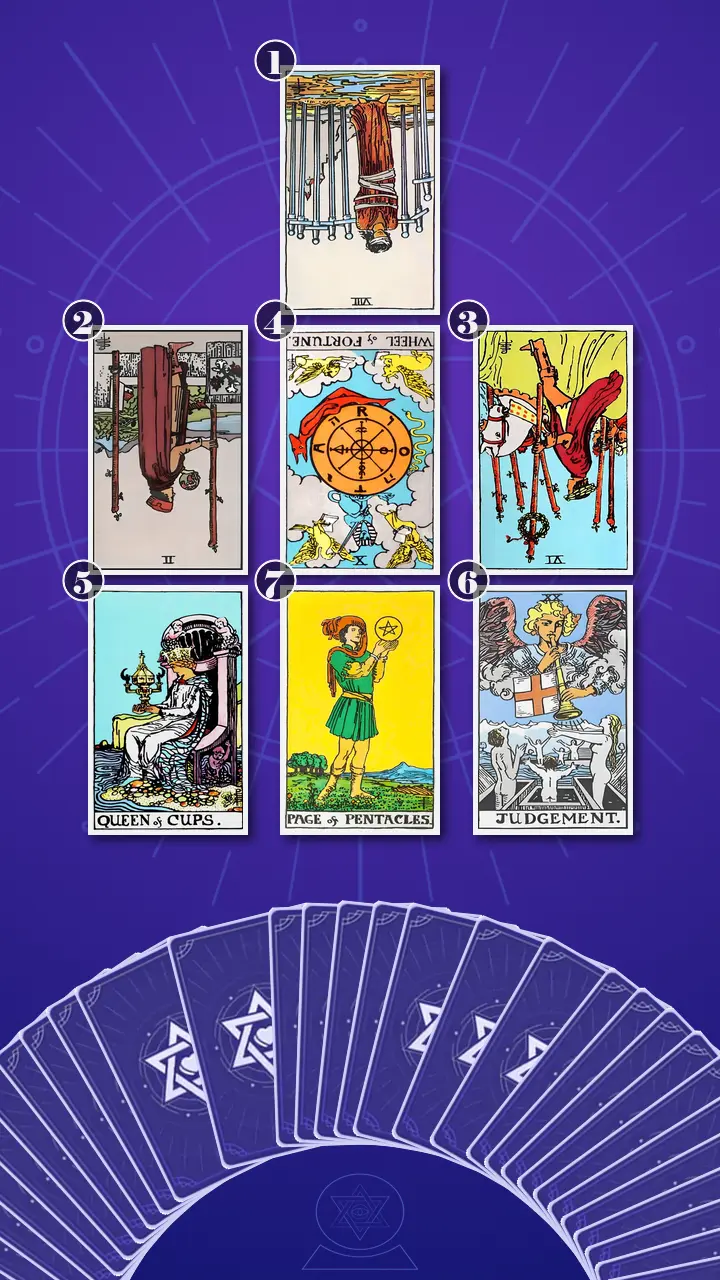
I chose the Energy Diagnostic Map · Context Edition, a seven-card tarot spread for mapping social comparison, limiting beliefs, and the overplanning loop. Its layout resembles a city transit map: several delayed lines converge at one central interchange, then open into a different route.
I chose it because Alex's difficulty was not located in a single hidden fear. An internal demand for certainty and an external culture of visible milestones were feeding each other. A smaller spread would have merged those pressures; a larger one would have added detail without making the feedback system clearer. These seven positions were enough to separate the observable blockage, the private conflict, the public scoreboard, and the recurring mechanism before identifying a resource, a transformation, and a grounded experiment.
I explained the route to Alex and, through the reading, to anyone wondering how tarot works without fortune-telling. The first card would show what comparison-driven paralysis looked like on the surface. The second and third would separate the inner demand for a complete map from the external demand for publicly legible progress. The fourth would reveal the loop where both pressures converged. The final three cards would show how to interrupt that loop and create evidence through action.
Where the Route Only Looked Locked
Position One: The Door Behind the Blindfold
I turned over the card representing Alex's observable blockage: the comparison-triggered research, planning, and inaction that made their nonlinear path feel like proof of failure. It was the Eight of Swords, reversed.
I pointed to the blindfold, the loosely wrapped bindings, and the incomplete ring of swords. Reversed, the card did not tell me that Alex's constraints were imaginary. Toronto rent, variable income, and short contracts were real. It showed a blockage of mental air: a conclusion had been placed over the facts so completely that available movement had become difficult to recognise.
After seeing a former classmate's promotion, Alex had opened job boards, salary reports, and course pages even though a potential-client email was already drafted. They told themselves they could not move until the correct route became obvious. The modern meaning of the card was sitting on their screen: one sendable email remained physically possible, but the thought "I cannot start until I know where this ends" had begun to function like a locked door.
"A borrowed timeline can feel like evidence without ever becoming a fact," I said. "What is one conclusion beginning with 'I am behind because' that we could test against something observable?"
Alex gave a short, bitter laugh. "That is so accurate it feels a little brutal. I was about to say I'm behind because I don't have a real career, but I finished a difficult client launch on Friday. So the observable fact is that I don't have a permanent title. The rest is... a verdict."
I saw their fingers stop switching windows. That pause mattered. They had not solved the career question, but they had noticed that uncertainty and immobility were not the same condition.
Position Two: Holding the Whole Globe in Notion
I turned over the card representing the inner tension between trusting a nonlinear path and demanding enough certainty to justify leaving familiar planning territory. It was the Two of Wands, reversed.
The figure held a globe while remaining behind a battlement. I connected it to the three complete career identities Alex had compared in Notion: agency producer, in-house strategist, and independent consultant. A sixty-minute portfolio test or one informational conversation could provide useful evidence, but neither could guarantee which identity would be correct. Alex therefore remained inside the document.
I described this as a deficiency of exploratory fire. Alex had imagination and ambition in abundance, but those qualities were blocked at the threshold because every experiment was being asked to guarantee a five-year destination. Their internal recommendation algorithm had been trained almost entirely on conventional promotion ladders. As a result, it filtered nonlinear options out before those options could generate evidence of their own.
"If the informational call cannot promise the right identity, it feels irresponsible," Alex said.
"Then the guarantee is the real entry fee," I replied. "What if the call's only job were to teach you one thing? A reversible experiment is not a marriage to a career identity. It is data collection."
I watched Alex lower one shoulder, then the other. The movement was small, but their posture no longer looked as though it had to hold the globe by itself.
Position Three: The Laurel Wreath in the Feed
I turned over the card representing the external timeline cues, public milestones, and recognition systems that activated the belief that progress had to be socially legible. It was the Six of Wands, reversed.
The laurel wreath and watching crowd translated easily into titles, announcement posts, reaction counts, and the familiar phrase "I'm thrilled to announce." Alex had finished a difficult freelance launch and felt proud of it. Five minutes later, a peer's permanent leadership role appeared on LinkedIn, and the completed project seemed to lose value because it had produced no promotion post or clean new headline.
The reversed energy showed an imbalance: external recognition had been given too much authority, while private recognition had been starved. I did not shame Alex for wanting to be seen. Recognition stable income, and a title can all matter. The problem began when applause stopped being information and became rank.
"It mattered before I opened the app," Alex said quietly. "Then I thought, if it were real progress, other people would know what to call it."
I asked which accomplishment would still matter if it were never posted. Alex named the client launch again, this time describing how they had translated an ambiguous brief, coordinated a scattered creative team, and delivered something the client could actually use. Their eyes remained on the card, and one thumb slowly stopped rubbing the other. I could see the sting of comparison remain, but I could also see them letting the unposted work occupy space beside it.
Position Four: The Sunday-Night Wheel
I turned over the card representing the core blockage: the repetition loop in which comparison led to rigid catch-up planning, overload, abandonment, and renewed proof of being behind. It was the Wheel of Fortune, reversed.
I traced the figures rising and falling around the wheel. Alex had been identifying with whichever point felt lowest, then treating that temporary position as an objective ranking of their entire life. The energy was blocked in repetition. There was plenty of motion, but almost none of it produced new information.
I mapped the sequence aloud: milestone post, spreadsheet rebuild, aggressive schedule, brief control, overload, abandonment, self-verdict. Each round changed one noun. "This time the course will make me current." Then the job. Then the city. Then the productivity system. The browser windows changed, but the request kept returning the same error.
"The plan gives you control for an hour, then invoices you for the rest of the week," I said.
Alex's chest rose and held. Their eyes moved through the sequence as if they could already predict the next scene. "By Wednesday, I drop it," they said. "And I never conclude that the plan was too big. I conclude that I never follow through."
My years on Wall Street taught me to pay attention when changing headlines conceal the same risk mechanism. I did not see seven unrelated failures in Alex's history. I saw one recurring system, almost like the resetting structure of Russian Doll: the setting shifted, but the loop remained intact until someone noticed how the reset worked.
That distinction removed moral weight without denying responsibility. A traceable loop is not fate. Once Alex could see its trigger, expected relief, and long-term cost, they could intervene before it completed another turn.
Position Five: The Feeling Beneath the Verdict
I turned over the card representing Alex's available resource: the capacity to distinguish an uncomfortable feeling from a factual verdict and identify the real need beneath comparison. It was the Queen of Cups, upright.
The Queen studied her enclosed cup beside moving water. I read the upright energy as emotional balance, not permanent calm. The card suggested that Alex could remain close enough to envy, disappointment, or fear to understand the message without letting the emotion issue a ruling on their worth.
I asked Alex to place their phone face down. As they did, the radiator released a long hiss into the sudden quiet. I invited them to name the feeling raised by the promotion post, then name one need beneath it.
"Envy is here," Alex said after a pause. "It may be pointing to a need for steadier income."
"Exactly. Envy can point to a need without proving a failure," I said. "You can want more stability without condemning freelancing. You can explore a permanent role without declaring your nonlinear work illegitimate. The feeling provides information. It does not get to fabricate the rest of the report."
I watched Alex exhale through parted lips. Their jaw shifted once, then loosened. The first credible movement in the reading was not a dramatic decision. It was the creation of a pause between the trigger and the usual catch-up response.
When Judgement Replaced the Borrowed Scoreboard
Position Six: A Trumpet, Not a Courtroom Sentence
I turned over the card representing the key transformation from borrowed timeline judgments to deliberate self-evaluation based on present values and meaningful commitments. It was Judgement, upright, the central antidote in the reading.
The room seemed to become quieter around the image. At 11:47, Alex had been caught in the demand to prove that every previous choice belonged in one respectable story. I could see them bracing for Judgement to confirm that demand, as though the card were about to review the evidence and deliver a sentence.
I pointed instead to the trumpet and the figures rising with open arms. "This is a wake-up call, not a prosecution," I said. "It asks what deserves a response now. It does not ask you to defend every detour before you are allowed to move."
I used a diagnostic lens I call Sunk Cost Decoupling. In strategic planning, time, education, reputation, and effort already invested can quietly demand that the future justify them. Decoupling does not mean pretending those investments never mattered. It means isolating them from the forward decision so they cannot charge the next five years with repairing the optics of the last five.
I asked Alex to review their varied contract history as data rather than evidence for the prosecution. Across different projects, they had repeatedly translated ambiguous briefs, coordinated creative teams, and made complicated work usable. Through Strategic Path Valuation, those recurring strengths became forward-looking assets. We could evaluate a future direction by current relevance, income stability, energy cost, learning value, and scalability, rather than by how neatly it redeemed the past.
Being off-script is not evidence that you are behind. The more useful question is not whether your life can justify its past, but which present commitment is still asking for your attention.
I let the sentence settle before giving Alex the clearest message of the spread.
Your detour is not a guilty verdict; answer one present call, and let Judgement's trumpet replace the borrowed scoreboard.
For one beat, I saw Alex stop breathing. Their fingers hovered above the trackpad, perfectly still. Then their eyebrows drew together and their eyes sharpened with something closer to anger than relief. "But doesn't that mean I got the last five years wrong?" they asked, their voice suddenly louder. I did not rush to soften the question. "No," I said. "It means the old metric was too narrow to value everything those years produced. Changing the metric does not erase the costs, disappointments, or useful choices. It stops requiring future payments merely to defend them." I watched their gaze lose focus as though several old projects were replaying behind it. Their lower lip pressed inward; their eyes brightened; then a slow breath left their chest. Their shoulders dropped, but the release carried a slight unsteadiness, the vulnerable blankness that can appear when a familiar accusation is gone and personal choice has to take its place. "Oh," they said, almost under their breath. "Then I still have to choose. I just don't have to punish myself first."
"Now, with this new perspective, think back: was there a moment last week when this insight could have made you feel different?" I asked.
Alex returned to the completed client launch. "I could have let it count," they said. "And I could have noticed that the part I want more of is shaping messy work into something people can use. I didn't need the project to explain my whole career."
I named the shift I could see: from contracted inadequacy and career timeline anxiety toward grounded self-trust through compassionate self-assessment and practical evidence. It was not total confidence. It was the first movement from asking, "How do I defend all of this?" to asking, "What keeps asking for my attention across all of this?"
Position Seven: One Pentacle Instead of the Whole Future
I turned over the card representing next-step grounding: one seven-day learning experiment that could produce evidence without requiring a complete life plan. It was the Page of Pentacles, upright.
I placed it beside the Two of Wands. Earlier, the figure had tried to hold the whole globe while looking toward a distant landscape. Now the Page held one pentacle at eye level while standing on workable ground. The upright earth energy restored balance through focus, patience, and a tangible result.
For Alex, the modern-life translation was direct: choose one skill, proposal, case study, application, or conversation; give it a defined week of focused attention; then review what it taught. The experiment did not have to become a permanent identity. Its value was that it would create grounded evidence where another speculative life plan could provide only temporary control.
"You do not need a five-year identity to complete a seven-day experiment," I told them.
Alex looked at the unsent potential-client email. "I can revise that into one proposal," they said. "Not launch a whole consultancy. Just send one proposal and see what I learn from the response."
I nodded. Tarot had not selected a destiny for them. It had helped us reduce the scale of control from mastering an entire future to engaging carefully with one real opportunity.
The Seven-Day Evidence Experiment
I read the spread as one connected story. The Eight of Swords showed a timeline assumption masquerading as a closed condition. The Two of Wands showed Alex demanding a panoramic map before permitting local experience. The Six of Wands revealed the public scoreboard feeding that demand. The reversed Wheel gathered all three pressures into a recurring comparison, overplanning, overload, and self-blame loop.
The final cards changed the operating system. The Queen of Cups separated emotional information from factual judgment. Judgement replaced condemnation with accountable, present-focused self-evaluation. The Page of Pentacles grounded that evaluation in one material learning cycle. The transit lines had not disappeared, but Alex no longer had to keep circling the same interchange.
The cognitive blind spot was precise: Alex had been treating the collapse of an oversized plan as evidence about their character instead of evidence about the plan's scale. They had also been judging an adaptive work history with a performance dashboard that recorded titles and announcements but had no field for autonomy, versatility, client impact, or useful work.
The transformation was not "freelancing is better" or "structure is bad." Alex was allowed to want stable income, a permanent role, public recognition, or a home. The change was to evaluate those goals according to present values and observable constraints, not as emergency repairs to a supposedly defective timeline.
I offered three options and asked Alex to begin with only one. These were interventions, not obligations, and none required a purchase, public post, or irreversible commitment.
- The two-minute feeling-to-need pause.After the next LinkedIn, Instagram, or group-chat milestone trigger, place the phone face down and write: "I feel ___; this may be pointing to a need for ___." Choose a concrete need such as steadier income, recognition, belonging, creative range, or rest.Keep the note private. One feeling word and one need phrase are enough; the need does not have to become an immediate task.
- The eight-minute Borrowed-Clock Check.Draw two columns titled "Observable fact" and "Borrowed timeline verdict." Separate one current behind-thought into what a date, document, message, or account balance can confirm and what the imagined adult schedule is claiming. If the trigger creates an urge to buy a course, accept low-fit work, or add a major goal, use a twenty-four-hour buffer.During the buffer, remove one item from the catch-up plan until it fits the time actually available this week. Urgent bills, safety needs, real deadlines, and genuinely time-limited opportunities are exempt.
- The 72-hour Hold-or-Pivot decision.I adapted my 5-Year Horizon Stress Test to a micro-decision: spend ten minutes listing three moments from past contracts when the work felt engaging or useful, circle one recurring strength, and ask what five more years of planning without testing would return. Within seventy-two hours, choose either Hold, giving one personally relevant direction a seven-day test, or Pivot, dropping that direction in favour of a better-fit experiment. Define one deliverable, such as sending one proposal, drafting one case study, or holding one informational call.Start with a fifteen-minute calendar block using tools you already have. The experiment only has to teach you something; it does not have to become your identity.
I told Alex that stopping was also available. If any exercise began to feel intrusive or turned into another performance system, they could close the note and take no further action. Self-authorship includes the right to pause. The objective was not to manufacture momentum at any cost. It was to replace borrowed urgency with personally relevant evidence.

A Week Later: The Quiet Proof
Six days later, I received a message: Alex had sent one client proposal and slept through the night. Their first thought that morning was still, "What if I'm wrong?" Then, they told me, they smiled and made coffee before checking LinkedIn.
I did not read that message as proof that every uncertainty had been resolved. Alex still had variable income, competing interests, and a Toronto budget requiring serious attention. The change was smaller and more credible: one comparison episode had ended with evidence instead of another total-life plan.
I thought back to the Page holding one pentacle rather than the Two of Wands holding the globe. The cards had not created Alex's clarity, and I had not handed them a correct future. Alex had created the first proof by choosing, acting, and allowing the result to teach them something.
If another person's milestone lights up your phone and your jaw locks before your rational mind can object, I hope you remember what I saw at Alex's table: the hardest part was not simply feeling late. It was fearing that a chosen life could not count unless the crowd already recognised its shape. A borrowed clock can sound official without telling your time.
If no borrowed timeline were available to grade the next seven days, which one-pentacle experiment would you be curious to answer for your own reasons?