When One Warm Reply Outweighed Two Silent Days: Tracking Reciprocity

The 10:52 p.m. WhatsApp Spiral
I met Casey, a 28-year-old marketing coordinator who could build a campaign report before lunch yet was losing the last quiet hour of Tuesday night to a two-line reply. At 10:52 p.m. in her Toronto condo kitchen, she had refreshed WhatsApp beside a mug of tea gone cold. The refrigerator hummed, the phone felt warm in her palm, and one affectionate message after two silent days made her chest release just before the vanished typing indicator tightened it again.
“When they come back warm, I forget how lonely the silence felt,” Casey told me. “I think, see, the closeness is still there. Then I start checking again. And if I ask what we are or what they actually want, I feel like I am being too much.”
I heard the central conflict immediately. Casey wanted to hold on because she longed for emotional closeness, but accepting the partner's recurring distance might mean releasing the hope that persistence would eventually make the relationship secure. Her longing felt like perfume trapped beneath a glass cloche: concentrated, sweet, and unable to disperse, until every breath seemed to belong to the same person.
“Your longing is real; it just cannot do both people's part,” I said. “You want closeness, so you hold on. But holding on is also keeping you from measuring whether closeness is mutual. I am not here to tell you whether to stay or leave. Let us give the confusion a structure and see what belongs to you, what belongs to them, and where your freedom still lives.”

Choosing the Map Beneath the Mixed Signals
I invited Casey to place both feet on the floor, take one ordinary breath, and hold her question in mind while I shuffled. I never treat this as a performance of mystery. The pause simply helps the nervous system move from refreshing, explaining, and anticipating into focused observation.
I chose the Transformation Path Grid (6) · Context Edition. This six-card relationship-pattern spread was designed for a repeating system rather than a yes-or-no prediction. A conventional relationship spread might have directed our attention toward what the other person feels or whether they will change. Casey's question required a more ethical and useful focus: why the loop keeps recruiting her attention, where it can be interrupted, and what she can choose without deciding for anyone else.
I arranged the cards in two rows. The upper row would show the present loop, the defense blocking movement, and the repeating root. The lower row would open with the clarity catalyst, continue into self-directed action, and end with a standard for relational integration. Position four would be the pivot between the closed loop above and the open path below.
This is how tarot works in my practice. A card does not deliver an external verdict. Its symbols place an internal pattern on the table, where memory, behavior, and intuition can be compared without any one of them controlling the whole story. For Casey, the most important positions would ask three grounded questions: What is she visibly doing when distance appears? What recognition could interrupt that cycle? What would mutual emotional participation look like in the present?
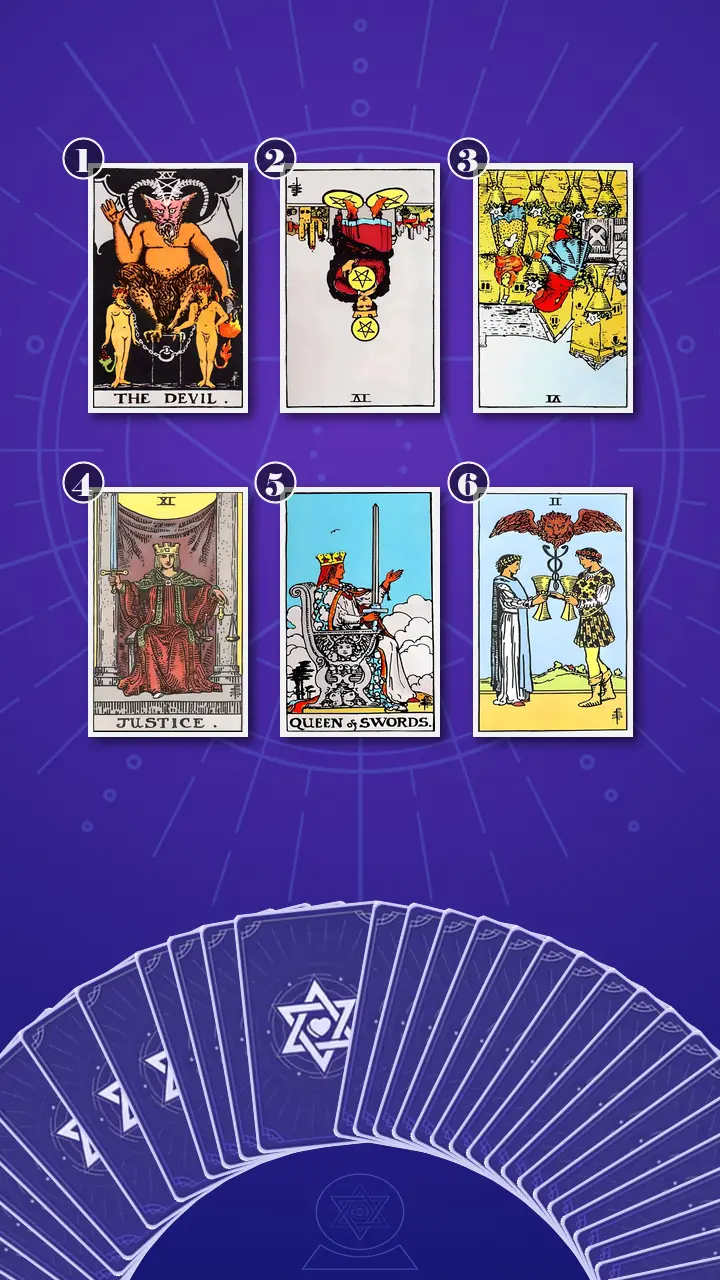
The Top Row: A Loop Disguised as Hope
Position 1: The Chain That Felt Like a Notification
I turned over the card representing Casey's present loop, the observable checking, rereading, and continued initiation that made the relationship more central whenever the partner became distant. It was The Devil, upright.
I pointed to the two figures chained to the shared pedestal. The chains look restrictive, but they are loose enough to be removed. I explained that this did not mean Casey should simply snap out of her attachment. It meant the bond could feel compulsory while choices about her attention and participation still existed.
“This card looks like your kitchen at 10:52,” I said. “You open the same chat for the fifth time. A brief warm reply makes the whole connection feel newly promising, so you reread earlier affection, check whether they are active, and organize another evening around waiting.”
I described the chat as a background app consuming memory. Nothing dramatic had to be happening on-screen for the relationship to occupy a large share of Casey's attention. The internal sequence was fast: just one check; maybe the warmth is back; I cannot miss the moment it changes. That was the Devil's attachment energy in excess, with agency temporarily blocked by the urgency of monitoring.
“What is the chain promising you each time you check?” I asked.
Casey gave a short laugh, but there was no amusement in it. She looked at her phone, turned it face down, and said, “That is so accurate it feels a little brutal. I think checking promises that I will catch the exact second things become good again.”
I let the honesty settle before responding. “Then we do not shame the part of you that checks. It is trying to protect a possibility. We simply notice that preserving the possibility and experiencing a mutual relationship are not the same thing. The loose chains are not blame. They are evidence that your next act can be chosen, even when the urge is loud.”
Position 2: The Phone Held Against the Chest
I turned over the card representing the blocking defense, the strategy of monitoring, rationalizing, gripping, or abruptly withdrawing in an attempt to control access to closeness. It was the Four of Pentacles, reversed.
The upright figure clutches one pentacle against the chest, pins two beneath the feet, and balances another over the head. Reversed, the grip becomes unstable. The energy moves between excess and deficiency: hold too tightly, threaten to release everything, then grab again when exposure becomes unbearable.
Casey had already given me the modern version. At 11:26 p.m. in a Queen West bar washroom, she saw that the partner had viewed her Instagram Story without answering a direct question about the weekend. Bass vibrated through the tiled wall, citrus hand soap cut through the warm air, and her fingers moved between mute, unfollow, a final-message draft, and the chat. She deleted “I cannot keep doing this” and sent, “How was your night?”
“Muting, checking, threatening to withdraw, and restoring contact can look like opposite behaviors,” I said, “but here they serve the same wish: I need control because I feel exposed. None of those controls can answer the emotional question. App settings can change access to a notification; they cannot manufacture another person's availability.”
I asked whether she was protecting herself or trying to prevent the connection from changing. Her breath paused. Her fingers tightened around the edge of her sleeve, her gaze drifted as if she were replaying the washroom scene, and then her jaw released with a small click.
“I call it a boundary when I draft the big message,” she said, “but half the time I am hoping it scares them into choosing me.”
“That distinction matters,” I replied. “A threat tries to control their participation. A boundary clarifies yours. The reversal is not telling you to cut contact suddenly. It is showing why alternating between pursuit and withdrawal keeps uncertainty in charge.”
Position 3: The Archived Highlight Reel
I turned over the card representing the repeating root, the familiar emotional script and selected memories that could outweigh what was occurring now. It was the Six of Cups, reversed.
The flower-filled cup is a tender image. I did not use the reversal to declare the past false or the good moments manipulative. Instead, I read it as emotional energy flowing backward, allowing a real memory to govern a present relationship long after the current pattern has changed.
Casey told me about standing in a grocery checkout line near Yonge and Eglinton. The scanner beeped, cold air entered through the sliding doors, and she scrolled back to a voice note from the first month of dating: “I miss you.” A direct question remained unanswered at the bottom of the current thread, but the old tenderness felt more convincing.
“Your memory has become an algorithm trained almost entirely on the relationship's first month,” I said. “It keeps recommending the original warmth while underweighting newer data. It is the painful Normal People gap between intense feeling and clear communication: both people may feel something, but feeling and mutual availability do not automatically arrive together.”
Casey's mouth tightened before she nodded. I could see that she was protecting the memory from being mocked or erased, so I made the distinction precise.
“The tenderness was real, and it is not a live update. You do not have to deny what it meant. You only have to stop making it responsible for describing what is happening now.”
Her eyes dropped to the six small white flowers on the card. “I always say what they can be like,” she said quietly. “I barely say what the last four weeks have actually been like.”
“That is the root this card is exposing,” I said. “Not that you are foolish for remembering, but that memory has been given more voting power than current reciprocity. A delayed answer is not always a puzzle. Sometimes it is information.”
When Justice Cleared the Air
Position 4: The Scales in the Notes App
The rain that had been ticking against my studio window stopped as I reached for the lower-left card. In the sudden quiet, I could hear the radiator settle and catch the dry trace of bergamot from a scent blotter on the shelf. The room seemed to make space before I did.
I turned over the card representing the clarity catalyst, the recognition capable of interrupting the loop by comparing Casey's need for closeness with consistent, observable reciprocity. It was Justice, upright, the key card in the reading.
I centered the balanced scales, the upright sword, and the symmetrical throne. Justice did not ask Casey to prosecute the partner or dismiss her feelings. Its balanced energy called in fair-minded discernment, self-respect, proportion, and accountability. The question was not whether the partner was good or bad. The question was whether what Casey requested, what they consistently offered, and what she did to preserve contact were in fair relationship to one another.
I translated the scales into a Notes app page with three headings: What I clearly asked for, What happened consistently, and What I did to keep contact going. I asked her to imagine recording the last four weeks in camera-visible language. “Answered after two days” belonged on the page. “They do not care” did not. “I sent three casual check-ins after my direct question went unanswered” belonged there. A theory about why they were distant did not.
This was where I used the diagnostic language that fifteen years of perfumery had taught me. I call it Intimacy Distance Calibration. A scent needs enough diffusion to cross shared air, but pressing a blotter harder against your own skin cannot make another person smell it from across the room. Casey had been crossing nearly the entire emotional distance whenever the space opened between them. The result was intensity on her side, not shared diffusion.
I paired that with my Boundary Permeability Assessment, separating three elements that had blurred together: Casey's need belonged to Casey; the partner's willingness and capacity belonged to the partner; Casey's future level of participation also belonged to Casey. Their reasons could deserve compassion without becoming her responsibility to repair. Her longing could remain valid without being required to fill the whole relational space.
I reminded her of the cold tea and the same chat open again. One affectionate reply had made her chest unclench so quickly that the previous two days of silence almost disappeared from the record. She was still trying to make the next message answer a question the repeated pattern had already been asking.
You do not need to hold tighter to make emotional distance become closeness; use Justice's scales and upright sword to compare what is offered, requested, and reciprocated, then let that evidence shape a boundary you choose for yourself.
For a second, Casey stopped breathing. Her index finger remained suspended above the edge of the card, and her pupils widened before her gaze lost focus. I watched the insight move through her in stages: first the physical freeze, then the silent replay of several evenings, then the sting. Her eyebrows pulled together and her eyes reddened. “But doesn't that mean I was wrong this whole time?” she asked, the words sharper than anything she had said so far. I did not rush to soften them into false reassurance. “No,” I said. “It means the warm moments mattered, and you made sense of them with the hope you had. Justice is not asking you to punish yourself for hoping. It is asking you to update the weight now.” Her shoulders lowered, her hand opened, and a long breath left her with a slight tremor. Relief arrived, but so did the dizzy vulnerability of realizing that clearer evidence would return responsibility for her participation to her.
I leaned forward slightly. “Now, using this new perspective, can you think of a moment last week when this insight might have made you feel differently?”
Casey thought of Thursday morning on the Line 1 train. She had checked the partner's active status, locked her phone, and opened it again before the next stop. “I could have admitted that the delayed reply was information,” she said. “Not information about whether I am lovable. Information about how the relationship functions when I ask for something real.”
I gave her the shorter truth beneath the card: “You do not need to hold tighter to prove closeness is possible; let consistent reciprocity carry as much weight as hope.”
We tested the three-column method for ten minutes. I emphasized that it was private, optional, and not a verdict. Casey wrote one camera-recordable fact under each heading and stopped there. If her body became overwhelmed, she could close the note and return by choice. Above the columns, she typed a sentence of her own: “I can care about the reason and still record the result.”
I named the emotional crossing while it was still visible. This was not a leap from uncertainty to perfect confidence. It was the first movement from reassurance-seeking pursuit to steady self-trust grounded in observable reciprocity. Casey had not solved the relationship. She had begun separating her worth from the task of keeping it alive.
The Open Path: A Sword and Two Cups
Position 5: One Sentence with an Open Hand
I turned over the card representing self-directed action, the practical move from clarity into one direct need, one respectful boundary, and measured observation. It was the Queen of Swords, upright.
I showed Casey the raised sword and the Queen's extended hand. The sword makes the truth visible; the open hand remains receptive. Her energy is not coldness. It is balanced discernment, warmth that no longer has to disguise itself as perfect-message engineering.
“In ordinary life, this card sounds like: ‘I need consistent emotional communication to keep participating in this relationship. Is that something you want and can offer?’” I said. “No case file. No shrinking the need. No sentence designed to force a yes.”
Casey winced. “What if clarity pushes them away?”
“Then clarity will have revealed something pursuit could not fix,” I replied. “That does not make directness a weapon, and it does not guarantee a particular outcome. It simply allows their response to remain theirs while your participation remains yours. A boundary names your participation; it does not control theirs.”
I thought of my early years at the perfume bench, when I still believed a muddy formula could be rescued by adding more of its prettiest material. Often, more concentrate only made the structure harder to perceive. The formula needed blank space, then time on the blotter, so I could observe what actually remained after the opening notes faded.
I shared that memory with Casey. “One more beautifully engineered message may be more of the same material,” I said. “The Queen's sword is one clean line. After that, space allows behavior to speak.”
Her shoulders loosened. She opened the long draft in her Notes app, selected three paragraphs of explanation, and read them once before deleting them. She did not send the shorter version during our session. I considered that restraint an act of agency too. Readiness cannot be bullied into existence, even by good advice.
Position 6: Two Cups, Two Participants
I turned over the final card, representing relational integration, the standard Casey could carry forward when deciding how much of herself to invest. It was the Two of Cups, upright.
I placed it where Casey could compare it with The Devil. The first card showed two figures sharing a tether beneath a dominating force. The final card showed two figures standing face to face, each bringing a cup into the shared space. I made the ethical limit explicit: this was not a forecast that the current partner would change, return, commit, or disappear. It was a picture of balanced emotional exchange.
“In your life, Two of Cups means checking whether emotional questions, plans, initiation, follow-through, and repair move in both directions,” I said. “It asks whether mutual participation is present often enough for the needs you have today. It does not ask how intensely you feel or how much effort you are capable of supplying.”
I invited Casey to look only at the previous month. She named one plan the partner had initiated and followed through on. Then she named three direct emotional questions that had been delayed, redirected, or met with affection that did not answer them. Both kinds of information remained on the table.
“I keep counting how much I want the relationship,” she said, “as though wanting it enough means two people are building it.”
“That is the final distinction,” I replied. “Persistence can preserve contact without creating closeness. The Two of Cups does not ask you to become less loving. It asks whether love, attention, and relational labor are actually being exchanged.”
The Reciprocity Reality Check
I read the full grid back to Casey as one coherent story. The Devil showed the present grip: unpredictable warmth had made the bond feel compulsory. The reversed Four of Pentacles showed the defense: checking, pursuing, muting, and threatened withdrawal all attempted to manage exposure without resolving uncertainty. The reversed Six of Cups revealed why the grip felt emotionally justified: tenderness from the past had become the primary evidence for the present.
Justice introduced the unused resource, a fair comparison between request, response, and reciprocity. The Queen of Swords turned that comparison into direct language and a boundary concerning Casey's own participation. The Two of Cups supplied the integrated standard: mutual exchange rather than one person maintaining both sides from hope. I also noted the absence of Wands. The spread did not suggest that Casey lacked passion, initiative, or effort. More chasing was not the missing ingredient.
The cognitive blind spot was specific. Casey already saw the distance, but she treated the relief of renewed contact as evidence that the relationship was becoming reciprocal. At the same time, she treated better wording as a way to change another person's capacity. That is why the loop kept surviving every new clue.
The transformation direction was equally specific: move from increasing pursuit to naming one concrete need, observing sustained reciprocal behavior, and protecting a boundary if that need remained unmet. The goal was not certainty, emotional hardness, or an immediate breakup decision. It was finding clarity about how the connection functioned and allowing Casey to choose her participation from present evidence.
For the next steps, I kept the actionable advice small enough to begin without turning the reading into another high-pressure project.
- Build the 10-minute Justice Ledger.On Tuesday evening at the kitchen table, open the Notes app and create three headings: “What I asked for,” “What happened consistently,” and “What I did to keep contact going.” Set a ten-minute timer and add only observable examples from the last four weeks.Tip: Use facts such as “answered after two days” instead of conclusions about motive. The minimum version is one example under each heading, and closing the note is allowed.
- Draft one need and one boundary.In a calm, private setting, write no more than four sentences for the partner: “I want a relationship with consistent emotional communication. When questions about feelings or direction remain unclear, I feel alone in the connection. Is that kind of consistency something you want and can participate in? If not, I will need to step back from how I am participating.” Read it once and remove any sentence designed to prove worth, assign motive, or force an answer.Tip: Drafting does not obligate sending. Casey can rehearse with a trusted friend, use two sentences, or keep the boundary private. If direct contact feels unsafe, she should not send it and can seek appropriate support.
- Use the Blank Space Protocol.After communicating, or after consciously choosing not to initiate, select one defined block such as 8 p.m. until the next morning and mute non-essential notifications. Then use a seven-day window to notice two or three ordinary behaviors: whether emotional questions receive direct answers, whether initiation moves both ways, and whether agreed plans are followed through.Tip: The blank space is oxygen, not bait. It is not engineered silence, punishment, or a covert test. The partner remains free to respond, while Casey protects her attention and records behavior without refreshing for a preferred result.
I explained why I call the final practice the Blank Space Protocol. In perfumery, the space around a fragrance is part of how it becomes perceptible. If the air is saturated, the nose fatigues and subtle structure disappears. In a relationship, deliberate space can reveal whether both people move toward the shared atmosphere or whether one person has been supplying all the diffusion. The space does not create reciprocity. It makes existing reciprocity, or its absence, easier to observe.

A Week Later: The Quiet Proof
A week later, I received a message from Casey. She had completed the three-column note, rehearsed her boundary with a friend, and sent a three-sentence version when she felt ready. The partner's reply was warm, but it did not directly answer whether consistent emotional communication was something they wanted and could participate in.
Casey recorded that response without translating it into hidden promise or hidden rejection. She kept Focus mode on overnight and did not check the partner's active status. She had not made a permanent decision about the relationship, but she reduced the casual check-ins that had been restoring contact without creating clarity.
Her last line held the small, bittersweet proof: “I slept through the night. I still woke up thinking, What if I am wrong? But I laughed, made coffee, and did not open WhatsApp first.”
I did not see a life magically solved. I saw a contracted pattern loosen by one degree. Casey still felt longing, and part of her still wished the answer had been different. But the longing no longer had exclusive control over the evidence, her attention, or her choices.
That was the real Journey to Clarity. The cards had not decided Casey's fate, and I had not rescued her from uncertainty. The spread gave her a clear surface on which to see the difference between memory and current behavior, control and boundaries, contact and closeness. Casey remained the author of what happened next.
I know how nearly impossible it can feel, when a warm reply finally loosens the tightness in your chest, to admit that the relief of being reached for is not the steadiness of being met. Noticing that difference is already a little clean air.
If your longing no longer had to fill both sides of the room, what small, observable sign of mutual participation would you place on Justice's scales next?