Finding Clarity in the Deleted Sentence
As a junior product designer in Toronto, Jordan could spend the whole TTC ride explaining why a delayed reply probably meant nothing, then send a softer follow-up anyway, classic reassurance seeking with a clenched jaw. I could picture the pattern before Jordan even arrived: a thumb checking the chat, a mind building a case for the other person, and the honest line being cut from the message.
At 8:47 PM on a Tuesday, I sat with Jordan in their small Toronto apartment as they balanced a warm phone in one hand and a draft message in the other. The radiator clicked; rain ticked against the window. I watched them delete "I felt dismissed" and send "Hey, are we okay?" instead. Their thumb hovered afterward, and their jaw locked as if holding the sharper sentence behind their teeth.
When Jordan asked me, "Why do I keep chasing closeness while hiding how angry I am?" I heard the contradiction clearly. They wanted contact to feel secure, but feared that naming the hurt would make the person they cared about pull away. They could explain the other person's silence in six reasonable ways, yet could barely say, "I am angry because I felt unimportant."
Longing and resentment can sit in the same message draft. In Jordan's body, the mixture felt like reaching for someone's hand with one hand while keeping the other closed around a hot stone: their chest tightened, their jaw ached, and their restless thumb kept searching for a sign that the bond was still intact.
I did not call the pattern dramatic or unreasonable. I told Jordan that anger was not a moral failure, and that a tarot reading could serve as an objective mirror rather than a verdict about the relationship or the other person's mind. "Let's draw a map through the fog together," I said. "Our Journey to Clarity is not about forcing certainty. It is about helping you see the next choice clearly enough that it belongs to you."

Choosing a Compass at the Relationship Crossroads
I invited Jordan to put the phone face down, take one slow breath, and focus on the question without trying to make the answer arrive faster. I shuffled slowly, treating the ritual as a practical transition from reacting to observing, not as a performance of mystery.
Today, I used the Relationship Spread · Context Edition. For anyone wondering how tarot works in a relationship reading, this is a deliberately compact five-card structure for looking at communication problems through card meanings in context. The issue is a repeating relational dynamic, not a request for a fixed future outcome, so I did not need the extra timing and external-event positions of a Celtic Cross.
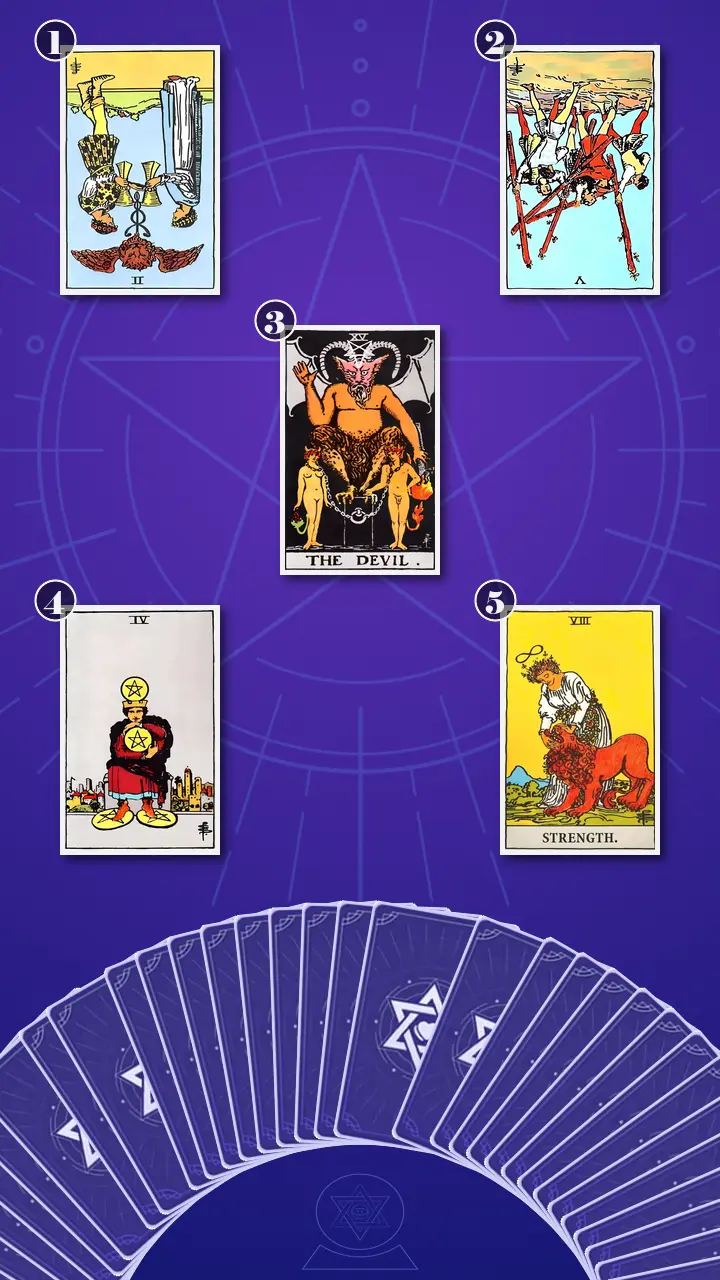
This relationship tarot spread holds five useful angles: the first card shows Jordan's observable role in the pursuit-and-silencing pattern; the second acts as a relational mirror, showing what that pattern puts into the shared space without pretending to read the other person's thoughts; the center card shows the bond being produced by the cycle; the fourth reveals the fear that keeps it in place; and the fifth offers one self-directed, bounded response.
I placed the third card at the center, the first and second above it as a mirrored pair, and the fourth and fifth below as movement from challenge toward guidance. The layout looked less like a prediction machine than a guarded conversation opening into a bridge. I would read from the first card across to the second, return to the center, and then move down toward the possible next step.
The Edited Conversation Comes Into Focus
The Two Cups That Never Quite Meet
I began with position 1, representing the querent's observable role: how the pursuit of closeness and suppression of anger appear in real time. I flipped the card and found the Two of Cups, in reversed position.
The two figures raising their cups toward one another became, in Jordan's life, an iMessage thread opened in search of mutual closeness. Jordan types, "I felt hurt and angry when you went quiet," deletes the line, and sends, "Are we okay?" instead. The two cups are near each other, but the information that would make the exchange genuinely mutual never quite gets handed over.
This is blocked Water, not absent feeling. The desire for connection is strong, but the flow is contracted by emotional editing. The brief reply or reaction heart can soothe Jordan for a moment, while the original grievance remains outside the conversation. I asked, "What would mutual closeness require you to say plainly before you ask for more reassurance?"
Jordan gave a short laugh with no humour in it. "That is almost too accurate," they said. "It feels a little cruel." I let the discomfort stay in the room rather than asking for a reassuring nod. The card was not accusing Jordan of withholding on purpose; it was showing the gap between wanting contact and offering the full emotional truth that would allow contact to become reciprocal.
The Five Drafts Arguing in Notes
I turned the second card, representing the relational mirror: what the pursuit-and-silencing pattern may communicate within the interaction and how it may shape the response, without claiming to know what the other person secretly thinks. The card was the Five of Wands, in reversed position.
In modern life, the reversed Five of Wands looked like a direct complaint softened into "No worries, I am probably overthinking this lol," followed by hours of private debate in Apple Notes. The five staffs crossing at different angles became competing unsent drafts, imagined replies, explanations, and rebuttals with no shared centre. The other person receives reassurance-seeking contact rather than one clear disagreement they can respond to.
Reversed Fire has not disappeared; it has lost its shared channel. Anger becomes private rehearsal, indirect humour, or a backlog of grievances carefully stored until one ordinary issue carries the weight of five older ones. "I want them to understand me," I said, "but I am giving them only the version that cannot respond to me."
Jordan's eyes dropped to the phone, though it was still face down. Their fingers opened and closed once, as if deciding whether to reach for the Notes app. I asked them to consider one low-stakes disagreement rather than the whole history: one feeling, one request, and no demand for an immediate emotional guarantee.
Hiding anger does not make closeness safer; it makes the relationship less informed. One specific disagreement can enter the relationship without becoming a total confrontation, and that possibility was the first opening I could see.
The Relief Button at the Centre
I returned to the centre of the spread, where the current bond was represented by the Devil, in upright position. This position asks what kind of connection the repeated cycle is producing when closeness is pursued and anger is withheld.
The Devil did not predict doom, and I said so before interpreting it. Here, the card showed attachment, narrowed choice, and a familiar mechanism: uncertainty creates alarm, a warm message brings immediate relief, and the relief makes it easier to postpone the anger that caused the checking. A new message becomes a relief button. It lowers the volume without repairing the wiring.
Jordan described the familiar sequence: a delayed reply, a second text, a warm voice note, an invitation, shoulders dropping, and then the irritation returning ten minutes later because the disappearance had never been discussed. "A warm reply can quiet the alarm without repairing what caused it," I said. "After the warmth arrives, do you feel that the original issue was addressed, or do you mainly feel less alone for a moment?"
The radiator clicked again. Jordan looked toward the rain-dark window, then back at the card. The loose chains in the image mattered to me: the pattern was powerful and repetitive, but it was not a sentence about fate. A choice still existed between seeking another soothing signal and moving toward honest information.
The Grip That Called Itself Safety
The Pentacle Held Against the Chest
I flipped the fourth card, representing the central challenge: the underlying fear and tension that keep the cycle intact, specifically the fear that anger will cost belonging. The card was the Four of Pentacles, in upright position.
The figure clutching the pentacle against the chest gave the pattern a physical shape. I could see Jordan monitoring tone, response time, punctuation, availability, and even the difference between a warm paragraph and a dry "k." They controlled the timing, wording, length, and visible amount of anger as if the right combination could keep the relationship secure.
This is guarded Earth, a grip that mistakes containment for safety. The anger is not gone; it is being held as a security deposit. Jordan offers understanding before asking for reciprocity, says "I get why you were busy," and leaves the hurt waiting behind the sentence. The emotional privacy settings are turned all the way up: nothing volatile gets through, but neither does an honest request.
I heard the private equation beneath the restraint: "If I say this, they might leave; if I do not say it, I can keep them close." The desired outcome is belonging, but the cost is self-erasure. Jordan's chest tightened and their jaw set again. Their thumb stopped moving toward the phone, and for a few seconds they simply held both hands open in their lap.
I asked, "What do you fear would happen in the next hour if you said, 'I am angry because I felt dismissed'? And what does holding that sentence back do to your chest, your jaw, and your urge to check the chat?" Jordan did not answer immediately. The silence was different this time. It was not an attempt to make the other person come closer; it was room to notice what the grip had been protecting.
When Strength Met the Lion Without Force
The room became unusually quiet when I reached for the final card. Even the rain seemed farther away. I told Jordan that we had reached the bridge of the reading, not because this card could guarantee a response from someone else, but because it could show a way to meet strong feeling without abandoning either honesty or self-respect.
The Calm Contact of Strength
I turned the fifth card, representing advice for the querent: one honest, bounded next step that lets closeness include anger rather than requiring its concealment. It was Strength, in upright position.
Strength translated into a calm conversation: "I felt angry when the conversation went quiet. I need clearer communication when plans change. I want to talk about it, but I will pause if we start dismissing each other." The anger remains present, but it is neither swallowed nor used to force reassurance. Like the woman's gentle hands meeting the lion, the feeling is held with patience, guidance, and a clear limit.
Strength brings warm, regulated Fire back into the spread. It does not ask Jordan to become permanently calm or endlessly understanding. It asks for enough self-trust to let anger become information, a request, or a boundary, instead of turning it into a weapon or a secret test.
At this point, I brought in one of my signature lenses, Toxic Script Identification. I named two roles that had been appearing automatically: the Reassurer, who rushes in to save the bond whenever contact feels uncertain, and the Silent Prosecutor, who keeps a private record of every grievance while appearing agreeable. These were scripts, not identities, and a script can be interrupted.
I followed with Dialogue Loop Auditing. We listened to the exact trigger phrases: "Are we okay?" invites warmth; warmth lowers the alarm; the original hurt remains unspoken; the resentment returns; the next reassurance request feels necessary. Seeing the loop in its actual language gave Jordan something more useful than a label. It showed the precise place where a different sentence could enter.
The Sentence Beneath the Reassurance
Jordan was still inside the old equation: if I admit the anger, I might lose them; if I smooth it over, I can keep them near. The warm reply looked like safety, but the erased sentence kept tightening the body. A choice could feel as exposing as the risk it replaced.
You do not have to hide anger to keep closeness; name it with courage and compassion, like Strength meeting the lion without force.
For one second, Jordan froze with their thumb above the card, breath caught halfway in. Their pupils widened, and the expression they had been managing all evening fell out of place. Then their gaze slipped past the lion toward the rain-dark window, as though replaying the deleted message, the second check-in, and every warm reconciliation that had arrived before repair. Their fingers tightened around the edge of the chair, released, tightened once more, and finally opened. The jaw that had been locked since the phone scene began trembled before easing. Jordan looked down; their eyes had gone bright, not with a dramatic collapse but with the shock of recognizing a choice where they had expected a rule. When they spoke, their voice was low and rough. "So I can say I am angry and still stay respectful." A long breath left their chest. Their shoulders dropped, and with the relief came a small, dizzying blankness: no script to perform, no guarantee to chase, only the responsibility of choosing what to say and what response to accept. I stayed quiet long enough for both relief and vulnerability to be real.
I asked, "Now, use this new perspective to recall last week. Was there a moment when this insight might have helped you feel different before you sent the softer message?"
Then I placed the phone face down between us and offered a ten-minute experiment: write one factual event, one sentence beginning "I felt angry because...," and one sentence beginning "What I need is..." Read the draft once without sending it. If the body becomes overwhelmed or direct contact does not feel safe, Jordan remains free to stop, pause, or choose a different boundary.
This was the first movement from self-silencing resentment and compulsive reassurance seeking toward self-respecting, mutually informed closeness. It was not certainty, and it did not promise that the other person would respond perfectly. It was the smaller, steadier shift of trusting that an honest feeling could exist without taking control of the whole relationship.
The One Clear Sentence That Changes the Pattern
When I gathered the five cards into one story, I could see why the cycle had felt so difficult to escape. The reversed Two of Cups showed Jordan reaching for connection while editing out the truth. The reversed Five of Wands showed the omitted conflict multiplying in private. The Devil showed relief becoming a familiar attachment loop, and the Four of Pentacles showed the grip that kept anger hidden in the name of belonging. Strength offered the missing practice: bring the feeling into the room without handing it the steering wheel.
The core metaphor was simple and uncomfortable: Jordan had been pulling someone closer while keeping one hand over a clenched fist. The cognitive blind spot was equating a warm reply with repair and emotional containment with safety. A relationship can become more active without becoming more honest. A person can feel temporarily chosen while still carrying an unresolved grievance alone.
The key shift was equally specific: name one angry feeling and the need beneath it in a calm first-person sentence before seeking more reassurance. That sentence does not force closeness. It gives closeness accurate information, and it gives Jordan a way to observe whether the exchange can hold mutuality.
To make the shift practical, I turned my exclusive intervention into what I call the Pattern Interruption Script. We role-played the old trigger, the automatic response, and the new choice. Trigger: the reply goes quiet. Old script: send "Are we okay?" and hide the grievance. New script: place the phone down, name what happened, identify the feeling and need, then decide whether a clear request, a pause, or no message is the most self-respecting response.
I gave Jordan three small pieces of actionable advice. Each one was designed to test the pattern without demanding a perfect conversation or a guaranteed outcome.
- The ten-minute draft pauseWhen a reply is delayed and the urge for a second iMessage rises, put the phone face down for ten minutes. In Apple Notes, spend three minutes recording only facts, three minutes naming the anger, and four minutes writing the need or request underneath it. Do not send anything until the timer ends.Tip: You do not have to send the draft. The smallest useful version is one honest sentence, and you can stop there.
- The One-Feeling-One-Need SentenceChoose one low-stakes moment, such as a calm walk or a planned phone call, and say: "When the conversation went quiet, I felt angry because I felt dismissed. What I need is clearer communication when plans change. I want to talk about it, but I will pause if we start dismissing each other." Then notice whether the response shows curiosity, accountability, defensiveness, or avoidance.Tip: Keep the focus on one observable event. If the conversation becomes overwhelming or disrespectful, pause without treating that pause as failure.
- The Relief-versus-Repair NoteAfter a warm reconciliation, affectionate message, or sudden return to closeness, make two quick columns titled "relief" and "repair." Record what changed in your body under relief, and whether the original grievance was acknowledged or addressed under repair. Check the note once the next day instead of repeatedly checking the other person's availability.Tip: Affection does not have to be rejected. This distinction simply helps you choose comfort, information, repair, or a boundary with clearer eyes.
These steps are not a test the other person has to pass, and they are not a demand that Jordan disclose everything at once. They are a way to separate feeling from action, relief from repair, and a boundary from punishment. One clear sentence can be more intimate than three softer check-ins.
Anyone returning to the Relationship Spread · Context Edition for hidden anger or communication problems can use the same five questions as a call to action: What am I doing in the moment? What am I putting into the shared space? What loop is being produced? What fear am I protecting? What honest, bounded choice is available to me now?

A Small Proof, Still Tender at the Edges
Four days later, I received a message from Jordan: "I used the three lines. I said I was angry about the cancelled plan, asked for earlier notice, and did not ask if we were okay afterward." Jordan told me the other person listened, became defensive for a moment, and then returned to the conversation after a pause. The response was information, not a verdict on Jordan's worth.
A week later, the plan was clearer and Jordan slept through the night, but the first thought the next morning was, "What if I got it wrong?" They smiled at the thought, put the phone face down, and made coffee before deciding what to say.
I did not see tarot solve Jordan's relationship. I saw the cards make an invisible pattern legible, and I saw Jordan reclaim the pen. Finding clarity had begun with a small act of ownership: allowing anger to be present without allowing it to hide, attack, or dictate the entire next scene.
When a delayed reply makes your chest tighten, you can reach for someone's warmth without hiding the anger that says you felt dismissed. You do not need to make the feeling disappear to belong; you can hold it with self-respect and choose what to share.
Before you ask for another sign that everything is okay, what might your first calm sentence sound like if it named one specific angry feeling and the need underneath it?
This story is adapted from psychological research, written so that those in a similar struggle can see their own pattern in it — and find their next step clearly.These insights are not a substitute for professional psychological, medical, legal, or financial advice.
Learn more about our Journey to Clarity.
How did this insight land for you?
🫂 This Resonates Deeply
🌀 Living This Story
✨ Now I See Clearly
🌱 Seeing New Possibilities
🧰 Useful Framework
🔮 The Confirmation I Needed
💪 Feeling Empowered
🚀 Ready for My Next Step
Author Profile
 AI
AI“I’ve always felt our lives are films currently in production. As an artist, I know that when you feel stuck, it’s often because you’ve bravely stayed in a painful scene for just a little too long. I’m not here to coldly analyze you. I want to sit closely with you, look at those difficult moments with profound empathy, and gently hand you the pen so you have the courage to write your next beautiful act.”
In this Love Tarot Reading :
Core Expertise
- Toxic Script Identification: Recognizing the repetitive, destructive roles you both automatically play (e.g., the Savior and the Victim) during conflicts.
- Dialogue Loop Auditing: Analyzing the specific triggering phrases that consistently escalate your arguments into dead ends.
Service Features
- The Pattern Interruption Script: A creative role-play directive to consciously change your default response to a known trigger, forcing the relationship dynamic to shift.
Also specializes in :
Explore Related Patterns:
Anxious AttachmentA delayed reply sends Jordan toward a second message, and the message asks whether the relationship is okay instead of naming the anger created by the silence. Jordan explicitly fears that disclosing the hurt will make the other person pull away, so proximity is pursued while the information that could risk disagreement is withheld. When closeness feels contingent on keeping difficult emotions out of view, you may chase contact as soon as uncertainty appears. The warm response calms the immediate attachment alarm, but the anger returns because security was obtained without repair. Anxious attachment connects both sides of Jordan's contradiction: the pursuit tries to prevent distance, while the concealment tries to prevent honest conflict from creating that distance.
Emotional Self-CensorshipJordan deletes "I felt dismissed" and replaces it with "Are we okay?" The edit does more than soften the wording: it removes the anger that would reveal what Jordan needs while preserving a safer bid for contact. Repeating the same substitution across messages shows an active defense against the feared relational consequences of emotional honesty. When you censor the feeling most likely to create disagreement, you may maintain contact without experiencing full mutuality. The immediate exchange can look calm, but the relationship is responding to an edited version of your experience. Emotional self-censorship names the mechanism through which anger is hidden to protect belonging, even as that protection leaves the original hurt unrecognized.
Intermittent ReinforcementJordan describes the same sequence more than once: uncertain contact, another message, a rewarding return of warmth, physical relief, and then the reappearance of the grievance. The timing of the warmth matters because it arrives after pursuit and is powerful enough to postpone direct discussion again. When uncertainty is followed by an emotionally rewarding signal, your nervous system can learn that pursuing contact is the fastest route to relief. The reward does not need to repair the problem to reinforce the behavior; it only needs to feel relieving in the moment. Intermittent reinforcement explains the loop's durability without assigning hidden motives to the other person: the pattern is strengthened by the unpredictable transition from alarm to warmth.
Outsourced Self-SoothingJordan's shoulders drop when the warm voice note or invitation arrives, then the irritation returns ten minutes later because the silence was never discussed. The other person's response changes Jordan's body quickly, but the internal shift depends on receiving an external cue rather than processing the anger or deciding on a boundary. When another person's availability becomes your main route back to emotional steadiness, closeness can function as borrowed regulation. You may feel better without gaining information about whether the underlying need can be met. Outsourced self-soothing identifies this dependency in the coping process: contact lowers the alarm for you, but the relief remains vulnerable to the next delay because the source of regulation is still outside your control.
People-Pleasing Resentment CycleJordan sends "No worries, I am probably overthinking this" while the direct complaint continues as hours of private debate in Notes. Understanding is offered before reciprocity is requested, and each unspoken grievance is stored until an ordinary issue begins carrying the weight of several earlier ones. When you protect harmony by appearing more agreeable than you feel, the accommodation can preserve immediate contact while resentment accumulates outside the relationship. You become responsible for both keeping the bond comfortable and privately containing what the comfort excludes. The people-pleasing resentment cycle names that repeating trade: self-silencing buys short-term closeness, but the hidden emotional cost makes future contact increasingly charged.
Reassurance SeekingJordan responds to delayed contact by checking the thread, sending a softer follow-up, and looking for a reaction heart, warm voice note, or invitation. Each signal answers the immediate question of whether the bond still exists, but none necessarily answers why Jordan felt dismissed or what needs to change. When you repeatedly ask for confirmation that everything is okay, the confirmation can become a short-term regulation strategy. Relief teaches you to seek another signal the next time uncertainty rises, even though the unresolved issue remains available to reactivate the alarm. Reassurance seeking therefore explains why the pursuit continues: the check-in works well enough to reduce distress now, but not well enough to create durable relational clarity.
Cognitive DissonanceJordan wants mutual closeness but removes the emotional information that would make the exchange genuinely mutual. A warm reply is experienced as evidence of safety even while Jordan recognizes that the grievance remains unresolved. The message therefore carries one goal outward while protecting a conflicting truth inside. When you believe that closeness requires honesty and also believe that honesty may cost you closeness, emotional editing becomes a way to keep both rules temporarily intact. The relief is unstable because neither side of the contradiction has been tested clearly. Cognitive dissonance names this internal friction and the defensive choices used to reduce it: you pursue evidence that the bond is safe while avoiding the disclosure that would reveal what kind of safety the bond can actually hold.
Relational HypervigilanceJordan monitors response time, punctuation, availability, and the difference between a warm paragraph and a dry "k." These small signals are treated as high-stakes evidence about the bond, while the locked jaw and deleted sentence show that Jordan's attention is directed outward even when important information is building internally. When your attention repeatedly scans another person's communication for signs of safety, ambiguous details can take control of the emotional field. You may become highly skilled at detecting changes without gaining clarity about what those changes mean. Relational hypervigilance describes this persistent threat-monitoring strategy: it attempts to prevent rejection by reading every cue early, but it also keeps your sense of security dependent on signals you cannot control.
RationalizationJordan can explain the other person's silence in six reasonable ways but can barely say, "I am angry because I felt unimportant." The explanations may all be plausible, yet their timing matters: they appear before Jordan acknowledges the emotional impact and make it easier to postpone the direct conversation. When you use analysis to make another person's behavior understandable, reason can become a shield against information that feels relationally dangerous. You are not necessarily thinking inaccurately; you are using accurate-sounding possibilities to avoid testing whether your hurt can be heard. Rationalization captures how intellectual fairness can protect closeness in the short term while quietly overriding your own emotional evidence.
RuminationJordan turns one softened complaint into hours of competing drafts, imagined replies, explanations, and rebuttals in Apple Notes. The conflict has plenty of mental activity but no shared channel, so analysis expands while the relationship receives little new information. When anger cannot enter a conversation, you may keep trying to resolve it internally by replaying every version of what could be said. The repetition can feel productive because it searches for the perfectly safe sentence, yet it does not test reality or produce repair. Rumination captures this cognitive loop: thought keeps circling the grievance after action has stalled, allowing older unresolved material to gather around the current event.
Explore Related Struggles:
Anger-Ownership SplitWhen you delete 'I felt dismissed' and replace it with 'Hey, are we okay?', the wish to stay connected moves forward while the sentence carrying your anger is held back. Your clenched jaw, hovering thumb, and softer follow-up make the conflict visible in the body. You are asking for closeness without letting the full reason for needing it enter the exchange. The same split appears when you can explain six reasonable reasons for silence but can barely say that you felt unimportant. You are left treating ownership of the anger as a possible threat to the bond, as though naming the feeling would hand someone else the power to decide whether you still belong. The bounded response in the story lets the anger become accurate information and a clear request while keeping the decision about what to say and what response to accept in your hands.
Belonging-Authenticity SplitWhen the draft changes from 'I felt dismissed' to 'Hey, are we okay?', you protect the possibility of staying close by reducing how much of your actual experience can enter the relationship. Jordan's private equation is explicit in the story. Saying the angry sentence might cost belonging, while smoothing it over keeps the person near but leaves the hurt waiting behind the sentence. That tradeoff can make a warm reply feel like safety even while the erased sentence keeps tightening your chest and jaw. You are confronting whether belonging can include an honest account of being dismissed. A calm first-person statement with a clear limit lets you examine that question without demanding a perfect response or giving anger control of the conversation.
Connection-Repair LoopWhen the reply goes quiet, you send a second text, receive warmth, feel your shoulders drop, and then notice the irritation return because the disappearance was never discussed. The warmth changes the immediate pressure, but the missing conversation remains in the shared space, so the next pause can call for another round of contact. You are chasing a signal that the bond is intact while the relationship still lacks the information needed for repair. The story's distinction between relief and repair gives the sequence a precise checkpoint. After a reassuring message, look for whether the original grievance was acknowledged or addressed. That observation separates comfort from repair and gives you a self-directed choice about a clear request, a pause, or no message.
Explore Related Emotions:
Cautious VulnerabilityJordan chooses one low-stakes disagreement, names the cancelled plan, asks for earlier notice, and leaves room for the conversation to pause. They disclose enough to be accurately understood without surrendering control over timing, boundaries, or how much more they will share. Vulnerability remains cautious because honest speech cannot guarantee a warm response. You can still permit yourself to be seen while retaining the freedom to stop, reassess, or choose a different boundary, allowing openness to coexist with discernment rather than requiring total emotional exposure.
Conditional Belonging FearJordan monitors response time, punctuation, availability, and the difference between a warm paragraph and a dry “k,” while holding to the private equation that speaking plainly may make the other person leave. Communication becomes less about accurately representing the experience and more about finding the wording least likely to threaten proximity. Belonging can then feel conditional on being agreeable, understanding, and easy to reassure. You may experience honest disagreement as a risk to your place in the relationship, creating a fear that closeness is available only when the inconvenient parts of your inner life remain carefully contained.
Grounded AgencyJordan places the phone face down, separates facts from feelings and needs, and decides whether a request, a pause, or no message is the most self-respecting response. Four days later they make the clear request; a week later they notice the old doubt, make coffee, and wait before choosing what to say. Grounded Agency grows through these small moments of authorship. You can experience a strong urge without treating it as an instruction, and you can receive another person's response as useful information rather than a definition of your worth, keeping the next choice anchored in your own observation and limits.
Guarded LongingJordan deletes “I felt dismissed” and sends “Hey, are we okay?” instead. The bid for connection is sincere, but it travels outward without the information that would let Jordan be fully known, leaving closeness physically near and emotionally incomplete. When you reach for someone while concealing the part of you that may create disagreement, longing acquires a guarded quality. You still want contact, but you approach it through a version of yourself designed to minimise the chance of withdrawal, so even a warm response may not reach the feeling left behind.
Invalidation AcheJordan can explain the other person's silence in six reasonable ways but can barely say, “I am angry because I felt unimportant.” Later warmth confirms that contact has resumed, yet it does not confirm that the dismissal, cancelled plan, or unspoken grievance has been understood. You can therefore feel less alone for a moment while still carrying the ache of not having your actual experience acknowledged. Invalidation Ache sits beneath the sharper reaction: it is the pain of receiving affection without recognition, and of remaining present in the relationship while the meaning of what happened to you stays outside the conversation.
Protective AngerJordan eventually says they were angry about the cancelled plan, asks for earlier notice, and does not follow the request with “Are we okay?” The feeling enters the relationship as specific information about what happened, what mattered, and what would need to change. Anger becomes protective when you let it identify a crossed limit without giving it control of the entire exchange. Here it protects Jordan's need for clearer communication and mutual regard, supporting a boundary that can preserve self-respect whether the other person responds with curiosity, defensiveness, or a need to pause.
Regulated CourageJordan places the phone face down, writes one factual event, one sentence naming the feeling, and one sentence naming the need before deciding whether to send anything. The pause does not erase the intensity; it creates enough room for the feeling to be translated into language and a clear limit. Regulated Courage is the experience of staying in contact with what matters while choosing its form deliberately. You do not have to become perfectly calm to speak honestly; courage can look like a rough voice, an exposed sentence, and enough steadiness to avoid swallowing the truth or using it to force reassurance.
Security HungerA delayed reply leads Jordan to send a second text; a warm voice note or invitation lowers their shoulders, yet the irritation returns ten minutes later because the disappearance was never discussed. The new message functions as immediate confirmation that contact still exists, without creating lasting confidence in the bond. When you need repeated signals to know that closeness is intact, comfort can become brief nourishment rather than durable security. Security Hunger names the persistent inner need beneath the checking: not simply wanting another reply, but wanting a relationship solid enough that every pause does not reopen the question of whether you still matter.
Self-Betrayal AcheJordan offers understanding before asking for reciprocity, deletes the statement that they felt dismissed, and leaves the hurt waiting behind “Are we okay?” The message may preserve immediate contact, but it no longer carries the experience Jordan most needs the relationship to recognise. Each time you remove your own position to make closeness easier to secure, part of the pain can come from the editing itself. Self-Betrayal Ache captures the intimate cost of remaining connected through a version of yourself that omits what mattered, even when the omission began as an attempt to protect the bond.
Suppressed ResentmentJordan's direct complaint becomes “No worries, I am probably overthinking this lol,” while five competing drafts continue arguing in Notes. The shared conversation is softened, but the jaw, chest, and private backlog keep carrying what the message excluded. When you repeatedly protect contact by withholding disagreement, the feeling does not vanish; it loses a shared channel. It can harden into suppressed resentment, where each ordinary disappointment starts carrying the accumulated weight of earlier moments that were soothed over but never voiced.
Truth ReliefJordan's jaw trembles and eases, their hands finally open, and a long breath leaves their chest after they say, “So I can say I am angry and still stay respectful.” Later, they name the cancelled plan directly and do not ask for immediate confirmation that the relationship is intact. The resulting relief comes from no longer splitting contact from truth. When you allow one accurate feeling and need to exist in the conversation, the body no longer has to hold the entire disagreement in private, creating a steadier release than the short-lived comfort of another affectionate message.
Explore Related Contexts:
Relationship Hypervigilance LoopJordan spends the TTC ride building explanations for a delayed reply, checks the chat, and sends a softer follow-up anyway. The same monitoring appears in the apartment scene, where response time, tone, punctuation, and availability become signals to track while the sentence about feeling dismissed is removed. The interaction therefore keeps directing your attention toward signs that contact is still available instead of toward a shared account of what happened. A warm reply can briefly restore closeness while leaving the grievance outside the conversation, so the next silence reopens the same search for confirmation. The external situation is a relationship exchange organized around repeated checking rather than mutual information.
Relationship Repair BreakdownJordan describes a delayed reply followed by a second text, a warm voice note or invitation, lowered shoulders, and irritation returning because the disappearance was never discussed. The later cancelled-plan example shows the same practical gap: contact can resume, but the event that created the rupture still has no shared conversation around it. You are dealing with a relationship exchange in which comfort arrives before repair. Warmth changes the immediate level of contact without necessarily changing the communication pattern, leaving you to distinguish whether the original grievance was acknowledged or whether the exchange only became less uncomfortable for a moment. That distinction explains why pursuing closeness can continue alongside unspoken anger.