Finding Clarity in the 11:38 p.m. WhatsApp Glow
If a single “K” can flip your whole evening into a Notes-app spiral, welcome to comparison-free, vibe-preserving conflict avoidance—aka the modern texting mind-reading loop.
Maya slid into the chair by the window of my café, hoodie still damp from the London drizzle. She was 29, a junior product manager, the kind of person who can be crisp in a stand-up meeting and somehow turn into a poet of apologies in a dating text.
She didn’t even need to show me her phone for me to see it: 11:38 p.m. on a Tuesday in a Hackney flat, sofa cushions swallowing you whole, the blue WhatsApp glow bleaching your face. The lamp hums. The kettle clicks off. Your tea has gone cold enough to taste like metal. Notes is open with three drafts of the same message. Your jaw is locked like it’s keeping a secret.
“I hate that a single letter can ruin my whole evening,” she said, voice tight at the back of her throat. “I want to call it out and ask for clarity. But I keep editing myself into silence so I won’t seem… demanding.”
Her anxiety wasn’t an abstract feeling—it sat in her body like she’d swallowed a stone that pressed up into her chest, while her thumb kept twitching toward the screen, trying to fix uncertainty by checking it again.
I nodded, gentle but direct. “You want clarity and self-respect. You fear being seen as ‘too much’ and getting dropped. Let’s not judge that—let’s map it. Tonight, we’re doing a Journey to Clarity, not a trial.”

Choosing the Compass: The Four-Layer Insight Ladder Spread
I asked Maya to take one slow breath in, one slow breath out—nothing mystical, just a clean transition from spiraling to observing. While I shuffled, the café did what it always does: espresso machine hissing softly, rain tapping the awning, the comfort of ordinary life holding the edges of something tender.
“We’re going to use a spread called the Four-Layer Insight Ladder · Context Edition,” I told her. “It’s designed for moments exactly like this—conflict avoidance in texting after a dismissive one-letter reply.”
And for you reading: I like this ladder because it keeps agency in the querent’s hands. It moves from behavior → trigger → root fear → shadow → integration → action. It doesn’t pretend to predict what the other person ‘really meant.’ Instead, it shows why the loop starts, why it sticks, and what a grounded next step looks like.
I previewed the three rungs that matter most tonight: the first card would show the observable habit right after the “K.” The fifth would reveal the balancing medicine—the middle path between silence and a fight. And the sixth would give a next-message script—a practical move, not a personality overhaul.
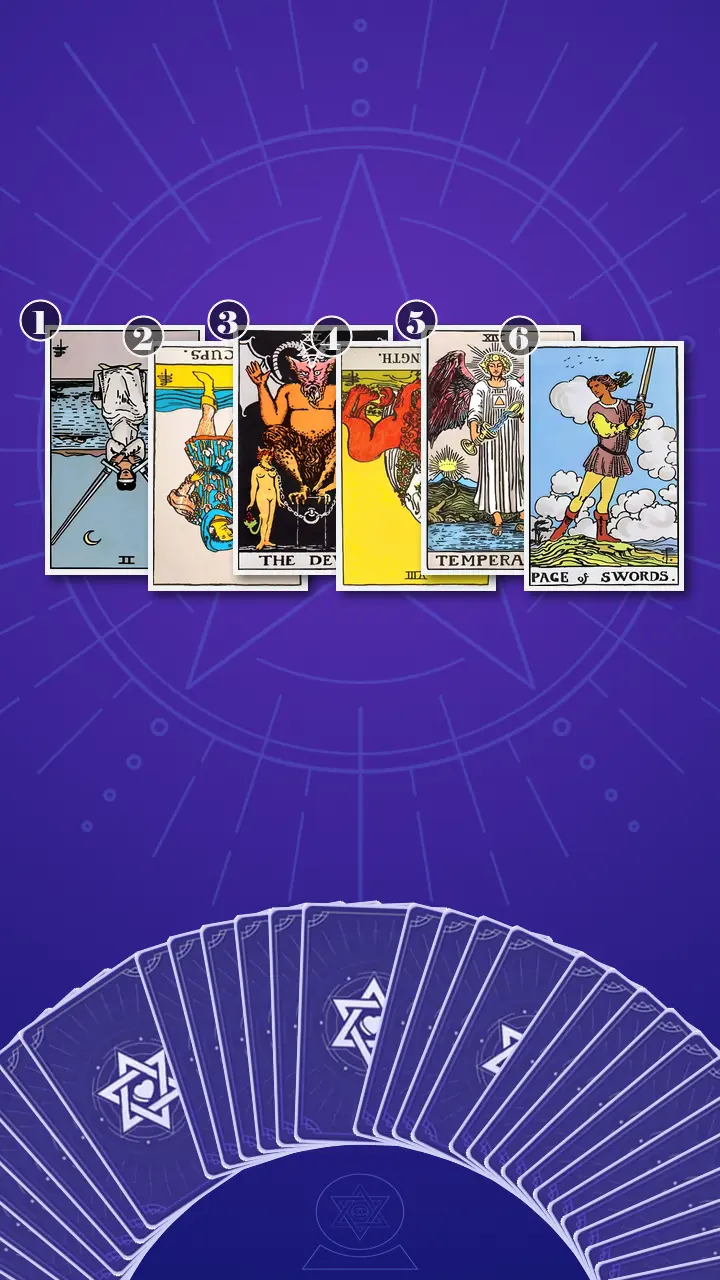
Reading the Ladder: From Blindfold to Breath
Position 1 — The Habit You Do on Your Phone: Two of Swords (reversed)
“Now we open the card that represents the observable conflict-avoidance habit that shows up right after the ‘K’ text.”
Two of Swords, reversed.
I pointed to the blindfold and the crossed blades held tight to the chest. “In modern life, this is you seeing ‘K’ and then locking your screen, unlocking it, reopening the chat, jumping to Notes, drafting multiple versions that all try to sound ‘least annoying.’ You keep the conversation technically alive—a safe emoji, a soft ‘no worries’—while avoiding the one thing you actually want: a direct read on what’s going on.”
Reversed, the energy isn’t calm neutrality. It’s a blockage—Air stuck in the throat. Communication held back like breath you don’t want anyone to hear. I mirrored it back exactly: the app-close/app-open loop; the jaw clench; the internal subtitles—If I say it plainly, I’m ‘too much.’ If I say nothing, I’ll resent them tomorrow.
Maya gave a small laugh that had a bitter edge. “That’s… so accurate it’s kind of rude.” Her shoulders dropped a millimeter, like the body appreciates being named without being shamed.
Position 2 — The Trigger: Page of Cups (reversed)
“Now we open the card that represents what the ‘K’ text triggers in you emotionally and cognitively.”
Page of Cups, reversed.
“See the cup, and the fish popping up like an unexpected fact?” I said. “This is the moment you sent something normal—maybe a plan, a check-in, a tiny vulnerable line—and the ‘K’ makes you feel instantly exposed. You start shrinking your tone. You add ‘haha’ or ‘no stress!’ because you’re trying to protect yourself from the possibility that you cared more than they did.”
In reversed form, this Page is a deficiency of emotional safety. Not because you’re wrong for wanting warmth—but because the system inside you starts negotiating your needs down before anyone has even answered.
I softened my voice. “I wasn’t asking for a poem—I was just hoping for warmth.”
Maya’s eyes went briefly glossy; she looked down at her hands. A quiet, almost embarrassed “yeah” slipped out, like admitting tenderness costs her something.
Position 3 — The Root Hook: The Devil (upright)
“Now we open the card that represents the deeper attachment or fear keeping the pattern in place.”
The Devil, upright.
“The chains are loose,” I said, tapping the image lightly. “That’s important. This isn’t fate. It’s habit.”
Then I used the metaphor that always lands cleanly: “This card feels like an autopay subscription to approval. Every time a reply goes cold, you renew the subscription with politeness—softening your ask, checking read receipts, waiting for them to rescue you from ambiguity—because cancellation feels like it could cost you belonging.”
Upright Devil energy is an excess of control-by-pleasing: treating their tone like a verdict on your worth. If they’re warm, you’re safe. If they’re curt, you’re at risk. So the keyboard becomes a place where you perform for safety instead of asking for reality.
Maya’s stomach visibly tightened—she pressed her lips together, then let out a slow breath through her nose. “God. I do act like I’m trying to earn my way back into ‘good standing.’”
Position 4 — The Shadow You Swallow: Strength (reversed)
“Now we open the card that represents the shadow you avoid expressing—the courage, boundary, or truth you swallow to keep peace.”
Strength, reversed.
I held the card between us. “Strength isn’t aggression. It’s steadiness. Reversed, it’s the fear that you won’t stay regulated if there’s pushback.”
And I gave her the split-screen: “You type, ‘That felt dismissive—what did you mean?’ Your body reacts like it’s danger—tight chest, clenched jaw. You swallow it; your tongue presses to your teeth. Then you replace truth with performance: a meme, a topic change, or silence dressed up as ‘being chill.’”
This is a deficiency of self-trust—not self-esteem as a slogan, but the specific trust that you can handle a tense reply without collapsing or exploding.
Maya took a sharp inhale. Her fingers curled, then unclenched on her cup. “I don’t trust myself to stay calm if they come back defensive,” she admitted. “So I try to prevent the whole situation by being… small.”
When Temperance Spoke: Two Cups, One Truth
Position 5 — The Integration: Temperance (upright)
I let the room go quieter on purpose before turning the next card. Even the espresso machine seemed to pause between hisses, like the café was listening with us.
“Now we open the card that represents the key integration that turns conflict into a workable conversation—the regulated middle path.”
Temperance, upright.
Temperance is the angel with one foot on land, one in water, pouring steadily between two cups. In real life: it’s not silence versus a fight. It’s a third option—honesty with calm.
Here’s where my café brain always kicks in. I’ve pulled thousands of espresso shots. When someone is exhausted, they keep the shot running too long—over-extraction. The result isn’t “more coffee.” It’s bitterness. In texting, you can over-extract too: you pull thirty interpretations out of one letter until the whole thing tastes harsh. Temperance is the exact opposite: balanced extraction. Enough truth to be real. Enough regulation to keep it drinkable.
Setup: Maya was right back on the sofa with her phone lighting up her face, rereading the thread like it’s evidence. Notes open, three drafts, jaw tight, thumb hovering—an entire evening decided by one letter she’s pretending she’s fine with.
Stop diluting your needs into silence; blend honesty and calm like Temperance pouring between two cups.
It landed, and her reaction came in a chain. First, a freeze—she stopped breathing for a beat, eyes fixed on the card like it had said her name. Then the thought pushed through, sharp and defensive: “But if I do that,” she said, voice rising, “doesn’t it mean I’ve been doing it wrong? Like… I’ve been the problem?”
I didn’t rush to soothe. I stayed steady. “It means you’ve been trying to stay safe with the tools you had. Temperance isn’t a verdict. It’s a skill.”
Her face changed again: the anger softened into something raw; her mouth opened slightly; her eyes reddened at the rims. Her shoulders lowered like she’d put down a heavy bag she forgot she was carrying. She exhaled—long, shaky, then cleaner. “So I don’t need the perfect reply,” she whispered. “I need a balanced one.”
I nodded. “Exactly. Set a 6-minute timer. Draft exactly two sentences—your ‘two cups’: (1) one neutral observation: ‘When I got “K,” I wasn’t sure how to read it.’ (2) one clean question: ‘Are you annoyed, or just busy?’ No apology. No emoji buffer. If your throat spikes, do three slow exhales. You can still choose not to send—this is practice, not a contract.”
Then I asked, softly but clearly: “Now, with this new lens—can you think of one moment last week when this would’ve changed the whole night?”
Maya stared past me for a second, like she was replaying footage. “Friday,” she said. “I typed the direct question, deleted it, and sent ‘lol fair’ instead. I spent two hours checking read receipts.”
“This,” I told her, “is the shift from phone-checking anxiety and self-editing into silence to regulated honesty and boundary-led curiosity.”
The Page of Swords Send Button
Position 6 — The Concrete Next Step: Page of Swords (upright)
“Now we open the card that represents a concrete next step you can do in the next message—one clean move that breaks the loop.”
Page of Swords, upright.
Wind-tossed hair, wide eyes, sword held cleanly up: this isn’t an attack. It’s a reality test. A question that replaces guessing with information.
I gave her the exact Page of Swords message script: “Hey—when you replied ‘K’ I wasn’t sure how to read that. Are you annoyed or just busy?”
Then I added the reframe I’ve watched change people’s posture in real time: “A clean ask is not a fight. It’s a request for reality.”
Maya’s thumb mimed the motion of pressing send. She inhaled, paused, then let the breath out slowly like she was proving to herself she could survive a moment of discomfort.
From Overthinking to Actionable Advice: The Two Cups Text
I leaned back and stitched the ladder together for her: after the “K,” the Two of Swords reversed shows the freeze-and-edit habit—neutral on the outside, clenched on the inside. Page of Cups reversed shows the tender drop—sincerity flipping into self-consciousness. The Devil shows the hook—belonging-by-performance steering the keyboard. Strength reversed shows the avoided skill—trusting you can stay steady if there’s pushback. Temperance is the integration—regulated honesty. Page of Swords is the behavior—one clean question, data over guessing.
The blind spot is subtle but huge: believing you can earn safety through perfect tone. That’s why you keep drafting and deleting. The transformation direction is simpler: clarity over perfect tone—one respectful ask, then letting the response give you information.
Before we wrote her next steps, I used one of my café tools. I placed her cappuccino down and watched it for a moment. “This is my Cup Temperature Scan,” I said. “If your cup cools fast, your system is already leaking energy. Texting from that place turns everything into emergency.” She gave a small, surprised smile—because it was absurdly true.
Then I offered her practical next steps she could actually do in the next 48 hours:
- Two Drafts MaxWhen you get a dry reply, allow yourself only two drafts in Notes. Draft 1 is whatever your anxious brain wants. Draft 2 is the cleaned version. After that, send or pause.Expect the urge to add “sorry if…”—that’s the old safety strategy. Two drafts max. After that, you’re not editing a text—you’re editing yourself.
- The Two Cups Text (Observation + Question)Set a 6-minute timer and write exactly two sentences: (1) “When I got ‘K,’ I wasn’t sure how to read it.” (2) “Are you annoyed, or just busy?”No apology padding. If it feels harsh, read it out loud once—if it sounds like something you’d say to a colleague, it’s probably fine.
- 5-Minute Coffee Meditation (Riposo Reset)Before you send, put your phone face down. Grind coffee or open a jar of grounds, inhale the aroma, and do three slow exhales. Unclench your jaw, drop your shoulders, then type the shortest honest version.This is riposo—an Italian pause. You’re not delaying to avoid conflict; you’re regulating so you can be clear.

A Week Later: Ownership, Not Certainty
A week later, Maya messaged me—not a paragraph, just a screenshot and one line: “I sent the Two Cups Text. My stomach flipped, but I did it.” The reply she got back was… normal. Not perfect, not magical. But real. She didn’t celebrate with fireworks—she sat alone in a café after work, drinking something hot on purpose, and let herself feel proud without needing anyone to co-sign it.
This is what finding clarity can look like: not certainty about their intentions, but ownership of your voice. You’re allowed to prefer clarity over vibes.
When one letter makes your throat tighten and your brain start auditioning ‘the least annoying version’ of you, it’s not drama—it’s the exact moment you’re choosing between belonging-by-performance and self-respect-by-clarity.
If you didn’t have to earn warmth tonight, what’s the smallest, cleanest question you’d feel okay sending—just to get real information?
This story is adapted from psychological research, written so that those in a similar struggle can see their own pattern in it — and find their next step clearly.These insights are not a substitute for professional psychological, medical, legal, or financial advice.
Learn more about our Journey to Clarity.
How did this insight land for you?
🫂 This Resonates Deeply
🌀 Living This Story
✨ Now I See Clearly
🌱 Seeing New Possibilities
🧰 Useful Framework
🔮 The Confirmation I Needed
💪 Feeling Empowered
🚀 Ready for My Next Step
Author Profile
 AI
AI“For twenty years, I’ve listened to stories unfold over the warm aroma of coffee. I don’t believe life’s complexities always require grand theories to be solved; often, we just need a safe place to tidy up our reality. I don’t offer high-minded preaching—just grounded, heartfelt insights to help you regain your sense of control amidst the clutter of daily life.”
In this Introspection Tarot Reading :
Core Expertise
Service Features
Also specializes in :
Explore Related Patterns:
Assertive CommunicationThe Two Cups Text gives Maya one neutral observation and one clean question: she was not sure how to read the 'K', and she asks whether the person is annoyed or just busy. You can see the shift from managing their possible reaction to making a respectful request for information. Assertive Communication fits because the message does not attack, beg, soften itself into nothing, or turn the issue into a performance of chillness. It holds a clear you/me boundary: Maya owns her uncertainty, asks directly, and lets the other person answer. The next step is not a personality overhaul; it is one sentence of honesty paired with one sentence of curiosity.
Conflict AvoidanceAt 11:38 p.m., the single 'K' sends Maya into locking and unlocking her phone, reopening WhatsApp, and drafting versions in Notes that are engineered to sound least annoying. You can see the habit in the way the direct question never disappears; it gets buried under safe emojis, a soft 'no worries', and silence dressed up as being chill. The defense is not simple passivity. It is a strategy for staying attached while avoiding the feared cost of being direct: seeming demanding, triggering pushback, or getting dropped. Conflict Avoidance fits because the tension is kept inside the body and the Notes app instead of being brought into the relationship as a clean request for reality.
Mind ReadingThe one-letter 'K' becomes a whole private courtroom in Maya's head: annoyed, busy, dismissive, not interested, maybe proof she cared more than they did. You can see the mind working hard to extract emotional certainty from a message that does not actually contain enough data. Mind Reading fits because the loop turns interpretation into evidence. Instead of asking whether the person is annoyed or just busy, Maya treats the imagined meaning as something she has to manage with perfect tone. The next step matters because a clean question interrupts the projection and gives reality a chance to answer.
Reality TestingThe Page of Swords script turns the guessed meaning of 'K' into a simple information check: are you annoyed, or just busy? You can see the mental move clearly because it stops treating the one-letter reply as a verdict and starts treating it as incomplete data. Reality Testing fits because the pattern interrupts the private spiral before it becomes a full story about rejection, blame, or being too much. Instead of rehearsing interpretations until one feels true, Maya asks the smallest question that could confirm or correct the assumption. The power of the step is that reality gets invited into the loop.
Self-SilencingMaya says the pattern plainly: she wants to ask for clarity, but keeps editing herself into silence so she will not seem demanding. You see the same move again when the direct sentence becomes a meme, a topic change, or a quiet performance of being fine. The psychological mechanism is self-erasure as short-term safety. Instead of letting the relationship metabolize a clear question, Maya absorbs the tension alone and turns her own need into something that must be hidden. Self-Silencing fits because the conflict is not resolved; it is relocated into her body, her drafts, and tomorrow's resentment.
Anxious AttachmentThe 'K' does not stay a minor texting cue for Maya; it quickly becomes a threat signal about whether she is safe, wanted, or too much. You see the attachment hook when warmth equals safety, curt tone equals risk, and a direct question feels like it might cost belonging. Anxious Attachment fits because the nervous system starts organizing around the other person's response before there is enough information to justify the alarm. Maya tries to earn steadiness through perfect tone, waiting for the other person to rescue her from ambiguity. The pattern is not about being needy; it is about using performance to manage the fear of being dropped.
People-PleasingWhen the 'K' lands, Maya does not only wonder what it means; she starts adjusting herself to become easier to keep. The added 'haha', the 'no stress!', and the urge to sound least annoying all show You a keyboard strategy built around preventing disapproval. People-Pleasing fits because the text becomes a performance space where safety is pursued through agreeableness. The hidden bargain is that if the tone is soft enough, the other person might stay warm and Maya might stay in good standing. The cost is that her real question gets diluted until the relationship receives a polished version of her instead of an honest one.
Emotional RegulationBefore Maya sends anything, the reading brings her back to breath, body, and pace: one slow inhale, one slow exhale, a 6-minute timer, three slow exhales, phone face down. You can see that the next message is not just a wording problem; it is a nervous-system timing problem. Emotional Regulation fits because Maya does not need to become fearless before asking for clarity. She needs enough steadiness to stop texting from emergency mode. The grounded pause lets her choose the shortest honest version instead of adding apology padding, checking again, or shrinking the need until it disappears.
Compulsive CheckingMaya's app-close, app-open loop turns the phone into an anxiety regulator: lock the screen, unlock it, reopen the chat, check read receipts, return to Notes. You can feel how each check promises relief while keeping her tied to the same unanswered signal. Compulsive Checking fits because the behavior gives a tiny hit of control without producing actual clarity. The body wants certainty, so the thumb keeps moving toward the screen, but the relationship cannot become clearer through surveillance alone. The pattern keeps Maya busy with monitoring when the real need is a direct, bounded question.
Explore Related Struggles:
Approval-Safety FusionMaya reads warmth as safety and curtness as risk. A one-letter reply stops being just a reply; it becomes a status update on whether she is still in good standing, so the keyboard turns into a place where she tries to earn her way back through perfect tone. You are carrying more than uncertainty in this loop. You are asking the other person's approval to regulate your sense of belonging. That is why the message has to be flawless, why politeness feels urgent, and why a direct question can feel like gambling with connection. Approval-Safety Fusion fits because the story shows safety being outsourced to someone else's tone. A clean ask matters because it returns the situation to reality: their response can give you information, but it does not get to become the full verdict on your worth.
Clarity-Exposure SplitMaya sees one curt letter and immediately knows what she wants: a direct read on what is happening. The problem is that clarity would make her visible. Asking plainly would reveal that the tone landed, that she cares, and that she is not willing to pretend the moment meant nothing. That is the split at the center of the story. You are pulled toward a clean question while another part of you treats that question as exposure. The phone becomes the pressure point where self-respect and social risk meet, so the honest sentence keeps getting softened before it can leave your body. Clarity-Exposure Split names the moment when wanting information starts to feel like risking rejection. The next step is not to become colder or more dramatic; it is to separate asking for reality from auditioning for acceptability.
Low-Maintenance Worth LockMaya's drafts keep shrinking around one goal: sounding least annoying. Before the other person has explained anything, her own need for warmth and clarity is already being negotiated downward, edited into something smaller, softer, and easier to tolerate. You are not just choosing a careful tone here. You are trying to become low-maintenance enough to feel safe. The cost is that your real question disappears inside the performance of being easy, and the relationship gets information about a version of you that is less direct than you actually are. Low-Maintenance Worth Lock names the structure where being kept around starts to feel dependent on needing less. The release point is not a louder text; it is allowing a reasonable need to remain visible without padding it in apology.
Monitoring-Safety FusionMaya deletes the direct question, sends 'lol fair,' and then spends two hours checking read receipts. The phone is no longer just a tool for communication; it becomes the place where she tries to extract reassurance without having to reveal what she needs. You keep looking for safety in the screen because asking directly feels too exposed. Each check promises information, but it does not settle the real issue. It only keeps your attention attached to the other person's tiny signals while your own voice waits offstage. Monitoring-Safety Fusion captures that locked loop: surveillance starts standing in for self-expression. The next step is to let one clear sentence do the work that repeated checking can never finish.
Performative HarmonyMaya does not abandon the conversation after the 'K.' She keeps it technically alive with softer wording, a safer tone, or a reply that signals she is fine even when the story shows she is not. The conflict is not absent; it is being managed through politeness. You can look calm in the chat while your body is doing something completely different. A safe emoji or a chilled-out phrase protects the surface, but it also blocks the actual exchange you need. Harmony becomes something performed for the other person rather than something built between two people. Performative Harmony fits because the story keeps showing peace being preserved at the cost of truth. The useful move is to stop treating calm as silence and start treating calm as a container for one clean question.
Third Path BlindnessMaya names the trap cleanly: if she says it plainly, she is afraid she will be too much; if she says nothing, she will resent them tomorrow. The story keeps placing her between two bad doors, silence or conflict, as if those are the only possible exits. You get stuck because the middle option has not felt real in your body yet. A direct question sounds like a fight, and silence sounds like maturity, so the balanced move gets hidden even though it is the one that protects both clarity and regulation. Third Path Blindness fits the exact hinge of the reading. The practical next step is the two-sentence ask because it gives shape to a third route: honest enough to be real, calm enough to stay in your agency.
Voice-Visibility LockMaya can type the truth, but the moment it would make her visible, she swaps it for a meme, a topic change, or silence dressed up as being chill. The story shows her voice arriving at the edge of expression and then being pulled back before it can take up space. You are not silent because there is nothing to say. You are silent because being heard might invite pushback, and pushback feels like something you may not stay steady through. Staying small becomes a way to prevent the situation before it can test you. Voice-Visibility Lock names that internal block between knowing what you mean and letting it be seen. The next message does not need to prove confidence; it only needs to let one honest question exist without disappearing into performance.
Explore Related Emotions:
Ambiguity DreadMaya keeps checking the screen because the unanswered part of the message feels unbearable. The story shows her trying to squeeze certainty out of a single letter, rereading the thread like evidence and hoping the other person's tone will somehow clarify itself without her having to ask. That is the shape of Ambiguity Dread: not simple confusion, but the tense feeling that not knowing might expose you, embarrass you, or leave you unprotected. You are suspended between possible meanings, and every interpretation starts to feel equally urgent. The next step in the story matters because it stops treating ambiguity as something to privately decode. A neutral observation and one clean question give the dread a boundary. Instead of letting uncertainty run the whole night, you ask for reality and let the answer become information.
Approval AnxietyMaya's safe emoji, soft 'no worries,' and repeated edits are all attempts to stay acceptable while avoiding the direct question she actually wants to ask. The message is being shaped less by truth than by the fear of how she will be perceived. Approval Anxiety shows up when the keyboard becomes a tiny stage. You are not just replying; you are auditioning for warmth, trying to sound calm enough, low-maintenance enough, and unbothered enough to avoid being dropped. That makes clarity feel risky because clarity cannot fully control the other person's reaction. The story's useful pivot is that Maya does not need to win approval through perfect tone. She needs a reply that respects her own need for information. Once that distinction lands, the next message can stop being a performance and start being a reality test.
Cautious Self-TrustMaya's shoulders lower when the pattern is named without shame, and later she practices the pause, the breath, and the two-sentence message. Nothing in the story suggests instant confidence; the shift is smaller and more credible than that. She starts to trust that she can stay present for one uncomfortable exchange. Cautious Self-Trust is the steadiness that appears when you stop demanding a perfect reply from yourself. You do not have to feel fearless to ask clearly. You only need enough internal footing to make one grounded move and let the answer be information. This emotion belongs in the story because the next step is not just the wording of the text. It is the experience of discovering that your voice can survive a tense moment. That makes the practice empowering without pretending the discomfort disappears.
Clarity ReliefMaya's relief arrives when the task becomes specific: one neutral observation, one clean question, no apology padding. The story stops asking her to solve the entire emotional field and gives her a smaller, cleaner way to step out of the loop. Clarity Relief is the easing that comes when you no longer need perfect tone to feel allowed to speak. You can ask for reality without pretending you are unaffected, and you can let the answer be data rather than a verdict on your worth. The week-later screenshot matters because the win is not that the reply becomes perfect. The relief is that Maya sends the honest message and lets herself feel proud without needing anyone else to validate the choice. Clarity becomes something she can practice, not something she has to be handed.
Conditional Belonging FearMaya describes the cold reply as if it changes her standing with the other person. Warmth means safety; curt tone means risk. That is why politeness becomes automatic, because the message is carrying a bigger question about whether she still has a secure place in the connection. Conditional Belonging Fear is the feeling that closeness depends on staying easy, agreeable, and carefully toned. You do not simply want a reply; you want proof that you have not lost access to warmth. When that proof is missing, the urge to perform gets stronger. The story loosens this fear by moving the focus from earning safety to gathering information. A clean ask does not guarantee the other person's response, but it returns ownership to your side of the exchange. You are no longer paying for belonging with silence.
Grounded AgencyThe reading refuses to turn the 'K' into a guessing game about the other person's hidden meaning. It keeps returning Maya to what she can observe, what she can ask, and what she can choose next. That is where the emotional center of gravity changes. Grounded Agency feels different from control. You are not trying to force warmth, prevent defensiveness, or guarantee the perfect outcome. You are choosing a clear action that belongs to you, then allowing the response to show you what is real. This is why the clean ask matters so much in the story. It breaks the conflict-avoidance loop without requiring a personality overhaul. You move from decoding and performing into a direct, respectful request for information.
Low-Maintenance ShameThe 'haha,' the 'no stress,' the deleted direct question, and the replacement 'lol fair' all point to the same inner pressure: Maya is trying to make her need for clarity look smaller than it is. She is not only avoiding conflict; she is trying to avoid being seen wanting too much. Low-Maintenance Shame is the sting that appears when having a normal emotional need starts to feel embarrassing. You can want warmth, clarity, and a direct answer, yet still feel pushed to package that need as casual so it will not threaten the connection. This emotion is central to the conflict-avoidance habit because shame is what edits the message before logic can. Naming it gives the habit a clearer outline: the next step is not to become more detached, but to stop treating honest curiosity as something that needs apology padding.
Message DreadThe 11:38 p.m. WhatsApp glow, the cold tea, the locked jaw, and the three Notes drafts all show how one tiny message takes over Maya's whole evening. The conflict is no longer only about what the other person meant; it becomes a charged atmosphere where every possible reply feels like it could make things worse. You can see Message Dread in the way the phone becomes both the threat and the hoped-for solution. She keeps reopening the chat because the body wants relief, but each check only gives the uncertainty more power. The dread lives in that loop: needing to respond, fearing the cost of responding, and feeling the night narrow around a single letter. This label fits because the story's central question is not whether the 'K' was objectively rude. It is what happens inside you when a brief, dry message turns into a full emotional weather system. Naming Message Dread separates the trigger from the habit, so the next step can become a clean ask rather than another round of self-editing.
Performance FreezeMaya's jaw locks, her chest tightens, her fingers hover, and the direct question disappears before it can become a real message. The body pauses first, then the performance takes over: safer wording, softer tone, fewer needs, less risk. Performance Freeze names the moment when you know what you want to say but feel unable to let the honest version stand. You stay technically responsive while becoming emotionally hidden, and the reply that gets sent is designed to keep the peace rather than tell the truth. The story's next step works because it gives the freeze a small container. Two sentences, six minutes, no apology buffer. That structure does not force certainty; it gives your voice enough steadiness to move without turning the conversation into a performance review of your worth.
Self-Betrayal AcheMaya says she wants clarity and self-respect, then watches herself edit the honest sentence down until it becomes silence or a safer substitute. The ache is in that split: one part of her knows the clean question, while another part keeps removing the self from the message. Self-Betrayal Ache is not about blaming yourself for avoiding conflict. It is the quiet pain of repeatedly choosing a version of peace that costs you your own voice. You stay in the connection, but a small internal distance opens because you did not tell the truth you already knew. This label fits the requested next step because the repair begins before the other person replies. The Two Cups Text gives Maya a way to stop abandoning her clarity in the drafting stage. It lets her choose self-respect without escalating the conversation into a fight.
Tenderness OverwhelmMaya's reaction becomes sharper when the story names what was underneath the original text: a tiny vulnerable line, a hope for warmth, a wish not to be met with emotional dryness. Her glossy eyes and lowered gaze show that the hardest part is not the letter itself, but the exposure of having cared. Tenderness Overwhelm is what happens when a soft need suddenly feels too visible. You may tell yourself you are only asking for clarity, but the body knows there is tenderness inside the ask, and tenderness can feel risky when the other person's response is clipped or unreadable. This emotion does not replace the practical next step; it explains why the next step feels so charged. The clean question is not just a texting tactic. It is a way to carry tenderness without hiding it under jokes, disclaimers, or silence.
Hard-Won ComposureMaya's composure is built through tiny physical acts: the phone face down, the jaw unclenched, the shoulders dropped, the slow exhale before the shortest honest version. The story never frames calm as automatic. It shows calm being practiced while discomfort is still present. Hard-Won Composure names the steadying that comes after the body has already reacted. You are not waiting until you feel completely relaxed; you are creating just enough room to respond without letting the spike choose for you. This emotion supports the next step because the clean message needs a regulated body behind it. The aim is not to become perfectly unaffected by conflict. It is to stay with yourself long enough to ask clearly.
Explore Related Contexts:
Low-Maintenance Dating PressureMaya says the conflict plainly: she wants to ask for clarity, but keeps editing herself into silence so she will not seem demanding. Later, that same pressure shows up in the small social edits: 'haha,' 'no stress,' 'lol fair,' a meme, a topic change, or silence dressed up as being chill. This is the dating pressure to stay low-maintenance even when the exchange is unclear. The external rule is never stated out loud, but the behavior shows its force: ask less, soften more, make the need look casual, and avoid becoming the person who cares too obviously. The next step challenges that dating script without turning the message into a fight. A neutral observation plus a clean question lets you keep respect in the room while refusing to trade clarity for the performance of being easy.
Digital Intimacy Boundary ConfusionWhatsApp, Notes, read receipts, and emoji-style buffers all become part of the relationship scene before Maya ever sends another message. The sofa, the cold tea, the blue screen glow, and the three drafts turn a small dating exchange into a digital room where every pause and word choice feels like it carries extra weight. The boundary confusion comes from the platformed intimacy of the moment. A direct ask would clarify the relationship field, but the phone makes indirect management feel easier: reread, soften, draft, delete, send something safer. You can keep contact alive while never quite stating what kind of contact you need. This context points to the real work of separating digital maintenance from relational clarity. The message script matters because it gives the boundary a shape: one observation, one question, no apology buffer, and no demand that the other person read your mind.
Direct Communication TrialThe next move is written directly into the story: set a six-minute timer, draft exactly two sentences, and ask, 'When I got K, I wasn't sure how to read it. Are you annoyed, or just busy?' The phone stops being a place where Maya auditions the least annoying version of herself and becomes a channel for one reality test. Direct Communication Trial fits because the story is not asking for a dramatic confrontation. It is testing whether a small, clean question can hold more self-respect than three softened drafts. The structure matters: observation first, question second, no apology padding, and no requirement to send before she is regulated enough to choose. A week later, she sends the Two Cups Text and gets a normal answer back. The outcome is less important than the role shift: you move from managing another person's possible reaction to making one clear request for information.
Mixed Signal LimboAt 11:38 p.m., the whole exchange narrows to a single 'K,' while Notes holds three versions of the same message and the chat keeps getting reopened. The conflict is not only the letter itself; it is the lack of usable social information around it, where annoyance, busyness, disinterest, and ordinary brevity all become possible readings. That ambiguity traps the conversation in a limbo state. You are not responding to a clear message; you are trying to locate your position inside a signal that refuses to say what it means. The direct question gets delayed because the external cue is too thin to support a stable decision. The next step in this context is not to decode the other person perfectly. It is to move the exchange out of signal-reading and into information-gathering, using one clean question that lets the response become data rather than another cue to analyze.