The 10:47 p.m. Yes: When Dating Moves Too Fast
When I met Maya, I recognised a pattern I often see in twenty-something city daters: she could name her ideal relationship pace in a Notes app, then lose access to it the second a promising new partner asked, "So, what are we?"
She brought me one precise moment. At 10:47 p.m. on a Tuesday, she had been sitting in her Zone 2 flatshare bedroom while traffic hissed over wet pavement outside. Her phone was warm against her palm, and the WhatsApp cursor blinked after the sentence, "I need a little more time." Her throat tightened. Her stomach braced. She deleted the sentence, sent, "Yes, that works for me," and opened Google Calendar to cancel brunch.
The reply stayed affectionate, so her breathing loosened for a few minutes. Then she lay awake with the blue-white screen turned face-down beside her and the waistband of her jeans pressing into her stomach. The chat stayed warm; her body did not.
"I know what I want until they ask me out loud," she told me. "If I say not yet, I am scared they will hear never. I keep calling it flexibility when I am actually abandoning my pace."
I heard the contradiction clearly. Maya wanted a relationship pace she could freely choose, but she feared that resisting accelerated dating pressure would cost her the connection. Her apprehension felt less like a vague cloud and more like standing at the edge of a Tube platform while the wind from an arriving train pressed against her ribs, before she had decided whether she wanted to board.
"I am not here to tell you whether this person will stay," I said. "I cannot promise that, and neither can the cards. What I can do is help us separate what they asked, what your fear predicted, and what you actually wanted. Let us make a map of the moment your pace disappears, then find the place where you can take the pen back."

Choosing the Compass for a Relationship Under Pressure
I invited Maya to place both feet on the floor, take one unforced breath, and hold the question without trying to solve it: "Why do I keep caving when a new partner pushes me to go faster?" I shuffled slowly, using the movement as a transition from reacting to observing. Nothing supernatural was required. The ritual simply gave her nervous system a few quiet seconds in which no answer was being demanded.
I chose the Relationship Spread · Context Edition, a five-card contextualised relationship tarot spread for dating pace, pressure, and boundaries. This is how tarot works in my practice: the cards externalise a pattern so we can examine it without treating every frightened thought as fact. Card meanings in context become prompts for discernment, not predictions carved into stone.
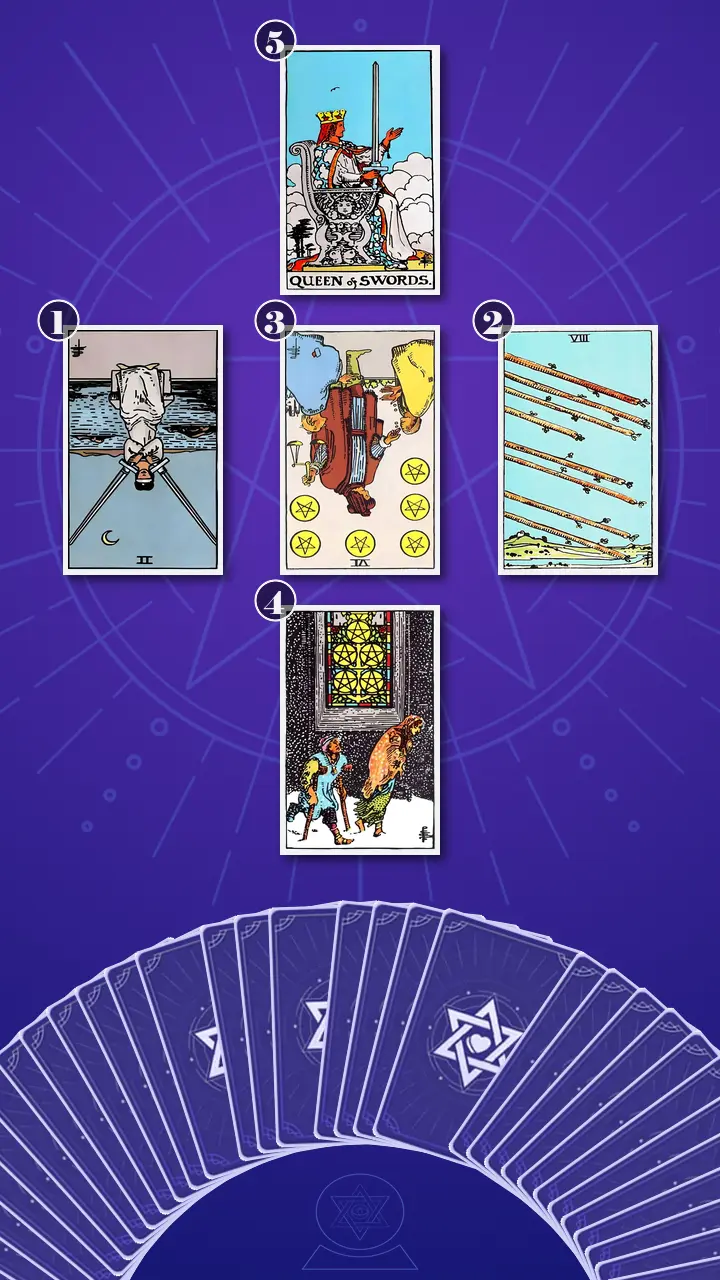
I laid the cards in a cross. The horizontal line would show Maya's response, the observable pressure coming towards her, and the exchange those energies created. The card beneath the centre would expose the fear supporting that exchange. The card above it would offer an integrating boundary practice, not a forecast of whether the relationship would succeed.
I chose this spread because five positions were enough to hold both sides of the interaction, the shared dynamic, the hidden obstacle, and Maya's agency. A larger Celtic Cross would have added unnecessary layers. A stay-or-leave spread would have asked the wrong question. Maya did not need a verdict about the partner's private motives; she needed a clear view of the sequence she could actually observe and change.
Where the Pause Collapsed
Position 1: The Two Swords Behind the Deleted Text
I began with the position representing the observable symptom: Maya loses access to her preferred pace and gives an answer before checking her readiness. I turned over the Two of Swords, in the reversed position.
I drew her attention to the blindfolded figure, the two swords crossed over the chest, and the unsettled water behind the body. Upright, this card can preserve a temporary holding space between competing options. Reversed here, that pause had become unstable. I read it as blocked Air: too much threat-scanning, too little room for a considered answer, and a useful delay collapsing into a quick yes.
"This is the 10:47 p.m. scene," I said. "You know you want more time, but holding the question open feels unbearable. The inner script runs: 'I know I want to slow down, but if I say that, they might pull away, so maybe I can agree now and feel the discomfort later.'"
The card did not tell me that Maya lacked a preference. It showed me that she used agreement to stop the immediate tension of having someone wait for an answer. The relief was real, but it was relief from pressure, not reliable evidence of readiness. It was like tapping "Accept" on a calendar invitation before checking her actual availability because the unresolved notification felt louder than her own capacity.
Maya gave a short laugh, but there was no amusement in it. Her fingertips stopped circling the rim of her mug, her eyes dropped to the crossed swords, and one corner of her mouth tightened. "That is so accurate it feels a bit brutal," she said.
"Then let us make the distinction less brutal and more useful," I replied. "You are not failing to know yourself. You are trying to end a threat response quickly. A freely chosen pause says, 'I have not answered yet.' A collapsed pause says, 'I must answer now so the warmth does not disappear.'"
I asked what she would have chosen if the other person had not been waiting. She answered without hesitation: "Another few weeks before making it official." I noted the speed of that reply. Her preference had not vanished. It had been edited out of the conversation.
Position 2: Eight Notifications Already in Flight
I moved to the position identifying the trigger Maya could directly observe: rapid messages, accelerated plans, and requests for immediate escalation, without pretending to know the partner's private motives. I turned over the Eight of Wands, upright.
Eight staffs flew through an open sky with no visible figure steering them. I translated them into the sequence Maya knew: "Are you free Friday?" followed by "Should we make this official?" followed by "Can you answer tonight?" A tentative connection could become a full relationship sprint backlog before she had checked her emotional capacity for the first request.
The card's Fire was active and unobstructed. Speed itself was not automatically harmful, and I would not use it to accuse the other person of manipulation. Some people genuinely prefer a faster pace. The difficulty emerged when that momentum met Maya's blocked pause and began to feel like an instruction rather than a proposal.
"The plan sounds decided before I have joined the decision," Maya said.
"Exactly," I replied. "Speed is not consent to speed. Their momentum is observable information. Your participation still requires your answer."
Her shoulders rose at the imagined notifications, then settled by a fraction. I saw recognition move through her in two stages: first the familiar brace, then a small nod as she separated another person's pace from her obligation to match it.
Position 3: The Private Cost of Being Easygoing
I turned to the centre, the position revealing the maintaining mechanism: Maya trades pace and preference for short-term reassurance, creating an unequal relational exchange. The card was the Six of Pentacles, reversed.
I pointed to the scales, the coins moving from one elevated hand, and the uneven positions of the figures. Reversed, the card showed Earth out of balance. Maya gave up time, sleep, privacy, an existing Friday plan, or a preferred relationship label. In return, she received an immediate sign that the connection was still warm. The practical cost was hers, while the terms of the trade remained invisible to the other person.
I pictured the narrow kitchen in her flatshare: the kettle clicking off, burnt toast leaving a bitter edge in the air, and a cancellation message to a friend sitting unread while Maya typed, "I am easy either way." One hand appeared to offer closeness. The other quietly surrendered brunch, a quiet Saturday, or the chance to think.
"You keep calling it flexibility because 'abandoning my pace' sounds too painful," I said. "But flexibility moves in more than one direction. This pattern leaves you privately counting what you conceded even though the other person may not know a concession occurred."
This was where I used my Toxic Script Identification lens. I was careful to name the script, not label either person as toxic. A destructive scene can be repeated by otherwise decent people. In this version, one role supplies momentum and the other edits out her own pace to preserve the mood. The problem is not that someone makes a request. The problem is that Maya's honest line never reaches the final cut, so there is nothing available for mutual negotiation.
As an artist, I have learned that continuity can make a film look smooth while concealing a missing scene. Maya's repeated yes created the appearance of seamless progress. Her resentment was the missing footage insisting that the story had skipped something essential.
She became very still. Her gaze lost focus as if she were replaying several weekends at once, and then her fingers slowly opened on the table. "I have been keeping a ledger they do not even know exists," she said. "Then I resent them for the balance."
"That does not make the pressure unreal," I said. "It tells us where your leverage is. You cannot negotiate a cost that remains in an unpublished draft."
Position 4: The Warm Window Maya Feared Losing
I descended to the position exposing the underlying fear: a request to slow down could lead to exclusion and be interpreted as evidence of low personal worth. I turned over the Five of Pentacles, upright.
Two figures moved through falling snow beneath an illuminated window. The warm light was visible, yet their attention remained fixed on the cold road. I saw the scarcity lens beneath Maya's quick agreement: she imagined herself outside the connection before she had gathered evidence about how this particular relationship could handle an honest difference in pace.
"The feared scene is not only that they might be disappointed," I said. "It is that their cooler tone, delayed reply, or missing heart emoji will mean, 'I was too difficult to choose.'"
Maya released a long breath through her nose. Her chin dipped, and her hand tightened once around the mug before loosening. "I do not want to find out they will not wait," she said. The admission carried both grief and relief: grief because incompatibility was possible, relief because the fear finally had a name.
"That possibility may hurt," I replied. "I will not cover it with 'the right person will always wait.' People can want different things, and a boundary cannot guarantee the outcome. But a reaction is information, not a verdict on your worth. Agreeing early can postpone that information; it cannot create mutual readiness."
The Five of Pentacles showed fear at an excess, narrowing Maya's attention until possible rejection looked like the only available future. The lit window reminded me that other forms of support remained present: her own judgment, friendships she did not have to cancel, and the possibility of negotiation. None guaranteed the relationship. All helped keep one response from becoming a measurement of her lovability.
When the Queen Put Maya's Voice Back in the Scene
Position 5: One Upright Sword, One Honest Answer
I reached the integrating position, the place where boundary language and a deliberate pause could restore freely chosen participation. The rain against my window had softened to separate taps. I turned over the final card, the Queen of Swords, upright.
Her sword stood vertical and visible. Her gaze was unobstructed. One hand held the line; the other remained open. I read this as mature Air in balance: discernment translated into concise speech, clarity without emotional withdrawal, and self-respect that left room for another person to respond.
I contrasted her with the first card. Maya had moved from two crossed swords held silently behind a blindfold to one sword shown clearly by someone who could see what she was choosing. The transformation was not from softness to hardness. It was from blocked discernment to voiced discernment.
In everyday language, the Queen sounded like this: "I like where this is going. I am not ready to decide that tonight. I will answer tomorrow." Interest. Limit. Timing. No defensive essay, no advance promise of a later yes, and no attempt to control the response.
I then used Dialogue Loop Auditing to slow Maya's recurring conversation down frame by frame. The external trigger was, "Can you answer tonight?" The internal trigger was, "If I slow this down, they will hear never." Her default line was, "I am easy either way." The short-term reward was continued warmth. The delayed cost was resentment, withdrawal, and less trust in her next preference. Once the loop was visible, we did not need to rewrite the whole relationship in one sitting. We needed to replace one line before the usual scene could gather momentum.
I asked Maya to picture the phone warm in her hand at 10:47 p.m., the brighter yes already forming, and tomorrow's resentment waiting behind it. She was caught between preserving intimacy and preserving authorship, as though only one could remain in the scene.
I said, "A boundary does not have to keep the connection intact. It has to keep your yes connected to what you freely choose."
You do not have to trade your pace for closeness; name a clear "not yet" and let the Queen's upright sword separate honest connection from pressured agreement.
The radiator clicked once, then the room went quiet.
I watched Maya's breath stop first. Her fingers remained suspended above the edge of the Queen, and her eyes widened as if the sentence had interrupted a familiar piece of dialogue mid-line. Then her gaze slipped past me towards the rain-dark window. I could almost see the memories passing through her attention: the cancelled brunch, the Northern line message, the morning she had brushed her teeth with a heavy stomach after agreeing too quickly. Her eyebrows drew together, and a flash of anger reached her voice. "But does that mean every time I said yes before, I was wrong?"
I let the question have space. Her anger softened into a tremor around her mouth; her eyes brightened, and her tightly raised shoulders slowly lowered. One hand opened fully on the table. When she exhaled, the sound came from deep in her chest, but relief was followed by a brief, exposed stillness. A clear choice meant she could no longer ask compliance to protect her from uncertainty.
"No," I said. "It means those answers were attempts to keep you connected when connection felt fragile. We can respect what that strategy was trying to do without asking it to direct the next scene."
I invited her back into lived evidence. "Now, with this new view, think about last week. Was there a moment when this insight could have made the scene feel different?"
"Friday on the Northern line," she said. "They asked me to stay all weekend and meet their friends. I recorded 'Can I think about it?' and deleted it. If I had kept the recording, I still would have been scared. But at least the answer would have belonged to me."
I heard the key shift in that sentence. This was not instant confidence or a promise that fear would disappear. It was the first movement from apprehensive, reassurance-seeking compliance to clear, self-respecting participation at a freely chosen relationship pace. A clear boundary keeps Maya's voice inside the connection, while the other person's response remains outside her control.
The Pace-Pause Rewrite
I gathered the spread into one coherent sequence. Maya's work had trained her to treat fast Slack replies and friction-free accommodation as competence. In dating, the same polished reflex met the Eight of Wands: a fast message became a rushed answer. The Two of Swords reversed showed the pause collapsing; the Six of Pentacles reversed showed the private reassurance bargain; the Five of Pentacles revealed the feared exclusion beneath it. The Queen of Swords supplied the missing line: interest could remain visible while pace became explicit.
The spread's absence of Cups mattered to me. Maya's feelings were not absent from her body. They were present in her throat, breath, stomach, and later resentment, but they had not been translated into speech before practical commitments were made. The cards did not need to manufacture intuition. They helped her move existing emotional information into language.
I named the cognitive blind spot plainly: Maya had been treating the other person's reaction as a verdict on whether her boundary was valid. That made her pace seem like currency she had to spend to buy continued warmth. The transformation direction was equally plain: take a time-limited pause, identify what she would choose without an audience, and state one preference before discussing alternatives.
I told her that finding clarity did not require a dramatic confrontation. It required actionable advice small enough to use while her throat was still tight. Together, we built two next steps around the key shift: a 24-hour pause and one concise interest-plus-limit statement before agreeing to any relationship escalation.
Two Next Steps for the Next Fast Request
- Save the Pace PauseBefore the next date, create a phone shortcut in Notes called "Pace Pause" containing: "I want to think about that and answer tomorrow." Use it whenever a request changes exclusivity, contact frequency, scheduling, physical intimacy, or labels. Set a reminder for the same time the following day, then spend no more than five minutes answering privately: "What would I choose if nobody were waiting for my reply?"If 24 hours feels impossible, use the ten-minute version. Send no substantive answer until the timer ends. If more messages arrive, repeat the timing once instead of inventing a longer explanation.
- Rehearse the Pattern Interruption ScriptAt home, role-play the known trigger once: imagine hearing, "Can you answer tonight?" Then say aloud, "I like where this is going. I am not ready to decide that tonight. I will answer tomorrow." In the real conversation, use the prepared line before offering compromises, and take one full breath rather than filling the silence with an apology.Keep the script to three short parts: interest, limit, timing. If the full version feels too exposed, use: "I am interested, and I am not ready for that yet." Maya remained free to stop the conversation for the evening and return when she chose.
I called the second practice the Pattern Interruption Script because it changed one repeatable piece of dialogue instead of demanding a new personality. Maya did not have to become cold, perfectly composed, or immune to disappointment. She only had to prevent the easygoing yes from automatically taking the next line.

A Week Later: The Quiet Proof
Six days later, I received a message from Maya. A request had arrived to spend the whole weekend together. She had felt the familiar clamp in her throat, pasted the Pace Pause, and put her phone down long enough to make tea. The other person replied that they had hoped for an answer that night but could wait until tomorrow. Maya noticed the disappointment without rushing to erase it.
The next morning, she decided she wanted one evening together, not the full weekend. She sent the interest-plus-limit sentence and kept her museum plan with her friend. She did not tell me the entire relationship had been solved, because it had not. She sent something more credible: "I slept through the night. My first thought was still, 'What if I got it wrong?' I actually laughed. The fear was there, but it was not typing for me."
I thought again of the Queen's sword and open hand. Tarot had not made Maya's choice, guaranteed the connection, or removed the risk of incompatible needs. It had given her an objective picture of the old script long enough for her to choose a different line. She remained the author of what happened next.
I want to leave the focus where it belongs: with the person holding the pen. When someone wants an answer now, many of us know the moment when the throat tightens and a real preference disappears behind an easy yes, because losing our pace can feel safer than risking the warmth leaving the room. Simply noticing that split means the old script is visible, even if the next scene still carries uncertainty.
If your next "not yet" were allowed to be information rather than a verdict on your lovability, what small truth would you write into the Queen's three-line script before anyone else's momentum enters the scene?
This story is adapted from psychological research, written so that those in a similar struggle can see their own pattern in it — and find their next step clearly.These insights are not a substitute for professional psychological, medical, legal, or financial advice.
Learn more about our Journey to Clarity.
How did this insight land for you?
🫂 This Resonates Deeply
🌀 Living This Story
✨ Now I See Clearly
🌱 Seeing New Possibilities
🧰 Useful Framework
🔮 The Confirmation I Needed
💪 Feeling Empowered
🚀 Ready for My Next Step
Author Profile
 AI
AI“I’ve always felt our lives are films currently in production. As an artist, I know that when you feel stuck, it’s often because you’ve bravely stayed in a painful scene for just a little too long. I’m not here to coldly analyze you. I want to sit closely with you, look at those difficult moments with profound empathy, and gently hand you the pen so you have the courage to write your next beautiful act.”
In this Love Tarot Reading :
Core Expertise
- Toxic Script Identification: Recognizing the repetitive, destructive roles you both automatically play (e.g., the Savior and the Victim) during conflicts.
- Dialogue Loop Auditing: Analyzing the specific triggering phrases that consistently escalate your arguments into dead ends.
Service Features
- The Pattern Interruption Script: A creative role-play directive to consciously change your default response to a known trigger, forcing the relationship dynamic to shift.
Also specializes in :
Explore Related Patterns:
Fawning ResponseMaya's throat tightens and stomach braces before she deletes the sentence asking for more time, sends an agreeable yes, and cancels brunch. When the affectionate reply arrives, her breathing loosens for a few minutes, showing how quickly compliance is rewarded with temporary relief. A fawning response uses appeasement to reduce perceived relational threat. You may still know exactly what you want, but the body prioritises restoring warmth over expressing it, so the safer-looking answer appears before your real preference can reach the conversation.
Self-AbandonmentMaya can name the pace she wants until a partner asks out loud, at which point she cancels plans, accepts escalation, and describes the concession as flexibility. Her body continues to register the lost preference through tension, sleeplessness, and resentment even after the conversation looks settled. Self-abandonment occurs when you preserve access to a relationship by repeatedly overriding information from your own needs, limits, and commitments. The strategy protects connection in the immediate moment, but it weakens trust that your next preference will remain intact when someone else's momentum enters the room.
Self-SilencingMaya deletes both the written request for more time and the later voice recording asking to think, then substitutes language such as being easy either way. Her preference is clear in private, but it is edited out before the other person has any chance to receive or negotiate it. Self-silencing moves potential disagreement out of the relationship and into your body, sleep, and later resentment. The pattern is not an inability to know yourself; it is the repeated removal of your knowledge from the shared conversation because expressing it seems more dangerous than carrying the cost alone.
Transactional IntimacyMaya gives up brunch, quiet time, sleep, privacy, and her preferred relationship timeline, then receives an affectionate reply and a few minutes of relief. Because the concession remains unpublished, the other person sees agreement while Maya privately absorbs the cost. Transactional intimacy turns accommodation into currency for continued warmth. You may appear to be freely giving closeness, but the hidden psychological bargain is that the concession should protect the connection, which prevents mutual negotiation and leaves an invisible ledger behind.
Conditional Self-WorthMaya fears that disappointment, a cooler tone, or a delayed reply will mean she was too difficult to choose. The partner's reaction is therefore asked to perform two jobs at once: respond to a difference in pace and certify whether Maya's needs are acceptable. Conditional self-worth makes accommodation feel like the price of remaining lovable. When you rely on continued warmth to validate your boundary, a slower pace can feel illegitimate until another person approves it, even though compatibility and personal worth are separate questions.
Rejection SensitivityMaya predicts that not yet will be heard as never, while a cooler tone, delayed reply, or missing heart emoji is imagined as evidence that she is about to be excluded. The anticipated rejection becomes psychologically active before this partner has actually responded to an honest boundary. Rejection sensitivity magnifies uncertain social cues and makes preventive compliance feel rational. You end up answering the rejection your mind predicts rather than the request in front of you, trading away pace to avoid discovering whether the feared outcome would occur.
Boundary DiscernmentMaya names another few weeks as her preferred timeline when no one is waiting, then later chooses one evening instead of a full weekend and keeps her museum plan. These choices separate the partner's invitation from her participation, allowing two different preferences to exist without automatically making either one wrong. When you use boundary discernment, a request becomes information rather than an instruction. The aim is not to guarantee that the connection remains warm; it is to keep your eventual yes connected to what you freely choose while leaving the other person's response outside your control.
Reflective DistanceMaya's 24-hour pause, the phone placed down while she makes tea, and the private question about what she would choose without an audience interrupt the original 10:47 p.m. sequence. The extra time lets her sort an observable request from the prediction that any delay will destroy the connection. Reflective distance does not require the fear to disappear before you act. It allows you to notice that a frightened thought is one input rather than a command, creating enough mental space for readiness, capacity, and existing commitments to re-enter the decision.
Cognitive DissonanceMaya calls herself flexible and says she is easy either way, yet the warm chat is followed by a braced body, lost sleep, and resentment over concessions the other person cannot see. Her public explanation and private experience therefore carry incompatible versions of the same decision. Cognitive dissonance is reduced temporarily by renaming an unwanted concession as adaptability. You gain a smoother immediate story, but the suppressed contradiction continues to surface through discomfort and private scorekeeping until the stated answer and actual preference are brought back into alignment.
Explore Related Struggles:
Agreement-Agency SplitAt 10:47 p.m., Maya sends an agreeable answer and immediately begins rearranging her calendar, yet her body remains braced and she later identifies a different choice. The yes performs the practical function of ending the wait and maintaining warmth, but it does not carry her actual readiness into the decision. You can therefore appear to be participating while your agency remains outside the answer. The central split is not between knowing and ignorance; Maya knows what she wants when the demand is removed. It is between the agreement another person receives and the choice you would make with enough room to hear yourself.
Approval-Safety FusionMaya imagines a cooler tone, delayed reply, or missing heart emoji and reads those possible reactions as evidence that she was too difficult to choose. After she agrees, the affectionate reply loosens her breathing, but only briefly; reassurance arrives as a temporary safety signal rather than evidence that the decision fits her. When approval carries this much authority, a boundary can feel valid only after someone else welcomes it. You are then pushed to secure the reaction before checking the choice, making continued warmth the price of trusting yourself. Separating their response from your worth allows disappointment or incompatibility to remain information without turning it into a verdict on whether you were allowed to speak.
Relational Pacing CollapseThe 10:47 p.m. text, the deleted Northern line recording, and the weekends Maya mentally replays all follow the same sequence: a request accelerates, her body braces, the pause disappears, and the faster option enters the calendar. Her preferred pace is still identifiable in private, but it repeatedly fails to survive the live interaction. When this structure locks in, there is no longer a visible discussion between two different speeds. Your pace is removed before negotiation begins, allowing the other person's momentum to become the relationship's default. Reintroducing even a time-limited pause changes the structure by giving your answer a place to exist before any commitment is made.
Relational Pacing StrainMaya can name her preferred pace immediately when nobody is waiting: she wants another few weeks. When a partner asks for an answer that night, however, her throat tightens, the sentence asking for more time is deleted, and another person's momentum meets her own timing as a competing instruction. When you are inside this strain, interest and hesitation can both be genuine. The struggle comes from trying to preserve the developing connection without letting its speed decide for you. Keeping a pause inside the conversation allows your participation to remain freely chosen, even when the other person's response cannot be controlled.
Self-Erasure ReliabilityMaya says "I am easy either way," cancels brunch, gives up quiet time, and removes the sentences that would reveal a different pace. The interaction looks smooth because she becomes reliably accommodating, while the information that could create friction is edited out before anyone else has to meet it. When reliability is maintained through self-removal, you can become dependable to the relationship's momentum while becoming less able to trust your own next preference. The cost is not simply one unwanted plan; it is the repeated experience of watching your voice disappear at the moment participation is being decided. One concise limit keeps dependability from requiring your absence.
Truth-Connection SplitMaya records "Can I think about it?" on the Northern line and deletes it before sending. She predicts that an honest "not yet" will be received as "never," so truth and continued connection appear unable to occupy the same exchange. When you are caught in this split, speaking plainly can feel less like sharing information and more like gambling the entire bond. The relationship may stay warm after an easy yes, but the part of you that needed time has not been included in that warmth. Leaving the honest sentence in the conversation creates the possibility of connection that can respond to your real pace rather than to an edited version of you.
Unseen Cost BindEach quick yes costs Maya something concrete: sleep, privacy, friendship plans, a quiet weekend, or several weeks of preferred relationship pacing. Because she presents the change as effortless flexibility, the other person may never know that a concession occurred, while Maya privately keeps the ledger and later feels its balance. When the cost remains unpublished, you are left carrying both the sacrifice and the accounting for it. Resentment cannot lead to mutual adjustment when the preference behind it never entered the exchange. Naming time, capacity, or pace makes the real terms visible without requiring blame, allowing both people to respond to the same information.
Explore Related Emotions:
Cautious Self-TrustSix days later, Maya uses the saved pause, puts down her phone, and decides the next morning that she wants one evening together rather than the whole weekend. She sends that answer, keeps the museum plan with her friend, and sleeps through the night. Her first thought is still that she might have got it wrong, but that thought no longer writes the message. Cautious Self-Trust describes the developing sense that you can use your own preference as valid information without first obtaining certainty, perfect composure, or another person's approval.
Conditional Belonging FearThe chat stays affectionate after Maya agrees, and her breathing loosens for a few minutes. She also imagines that a cooler tone, a delayed reply, or a missing heart emoji after a boundary could mean that she was too difficult to choose. This makes warmth feel conditional on matching the other person's pace. Conditional Belonging Fear names the inner weather created when you experience continued closeness as something that must be purchased through accommodation, so a slower answer feels less like information and more like a possible exit from belonging.
Liberating UncertaintyMaya is told plainly that a boundary cannot guarantee whether the relationship will continue, and the later pause does not remove that unknown. The other person says they had hoped for an answer that night but can wait, while Maya allows their disappointment to remain visible without rushing to erase it. Uncertainty stops functioning as an emergency that must be closed with compliance. Liberating Uncertainty names the space that opens when you accept that another person's response is outside your control while recognising that your timing, judgment, friendships, and ability to negotiate remain available to you.
Preference Exposure DreadMaya can name her preferred relationship pace in private and immediately answers that she wants another few weeks when no one is waiting. The difficulty arrives when that preference must become visible to a new partner, because not yet is expected to be heard as never. That expectation turns ordinary self-disclosure into a high-stakes exposure of whether she will still be considered desirable. Preference Exposure Dread captures the moment when you know what you want but fear that saying it aloud will make your needs look like evidence against your lovability.
Regulated CourageWhen the next fast request arrives, Maya still feels the familiar clamp in her throat. She pastes the pause, puts down the phone long enough to make tea, and later states both her interest and her limit without disappearing from the connection. The physical response remains present, but it is no longer operating the keyboard. Regulated Courage captures the experience of acting with the body still activated while giving yourself enough structure to speak deliberately, allowing you to protect your pace without demanding that all apprehension vanish first.
Self-Betrayal AcheMaya sends that the faster pace works for her, cancels brunch, and then lies awake while the chat remains warm and her body does not. Her actual preference has not disappeared; it has been removed from the conversation before the relationship can respond to it. The agreement preserves the surface of connection while separating her outward yes from her inward choice. Self-Betrayal Ache describes the private pain that follows when you protect closeness by abandoning information you already possess about your own readiness.
Ambiguity DreadAt 10:47 p.m., Maya watches the cursor blink after writing that she needs more time, then deletes the sentence and sends an immediate yes. The unanswered space becomes so physically charged that ending the wait feels more urgent than checking whether the answer fits. On the Northern line, she repeats the sequence by recording a request to think and deleting it. If you recognise this pattern, Ambiguity Dread does not mean you have no preference; it names the strain of leaving a relational question open when immediate agreement seems like the fastest way to keep the atmosphere warm.
Hidden ResentmentMaya describes keeping a ledger that the other person does not know exists. Each easygoing answer conceals surrendered time, cancelled plans, lost sleep, or a quieter weekend, so the practical cost accumulates without ever becoming available for mutual negotiation. Because the concession remains unpublished, the relationship appears smoother than it feels from inside her experience. Hidden Resentment captures the delayed reaction that can build when you repeatedly say yes to preserve the mood and then privately carry the balance of everything that yes displaced.
Alignment ReliefThe next morning, Maya chooses one evening together, communicates that limit, and keeps the museum plan already in her calendar. Her spoken answer, actual preference, bodily response, and practical schedule are no longer pulling in separate directions. She does not report that the relationship is solved; she reports that she slept through the night. Alignment Relief describes the quieter release that can arrive when your yes or not yet belongs to you, reducing the hidden work required to maintain an agreement that never matched your readiness.
Clarity ReliefWhen Maya is asked what she would choose if the other person were not waiting, she answers without hesitation: another few weeks. Separating the request, the prediction of rejection, and the preference itself shows that her pace was never absent; it had been edited out under pressure. The distinction also releases her from treating every bodily alarm or imagined reaction as proof that she must agree. Clarity Relief emerges when you can finally see that knowing what you want and feeling able to say it are separate processes, giving you a more accurate place from which to choose.
Emotional HangoverThe affectionate reply loosens Maya's breathing for a few minutes, but she later lies awake with the phone face-down beside her and pressure held in her stomach. She recalls other mornings when an answer given too quickly remained present in her body after the conversation had ended. The immediate reassurance has expired while the deferred cost is still being processed through sleep, tension, and disrupted plans. Emotional Hangover names the lingering aftermath you may feel when a quick agreement successfully ends the social pressure but does not resolve the mismatch between the commitment and your readiness.
Explore Related Contexts:
Premature Commitment PressureAt 10:47 p.m., Maya deletes 'I need a little more time' and agrees to a relationship step she would independently postpone for several weeks. Later requests combine a full weekend, meeting friends, and an immediate answer, so several forms of commitment are placed on the table before she has evaluated the first one. When a developing connection moves faster than your readiness, a proposal can begin functioning like a deadline even without evidence of malicious intent. Premature Commitment Pressure names the external stage in which labels, time access, and social integration are being advanced before your preferred pace has entered the negotiation. An immediate yes preserves continuity for the moment, but it leaves the actual commitment terms unresolved.
Readiness Mismatch CycleMaya can answer immediately when asked what she would choose without an audience. She wants several more weeks before making the relationship official. The developing partner is already proposing official status, immediate answers, full weekends, and introductions to friends, placing two different readiness timelines inside the same connection. A Readiness Mismatch Cycle forms when the difference is repeatedly settled through compliance rather than made available for negotiation. Neither pace has to be inherently wrong for the mismatch to create pressure. When your slower timeline remains unpublished, the faster timeline becomes the only visible plan, and every early yes conceals the evidence that the relationship is moving at a pace you did not freely select.
Relationship Autonomy NegotiationSix days later, Maya receives another request for the full weekend, sends the prepared pause, and answers the next morning with a preference for one evening. The partner acknowledges wanting an earlier answer but waits, and Maya keeps the museum plan she had already made with her friend. Relationship Autonomy Negotiation is present because both people's preferences remain visible without either one automatically becoming the rule. You can recognise the other person's disappointment, interest, or faster pace while retaining authority over your own time and level of commitment. The connection is no longer organised by silent compliance. It becomes a live negotiation in which your answer can differ and still participate in the relationship.
Response Time PressureThe WhatsApp cursor is still blinking when Maya deletes her request for more time, and the Northern line voice note asking to think is also removed before it can be sent. In both scenes, the relationship question is paired with a live expectation that she should answer while the other person is waiting. Response Time Pressure shifts decision authority by making another person's preferred timing feel like the timetable you must use. The issue is not merely fast messaging. You are being asked to produce consequential answers before you have checked readiness, existing commitments, or available capacity. The repeated deadline turns silence and delay into apparent relational risks, which makes quick agreement the most accessible way to end the immediate pressure.