Day-of Confirmation Anxiety and the 2 a.m. Texting Limbo
You’ve typed “still on for tonight?” then deleted it, then retyped it with a joke, then added “no worries if not!”—because the fear of sounding needy is louder than your actual need.
When Alex came into my café in Toronto, she sat down like someone trying to look casual while carrying a backpack full of bricks. The street outside still had that weekday-after-work edge—cars hissing over damp pavement, a TTC streetcar bell in the distance, people walking fast like they had somewhere to be even if they didn’t.
“It’s not even the canceling,” she said, pulling her phone from her tote like it had its own gravity. “It’s the waiting.”
She described the same scene I’ve heard in a hundred variations—8:47 p.m. on a Tuesday, lying in bed in a downtown apartment, blue phone-glow on the ceiling, radiator clicking in little metallic sighs. She refreshes iMessage again. Her jaw tightens. Her fingers keep reaching, like the phone is a hot pan she can’t stop touching. She drafts a check-in text she doesn’t even want to send, because she wants closeness, but she’s terrified that needing clarity makes her “too much.”
Texting limbo turns a normal plan into a full-time job in your head.
As she talked, I watched her body do what her words didn’t fully admit: shoulders inching up, breath getting shallow, a little swallow like she was trying to push the feeling down her throat. That particular kind of anticipatory dread always reads to me like being over-caffeinated on an empty stomach—your mind buzzing, your chest tight, and no real fuel under it.
“I get it,” I told her, keeping my voice soft but steady. “We’re going to aim for something really practical today: not ‘how do I care less,’ but how do we create clarity so your brain can stand down. Let’s try to draw a map for the fog.”

Choosing the Compass: The Relationship Spread · Context Edition
I slid a small espresso toward her—not as a cure, just as a comfort. In my café, coffee isn’t a performance. It’s a pause. I asked her to take one slow breath before she sipped, the way I do when I’m teaching a new barista: focus first, then move.
While she held her question in mind—They only confirm plans day-of. What boundary stops my overthinking?—I shuffled my well-worn tarot deck on the marble table. Not as a mystical show. As a transition. A way of telling the nervous system: we’re doing something different now.
“Today I’m using a spread I call the Relationship Spread · Context Edition,” I said. “It’s built for relationship communication boundaries—especially when the issue is relational, but the solution has to be self-led.”
For you reading this: the reason this spread works for day-of confirmation anxiety is that it separates three things people blur together when they’re spiraling: your internal response, their planning style, and the loop the two of you accidentally create. Then it drops down into what you can actually control (structure) and what’s inflaming the whole thing (the psychological trigger), before landing on the exact boundary language that reduces ambiguity.
“The first card shows you right now—what you do when plans aren’t confirmed,” I told Alex. “The second shows them—without judging, just their style. The third is the dynamic between you. And the last card is the boundary: the words and follow-through that end the mental noise.”
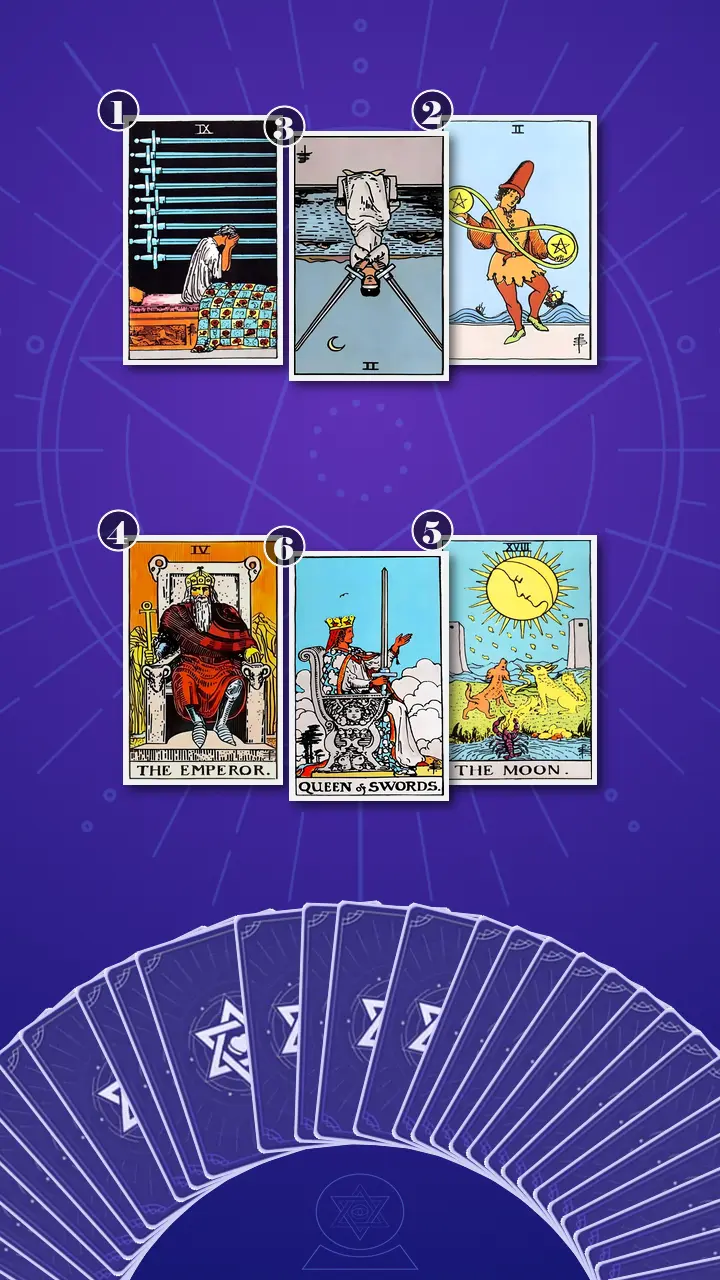
Reading the Map: Six Cards, One Boundary
Position 1: Your Overthinking Loop
“Now we turn over the card representing you right now: your observable mental/behavioral response when plans aren’t confirmed,” I said.
Nine of Swords, upright.
I didn’t even need to reach for a poetic interpretation. The card did it on its own: the person upright in bed, hands over their face, swords lined up like intrusive thoughts you can’t turn off.
“This is late, you’re in bed, and the plan still isn’t confirmed,” I said, using the plainest translation possible. “You reread the thread like it’s evidence, draft three versions of ‘still on?’—one casual, one funny, one overly polite—and your body stays on alert. Tight chest. Clenched jaw. Like the outcome will decide your worth by morning.”
The energy here is excess Air: too many thoughts, too much interpretation, not enough grounding. In my café language, it’s like over-extraction—when water runs through the grounds too long, and what you get isn’t more coffee, it’s more bitterness. Overthinking feels like “getting more information,” but it’s actually extracting pain from uncertainty until it tastes like certainty.
I leaned in a little, gentle but clear. “Let’s do the courtroom version your brain is already doing.”
“Exhibit A: they watched your story.”
“Exhibit B: no reply.”
“Exhibit C: you don’t want to look needy.”
“Verdict: you’re an option.”
Alex let out a small laugh that had no humor in it. Her shoulders held tight anyway.
“That’s… yeah,” she said. “It’s so accurate it’s almost mean.”
“It’s not mean,” I said. “It’s patterned. And patterns can be changed.”
Position 2: Their Planning Style (No Moral Verdict)
“Now we turn over the card representing them right now: their likely planning/communication style,” I said.
Two of Pentacles, upright.
“This is the juggler,” I told her. “They’re not necessarily trying to mess with you—they’re juggling. They confirm based on how the day shakes out: work runs late, social energy changes, other plans compete. To them, it’s adaptability; to you, it feels like your time is endlessly adjustable and always second in line.”
The energy here is balance under motion: not evil, not careless by default—just someone used to living inside an infinity loop of ‘we’ll see.’ And when that infinity loop meets your Nine of Swords, your mind starts trying to solve their flexibility like it’s a riddle you can win.
“Their uncertainty doesn’t get to rent space in your calendar for free,” I added, and I saw Alex’s eyes flick up—like that sentence landed somewhere under her ribs.
Position 3: The Shared Dynamic (Where You Go Silent)
“Now we turn over the card representing the relationship dynamic: the interaction pattern created when your need for clarity meets their day-of confirmation habit,” I said.
Two of Swords, reversed.
“This is the part of you that tells yourself you’re being chill,” I said, “but you’re actually frozen.”
In modern life: you don’t book a class, don’t text other friends back, don’t start cooking—because you’re bracing for a last-minute yes or no. Your defenses are crossed (no direct ask), and the pressure builds until you either overtext or go cold.
Reversed, the energy is blockage collapsing into overwhelm. The blindfold isn’t peaceful; it’s sensory deprivation. Your nervous system can’t regulate without information, so it makes information out of anything—punctuation, response time, Instagram story views.
Alex nodded once, tight. She didn’t look at the card; she looked at the edge of the table, like she was seeing her own calendar with that suspicious “pending” gap.
Position 4: Your Strength (The Structure You Can Control)
“Now we turn over the card representing strengths you can use: the personal resource that helps you set structure and protect your time,” I said.
The Emperor, upright.
This card always feels like a deep exhale in the middle of a messy story. Stone throne. Armor. A calm, pre-decided standard.
“You already have this,” I told her. “You decide—before you’re triggered—that your time has a structure. You treat your calendar like a protected resource. Weeknights need a confirm-by time, and if it doesn’t happen you don’t ‘wait harder’—you choose your own plan. It’s not a power move; it’s self-leadership.”
The Emperor’s energy is containment. Not coldness—containment. In my world, it’s espresso machine maintenance. If I don’t do the boring, scheduled care—clean the group head, check the pressure—everything gets chaotic during the rush. Not because the machine is “bad,” but because structure is what makes consistency possible.
Alex’s shoulders dropped a fraction, like her body recognized the relief of a policy.
“I could do that,” she said, then immediately grimaced. “But it’s the awkward part. Like… who am I to set rules?”
“You’re the person who has to live inside your own evening,” I said. “That’s who.”
Position 5: The Trigger That Fuels the Spiral
“Now we turn over the card representing the challenges that fuel overthinking: the psychological trigger that keeps the uncertainty loop alive,” I said.
The Moon, upright.
The café seemed to go quieter for a second—just the low hiss of steaming milk behind the counter, a spoon tapping ceramic somewhere far away. The Moon always does that. It changes the light in a room.
“This is Moon-fog storytelling,” I told her. “The silence becomes a fog where your brain starts making up street signs. You read into response times, punctuation, story views. Your body scans for danger, and you try to solve uncertainty with interpretation—until the situation feels heavier than the plan ever was.”
The energy here is excess Water—emotion and imagination filling gaps where facts aren’t available. It’s like the algorithm filling in the blanks: no data, so your brain serves you the most emotionally sticky story.
This is where my Stress Flavor Profile lens always clicks into place: Moon-fog makes you over-extract. You keep running water through the same grounds—checking, scanning, re-reading—trying to get something clean. But what you get is more bitterness and a racing heart. Not because you’re dramatic. Because your system is trying to create safety out of ambiguity.
Alex’s mouth tightened; she swallowed, then let out a slow breath. “The worst part,” she said, “is I can feel myself doing it. Like I’m on the King streetcar, the lights are flickering, and I’m convincing myself a story view is evidence.”
“Exactly,” I said. “So the fix isn’t ‘interpret better.’ It’s ‘change the informational environment.’”
When the Queen of Swords Drew a Line in Daylight
Position 6: The Boundary That Stops Overthinking
I let my hands rest on the deck for a beat. “We’re turning over the integrating advice now,” I said, “the boundary language that reduces ambiguity and stops the cycle.”
Queen of Swords, upright.
Her sword is raised—not to threaten, but to be unmistakable. And her open palm says: I’m available, and there are conditions.
In real life, this is daylight language. Not paragraphs. Not disclaimers. Not a closing argument designed to manage someone else’s reaction. It’s one line, and then your life continues.
Here’s the setup I named out loud, because Alex wasn’t the only person who needed to hear it: it’s that 5 p.m. moment—Slack quiet, phone in your hand, calendar still blank—like your night is paused until someone else decides whether you’re worth confirming. That pause is the trap.
Not endless "maybe" waiting—name a clear deadline and cut the mental noise with the Queen’s single, upright sword.
Alex had a reaction chain so physical it made the whole reading feel real in my bones: first, she went still—breath paused, fingers hovering above the lip of her cup. Then her eyes unfocused for a second, like her mind replayed every “pending” evening in fast-forward. Then she exhaled, long and shaky, and her shoulders lowered as if she’d been holding a bag she forgot she was carrying.
“But if I do that…” she started, and there was a flash of anger under the fear. “Doesn’t it mean I’ve been doing it wrong? Like I’ve been letting this happen?”
I kept my voice warm. “It means you learned a survival strategy—stay easygoing, stay available—and it helped you avoid a clear no. That’s not ‘wrong.’ It’s just expensive.”
I tapped the Queen’s sword lightly with my fingertip. “This isn’t punishment. It’s clarity. A deadline isn’t an ultimatum—it’s a door you close so you can live your evening.”
And then I invited her in, right on the edge of the insight: “Now, with this new lens—time-based and action-based—think back to last week. Was there a moment when you checked your phone for the fifth time, and if you’d had a confirm-by time, your body would’ve softened instead of tightening?”
Her eyes got a little glossy, not in a dramatic way—more like her nervous system was relieved to be understood. “Thursday,” she said. “I literally didn’t eat dinner because I kept thinking I’d have to ‘be ready’ if they texted.”
“That,” I said gently, “is the shift beginning—moving from anticipatory dread and self-doubt to relieved clarity and self-respect. Not because they changed, but because you did.”
The One-Line Boundary and the Backup Plan
I slid the cards into a clean line and told her the story they’d been telling all along.
“When plans aren’t confirmed, you go into Nine of Swords—your mind turns into a courtroom and your body pays the bill. They operate like the Two of Pentacles—juggling, flexible, deciding late. Together, you land in Two of Swords reversed: you go quiet to seem chill, then resent the silence, then feel forced into last-minute decisions. The Moon is the accelerant—no facts, so your brain writes plot. The Emperor says: make a policy. And the Queen of Swords says: speak it once, clearly, then follow through.”
“Here’s the blind spot,” I added, because this is where people usually slip: “You’ve been treating a direct boundary like it’s a referendum on whether you’re ‘needy.’ But the real issue isn’t your need. It’s the open loop. You’re not asking for devotion. You’re asking for scheduling clarity.”
Then I gave her next steps that were small enough to do, even if her stomach flipped while doing them. I didn’t want a grand speech. I wanted a working system—confirmation deadline and backup plan—so her evening didn’t stay on hold.
- Write Your Weeknight Policy (The Emperor)Open your Notes app and write one sentence: “For weeknights, I need confirmation by ___ p.m.; if not, I make other plans.” Screenshot it so Future You can’t pretend you didn’t decide.If you’re unsure, start with a softer window (like 3 p.m.) and adjust later—policies can evolve, but they must exist.
- Send the Daylight Deadline Text (Queen of Swords)Send one clean line: “Hey—just so I can plan my night: if I don’t hear by 4 p.m., I’ll assume it’s not happening and I’ll make other plans.” Then stop talking.One line. No courtroom. No closing argument. If you feel the urge to add jokes/disclaimers, you’re negotiating yourself.
- Close the Maybe: DND + a Physical Task (Two of Swords Reversed)After you send the text, put your phone on Do Not Disturb for 60 minutes. During that hour, do one physical thing you need anyway (groceries, laundry, a brisk walk).If an hour feels impossible, do 20 minutes. In my café I call it a “riposo for your nervous system”—a scheduled pause so you don’t over-extract your mind.
I also used one of my own little diagnostics, because Alex’s body was giving us data. I nodded at the cappuccino in front of her; the foam had fallen and the cup had cooled fast.
“That’s a Cup Temperature Scan,” I told her. “When your energy drops this quickly, waiting time feels twice as loud. So your boundary isn’t just social—it’s physical. You’re not being ‘too much.’ You’re being over-spent.”
“Default-no,” I said, and watched her flinch a little, “and then self-yes. If the confirmation doesn’t happen by your time, your plan isn’t ‘sit and seethe.’ Your plan is: go live your evening.”

A Week Later: The Quiet Proof
A week later, Alex messaged me a screenshot. One line sent at 11:58 a.m. Another line received at 5:17 p.m. And in between: nothing. No frantic follow-ups. No spiral paragraphs.
“I did it,” she wrote. “I set 4 p.m. I put my phone on Focus. I booked a class. They texted late, and I said I made other plans. My hands were shaking, but… I ate dinner like a normal person.”
She didn’t sound euphoric. She sounded steady. That’s what clarity often looks like in the real world.
Submitted the class booking, then celebrated by sitting alone at a café for twenty minutes—warm cup in both hands, a little lonely, a little proud. The night wasn’t perfect, but it was hers.
When I think about her reading, I think about what the cards did best: they didn’t tell her what they meant. They showed her what the pattern meant—and exactly where her leverage was. Clarity became a standard, not a craving.
When plans stay unconfirmed, it can feel like you’re standing in the hallway with your coat on—trying to look chill while your chest tightens, because asking for clarity feels like risking the truth about whether you matter.
If you gave your evening a confirm-by time this week, what would you want to do with the freed-up mental space between “sent” and “answered”?
This story is adapted from psychological research, written so that those in a similar struggle can see their own pattern in it — and find their next step clearly.These insights are not a substitute for professional psychological, medical, legal, or financial advice.
Learn more about our Journey to Clarity.
How did this insight land for you?
🫂 This Resonates Deeply
🌀 Living This Story
✨ Now I See Clearly
🌱 Seeing New Possibilities
🧰 Useful Framework
🔮 The Confirmation I Needed
💪 Feeling Empowered
🚀 Ready for My Next Step
Author Profile
 AI
AI“For twenty years, I’ve listened to stories unfold over the warm aroma of coffee. I don’t believe life’s complexities always require grand theories to be solved; often, we just need a safe place to tidy up our reality. I don’t offer high-minded preaching—just grounded, heartfelt insights to help you regain your sense of control amidst the clutter of daily life.”
In this Introspection Tarot Reading :
Core Expertise
Service Features
Also specializes in :
Explore Related Patterns:
Anxiety SpiralAlex refreshes iMessage, rereads the thread, drafts several versions of the same check-in, and watches her evening shrink around an unconfirmed plan. The behavior is visible and repetitive: each missing reply creates another round of checking, interpretation, physical tension, and mental bargaining. The mechanism is an uncertainty loop. Your brain treats ambiguity as a threat to resolve, so it keeps scanning for evidence, but the scanning creates more material to fear. Response time, punctuation, and story views become emotional data points, even though they cannot give the certainty your nervous system is trying to extract. Anxiety Spiral fits because the problem is not simply caring about the plan. It is the way the open loop recruits your attention, body, and self-worth into a feedback cycle. The boundary works because it changes the system from endless interpretation to a clear decision point: after the confirm-by time, your evening belongs to you again.
Assertive CommunicationAlex's shift happens when she moves from drafting anxious paragraphs to sending one clean line: if she does not hear by 4 p.m., she will assume it is not happening and make other plans. The message is specific, time-based, and tied to her own follow-through. The mechanism is direct communication with a contained consequence. You are not trying to control the other person's planning style or argue them into caring more. You are naming the condition under which your own calendar stays available. Assertive Communication fits because the boundary is clear without becoming punitive. It protects your time while leaving the other person free to respond, which is exactly what stops the overthinking from becoming a negotiation with yourself.
Boundary DiscernmentAlex's confirm-by time changes the whole shape of the evening. Instead of keeping a blank space open until someone else decides, she names the point where waiting ends and her own plan begins. The psychological mechanism is boundary sorting. You separate what belongs to them, their flexible day-of planning, from what belongs to you, your time, your food, your class, your nervous system, and your right to structure a weeknight. Boundary Discernment fits because the story is not asking for a wall; it is asking for a clean line. The boundary stops overthinking by making ambiguity finite, so your brain no longer has to keep treating someone else's uncertainty as your assignment.
Self-SilencingAlex types the direct question, deletes it, rewrites it with a joke, then adds a softener like 'no worries if not.' The need is simple, but the delivery gets padded because sounding needy feels more threatening than naming the need. The defense is self-erasure through politeness. You stay quiet or over-soften the ask to protect the connection, but the unspoken need does not disappear. It turns into resentment, body tension, and a frozen evening that still revolves around the answer you were afraid to request. Self-Silencing fits because the central boundary problem is not a lack of words; it is the fear of letting the words be clear. The one-line deadline works because it lets you communicate without performing chillness, overexplaining, or making your need smaller than it is.
Compulsive CheckingAlex's fingers keep reaching for the phone like it has its own gravity. She refreshes iMessage, rereads the thread, tracks story views, and looks for meaning in silence because the plan has not been confirmed. The checking gives a brief sense of agency, but it does not actually solve the missing information. It turns the phone into a regulation tool: every glance promises relief, then reopens the same uncertainty when there is still no clear answer. That is why the behavior feels hard to stop even when you can feel yourself doing it. Compulsive Checking fits because the loop is not about ordinary texting etiquette. It is a repeated attempt to lower anxiety through micro-surveillance of digital cues. A confirm-by boundary interrupts the checking cycle by replacing constant monitoring with one clear threshold and one follow-through action.
Anxious AttachmentAlex wants closeness, but the moment clarity becomes necessary, she starts editing herself. She drafts, deletes, softens, waits, and stays available because a direct ask might expose an answer she is afraid to hear. The defense is attachment-based uncertainty management. You try to preserve connection by becoming easier to schedule around, but the cost is that your nervous system starts treating their response pattern as proof of your place in the relationship. Anxious Attachment fits because the story links ambiguity, fear of being too much, indirect reassurance bids, and difficulty letting the evening belong to you until the other person confirms. The boundary helps by giving the attachment alarm a structure to work with instead of leaving it to negotiate with silence.
CatastrophizingAlex does not just notice that the plan is unconfirmed; her body reacts as if the uncertainty is carrying a bigger verdict. The tight chest, clenched jaw, shallow breath, and courtroom logic all point to a jump from scheduling ambiguity to emotional danger. The cognitive distortion is escalation. A late reply becomes evidence of being deprioritized, and an unconfirmed evening starts to feel like a referendum on whether she matters. That shift makes the situation feel heavier than the plan itself. Catastrophizing fits because the mind moves from limited facts to the most painful conclusion before the facts can support it. A time-based boundary reduces the catastrophic fuel by shrinking the open-ended waiting period and giving your brain a concrete next step instead of a worst-case storyline.
Mind ReadingAlex's mind builds a courtroom out of tiny cues: they watched the story, they have not replied, the plan is still unconfirmed, so the verdict becomes that she is only an option. The facts are sparse, but the interpretation arrives with the force of certainty. The defense mechanism here is projection under ambiguity. When the other person gives too little information, your brain fills the gap with a story that feels protective because it prepares you for disappointment. The problem is that preparation starts to feel like proof. Mind Reading fits because the story shows a repeated leap from digital signals to assumed motives. The boundary helps because it stops asking your nervous system to decode hidden meaning and asks for the only information that matters: whether the plan is confirmed by a specific time.
Self-SoothingAfter Alex sends the boundary text, she does not leave herself alone with the phone and the open loop. She puts the phone on Focus, books a class, and gives her body something concrete to do with the waiting period. The mechanism is nervous system regulation through structure. You reduce the cue exposure that fuels the loop, then redirect attention into a physical plan that proves your evening can continue before the reply arrives. Self-Soothing fits because the repair is not only verbal. The boundary gives the mind clarity, while the follow-through gives the body evidence of safety: no frantic follow-ups, no spiral paragraphs, and enough steadiness to eat dinner like a person who belongs to her own night.
Explore Related Struggles:
Boundary Ambiguity LockThe unconfirmed plan leaves Alex lying under the phone glow while her calendar holds a suspicious blank space. She does not book a class, text other friends, start cooking, or fully enter her own evening because a last-minute yes or no might still arrive. The pressure comes from the missing edge around the maybe. Without a named point where uncertainty expires, your choices have to stay half-open, and a half-open evening slowly becomes someone else's holding area. You are not simply waiting for a text; you are being asked to keep your life available without a shared agreement. A confirm-by boundary works because it gives the ambiguity a container. Once the deadline passes, the plan becomes a default no and your attention can return to the night in front of you instead of orbiting a possibility that has not earned the space it is taking.
Clarity-Exposure SplitAlex keeps typing "still on for tonight?" and then softening it with a joke, a disclaimer, or "no worries if not." The actual need is small and concrete, but the act of naming it feels exposed, as if a scheduling question could suddenly become evidence that she is too much. That is the split at the center of the story. You want clarity because your time and body need something to organize around, yet asking for it feels like stepping into the open where the answer might reveal how much space you are allowed to take. The message is no longer just a message; it becomes a test of whether needing a basic plan will cost you connection. The boundary reduces the exposure because it makes clarity procedural instead of personal. A confirm-by time says what your evening requires without turning the request into a referendum on your worth, your desirability, or your right to need information.
Monitoring-Safety FusionAlex refreshes iMessage, rereads the thread, and starts treating punctuation, response time, and story views like signals she can decode. Her fingers keep reaching for the phone even when the phone has not given her anything new. The scan feels practical because it offers the sensation of doing something. Underneath it, your attention is trying to buy safety from fragments that cannot actually provide it. A watched story, a late reply, or a missing period becomes heavier than it can bear, and the more you monitor, the less settled you feel. The clean boundary changes the informational environment instead of asking you to become a better interpreter of ambiguity. When there is a deadline and a follow-through plan, safety no longer has to come from checking the screen; it can come from the structure you already decided to honor.
Timing Control StrainThe other person confirms plans based on how the day shakes out, while Alex's whole evening has to stay adjustable around that moving target. To them it reads as flexibility; inside her calendar, it functions like a claim on time that has not actually been confirmed. The strain lives in the mismatch between two timing systems. Your life needs a usable decision point, while their planning style keeps the decision suspended until the last possible moment. Without a shared time standard, their flexibility becomes your waiting room. A confirm-by time is effective because it stops timing from becoming relational leverage. It does not force them to plan like you; it tells your own calendar when it is allowed to move on.
Low-Maintenance Worth LockAlex keeps adding softeners to the ask, then later admits the old strategy was to stay easygoing and available so she would not have to face a clear no. Even when the boundary is simply about protecting a weeknight, the question that comes up is, "who am I to set rules?" That hesitation shows how expensive low-maintenance can become. You are not only trying to avoid conflict; you are trying to remain easy to choose, easy to reschedule, easy to keep around. The problem is that the performance of being effortless starts taking payment from your dinner, your plans, and your right to know what your night is. The boundary matters because it separates being considerate from making yourself endlessly adjustable. You can be open to someone and still refuse to make your availability the proof that you are worth keeping.
Read Receipt Worth LockAlex's brain builds a courtroom out of tiny digital traces. They watched her story, they did not reply, and suddenly the verdict is that she is only an option. The trap is that app-level signals start carrying relationship-level meaning. You are trying to locate your place in someone's life through response time, story views, and silence, even though those signals are too thin to hold that much emotional weight. The screen stays active, but the connection itself remains undefined. A time-based boundary protects you from letting metadata become a measure of worth. If the plan is not confirmed by the agreed time, the answer is operational rather than existential: you make other plans, and the story view no longer gets to decide what you mean.
Explore Related Emotions:
Ambiguity DreadAt 8:47 p.m., the blue phone-glow is on the ceiling, the radiator is clicking, and there is still no confirmation. The silence becomes a fog where the mind starts inventing street signs, turning a normal plan into a full-time job inside your head. Ambiguity Dread is the heaviness that arrives when no clear yes or no is available, so the unknown starts to feel more meaningful than the facts. A confirm-by boundary gives the fog a wall, which lets your evening stop expanding around someone else's delay.
Boundary GuiltWhen the confirm-by policy becomes real, her first reaction is not pure ease; it is "who am I to set rules?" and then the sharper question of whether drawing the line means she has been letting the pattern happen. The boundary protects her evening, but it also exposes how unfamiliar it feels to take up space. Boundary Guilt names that recoil after a standard is stated. In this case, the work is to separate having a need from accusing someone, so your deadline can become a clean container rather than a moral trial.
Clarity ReliefA week later, one line is sent at 11:58 a.m., another line arrives at 5:17 p.m., and in between there are no frantic follow-ups and no spiral paragraphs. She puts the phone on Focus, books a class, and eats dinner like a normal person. Clarity Relief is the body-level drop that comes when the open loop finally has a structure. The relief is not euphoric; it is steadier and more useful, because your evening no longer has to organize itself around an unanswered maybe.
Grounded AgencyShe sets 4 p.m., puts her phone on Focus, books a class, and lets the late reply meet a plan that already exists. The shift is practical, but it changes the whole emotional architecture: her night is no longer waiting to be assigned from the outside. Grounded Agency names the calm authority of acting where you actually have leverage. You cannot make another person confirm earlier, but you can decide when your own availability ends, and that decision gives your mind something solid to stand on.
Hypervigilant AnxietyHer jaw tightens, her breath gets shallow, and her fingers keep reaching for the phone while she refreshes iMessage and rereads the thread. Response time, punctuation, and story views become tiny objects of inspection, as if the right clue will finally make the uncertainty usable. Hypervigilant Anxiety captures the state where your body stays on watch because the plan has not been confirmed. The boundary works by changing the informational environment, so your mind does not have to keep manufacturing evidence from scraps.
Low-Maintenance ShameShe types "still on?", deletes it, retypes it with a joke, and softens it with "no worries if not" before the message even leaves her phone. The need is simple, but the performance around the need keeps expanding because sounding easy feels safer than sounding clear. Low-Maintenance Shame sits in that gap between what you need and what you allow yourself to ask for. In this story, the boundary has to interrupt the belief that basic scheduling clarity makes you too much, because that belief is what turns one text into a whole self-editing ritual.
Resentful WaitingShe keeps her night open while they confirm based on how the day shakes out, and the cost lands in small practical places: no class booked, no dinner started, no other friend answered. The longer the plan stays vague, the more her time becomes adjustable around someone else's convenience. Resentful Waiting names the souring that happens when availability starts to feel extracted rather than chosen. The boundary protects more than the calendar; it protects the part of you that needs your own time to count before someone else decides what they want.
Standby Mode AnxietyShe does not book a class, does not text friends back, does not start cooking, and later admits she did not eat dinner because she kept thinking she had to be ready if they texted. The unconfirmed plan stops being one calendar item and turns into a suspended evening, with your attention held in reserve for someone else's timing. Standby Mode Anxiety names the feeling of keeping your whole system available while your life waits for permission to continue. The useful boundary here is not about caring less; it is about giving your evening an exit ramp so ambiguity no longer gets to occupy the whole night.
Verdict DreadThe thread becomes a courtroom: they watched your story, they have not replied, and you do not want to look needy. From those fragments, the mind delivers a verdict that feels far bigger than the plan: you are an option. Verdict Dread captures the moment logistics get converted into a ruling on your worth. A time-based boundary matters because it pulls the situation back down to scheduling clarity, so one delayed confirmation does not get to act like a final answer about whether you matter.
Quiet Self-RespectThey text late, and she says she made other plans. Later, she sits alone at a cafe with a warm cup in both hands, a little lonely and a little proud, with a night that is not perfect but is hers. Quiet Self-Respect fits because the win is not about seeming unaffected. It is the quieter fact that you can feel the sting of the situation and still choose not to abandon your own evening.
Explore Related Contexts:
Always On AvailabilityAlex does not just wait for a message; she keeps her whole evening ready for a possible message. She avoids booking a class, delays replying to other friends, does not start cooking, and even skips dinner because a late confirmation might require her to be instantly available. That is the outer structure of always on availability. Your time becomes flexible inventory while the other person's commitment remains optional. The cost is not only emotional noise; it is the practical loss of ordinary choices that would make the evening yours. A confirm-by boundary restores ownership of the calendar. When the deadline passes, You are no longer on standby for someone else's uncertainty. You can make a plan, eat dinner, move your body, or see another friend without treating availability as proof of interest.
Last-Minute Dating PatternAlex is not reacting to one messy night; she is describing a repeated planning structure where confirmation only arrives when the other person's day has already played out. Work running late, shifting social energy, and competing options all become reasons the plan stays open, while her evening remains practically undecided. That creates a dating pattern where flexibility is not shared evenly. The other person gets to decide late, but Alex has to absorb the uncertainty early: she holds space in her calendar, monitors her phone, and waits for a yes or no that should have been basic scheduling information. The boundary that fits this context is not about becoming less interested or less available as a person. It is about refusing to let a last-minute confirmation habit control the usable shape of your night. A confirm-by time gives You a clean external rule for when the plan is real and when your evening returns to you.
Relationship Boundary NegotiationAlex's turning point is concrete: she sets a 4 p.m. confirmation deadline, puts her phone on Focus, books a class, and tells the other person she made other plans when they text late. The boundary is not a speech or a demand for reassurance; it is a scheduling rule with follow-through. This is relationship boundary negotiation because the conflict lives at the edge between connection and logistics. You are not asking someone to prove your value through instant replies. You are naming the conditions under which a plan can use your time. The strength of this context is that it gives You leverage without trying to control the other person. They can still be flexible, late, or inconsistent. Your part is to decide when uncertainty stops taking up calendar space and when your evening becomes available to you again.
Response Time PressureAlex keeps returning to the same thread, refreshing iMessage, drafting the check-in text, and reading story views as if they can answer whether the plan still exists. The phone stops being a coordination tool and becomes the place where the evening is approved, delayed, or quietly cancelled. This is response time pressure because the external signal is doing too much work. A late reply is not just a late reply inside this setup; it decides whether You cook dinner, book a class, text another friend back, or keep the night suspended. The pressure comes from a communication environment where silence carries practical consequences. A useful boundary changes the information architecture. Instead of letting response time stretch across the entire evening, You define the window in which a reply matters. After that point, the lack of confirmation becomes actionable information, not another reason to keep checking.
Situationship AmbiguityAlex wants closeness, but even a basic check-in text has to be drafted, deleted, softened, and padded with no worries if not. The relationship field is not defined clearly enough for a scheduling need to feel neutral, so a plan becomes a referendum on priority, interest, and whether asking directly is too much. That is why the ambiguity matters. The issue is not only that the other person confirms late; it is that the connection does not provide a stable enough structure for You to know what level of clarity is normal to request. The practical plan and the emotional status of the connection get tangled together. A boundary helps separate those layers. You can ask for scheduling clarity without turning the entire relationship into a trial. If the structure cannot hold a simple confirm-by time, that gives You useful information about the connection's capacity, not just about one night's logistics.