Rewriting Red Flags Until One Unedited Fact Led to a Boundary

The 11:40 p.m. Notes Edit
I recognized the pattern before Jordan took off her coat. I had written the sentence I wanted to offer without judgment: “If you’re a 28-year-old hybrid product designer in Toronto who can identify edge cases for a living but still changes ‘dismissed my concern’ to ‘probably overwhelmed’ at 11:40 p.m., you already know what red flag rationalization feels like.”
I could picture the scene she had described: a downtown Toronto apartment on a Tuesday night, Jordan on the sofa with a chat thread and her Notes app open side by side. The radiator clicked in the quiet; blue screen light pooled across the cushions, and the phone felt warm against her palm. She changed “dismissed my concern” to “might have been overwhelmed,” while a tight band gathered across her chest.
When I asked what had brought her in, she looked down at her hands and said, “Why do I keep rewriting red flags when someone feels perfect? They’re amazing in every other way. I don’t want to sabotage something rare by being too sensitive.” I heard the central conflict immediately: she wanted to preserve the feeling that this person was perfect, but taking the concerning behavior literally seemed dangerously close to losing the connection.
I watched her longing behave like a hand smoothing a creased photograph so insistently that the paper began to thin. The more perfect the connection felt, the more concerning evidence had to sound like a misunderstanding. Her stomach sank whenever a plain fact disrupted the image, and then her thoughts raced to retouch it.
“You’re not failing at dating because you need context,” I told her. “You’re trying to protect something that feels unusually meaningful. We can honor that hope without asking it to overrule what happened. Today, we’ll use the cards as a map for finding clarity—not a verdict about another person, and not a substitute for your judgment.”

The Shadow Spread on the Table
I invited Jordan to place both feet on the floor, take one slow breath, and hold the question in a simple form: what happens inside me when attraction makes a red flag hard to read? I shuffled slowly, treating the ritual as a psychological transition from the speed of rereading messages to the steadier pace of observation.
For this relationship self-reflection reading, I used The Shadow Spread, a focused five-card cross. I explained to Jordan—and to anyone reading along—that this is one practical way to understand how tarot works without asking the cards to predict a stranger’s motives, character, or future behavior. The spread gives separate places to the visible pattern, the truth being edited out, the fear beneath it, the short-term payoff of the defense, and the perspective that can turn insight into choice.
I placed the Seven of Cups at the center as the observable habit, the reversed Two of Swords to its left as the disowned truth, the Five of Pentacles beneath it as the root fear, the Four of Pentacles to the right as the protective function, and the Queen of Swords above it as integration. The cross looked almost like a compass rose: the horizontal line showed how idealization, explanation overload, and protective holding kept Jordan stuck; the vertical line rose from exclusion fear toward clear self-trust.
I chose this five-card tarot spread for dating self-doubt because it was small enough to stay specific and deep enough to trace the whole mechanism. It did not ask, “Is this person secretly good or bad?” It asked, “How am I replacing observable behavior with a story, what fear makes that replacement feel necessary, and what would let me remain open without abandoning myself?”
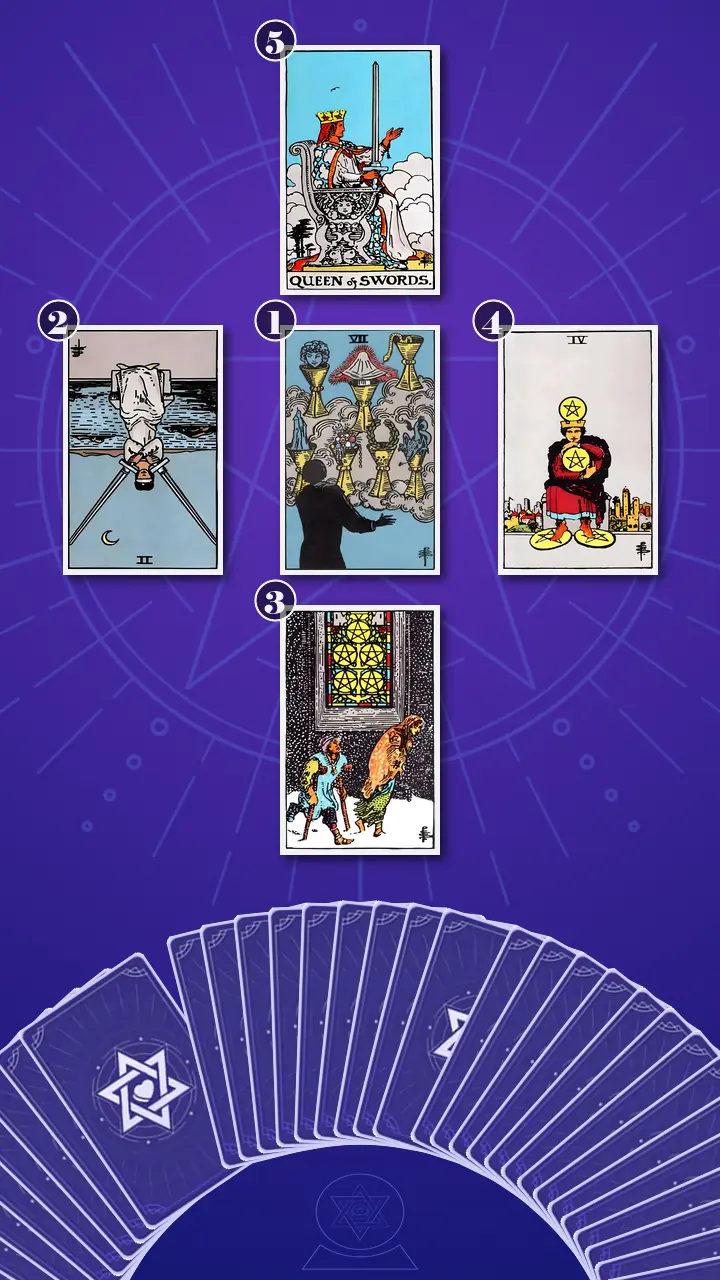
The Screen Where Possibility Outshone Evidence
The Highlight Reel: Seven of Cups, Upright
The position I turned first presented the observable pattern identified in the diagnosis: Jordan idealizes someone who feels perfect and recasts concerning behavior as an exception. The card was the Seven of Cups, in upright position.
I saw the seven cloud-suspended cups as seven tiles on the same mental dashboard: the person’s warmest messages, shared tastes, an imagined weekend away, sexual chemistry, a thoughtful gesture, a polished Hinge profile, and the one dismissive interaction. Everything was technically visible, but emotional glamour gave the most appealing tiles the brightest focus. The feeling that this person could be perfect had started functioning like evidence, while the behavior that conflicted with that image was relabeled as a one-off.
The upright Water energy was not absent; it was overflowing. Imagination, hope, and projection had become so vivid that possibility felt almost as substantial as demonstrated consistency. I compared it to treating a beautiful Figma prototype as a shipped product: the ideal state was rendered perfectly, while the error states and actual user behavior remained in another tab.
I let myself hear the highlight-reel sequence in her own rhythm. “But they remembered that detail. But the date felt different. But nobody is perfect. But they sent that sweet message afterward. The chemistry has to mean something.” I placed those thoughts beside one question: which qualities had Jordan actually observed repeatedly, and which ones had hope supplied from a few emotionally bright moments?
Jordan did not nod. She gave a short, bitter laugh and rubbed her thumb along the edge of her phone. “That’s too accurate,” she said. “Almost rude. I know what I saw, but I can also explain it.”
I didn’t rush to make the card feel nicer. “That laugh makes sense,” I said. “The Seven of Cups is not calling you foolish. It is showing that the warning sign is still on the screen. The problem is that the more attractive story keeps receiving the emotional spotlight.” Then I added, “Chemistry is data, not a safety certificate.”
Her shoulders lifted as if she had been preparing to defend the connection in court, then lowered by a fraction. I could see the first pause in the highlight reel. The question was no longer whether attraction was real; it was whether attraction had been asked to certify safety and compatibility before consistency had a chance to speak.
The Eighteen-Tab Blindfold: Two of Swords, Reversed
The second position revealed the truth Jordan edited out of awareness: she already registered the concerning behavior, but treated alternative explanations as more authoritative than her first observation. The card was the Two of Swords, in reversed position.
I returned to the Line 1 commute she had described. On the train, beneath fluorescent lights and the low hum of the tracks, she reread one clear sentence: the person had dismissed her concern. Around it, she opened an invisible browser full of motives. Maybe they were exhausted. Maybe Jordan had phrased it badly. Maybe the timing was unfair. Maybe her friend lacked context. Maybe she was being too sensitive. The factual sentence was still there, but it had become difficult to locate.
Reversed Air showed a blockage rather than a lack of intelligence. Jordan’s product-design instinct—to consider multiple users, edge cases, and competing interpretations—had been recruited as noise-cancelling analysis. She was no longer gathering context that could genuinely change a decision; she was multiplying theories until no boundary could feel fair enough to use.
“An explanation can add context; it does not get to erase impact,” I said. “Possible motive and observed behavior are not the same kind of information.” I asked her to notice the moment when research stopped producing clarity and began postponing the choice to name what treatment worked for her.
Her breath caught. Her thumb hovered above an imaginary message; then her jaw tightened, and her eyes went briefly unfocused, as if she were watching the exchange replay with different subtitles. “Maybe it only sounds bad because I’m telling it badly,” she whispered. The room became very quiet around that sentence.
I felt my Jungian training sharpen my attention there. I have learned, across cultures and across many conversations, that a defense is often a clever attempt to protect something tender. I did not need to shame the analysis to interrupt it. I only needed to help Jordan hear the original fact before the explanations covered it.
The Lit Window in the Snow: Five of Pentacles, Upright
The third position uncovered the mechanism’s underlying fear: taking the red flags seriously could end the connection and activate a deeper fear of not belonging. The card was the Five of Pentacles, in upright position.
I brought in the rainy Sunday bedroom from her story. At 10:06 p.m., Jordan had been in bed scrolling through Instagram engagement photos, anniversary carousels, and carefully framed Sunday dinners. Rain tapped the glass. The screen cast a cold glow over the duvet. Beneath her ribs, a hollow sensation opened as she imagined the connection disappearing, the warm messages stopping, and dating-app burnout waiting on the other side.
“What if I’m misreading them?” had been the visible question, but the Five of Pentacles let me hear the one underneath it: “What if I lose this and there is nobody else?” This Earth energy carried the weight of scarcity. It made one promising match feel like the nearest lit window in winter, and the nearest visible warmth began to look like the only shelter in the city.
I told her that this fear did not prove anything shameful about her, and it did not prove that the person was uniquely safe or compatible. It simply meant that the possible loss of this connection had become entangled with a larger fear of returning to loneliness, app fatigue, and the feeling of being left outside while everyone else seemed to be finding love.
Jordan’s scrolling stopped. First her finger froze above the screen; then her gaze drifted toward the rain-streaked window, as if she had forgotten which room she was in. Finally, she exhaled and said, “I think losing the imagined future has been scarier than the actual behavior has been informative.” Her shoulders softened, but her mouth pulled into a small, sad line.
“That distinction is important,” I said. “Fear of being outside love is real information about your inner world. It is not evidence that this particular person is your only workable shelter.” For the first time, the fear could sit beside the facts without disguising itself as a defense of the other person.
The Grip That Bought One More Evening: Four of Pentacles, Upright
The fourth position identified the defense’s short-term payoff: preserving the perfect image protects Jordan from uncertainty, disappointment, and the immediate possibility of loss. The card was the Four of Pentacles, in upright position.
I placed her in the condo lobby again. At 7:18 p.m., winter air slipped through the opening door while the intercom buzzed sharply. A charming message had arrived shortly after the person minimized her concern. Jordan’s thumb went still above a drafted reply: “I need you not to dismiss me when I raise something.” Then she deleted the boundary, sent a heart, and confirmed their next plan.
The upright Earth energy was an excess of control and conservation. The perfect story was the pentacle clutched against the heart; the next date and future possibility were pinned beneath her feet. Holding tightly bought immediate relief. Her pulse settled. She did not have to decide that night, feel the disappointment fully, or risk discovering that a clear limit might change the connection.
“The defense is not random,” I said. “It works for a moment. That is why it repeats. But it also restricts your movement. When the explanation becomes more important than observing how the connection functions, you have less room to reassess, pause, or change your mind.”
Jordan looked at the Four of Pentacles, then gave another small exhale. “I can feel the relief,” she said. “That’s the weird part. I send the sweet reply and my whole body settles, even though nothing about the original interaction has changed.”
“That is not weird,” I told her. “It is a relief cycle. If the fact only feels tolerable after editing, the edit is part of the pattern.” I let the sentence remain gentle. The goal was not to take away her hope; it was to stop temporary relief from being mistaken for evidence that the connection had become workable.
When the Queen of Swords Let the Fact Stand
The room changed when I reached for the card above the center. The late-afternoon light had thinned across the table, and the traffic outside sounded farther away. I turned the final card slowly, knowing we had reached the spread’s integrating perspective and its antidote to the loop.
The Open Hand and the Raised Blade: Queen of Swords, Upright
This position embodied the key shift from explaining behavior in the other person’s favor to separating facts, impact, and boundaries with compassionate discernment. The card was the Queen of Swords, in upright position.
I read the upright Air as restored function: a clear mind, direct language, and a boundary that did not require hostility. The sword could separate what happened from what Jordan imagined the behavior meant. The Queen’s open hand could receive context without handing context the power to erase impact. She did not need to label the person evil, deny the chemistry, or decide the entire future before taking one concerning pattern seriously.
I asked Jordan to write one unembellished sentence on her screen: “When I raised a concern, they dismissed it.” Underneath, I asked her to leave space for two separate lines: “The impact on me was…” and “The boundary available to me is…” This was not a case file. It was a way to preserve her perception long enough to choose.
At that moment, I used my signature Shadow Projection Analysis. I invited Jordan to hold two panes of information side by side: the other person’s actual behavior, and the fear her mind had supplied about what naming that behavior would cost. The exercise did not diagnose the partner, declare an anxious-avoidant trap, or insist on a childhood explanation. It simply asked whether an older fear of rejection or unmet belonging was being projected onto this current decision. The sword kept the present behavior visible; the open hand allowed compassion without self-erasure.
I translated the shift in plain language: “You are not ruining something perfect by leaving the fact unedited; you are letting observable behavior inform a boundary before hope edits away your authority to choose.”
Jordan was still caught in the old demand for a perfect verdict. If she could not prove the person unsafe, she believed she had to stay open; if she named the red flag, she feared she would become the one who ruined the rare connection. The decision felt like a trap with no fair exit.
You are not ruining perfection by naming a red flag; you are protecting self-trust by meeting the evidence with the Queen of Swords' raised blade and open hand.
For three seconds Jordan did not move. Her breath stopped halfway to her chest, and her fingers held the card’s edge as if it might slide away. Then her gaze lost focus; I could almost see the subway platform, the softened Notes sentence, the drafted boundary disappearing under her thumb. Her jaw trembled once. When she looked back at me, her eyes were bright, not with a dramatic answer but with the shock of hearing her own authority returned. Her shoulders lowered. One fist opened against her knee, and she released a breath that sounded like a quiet, disbelieving laugh. Relief arrived first, followed by a small blankness—the light dizziness of no longer carrying the whole relationship alone. I asked her to set an eight-minute timer and write three lines: “What happened,” “Impact on me,” and “Boundary available to me.” No motive, no message, no verdict. If that felt too exposed, one unedited factual sentence would count.
I asked her, “Now, use this new perspective to recall whether there was a moment last week when this insight might have made you feel differently.”
She looked at the sentence on her screen for a long time. There was grief in the new clarity because the perfect image could no longer do all the emotional work. There was also a fragile opening: attraction could remain present without being granted automatic access, and hope could remain alive without being appointed judge of the facts.
“This is the first time I’ve understood that I can be fair to them without being unfair to myself,” she said. I told her that this was the first small crossing from chemistry-driven narrative editing and scarcity fear toward compassionate discernment, clearer self-trust, and grounded openness with firmer boundaries. The cards had not taken over her choice. They had helped her see the choice she already had.
The Map Became a Sentence
When I gathered the cards into one story, the pattern made sense. The Seven of Cups showed how romantic possibility became brighter than evidence. The reversed Two of Swords showed thought multiplying explanations until the original discomfort lost authority. The Five of Pentacles revealed the fear of being left outside meaningful connection, and the Four of Pentacles showed how protecting the perfect image bought a few hours of relief while restricting honest movement. The Queen of Swords offered a different route: keep the warmth, keep the context, and leave the behavior unedited long enough to decide what treatment works for you.
I told Jordan that her blind spot was not an inability to notice red flags. It was an impossible proof threshold. She had been acting as if she needed to prove someone was entirely bad before she could call one repeated behavior concerning or choose a limit. But a boundary does not require a villain. It can respond to observable behavior and personal impact while the other person remains complicated, attractive, stressed, wounded, or capable of explanation.
The key shift was practical: record what happened, record how it affected you, and identify the boundary available to you before deciding what the behavior means. That is how the same photograph stops being endlessly retouched. The warning sign does not have to become the whole picture, but it must be allowed to remain visible. The cards also showed that clarity cannot stay private forever; because the spread contained no Wands, Jordan needed one small act of behavioral testing to turn insight into lived information.
The Fact–Impact–Boundary Check
I offered Jordan two small next steps. Neither required a confrontation, a final verdict, or a promise about the relationship’s future. They were designed to give her observable information while keeping the exit button visible and entirely under her control.
- The Projection Detachment ExerciseAfter the next concerning interaction, I asked Jordan to open the Notes app before rereading the chat and write exactly one sentence under each heading: “Observed behavior,” “Impact on me,” and “Boundary or next step available to me.” She could set a 24-hour reminder and later ask whether any new fact changed the behavior, impact, or boundary—not merely whether a kinder explanation appeared.This is my structured Projection Detachment Exercise and Queen of Swords-inspired Fact–Impact–Boundary Check. It is not a prosecution file and does not need to establish anyone’s character. The two-minute version is enough. She does not have to send the note or confront anyone; if direct communication feels unsafe or intimidating, pausing contact and involving a trusted person is a valid choice.
- The Boundary-First Reality TestI suggested choosing one low-stakes boundary to test this week, such as, “If plans are not confirmed by noon, I will make other plans,” or, “If that joke comes up again, I will end the conversation.” Jordan could communicate it once in plain language, without a long defense, pause new planning for 48 hours, and write, “What their response demonstrated was…” while keeping chemistry and future potential in a separate sentence.A clear boundary can reveal what another hour of analysis cannot. The test is reversible, not a trap, and not a demand to control another person. She could stop, delay, or step away at any point. If the response became pressuring, insulting, or frightening, she would not owe further debate or explanation.
I reminded her that the purpose was not to make the perfect person fail an exam. It was to let reality participate in the relationship. Attraction could stay in the room, but it would no longer be allowed to speak for consistency, safety, or compatibility by itself.

A Week Later, the Quiet Proof
Four days later, I received a text from Jordan: “I wrote the three lines and told them I need concerns discussed without minimising me.” She slept through the night, but woke with “What if I’m wrong?” still present. She smiled, left the sentence unedited, and made coffee.
The future of that connection was still open. I did not read her message as proof that the other person would respond perfectly; I read it as the first visible evidence that Jordan could remain open to attraction without abandoning her own perception. The Shadow Spread had not solved her dating life. It had returned enough room for her to make the next choice herself.
When someone feels rare, I know the chest can tighten around one plain fact and the story can start getting polished, because losing the perfect version can feel dangerously close to being left outside love altogether. That tenderness deserves understanding, not shame—and it can coexist with a clear-eyed boundary.
If you let one unedited fact remain visible for a moment, what small boundary might become imaginable without deciding the whole future?