Forced Positivity Gives Way When the Deleted Question Returns

The 11:40 p.m. Scroll: When Forced Positivity Becomes Relational Self-Silencing
At 11:40 p.m., I watched Alex (name changed for privacy), a 29-year-old early-career UX researcher in Toronto, sit on the edge of her bed with her phone warm against her palm. The radiator clicked in the quiet, the blue light sharpened the tiredness beneath her eyes, and the city outside had gone almost soundless.
She had typed a direct question into an iMessage thread, deleted it, typed a softer version, deleted that too, and finally sent a heart emoji with a joke. The chat now looked affectionate. Her throat was tight, her breath was held, and her stomach felt hollow. She looked at me and said, 'Nothing is technically wrong, so why do I still feel tense? I say we are fine, and then I spend the whole night replaying the conversation.'
I recognised the pattern as more than ordinary overthinking. It was like covering a dashboard warning light with a cheerful sticker because the commute was already stressful. Alex was forcing positivity to preserve the relationship while trying not to trust the feeling that the relationship was off. The relief from reassurance lasted for an evening; the unspoken moment stayed in her body.
'You are not failing to find the right silver lining,' I told her. 'Something in you is asking to be described before it is explained away. We do not need to decide the entire future of this relationship tonight. Let us make a map of the moment first. That is where our Journey to Clarity begins.'

Choosing the Compass: The Relationship Spread - Context Edition
I asked Alex to take one slow breath and keep the question simple: what happened, what did she notice, and what did she do next? I shuffled slowly while she placed both feet on the floor. The process was a deliberate shift of attention, not a supernatural test. It gave her mind somewhere steady to stand.
'Today, we will use a five-card Relationship Spread - Context Edition,' I said. 'This spread is useful because your question is not simply whether you should stay or leave. It is about how a relational interaction turns positivity into a protective strategy, and how that strategy makes it harder to hear yourself.'
I explained that this is how tarot works in a focused reading: the cards provide images and questions that help us separate observable behaviour from the story we build around it. The five positions would show Alex's visible reassurance, the relational cues she was responding to, the belonging fear beneath the pattern, the resource that could interrupt it, and the practice that could hold care and discomfort together. This Relationship Spread - Context Edition was small enough to stay with one real problem instead of turning a single difficult exchange into a verdict about her whole life.
'The first card will show the observable knot in your present stance,' I continued. 'The second will focus on what you actually received from the interaction, not on guessing your partner's private intentions. The centre card will touch the fear that makes honesty feel dangerous. Below it, we will find your resource. Above it, we will look at integration: the next measured way to speak and observe.'
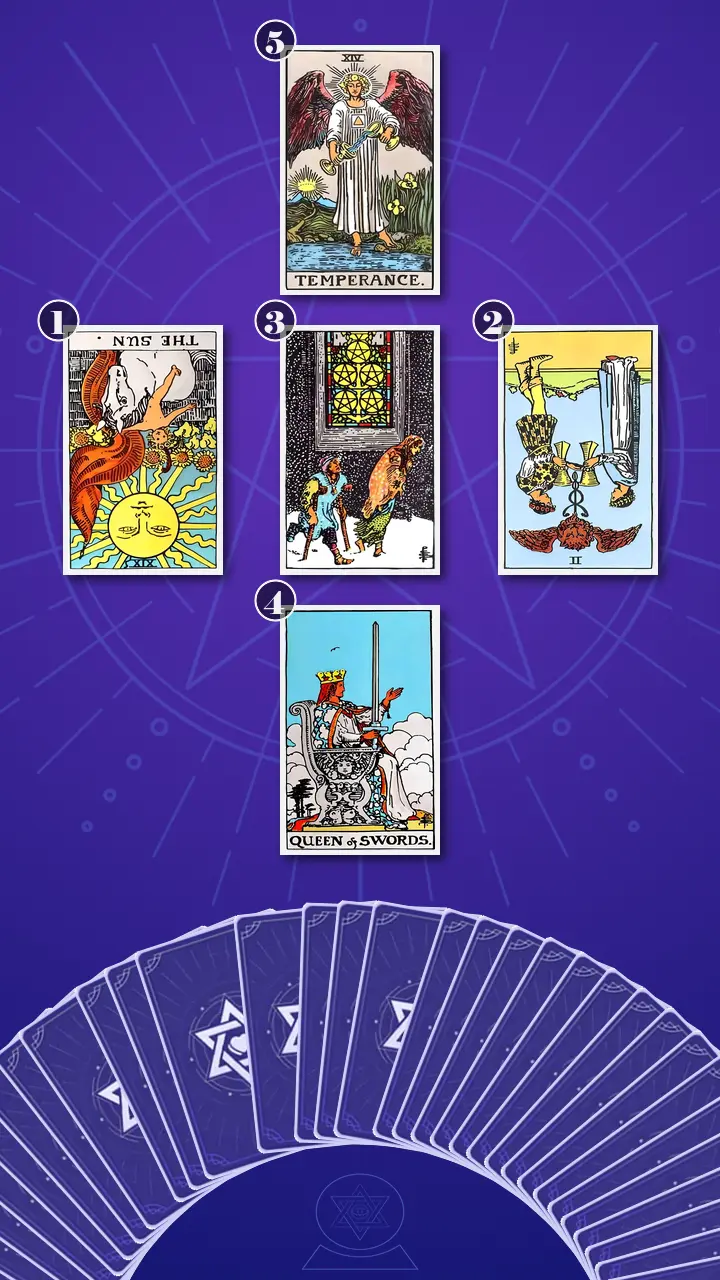
The Brightness She Kept Reapplying
Position 1: The Cheerful Story Covering the Feeling
I turned over the card representing the observable knot in the diagnosis: Alex's habit of performing reassurance while privately feeling that something was off. The card was The Sun, in reversed position.
In the Rider-Waite-Smith image, a child raises a red banner beneath an enormous sun, while a wall keeps the sunflowers and the wider landscape at a controlled distance. In Alex's life, the child became the cheerful relationship narrative she presented after tension. The wall became the feelings she kept outside that narrative.
The Sun reversed does not mean that no affection exists. It shows blocked fire and overperformed brightness. After a tense comment, Alex says everything is fine, adds a joke, sends an affectionate message, or posts something cheerful before she has identified what hurt. The positivity is not necessarily false; it is effortful because it arrives before the feeling has been allowed to speak. She gains a quiet evening, but the original discomfort remains in her throat and stomach.
'This is the Instagram filter applied before you have looked at the original photo,' I said. 'Or the relationship status set to all good while the notification you keep avoiding is still unread. The useful question is not whether you can sound positive. It is what you had to edit out in order to sound positive.'
Alex gave a short laugh, but there was no ease in it. 'That is accurate enough to be rude,' she said. Her fingers tightened around the edge of her phone.
I did not ask her to agree with the card or make the moment more optimistic. 'We can stay with the rudeness of the image,' I replied. 'It is pointing to a behaviour, not judging your character. After the next uneasy moment, pause before reassurance and record one factual sentence about what happened beside one honest feeling word.'
Position 2: Two People Answering Different Questions
I turned over the card representing the observable relational cues Alex was responding to, including moments when emotional reciprocity or acknowledgement felt misaligned. It was the Two of Cups, in reversed position.
The two figures in the image face one another with cups extended across a gap. Reversed, the exchange has lost alignment. This is like two people replying in the same chat while answering different questions. Alex raises a concern, her partner offers a silver lining or good intention, Alex nods and changes the subject, and later she rereads the conversation to decide whether her original discomfort was legitimate.
Affection may still be present. Shared routines may still be present. The problem is that the conversation does not consistently remain with the same emotional reality long enough for Alex to feel acknowledged. A silver lining is not the same thing as acknowledgement. When reassurance arrives before impact has been heard, the relationship can look warm while the exchange still feels emotionally uneven.
I pointed to the cups. 'The question here is not whether your partner meant well. The question is whether there was room for what happened to you. Name one specific behaviour or phrase, and notice what follows: curiosity, acknowledgement, defensiveness, a change of subject, or a request for time.'
Alex looked from one cup to the other, then down at her hands. Her shoulders lowered a fraction, as if the distinction between intention and impact had given her a less crowded sentence to carry.
Position 3: The Fear Outside the Lit Window
I turned over the card representing the underlying belonging fear that makes forced positivity feel necessary and keeps the inner conflict active. The card was the Five of Pentacles, in upright position.
Two figures move through falling snow beside an illuminated stained-glass window. One leans on a crutch. The light is visible, but the figures remain outside it. I read this as the fear underneath the positivity, not as proof that Alex was actually being rejected or that her relationship was doomed.
The Five of Pentacles shows what honesty seems to threaten in her imagination: affection, shared plans, emotional shelter, or her secure place in the relationship. When Alex thinks about saying, 'That response hurt,' her mind jumps ahead to conflict, distance, cancelled plans, or being labelled impossible to satisfy. She treats one honest message as if it might cancel her emotional lease. The fear makes silence feel practical, even while silence is quietly weakening her trust in her own perception.
I used the image of the window and asked her to complete two sentences. 'If I say this, then maybe I will lose my place here. If I stay quiet, I already feel alone with it.' The contrast mattered. It allowed her to see that the choice was not simply between a perfect relationship and a disastrous conversation. It was between anticipated exclusion and the real cost of repeatedly abandoning her own account of what happened.
Alex's breath stopped first. Her eyes went unfocused as if she were replaying the last exchange on the blue-lit screen. Then her fingers, which had been pressed into her palm, slowly opened, and a long breath left her chest.
'I am not only avoiding the awkward conversation,' she said quietly. 'I am trying not to lose my place here.'
I nodded. 'That fear deserves care, but it does not get to decide what the facts are. We can respect the fear without handing it the pen.'
When the Queen of Swords Lifted One Clear Blade
Position 4: The Resource That Does Not Disappear
The room seemed to become quieter before I touched the next card. I turned over the card representing the inner resource that can interrupt Soft Power Strain: precise truth, discernment, and boundaries that do not require hostility. The card was the Queen of Swords, in upright position.
Her sword stands straight in the air, while her other hand remains open toward the viewer. The image holds two things together: precision and receptivity. The Queen of Swords is not asking Alex to become cold, punitive, or certain about the entire relationship. She is offering a clean description of one interaction, its impact, and one question.
I told Alex to imagine writing a UX research note instead of an apologetic essay: 'When you responded with a silver lining before acknowledging what I said, I felt alone in the conversation. Can we stay with that part for two minutes?' One observable behaviour. One impact. One question. No affectionate padding, no joke to rescue the other person, and no prediction about where the relationship must end.
I have spent a lifetime at Cambridge and on archaeological digs, and I have learned to distrust any surface that demands an instant conclusion. When an emotional trigger arrives with unusual force, I use what I call Cognitive Stratigraphy. I treat the first reaction as a surface artifact, then carefully examine the layers beneath it: the current behaviour, the old belonging fear, and the obsolete belief that honesty automatically causes exile.
That is not a diagnosis, and it is not an excavation of the partner's motives. It is a way to ask which era a fear belongs to. The trigger may be current; the belief that one difficult sentence will destroy a secure place may have been built much earlier. Separating those layers gives Alex room to say, 'This interaction felt wrong to me,' without pretending that the sentence proves everything is wrong.
At 11:40 p.m., the chat had looked warm because Alex had deleted the direct question and sent a heart with a joke. Her body had kept another record. She was now caught between the urge to reassure and the fear that naming the mismatch would make her responsible for breaking something good.
I said, 'Affection is not evidence that your discomfort is wrong. Name one concrete truth, then let the response become information rather than a verdict on your worth or the entire future of the relationship.'
You do not have to keep the emotional weather artificially clear; like the Queen's upright sword, a precise truth can protect connection without sacrificing self-respect.
For a second, Alex's breath stopped again. Her pupils widened slightly, and her face held the startled stillness of someone hearing a private rule spoken aloud. Her gaze moved to the place where the deleted question had existed in her mind. Then her jaw loosened, her shoulders dropped, and the hand gripping her phone opened one finger at a time.
'But does that mean I was wrong before?' she asked. The irritation in her voice came first, followed by a tremor she tried to swallow. Her eyes grew bright, not with a dramatic release, but with the tired recognition of how long she had been paying for temporary peace with a night of self-doubt.
'No,' I said. 'It means the old strategy protected you from ten minutes of tension by leaving you alone with the evidence afterward. You are not required to condemn the strategy. You are allowed to update it.'
She looked down at the Queen's open hand. Her next exhale was uneven but deeper. I offered a ten-minute practice: in the Notes app, write three lines only, what happened, what you felt in your body, and what you needed but did not say. She did not have to send it or start a conversation that night. If the exercise made her more activated, she could stop, look around the room, and return to something grounding that she chose for herself.
'Now,' I asked, 'use this new perspective to remember last week. Was there a moment when naming one concrete truth might have made the next ten minutes feel different, even if it did not solve the whole relationship?'
Alex sat with the question. The Queen of Swords had not delivered a verdict. She had given Alex a way to distinguish the warning light from the story that the entire car had failed. That was the first movement from performative positivity and fear-driven self-silencing toward precise, self-respecting honesty.
Position 5: The Practice of Keeping Both Cups Visible
I turned over the card representing the transformation as an integrated practice: holding care and discomfort together while taking one measured, honest step. It was Temperance, in upright position.
The angel pours water between two separate cups, with one foot on land and one in water. The image does not collapse the cups into one container. It preserves difference while creating communication. Temperance therefore does not ask Alex to choose between relentless positivity and total condemnation of the relationship.
In ordinary language, Temperance sounds like this: 'I care about us, and this interaction did not feel right to me.' The sentence can remain unresolved for a beat. Alex can stay grounded while affection, concern, uncertainty, and a boundary occupy the same conversation. She does not need to rush in with a joke, and she does not need to decide what the moment means forever.
I told her that healthy integration was like keeping both sides of a research document visible: what I know happened, and what I am still interpreting. 'Both can be true while I gather more information,' I said. 'You can care about the relationship and still observe whether the response makes room for your experience.'
Alex ran her thumb along the edge of the Temperance card. This time, she did not try to make the tension disappear. She breathed in, let it remain, and said, 'That feels less like being negative. It feels like checking whether there is actually space for me in the conversation.'
'Exactly,' I said. 'Warmth without self-erasure is still warmth.'
The One-Sentence Reality Check
When I placed the five cards together, their story was clear without being absolute. The Sun reversed showed fire turned into the performance of cheerfulness. The Two of Cups reversed showed affection continuing while emotional reciprocity lost alignment. The Five of Pentacles revealed the belonging fear beneath the pattern: Alex had been treating honesty as a possible eviction notice. The Queen of Swords offered the resource of precise, receptive truth, and Temperance showed how to combine that truth with care instead of swinging into accusation.
The core contradiction was not that Alex was too positive or that her partner was automatically unsafe. It was that she was forcing positivity to preserve the relationship while distrusting the feeling that something was off. Her cognitive blind spot was assuming that reassurance was neutral. In practice, reassurance had become a choice to make the relationship look fine before checking whether it felt fine.
I used my Ruins Restoration Thinking here. A fractured pattern does not mean a ruined self. Chronic exhaustion and a fragmented sense of what she was allowed to feel could mark a necessary internal transition, a moment when an old structure had stopped protecting what mattered. I was not promising that every relationship can be restored, and I was not asking Alex to restore one on anyone else's behalf. I was helping her restore the connection between her perception and her words.
The transformation was deliberately modest: name one observable interaction and its impact before adding reassurance, then let the response become information. Not a verdict on her worth. Not a prediction about whether she should stay or leave. Information.
I gave Alex three small experiments. Each one had a stopping point, because practical clarity should not become another form of rumination.
- Run the Trigger Excavation ExerciseAfter the next interaction that leaves your throat tight, open the Notes app privately and set a ten-minute timer. Write one observable fact, one body response or feeling, and one thing you wanted to ask for. Keep the note to that single interaction. Before sending an affectionate follow-up message, read it once and check whether reassurance is replacing a sentence you want to say.If the full note feels too formal, begin with three words: happened, felt, needed. Stop at ten minutes. This is information gathering, not a case file.
- Use the Two-Minute Uncomfortable-Part PauseIn one conversation this week, when a concern receives a quick silver lining, say, 'I hear the positive part, and I need us to stay with the uncomfortable part for two minutes.' If you need a more specific version, say, 'When you responded with a silver lining before acknowledging what I said, I felt alone in the conversation. Can we stay with the impact first?' Then allow a few seconds of silence.Use the smallest version if a full talk feels too large: name the incident, name the impact, and say you want to return to it when both people have capacity. If the exchange becomes insulting, coercive, or overwhelming, pause and choose support for yourself.
- Practise Response-as-InformationAfter you name one honest concern, record only what you observed: curiosity, acknowledgement, defensiveness, dismissal, a changed subject, or a request for time. Notice your body for thirty seconds, then compare what you predicted with what actually happened in two short columns. Do not use one observation to decide the entire relationship that night.Discomfort is information, not a verdict. If the response is unclear, ask one follow-up question such as, 'Are you willing to talk about this part with me?' Then let the answer remain data.
These actions were not tests of the relationship and not tests Alex had to pass. They were ways to stop editing out the evidence before she had even looked at it. The point was not to become less loving. It was to make love compatible with self-trust.

A Week Later, the Weather Was Allowed to Change
Four days later, I received a message from Alex while the late afternoon light was turning the windows of my study pale gold. She wrote, 'I used the note. One fact, one body feeling, one thing I wanted to ask. Then I said, When you moved to the positive side before acknowledging what I said, I felt alone in the conversation. Can we stay with that for two minutes?'
Her partner did not produce a perfect speech. There was a pause, then a question about what Alex had heard and a willingness to return to the conversation after dinner. Alex recorded that response without turning it into proof that everything was fixed. The exchange had become more legible, which was enough for a first piece of evidence.
That evening, Alex sat alone in a neighbourhood cafe after sending the message, watching rain thread down the glass. She felt lighter, but the first thought the next morning was still, 'What if I got it wrong?' This time, she noticed the thought, made coffee, and opened her Notes app instead of sending an immediate reassurance.
That was the quiet proof. The cards had not decided what the relationship must become. They had helped Alex recover the authority to notice, name, and observe. Her clarity was not perfect certainty. It was the growing ability to let affection and concern remain in the same room.
When your throat tightens as you say, 'we are fine,' protecting the relationship can start to feel safer than telling the truth about how alone that moment made you feel. You do not have to make the emotional weather artificially clear before you are allowed to look at it.
If affection and concern could stay in the same room for one more minute, what is the smallest honest sentence you might privately admit about that last exchange, perhaps in the Notes app beneath the Queen's upright sword?