A Heart Reaction Reopened the Chat Before Justice Weighed the Pattern

The 11:47 p.m. Mixed-Signals Reset
I have met the intermittent-attention loop in many forms, but Maya, a 27-year-old marketing coordinator in Toronto, described one of its sharpest contradictions: she could manage five project channels during a hybrid workday, yet one late-night heart reaction could take over her entire evening.
As she told me about the previous Tuesday, I could almost frame the scene like a film still. At 11:47 p.m., she was in bed beneath the blue wash of her phone while the radiator clicked against the quiet of her apartment. After four days of silence, the person's name appeared beside a heart reaction; the screen warmed her palm, her chest released, and her thumb reopened a month of messages before anything else had actually happened.
“A two-word reply can reset my entire week,” she said. “I know it is inconsistent, but this message feels different. Then I check whether Saturday is free before they have even suggested meeting.”
I watched her turn the phone face down, then turn it over again less than a minute later. Her longing seemed to work like a phone-shaped slot machine behind her sternum: silence tightened the spring, one tiny signal lit the screen, and the relief made another pull feel reasonable. Beneath the hope sat a harder fear. If she stopped protecting the possibility and the attention disappeared, she worried the disappearance would say something final about her worth.
“I do not think you are foolish for reacting,” I told her. “The relief is real, and so is the attraction. But neither one can tell us, by itself, whether this connection is becoming reliable. Let us make a map of the loop so you can decide what deserves your attention without turning your feelings into evidence against yourself.”
I also clarified what I would not be doing. I would not use tarot to predict whether this person would return, assign motives I could not verify, or make Maya's relationship decision for her. I wanted the cards to function as an objective pattern-recognition tool: a way to bring her intuition, her body, and the observable contact record into the same conversation.

Choosing the Circuit Through the Fog
I invited Maya to take one slow breath while holding the question, “Why do tiny bits of attention keep me hooked on the same person?” I shuffled at an unhurried pace. The breath and cards were not a performance of mystery; they gave her nervous system a brief transition from notification speed to reflective attention.
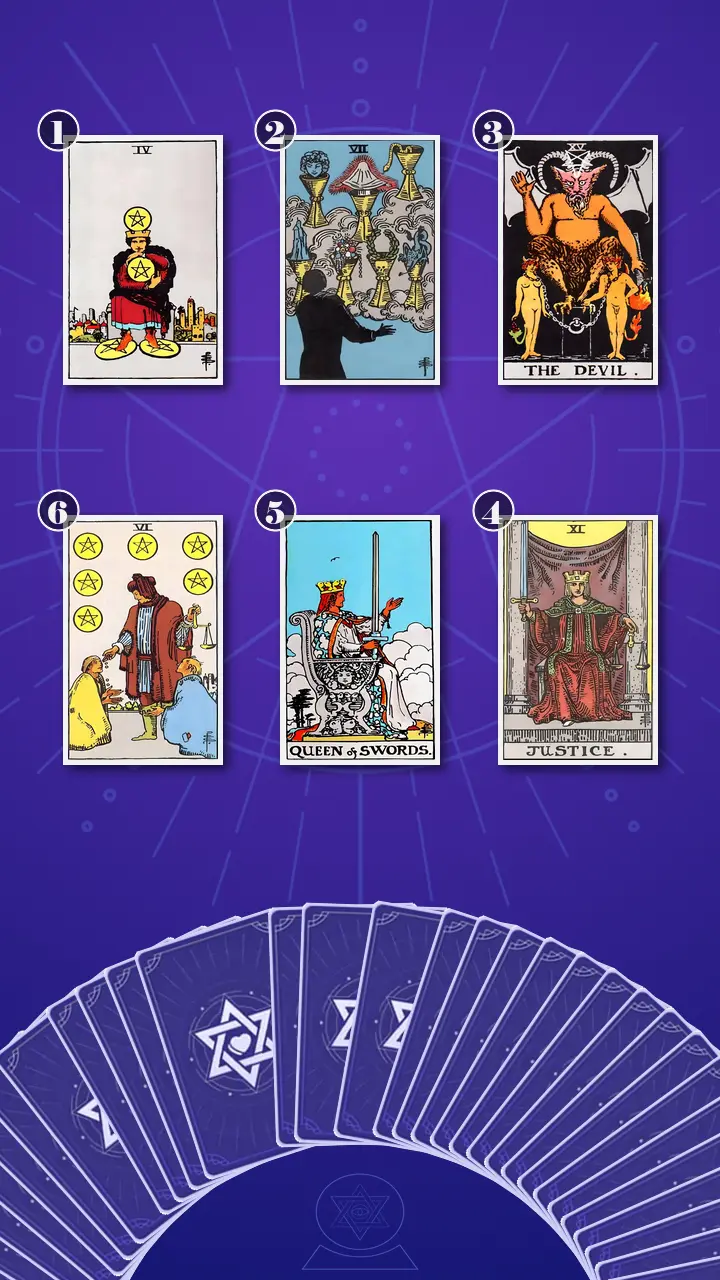
I chose the six-card Transformation Path Grid · Context Edition. For anyone wondering how tarot works in my practice, this spread was appropriate because Maya was asking about a repeating mechanism, not for unsupported access to another person's feelings. A conventional relationship spread might have pulled our attention toward what the other person supposedly thought. This grid kept authority where it belonged: with Maya's experience, evidence, standards, and choices.
I arranged two rows of three cards like an opened electrical circuit. In the top row, I would trace the observable symptom, the immediate blockage, and the psychological root. Then I would drop to the key transformation trigger and travel back through a practical response to an integrating principle. The route would show how the charge of one notification entered the loop and where Maya could redirect it into conscious choice.
I told her the first position would reveal what she was visibly holding in place. The second would show how limited information became a blockage. The third would expose the reward mechanism beneath the checking. Most importantly, the fourth position would identify the switch capable of interrupting the circuit; the final two cards would translate that insight into a boundary and an ongoing reciprocity benchmark.
Reading the Automatic Loop
Position 1: The Coin Held Against the Heart
I began with the position representing the observable symptom: gripping each breadcrumb of attention, reopening the chat, and keeping emotional availability reserved for the same person. I turned over the Four of Pentacles, upright.
I pointed to the figure pressing one pentacle against the chest while pinning two more beneath the feet. “This is the 11:47 p.m. scene,” I said. “You are protecting one heart reaction as though it were a scarce asset. The phone comes close to your chest, the chat reopens, and Saturday stays uncommitted even though no meeting has been proposed. The message is real, but guarding its possibility restricts where the rest of your attention can move.”
The upright card showed an excess of conservation within already contracted Earth energy. Holding on can be sensible when a resource is genuinely valuable, but here the fear of loss had turned preservation into immobility. Maya was not only holding a message. She was holding calendar space, mental bandwidth, and access to a wider life around it.
I gave the unspoken script a voice: “It is only one message, but if I release the possibility, I might lose my chance.” Then I asked what she had declined or postponed while waiting for plans that had never become concrete.
Maya gave a small, bitter laugh instead of nodding. “That is so accurate it is almost rude,” she said. Her fingers closed around the edge of her sleeve, then released it. “My friend asked about Sunday dinner last week. I said I needed to check, but there was literally nothing in this chat to check.”
“That laugh tells me the card has found the cost, not that it has issued a verdict,” I replied. “You do not have to stop caring. We are noticing that scarce reassurance has started charging rent in your schedule.”
Position 2: Seven Browser Tabs in the Clouds
I moved to the position representing the immediate blockage: limerent projection turning limited information into several hopeful scenarios before the complete pattern could be assessed. I revealed the Seven of Cups, upright.
The seven cups floated in clouds without touching solid ground. I translated them into seven mental browser tabs opened by one notification: perhaps the person had been overwhelmed; perhaps they were afraid of intimacy; perhaps the timing meant they had been thinking seriously about Maya; perhaps this message was different; perhaps next weekend would finally become a plan.
“One warm sentence arrives after several quiet days,” I said, “and by bedtime it has generated several possible futures. The only confirmed event is the sentence. The sustained conversation, the plan, and the change in consistency have not happened yet.”
This was excess Water without enough grounding: imagination and emotional possibility expanding faster than verification. Maya's capacity to imagine was not the enemy. The blockage appeared when uncertainty functioned like a recommendation algorithm, repeatedly serving the most hopeful interpretation because that was the one receiving the longest watch time.
I drew an invisible line down the table. “On this side: the fact is that a warm message arrived. On the other: the future I built from it is that consistent contact may be beginning. Both sentences matter, but they are not the same kind of information.”
Maya's thumb stopped moving over the dark screen. Her eyes shifted away from the cards as if she were counting the tabs in her own mind. “I always have an explanation ready,” she said quietly. “Usually before I have a second message.”
“A notification can be real without being proof that the connection is becoming reliable,” I said. “Hope does not need to be shamed. It needs to be distinguished from follow-through.”
Position 3: The Chain Made of Relief
I turned to the position revealing the psychological root: uncertainty followed by a small burst of attention, relief, and renewed hope. The card was The Devil, upright.
I centred the loose chains around the figures' necks rather than the imposing figure above them. “I am not using this card to call the other person evil, and I am not saying your attraction is fake,” I told Maya. “The Devil is showing us a binding pattern that feels absolute while still containing room for awareness and choice.”
I brought the image into an ordinary lunch break. Maya's phone buzzes beside the humming office microwave. She sees the person's name and feels relief before reading the two-word check-in. She answers within a minute, checks repeatedly through lunch, and treats the sudden end of uncertainty as new evidence of security. By 2:00 p.m., there is no follow-up, but the waiting cycle has already restarted.
The card showed blocked agency combined with an excess of immediate reward-seeking. Silence created tension. Unpredictable contact released it. Because the relief was intense, the mind confused the size of the bodily reaction with the significance of the relationship. It worked like pull-to-refresh or an irregular slot-machine payout: the occasional result trained the hand partly because its timing could not be predicted.
Maya's shoulders rose and her chest became visibly still. After a few seconds, she asked, “Are you saying none of it is real?”
“No,” I said. “The contact is real. Your feelings are real. What remains unproven is the meaning your relief assigns to the contact. The chain is not love itself; it is the sequence that says, ‘I know the pattern, but my hand is already reopening the chat.’”
Her gaze returned to the loose chains. Her fingers tightened around the phone, her eyes briefly lost focus as if replaying several lunch breaks at once, and then a slow breath left her chest. I watched recognition arrive with relief and sadness together. Scarcity can make attention feel significant without making it reciprocal.
When Justice Opened the Full Dashboard
Position 4: The Scale Beneath the Latest Message
I reached the position supplying the key transformation trigger: weighing the complete record of consistency, initiation, and follow-through instead of privileging the latest emotional spike. The card was Justice, upright.
The room seemed to change pace. On Maya's side of the video call, the radiator clicked once and went quiet. A Toronto streetlight divided the window behind her into two pale columns, as if the environment itself had drawn the fact-and-interpretation table we needed.
I showed her the balanced scales and upright sword. Justice brought balanced, evidence-based discernment into a circuit previously driven by contraction, projection, and temporary relief. The scales gathered the entire contact record. The sword separated what had happened from what hope had added.
For Maya, the modern card meaning was familiar from work: a marketing coordinator stops judging a campaign by one flattering data point and opens the full analytics dashboard. She creates a private timeline showing who initiated, when conversations stopped, which proposed plans became concrete, what received follow-through, and how she felt afterward. The latest warm message stays on the record, but it no longer erases the preceding silence.
I watched her return to the familiar bind: at 11:47 p.m., a heart reaction lands after several quiet days; her chest lifts; the chat reopens; one real signal becomes a weekend of possible futures before the person has made a plan. She had been trying to make the latest moment answer a question that only repeated behaviour could answer.
A tiny message is not proof of a growing bond; let Justice's balanced scales weigh the full pattern, then choose the level of attention that matches what is actually reciprocated.
I left a pause before adding the second edge of the insight.
The emotional spike tells you that the attention matters to you; only the repeated pattern can tell you whether the connection is becoming reliable.
I thought of my own work as an artist. In an editing suite, one luminous reaction shot can be made to carry an entire romance if every empty stretch is cut away. Maya had not invented the warm moments, but she had been reviewing a highlight reel while living inside the omitted footage. A relationship needs more than a compelling shot; it needs enough consistent scenes to support the story.
This was where I used Dialogue Loop Auditing, one of my core diagnostic tools. I usually use it to identify phrases that send two people back into the same dead-end argument. Here, the escalating dialogue was between a notification and Maya's private script. The cue said, “They reacted.” Her first line answered, “This feels different.” Fear followed with, “Do not ask for more or it may disappear.” The final line was, “Stay available so you do not miss the moment it becomes real.” Each notification called “Action” on the same scene before the new contact had supplied a different script.
Maya froze. Her breath stopped halfway in, and one finger remained suspended above the phone. Then her gaze slipped past the screen; I could see her replaying the rainy Queen streetcar, the unanswered Sunday invitation from her friend, and the quiet evenings she had treated as waiting rooms. Her pupils widened. The muscles around her mouth tightened, and her eyes became faintly red.
“But does that mean I was wrong this whole time?” she asked. The question came out sharper than anything she had said earlier. Her fist closed against the duvet before slowly opening again.
“It means your reaction accurately measured your longing,” I said. “It did not measure their consistency. That distinction does not make your past self stupid. It gives your present self better information.”
Her shoulders dropped, but the release was followed by a brief, almost dizzy blankness. I could see the new vulnerability in it: if the pattern became clear, she would have to choose what to do with the clarity. She exhaled a small, unsteady “Oh.” The relief was real, but so was the responsibility returning to her hands.
Then I asked, “Now, using this new perspective, can you think of a moment last week when this insight might have made you feel different?”
“Friday on the streetcar,” she said. “My friend asked about Sunday dinner. I could have noticed that the heart reaction mattered to me without treating it like an unspoken plan.”
I asked her to open a private note and set a seven-minute timer. She made two columns: What happened and What I imagined it might mean. I asked her to add the last three contacts using observable facts only, then circle any evidence of consistency, reciprocity, or follow-through. She did not message anyone or make a relationship decision during the exercise. I reminded her that if her chest tightened or the note became another hour of analysis, she could stop after one entry; the one-entry version still counted.
After the second entry, Maya looked up. “The warm messages are there,” she said. “But so are the dropped conversations. I keep evaluating the moment instead of the pattern.”
“Exactly,” I replied. “The spike is a feeling; the pattern is the evidence.”
I named the emotional crossing I had just witnessed. This was not instant detachment, and it was not certainty about the relationship. It was a first step from notification-driven longing and self-worth anxiety toward grounded self-respect and openness to reciprocal connection. Justice had not removed attraction. It had placed evidence between the cue and the automatic response.
The Sword, the Open Hand, and the Missing Fire
Position 5: A Boundary Without a Closing Argument
I moved to the position translating clarity into a self-directed action: defining a minimum standard for reciprocal contact and choosing a communication or behavioural boundary that reflected it. I revealed the Queen of Swords, upright.
I held the card close enough for Maya to see the Queen's paired gestures. The upright sword separated fact from projection. The open left hand remained receptive to contact without surrendering the right to choose. This was balanced Air energy: clear perception and direct language working together, rather than emotional shutdown or punishment.
I asked Maya to write one plain sentence before another message arrived: “I invest more when contact and plans are consistent.” From there, she could ask one direct question, reply on her own schedule, or reduce engagement without composing a long defence of why her needs were legitimate.
“You do not need a closing argument to choose a smaller investment,” I said. “A boundary is a decision about your participation, not a strategy for making someone chase you. The other person's response remains theirs. Your availability remains yours.”
Maya read the sentence twice. Her jaw loosened, though a crease remained between her eyebrows. “I can like them and still choose how much access this pattern gets,” she said.
“That is the Queen's open hand,” I replied. “Receptive, not permanently on call.”
Position 6: The Exchange Made Visible
I turned the final card in the integration position, where an ongoing reciprocity benchmark could stabilise the learning. It was the Six of Pentacles, upright.
I connected the scales in this card to Justice, then contrasted the distributed coins with the Four of Pentacles' closed grip. The reading had moved from clutching one scarce signal, through weighing the whole record, to making the exchange visible. This was balanced Earth energy: attention, initiation, time, and follow-through becoming observable resources rather than emotionally charged abstractions.
I asked Maya to imagine a simple weekly review. Did attention move mostly one way or both ways? Who initiated? Did proposed time become a confirmed plan? Did words receive follow-through? A dramatic message no longer needed to carry extra weight merely because it felt intense.
“Reciprocity is more like a two-way TTC line than a surprise ride appearing once on one platform,” I said. “The occasional arrival can be welcome. It does not make the route functional if nothing travels reliably in both directions.”
Maya leaned back for the first time in the reading. Her shoulders softened, and her phone remained face down. The absence of Wands across the spread also became meaningful to me: desire and analysis were already abundant, but deliberate action had not yet become stable. The missing Fire would not come from another hour of interpretation. It would come from one chosen response that differed from the old loop.
I reminded her that the Six of Pentacles did not predict what this person would do, declare either person good or bad, or demand perfect symmetry in every exchange. It offered Maya a continuing question: “What level of investment matches what is being reciprocated today?”
The Pattern Interruption Script
I gathered the cards into one coherent story. The Four of Pentacles showed why one scarce signal felt too valuable to release. The Seven of Cups showed how that signal expanded into possible futures. The Devil revealed the variable-reward sequence that fused uncertainty, relief, and hope into felt compulsion. Justice restored the complete record; the Queen of Swords gave Maya language and choice; the Six of Pentacles gave her a practical standard for future investment.
The cognitive blind spot was not that Maya lacked intelligence or failed to notice the inconsistency. She noticed it repeatedly. The blind spot was allowing the latest emotional spike to overrule the longer record, as though intense relief were evidence that the relationship had become more secure. Her analysis then protected hope from disappointment while also protecting the loop from evaluation.
The transformation direction was precise: she would stop judging the connection notification by notification and start recording whether contact was consistent, reciprocal, and supported by follow-through. Attention could remain meaningful without becoming proof of value. Attraction could stay in the room without being promoted to the director's chair.
I offered three small experiments. None required Maya to block anyone, force a confrontation, or decide the entire future of the connection that night.
- The Seven-Minute Justice Audit On one evening this week, open a private Notes or Notion page and record the last three contacts under four headings: who initiated, what was said, what plan was made, and what followed through. Stop when a seven-minute timer ends, and keep the note for your eyes only. Tip: Use observable facts, not motive analysis or character scores. Do not send the log or make a relationship decision while writing it. If three entries feel activating, record only the latest contact; one entry still counts.
- The Pattern Interruption Script When the next non-urgent notification appears, pause before reopening the whole chat. Write, “The observable fact is...” and then, “The story my hope added is...” Replace the old line “This feels different, so I must stay available” with “This message can matter to me without deciding my schedule or my worth.” Set a ten-minute timer before choosing when or whether to reply. Tip: The pause is an experiment, not a test of willpower and not a tactic to provoke pursuit. If ten minutes feels too long, take one slow breath and write only the observable-fact sentence.
- The Queen's One-Sentence Standard Before making weekend plans, complete the sentence, “For me, sufficient consistency looks like...” with one observable behaviour, such as following through on a proposed meeting. Then confirm one plan with a friend, a new date, or yourself instead of holding an unconfirmed time slot open. At the end of the week, ask whether attention, initiation, time, and follow-through moved one way or both ways. Tip: Use the standard as a light reality check, not a verdict on anyone's character. The minimum version is one weekly question: “Did initiative and follow-through move both ways?”
“These are not instructions for becoming less emotional,” I told Maya. “They are ways to keep an emotional moment from automatically becoming a practical commitment. You remain free to ask a direct question, continue at a smaller level of investment, step back, or gather more information. The cards do not own that choice. You do.”

A Week Later, Saturday Had a Name
A week later, Maya told me she received another heart reaction, wrote one fact and one hopeful story, waited ten minutes, then confirmed Saturday ramen with a friend. The chat remained unresolved. She slept through the night, woke thinking, “What if I am wrong?” and smiled before getting up.
I did not read her update as proof that the pull had vanished or that one exercise had solved her romantic life. I read it as a small, credible change in authorship. The notification still produced a pulse of hope, but it no longer received automatic control of the next scene.
That was the quiet proof of our Journey to Clarity. The six-card Transformation Path Grid had not told Maya whom to choose. It had helped her see the difference between attraction and evidence, between temporary relief and durable security, and between keeping an open hand and keeping her whole life on hold.
I know why it can feel safer to protect one tiny rush when a notification finally loosens the tightness in your chest after days of silence. Facing the full record may bring disappointment, and losing scarce attention may touch the fear that another person's availability is a verdict on your worth. But noticing that fear already begins to loosen the old script.
If the next notification were allowed to rest on Justice's scale as information rather than a verdict on your value, what is one small choice you might finally feel free to write into your next scene?