A Six-Paragraph Lesson Shrinks Into a Three-Sentence Repair Message

The 11:40 p.m. Essay That Would Not Say “I’m Sorry”
I recognized the pattern before Jordan (name changed for privacy) finished their first sentence. They were the emotionally aware friend who could name attachment styles, projection, boundaries, and nervous-system responses, yet their chest tightened whenever someone said, “Please stop analyzing me and answer the question.”
We met over video on a winter evening, with Jordan seated at the small kitchen table in their Toronto apartment. They showed me the message they had been editing at 11:40 the previous night. Above the draft, their partner’s unanswered question read, “Can you acknowledge what you said?” Below it, Jordan had written, deleted, and restored a paragraph beginning, “I think this conflict is showing you...”
As Jordan described the moment, I could almost hear the radiator clicking behind them. Their tea had gone cold and tannic. The phone had felt hot in their hand. Their jaw had locked while their restless fingers tapped the mug and returned to the keyboard. They had been asked for acknowledgment; they had prepared an interpretation.
“I wasn’t trying to dodge responsibility,” Jordan told me. “I just thought there had to be a reason the conflict kept happening. I wanted them to understand the deeper pattern.”
I heard the sincerity in that sentence. I also heard the hidden bargain: if Jordan could identify the deeper lesson, they could remain the thoughtful person in the room rather than the person whose thoughtlessness had caused pain. Their defensiveness felt less like a wall than a seat belt locking during a sudden stop, constricting their breath before they had even decided whether they were in danger.
This was weaponized self-awareness in real time, but I did not use that phrase as an accusation. Jordan’s reflective intelligence was real. The problem was the direction in which it moved. Like a front-facing camera flipped outward at the first sign of shame, it examined everyone except the person holding the phone.
“Insight stops being insight when it leaves you exempt from the lesson,” I said. “That does not make your insight fake, and it does not make you a bad person. It means we need to look at what your explanations protect before we decide what they mean.”
Jordan pressed their lips together. Their shoulders remained high, but their hands became still.
“I’m not here to prove that your partner’s interpretation is completely correct,” I continued. “I’m also not here to help you build a better case against it. I want us to map the moment when explanation replaces contact. Our journey to clarity is about finding where you still have choice.”

Choosing a Mirror Path Through the Conflict
I invited Jordan to place both feet on the floor and take one slower breath than felt natural. I shuffled while they held one precise question in mind: “Why do I turn every conflict into someone else’s lesson?” The breathing and shuffling were not theatre or prediction. They marked a transition from rehearsing the argument to observing the pattern.
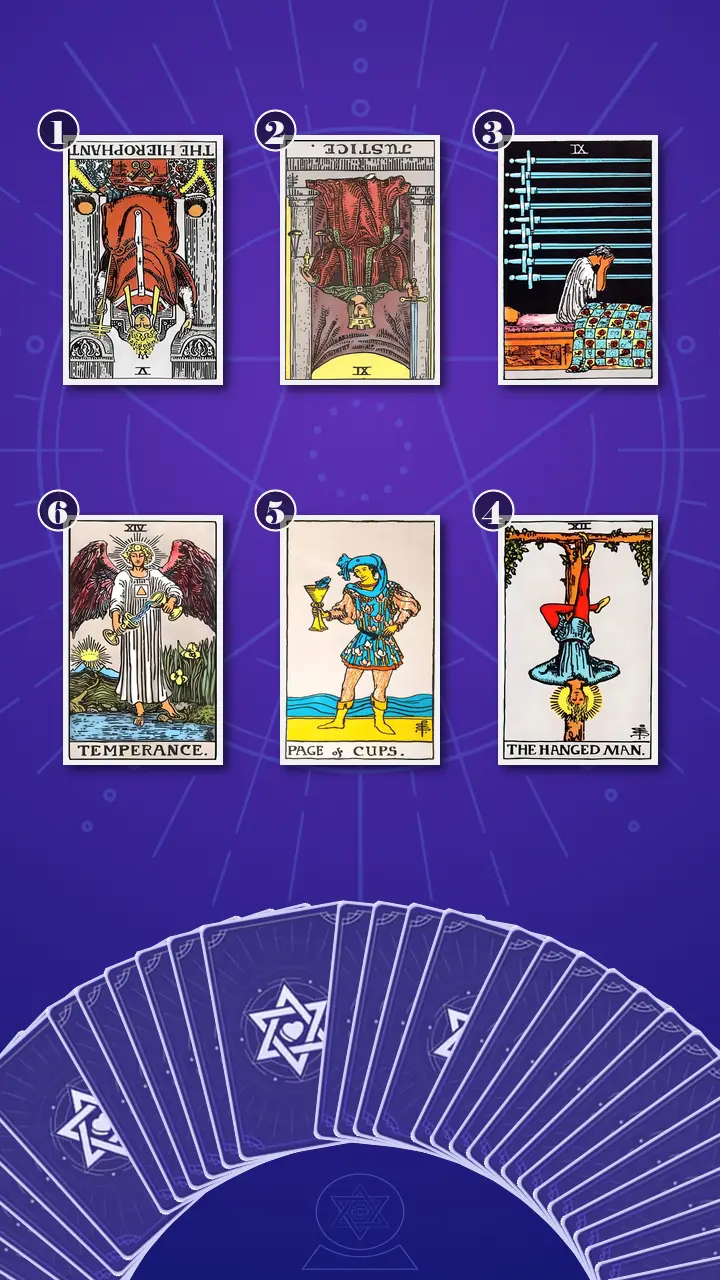
I chose the six-card Transformation Path Grid · Context Edition, a tarot spread for conflict accountability and relational repair. A traditional relationship spread could have compared Jordan’s viewpoint with their partner’s, but that would not have fully shown the loop sustaining the disagreement. A conventional shadow spread could have revealed the shame underneath, yet it might have left the interpersonal repair sequence too vague. This grid was the smallest map capable of holding both.
For readers wondering how tarot works in a session like this, I do not treat a card as a supernatural ruling. I treat the spread as a structured set of perspectives. Card meanings in context help us separate what is visible from what is defended, and what is defended from what can actually change.
I arranged the cards in two rows of three. The upper row would show the observable teaching posture, the imbalance blocking accountability, and the private fear beneath it. At the upper-right corner, the path would turn downward into the pivotal pause. From there, the lower row would move back toward emotional curiosity and patient integration.
The layout resembled a mirror path folding toward the self. Jordan’s attention would first travel outward through explanation and judgment. Then it would turn at the hidden root and return through accountability, repair, and repeated behavior.
Across the Upper Row: The Anatomy of an Explanation
Position 1: The Teacher Who Entered an Equal Conversation
The card I turned over now represented the observable symptom: converting a shared conflict into a lesson delivered to the other person. It was The Hierophant, reversed.
I pointed to the central figure’s raised teaching hand and elevated seat. “In its balanced form, The Hierophant can represent guidance, shared values, and useful traditions. Reversed here, its teaching energy is in excess while reciprocity is in deficiency. Guidance becomes authority. A conversation between equals becomes an unsolicited curriculum.”
I brought Jordan back to the kitchen-table draft. Their partner’s original question had moved farther up the screen as Jordan’s paragraphs lengthened. The hand that could have typed, “My part in this was...” had instead begun explaining what the conflict reflected about the other person’s triggers and growth.
“If I can name the lesson, I can remain the person who understands,” I said, giving language to the posture I could see. “That is different from using wisdom in service of the relationship. Wisdom offers something and remains open to correction. Authority decides what another person’s experience means before they have finished describing it.”
Jordan gave a short laugh, but there was no amusement in it. Their eyes dropped to the card. “That’s so accurate it’s a little brutal.”
I let the silence stay gentle. “Accurate does not have to mean condemning. The Hierophant reversed is not calling you fraudulent. It is showing what happens when a genuine strength takes the wrong seat in the room. You do not need to lose your capacity for reflection. You need to stop placing it above another person’s report of their own experience.”
Jordan rubbed their thumb along the edge of their mug. The defensive lift in their chest did not disappear, but I watched it soften enough for curiosity to enter.
Position 2: The Scale Loaded With Context
The card I turned over next represented the immediate obstruction: resisting balanced accountability by privileging intention, interpretation, or moral position over the other person’s reported impact. It was Justice, reversed.
I centered the card between us. “Justice asks for cause, effect, evidence, and responsibility. Reversed, that energy becomes blocked by selective accounting. Your intention receives witnesses, context, footnotes, and a closing argument. Their reported impact is treated like an unconfirmed complaint.”
Jordan’s mouth tightened. I asked them to remember a recent workplace debrief in which a colleague had said that Jordan’s interruption felt dismissive. Jordan told me how quickly they had listed the deadline pressure, their inclusive intentions, and two occasions when the colleague had interrupted someone else.
“The context must be admitted before my impact can be named,” I said, reflecting the logic beneath that response. “But by the time all the context is admitted, the impact has been cross-examined out of the conversation.”
I thought of the many facilitation rooms I have encountered across cultures. The vocabulary changes, but the body often reveals the same threshold: the lifted chest, the shortened breath, the jaw preparing for judgment. Shame starts writing the defence before curiosity has heard the charge.
“Balanced accountability is not the same as accepting total blame,” I told Jordan. “You are allowed to have context. You are allowed to disagree with part of someone’s interpretation. Justice simply asks you to let both forms of evidence onto the scale. Intention tells us what you meant. Impact tells us what occurred in the relationship. Neither becomes complete by erasing the other.”
Jordan inhaled as if they were about to object. Their fingers curled once against the table, then slowly opened.
“So I can acknowledge that it landed badly without agreeing that I’m entirely responsible for everything they felt?” they asked.
“Exactly. Acknowledgment is not a confession to an identity. It is an accurate response to information.”
Position 3: The Trial Held at 2:08 a.m.
The third card represented the psychological root beneath the elevated language: the private fear that being wrong, harmful, or ordinary would diminish Jordan’s worth. I turned over the Nine of Swords, upright.
The image showed a figure sitting upright in darkness, face covered, with nine swords crossing the wall behind them. Mental air was in excess here: arguments, frameworks, searches, and revised messages moving so quickly that emotion could not be met directly. Grounded self-worth was the missing element.
I asked Jordan about the night after the argument. They described waking at 2:08 a.m. under the blue-white light of their phone. The sheets felt too warm. Their stomach dropped when they remembered the exact sentence their partner had called dismissive. Within minutes, they were searching “conflict as mirror relationship” and scrolling through saved posts about projection.
“The thoughts move between two extremes,” I said. “One says, ‘Maybe I am harmful.’ The other says, ‘Maybe they are projecting.’ Both positions promise certainty. Neither asks the more tolerable, useful question: ‘What did I do, and what can I change without turning that behavior into my whole identity?’”
I introduced what I call a Shadow Integration Audit. Through a Jungian lens, the shadow is not an evil self hiding behind the conscious one. It includes feelings the preferred identity has no room to hold. I asked Jordan to identify what had been pushed outside their emotionally aware self-image.
“Irritation,” they said first. After a pause, they added, “Shame. And fear that they’ll see me as fake.”
I mapped those emotions with them. Irritation supplied the energy for rebuttal. Shame made one careless action feel like exposure of the whole self. Fear of exposure drove the urgent search for a framework in which Jordan could become useful, composed, and morally legible again. Together, those suppressed feelings were covertly draining the psychological bandwidth needed for listening.
“Responsibility is information about your behavior, not a verdict on your worth,” I said. “When those become confused, analysis feels like rescue. It offers temporary relief from the inner trial, but the body remains awake and the relationship remains unrepaired.”
Jordan’s breathing stopped for a beat. Their gaze moved away from the card and lost focus, as though the dark wall behind the Nine of Swords had become the screen on which they were replaying the argument. Then they released a long breath from somewhere low in their chest.
“The explanation always comes after that stomach-drop feeling,” they said quietly. “I thought I was calming down by understanding it.”
“You were trying to regulate yourself,” I replied. “The strategy makes sense. It simply sends the cost of that regulation into the relationship.”
When The Hanged Man Turned the Lesson Around
Position 4: The Verdict Left Unfinished
The card I turned over now represented the pivotal insight that could break the Projected Mirror Loop: suspending the teacher role long enough to receive another perspective without rebuttal. Before I revealed it, the radiator behind Jordan made one last metallic click. Then the kitchen became unusually quiet.
I turned over The Hanged Man, upright.
I drew Jordan’s attention to the calm face rather than the suspended body. “This card does not describe punishment, passivity, disappearance, or agreeing with every accusation. Its energy is voluntary stillness in balance. You interrupt the automatic response so that a perspective you did not choose can remain visible.”
In ordinary life, this looked almost unremarkable: Jordan reading, “Can you acknowledge what you said?”, placing the phone face down for twenty minutes, and allowing the message to stand without immediately translating it into a lesson. The pause would not settle the entire conflict. It would only stop the auto-send rule that converted every uncomfortable notification into a prewritten explanation.
I used my Inner-Critic Neutralization lens to distinguish this stillness from self-punishment. Jordan’s inner critic had been masquerading as rigorous self-discipline, insisting that every mistake required an immediate ruling on whether they were conscious, worthy, and good. The Hanged Man suspended that internal court. It did not throw out the evidence. It refused to let identity be sentenced before behavior could be examined.
Jordan was still looking at the same unanswered question on their screen, with cold tea beside them and six paragraphs of theory waiting in drafts. Their jaw tightened again because the single requested acknowledgment felt more exposing than every sophisticated explanation they knew how to give.
The breakthrough is not finding a better lesson for them; it is letting their perspective stand long enough for your own impact to become visible.
I left a pause around the sentence.
Conflict is not proof that you must become the teacher; suspend the verdict, receive the other perspective, and let The Hanged Man's stillness turn the lesson back toward your own choices.
For a second, Jordan did not move. Their index finger remained suspended above the phone as if their body had forgotten the next instruction. Their pupils widened, and their gaze slipped past me toward the message still open on the screen. I watched recognition arrive before acceptance: first a frozen breath, then a faint crease between their eyebrows, then heat rising around their eyes. Their shoulders lowered, but the release seemed to leave them briefly unsteady, as though they had put down a weight and had not yet learned how to stand without it. They blinked hard and drew both hands into their lap.
“But doesn’t that mean I’ve been wrong this whole time?” Jordan asked. The words came out sharper than their earlier voice, carrying anger, grief, and a small tremor underneath. “I’ve spent years trying to be the person who helps people see patterns.”
“No,” I said. “It means the role that once helped you create safety is no longer useful in every room. You are not retiring your wisdom. You are retiring its authority over someone else’s emotional reality. That can feel like losing an identity before it feels like gaining freedom.”
Jordan swallowed. Their eyes remained wet, but their hands unclenched.
“You do not have to agree with every interpretation to acknowledge an impact,” I added. “The pause is not submission. It is the moment in which shame becomes tolerable enough for curiosity to survive.”
I asked, “Now, with this new perspective, think back to last week. Was there a moment when this insight could have changed how you felt or responded?”
Jordan returned to the workplace debrief. They remembered their colleague saying, “I’m not asking you to explain the whole meeting. I’m asking you to acknowledge that you cut me off.” Jordan said the Hanged Man would not have made the feedback painless. It would have created enough space to answer the sentence that had actually been spoken.
I set a two-minute timer, the smallest version of the exercise. Jordan wrote three private lines: “The observable thing I did was interrupt.” “The impact they named was feeling dismissed.” “One repair I could offer is listening through their full point at the next debrief and apologizing for cutting them off.”
When the timer ended, Jordan looked surprised by how little text was on the page.
“I kept waiting for the part where I explain why,” they said.
“That part can remain unfinished,” I replied. “This is the first movement from defensive interpretive certainty toward shame-tolerant curiosity and grounded mutual accountability. It is not complete clarity. It is the first place clarity can enter.”
The Return Path: From Verdict to Conversation
Position 5: The Three Sentences That Leave Room
The fifth card represented the practical action that would give the new perspective relational form: emotional curiosity, concise acknowledgment, and a repair-oriented question. I turned over the Page of Cups, upright.
The Page looked into a cup from which an unexpected fish had appeared. I read the card as emotionally receptive energy moving into balance. Jordan did not need a better conclusion. They needed enough beginner’s mind to receive information they had not predicted.
I offered a direct translation: “This is the human three-sentence version instead of the polished Notes-app statement.”
I typed the message where Jordan could see it: “I can see how my comment dismissed you. I am sorry for my part. Is there something important I am still not hearing?”
Beneath it, I left an empty space where Jordan would usually add a paragraph about the other person’s triggers, history, or lesson. That empty space was part of the practice. It protected the other person’s right to answer with information Jordan had not already assigned to them.
Jordan read the message twice. “It sounds almost too simple,” they said. “Like I’m missing the intelligent part.”
“The intelligence is in the accuracy and the restraint,” I replied. “A repair makes room for an answer; a lecture arrives with the answer already decided.”
I also clarified what the Page of Cups did not require. A concise acknowledgment did not erase Jordan’s context, permit insults, or obligate them to remain in an unsafe exchange. It simply stopped their perspective from arriving first. Context could follow later if it served mutual understanding rather than identity protection.
Jordan picked up their phone, opened the old draft, and highlighted the first paragraph about their partner’s pattern. Their thumb hovered over the selection. Then they moved it into a private note instead of leaving it in the message.
“That feels weirdly exposed,” they said.
“That is emotional beginnerhood,” I told them. “Reachable often feels less impressive than prepared.”
Position 6: Temperance After the Profound Conversation
The final card represented the emerging state created by practising the pause and the repair together: patient, reciprocal growth that did not demand an immediate lesson, resolution, or elevated identity. I turned over Temperance, upright.
I traced the stream moving carefully between the two cups. One foot rested on land while the other touched water. Here, feeling and observable reality were not forced into sameness. Intention could remain true without overruling impact. Another person’s pain could be respected without becoming the sole definition of Jordan’s character.
In modern terms, Temperance measures a software update by whether the recurring bug changes, not by how impressive the release notes sound. Jordan’s growth would not be proved by one profound conversation. It would appear in ordinary follow-through: not interrupting at the next meeting, checking before giving advice, respecting a request for space, and returning when promised without attaching another lesson.
I noted that the spread contained no Wands or Pentacles. Insight and emotion were present, but direct initiative and concrete behavior would not arrive automatically. The cards could show the missing bridge. Jordan would still have to build it.
“The clearest lesson may be the behavior that changes after the conversation ends,” I said.
Jordan looked from Temperance back to the Hierophant reversed. Their expression held recognition and a trace of sadness. “So the point isn’t to stop looking for meaning.”
“No. The point is to stop forcing meaning to arrive before repair. Temperance lets the relationship develop at its actual pace. You offer acknowledgment, change what is yours to change, and let the other person retain agency over their timing and response.”
Jordan’s shoulders settled against the chair. The conflict was not solved, and their partner had not appeared on screen to offer forgiveness. Still, the urgency in Jordan’s hands had quieted. For the first time that evening, their phone lay untouched beside the cold tea.
The Inward Mirror Plan for the Next Conflict
I gathered the six cards into one coherent story. The Hierophant reversed showed Jordan entering conflict as the person authorised to explain its higher meaning. Justice reversed revealed the uneven accounting that treated intention as strong evidence and impact as something to debate. The Nine of Swords exposed why that imbalance felt necessary: admitting harm had become confused with admitting worthlessness.
The lower row redirected the same reflective capacity rather than destroying it. The Hanged Man paused the outward-facing mirror. The Page of Cups turned reflection into a concise, emotionally reachable response. Temperance moved the measure of growth away from eloquence and toward proportionate, observable follow-through.
Jordan’s cognitive blind spot was not a lack of self-awareness. It was the belief that understanding their pattern meant they had already taken responsibility for its impact. They had also treated accountability as a choice between two extreme roles: innocent teacher or guilty defendant. The spread offered a third position, an imperfect equal who could acknowledge behavior, retain context, make repair, and continue learning.
I distilled the key shift into one sequence: before explaining what the conflict means for the other person, name one observable action you took, reflect the impact they reported, and identify one repair you can offer. Explanation may still have a place, but it no longer gets first access to the conversation.
Two Small Practices for Actionable Repair
- The Inward Mirror PauseWhen a difficult message arrives, tell the person when you will return if a delay needs context, then place the phone face down for ten minutes. Write three private lines: “What I did,” “What impact they named,” and “What I can offer now.” Using my Active Imagination Protocol, add two brief prompts: “The part of me that needs to become the teacher says...” and “What that part is trying to protect me from is...” Keep the dialogue inward. Do not write the other person’s lesson.Use a visible timer so the pause has a boundary. Start with two minutes or three slow breaths if ten minutes feels intolerable. Pausing does not require agreeing with every claim.
- The Three-Line Repair With One Observable Follow-ThroughOnce this week, respond in no more than three sentences: name the observable action, acknowledge the possible impact, apologise for your part where appropriate, and ask one curious question. Move every sentence about the other person’s projection, trigger, or growth into a private note. Then choose one behaviour they can observe, such as not interrupting at the next debrief, and set a fifteen-minute calendar reminder three days later to check whether it changed.Use an energy budget of one acknowledgment, one repair offer, and one follow-up invitation. Your context can come later if it supports understanding rather than erasing impact.
I reminded Jordan that these practices were designed for ordinary conflict in which mutual reflection was genuinely possible. Accountability never creates an obligation to remain in threatening, coercive, retaliatory, or abusive contact. In unsafe circumstances, distance, documentation, professional support, or formal safeguards may be the accountable next step.
“This is not about becoming the perfect apologiser,” I said. “That would only give the inner critic a new identity to police. The goal is to become reachable enough to notice your impact and grounded enough to act without collapsing into shame.”

Six Days Later: The Quiet Proof of Finding Clarity
Six days later, Jordan sent me a screenshot. Their new message contained three sentences: “I can see how my comment dismissed you. I’m sorry for my part. Is there something important I’m still not hearing?” The six-paragraph interpretation remained in a private note.
The reply was not a cinematic reconciliation. Jordan’s partner wrote, “Thank you. I need a little time, but this answers what I was asking.” Jordan felt the urge to send more context. Instead, they respected the request and left the conversation alone for the evening.
Jordan told me they slept through the night. Their first thought the next morning was, “What if I still got it wrong?” They smiled anyway, because this time the question did not require an immediate defence.
At work, Jordan also let a colleague finish speaking during the next debrief. No one applauded. No profound lesson was announced. A recurring behavior simply changed once, which gave it the possibility of changing again.
When I think about that Journey to Clarity, I do not credit the cards with changing Jordan’s relationships. Tarot made the pattern visible and gave its turning point an image. Jordan remained the person who placed the phone down, tolerated the unfinished meaning, sent the shorter message, and followed through.
When your jaw locks and your mind starts building a lesson for someone else, it may be because standing beside the hurt as an imperfect equal feels far more exposing than standing above it as the one who understands. I hope you remember that exposure is not a verdict. It can be the first honest opening through which mutual contact returns.
If you let one unfinished conflict remain information rather than a verdict, which line will you write first in your own inward-mirror note: what you did, the impact they named, or the repair you can offer?