From Polished Post to Plain Sentence: Leaving the Phone in the Kitchen

Finding Clarity Between the Mask Slip and the Post
Alex, a 27-year-old non-binary communications coordinator in London, could turn a shaky admission into a polished caption before the Tube reached the next stop. At 8:47 p.m. on the Victoria line, after their voice caught during a WhatsApp exchange, they opened the Notes app beneath buzzing fluorescent lights. The phone was warm in their palm; their throat stayed tight; their thumb trimmed the raw moment into something articulate, self-aware, and easy to receive.
By the next station, the sequence was complete: the mask slipped; heat climbed into their face; they made the story beautiful; they checked whether people understood; the first heart reaction lowered the heat for a few seconds, and they called that relief healing. It was the exact problem behind their question: “Why do I keep performing vulnerability in public after my mask slips?” They wanted genuine connection, yet the public performance gave them control over how connection was allowed to see them.
When Alex appeared on my screen for our reading, blue laptop light fell across their Hackney kitchen table. A kettle clicked as it cooled beside them. They kept turning their phone over, screen up and then screen down, as if neither position felt quite safe.
“If I am going to be exposed, I need to make the story beautiful,” they said. Then their voice dropped. “I do not know whether I am healing or just getting better at explaining the wound.”
The feeling they described was exposure shame, but it did not arrive as an abstract label. It felt more like a stage light trapped beneath the skin: a hot face, a tightened throat, hands searching for something to edit, followed by a dense numbness once the audience had responded and moved on.
“Wanting to be understood is not the problem,” I told them. “We are not here to shame public sharing or declare privacy morally superior. We are here to examine the moment when sharing stops feeling chosen and starts feeling compulsory. Let us give that sequence a map, so you can decide where your vulnerability belongs instead of letting the urgency decide for you.”
Choosing the Map from Public Square to Quiet Room
I invited Alex to take one slow breath and hold the consultation question in plain language. I shuffled while they focused, using the movement as a practical transition from reacting to observing. Nothing about the ritual required belief in fate; it simply gave the mind a clean threshold.
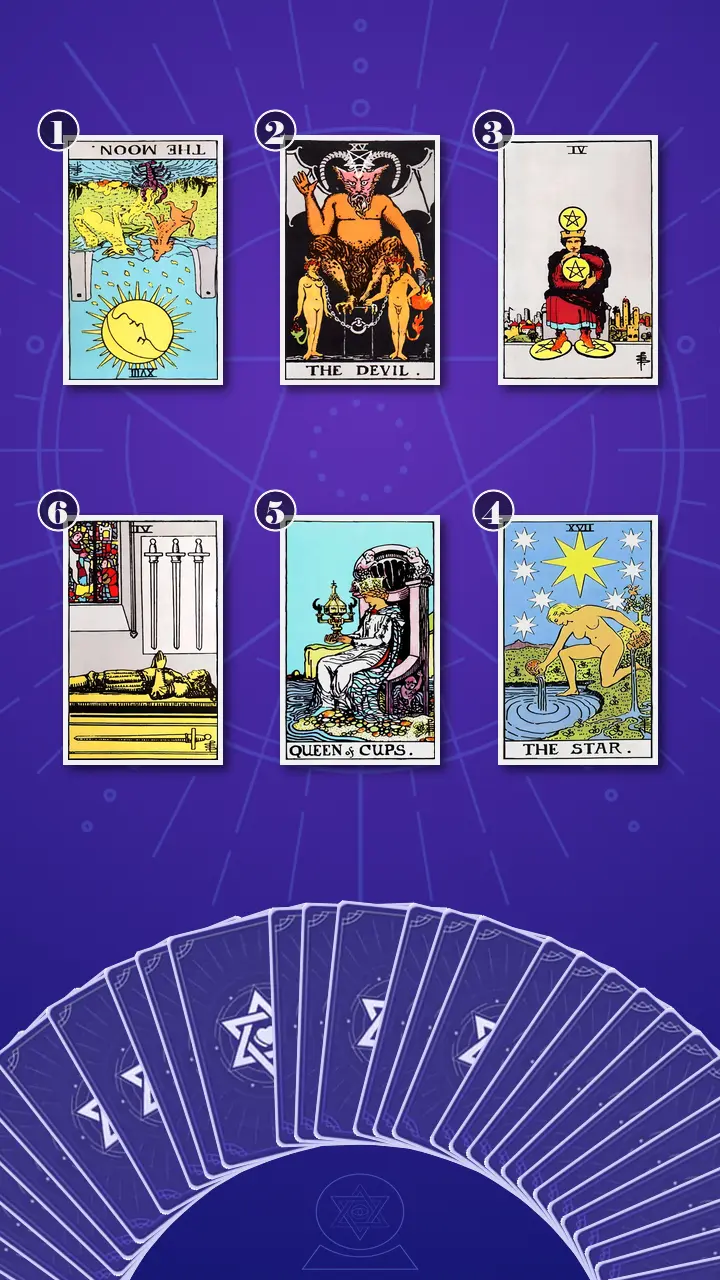
I chose the Transformation Path Grid (6) · Context Edition, a six-card tarot spread arranged as a two-by-three serpentine path. The top row would move from the visible response to its reinforcing payoff and then to the guarded root. The lower row would turn at the catalyst, pass through a boundary-aware practice, and end with integration.
I selected this spread because Alex was not facing a simple choice between posting and staying silent. They were describing a self-reinforcing loop: exposure, polished explanation, response-checking, temporary relief, and private stagnation. A decision spread would have reduced that loop to two options. A broad Celtic Cross could have shown more context, but it would have diffused the compact causal chain we needed to see. This grid was designed for systemic deconstruction, which made it better suited to the repeated behaviour underneath performative vulnerability after feeling exposed.
For the reader following the map with me, the first position asks what happens immediately after the mask slips. The second identifies what makes the pattern rewarding enough to repeat. The third reveals the belonging fear beneath the control. Position four is the hinge, where a different relationship with vulnerability becomes possible. Positions five and six translate that shift into discernment and deliberate rest.
The layout resembled a path through a public square that bent toward a quiet room. That image mattered. I was not using tarot to predict what Alex would post, how their friends would respond, or whether one exercise would heal anything. This is how tarot works at its most useful for me: card meanings in context turn a private blur into an observable structure. Alex would test the structure against their own life and keep authority over every conclusion.
The Story Before It Was Ready
Position One: The Caption Before the Feeling
I began, “Now I am turning over the card that represents the observable public response after the mask collapses: how vulnerability becomes a performance and where healing begins to stall.”
The Moon, in reversed position.
In the Rider-Waite-Smith image, the moon has a face, the dog and wolf stand on opposite sides of the path, and a crayfish rises from dark water. Reversed, the card did not tell me that Alex had reached clarity. It showed hidden material breaking the surface before interpretation had settled. Revelation had happened, but understanding had not caught up.
I connected the symbols to the Victoria line sequence. Alex had an unplanned emotional reaction, opened Notes, and converted uncertainty into a beautiful explanation before deciding what the feeling needed. The dog and wolf reflected the split I could already hear in their account: one part longed for acceptance while another scanned for judgement. The crayfish was the raw emotion still emerging beneath the polished story.
The energy dynamic here was blockage. Feeling could surface, but it was blocked from becoming self-knowledge because narrative production began almost immediately. The Moon reversed was like a phone camera switching from automatic exposure to manual. The image had become visible, but adjusting the brightness did not necessarily reveal what the image meant.
“The mask slipping is not the same as the story being ready,” I said. “The last time your voice caught or you admitted more than planned, what happened in the next hour? Did you stay with the feeling, or did you make it coherent and audience-ready?”
Alex gave a short laugh, but there was no amusement in it. Their fingers stopped turning the phone. “That is too accurate. Kind of brutal, actually. I had a real feeling, made it articulate, posted it, and then watched the replies to find out whether I was allowed to have it.”
“If it feels brutal, we slow down,” I replied. “The card is describing a sequence, not issuing a verdict on your character. Your communication skill is real. The question is whether that skill is serving the feeling or getting between you and it.”
Position Two: The Loose Chain of the Typing Bubble
I continued, “Now I am turning over the card that identifies the attachment or protective payoff keeping performative vulnerability active, including the need to manage how the audience interprets you.”
The Devil, upright.
The Devil showed the short-term relief of being witnessed. Alex would post a personal confession, receive warmth, and then feel pulled into replying, clarifying, and revealing more because the next reaction seemed to determine whether the original disclosure had been acceptable. A delayed read receipt, a single heart, or a disappearing typing bubble could change the emotional temperature of the entire evening.
I laid out the inner monologue as plainly as I could: I shared to feel close. The silence now feels like rejection. I explain more so the connection stays visible. Each reply briefly settled the fear, but it also made another reply feel necessary. Genuine connection had entered a transaction with narrative control.
The energy dynamic was excess: not an excess of wanting care, but an excess of power handed to intermittent audience feedback. The loose chains around the figures mattered. I did not read them as a prediction of permanent bondage. I read them as evidence that the exchange could be examined. The pattern felt compulsory, but it was not identical to fate.
Looking at the card, I flashed back to the Wall Street dashboards I once watched late into the night. A number could rise for seconds and still conceal a structurally weak position. That professional memory led me into one of my core diagnostic tools, Network ROI Analytics.
I was careful with the metaphor. I was not assigning financial value to Alex's friends, and I was not calling a caring audience toxic. I was separating the relationship from the engagement strategy. On one side of the ledger, Alex was investing attention, clarifications, personal details, refreshes, and hours of physiological vigilance. On the other side, they were receiving real but brief reassurance. The relationship could be caring while the transaction around the disclosure remained high-drain and low-return.
“When the vulnerable post gets a delayed reply or a single heart,” I asked, “what do you hope the next paragraph will settle?”
Alex's shoulders rose. Their gaze moved away from me and fixed on the dark window behind their laptop. “That they have not changed their mind about me,” they said. “That I am not embarrassing. That I still belong there.”
“Audience relief is still relief, but it is not the same thing as inner movement,” I said. Alex looked back at The Devil, pressed their lips together, and slowly set the phone face down.
Position Three: The Story Held Against the Chest
I said, “Now I am turning over the card that reveals the underlying fear and belonging story making private, unfinished feeling seem unsafe or insufficient.”
Four of Pentacles, upright.
The figure on the card clutches one pentacle against the chest, balances two beneath the feet, and holds another above the head. In this reading, the valuable possession was not money. It was control over the public meaning of an emotional experience.
I connected that image to Alex's daily life. After a difficult Slack exchange with a senior colleague, they could write a perfectly balanced explanation of why the message affected them, edit out anything that sounded too angry or needy, and rehearse how every sentence might be received. In creative circles, they could share something true while selecting the audience, timing, context, joke, and ending so precisely that nobody else had much room to define what the moment meant.
I thought of the direct-to-camera glances in Fleabag: real pain is revealed, but the act of narrating it also keeps the audience at a carefully controlled distance. Alex's eloquence was not proof that their feeling was false. It was a sophisticated grip around access, meaning, and reputation.
The energy dynamic was another form of excess, this time an excess of protective control. Ownership of an experience is healthy; trying to pre-empt every possible interpretation keeps the nervous system on permanent communications duty.
I used a measured version of my Toxic Hierarchy Filtration framework. The aim was not to declare Alex's workplace, friends, or creative community toxic. I wanted to identify which imagined gatekeepers had acquired authority over the meaning of an unpolished moment. A senior colleague held formal status. Articulate peers held cultural status. A broad online audience held visible metrics. Alex had been giving all three groups voting rights over an inner experience they had not yet understood themselves.
“If you left a vulnerable moment unexplained,” I asked, “what are you afraid people would decide about you? And what would that decision seem to prove about your belonging?”
Alex inhaled through their nose. Their hand tightened once around the mug and then loosened. “They might think I am needy, chaotic, or not as emotionally intelligent as I seem. At work, maybe not composed enough for the role. With friends, maybe too much effort.”
“That is the root,” I said. “You are not only explaining a feeling. You are trying to secure your place before anyone can use the unfinished version as evidence against you. The control makes sense as protection. It also prevents you from learning that an unfinished feeling can remain yours without becoming a reputational emergency.”
When The Star Cancelled the Content Deadline
Position Four: The Unedited Stream
The rain that had been tapping Alex's kitchen window softened. Their kettle gave one final metallic click, and for a moment there was no notification sound between us. I let that quiet remain before reaching for the card at the lower-right turn of the grid.
“Now I am turning over the card that names the inner shift capable of interrupting the loop: vulnerability as uncurated contact rather than proof submitted to an audience.”
The Star, upright.
The naked figure kneels without theatrical explanation. One pitcher pours into the pool, while the other pours onto ordinary land. I read that two-way flow as a balanced use of emotional energy: one stream nourishes private inner life; the other reaches daily reality through a small, chosen act. Neither stream is directed toward applause.
The Star's energy was balance, but not completion. It offered self-trust, restorative hope, honest openness, and the possibility of letting emotional truth matter before it became public evidence. This was the bridge card, not a guaranteed outcome. It showed a credible change in direction.
I brought Alex back to 8:47 p.m. The carriage lights buzzed, the phone was warm, and their throat had not released what they had admitted. Before the train reached the next stop, Notes had already converted the raw moment into a caption. Had being understood replaced feeling it?
Stop treating public disclosure as proof that healing is happening; allow The Star's naked figure to model one unedited feeling held in a chosen space.
A mask slipping is an exposure event, not a content deadline. One unedited, bounded act of honesty can be real before it is legible to anyone else.
I stopped speaking and let both sentences remain in the room.
I watched Alex's breath catch. First came a physical freeze: their fingers hovered above the face-down phone, their jaw held rigid, and their eyes widened by a fraction. Then their focus drifted past the screen as if they were replaying every caption written on the way home. Their eyebrows pulled together, and when they spoke, the first note in their voice was not relief but anger. “But does that mean I was fake before? Does it mean all those times I shared, I was doing vulnerability wrong?” I kept my voice level. “No. The connection was real, and so was the relief. We are separating what helped for a moment from what you needed afterward.” Their fist slowly opened. Colour rose around their eyes; their shoulders dropped on a long, unsteady exhale. Then they went very still, almost disoriented by the space that appeared once no immediate explanation was required. “That is weirdly scarier,” they whispered. “Because then I have to decide what I actually need.”
“Now, using this new perspective, think back to last week,” I invited. “Was there a moment when this insight could have made the experience feel different?”
Alex remembered the difficult Slack exchange. They had drafted three versions of a message explaining why it hurt. “I could have written, ‘I feel embarrassed and defensive,’ and left it in Notes,” they said. “I did not need to turn it into a case for why I was still competent.”
I returned to Network ROI Analytics, but The Star changed the unit of return. Under The Devil, success had meant engagement: a reply, a heart, proof that the audience remained present. Under The Star, success meant contact: Did this act bring Alex closer to their feeling, their body, or one carefully chosen person? A plain private sentence could receive zero public engagement and still produce a better emotional return than a polished post that consumed the rest of the night.
The two pitchers made the distinction visible. One stream could enter the private pool as self-witnessing. The other could reach ordinary life through a direct request for company, listening, or space. This was not a demand for silence. It was an audience boundary.
I named the transition clearly: this was one step from exposure shame and audience-regulated narrative control toward selective, unedited vulnerability and grounded self-trust. Alex had not suddenly lost the urge to post. They had begun to see the urge as information rather than an instruction.
The Lidded Cup and the Quiet Room
Position Five: One Person, One Sentence, One Boundary
I said, “Now I am turning over the card that translates the shift into a one-week, boundary-aware practice for choosing when, where, and with whom to share.”
Queen of Cups, upright.
The Queen's attention rests on an ornate lidded cup. She neither discards it nor displays its contents to everyone. Her stone throne sits beside moving water, which gave me a precise image of emotional receptivity supported by structure.
In Alex's life, this looked like noticing the urge to post, naming the feeling in ordinary words, and choosing one person who could listen without requiring a completed healing narrative. The lidded cup did not mean concealment. It meant that access could remain deliberate. Privacy was not denial, and selective sharing was not a failure of authenticity.
The energy dynamic here was balance: receptivity without emotional spillage, containment without suppression, and connection without surrendering ownership. The Queen of Cups invited Alex to become their own first witness while still allowing relational support.
“After the next emotional crack,” I asked, “who could receive one plain sentence? What would you ask them not to do, and what information would you keep for yourself?”
Alex looked down at the lidded cup and traced its outline in the air with one finger. “I have a friend who does not turn everything into advice,” they said. “I could say, ‘I felt exposed after that, and I do not have a polished explanation yet. I only want you to listen.’”
Their expression held relief and reluctance together. A whole audience had felt safer because no single request needed to be made directly. One-person honesty asked for less disclosure, but more precision about the actual need.
Position Six: The Phone in the Other Room
I continued, “Now I am turning over the card that shows the integrated definition of healing to carry forward: feeling and processing without requiring public validation.”
Four of Swords, upright.
The recumbent figure rests beneath three aligned swords, with a fourth held separately below. I read the image as a distinction between laying down the active mental story and retaining one clear truth for later reflection.
In modern terms, this was the deliberate pause after exposure. Alex could put the phone in another room, leave a vulnerable message unanswered for a while, and allow the next part of the experience to develop without composing another explanation. The quiet would be chosen, not imposed. Rest would not mean disappearance, punishment, or pretending to be fine.
The energy dynamic addressed a current deficiency of recovery time and offered a more balanced interval. I pointed out that this was the second Four in the spread. The Four of Pentacles contained feeling by gripping its public meaning. The Four of Swords contained it by laying down the tools of management. The same structural energy had moved from control to rest.
“If nobody witnessed the pause,” I asked, “what would tell you that you had stayed in contact with the feeling?”
Alex considered the question without reaching for their phone. “My jaw might unclench,” they said. “I might know whether I want comfort, clarification, or just somewhere for the feeling to exist. And maybe there would not be a follow-up draft.”
I nodded. “That is integration in this reading. Not a perfect absence of urgency. A chosen interval in which the urgency is no longer the only voice in the room.”
A Low-Drama Exit from the Public-Proof Loop
Taken together, the six cards told one coherent story. The Moon reversed showed emotion becoming visible before its meaning had settled. The Devil revealed the sticky but understandable payoff of audience reassurance. The Four of Pentacles exposed the protective grip beneath the polished account: if Alex controlled every word, perhaps nobody else could define the rupture. The Star redirected emotional water into private life and ordinary contact. The Queen of Cups added audience discernment, and the Four of Swords created the quiet in which the feeling could become self-knowledge.
The central blind spot was not that public sharing was fake or that online support did not matter. It was the assumption that public legibility proved emotional validity. Alex had been using the audience's understanding as evidence that the feeling counted, then mistaking brief shame relief for completed inner movement. When the relief faded, they assumed they needed a clearer story rather than a different kind of contact.
The transformation direction was therefore specific: move from proving vulnerability through polished public performance to practising small, unedited honesty with clear audience boundaries. The goal was not certainty. It was ownership over access, pace, and meaning.
The Social Divestment Plan
I translated the reading into my Social Divestment Plan, a calculated but humane protocol for withdrawing energy from a high-drain interaction without creating unnecessary drama. In this case, Alex did not need to liquidate friendships or announce a social-media detox. They needed to divest from the compulsory transaction that said every exposed feeling owed the audience more explanation. We would freeze new investment, review the actual need, and reallocate attention toward a chosen form of contact.
- The Unfinished Truth Pause After the next visible emotional moment, open Notes before Instagram, WhatsApp, or Slack. Set a five-minute timer and write one sentence beginning with “I feel” without adding context, humour, a lesson, or a polished ending. Add the date and a review time 24 hours later. At the review, ask whether you want contact, clarification, or simply a place for the feeling to exist. If 24 hours feels too large, begin with ten minutes. Put the phone face down, name three ordinary details in the room, and stop the exercise if it becomes too intense. Recording the moment is enough; displaying it is optional.
- One-Person Honesty Choose one person who has earned access, not merely the person most likely to reply quickly. Send one plain sentence, such as “I felt exposed after that happened, and I do not have a polished explanation yet.” Add the boundary in the same message: “I only want you to listen,” or “I am not ready to discuss details.” Leave the message without adding context for 20 minutes. Keep the act small and reversible. You may keep the sentence private, change your mind, or end the conversation. If you do send it, place a glass of water beside the face-down phone and let the boundary do the explanatory work.
I reminded Alex that these were experiments, not rules. A public post could still be a valid expression of creativity, advocacy, community, or connection when freely chosen. The test was not private good, public bad. The test was whether Alex was choosing the audience or asking the audience to certify that their unpolished self still belonged.

A Week Later, the Sentence Stayed Plain
Six days later, I received a message from Alex. After another tense workplace exchange, they had opened Notes and written, “I feel embarrassed, defensive, and tired.” They did not turn it into a case about professionalism. At the review point, they sent one sentence to a trusted friend and added, “Company would help; advice will not.” Then they left the phone in the kitchen for 20 minutes.
“I still wanted to add three paragraphs,” Alex wrote. “But the urge stopped feeling like an emergency. It became an option.”
They also told me they slept through the night, then woke with the thought, “Maybe I should have explained more.” They smiled at it, made tea, and left the note unopened until breakfast.
I did not treat that message as proof that the pattern had disappeared. It was the kind of small, bittersweet evidence I trust: clarity with some vulnerability still attached. Alex had taken one action without turning it into a finished identity or a public recovery narrative.
That was the quiet result of our Journey to Clarity. The cards had not exposed a secret destiny, and I had not given Alex a verdict. The six-card Transformation Path Grid placed the loop outside them long enough for them to see its structure. Once it was visible, Alex chose a different next step. The agency was theirs.
When your throat tightens and your face burns after the mask slips, you can genuinely want to be held and still reach for a polished story, because an unfinished feeling can make belonging feel like something you must prove. Not every true feeling needs a public receipt. Letting one feeling remain unfinished does not return you to the beginning; it may be the first moment in which the feeling belongs to you before it belongs to the narrative.
If one quiet, unedited feeling could matter before it belonged to an audience, what would you notice in the next minute beside the face-down phone: the plain word itself, the body carrying it, or the boundary that lets it remain yours?