When Your Future Self Grades the Present—Try One Small Test This Week

When an Imagined Future Made an Ordinary Day Feel Like Failure
I met Avery at one of those modern career crossroads where the question is not whether there is a future, but why the future keeps making the present feel guilty. They had finished another ordinary day as a junior content designer in Toronto, opened a private future-self document instead of the one practical task already identified, and searched 'career pivot anxiety' because planning felt safer than finding out what a small experiment could actually change.
As Avery described the 8:47 p.m. westbound TTC Line 1 ride home, I could picture the fluorescent lights buzzing above them, the phone warm against their palm, and the brakes squealing at every stop. They had completed the work they were paid to do, yet polished LinkedIn promotions and studio launches had turned the commute into a private performance review.
'I can see who I could become,' Avery told me, 'so why does today feel like proof that I am not becoming them?' They wanted creative depth, autonomy, and a more spacious life, but feared that respecting a stable job or an ordinary evening meant settling. The imagined future had become a standard, and the current life was being asked to pass an exam before it was allowed to teach them anything.
I could see the self-doubt in the way Avery's shoulders hovered near their ears and in the heavy pause before each small task. It was like living beneath a glowing billboard for a future self while every ordinary day auditioned for a role it could never quite reach.
'I am not going to ask the cards to decide whether you are behind,' I said. 'We can use them as a clear, objective mirror for the pattern. Then we can look for one present-tense action that belongs to you. Let us draw a map through this fog, without treating the map as a script. That is our Journey to Clarity.'
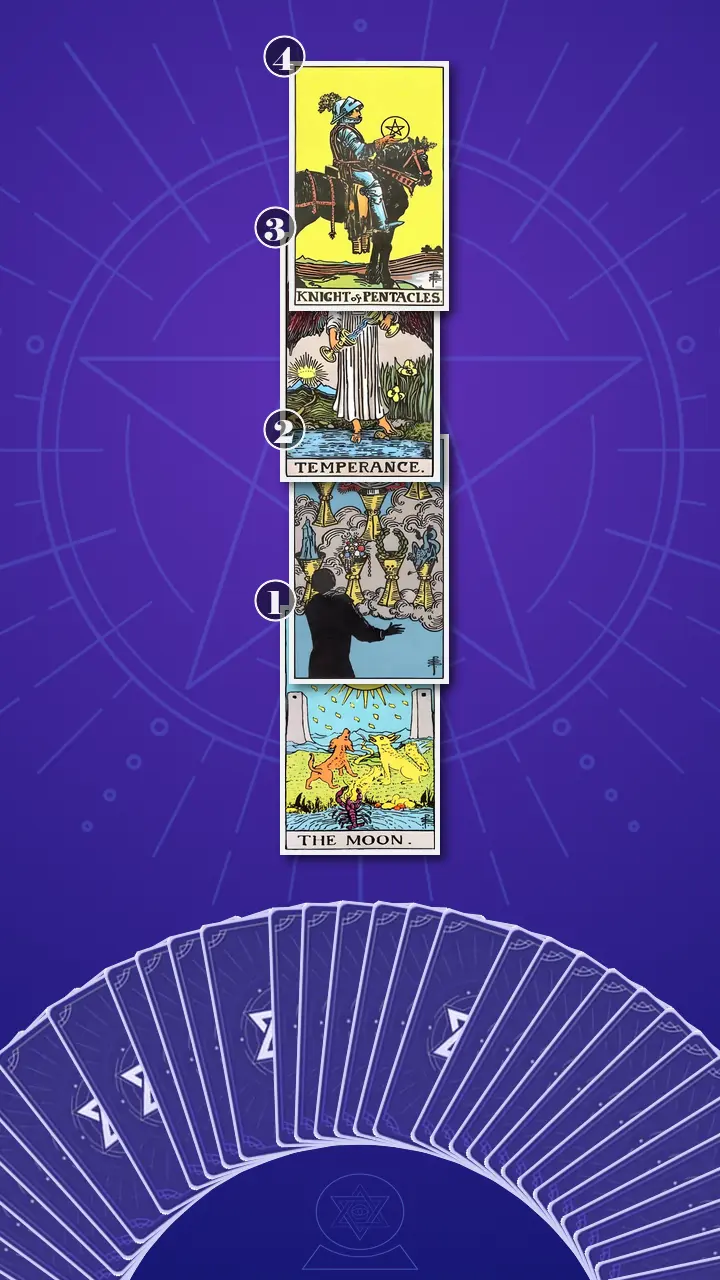
A Four-Layer Insight Ladder for Finding Clarity
I asked Avery to place the phone face down, take one slow breath, and name the question in plain language. I shuffled gradually, using the movement to mark a transition from scrolling and self-scoring into deliberate observation. Nothing about the preparation needed to be mysterious; it was simply a way to give one crowded question enough room to be seen.
I chose the Four-Layer Insight Ladder · Context Edition, an original four-card tarot spread for self-reflection and cognitive clarity. The question described a self-reinforcing Projected Mirror Loop, not a choice between two external options and not a timing question. A larger spread could have added noise, while a Past-Present-Future spread might have treated Avery's imagined future as an outcome instead of noticing how it was functioning as a mental mirror.
For anyone wondering how tarot works in a reading like this, I explained that the cards would slow the pattern into four observable questions. The first position would show the visible symptom: how ordinary routines were being scored. The second would expose the underlying loop: how several possibilities had become an internal standard. The third would offer the transformational bridge between vision and process. The fourth would translate that bridge into grounded integration through one repeatable action. The structure was designed to support self-exploration, not to make a decision on Avery's behalf.
Reading the Map Without Letting It Judge
The Moon and the Daylight Facts
'Now turned over is the card representing the visible symptom: the observable behavior of comparing ordinary present-day choices and routines against the imagined future, including the moment when the current life is mentally scored as a failure.' I turned the card toward Avery. It was The Moon, upright. Traditionally, this position shows the visible condition on the surface; here, the moonlight showed how the surface had become emotionally charged before it had been properly understood.
The winding path on the card mattered. The light was present, but indirect, so every bend looked suspicious. I connected it to Avery's normal workday through the glow of a future-self document and polished social updates: a delayed portfolio task, a quiet evening, or a repetitive product revision began to look like evidence of failure. The Moon asked a more useful question: what is factual about today, and what part has been cast by fear, longing, and someone else's carefully framed highlight?
The energy here was projection in excess and direct evidence in deficiency. Avery's imagination was not the problem; it was being used as a measuring device before it had become a workable direction. The dog and wolf facing the moon reminded me of three possible reactions to uncertainty: seeking approval, reacting instinctively, and fearing whatever has not yet been named. The crayfish emerging from the pool suggested a fourth truth: something real may be rising, but it cannot be identified while the whole scene is being judged from a distance.
I use a signature diagnostic lens called Internal Monologue Auditing. I asked Avery to listen for the genre of the voice narrating the day. Was it a patient documentary, recording what had actually happened, or a tragedy in which every quiet scene foreshadowed failure? The sentence I heard underneath the comparison was, 'If today's task does not visibly resemble my future, then today's task does not count.'
Avery gave a short, bitter laugh. 'That is too accurate,' they said. 'Almost cruel.' Their fingers tightened around the edge of the chair, and then their gaze moved from the card to the floor. I told them the card was not accusing them; it was making the mechanism visible. A projection can be examined without becoming a verdict about the person who has been living under it.
Seven of Cups: The Browser Tabs That Never Land
'Now turned over is the card representing the underlying loop: how the Projected Mirror Loop and Inner Conflict turn imagined possibilities into an internal standard, causing the process to lose value before it can generate evidence.' The card was the Seven of Cups, upright. Its traditional meaning concerns hidden causes, wishful images, and difficulty discerning among alluring possibilities.
I pointed to the seven cups floating inside the cloud. They looked like Avery's open browser tabs: a new creative role, a portfolio concept, a course, a different routine, a more spacious apartment, a better personal brand, and an imagined identity with none of the awkward middle parts. On a quiet Sunday, Avery could move between a career plan, a portfolio idea, and polished LinkedIn updates for forty minutes, feel briefly productive, and still leave their feet exactly where they had started.
The energy of possibility was in excess, while discernment and present action were blocked. This was not a lack of vision. It was possibility overload. Every image remained attractive because none had been allowed to become a small experiment that could provide real information. A plan can create direction and still be a place to hide.
I asked Avery to complete the inner-monologue sentence aloud: 'I am planning because I care, but I may also be planning so I do not have to find out what one real step can do.' The raised arms of the figure on the card seemed to reach toward every cup at once, while the feet remained still. I also named the second lens I sometimes use, Persona Fatigue Diagnosis, not as a label but as a question: how tiring is it to keep performing the character who should already have arrived?
Avery's eyes moved as if they were switching between invisible tabs. Then they stopped and said, 'Wait, I do this. I call it planning, but I am also using the future to grade the day I am actually living.' The recognition did not make them instantly cheerful. Their jaw stayed tight, but their hand moved away from the phone. For the first time, the difference between being inspired by possibility and being immobilized by it had a shape.
When Temperance Turned the Verdict into a Conversation
Before I touched the third card, a streetcar bell sounded below my studio window and faded into the Toronto traffic. The room seemed to make space around the centre of the ladder. I turned the card slowly, because this was the bridge the first two cards had been asking for.
The Two Cups and the Compass
'Now turned over is the card representing the transformational bridge: the practical mindset that can reunite vision and process, directly challenging the fear that honouring the current pace means settling or failing.' The card was Temperance, upright. Its standard meaning is integration, balance, patience, and the ability to combine different elements without forcing either one to disappear.
The angel poured water between two cups. One foot stood on land and one in water, while a path led toward distant light. I described the image as an exact answer to Avery's split: the future did not need to be abandoned, and the present did not need to impersonate the entire vision. Creative depth could become ten minutes with a blank note. Autonomy could become one decision made without opening six more tabs. Spaciousness could become a protected block in a real calendar.
Temperance brought balance where The Moon and Seven of Cups had created shifting water and emotional overload. Its energy was not passive waiting. It was proportion: enough aspiration to keep the direction alive, enough respect for current capacity to make the action repeatable, and enough patience to let the process produce information.
The Sentence Between the Cups
By then, I could feel Avery trying to solve the old problem again: if they respected this stable job, would ambition quietly die; if they wanted more, did they have to reject everything here? The imagined future had become a courtroom, and every ordinary day was sitting in the witness box.
Do not use the future as a verdict that the present has failed; blend one future value into today's repeatable practice, as Temperance blends water between two cups.
For one beat, Avery's thumb froze above the phone. Their breath stopped, then their brow tightened; they did not offer the easy nod. 'But doesn't that mean I was wrong?' they asked. 'If I stop making the present prove the future, what have all those plans been?' I felt the anger under the question and left it room. First came the physical freeze: fingers held in midair, jaw set, eyes fixed on the cups. Then the thought sank in; their gaze lost focus as if replaying Sunday tabs, the TTC post, and the untouched portfolio draft. Finally, a low 'Ah' rose from the chest. Their shoulders dropped a fraction, their fist opened against the table, and the next breath arrived shaky but fuller. Relief was there, but so was a small, dizzying blankness: without the courtroom, Avery would have to choose, observe, and revise in real time. That responsibility was not a punishment; it was ownership.
I asked, 'Now, use this new perspective to recall a moment last week when this insight might have made you feel different. What would you have done if the future had been a compass rather than a courtroom?' Avery looked toward the window. The traffic lights reflected in the glass like small, steady stars.
I returned to Internal Monologue Auditing and asked Avery to revise the genre without forcing a happy ending. The old narration said, 'I am behind, and this ordinary day proves it.' The more accurate version was, 'I completed the content update. I have not tested the portfolio idea yet. I can choose a ten-minute test without knowing what it will become.' That was not positive thinking. It was a change from a punitive plot to an evidence-based one.
We kept the future-self document open, closed one aspirational tab, and wrote creative depth at the top of a blank note. Under it, Avery wrote one ten-minute action and one thing the action could not prove about their identity. Nothing had been solved, but the relationship between these two things had changed. The future was still meaningful. It simply no longer had permission to stand over the present with a scorecard.
This was the first crossing from future-focused shame, restless comparison, and self-doubt toward process-based self-trust. Not certainty. Not a guaranteed career pivot. Just the first moment in which Avery could want more while respecting what was already here.
The Knight of Pentacles and the Evidence That Repeats
'Now turned over is the card representing grounded integration: the repeatable present-tense action that lets Avery learn from the process without asking it to prove the entire imagined future.' The card was the Knight of Pentacles, upright. Traditionally, this position points to the practical response that integrates an insight through steady effort.
The horse stood still, but it was not defeated. The Knight held the pentacle carefully at chest height, and the ploughed field waited beneath a quiet landscape. I connected that stillness to one recurring calendar block, one revised portfolio section, one course exercise, or one creative concept completed at a sustainable pace. Deliberate movement is still movement, especially when it gives the person information that another roadmap cannot provide.
The upright energy here restored what the earlier cards had lacked: patience, reliability, and a grounded form of evidence. The excess was no longer dramatic urgency. The deficiency was no longer proof. The practice could be modest without being meaningless. Quiet progress is still evidence when it can be repeated.
Avery's shoulders did not fully relax, and I did not expect them to. They placed one hand flat on the table and said, 'I think I keep waiting for a step to make me feel like the future person before I let myself repeat it.' I nodded. The Knight offered the reverse order: repeat the action, notice what it teaches, and allow identity to become less of a performance and more of a record.
The Future as Compass, Not Courtroom
When I laid the four cards together, I saw a clear sequence rather than a prediction. The Moon showed the indirect light of a future image projected onto an ordinary Toronto workday. The Seven of Cups revealed the possibility overload beneath it: too many imagined lives becoming competing standards. Temperance offered the bridge, turning the future from a verdict into a value that could be practised now. The Knight of Pentacles carried that value into earth through a repeatable task.
The cognitive blind spot was not that Avery lacked ambition or needed a more impressive plan. It was the assumption that today's step had to prove the whole future before it was allowed to count. Accepting the current pace had been confused with surrender, while rejecting the current pace had been confused with ambition. The transformation direction was more precise: replace the imagined future as a verdict with a weekly process experiment that expresses one future value through a small action available today.
As an artist, I thought about a film still in production. A rough scene can reveal the direction of a story without having to look like the final cut. If I judge every unfinished frame by the finished film, I learn nothing about what the scene is already doing. I told Avery that I was not handing them a new identity. I was handing the pen back and asking them to make one honest edit.
I offered three small experiments as actionable advice, not commandments. Each one was designed to create information without turning the result into a verdict.
From Insight to a Present-Tense Experiment
- Name one future valueOn one weekday after work, open the future-self document, choose one value such as creative depth, autonomy, or spaciousness, and write a ten-minute action that expresses it with tools already available to you. When the timer ends, record one sentence beginning, 'What this action taught me was...'Use a phone timer and stop when it ends, even if you could continue. If ten minutes feels too small to count, make the smallest version one sentence. The action is an invitation, not a commitment to a new career or identity.
- Create process evidenceAdd one recurring 45-minute calendar block this week called 'process evidence'. Use it for one concrete task, such as revising one portfolio case-study section, completing one course exercise, or drafting one creative concept. Mark whether the block happened and what you learned.Define the finish line before you begin and keep the upper limit at 45 minutes. Do not rate the result against the imagined future. Let reliability and repeatability become evidence in their own right.
- Make The Director's Cut of Self-CompassionDuring the next comparison spiral, open a note titled 'Moonlight versus daylight'. Write three observable facts about today beside the future-based story being projected onto each one. Then mentally edit the narrator from a punitive judge into an objective, supportive observer and choose one fact that needs a small test.Let the story remain emotionally real without treating it as proven fact. If separating facts from the future story feels dismissive or uncomfortable, pause. You choose whether to continue, and clarity does not have to be forced in one sitting.
I reminded Avery that the point was not to shrink the vision. It was to stop using the vision to punish the present. The cards had not promised that every experiment would work. They had shown a way to learn without making one imperfect result carry the weight of an entire life.
A Small Proof in the Ordinary Week
Three days later, I received a message from Avery. They had used the ten-minute future-value check after a repetitive workday, chosen creative depth, and drafted a rough alternate landing-page concept in a blank note. They had not redesigned the whole portfolio or rewritten the five-year plan. They had simply completed the experiment and written, 'I learned that starting feels less impossible when I am not asking the first draft to introduce my future self.'
On Thursday morning, the first thought was still, 'What if I am wrong?' Avery smiled, opened the daylight-facts note instead of the five-year plan, and wrote one fact before making coffee. The clarity was real but fragile, and that was enough for a beginning.
For me, this was the quiet shape of a Journey to Clarity. The Moon and Seven of Cups had not been enemies; they had shown where imagination had become a mirror and then a judge. Temperance changed the relationship, and the Knight of Pentacles gave Avery a way to build trust through participation. Avery remained the author of the next act, with the cards serving as a map and not a fate.
I know the tight-chested pause after an ordinary workday, when feeling okay about what is here can seem dangerously close to admitting that the life you can picture will never arrive. But a present life does not need to resemble the final picture to be worthy of attention, learning, rest, or care.
If your future-self document could stay open without becoming a performance review, what small quality from it - creative depth, autonomy, or spaciousness - might you quietly notice in the life you are already living?