Repeating Childhood Scripts in Big Decisions: Naming the Rule First
The Seventh Column at 8:47 PM: Repeating an Inherited Childhood Script
I said it gently when Jordan, a 29-year-old non-binary project coordinator in London, sat down: 'You are a London project coordinator who can make ordinary calls all day, then spend Sunday night adding another column to a major decision because the familiar option feels safer than the one you privately want.' I added, 'That is not just Sunday Scaries; it can be Comparison Fatigue wearing a responsible-looking outfit.'
At 8:47 PM on the Sunday Jordan had described, I watched them sit at a small kitchen table with a laptop open to a project-and-move comparison sheet. They added a seventh column while the laptop fan hummed, a mug of tea cooled beside their elbow, and the radiator clicked behind them. An old message remained open in another tab, waiting to explain what the responsible choice was supposed to be.
Jordan told me, 'I know what I want until the choice becomes real.' A promotion had brought more visibility, more money, and a possible change of routine. The adult option looked like the life they actually wanted, but the familiar option carried the old labels safe, sensible, and acceptable. The contradiction was plain: Jordan wanted to make a major decision as an adult while repeating the same childhood script.
I could see confusion moving through their body like a browser with twenty-seven tabs open, each one playing a different warning while none of them selected a destination. Their jaw was tight, their chest looked heavy beneath a careful breath, and the pause before commitment had the frozen quality of a screen that refused to load. After each delay came restless mental replay, followed by shame for having delayed again.
I told Jordan that this did not sound like a lack of intelligence or discipline. I was not there to lecture, predict an outcome, or make the promotion, move, or relationship boundary on their behalf. I wanted us to sit beside the decision document and make the hidden rule visible. 'Let us draw a map through the fog,' I said. 'That is our Journey to Clarity today, and you remain the person holding the pen.'
Choosing a Map Through the Loop
I invited Jordan to place both feet on the floor, take one slower breath, and hold the question in mind without trying to solve it immediately. I shuffled slowly. For me, this is a focusing practice and a psychological transition, not a supernatural demand for certainty.
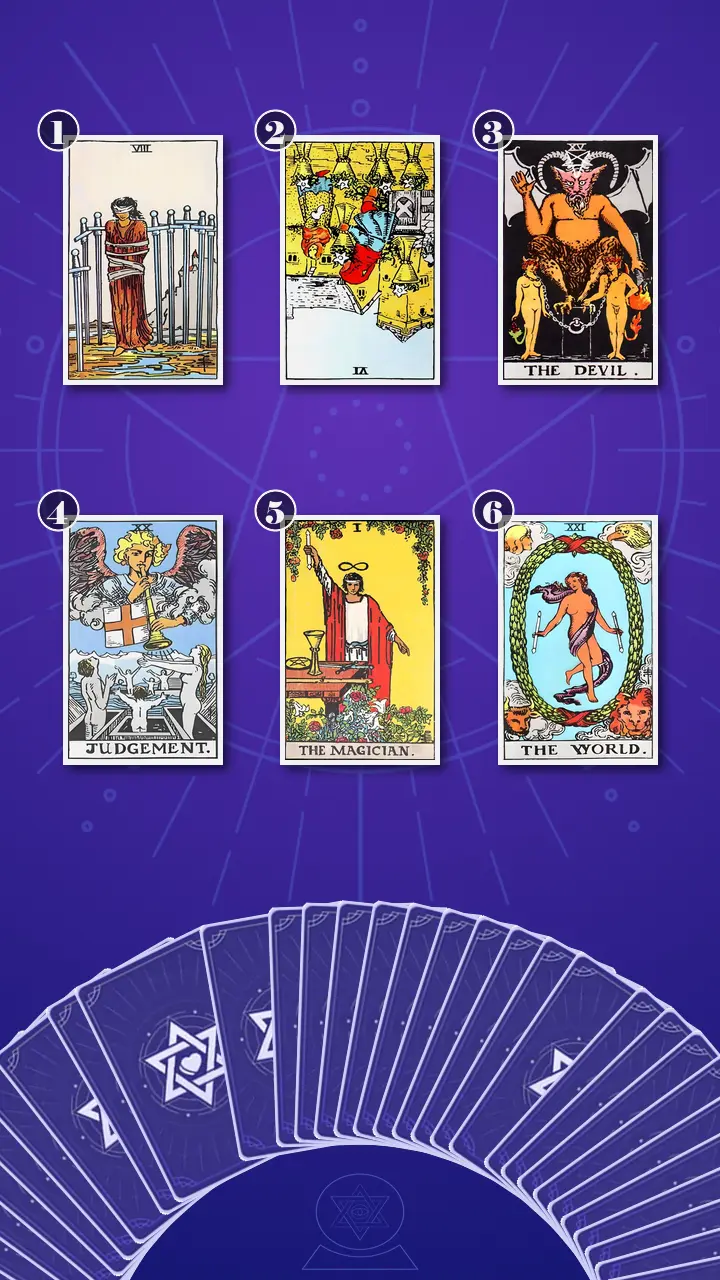
I chose the Transformation Path Grid (6) · Context Edition, a six-card tarot spread designed for tracing a repeating childhood pattern through a present-day decision. This is how tarot works in this reading: the images externalize a process that has been difficult to observe from inside, allowing card meanings in context to sit beside current facts, body signals, and personal values.
For anyone following this as a way to understand decision paralysis, the reason this spread fits is its structure. A Celtic Cross could offer broad context, and a Past-Present-Future spread could create a linear story, but neither would show the six causal links this question needs. The grid moves from current pattern to blockage, root attachment, catalyst, action experiment, and integration. It maps the loop without treating it as destiny.
I explained that the top row would show what was visible: the behavior, the emotional filter, and the attachment beneath it. The lower row would offer a route through the pattern: the conscious interruption, the practical next step, and the wider perspective Jordan could build. The six positions were not instructions from the cards. They were prompts for self-observation and agency.
Reading the Narrowed Field
Position 1: The Loop That Looks Like Research
I began with the card for the current pattern and visible loop: the observable behavior in which Jordan delayed or over-analyzed a major decision while the decision blind spot remained hidden. I turned it over. It was the Eight of Swords, in upright position.
In the RWS image, the blindfolded figure stands with crossed hands inside a ring of swords, yet the bindings are loose and open space remains beyond the enclosure. I read that as Jordan's mind narrowing a present-day choice until the familiar childhood rule appeared to be an external restriction. At 9:16 PM, a promotion, a move, or a relationship boundary could be open on the laptop with several genuine options visible, but every option became another comparison column.
The upright energy was an excess of mental Air and a deficiency of tested perception. Jordan had gathered salary figures, commute times, workload details, and other people's opinions. The useful information had already arrived, but the blindfold turned an inherited idea of being responsible into a hard system restriction. More research gave short-term relief because no irreversible step had been taken. It did not give Jordan present-day evidence about what they actually valued.
Jordan gave a short, bitter laugh. 'That is too accurate. Maybe a little cruel.' Their fingers tightened around the mug, then went still against the cold ceramic.
I did not ask them to agree with the card. 'Recognition can sting without being a verdict,' I said. 'We are looking at the moment when careful thinking changes function. Does this comparison add useful evidence, or is it waiting for someone else to make your preference feel permitted?'
Position 2: The Flower-Filled Rule
I moved to the card for the blocking force: the emotional residue and inherited childhood filter that made the familiar script feel safer than a choice belonging to Jordan's current life. The card was the Six of Cups, in reversed position.
The RWS children and their flower-filled cups brought an old phrase into the room. I compared the cup to a saved voice note, an old message, or a remembered approval standard that still felt tender and authoritative whenever a career, relationship, or moving decision became emotionally loaded. The older figure moving through the village suggested a past context continuing to walk across the present, even though the people, resources, and choices had changed.
Reversed, the water of memory was not balanced with current evidence. The blockage was not that Jordan remembered too much, or that the past was bad. It was that emotional familiarity had been given veto power. I asked Jordan to hear the inner sentence clearly: 'I learned this was what good or safe people choose, but what evidence says it still fits now?'
Jordan looked down at the six cups. Their breath paused, then their chest released by a small degree. They said, 'I keep calling it careful thinking, but sometimes I am just waiting to feel permitted.' Their shoulders remained raised, but their hand stopped reaching for the phone.
I also named the overcorrection risk. Rejecting every practical consideration just to prove freedom would still let the childhood script control the choice. The most unfamiliar option is not automatically the most adult one. The invitation was more precise: honor where the rule came from, then test whether it belongs in this decision now.
Position 3: The Subscription That Keeps Renewing
I turned to the card for the root attachment: the underlying fear and repetition compulsion keeping the limiting pattern active beneath the visible decision behavior. It was The Devil, in upright position.
I told Jordan that The Devil was not a prediction of doom, a moral judgement, or proof that they were permanently bound. In the RWS image, the two figures wear loose chains beneath a larger figure. The chains matter because they are restrictive but noticeable. They resemble a default setting that keeps renewing because cancelling it feels riskier than continuing to pay for something no longer chosen.
The energy here was attachment in excess. The familiar script offered a known way to survive disappointment, disapproval, or the possibility of being alone. Jordan could tell themself that the familiar option was simply practical, while a deeper layer asked a more frightening question: if I choose differently and someone is disappointed, will I still belong?
I asked, 'Which part of this pattern is genuinely necessary now, and which part is maintained because you already know how to survive it?'
Jordan's eyes stayed on the loose chains. I could see frustration arrive after the relief of being understood. They did not look broken to me. They looked like someone noticing that a coping pattern had been doing two jobs at once: reducing uncertainty and defining safety. That distinction gave us somewhere specific to work.
When Judgement's Trumpet Named the Background Process
Before I reached for the fourth card, the room became unusually quiet. The radiator stopped clicking, and the glow from Jordan's laptop fell across the old message, the unfinished table, and their crossed arms. It felt less like a dramatic omen than the moment a phone notification finally reveals the background process that has been draining the battery.
Position 4: The Call to Interrupt the Loop
I began with the card for the catalyst for conscious interruption: the key shift required to name the childhood rule and separate present-day values from inherited permission. I turned it over. It was Judgement, in upright position.
In the RWS image, an angel raises a trumpet while figures rise from their coffins with their arms lifted toward the call. I read the scene as awakening, honest self-review, and release from an old identity, not as a forecast. Judgement asks Jordan to hear the exact sentence running beneath the decision rather than describe the entire experience as confusion.
Here I used my signature diagnostic lens, Cognitive Stratigraphy. When a sudden emotional reaction seems larger than the current facts, I treat the first wave as a surface artifact. I look carefully through its layers: what happened now, what label appeared, what older belief system might have supplied that label, and what present evidence has not yet been allowed into the room. I do not invent a family history or declare a hidden trauma as fact. I use the image to distinguish an inherited instruction from a current reality.
My practical version of this is called the Trigger Excavation Exercise. I asked Jordan to write the present trigger, the body signal, and the exact childhood-style sentence before trying to defeat, obey, or explain it. The purpose was not to erase the younger self. It was to create a pause in which the adult self could be heard.
At 8:47 PM on a Sunday, Jordan was adding another column to the decision table while an old message sat open in another tab. Their jaw tightened as the familiar option began to sound responsible, although their adult priorities pointed elsewhere. They were not short of facts; they were waiting for permission.
I let the quieter sentence come first: 'The childhood rule may still explain why familiarity feels safe, but it does not have to decide what safety means in your adult life. Naming the rule creates room for one present-day value to enter the decision.'
You are not required to answer every big decision from the childhood script; let Judgement's trumpet wake up the adult perspective that can name the rule and choose one present-day criterion.
For a second, Jordan's fingers froze above the keyboard and their breath stopped midair. Their pupils widened; then their gaze lost focus, as if the old message had started playing in another room. I watched recognition move from the screen to their face, followed by a flash of anger. They said, 'But if I choose differently, doesn't that mean I was wrong before?' I did not rush to turn the protest into positivity. I said, 'It may mean the old rule helped you survive a different set of conditions. It does not make your adult value invalid now.' Their crossed arms loosened, one hand opened against the tabletop, and a slow breath reached the bottom of their chest. The radiator clicked once, like a notification finally naming a background process. Jordan looked at the unfinished table and wrote, 'I can hear this rule without treating it as permission or law.' I asked, 'Now, use this new perspective to remember whether there was a moment last week when this insight might have made you feel differently?'
This was the first clear movement from automatic replay toward integrated self-trust. Jordan did not need to reject the past, force a breakthrough, or choose immediately. They had noticed that repetition was a learned protection, not proof of safety. A big decision had become information about present values rather than a referendum on whether they belonged.
Position 5: The One-Page Agency Experiment
I moved to the card for the action experiment: the small, observable alternative Jordan could try within one week without asking the cards or another person to decide. It was The Magician, in upright position.
The RWS Magician raises one hand with a wand and grounds the other toward the table, where a cup, sword, wand, and pentacle are already available. I read that as conscious will moving between feeling, thought, intention, and practical evidence. The answer was not another hour of research. It was a one-page dashboard that allowed every relevant kind of information to share the same workspace without one inherited rule dominating it.
I asked Jordan to create four lines: old rule, current evidence, present-day value, and one small action. The value might be autonomy, learning, rest, mutuality, or financial steadiness. The important part was choosing a value that belonged to the life Jordan was actually living, not a value selected to sound universally responsible.
The Magician's energy was agency in balance. Its shadow would be turning the exercise into another elaborate performance of perfect decision-making, so I set a ten-minute limit. Jordan did not have to decide whether to accept the promotion during the reading. They only had to see what changed when autonomy or learning stood beside the old rule.
Jordan wrote the word autonomy, then drew a line beneath it. Their shoulders lowered another fraction. The laptop still showed the same options, but the page no longer looked like a courtroom. It looked like a small experiment Jordan could run, review, and revise.
Position 6: The Wider Frame
I finished with the card for integration and self-understanding: the perspective in which Jordan could remember the childhood script, recognize repetition, and make a present-day choice without treating the pattern as fate. The card was The World, in upright position.
The RWS figure dancing inside a wreath, surrounded by four balanced figures, gave the decision a wider frame. The circle suggested completion without rigidity. I told Jordan that integration did not mean every future choice would feel easy. It meant the old rule could remain part of the record without occupying the whole screen or authoring every future route.
I have spent a lifetime at Cambridge and on archaeological digs, and ruins have taught me to distinguish a damaged surface from the fate of an entire structure. I call this perspective Ruins Restoration Thinking. If a repeated pattern has left someone feeling fragmented or mentally exhausted, I do not treat that fracture as proof of permanent brokenness. I ask what old structure has been carrying too much weight, what remains enduring underneath it, and what can be restored for the life that exists now.
For Jordan, restoration did not mean rebuilding the childhood script because it was familiar. It meant keeping the younger self's history, removing the rule's automatic authority, and making room for adult boundaries and values. Jordan looked at the wreath and said, 'I can understand why I learned this without making it my only way to belong.' I heard the difference immediately. The card offered a possible practice, not a guaranteed result.
The One-Page Rule-and-Value Split
The Story the Six Cards Told Together
When I read the six cards as one system, the reason for the repetition became clear. The Eight of Swords narrowed the field, the reversed Six of Cups imported an old emotional context, and The Devil showed why familiar restriction could feel safer than freedom. Delay then lowered the pressure for a little while, but it left Jordan's adult preferences untested, which made the familiar path seem even more trustworthy the next time. The top row formed a closed loop.
The lower row opened a route through it. Judgement named the background rule, The Magician turned recognition into a small decision experiment, and The World offered an integrated frame. The old message had behaved like a pinned note in an ancient family group chat, outdated but still appearing at the top whenever a new decision arrived. The insight was not to delete history. It was to stop letting one old message decide what counted as evidence.
The cognitive blind spot was treating indecision as evidence that more information was needed. In reality, Jordan often had enough facts and was searching for emotional permission. The key shift was simple and demanding in the right proportion: before deciding which option is safest, name the childhood rule being replayed and add one criterion based on present-day values.
I said, 'Familiar is a feeling, not a safety score.' I also reminded Jordan, 'A big decision is not a referendum on whether you belong. It can be a way to gather present-day evidence about what supports your life, your boundaries, your learning, and your sense of self.' That did not remove practical trade-offs. It put them back in their proper place.
Small Experiments, Real Evidence
I gave Jordan three actionable next steps. Each one was intentionally small. None required the cards, a friend, or a group chat to select the outcome.
- Trigger Excavation Exercise: name the old ruleWithin the next seven days, open one live promotion, move, or relationship-boundary document and add a section titled Old Rule. Write, without editing, one sentence beginning with A good, safe, or acceptable person would... Save the exact sentence as a snapshot of the rule currently influencing the choice.Use the smallest version and stop after ten minutes. Keep legal, health, housing, financial, and other practical facts in a separate check. This exercise notices inherited meaning; it does not replace due diligence or qualified advice.
- The Rule-and-Value SplitChoose one present-day value that matters in the decision, such as autonomy, learning, rest, mutuality, or financial steadiness. Write it beside the old rule, apply both criteria to one live option, and make two short notes about what each criterion prioritizes. Circle one difference.Use a five-minute timer if the value starts turning into a demand for the perfect answer. Stop after noticing the difference. No external decision is required during this experiment.
- Ask for a witness, not permissionSend one WhatsApp voice note to a trusted person saying, I am not asking you to decide; I am testing whether I can hear my own present-day criterion. Share only the old rule and the current value, then wait thirty minutes before requesting another opinion.Keep the conversation to one person and one voice note. If the response becomes pressuring, pause and return to your own notes. Support can witness your process without becoming the authority that permits your choice.
I made the boundary explicit: the cards had not chosen the promotion, the move, or the relationship boundary, and neither had I. The spread had made the process observable. Jordan was still the person who would weigh workload, money, housing, health, consent, and timing. Tarot had served as a structured cognition tool, giving a name to the loop so that Jordan could test a different criterion in real life.

A Wider Way to Belong
Five days later, I received a WhatsApp voice note from Jordan. They had written the old sentence at the top of the decision page, added autonomy beneath it, and sent their manager one direct question about the promotion's scope and workload instead of asking three friends what they would do. The question did not settle the whole future, but it belonged to the present.
A week later, Jordan slept a full night after asking that question. At breakfast, the first thought was still, 'What if I am wrong?' They noticed it, smiled, and opened the decision sheet instead of LinkedIn. The old rule was present, but it was no longer alone.
I think of that as the first small proof of finding clarity. Not certainty, not a personality makeover, and not the promise that an old pattern will never return. It was one adult action made with incomplete certainty, followed by enough self-trust to review the result rather than turn it into a verdict.
Our Journey to Clarity moved from the tight circle of automatic replay to a wider way of seeing. Jordan could remember the childhood rule without handing it the steering wheel. The past remained part of the story, while the next page became something Jordan could write.
When a big choice makes your jaw lock and your chest go heavy, you can be standing in an adult life while an old rule quietly asks you to prove you still belong by choosing what feels familiar. The moment you notice that request, you are already no longer at the exact point where the loop began.
If you named the old rule and added one present-day value, which tiny part of this decision would you want to look at with your own eyes first?