The Sunday Plan That One Neutral Reply Erased
If you know exactly what you want until you put it in the group chat, then watch one skeptical emoji turn a clear plan into approval-seeking decision paralysis, this story may feel uncomfortably familiar.
At 8:47 p.m. on a wet Sunday, Maya (name changed for privacy) appeared in my video window from the narrow kitchen of her London shared flat. The kettle clicked off behind her, buses hissed over rain-dark pavement, and her phone sat warm in her restless hand. On her laptop, a completed Notion task had just disappeared from the calendar.
“I had a next step,” she told me. “Then my friend asked, ‘Have you thought about whether that is realistic?’ Now I have five tabs open and no idea what I am doing. Why do I lose my direction whenever other people might disapprove?”
I heard the contradiction immediately. Maya wanted a direction she had chosen, yet she was trying to preserve belonging by making that direction impossible for anyone to question. The attempt to stay connected was quietly erasing the very choice she wanted other people to understand.
Her apprehension was visible before she named it. Her shoulders hovered near her ears, her chest barely moved when she breathed, and her fingers kept waking the phone screen as if the next notification might contain permission. It looked like trying to read a Tube map while every nearby passenger reached over to move the destination sticker.
“A neutral reaction is not a no,” I said, “but your body may have learned to read it that way. I am not going to tell you which career direction is destined to work. I want us to identify what happens between someone else reacting and you deleting your own plan. Then we can give you a practical way to keep hold of the pen.”
I reminded her that tarot, as I practise it, is not an authority handing down a verdict. It is a visual structure for slowing a fast psychological pattern until its moving parts can be seen. Our Journey to Clarity would not require Maya to stop caring about people. It would help her receive their perspectives without turning feedback into permission.

Choosing the Compass Beneath the Noise
I asked Maya to place both feet on the kitchen floor, take one unforced breath, and hold the question without trying to make it sound sensible. I shuffled slowly while she turned her phone face down. The small ritual was simply a transition: out of the WhatsApp thread and into sustained attention.
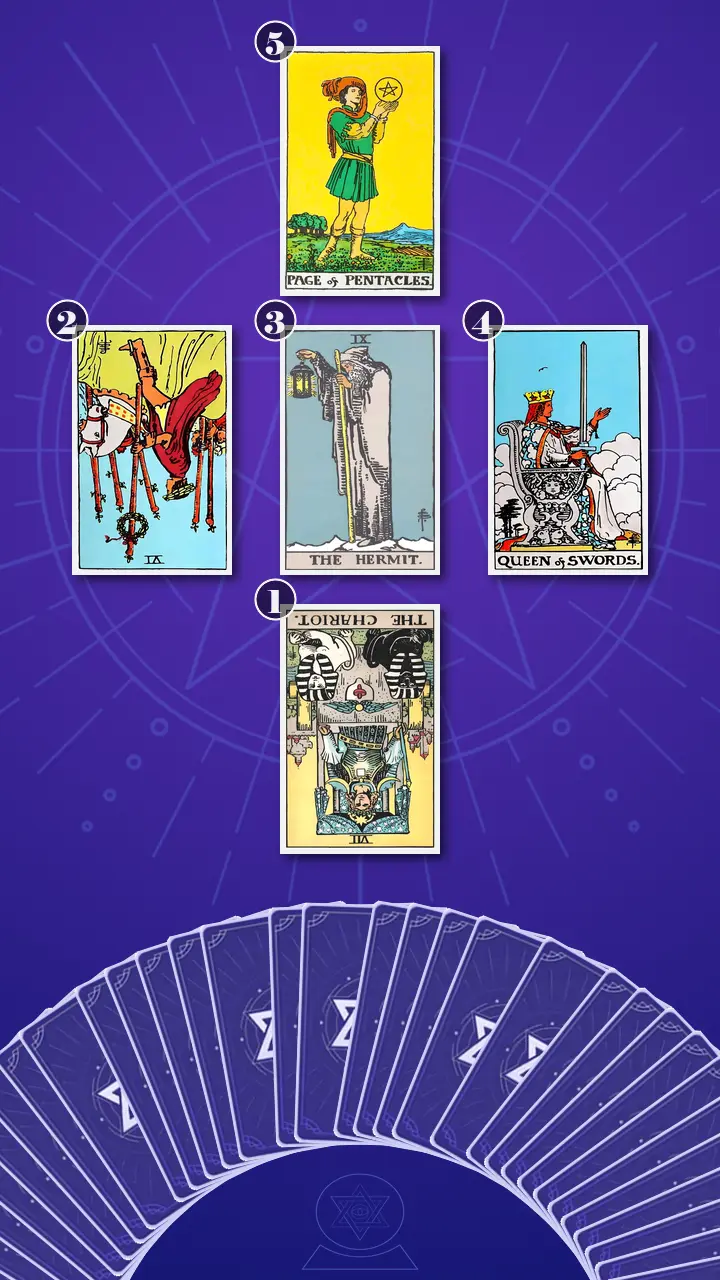
I chose The Inner Compass, a five-card tarot spread arranged as a compact compass-shaped cross. It was the shortest structure that could hold the full mechanism of her problem without turning a specific pattern into a sprawling life diagnosis.
For anyone curious about how tarot works in a reading like this, each position performs a distinct analytical job. The lower card shows the Present Bearing, the observable way Maya currently loses momentum. The left card reveals the Interference pulling her off course. The central card marks True North, the private source of guidance beneath public reaction. To the right, Discernment shows how to filter feedback. Above the centre, the Grounded Step turns the insight into a reversible experiment.
The layout also made the conflict visible before I interpreted a single card. Approval pulled from the left, discernment waited on the right, drift sat below, and practical experience waited above. The centre would have to regulate all four. That is why The Inner Compass is useful for approval seeking and self-trust: it does not ask whether other people are right or wrong. It asks who has been given authority, what evidence exists, and what can be tested next.
The Chariot Stalled in a Kitchen Full of Tabs
Present Bearing: The Chariot Without Reins
I turned over the card representing Present Bearing: the observable pattern of rewriting plans, reopening options, and delaying action after possible disapproval, together with the contracted inner conflict driving that behaviour. It was The Chariot, reversed.
I angled the card towards the camera and pointed out the charioteer, the absence of visible reins, and the black and white sphinxes facing in different directions. Upright, The Chariot coordinates competing forces around a chosen course. Reversed, that directional energy is blocked. The will has not disappeared, but its forces are no longer taking instruction from the same source.
“This is your Sunday evening in one image,” I said. “You had a workable next step scheduled in Notion. One friend sent a cautious question. Within minutes, you deleted the task, reopened three discarded career routes, and started building a twelve-month comparison table. The plan was not disproved. Its direction was split between what you intended and what might attract the least criticism.”
Maya told me the words that had run through her mind: “I knew what I wanted until she asked that. Now I need to check the market again. Maybe I should reopen agency work. Maybe in-house is safer. Maybe I need another qualification.” Her hands had moved faster as the actual plan stopped moving.
The reversed energy showed Blockage rather than incapacity. Maya could choose in private, but the moment the decision became visible, her internal navigation system recalculated around every passenger's concern, even when nobody had supplied new traffic data. More planning gave her a brief sense of control, but it also created more routes, more criteria, and more imagined audiences to satisfy.
She gave a short, bitter laugh and looked away from the screen. “That is so accurate it feels a bit brutal.”
“Then let us make the accuracy useful, not punitive,” I replied. “I do not see a weak or naturally indecisive person here. I see a social safety strategy working overtime. It reduces the immediate risk of standing alone, but it prevents you from collecting the lived evidence that could create real direction.”
Her fingers stopped tapping. She did not look relieved yet, but her hands were still enough for the card to remain in view.
Interference: The Applause Dashboard
I turned over the card representing Interference: the approval-based belief, reassurance-seeking defence, and fear of losing belonging that pulled Maya away from a self-chosen course. It was the Six of Wands, reversed.
The card showed a laurel-crowned rider surrounded by raised wands. I asked Maya to imagine the image inverted, with public recognition no longer secure. The Wands energy was blocked at its source: enthusiasm and forward motion had become conditional on visible approval. At the same time, approval-monitoring had moved into Excess.
“You share a possible career move in a group chat and read the replies like launch analytics,” I said. “Four people may be supportive, but the one person who asks, ‘Is that realistic?’ becomes the only response that feels credible. Missing enthusiasm starts to look like failed market validation.”
I watched Maya press her lips together. The line beneath the behaviour was not merely, “Maybe this plan needs work.” It was, “If they believed in me, they would sound more excited. If they are not excited, I must have missed something. If I continue anyway, I may look foolish or become less recognisable to them.”
“Missing applause is not missing evidence,” I said. “A flat response may contain information, or it may reflect somebody's taste, mood, risk tolerance, limited imagination, or rushed commute. Until we separate those possibilities, tone is being granted more authority than fact.”
This was also where I recognised what I call Persona Fatigue. Maya had built several socially legible versions of herself: sensible employee for her manager, cautiously curious friend in the group chat, polished emerging professional on LinkedIn, and privately ambitious creator when nobody was watching. None of those roles was inherently false. The exhaustion came from changing the script so rapidly that the authentic preference never stayed on screen long enough to develop.
“At work, everything I write goes through three people before it becomes public,” she said quietly. “I think I have started treating my life like a Google Doc in suggestion mode.”
Her breath paused. Her eyes drifted towards the deleted calendar space as if replaying the moment her friend's message arrived. Then she let out a low “oh” and lowered her shoulders by a fraction.
“That makes sense,” I said. “Review is useful in communications work. It becomes disorienting when every person with comment access is also given admin access to your private criteria.”
When the Hermit's Lantern Reduced the Whole Road to One Step
True North: The Light That Did Not Need an Audience
As I reached for the central card, the kitchen seemed to quiet with us. The washing machine behind Maya's wall ended its spin cycle, and the reflected phone light vanished when she pushed the device farther away. I turned over the card at the heart of the reading: The Hermit, upright.
This position represented True North, the private value or inner source of guidance still available beneath public reaction and existential drift. On the card, a solitary figure stood on a snowy height with a grounded staff and one small lantern. The light did not cover the mountain. It illuminated only the path immediately ahead.
The Hermit's energy was available in Balance. This was not a command to isolate, reject advice, or pretend that material consequences did not matter. It was a deliberate pause between receiving a reaction and rewriting a choice. In modern life, it looked like Maya closing the group chat, leaving her phone in another room, and writing down why she wanted the direction before preparing to defend it.
I asked her to picture Sunday again: one cautious WhatsApp reply glowing beside the Notion plan that had felt clear ten minutes earlier, her chest tightening, the task vanishing from the calendar, five abandoned alternatives reopening as if uncertainty itself were proof of diligence.
I use Internal Monologue Auditing when a person's thoughts have begun behaving like a film genre they never consciously chose. Maya's internal cut had become a social-survival thriller. A delayed reply was scored like approaching danger. A skeptical question foreshadowed humiliation. A friend's inability to picture her new direction was edited into a scene of future exclusion.
The Hermit did not turn that film into a fantasy in which nobody disagreed. He changed the camera position. Before the crowd entered the scene, he asked: What mattered to Maya? Which value remained true when nobody was reacting? What could she personally verify?
You are not directionless; your direction keeps getting overwritten when someone else's reaction is mistaken for an instruction. The next step needs one criterion you chose, not a unanimous vote.
I let the sentence settle before I gave her the card's sharpest message.
You are not directionless because the crowd is unconvinced; choose the next verifiable step by your own criterion, as the Hermit's lantern lights the path immediately ahead rather than the entire road.
For one beat, Maya's breathing stopped. Her fingers hovered above the trackpad without touching it. Then her gaze lost focus, and I could see her replaying something beyond the kitchen: the Thursday voice note, the altered bio, the calendar blocks removed after ordinary questions. Her eyes brightened, but her jaw tightened first. “But doesn't that mean I have been getting it wrong this whole time?” she asked, anger briefly roughening her voice. I told her no. The revisions had been attempts to protect connection, not evidence of stupidity or failure. The new insight simply made the cost visible. Her fist slowly opened on the table. Her shoulders dropped on a long, uneven exhale. After the release came a brief blankness, almost a light-headed pause, as if clarity had removed a familiar burden and revealed the responsibility underneath it: the next edit would be hers.
“Now, with this new perspective, think back to last week,” I said. “Was there a moment when this insight could have made you feel different?”
Maya returned to the voice note in which her friend had said, “I just cannot picture you doing that.” She touched her sternum and said, “I could have let that hurt without changing the sentence in my bio. Her not picturing it was not the same as me not wanting it.”
That distinction marked the first visible movement from apprehensive, approval-driven plan rewriting to grounded self-authorship that could coexist with disagreement. It was not permanent confidence. It was a small interval in which Maya's original preference remained present while somebody else's uncertainty existed beside it.
To make the interval concrete, I set a timer for seven minutes. I asked Maya to finish three lines: “Before I asked anyone, I wanted...”; “The criterion that matters to me is...”; and “A reversible step I can take is...”
She wrote that she wanted more creative ownership. She chose creative ownership as her temporary criterion, not a universal truth she had to defend forever. Her reversible step was to complete one sample communications brief within a two-hour limit. I asked her to put it in the calendar and leave it unchanged for seventy-two hours after nonessential feedback.
I was explicit about the boundary around that experiment. The pause did not apply to legal, financial, contractual, health, role-specific, or safety information. Reflective self-trust does not mean ignoring expertise. It means refusing to confuse another person's unexamined discomfort with essential evidence.
The Open Hand, the Upright Sword, and the First Finished Thing
Discernment: The Queen Who Let Feedback In
I turned over the card representing Discernment: the boundary and evaluative capacity Maya needed to separate relevant feedback from other people's preferences without rejecting connection or surrendering authorship. It was the Queen of Swords, upright.
The Queen held her sword vertically while extending her other hand. I read those gestures together. The open hand welcomed information; the sword applied a standard. This was clear Air functioning in Balance, not the Excess of analysis that had filled Maya's Notion table and not the Deficiency of refusing to listen.
“Imagine a colleague says your idea sounds risky,” I said. “Instead of rewriting the plan, you ask, ‘Which concrete assumption or outcome concerns you?’ Then you check the answer against cost, time, role expectations, and your chosen criterion. You use the factual part. You do not automatically adopt the speaker's comfort level as your own.”
I gave her three questions, each as clean as the Queen's sword: What fact is here? What preference is here? Which part is mine to use?
As an artist, I have sat with feedback that was technically informed, emotionally charged, brilliantly useful, or simply a description of what somebody else would have made. I thought of those critique rooms as I looked at the Queen. Receptivity is not obedience. A thoughtful creator can listen closely and still decide which note belongs in the work.
“Feedback can enter the room without taking the chair marked ‘decision-maker,’” I told Maya.
She reopened her manager's question about whether the self-directed project was realistic. This time, she examined the wording aloud. No budget limit had been named. No deadline had changed. No performance concern had been raised.
“So the factual content is that I need to check capacity,” she said. “The rest might be their preference for predictability.”
I watched her nod once, slowly. Rain still marked the window behind her, but the pane had stopped reflecting her phone. She was not dismissing her manager. She was reducing a broad question to the part she could investigate.
Grounded Step: The Page Who Did Not Announce a New Identity
I turned over the final card, representing the Grounded Step: one small, reversible experiment through which Maya could replace consensus-seeking with direct evidence. It was the Page of Pentacles, upright.
The Page held one pentacle at eye level with complete attention. Cultivated ground stretched behind him towards distant hills. The image carried stabilising Earth in Balance: one object of study, bounded conditions, patient effort, and learning that did not have to perform for an audience.
“This is not a dramatic career-pivot announcement,” I said. “It is one sample brief, one portfolio page, one informational conversation, or one introductory class. You choose a deliverable that fits your real financial and energy limits, complete it before announcing a new identity, and record what it teaches you.”
The Page changed Maya's question from “Will everyone respect this direction?” to “What did one completed task let me verify about my interest, capability, and fit?” The potential she had not been using was not certainty. It was the right to be a beginner whose first experiment did not have to justify an entire future.
“I can make the sample brief on Tuesday,” she said. “Two hours, no spending, and no posting it. This does not have to prove who I am. It only has to teach me something.”
Her hands rested flat on the table. I did not mistake that stillness for a completed transformation, but I recognised it as grounded curiosity. The plan had become small enough to hold and concrete enough to test.
The Director's Cut: Three Ways to Keep the Pen
Seen together, the cards told a coherent story. The reversed Chariot showed Maya's agency divided whenever private desire and anticipated judgment pulled apart. The reversed Six of Wands revealed why: a missing note of enthusiasm was being treated as a verdict on competence, legitimacy, and belonging. The Hermit restored one private point of reference. The Queen of Swords filtered outside input by evidence and relevance. The Page of Pentacles turned the surviving preference into lived data.
In film terms, Maya's life had acquired too many guest editors. Every comment triggered a new cut, every doubtful expression reshot the scene, and the original director's intention disappeared beneath revisions. The answer was not to ban notes from the production. It was to restore a clear process for deciding which notes improved the work and which belonged to someone else's film.
Her cognitive blind spot was the assumption that feeling exposed meant the direction had become less valid. A tight chest was real, but it was not proof. A friend's hesitation was real, but it was not automatically evidence. Her transformation direction was precise: stop treating reactions as verdicts, define one personal criterion, take one small reversible step, and seek nonessential feedback only after experience had produced something concrete to evaluate.
I introduced what I call The Director's Cut of Self-Compassion. When Maya's internal narration switched from observation to prosecution, she would pause the scene and remove the punitive voice-over. Instead of “A sensible person doubts me, so I am being foolish,” the objective cut would be: “I received a cautious reaction. My body contracted. I have not yet received a new fact. I can check the evidence before changing the plan.”
This was the actionable advice produced by The Inner Compass five-card tarot spread. The cards had helped us name the pattern, but Maya would create clarity through the experiments she chose to run.
- The One-Lantern Criterion: For one live, non-urgent decision, spend seven minutes alone in the flat, a quiet cafe, or a library. Complete: “Before I asked anyone, I wanted...”; “The criterion that matters to me is...”; and “A reversible step I can take is...” Put the step in your calendar and keep it unchanged for seventy-two hours after nonessential feedback. Treat the criterion as a temporary test condition. Use a two-minute version if seven minutes feels exposing, and always seek qualified input for legal, financial, health, contractual, or safety issues.
- The Evidence-or-Preference Filter: After the next cautious comment, copy the exact words into a two-column note labelled “verifiable evidence” and “their preference or comfort level.” Where appropriate, ask one question: “What concrete outcome or assumption concerns you?” Investigate one factual item and leave the rest outside the decision unless it matches your criterion. The minimum version is two labels in a locked phone note. The goal is not to win an argument or dismiss the person; it is to identify what the comment can actually tell you.
- The Grounded Apprentice Trial: Choose one deliverable you can finish within seven days, such as a one-page sample brief, a portfolio revision, a thirty-minute introductory lesson, or one informational conversation. Cap the first version at two hours with no unplanned spending. Afterward, record three observations under “interest,” “capability,” and “fit” before asking whether anyone is impressed. The experiment's job is to produce one piece of personal evidence, not settle your identity. Reduce it to twenty minutes, one paragraph, or one conversation when time or money is tight.
I asked Maya to choose only the first and third actions for that week. More tools would have risked becoming another elaborate planning system. She selected the private criterion note and the two-hour brief, then took a screenshot of the calendar block before closing Notion.

Six Days Later, the Calendar Block Was Still There
Six days later, Maya sent me a photo of a finished one-page campaign brief and its calendar block, still intact. She had slept through the night; her first thought that morning was still, “What if this is wrong?” She told me she smiled, then opened the learning log.
She had written that the work held her attention, that she needed to strengthen one technical skill, and that a more self-directed path might fit if she protected financial steadiness. A friend had responded cautiously when Maya mentioned the experiment. She listened, sorted the useful question into her evidence column, and did not delete the next task.
I did not call that certainty, and neither did she. It was the quieter proof that mattered: disagreement had entered the room, but Maya remained the author of the next scene. Tarot had not chosen her future. It had helped her see where she had been handing away the pen, and she had decided to pick it up.
That was the real Journey to Clarity: not a move from doubt to fearlessness, but from automatic plan rewriting to a steadier self-authorship that could keep connection, practical caution, and personal judgment in the same frame.
If a neutral reply makes your chest tighten and your hand reach to delete the plan, the fear may not be only that you chose badly. It may also be that choosing for yourself could cost you a place with other people. Simply seeing that hidden price means the old edit is no longer happening entirely in the dark.
If one private value became your Hermit's lantern and illuminated only the next small, reversible scene, what would you be curious to let it show you before anyone else's reaction entered the room?

Every reading at AceTarot is a journey to connect with inner wisdom and empower the path ahead. This reading shared here is a psychological mirror, not a private record—crafted to reflect universal emotional loops and help restore personal clarity. Please note that these insights do not replace professional psychological, medical, legal, or financial advice, and should not serve as the sole basis for major life decisions.
Learn more about our Journey to Clarity.
How did this insight land for you?
🫂 This Resonates Deeply
🌀 Living This Story
✨ Now I See Clearly
🌱 Seeing New Possibilities
🧰 Useful Framework
🔮 The Confirmation I Needed
💪 Feeling Empowered
🚀 Ready for My Next Step
Author Profile
AI Juniper Wilde
1056 readings | 537 reviews
“I’ve always felt our lives are films currently in production. As an artist, I know that when you feel stuck, it’s often because you’ve bravely stayed in a painful scene for just a little too long. I’m not here to coldly analyze you. I want to sit closely with you, look at those difficult moments with profound empathy, and gently hand you the pen so you have the courage to write your next beautiful act.”
In this Introspection Tarot Reading :
Core Expertise
- Internal Monologue Auditing: Identifying the destructive 'genre' (e.g., tragedy, horror) of your subconscious thoughts that constantly induces anxiety.
- Persona Fatigue Diagnosis: Assessing the heavy psychological toll of maintaining an artificial 'social character' that conflicts with your authentic self.
Service Features
- The Director's Cut of Self-Compassion: A mental editing technique to pause a spiral of self-hatred, reframing the internal narrative from a punitive judge to an objective, supportive observer.
Also specializes in :
Explore Related Patterns:
Advice-Based Permission SeekingMaya deletes a scheduled task after one friend asks whether her plan is realistic, and she later recognizes that another friend's inability to picture her new direction had been enough to change the sentence in her bio. The advice does not simply enter as information. It is converted into permission that determines whether her original preference is allowed to remain active. When you use advice this way, the hidden question shifts from "What can this person help me evaluate?" to "Am I still allowed to want this?" The immediate revision protects connection and reduces the exposure of choosing independently, but it also transfers authorship to people who may be expressing only a mood, taste, or personal tolerance for risk. That repeated transfer is the mechanism behind Advice-Based Permission Seeking.
Approval-Driven Decision ParalysisWithin minutes of a friend asking whether her plan is realistic, Maya deletes the scheduled task, opens five tabs, reactivates three discarded career routes, and starts constructing a twelve-month comparison table. The plan has not been disproved, but action stops as soon as the choice becomes socially visible. When you respond to possible disapproval by generating enough alternatives and criteria to satisfy every imagined audience, analysis becomes a social safety defense. It briefly protects you from standing behind one contestable choice, yet it also makes movement conditional on a consensus that may never arrive. Approval-Driven Decision Paralysis names this loop in which anticipated judgment divides your direction faster than new evidence can clarify it.
Self-AbandonmentMaya removes her own calendar blocks and changes the sentence in her bio after ordinary questions, even though she knew what she wanted before those reactions arrived. Across work, friendship, LinkedIn, and private ambition, she keeps changing the script until the preference that initiated the decision no longer remains visible. When you protect belonging by withdrawing support from your own stated direction, the relationship may feel safer in the short term while your internal position disappears. Self-Abandonment does not require another person to issue a demand. It can happen when you grant an ambiguous reaction more authority than your own criteria, then erase the choice before anyone has to openly reject it. Seeing that transfer makes it possible to preserve connection without leaving yourself out of the decision.
Boundary DiscernmentMaya asks what concrete assumption concerns her manager, checks whether any budget, deadline, or performance condition has changed, and keeps only the capacity question as relevant input. She also creates a seventy-two-hour pause for nonessential feedback while explicitly preserving a channel for qualified legal, financial, contractual, health, role-specific, and safety information. When you practice this kind of boundary, listening and obedience stop being treated as the same act. You can let another person's perspective enter, identify the part that is verifiable or relevant, and leave their personal comfort level with them. Boundary Discernment protects authorship without requiring defensiveness, isolation, or the rejection of useful expertise.
Uncertainty ToleranceSix days after the reading, Maya's calendar block is still intact even though her first thought remains, "What if this is wrong?" When a friend responds cautiously to the experiment, she records the useful question and does not delete the next task. When you can leave uncertainty unresolved for long enough to act, doubt stops functioning as an emergency command. You do not have to become fearless or convince everyone before moving. Uncertainty Tolerance means allowing discomfort, disagreement, and an unfinished answer to coexist while a bounded experiment produces information that anxious prediction cannot provide.
Emotional ReasoningMaya's chest tightens when the cautious WhatsApp reply arrives, and the task disappears from her calendar before any new market, financial, contractual, or performance information has emerged. The story later identifies the blind spot directly. Feeling exposed has been treated as evidence that the direction itself is less valid. When you use an emotional or bodily reaction as proof about an external decision, a real feeling becomes an unreliable verdict. The contraction may accurately signal social apprehension, but it cannot establish whether the plan is workable. Emotional Reasoning keeps the loop active by turning "This feels risky to reveal" into "This must be the wrong direction," making self-correction begin before reality has supplied anything to correct.
Reality TestingMaya reopens her manager's exact question and notices that no budget limit, deadline change, or performance concern was actually stated. Instead of reacting to the broad tone of risk, she reduces the message to one testable issue about capacity. When your body and imagination have already turned a cautious reaction into a verdict, checking the observable record interrupts that escalation. Reality Testing does not assume that the other person is wrong. It asks what was said, what materially changed, and which claim can be verified before you rewrite the plan. This creates a pause between social discomfort and decision reversal.
Values-Based Decision MakingMaya writes that she wants more creative ownership, names it as a temporary criterion, and turns it into one two-hour sample brief. Six days later, she evaluates the finished work through interest, capability, and fit instead of asking whether the people around her are impressed. When you organize a decision around a value you can name, feedback no longer has to supply the entire direction. The value is not treated as an unquestionable truth or a permanent identity. It becomes a working standard that can guide one reversible action and then be updated with lived evidence. That is how Values-Based Decision Making restores movement without demanding certainty.
Explore Related Struggles:
Approval-Safety FusionMaya places a workable career step in Notion, then deletes it minutes after a friend asks whether it is realistic, even though the message adds no new constraint. Her attempt to keep the direction socially acceptable turns belonging into a condition the decision must satisfy before it can move. When you treat another person's enthusiasm as a signal that connection is secure, your own preference has to compete with the possibility of looking foolish or becoming less recognizable to people you value. The resulting bind is not simply that you care about feedback. Connection and self-direction have been made to depend on the same social vote. Seeing that fusion gives you room to keep people involved without making unanimous approval the price of action. A cautious reaction can remain part of the relationship while your own criterion retains responsibility for the next reversible step.
Clarity-Exposure SplitMaya knows what she wants before the plan enters the group chat, but exposure changes the status of that clarity. The scheduled task disappears, discarded routes reopen, and a direction that was workable in private becomes difficult to hold once someone else can evaluate it. When your clarity survives solitude but fractures under observation, visibility becomes more than a neutral stage for the decision. You are carrying both the action itself and the risk of being seen choosing it, so execution stalls even though the original reasons for the choice have not changed. The split becomes visible in the gap between receiving a reaction and editing the plan. Protecting that interval allows your preference to remain present beside disagreement long enough for a completed action, rather than an imagined audience, to provide the next piece of evidence.
Internal Authority CollapseMaya describes her life as a Google Doc in suggestion mode after noticing that the review process from her communications job has spread into private decisions. Friends and managers can raise ordinary questions, but those comments repeatedly acquire enough authority to alter her bio, remove calendar blocks, and reopen choices that had already been made. When other people's reactions move from comment access to administrative access, your uncertainty is no longer only about which option is best. The deeper lock concerns who is authorized to define the criteria, decide when the evidence is sufficient, and keep a choice in place while disagreement remains unresolved. Rebuilding internal authority does not mean refusing informed advice. It begins with keeping the distinction between receiving information and transferring authorship, so qualified evidence can change a plan while another person's unexamined discomfort cannot automatically replace your judgment.
Belonging-Authenticity SplitMaya moves among several socially legible versions of herself, including the sensible employee, the cautious friend, the polished professional, and the privately ambitious creator. None of these roles is necessarily false, but the script changes so quickly that her wish for creative ownership cannot remain visible long enough to guide a sustained action. When being recognizable to other people competes with expressing a preference they may not immediately understand, you are asked to choose between two forms of continuity. One preserves your place within familiar relationships, while the other preserves contact with the direction that feels personally meaningful. The work is not to reject every role or make independence into another performance. It is to notice which criterion belongs to the current decision and let that criterion remain intact while other people take time to adjust, disagree, or ask questions.
Feedback DisconnectionFour people may support Maya's idea, yet one person asking whether it is realistic becomes the response that redirects the plan. When she later examines her manager's question, she finds no changed deadline, budget limit, or performance concern inside it, only a broad prompt to check capacity. The friction appears because the emotional weight of a response and the informational value of that response are traveling through the same channel. When you cannot reliably separate tone from evidence, another person's hesitation can carry more decision-making force than the facts it actually contains. Restoring the distinction does not require dismissing feedback or defending every choice. It means asking what concrete assumption has been challenged, investigating that part, and allowing the speaker's personal comfort level to remain theirs when it does not alter your chosen criterion.
Self-Editing ExhaustionMaya responds to one cautious message by deleting a scheduled task, opening five tabs, reconsidering agency work, weighing an in-house role, considering another qualification, and starting a twelve-month comparison table. Her hands become busier while the action that could test the original direction stops moving. Each edit is meant to produce a version of the plan that can survive more audiences, but every revision adds another criterion and another imagined reviewer. When you keep rewriting yourself for anticipated reactions, the work consumes attention without creating the lived evidence that could settle or refine the decision. This exhaustion is different from thoughtful reconsideration because the editing has no stable endpoint. A bounded experiment interrupts the loop by giving the decision one temporary criterion, one deliverable, and one period in which nonessential reactions are not allowed to trigger another rewrite.
Explore Related Emotions:
Agency ReliefMaya's shoulders lower as the plan becomes one bounded experiment, and six days later the calendar block is still there beside a finished brief. A friend's cautious reaction has entered the conversation, but it has not taken control of the next task. Agency Relief is the release that comes from no longer needing unanimous approval before you can move. It does not remove doubt or responsibility; it reduces the exhausting burden of treating every reaction as a command and returns the next decision to a process you can actually navigate.
Approval AnxietyMaya deletes a completed calendar task within minutes of receiving one cautious question, then checks her phone as though another notification could restore permission. Her body treats a neutral reaction as a verdict before the comment has supplied any new fact. When you need approval to keep a self-chosen direction intact, another person's tone begins regulating your momentum. Approval Anxiety names the braced inner weather created when social acceptance feels like a prerequisite for trusting what you already wanted.
Cautious Self-TrustMaya hears another cautious response, identifies the useful capacity question, and leaves the next task in her calendar. She does not dismiss her friend, claim certainty, or turn the experiment into a permanent identity; she simply refuses to erase the action automatically. Cautious Self-Trust grows when you let your judgment remain active alongside other people's perspectives. It feels provisional because it is built through bounded evidence rather than bravado, but every completed step shows that disagreement and self-authorship can occupy the same room.
Conditional Belonging FearMaya hears a friend's inability to picture her new direction and immediately imagines looking foolish or becoming less recognizable to the group. The practical decision becomes entangled with whether she will still feel legible and accepted by people whose connection matters to her. When belonging seems conditional on remaining familiar, choosing for yourself can carry a hidden relational price. Conditional Belonging Fear captures the feeling that an authentic preference may cost you your place, even when nobody has actually threatened to withdraw it.
Preference Exposure DreadMaya knows what she wants before she puts it in the group chat. Once the preference is visible, her chest tightens, the task vanishes from Notion, and several abandoned routes return as possible shields against criticism. A preference can feel relatively safe while it remains private and suddenly dangerous when it becomes observable. Preference Exposure Dread names the inner contraction that appears when saying what you want also means allowing other people to see, question, or misunderstand you.
Self-Betrayal AcheMaya remembers changing a sentence in her bio, removing calendar blocks, and rewriting plans after ordinary questions from other people. Each edit protects her from standing visibly apart, but it also removes something she had privately recognized as her own. The pain is not simply that other people may disagree. Self-Betrayal Ache emerges when you watch yourself abandon a genuine preference before the evidence requires it, then realize that the person repeatedly erasing your direction has been you under social pressure.
Wrong Choice PanicMaya's chest contracts after a cautious reply, and a workable next step rapidly expands into market checks, alternative jobs, safer routes, and another possible qualification. Six days after finishing the brief, the first thought still waiting for her is, “What if this is wrong?” Wrong Choice Panic turns uncertainty into an urgent demand to escape the current path before it can expose you. The bodily alarm is real, but recognizing it as a feeling rather than proof gives you room to examine evidence before dismantling the choice.
Identity PR FatigueMaya maintains a sensible employee for her manager, a cautiously curious friend in the group chat, a polished professional on LinkedIn, and a privately ambitious creator when nobody is watching. She changes the script so quickly that no single preference stays visible long enough to mature. Identity PR Fatigue is the exhaustion of continually managing how each version of you will land with a different audience. The roles do not have to be false for the constant editing to become draining; the cost appears when presentation work consumes the energy needed to discover what you actually want.
Solitary ClarityMaya turns her phone face down, lets the kitchen grow quiet, and completes three private sentences about what she wanted before asking anyone. Seven uninterrupted minutes reduce an entire uncertain career future to creative ownership and one two-hour brief. Solitary Clarity is not isolation or total certainty. It is the clean internal space in which you can hear a preference before live reactions begin editing it, allowing one personally chosen criterion to illuminate the next step without pretending to reveal the whole road.
Clarity ShockMaya's jaw tightens before her fist opens, and a long uneven exhale gives way to a brief blank pause. She can suddenly connect the voice note, altered bio, and deleted calendar blocks, while also seeing that the next edit will belong to her. Clarity Shock names the disorienting instant when an explanation fits so precisely that it rearranges your understanding of earlier choices. The insight releases one burden but exposes another: once the pattern is visible, your own capacity to respond becomes harder to overlook.
Grounded CuriosityMaya chooses one sample brief, caps it at two hours with no unplanned spending, and records what it teaches her about interest, capability, and fit. The task does not have to prove a career identity or persuade an audience before it can be useful. Grounded Curiosity replaces the demand for a guaranteed future with attention to what direct experience can reveal. You remain practical about limits while becoming open to evidence that belongs to you, making the next question smaller, steadier, and genuinely answerable.
Scattered OverwhelmMaya moves from one scheduled task to five open tabs, three discarded career routes, another possible qualification, and a twelve-month comparison table. Her hands become busier at the exact moment the action that mattered stops moving. When every possible objection generates another route to assess, mental activity loses its organizing centre. Scattered Overwhelm describes the crowded inner weather in which you are surrounded by options and criteria but cannot find enough clear space to take the next step.
Explore Related Contexts:
Approval BottleneckMaya deletes a scheduled Notion task minutes after a friend asks whether it is realistic, then reopens agency work, an in-house route, and another qualification without receiving new market information. Similar caution from her manager and another friend repeatedly delays action without creating a formal prohibition or a concrete practical barrier. When other people's tone determines whether your next step remains active, direction has to pass through an approval bottleneck before it can generate evidence. You may already have a preference, time, and a workable experiment, but the plan waits for social clearance that nobody has formally required. Identifying that gate lets you distinguish real constraints from permission you have been treating as necessary.
Creative Career Legitimacy ScrutinyMaya's manager asks whether her self-directed project is realistic, and a friend says, "I just cannot picture you doing that." Neither response identifies a changed deadline, budget limit, performance problem, or other fact that rules out her two-hour experiment, yet both place her move toward creative ownership under a test of plausibility and recognisability. Creative career legitimacy scrutiny appears when your direction is judged through how easily established audiences can picture you in it. Their uncertainty can carry real social weight, especially when the new path does not match the professional version of you they already know. Separating concrete concerns from familiarity-based doubt allows you to examine the scrutiny without letting it define what you are permitted to test.
Design by Committee TrapEverything Maya writes at work passes through three reviewers before publication, and she says she has started treating her life like a Google Doc in suggestion mode. A group chat reaction, a manager's broad question, or a friend's comment can therefore initiate another revision cycle even when the decision concerns her own private career experiment. The design by committee trap forms when a useful collaborative process expands beyond its proper boundary and becomes the default structure for personal authorship. You can remain open to informed review while noticing that friends and colleagues do not all hold equal decision rights over your criteria. The practical point is to restore clear ownership of the final edit, not to remove other people from the conversation.
Career Visibility ParalysisMaya can choose a career step while it remains private, but she deletes the calendar block after placing the idea in a group chat. She also recalls altering her bio and removing earlier plans after a friend's voice note, showing that visibility repeatedly changes whether the same direction remains actionable. Career visibility paralysis is the external stage where a private possibility becomes an audience-facing proposition before you have gathered enough direct evidence to support it. Once friends, managers, or professional contacts can see the move, their reactions begin shaping the plan more strongly than your original criterion. A bounded period of private testing gives you something concrete to evaluate before visibility turns experimentation into a public legitimacy test.