An Unsent Acceptance Email Became One Question Worth Testing

The Spreadsheet That Wouldn’t Let You Leave: Logic-versus-Intuition Decision Paralysis
“You’re a Toronto product insights analyst with a salary comparison sheet open, but after the weighted score says accept, your stomach drops when you picture the weekly reality,” I said to Jordan. “That is the shape of logic versus intuition decision paralysis.”
Jordan had described the scene from the night before: 11:43 p.m. at the kitchen counter, one hand changing the weighting in a Google Sheet while a phone note titled ‘Why This Still Feels Wrong’ waited beside the laptop. I could almost hear the laptop fan and the refrigerator clicking on between sentences. The phone had felt warm in their palm; their jaw had tightened, their chest had compressed, and the sensible option had still won on paper.
When I asked what kept reopening the case, Jordan looked down at the table. “The sensible answer is obvious, so why can’t I commit to it?” they said. They had changed the criteria, reread messages from three friends, searched Glassdoor reviews, and drafted the first line of an acceptance email without sending it. The choice offered better salary, timing, and professional status, while an opposing signal returned whenever they imagined an ordinary Tuesday inside it.
Their conflicted uncertainty did not look like an empty mind. It looked like a browser with twenty-seven tabs open in a room with no door: every tab argued, the screen stayed busy, and there was nowhere for the body to unclench. Jordan was torn between making the choice that appeared sensible and trusting an intuitive response that pointed elsewhere. “I don’t know whether this is intuition or fear with better branding,” they added.
I did not treat that feeling as a prophecy, and I did not ask Jordan to ignore Toronto rent, a limited savings cushion, or a real response deadline. “We can respect the facts without forcing them to explain everything,” I told them. “Let’s draw a map of what each signal is protecting. Our Journey to Clarity begins by making the conflict visible, so you can decide from a fuller view rather than from pressure.”

A Compass at the Career Crossroads
I invited Jordan to take one slow breath and place the decision in a single sentence. Then I shuffled the cards gradually, using the movement as a practical transition from collecting information to observing it. Nothing about the preparation was meant to prove anything; it was a way to give the mind one clear container.
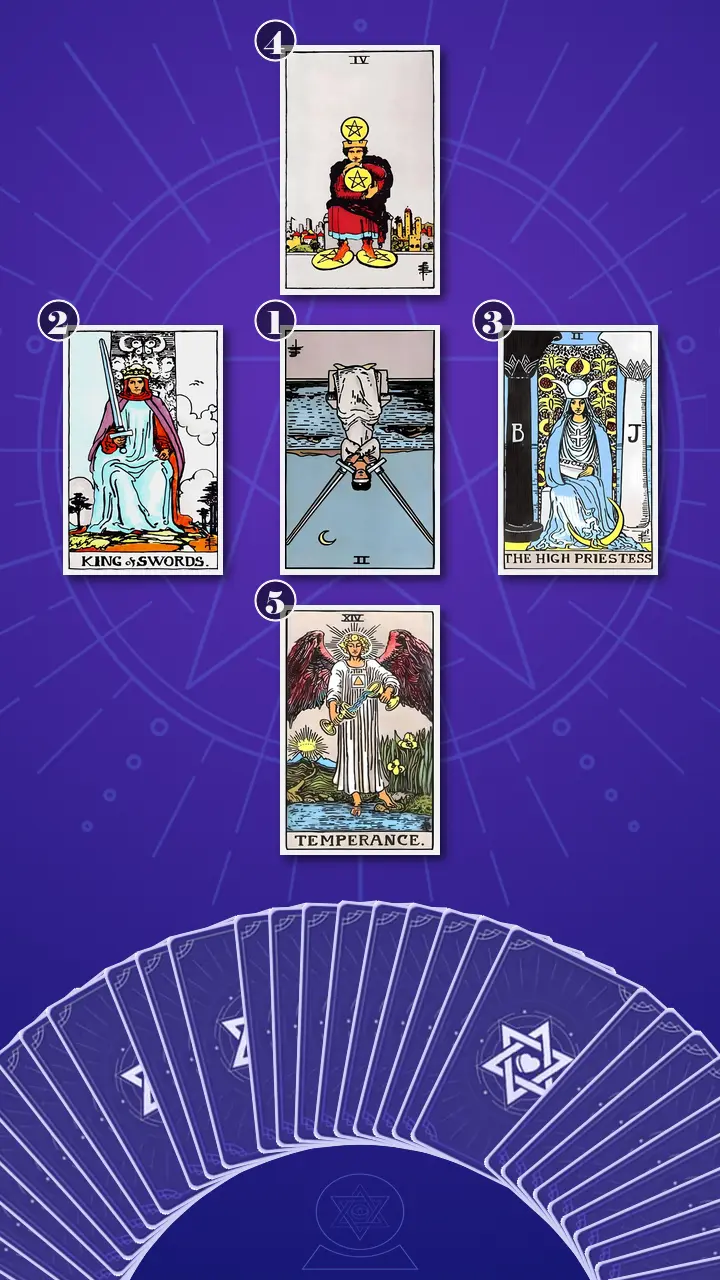
For this question, I chose a five-card Decision Cross tarot spread. This is how tarot works in a non-predictive reading: the images create a structured conversation between information that is easy to name and information that has been harder to articulate. The spread is small enough to keep the decision self-contained while still showing the present stalemate, both sides of the conflict, the hidden influence beneath it, and a constructive next perspective.
I placed the first card at the center, where it would show the present observable stalemate. To one side, a card would clarify what the sensible choice genuinely gets right; opposite it, another would explore what the recurring intuitive signal might be registering. Above the center, I would look for the missing influence beneath the argument. Below it, the final card would offer the bridge: not a verdict, but a way to let both forms of information meet reality.
That structure matters when someone is asking, What am I missing when logic and intuition disagree? A two-outcome spread could turn the reading toward forecasting which option would win. The Decision Cross keeps the focus on accountable judgment: what is known, what is noticed, what is being protected, and what can be tested.
Where the Swords Stop Arguing
The Locked Blades on the Counter
Now I turned over the card representing the present observable stalemate: repeated analysis, reassurance seeking, and delayed commitment when the defensible answer does not resolve the internal response.
It was the Two of Swords, in reversed position.
The white blindfold and the crossed blades immediately brought Jordan’s kitchen counter to mind. The spreadsheet and the private note were like two open documents held across the chest: both were active, but neither was allowed to change the frame. The dark water beneath the figure suggested the emotional information Jordan kept trying to hold outside the decision, even as it continued to move beneath the surface.
In this reversed position, the energy was blocked air and overused analysis. Jordan was not lacking intelligence or effort. Thought had become a defensive loop. Each new criterion created the sensation of movement, but no criterion was permitted to remain incomplete or uncomfortable long enough to offer a different kind of information. More criteria can create more motion without creating more information.
I described the operating system underneath the loop as plainly as I could: “If I change the formula one more time, I might finally be safe from regret.” The spreadsheet was doing a useful job at first, but it had quietly become a second workplace where every new row needed approval. The practical question had turned into a certainty test: Can I make a choice no future version of me, no friend, no manager, and no LinkedIn observer could criticize?
Jordan’s thumb froze above the phone first. Then their eyes went unfocused, as though the unsent email and the late-night comparison were replaying on one small screen. Finally, they let out a short, bitter laugh and rubbed the hinge of their jaw.
“That is too accurate,” Jordan said. “It’s almost cruel.”
“I hear the exhaustion in it,” I replied. “This pattern is not a character flaw. It is a protection strategy with a short-term benefit: another round of analysis briefly lowers the risk of committing. The useful question is not why you have failed to think hard enough. It is what you hoped the next score would remove.”
I asked Jordan to separate the decision that could be made with the available information from the uncertainty that no spreadsheet could eliminate. The reversed Two of Swords did not demand an immediate answer. It asked for a more honest description of the stalemate.
The Sword That Names What Is Real
Now I turned over the card representing what the sensible choice genuinely gets right, including facts, constraints, responsibilities, and practical advantages that should not be dismissed.
It was the King of Swords, in upright position.
The King’s raised sword was not a gavel. I read it as an editor’s tool: a clear list of non-negotiable facts such as income, timing, workload, contract terms, commute, and housing needs. His direct posture and stone throne gave disciplined reasoning a useful dignity. This card did not shame Jordan for caring about stability. It showed the analytical skill that had already helped them succeed at work.
In this upright position, the energy was balanced air. Reason was strong when it defined what was true, tested claims, and accepted inconvenient facts. It became distorted only when it claimed the right to erase every response that could not be converted into a number. A clean argument could establish what an option offered; it could not prove that the option contained every emotional and future variable.
“A choice can be sensible without being complete,” I said. “Let the King keep the rent calculation, the savings threshold, the actual salary, the required hours, and the response date. Take out the imagined audience for a moment. If nobody could see this choice on LinkedIn, which facts would still matter?”
After years of moving across cultures, I have learned that responsibility can be described in many accents, but an actual rent payment remains an actual constraint. I thought of the product-risk reviews Jordan handled professionally: a genuine launch blocker was recorded differently from a stakeholder’s imagined objection. I asked Jordan to bring that same precision to their personal decision.
Jordan nodded, but it was not a surrender to the King. Their shoulders stayed high. “The salary and timing are real,” they said. “The part about whether I look cautious or ambitious is harder to admit.”
“That distinction is the work,” I answered. “The sensible option deserves an honest hearing. It does not deserve sole authority simply because it can be defended in a meeting.”
The Veil Behind the Feeling
Now I turned over the card representing what the intuitive signal may be registering, including values, accumulated pattern recognition, bodily feedback, and information not yet expressed as a formal argument.
It was The High Priestess, in upright position.
Her veil hung behind her rather than across her eyes. That detail mattered. Unlike the blindfold on the Two of Swords, this was not a command to shut out information. It was an invitation to sit at the threshold of what had been noticed but not yet translated. The black and white pillars held two kinds of knowledge without requiring either one to become the other.
The upright energy here was receptive water: quiet, observant, and potentially precise when given time. The recurring tightness in Jordan’s chest could have been fear, fatigue, a value conflict, an overlooked detail, or accumulated pattern recognition. The card did not tell Jordan to obey the sensation. It asked them not to delete it merely because it had not become a polished argument.
“When you picture an ordinary Tuesday inside the sensible option,” I asked, “what specific feature creates the same resistance each time? Not the whole future. One feature. The team rhythm, the manager, the workload, the kind of problems you would solve, or the version of yourself you imagine becoming there.”
Jordan looked at the High Priestess for a long moment. “I don’t know whether this is intuition or fear with better branding,” they said again, more quietly this time.
“Then we translate it before we judge it,” I said. “Intuition is not a verdict; it is a signal worth translating. We can ask what memory, value, need, or practical concern keeps returning. We can also notice whether the signal changes after a fact becomes clearer. That is observation, not blind trust.”
Jordan’s hand moved from the phone to the edge of the table. Their fingers stopped tapping. I watched the body make a small amount of room for the question. “The work itself feels too familiar,” they said. “The salary would be better, but the day-to-day version sounds like a polished repeat of what already drains me.”
I wrote that sentence down without turning it into a conclusion. The High Priestess had offered a lead, not a command.
The Pentacle Held Too Tightly
Now I turned over the card representing the missing influence beneath the conflict: the extent to which safety, control, or the need to remain publicly defensible had been labelled as pure practicality.
It was the Four of Pentacles, in upright position.
The figure pressed one pentacle to the chest and pinned two beneath the feet. I saw Jordan checking their savings balance before rent was withdrawn, then reopening the offer details. The city in the distance became the professional identity they were trying to hold together: stable enough to explain, ambitious enough to respect, and controlled enough to prevent anyone from asking whether the choice had been a mistake.
In this upright position, the earth energy was legitimate but overheld. Security was a real need. The blockage began when eliminating every possible downside became another supposed practical requirement. Jordan was protecting income and housing, but also trying to protect the story other people might tell about the decision. Those were not the same cost.
I brought in my second diagnostic lens, Hidden Cost Deconstruction. “For each option,” I explained, “we can identify the emotional bills attached to it. One route may carry the cost of disappointing someone, appearing less ambitious, or explaining why the obvious offer was not enough. Another may carry the cost of reduced savings, a slower timeline, or a less predictable month. The bills are real as experiences, but they should not all be disguised as financial facts.”
“I am calling this practical, but how much of it is about never having to explain myself?” Jordan read from the note I had helped them write. Their face tightened. Their eyes moved to the savings figure, then to the Four of Pentacles, and finally back to me.
“That feels unfair,” they said. “Rent is not a public story.”
“You’re right,” I said. “I will not turn a real constraint into a mindset problem. Security is a real constraint. Being publicly defensible is a different one. The point is to give each its proper name, so the practical facts can be protected without making reputation carry the whole decision.”
Jordan’s expression went still first. Then their gaze dropped to the two columns on the paper, and I saw recognition move through them. Their shoulders lifted as if bracing for an accusation, but after a long breath they lowered them again. The hidden motive had become visible without becoming shameful.
When Temperance Let the Cups Speak
When I reached for the fifth card, the room seemed to narrow around the small rectangle of painted paper. Outside my window, a streetcar bell sounded once and faded. The refrigerator clicked off. For a moment, there was only the soft drag of my thumb along the card’s edge and the quiet between us.
Now I turned over the card representing the key shift from choosing one inner authority to integrating both through explicit criteria, proportionate safeguards, and a reversible real-world experiment.
It was Temperance, in upright position.
The angel’s two cups were open, and water moved visibly between them. One foot stood on land and one in water. Nothing in the image asked one element to defeat another. I read the card as integrated discernment: reason could name the constraint, intuition could name what kept returning, and a measured experiment could let both encounter lived reality.
“This is where I use a practice I call Fear-Driven Logic Decoupling,” I told Jordan. “We let the decision matrix carry observable facts, and we place the subconscious fear of failure on its own line. That way, fear cannot borrow the vocabulary of salary, responsibility, or timing and quietly decide the entire case. We do not silence the fear; we stop mistaking it for the whole truth.”
At 11:43 p.m., the spreadsheet is open, the note says ‘Why This Still Feels Wrong,’ and the decision email is still unsent. Another round of scoring brings brief relief but no new information. I asked Jordan to revisit that scene before asking what certainty was trying to protect.
You are not missing a final verdict. You are missing a way to let facts and felt response generate information together, so the decision can become a learning process instead of a test of perfect foresight.
Do not silence the cup you cannot explain; let facts and felt response pour into each other as Temperance does, then use a measured experiment to clarify the next step.
Jordan’s breath stopped first; their fingers hovered above the notebook, perfectly still. Then their gaze lost focus, as though the unsent email, the rent transfer, and the ordinary Tuesday they had avoided imagining were replaying on one screen. Their mouth tightened. “But then neither one gets to win?” they asked, and the question carried a flicker of anger rather than relief. I waited. The anger shifted into recognition; their fists, which had been closed against their knees, opened. Their shoulders dropped a fraction, then more. A shaky exhale moved through their chest. The silence did not feel magical. It felt like the first quiet room after an alarm stops. Jordan’s eyes grew bright, and they gave a small, almost embarrassed laugh. “I can test something without promising my whole life,” they said. I set a ten-minute timer and watched them write: facts protect, signal protects, still unknown, one assumption to test. Their hand trembled, but it kept moving. A brief dizziness followed the relief: a path had appeared, and their choices belonged to them again.
“Now, use this new perspective to revisit last week,” I said. “Was there a moment when asking what each signal was protecting would have felt different from trying to make one defeat the other?”
This was the first movement from certainty-seeking analysis paralysis and self-doubt toward integrated discernment, cautious confidence, and accountable self-trust. Jordan was not suddenly certain. They were becoming curious about the information inside the conflict, which was a more durable kind of progress.
The Page Where the Case Becomes a Path
I looked across the five cards and told Jordan the story I saw. The reversed Two of Swords showed the visible loop: more research, more opinions, more edits, and the same delayed commitment. The King of Swords protected the genuine facts: income, timing, workload, and housing. The High Priestess preserved the recurring response that appeared whenever Jordan pictured the ordinary week, without turning that response into an infallible command. The Four of Pentacles revealed the pressure underneath both sides: material security braided together with the wish to remain impossible to criticise. Temperance offered the bridge, where both channels could generate fresh evidence.
The deeper pattern was an inner courtroom. Jordan had put reason and intuition on opposing witness stands, then postponed the verdict until one could provide complete certainty. The practical answer looked like the judge because it could speak in metrics. The quiet signal looked unreliable because it arrived as tightness, resistance, and a sentence that had not yet learned how to sound professional. The spread showed that the problem was not a lack of evidence. It was the demand that one inner voice become the sole authority before action was allowed.
The cognitive blind spot was treating unresolved feeling as proof that more research was required. The more useful distinction was this: hard constraints deserve concrete numbers; values and pattern recognition deserve careful listening; public stories deserve to be named as stories; and unknowns deserve a place where they can remain unknown without taking over the entire calculation.
The transformation direction was equally practical. Stop asking which voice wins. Ask what each voice is protecting. Reason can identify genuine limits. Intuition can flag a repeated value conflict or overlooked pattern. A small experiment can then show what neither abstract argument can reveal. This changes the career decision from an attempt to predict and prevent every possible regret into an accountable learning process.
I told Jordan that this is why a five-card Decision Cross tarot spread can help explore a career decision when practical reasoning conflicts with recurring intuitive information. The cards do not choose the job, the move, or the message. They make the structure of the conflict visible, so the person making the decision can use both insight and evidence without surrendering authorship.
“The signal does not get the gavel,” I said. “It gets translated and tested. And the facts do not get to erase the parts of your life that cannot fit in a weighted column.”
I offered Jordan three pieces of actionable advice. Each was deliberately small, reversible, and optional. None required sending the email that night.
- The 20-minute Two-Channel Decision CheckSchedule one protected twenty-minute session this week in the same calendar slot instead of reopening the comparison every night. In the existing Google Sheet or a plain phone note, create the headings ‘What the facts protect’ and ‘What the recurring signal protects.’ Write three concrete items under each, then add a third line called ‘Still unknown.’ When the timer ends, close the document and record whether you feel clearer, temporarily reassured, or more pressured.Do not force the two columns to agree. A plain note is enough; the exercise is meant to create information, not solve a major career decision in one sitting.
- The Defensible-Enough FilterBefore the next advice conversation with a friend, spend twelve minutes sorting every criterion into ‘hard constraint,’ ‘important preference,’ or ‘public story.’ Beside each hard constraint, write one direct consequence such as monthly cash flow, required hours, commute time, or contract timing. Beside each public story, write who you imagine judging the choice and what you fear that judgment would prove. Temporarily remove one public-story criterion from the score and notice what changes.Use two colours in the spreadsheet and keep the first pass private. Security deserves protection, but you do not need to ask someone else to validate a story about how your choice will look.
- The Shadow Choice Experiment and Reversible Evidence SprintFor forty-eight hours, use a blank page to intentionally choose the more feared option on paper only. Write what your fear predicts, what safeguards would be needed, what practical costs are real, and what small sense of relief or curiosity appears when the choice is temporarily treated as made. Do not send a message, spend money, resign, or make a commitment. Then select one disputed assumption and test it within seven days through one precise question, one realistic schedule check, one short informational conversation, or one available meeting observation. Record one measurable result and one felt-response result before setting a decision point.The paper exercise is not a command to take the feared route. Define an exit before contacting anyone, keep the test proportionate, and allow the result to be partial information rather than a permanent verdict.

A Week Later, the Cursor Moved
Six days later, I received Jordan’s message: “I asked for the weekly schedule and booked one short conversation.” The facts were clearer, but the question was not settled. Jordan slept through the night, then woke with What if I’m wrong? in mind—and smiled, because doubt no longer had the gavel.
That was the first small proof of the journey. Jordan had not solved a whole career or turned intuition into a magical answer. They had created contact with reality, kept the financial constraints visible, and let a recurring response receive investigation instead of dismissal. The choice was becoming sensible enough to explore rather than perfect enough to fear.
I did not give Jordan an answer. I helped them recover a process in which the answer could belong to them. The cards offered a language for the hidden pattern; Jordan supplied the judgment, the boundaries, and the next step. That is what finding clarity looked like here: not certainty, but grounded movement with both eyes open.
When the practical answer leaves your jaw tight and your chest braced, rebuilding the case can feel safer than choosing a life you might later have to explain. Noticing that pattern is already a quiet beginning of self-trust.
If you let both the spreadsheet and the quiet signal stay in the room for one small, reversible question, what would you be curious to notice first: the genuine constraint, the recurring value, or the fear of how the choice might look?