Family Approval Anxiety: Values Before Voices, Then the Cursor Moved

When Family Approval Anxiety Owned the Submit Button
I often meet the dependable project coordinator who can organise everyone else’s deadlines but freezes before submitting her own course application. Maya, a 28-year-old project coordinator in Toronto, joined my video call from her kitchen at 11:40 p.m. The radiator hummed beneath the window, her peppermint tea had gone cold, and a course application cast a pale rectangle across her face. Beside the laptop, her family group chat lit her phone warm against her palm.
I watched her type three sentences into the application, glance at the notification, and move the cursor away from “Submit.” Her shoulders drew inward. Indeed appeared in another tab, followed by salary comparisons for roles she could explain more easily.
“I know what I want until I imagine explaining it to them,” she said. “Then I start wondering whether I’ve missed something obvious. I keep calling it research, but honestly, I think I’m waiting for permission.”
There was the contradiction in plain sight: Maya wanted a personally meaningful career path, but she feared that leaving the familiar family role would cost approval and belonging. She could feel excitement while the choice remained private. The moment it became visible, her jaw locked, her chest tightened, and a heavy knot settled behind her ribs, like an inherited admin account had suddenly revoked her permission to edit her own life.
“I don’t want to disappoint them,” she said, rubbing the side of her mug. “But I’m tired of disappointing myself.”
I told her that nothing in this pattern meant she lacked direction or courage. A protective strategy can keep running long after the situation that taught it has changed. “I’m not here to tell you whether to take the course,” I said. “Let’s use the cards to separate your preference, the practical facts, and the fear of losing your place. We’re going to draw a map of the fog, then you will decide where to walk.”

Choosing the Compass: The Five-Card Shadow Spread
I invited Maya to place both feet on the floor, take one unforced breath, and hold one question in mind: “Why do I keep playing my family role instead of choosing my path?” I shuffled slowly. I treat this preparation as a transition of attention, not a supernatural performance. It gives the nervous system a moment to arrive before the analysis begins.
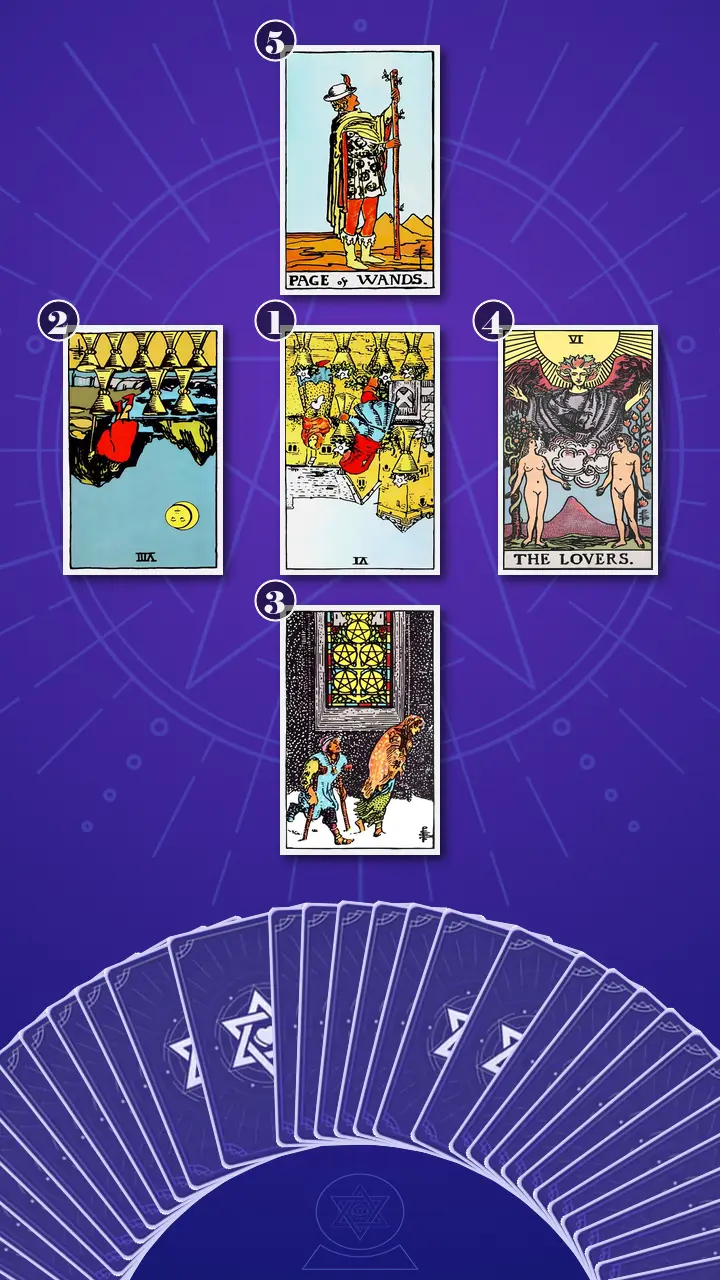
I chose The Shadow Spread. For anyone wondering how tarot works in a situation like this, I use the cards as a structured cognitive map rather than a fixed prediction. This five-card spread was suited to Maya’s question because it could trace the full sequence: the identity she consciously performed, the desire pushed outside that identity, the fear sustaining the split, the principle that could integrate both sides, and one behaviour through which the insight could become testable.
I placed the first card at the centre for the dependable role Maya presented to preserve recognition. The second went to the left for the path she kept wanting and abandoning. The third sat below them for the belonging fear underneath the loop. To the right, a fourth card would show how connection and autonomy could coexist. The final card would sit above the centre and identify an embodied next step. The cross resembled a compass, with the old role occupying the middle until Maya’s own values could establish a direction.
“None of these positions gets to issue a verdict,” I told her. “They let us inspect different variables instead of forcing every concern into one overwhelming feeling.”
The Courtyard Where an Adult Voice Became Smaller
Position 1: Six of Cups Reversed and the Dependable Family Role
I turned over the card representing the diagnosis-level symptom: the family identity Maya displayed when she anticipated a reaction. It was the Six of Cups, reversed.
In the Rider-Waite-Smith image, one figure offers a flower-filled cup to a smaller figure inside an enclosed courtyard. Reversed, that exchange can point to an old relational identity intruding on an adult decision. I read its Water energy as blocked. Care, memory, and loyalty were not flowing into present-day connection; they were routing Maya back toward a younger, more compliant position.
I asked what happened when work came up during a family visit. Maya described a Sunday kitchen where onions hissed in a pan, citrus cleaner hung in the air, and cutlery tapped against a plate. She had arrived as a competent 28-year-old professional. Then someone asked whether she planned to stay in her current role.
“My voice got weirdly bright,” she said. “I told them the job was fine. I didn’t mention the course, and then I offered to sort out a phone-bill problem for someone.”
That was the Six of Cups reversed in modern life: an adult entering the conversation, then speaking and seeking recognition from the position occupied years earlier. The card did not say that Maya’s reliability was fake or that caring for her family was wrong. It showed a valuable capacity operating automatically. Whenever a personal choice threatened to update the family’s picture of her, the old role took control before she had consciously chosen it.
“Think about the last family conversation involving work, money, dating, or the future,” I said. “What did you minimise before anyone had actually objected?”
Maya let out a short, bitter laugh. Her fingers tightened around the mug before loosening again. “That’s so accurate it’s almost rude. I always lead with, ‘It’s only an idea.’ I make the choice smaller before they can.”
I did not turn her recognition into blame. “That sentence helped you keep conversations predictable,” I said. “We’re only asking whether it still deserves automatic access to every adult decision.”
Position 2: Eight of Cups Reversed and the Departure That Never Became Visible
I turned next to the card representing Maya’s disowned self: the part that wanted to leave the inherited script and discover what she would choose without managing everyone else’s comfort. The Eight of Cups appeared reversed.
The upright image shows a cloaked traveller walking away from eight cups, one conspicuous gap revealing that the arrangement is incomplete. Reversed, the traveller’s departure stalls. I read this as a second blockage in Water. Maya could see the missing fulfilment, but attachment and anticipated family emotion kept circulating her desire back toward the familiar option.
The scene was already open in front of me. One browser tab held the course Maya wanted. Another held an application draft. A third contained salary data. Then Indeed filled the screen with safer roles chosen partly for how explainable they would sound. The inner argument followed a predictable formula: “I want this, but before I can want it properly, I need to prove it will be stable, respected, affordable, and impossible for anyone to question.”
The cursor hovered over “Submit.” The tea stayed cold. The phone stayed warm. Maya’s shoulders moved closer to her ears as the preferred path became a defence brief for a debate no one had started.
“Research can become a waiting room for permission,” I said. “Useful due diligence answers a defined practical question. Reassurance research keeps adding columns until no imaginable objection remains.”
I thought of the colour-coded Notion dashboards I had seen in other sessions: salary, stability, credentials, family reaction, research later. The personal-interest column was nearly empty. It was the decision-making equivalent of scrolling through increasingly safe options while the choice with actual energy remained open in another tab.
I asked Maya which path she had reopened more than once. Her gaze moved from the cards to the application on her screen. She did not answer immediately. Then she said, “This one. Three times. I keep saying the research isn’t finished, but the missing information changes every time I find it.”
Her mouth pulled into a small smile that held recognition and grief together. The card had not revealed an absent desire. It had shown a desire repeatedly prevented from becoming direct experience.
Position 3: Five of Pentacles and the Window That Looked Locked
I turned over the card representing the root of the shadow: the fear that made an ordinary difference of opinion feel dangerous. The Five of Pentacles appeared upright.
Two figures move through falling snow beneath an illuminated stained-glass window. In Maya’s reading, upright Earth had hardened a relational fear into something that felt like material fact. One delayed reply could become evidence of future isolation. One doubtful question could turn into a complete forecast involving Toronto rent, a difficult job market, emotional distance, and the imagined disappearance of every available form of support.
I gave her the card’s modern-life translation. “A relative takes two hours to answer your message about the course. Before an answer arrives, your chest tightens. You calculate rent, employment risk, and who might think you’re unrealistic. The inner logic is: ‘If they sound doubtful, I must be on my own. If I’m on my own, the choice must be unsafe.’”
Maya’s breathing stopped for a beat. Her thumb froze against the mug. Then her gaze drifted beyond my image on the screen as if she were replaying a dozen family-chat pauses at once. When she looked back, the muscles around her mouth had softened.
“I don’t actually think they would cut me off,” she said slowly. “But my body acts like the group chat has revoked my membership.”
The vague dread had become a specific, testable prediction: difference would cost belonging. That precision mattered. I was not telling Maya that every practical concern was imaginary, or that family advice had no value. I was showing her where disagreement and exclusion had become fused.
“Could a delayed reply sometimes be a delayed reply, not a verdict on your place in the family?” I asked. “And if someone did disagree, what support would still exist through your friends, colleagues, savings, skills, and your own capacity to adjust?”
A long breath left her chest. Her shoulders dropped, but her eyes shone with the discomfort of seeing how much energy she had spent standing outside a lit window before checking whether the door was locked. I let that recognition remain tender. Connection does not require identical choices, but learning that in the body can take longer than understanding it in a sentence.
When The Lovers Separated Love from Compliance
Position 4: The Choice That Could Keep Connection Without Surrender
The room seemed to become quieter as I turned over the card representing Shadow Integration: the perspective that could bring Maya’s dependable identity and independent desire into a conscious relationship. The Lovers appeared upright.
I asked Maya to set aside the card’s reputation as a romance symbol. In this position, its balanced energy concerned values, conscious choice, and honest differentiation. Two uncovered figures stand separately beneath an angel. Their openness does not erase their distinction. A mountain rises between them, acknowledging that truthful connection can require an uncomfortable crossing.
In Maya’s life, this could look like writing down curiosity, autonomy, and useful contribution before calling her family. She could explain that she was exploring a course, listen to practical concerns, and resist rewriting the plan in real time to eliminate everyone else’s discomfort. Family reactions could matter without taking ownership of the decision.
At 11:40 p.m., the application was still open, the family chat was glowing beside it, and a choice that had excited Maya ten minutes earlier had become a case she thought she had to defend. She was still trying to make the choice impossible to criticise before allowing herself to explore it.
Your family’s discomfort can be real without becoming the verdict on your life. The shift is not from caring to rebellion; it is from asking for permission to choosing through named values.
You are not betraying your family by ending automatic compliance; choose through named values, like the two figures in The Lovers standing openly beneath the angel.
I stopped speaking. Even the radiator seemed to recede, leaving the faint buzz of Maya’s laptop and the silence between us.
For one beat, Maya went completely still. Her breath paused high in her chest, and two fingers remained suspended above the rim of her mug. Then her eyebrows drew together. “But doesn’t that mean I’ve been doing this wrong for years?” she asked, sharper than before. The anger arrived first, protecting something more vulnerable. Her gaze lost focus as if old messages, postponed applications, and automatically accepted family errands were replaying behind it. Moisture gathered along her lower lashes. Finally, her jaw unclenched. Her shoulders lowered, and a shaky breath escaped with something between a laugh and a sigh. The relief did not look simple. I also saw the slight blankness that can follow when a burden lifts and personal responsibility becomes visible underneath it.
“I wouldn’t call those years a mistake,” I said. “Automatic compliance helped you protect connection and become exceptionally capable. We’re recognising that the strategy now has costs. You don’t have to condemn the version of you who learned it in order to give the adult version of you more authority.”
I invited her to test the insight against reality. “Now, with this new perspective, think back to last week. Was there a moment when this could have made you feel different?”
Maya mentioned the online information session she had planned to attend. At 6:07 p.m., a relative had asked for help comparing insurance options. She had replied “Of course” before checking the time, missed the session, and spent the next hour feeling useful and resentful.
“I could have said, ‘I can look tomorrow; I have something booked tonight,’” she said. “They might have been annoyed. But annoyed isn’t abandoned.”
I named what I was watching: the first movement from contracted approval-seeking, guilt, and resentment to values-led self-trust and cautious independent exploration. It was not a dramatic break from her family. It was one adult distinction between another person’s reaction and her own responsibility.
To make that distinction practical, I used a diagnostic lens I call Cyclical Variable Filtering. After a decade of guiding people through changing life cycles, I have learned that a temporary low tide can distort the horizon without changing the coastline. I drew three rings on a page. In the inner ring, I wrote Maya’s values: curiosity, autonomy, and useful contribution. In the middle ring, I placed structural facts that deserved serious attention: rent, savings, tuition, deadlines, employability, and the course’s actual quality. In the outer ring, I placed cyclical weather: tonight’s spike of guilt, one relative’s first reaction, a rough week at work, and a frightening headline about the job market.
“Filtering doesn’t mean ignoring family or pretending money is irrelevant,” I explained. “It means refusing to let temporary friction impersonate a permanent fact. Your values are the route settings. Practical evidence helps determine whether the route is viable. Family reactions are traffic reports: useful information, but not automatically authorised to change the destination.”
I then applied Decision Timing Calibration. This emotionally charged night was not structurally optimal for resigning, paying a large non-refundable fee, or announcing a new identity. It was perfectly adequate for choosing a reversible thirty-minute experiment. Maya did not need one enormous act of certainty. She needed to match the size of the decision to the quality of the evidence available.
“So I don’t have to decide whether this is my new career tonight,” she said.
“Exactly. The Lovers asks you to choose the values that will guide the inquiry. It does not force you to pretend the inquiry is finished.”
The Page of Wands Offered a Private Beta
Position 5: One Experiment Before the Public Rebrand
I turned over the final card, representing the embodied next step: a small, observable action through which Maya could test a personally chosen direction without demanding total certainty or permanent separation. The Page of Wands appeared upright.
The Page studies a sprouting wand in an open landscape. I read the Fire energy as available and balanced, but still young. It did not need to become a five-year plan or a LinkedIn “I’m thrilled to announce” post. It needed a contained place to move.
In modern terms, the card suggested a private beta test. Maya could book one thirty-minute information session, complete only the first section of an application, or try one sample task in the field. She could then measure the experience by her energy before it, her interest during it, and her energy afterward. Nothing had to be announced, defended, or made permanent.
“You do not need a five-year defence for a thirty-minute experiment,” I told her. “The Page learns through contact with the wand, not through building another immaculate dashboard about what the wand might mean.”
Maya looked at the application again. This time, I saw her curiosity arrive before the explanation. Her posture was not suddenly fearless; her hand still moved toward the phone when another notification appeared. She caught the motion, turned the phone face down, and said, “I could finish one section on Saturday. Privately. Then I’d have an actual experience instead of another hypothetical argument.”
That was enough. The card was not promising a successful career change. It was identifying unused potential: the capacity to let interest generate evidence before anticipated approval edited the experiment out of existence.
Values Before Voices: Turning the Reading into Next Steps
I gathered the five cards into one coherent story. The Six of Cups reversed showed an old family role that had once earned warmth and recognition. The Eight of Cups reversed showed the personally meaningful direction Maya kept approaching but could not make visible. The Five of Pentacles named the mechanism holding both in place: disagreement was being forecast as exclusion. The Lovers supplied the missing internal reference point, and the Page of Wands translated that reference point into lived evidence.
The central blind spot was not simply that Maya cared too much about other people’s opinions. It was that she treated the physical sensation of family discomfort as proof that a decision was wrong. Then she used more research to improve the explanation while leaving the source of authority unchanged. The family costume still looked like care and competence, but it had become too tight for a life requiring a separate adult voice.
The transformation direction was specific: personal values would receive the first vote, practical constraints would receive rigorous attention, and family reactions would be treated as information rather than instructions. Independence would be practised through small, reversible experiments, not proven through rebellion, emotional cutoff, or one irreversible leap.
This five-card Shadow Spread had traced the performed family role, disowned desire, belonging fear, values integration, and embodied next step. I translated that map into three actions Maya could begin without quitting her job, announcing a career change, or asking anyone to suppress a genuine concern.
Three Small Moves That Keep the Decision in Maya’s Hands
- Run the seven-minute Values Before Voices check.On Tuesday evening at her kitchen table, Maya will open a private phone note, name three qualities she wants the career decision to express, score the course from 1 to 5 against them, and finish one unedited sentence: “If I did not need to explain this tonight, I would choose to explore...” She will leave the sentence unchanged for twenty-four hours.Tip: If three values feel too abstract or her chest tightens, she can choose one value, write one sentence, or stop. The exercise is an experiment, not a demand for a decision.
- Complete one private Page of Wands beta test.On Saturday morning, before opening salary comparisons or family messages, Maya will spend no more than thirty minutes completing one application section or attending one virtual information session. Afterward, she will record three observations: energy before, interest during, and energy after.Tip: The minimum version is ten minutes. Saving the application without submitting it still counts because the goal is direct evidence, not a public commitment.
- Use the 72-hour Orbital Pause.When a non-urgent family reaction triggers the urge to cancel, defend, or rewrite the plan, Maya will wait seventy-two hours before changing it. During the pause, she will separate structural facts such as budget, deadlines, and safety from cyclical friction such as guilt, a doubtful tone, or one delayed reply. She will then revise only what the evidence supports.Tip: The pause does not apply to immediate safety, legal, or financial emergencies. It prevents a temporary emotional tide from making an irreversible choice on her behalf.
“What if the pause feels like I’m hiding the choice from them?” Maya asked.
“Privacy during an early experiment is not deception,” I said. “You are allowed to hear your own signal before opening the discussion. When you do speak, decide whether you are informing them, requesting one piece of practical information, or asking for emotional support. A general request for approval will put you back in the old loop.”
I suggested one sentence she could adapt: “I’m exploring this because learning and autonomy matter to me. I’m not asking for a final verdict, but I’m open to one practical question.” I reminded her that she could remain caring, reliable, and connected. Those qualities belonged to her; the family role did not own them.

Six Days Later, the Cursor Moved
Six days later, I received a message from Maya with a photograph taken in a Queen West café. Winter light flashed against the window. At the top of a notebook page, she had written: “curiosity, autonomy, useful work.” Her phone was face down beside it, and the first section of the course application showed as complete on her laptop.
Her message read, “The family chat pinged and my stomach still dropped. I finished ten minutes before I checked it. This is ridiculously small, but it’s the first time the plan didn’t immediately move to make room for everyone else.”
The following morning, she still woke with the thought, “What if I’m wrong?” She told me she smiled at the question, made coffee, and kept the information session in her calendar. Clarity had not removed uncertainty. It had stopped uncertainty from automatically handing authority to someone else.
I did not read the completed section as proof that the course was destined for her. I read it as proof that Maya could create enough room to learn what she actually thought. The cards had provided distinctions, images, and questions. Maya had supplied the values, the boundary, and the movement. She remained the author of what happened next.
When a choice is truly yours but your chest tightens as the family chat lights up, becoming more fully yourself can feel as though it might cost the place where you first learned to belong. I want to leave you with the gentler truth Maya began to practise: the tightening deserves care, but it does not deserve the final vote.
If no explanation were due today, what tiny, reversible move could let one of your own values have the first say?