When Wanting More Became a Character Test: Naming the Old Rule

Why "I Want More" Became a Character Test
"You can write clear copy for everyone else, but when the sentence is 'I want more,' you turn it into a moral risk assessment," I said to Jordan at 9:14 on a rainy Sunday evening. She was calling from a Zone 2 flat, with a blank Notes page glowing beside our video window. The kettle clicked off. Rain ticked against the glass. Her phone had warmed in her palm while one direct sentence became a paragraph of stakeholder-approved caution.
The first version had read, "I want more consistency from dating, and I want more ownership at work." Twenty minutes later, it read, "I would appreciate exploring whether there might be opportunities for greater involvement, if that would be useful," followed by several lines proving that she was flexible, realistic, and not remotely demanding.
"I'm tired of turning every desire into a moral exam," she said. "I want a fuller life. More intimacy, pleasure, recognition, maybe a creative project that is actually mine. But as soon as I admit that, I start wondering whether wanting it makes me selfish. I want to be whole, but I keep performing goodness instead."
I watched her jaw set around the last word. Her shame moved like a smoke alarm triggered by steam: immediate, physical, and certain that ordinary warmth meant danger. The pressure sat in her chest, locked her teeth together, then opened a hollow space beneath her ribs whenever a private want became specific enough to say aloud.
"I won't ask the cards to certify the desire as good or bad," I told her. "And I won't tell you what you must do with it. Let's use them to find the old rule that keeps putting your character on trial. We are not looking for a verdict. We are drawing a map through the fog so that your own discernment can come back into view."

Four Cards Climbing Out of the Narrow Room
I asked Jordan to place both feet on the floor and hold the question in plain language: "What old purity rule still makes me judge myself for wanting more?" I shuffled slowly, using the repetition as a way to narrow our attention rather than to manufacture mystery.
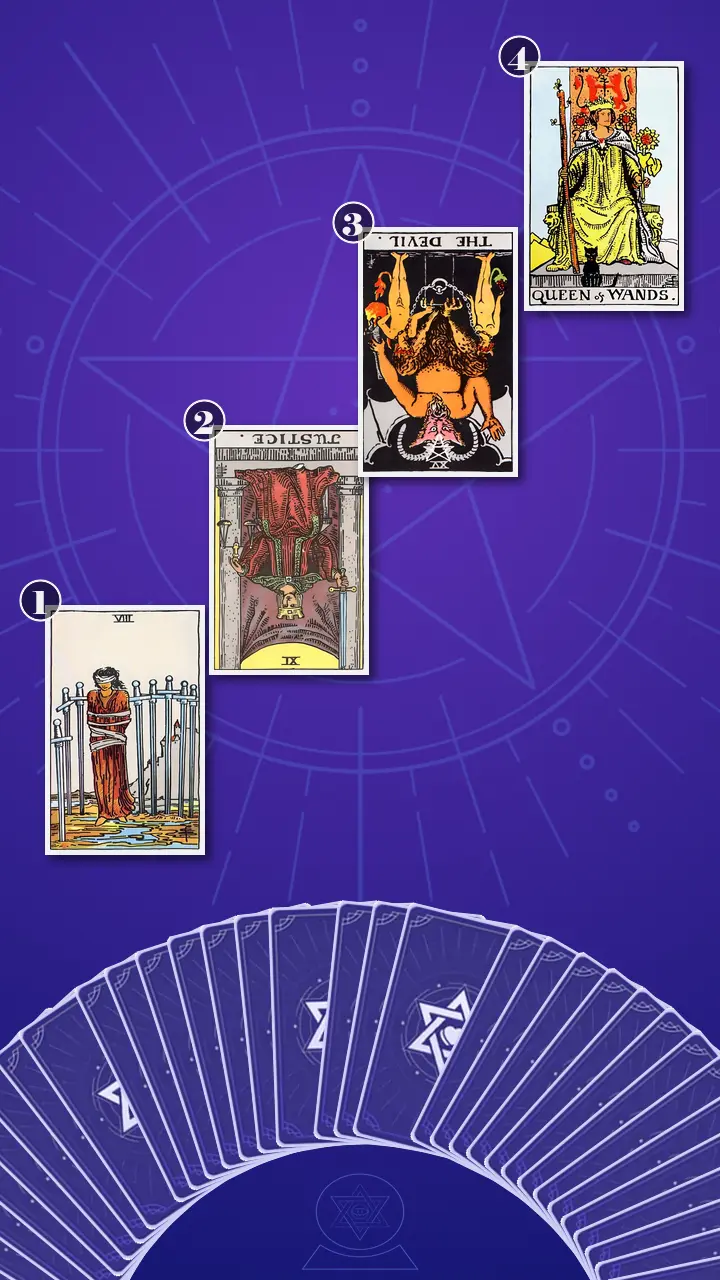
I chose the Four-Layer Insight Ladder · Context Edition. In my practice, this is how tarot works: not as a supernatural ruling, but as a structured reflective lens. Card meanings in context can separate a behaviour from the belief beneath it, expose the mechanism keeping that belief active, and translate the insight into practical next steps.
A larger spread would have introduced outcomes, external influences, and possible futures that Jordan had not asked me to predict. This four-card reflection was the smallest sufficient map. The first position would show the visible bind, the way self-judgment appeared in daily behaviour. The second would uncover the root rule. The third would identify the release point. The fourth would turn the insight into embodied, boundary-aware action.
I laid the cards in a rising diagonal, each one slightly higher than the last. The arrangement looked like four uneven steps leaving a narrow room: restriction, judgment, awareness, and finally a patch of open daylight.
The Blindfold and the Impossible Performance Review
Position 1: The Eight of Swords and the Edited Want
I turned over the card representing the visible bind, the observable habit of mentally auditing, softening, suppressing, or delaying a desire. It was the Eight of Swords, upright.
I pointed to the blindfolded figure, the loose bindings, and the ring of swords. A distant castle remained visible beyond the enclosure, and gaps existed between the blades, but the figure could not yet use what she could not see. The card did not tell me that Jordan had no options. It reflected the moment she mistook a learned conclusion about worth for an external barrier.
"This is Sunday at 9:14," I said. "You type, 'I want more consistency from dating and more ownership at work.' Your jaw tightens, and the sentence becomes a case proving that your wants are modest, reasonable, and useful to everyone else. No one has rejected you. No actual boundary has been named. Yet the imagined judgment already feels like every route has closed."
The Swords energy was in excess. Thought, which could have clarified the request, had become surveillance. The blockage was not intelligence but the way intelligence had been recruited to protect Jordan's reputation from a trial that had not happened.
"Desire is information, not a character reference," I told her. "The fact that you want something does not decide what you should do, but editing the want before you examine it removes the information you need for a fair decision."
I gave the loop its private voice: "I want this. But a good, mature person would say something less demanding. Maybe I should wait until I can explain it better." Honest preference disappeared into reputational safety before another human being had a chance to respond.
Jordan let out a short laugh that carried no amusement. Her fingers tightened around the mug, then released it. "That's painfully accurate," she said. "A bit brutal, actually. I thought I was being thoughtful."
"You were trying to be safe," I replied. "The question is whether the strategy still produces safety, or whether it now produces silence."
I asked her to remember the last request she had softened. "What did the first sentence say, and which words did you remove to sound less demanding?"
Her eyes shifted away from the screen. "The first sentence was, 'I want to lead the strategy.' I changed it to, 'I'm happy to support wherever the team needs me.' I removed myself from it completely."
Position 2: Justice Reversed and the Distorted Moral Ledger
I turned over the card representing the root rule, the old moral equation that turned wanting more into evidence about character. It was Justice, reversed.
The scales, upright sword, rigid throne, and stone pillars created the image of an internal tribunal. In reversal, the problem was not a lack of ethics. It was distorted proportion. One mixed motive could outweigh consent, reciprocity, practical facts, and every chosen value. The verdict had begun to replace discernment.
"Before your work one-to-one," I said, "you build a case for why a larger role would benefit the client, the team, and your manager. The one reason you exclude is, 'I want to grow.' Your internal scoring system asks whether ambition is selfless enough, mature enough, and consistent with everything you have ever said about being grounded."
I compared it to The Good Place's impossible points system running privately in the background. Every ordinary desire was scored, but the standard for unquestionable goodness kept moving. A wish for recognition lost points for ego. A wish for consistency lost points for neediness. Pleasure lost points unless it could be presented as productive, educational, or deserved.
"You do not need an innocent motive to have an honest preference," I said. "Mixed motives make a desire human. Accountability belongs in what you choose to do, how you handle impact, whether consent is present, and whether another person remains free to answer. It does not require prosecuting the existence of the want."
Justice's energy was imbalanced rather than absent. Discernment should have asked whether the request was realistic, reciprocal, negotiable, and compatible with Jordan's limits. Instead, the reversed scales asked whether wanting personal benefit made her less good.
Looking at those tilted scales, I remembered a set of corroded measuring weights I had once catalogued in Cambridge. They looked official long after they had stopped measuring accurately. An instrument can retain the appearance of authority while producing the same error every time. Jordan's internal ledger had that quality: formal, familiar, and badly calibrated.
"Discernment asks what fits; shame asks what wanting says about you," I said. "Your current system is judging the person instead of evaluating the request."
Jordan's shoulders rose. Her mouth opened, but no words came out at first. Her gaze dropped to the scales as though she were replaying years of conversations. Then she pressed her palm lightly against her stomach.
"If I can find one selfish reason, I throw the whole thing out," she said. "Even if the request is fair."
"That is the blind spot," I replied. "You have been treating imperfect motives as proof that discernment has failed, when they are precisely why discernment is needed. We do not have to decide where the old rule came from today. We only need to notice that it is still applying an obsolete standard to present facts."
When the Devil's Chain Became an Artifact
Position 3: The Release Point in The Devil Reversed
The rain softened outside my window as I reached for the central card. The room became quiet enough for me to hear the old clock behind my desk. I turned over the card representing the release point, the attachment that could be examined so desire and shame no longer had to arrive as one fused experience.
It was The Devil, reversed.
I directed Jordan's attention to the chains around the two figures and the torch held above the dark pedestal. I did not describe the reversal as a dramatic command to break every restraint. That would merely replace performed purity with performed liberation. Instead, the card showed awareness changing the relationship to the chain.
"This is the moment you open a private note and write three lines," I said. "'I want more consistency.' 'The old rule says needing more makes me difficult.' 'The value I choose is mutual clarity, and my boundary is that I can ask without forcing an answer.' Nothing has to be sent. No commitment has to be made. The change begins when the rule can remain present without automatically controlling the response."
The reversed energy suggested a blockage beginning to loosen. The old rule had not vanished, but it no longer had to function as law. The torch offered a plain question: "Do I consciously choose this boundary, or am I repeating a verdict?" Freedom here was not permanent openness. Freedom was being able to hear a yes, a no, and a not yet.
This was where I used what I call Cognitive Stratigraphy. On an archaeological site, a surface artifact may be the first thing uncovered, but it is never the whole history. I treated Jordan's chest contraction as the surface artifact. Beneath it lay the edited press-release language. Beneath that lay the internal tribunal. At the foundational layer sat the old equation: a good, worthy, fully healed person should not want more unless the desire can be made perfectly selfless and controlled.
Archaeology does not grant the oldest layer permanent authority over the living city above it. The presence of an old structure tells me that it shaped the ground. It does not tell me that the current inhabitant must continue obeying its walls.
On Sunday night, one honest sentence had sat on Jordan's blank Notes page. Twenty minutes later it read like a responsible press release. The kettle had clicked off, her jaw had stayed tight, and the want had survived only as something carefully defended.
A desire does not have to prove your purity to be worth examining. It needs honest naming, chosen values, consent, and a boundary you can actually keep.
I let the clock mark two beats before I continued.
Stop treating the old purity rule as a chain you must obey; name what you want and choose a boundary-respecting response, like noticing that The Devil's links are a pattern to examine rather than a verdict on your character.
For a moment, Jordan did not move. Her breath stopped, and two fingers remained suspended above the rim of her mug. Then her pupils widened and her gaze slipped past the screen, as if she were watching old messages replay against the wall behind me. Colour rose along her cheekbones.
"But doesn't that mean I've spent years getting this wrong?" she said. The words came out sharper than anything she had said before. Her shoulders remained braced, but her hands had begun to open.
"It means a strategy that once promised protection has become too expensive," I replied. "You do not have to shame the earlier version of yourself for using it. We are separating its history from its present authority."
Her anger flickered into grief. Her eyes shone, and she looked down as a long breath left her chest. When her shoulders finally dropped, the relief made her look briefly unsteady, as though putting down a heavy bag had changed her sense of balance.
I asked, "Now, using this new perspective, can you think of a moment last week when this insight might have made you feel different?"
"Friday," she said quietly. "A date asked what I wanted. I said I was open, but I wanted to say, 'Yes, I want to see you again, and I want to go slowly.' I thought those two things contradicted each other."
"They do not," I said. "One names desire. The other names pace. Together, they are discernment."
I named the crossing plainly: this was the first step from shame-driven self-surveillance and performed goodness toward values-based discernment and grounded self-permission. The breakthrough was not certainty about every desire. It was enough space to examine one without using it as evidence for or against her worth.
The Sunflower After the Tribunal
Position 4: The Queen of Wands and One Visible Preference
I turned over the final card, representing embodied integration, the practical quality Jordan could bring into one small, boundary-aware action. It was the Queen of Wands, upright.
I showed Jordan the Queen's direct gaze, the sunflower held in daylight, the upright wand, and the watchful black cat at her feet. Nothing in the image suggested recklessness. The Queen was warm, visible, and alert. Her confidence did not depend on pretending that consequences, limits, or other people had disappeared.
"At work, this could sound like, 'I'd like to lead more of the strategy on the next campaign. Could we discuss what would make that possible?'" I said. "After a date, it might be, 'I'd like to see you again, and consistency matters to me. What are you looking for?' The preference is visible, but the other person remains free to respond."
The Queen's Fire was balanced. It gave the desire a direct channel without setting the whole landscape alight. The practical boundary supplied Earth: timing, capacity, money, consent, workplace realities, and impact. I also noted the absence of Cups from the spread. Jordan had been turning longing into browser tabs and decision matrices before allowing herself to feel it. The task was not to obey emotion, but to let it enter the evidence.
Jordan opened the message she had drafted for her next one-to-one. I watched the cursor remove, "Sorry if this sounds a bit ambitious," then delete two paragraphs about why the request would be good for everyone. The sentence that remained was specific, warm, and open to negotiation.
Her shoulders loosened. She still looked uncertain, but uncertainty no longer seemed to require disappearance.
"A clear preference does not need a closing argument," I told her. "It needs enough honesty to be understood and enough respect to leave room for an answer."
Restoring a Life Without Rebuilding the Old Courtroom
I drew the four cards back into one story. The Eight of Swords showed the visible result of years spent treating an internal warning as an external wall. Justice reversed revealed the unfair instrument maintaining that enclosure: a moral ledger that measured character instead of context. The Devil reversed exposed the chain as a learned pattern that could be examined rather than automatically obeyed. The Queen of Wands offered the available resource, not a new personality to perform, but a warmer form of self-possession in which desire, limits, and another person's agency could coexist.
The blind spot was Jordan's assumption that bodily discomfort meant a desire had already failed an ethical test. In reality, the tight chest and clenched jaw often marked the activation of the old rule. They were signals to investigate, not final verdicts. The direction of change was equally precise: stop demanding proof that a desire is perfectly pure, name it, separate the inherited warning from a consciously chosen value, and take one small step that respects consent, reciprocity, boundaries, and likely impact.
I call this Ruins Restoration Thinking. A period of fragmentation or mental exhaustion does not always mean a person has lost their true self. Sometimes an old inner structure has stopped being liveable before a new one has fully taken shape. Restoration is not the fantasy of returning every stone to its original position. It is the careful decision about which foundations remain sound, which walls belong to another era, and what the current life genuinely needs.
I translated that perspective into two pieces of actionable advice. Neither required Jordan to disclose a private desire, make a purchase, accept an invitation, send a message, or decide her future that night.
- The seven-minute Trigger Excavation field note. On Sunday evening, Jordan would set a seven-minute timer and write one sentence under each heading: "What I want," "The old rule judging it," and "The value or boundary I choose now." She would then circle one value, such as honesty, consent, reciprocity, rest, fairness, creativity, or financial stability. Tip: Stop when the timer ends. If the subject feels too exposing, use a general category or a low-stakes preference. Naming a desire creates no obligation to disclose or act on it.
- The one-sentence want with a present-facts check. Before one low-stakes request at work, after a date, or while making an ordinary social plan, Jordan would spend two minutes checking four facts: Is it consensual? Is it reciprocal or negotiable? Can I respect my limits? Am I willing to own the likely impact? She would then state one preference, such as, "I'd like to own more of the strategy on the next campaign. Could we discuss what would make that possible?" Tip: Begin with a meeting time, venue, meal, quiet evening, or ownership of one task. Remove the apology and the defence, but keep warmth and room for the other person's answer.
"These cards are not giving you permission," I said. "That would make tarot another external authority. They are helping you notice that permission to examine your own experience was always yours. You remain responsible for the boundary, the action, and the consequences. You also remain free to decide no, not now, or not this way."

A Week Later, the Sentence Stayed Honest
A week later, Jordan sent me a message. She had used the Trigger Excavation Exercise after seeing a former colleague announce a promotion on LinkedIn. Her first reaction had been the familiar stomach drop, followed by a search tab asking whether ambition was ego. This time, she closed the tab and wrote: "I want more strategic ownership. The old rule says ambition makes me grabby. I choose growth with realistic capacity."
At her one-to-one, she used the shorter sentence. Her manager did not hand her an instant promotion or promise a perfect outcome. They scheduled a separate conversation about scope, training, and what she could lead on the next campaign. Jordan's proof of change was smaller and more important: she had allowed the original preference to remain in the room.
She slept through the night. Her first thought in the morning was still, "What if that was too much?" She smiled, made coffee, and left the message unedited.
I have spent enough years among ruins to know that rebuilding rarely begins with a triumphant unveiling. More often, it begins when one fragment is correctly identified and no longer mistaken for the whole structure. Jordan had not eliminated shame or solved every question about intimacy, ambition, pleasure, and recognition. She had created a little room between the old warning and her next response.
That was the real Journey to Clarity. The cards did not master her fate, reveal a compulsory desire, or guarantee an outcome. They helped her see the pattern clearly enough to recover choice. The authority returned to the only person who could decide what fit her values, limits, and life: Jordan herself.
I would leave the same thought with anyone whose chest tightens before an honest preference has even been spoken. Editing yourself can feel safer than risking that the desire will be read as proof that you are not good enough. Yet the old warning may be an artifact, not a locked gate, and noticing the difference already means you are no longer standing exactly where you began.
If you placed one unedited sentence on your own Four-Layer Insight Ladder, what is the smallest honest preference you could let remain visible for seven minutes, while naming the value and boundary that keep the choice yours?