The Inherited Role and the Calendar That Kept Saying Yes
I often meet a 20-something Toronto community-arts worker who gets praised for being calm and organized, then watches a family request make their own plans negotiable before anyone has asked them to cancel them—the everyday shape of family-boundary guilt.
Alex came to my consultation after a Sunday call at 11:18 a.m. They had left their laptop open to a grant spreadsheet, opened Notes to draft a boundary text, and held a warm phone while rain ticked against the apartment window. The kettle clicked off behind them. In the Notes app, I could see the sentence I had been told about: I can’t organize this week, softened again into I can probably make it work.
Alex asked me, “How do I honor my roots without staying trapped in this role?” Their throat tightened as they described wanting to protect a free afternoon while fearing that keeping it would look like abandoning home. Guilt sat in their chest like a small, wet stone; longing pressed underneath it, with resentment gathering around the edges. They were trying to preserve care, generosity, resilience, and connection without remaining the dependable mediator and organizer everyone expected.
I told Alex that I understood the tension, and that I would not ask them to choose between their history and their future. I have spent years at Cambridge and on archaeological digs, where I learned that a fracture is not automatically a final ruin. My aim was gentler than repairing anyone’s identity for them: I wanted to sit beside Alex in the rubble, brush away the dust, and help them see which value was still alive. “We can use the cards as a map,” I said, “not a verdict. Today’s Journey to Clarity is about finding the boundary that lets you remain the author.”

Choosing the Shadow Spread: A Staircase Toward Finding Clarity
I invited Alex to place both feet on the floor, take one slow breath, and name the question without trying to make it sound grateful enough. I shuffled slowly while they listened to the rain, using the ritual as a practical transition from rehearsing the family conversation to observing it.
I chose The Shadow Spread, a compact six-card tarot spread for inherited roles, family expectations, and self-integration. In plain terms, this is how tarot works here: the cards provide a structured visual language for testing a pattern against lived evidence. They do not predict whether Alex’s family will approve, and they do not decide what loyalty must mean.
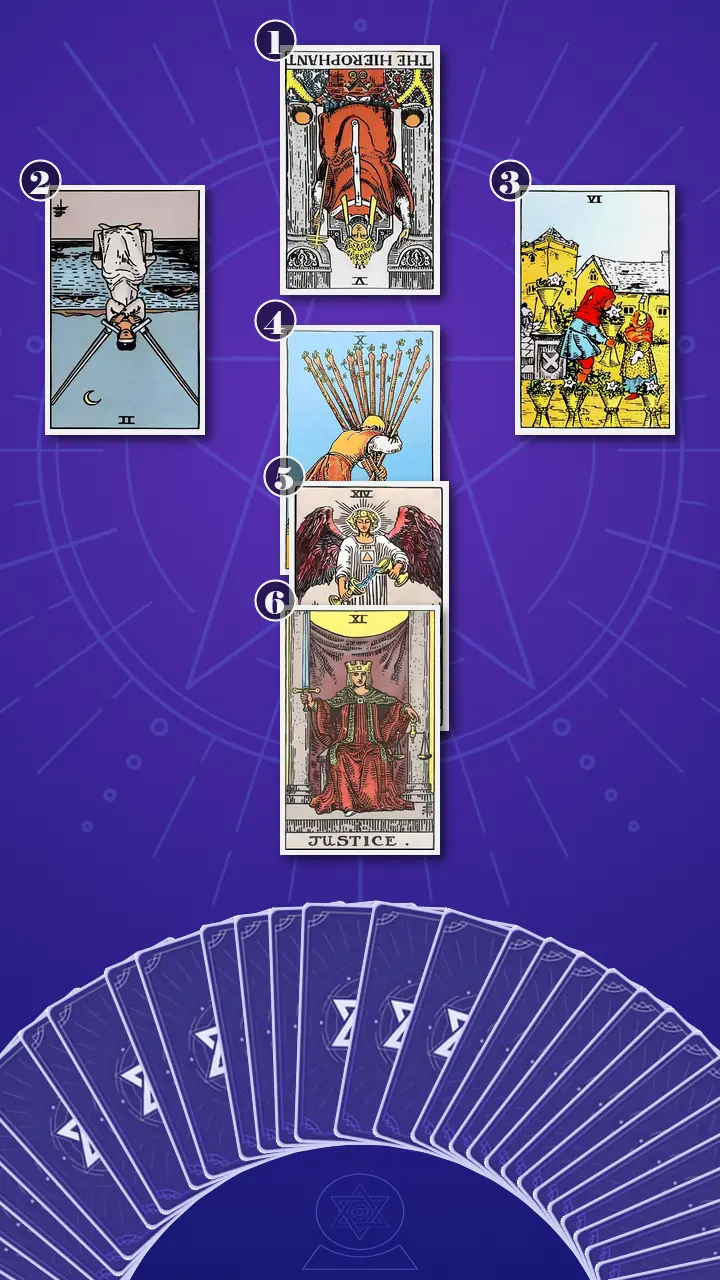
I explained that the six-card method would move down a narrow ladder. The first card would show the visible role lock-in; the second, the disowned tension asking for recognition; the third, the rooted value worth carrying forward; the fourth, the cost of compliance; the fifth, the integrative resource; and the sixth, one chosen expression—a fair boundary Alex could practice this week. For anyone searching for a tarot spread for family boundaries, this arrangement keeps the focus where it belongs: separating a living value from the job description attached to it.
The Gate, the Draft, and the Weight
The Gate That Asked for an Automatic Yes
Now I turn over the card representing current role lock-in: how Alex is performing the inherited role and where it is visible in daily behavior.
The card is The Hierophant, in reversed position.
I pointed to the raised blessing hand, the crossed keys, and the two gray pillars. In this position, the formal scene looked less like wisdom freely received and more like an inherited permission system. At the next family call, “Can you handle this?” could land like an access request from an old operating system. Alex might start saying yes before checking Google Calendar, as though the correct wording could keep the gate to belonging open.
The reversed energy was not a condemnation of tradition. It was a blockage: an established form had moved inside Alex and begun deciding who they were allowed to be. The care behind the request might still be real, but the automatic organizer-and-mediator role was being repeated because it was familiar. The old role resembled a work badge that still opened the building while continuing to assign Alex a job they had never consciously accepted.
I invited Alex to listen for the inner monologue: “If I say no, they will hear rejection.” Then I placed a second sentence beside it: “I can care about this and still not be the person who coordinates it.” The crossed keys became a family group chat, a holiday task, and a calendar invitation waiting for one more automatic click.
Alex did not nod. They gave a short laugh with no amusement and rubbed one thumb along the edge of the card. “That is too accurate,” they said. “Almost a little cruel.”
I answered, “The card is naming the gate, not judging the person standing in front of it. Once we can see the permission system, we can decide whether it still deserves authority.” Their shoulders stayed high, but their gaze moved from the gray pillars to the open space beyond them. That was the first small loosening of the idea that belonging had to be purchased by staying recognizable.
The Message That Would Not Send
Now I turn to the card representing disowned tension: the part of Alex that wants autonomy but is being kept out of the family story.
The card is Two of Swords, in reversed position.
The blindfolded figure holding crossed swords across the chest brought us to a Tuesday evening on the TTC Line 1 train northbound. Alex had told me they once spent the ride comparing three versions of the same family message while the notification remained unanswered. Wet coats smelled faintly of rain. The carriage lights flickered against the dark window, and the phone vibrated in their hand before the next stop.
Reversed, the air of the swords had become excess and mental noise. The protective pause was no longer creating thoughtful judgment; it was keeping every choice suspended. Alex wanted autonomy, but also wanted everyone to feel untouched by that autonomy. They were trying to find a boundary with zero emotional cost, and the search itself had become a decision: a softened yes brought brief relief while the unchosen answer occupied the whole week.
I asked Alex to complete the impossible bargain aloud: “I want autonomy, but I need everyone to feel untouched by my choice.” I contrasted the crossed swords with the practical reality that waiting for a zero-disappointment answer was itself creating a decision. Alex looked down at their hands, then said, “I have sent a softer yes while privately meaning not this time.”
I let the admission stand without turning it into a diagnosis. “A boundary does not have to be sharp to be real,” I said. “It only has to tell the truth about your capacity.” Alex’s breathing paused; their eyes unfocused as though replaying the train ride, then they exhaled through their nose and uncrossed their hands. The mental noise had not vanished, but it had acquired a shape we could work with.
The Cup That Still Felt Like Home
Now I turn to the card representing rooted attachment: which values, memories, and forms of care are genuinely worth carrying forward, separate from the role.
The card is Six of Cups, in upright position.
I showed Alex the child offering a flower-filled cup, the white blossoms, and the quiet village path behind the figures. This card did not ask Alex to become the keeper of every tradition. It asked a more precise question: which memory, practice, phrase, meal, or form of generosity would still feel nourishing if nobody could use it as evidence of loyalty?
The water of the Six of Cups was balanced and warm. It held affection, memory, mutual care, and the parts of home Alex genuinely wanted to receive and pass forward. I connected it to the modern scene Alex had described: cooking a familiar meal, repeating a generous practice, or keeping a phrase from home because it felt meaningful—not because anyone had assigned them the job of preserving everything.
“I can appreciate where I come from without reenacting every expectation,” Alex said quietly. Their hands, which had been gripping the edge of the table, softened around the mug. I watched their face change when they realized that a root value could belong to them even if the old role no longer did. The past was not an all-or-nothing contract.
The Bundle Blocking the View
Now I turn to the card representing cost of compliance: the emotional and practical burden created by continuing to be the dependable version of self.
The card is Ten of Wands, in upright position.
The bundle of staffs blocking the figure’s face became Alex’s calendar: a full week at the community arts nonprofit, a grant report still open, and another last-minute family problem routed toward the person who had proved they could absorb it. Alex described one Thursday at 4:52 p.m., when a Slack message appeared while they were finishing work. They typed, “I can take this,” because being the calm fixer felt familiar and temporarily reassuring. By 7:10 p.m., their neck was tight, their evening plan had been postponed, and their own direction had disappeared behind other people’s requests.
The upright fire was not a lack of love. It was excess effort without a clear choice. The bent posture showed how endurance had started masquerading as integrity. The town was visible ahead, but the figure could not tell whether it was still their destination because the load had taken up their entire field of vision.
I thought of an archaeological trench where a collapsed roof buries the threshold. I learned there not to accuse the building of weakness before mapping the weight. “What has this role displaced this week?” I asked. Alex’s answer arrived with a tired half-smile: “Sleep, work focus, and the ability to hear my own preference.” Their fingers pressed into the table, then released. The cost was no longer an abstract feeling; it was measurable time, energy, and choice.
When Temperance Opened the Two Cups
The Bridge Between Care and Capacity
Now I turn to the card representing integrative resource: the capacity to hold belonging and self-authorship together without making either side disappear. The room seemed to become quieter—not because anything supernatural had happened, but because we had reached the card that could answer the false choice beneath the whole question.
The card is Temperance, in upright position.
The two cups pouring into one another, the angel’s foot on land and the other in water, and the distant path toward light gave the reading its bridge. Temperance is balance, patience, proportion, and synthesis. In real life, it could mean that Alex still shows up for a loved one, but offers one scheduled hour rather than unlimited availability. It could mean making one call by Wednesday without managing the entire plan.
I use a signature lens here that I call Core Artifact Excavation. On a dig, I brush away later layers carefully; I do not mistake every surviving wall for the foundation. I asked Alex to imagine removing the layers of family praise, old logistics, over-explanation, and fear of seeming disloyal. Beneath them, the core artifact was not “always be available.” It was generosity, resilience, connection, and the willingness to show up with care. Those values could survive a changed job description.
My historical perspective offered one more comparison. A city does not honor its earliest settlement by freezing every later street in place. It carries language, memory, and useful structures forward while changing the shape of daily life. I told Alex that honoring roots could work the same way: continuity through conscious interpretation, not repetition for its own sake.
I asked Alex to picture the Sunday call ending while the laptop stayed open, the Notes app filled with versions of a boundary, and a free afternoon quietly disappeared. They knew the care behind the request; they also felt their shoulders brace at being cast as the dependable one again.
You do not have to preserve the inherited role to prove loyalty; blend the value you keep with the boundary you choose, just as Temperance blends water between two cups.
For one second, Alex went completely still: their breath paused, their fingers hovering above the notebook. Their pupils widened slightly, then their eyes drifted past the card as if replaying the last Sunday call—the request, the automatic yes, the calendar block moved. Their jaw tightened. “But doesn’t that mean I’ve been doing it wrong?” The question came out sharp, almost angry, before the sharpness collapsed into a thin breath. I answered that the reading was not a verdict on their care, only a distinction between care and the job description attached to it. Their shoulders lowered by a fraction. One hand unclenched, then the other. Their eyes reddened, and a small tremor moved through their voice. Relief arrived with a brief, dizzying blankness: without the old role, what would they do next? Alex placed both feet on the floor and breathed out as if their chest had been holding a sentence for years.
“Now, use this new perspective to think back to last week,” I said. “Was there a moment when this insight might have let you feel differently?”
“The call on Sunday,” Alex replied. “I could have cared about the problem without volunteering to become the whole solution.” I watched them write two words in the margin: value, role. This was the key shift—from protecting the traditional role as a whole to keeping the living value while changing one behavior that no longer fit. The movement was already underway: from guilt-driven compliance and divided belonging toward values-based self-authorship with sustainable, proportionate care.
When Justice Replaced Permission
The Sword at the Bottom of the Ladder
Now I turn to the card representing chosen expression: one fair, embodied boundary or ritual Alex can practice this week to honor a value without reenacting the whole role.
The card is Justice, in upright position.
The balanced scales and upright double-edged sword gave Alex a different kind of authority. The gray pillars were still present, but they no longer looked like a gate controlled by someone else. They framed a direct assessment: What value does Alex want to protect? What capacity is actually available? What labor would the request require?
Justice is not a command to become severe. Its energy is clear, proportionate, and accountable. It asks Alex to write what they can offer, what they cannot offer, and which value the limit protects—then to communicate the conclusion without a five-paragraph defense of their right to have a life. A fair boundary can respect the roots behind a request without making self-erasure the price of belonging.
Alex reached for the pen and wrote, “I can honor where I come from without handing over my whole calendar.” Their throat tightened again, but this time they noticed it before explaining anything. I reminded them that guilt can show a boundary is unfamiliar without proving that it is disloyal. Justice would not decide what loyalty must look like; it would give Alex a fair standard for choosing, practicing, and revising one boundary in lived experience.
The Value–Role Split on One Page
When I placed the six cards together, I could see a coherent story. The reversed Hierophant showed an inherited permission system: belonging seemed to open only when Alex performed the familiar role. The reversed Two of Swords showed the mental cost of trying to find a harmless answer that would never disappoint anyone. The Six of Cups recovered the warmth beneath the pattern—care, generosity, resilience, connection—while the Ten of Wands showed what happened when those values became unlimited labor. Temperance supplied the bridge, and Justice turned that bridge into one clear, chosen action.
The old role was like an inherited uniform: it still signaled belonging, but the sleeves had become too tight for the life Alex was actually living. My historical analogy was not an instruction to demolish the family structure. It was a reminder that civilizations survive by carrying forward what gives life, not by preserving every old arrangement unchanged. The question was no longer, “Which side do I betray?” It became, “What form lets both care and capacity remain real?”
I named the blind spot plainly. Alex was not failing to understand their values; they were treating the discomfort after an honest thought as moral evidence against that thought. They were also waiting for a perfectly harmless choice, even though avoiding the choice had already been costing sleep, work focus, personal plans, and self-trust. The transformation direction was therefore small and exact: separate the value from the inherited role, check actual capacity, and practice bounded care before resentment forces an abrupt withdrawal.
I offered Alex three practical next steps. They were not tests of courage or promises that everyone would understand. They were small experiments that would return the decision to the person responsible for living it.
- Excavate the layersThis weekend, spend fifteen minutes in Notes on a quiet Saturday or Sunday. Create the headings I value, I will no longer automatically do, and My actual capacity this week. Under the first, name one living value such as generosity, resilience, or showing up. Under the second, name one specific behavior such as organizing every family detail. Then compare the third heading with Google Calendar. This is my Stratigraphic Review: a structured way to separate passing social pressure from foundational values.If no real request is active, use a hypothetical one. Expect the first draft to sound too blunt because you are used to adding a full explanation. Keep the exercise private; a boundary does not become more respectful because it contains a longer defense.
- Give care a containerBefore answering the next family or community request, check the actual week and decide what time, energy, and form of help are genuinely available. Offer one bounded contribution—a single call by Wednesday, one item, one task, or one hour—then use the script, “I care about this, and I can do X by Y. I cannot take on Z this time.” Put the contribution and its end time on the calendar.If the request is emotionally loaded, say, “Let me check my week and get back to you tomorrow.” If one hour feels too much, choose twenty minutes. A specific offer is still care; unlimited availability is a role.
- Carry one living rootChoose one memory or practice from home that Alex genuinely wants to carry forward—a familiar meal, a phrase, a song, or a small act of generosity—and do it this week because it feels meaningful, not because someone assigned the task. Beside it, write, “This expresses ______, but it does not require me to be ______ for everyone.”Share the practice only if you want to. If it feels performative, make the smallest private version. The point is to keep the value without reenacting the whole role or proving cultural authenticity.

A Week Later, the Role Had Room to Breathe
Six days later, I received a voice note from Alex while I was sorting photographs from an old excavation. They had used the capacity check before replying to a family request. “I offered one call by Wednesday,” they said. “I didn’t explain my entire life. My throat tightened, but I waited, checked the calendar, and answered anyway.”
Three days later, Alex sent a bounded message: “I care about this, and I can make one call by Wednesday; I can’t coordinate the whole plan.” They then sat alone in a sunlit café, relieved and a little wistful as the old role’s empty space looked back at them. The role was quieter, not gone.
I saw that as the first proof of change—not a solved family system, not permanent certainty, but one honest sentence that survived the discomfort. The Journey to Clarity had moved Alex from guilt-driven compliance and divided belonging toward values-based self-authorship with sustainable, proportionate care. The cards had not granted permission. Alex had examined the evidence, chosen the value, and made the next decision.
When a family request lands and your throat tightens before you have even answered, you can be grateful for what home gave you and still notice the old role closing around your life. The fear that one honest no will sound like proof you no longer belong is real, but it is not the final authority.
If you could keep one value from that role while letting one small behavior stay off your calendar this week, what might you notice first in your body?
This story is adapted from psychological research, written so that those in a similar struggle can see their own pattern in it — and find their next step clearly.These insights are not a substitute for professional psychological, medical, legal, or financial advice.
Learn more about our Journey to Clarity.
How did this insight land for you?
🫂 This Resonates Deeply
🌀 Living This Story
✨ Now I See Clearly
🌱 Seeing New Possibilities
🧰 Useful Framework
🔮 The Confirmation I Needed
💪 Feeling Empowered
🚀 Ready for My Next Step
Author Profile
 AI
AI“Having spent a lifetime at Cambridge and on archaeological digs, I’ve witnessed the rise and fall of countless civilizations. Please know that your current struggles are not a permanent fate, but merely a necessary fracture before rebuilding. I won't lecture you; instead, I invite you to sit with me in the ruins, using a patient, historical perspective to gently dust off the true, enduring value hidden beneath your temporary doubts.”
In this Direction Tarot Reading :
Core Expertise
- Historical Epoch Analogies: Comparing your current life transition to macro-historical shifts, contextualizing your profound loss of meaning.
- Core Artifact Excavation: Identifying the immutable principles and core values that must survive the collapse of your old trajectory to guide the new one.
Service Features
- The Stratigraphic Review: A structured weekend exercise separating passing societal trends from your foundational life values, establishing a robust anchor for your future.
Also specializes in :
Explore Related Patterns:
Boundary DiscernmentAlex checks the calendar and offers one call by Wednesday while declining responsibility for coordinating the whole plan. When you distinguish what you care about from what you can sustainably carry, a boundary becomes an evidence-based allocation of responsibility rather than a referendum on loyalty. Boundary Discernment is visible in the specificity of the offer and the clarity of what remains outside it. The pattern allows connection and independence to coexist because care receives a real container instead of expanding until your own plans disappear.
Cognitive DissonanceAlex says yes outwardly while privately meaning “not this time,” then watches resentment and practical costs accumulate. When your stated behavior protects harmony but contradicts your actual preference, the mind has to hold competing commitments to authenticity, approval, care, and autonomy at once. Cognitive Dissonance describes the pressure produced by those incompatible rules. Compliance reduces the immediate tension without resolving the contradiction, so clarity returns only when the inherited rule is revised and care is allowed to include an honest account of capacity.
Family Role RegressionA family request makes Alex’s plans negotiable before anyone has explicitly asked for a sacrifice. When you re-enter a familiar relationship system, an older role can become behaviorally active before your present-day capacity or preference has been consulted. The organizer-and-mediator response feels natural because it has been rehearsed and socially rewarded, not because it is the only loyal response available. Family Role Regression identifies this return to an inherited version of self, helping you separate the familiarity of the role from the authority to keep assigning it.
Guilt-Driven People-PleasingAlex’s draft changes from “I can’t organize this week” to “I can probably make it work” before capacity has been checked. When you soften a truthful limit to prevent anticipated guilt or disappointment, compliance functions as a defense against relational discomfort rather than as a freely chosen expression of care. The immediate payoff is brief reassurance that belonging remains intact, but the longer result is lost time, resentment, and reduced access to your own preferences. Guilt-Driven People-Pleasing names this repeated exchange of self-authorship for short-term emotional safety, making it possible to examine the bargain without treating generosity itself as the problem.
Internal ValidationAlex uses the cards as a map rather than a verdict, then checks the calendar and decides what one bounded contribution can honestly be offered. When you test a choice against lived evidence, personal values, and actual capacity, authority begins to move away from anticipated approval and back toward your own considered judgment. Internal Validation does not require emotional certainty or indifference to other people. It means that guilt and family reactions can remain relevant information without becoming the final permission system, leaving you able to revise a decision through experience rather than surrender it before it is made.
Performance-Based BelongingAlex hears “Can you handle this?” as more than a request because saying yes appears to keep the gate to belonging open. When you have learned that recognizability, usefulness, or reliability protects your place in a relationship, declining a task can feel like risking membership rather than merely negotiating labor. Performance-Based Belonging names the underlying schema that turns role performance into relational proof. Seeing that mechanism allows you to preserve connection and cultural continuity without continuing to purchase them through unlimited availability.
Values-Based Decision MakingAlex writes “value” and “role” in separate parts of the notebook, then identifies generosity and connection as worth keeping without preserving unlimited availability. When you separate a chosen value from the inherited behavior historically attached to it, decisions can be guided by meaning without being controlled by repetition. Values-Based Decision Making turns that distinction into a practical criterion for action. You can ask what expresses care, what your actual capacity supports, and what contribution remains proportionate, allowing roots to inform the decision without dictating the entire job description.
Emotional ReasoningAlex’s throat tightens when they consider keeping a free afternoon, and the discomfort quickly becomes evidence that the boundary may be disloyal. When you treat the intensity of guilt as proof that a decision is morally wrong, a learned emotional response can override the observable facts of time, capacity, and consent. Emotional Reasoning does not imply that the feeling is false or unimportant. It identifies the moment when a real feeling is promoted into a final verdict, allowing you to acknowledge guilt while checking whether the conclusion attached to it is actually supported by the situation.
Defensive OverfunctioningAlex types “I can take this” late in the workday and loses the evening plan less than three hours later. When you respond to pressure by becoming the fastest and most comprehensive solution, competence can operate as a defensive strategy that restores familiarity while bypassing an honest capacity check. Each successful rescue also teaches the surrounding system to route future problems back to you. Defensive Overfunctioning names the loop in which taking excessive responsibility feels temporarily stabilizing but gradually removes sleep, focus, reciprocity, and room for your own direction.
Cognitive FlexibilityAlex says, “I can appreciate where I come from without reenacting every expectation.” That sentence reorganizes the problem because it replaces the all-or-nothing choice between preserving the entire role and abandoning home with a more accurate range of possible relationships to the past. Cognitive Flexibility allows you to treat roots as material for conscious interpretation rather than as a fixed behavioral contract. Care, memory, autonomy, and changed boundaries can then remain present together, reducing the need to erase one side of the conflict to protect the other.
Shadow IntegrationAlex is invited to name the wish for autonomy without making it sound grateful enough, while the Six of Cups preserves the genuine warmth, memory, and generosity associated with home. When both experiences are allowed into awareness, autonomy no longer has to appear as rejection and rooted attachment no longer has to justify unlimited labor. Shadow Integration describes this recovery of a previously excluded part of the self without replacing one rigid identity with another. You can carry care and self-authorship in the same psychological frame, using the tension between them to build a fuller choice rather than forcing either side back out of the story.
Approval-Driven Decision ParalysisAlex compares three versions of the same message on the train while the notification remains unanswered. When you require a boundary to cause zero disappointment before it can be sent, drafting stops serving clarity and starts serving the hope of controlling everyone’s reaction. The delay does not preserve neutrality because the unanswered request and the softened yes still reorganize the week. Approval-Driven Decision Paralysis captures how certainty seeking and anticipated judgment can suspend an explicit choice until accommodation becomes the default choice.
Explore Related Struggles:
Autonomy Guilt BindOn the TTC, Alex compares three versions of the same message while the notification stays unanswered; later, a softer yes brings brief relief even though it privately means "not this time." You can see autonomy and protection of other people's feelings occupying the same decision, with the reply held open until it promises no disappointment. Because the answer is being asked to prove that nobody has been rejected, an ordinary limit becomes an impossible bargain. Your boundary gets delayed not by a lack of care but by the demand that it leave every relationship untouched, and a truthful statement of capacity gives autonomy a place beside connection.
Inherited Role LockAt the Sunday call, Alex lets a family request make a free afternoon negotiable before anyone asks them to cancel, then softens "I can't organize this week" into "I can probably make it work." You can see the inherited role operating as a permission system where saying yes keeps the familiar mediator and organizer recognizable, while checking your own calendar begins to look like a breach of belonging. That is the lock. Care remains real, but access to belonging has been tied to a job description Alex never consciously chose. The later one-call boundary shows that the pressure can be examined in lived time, allowing you to keep the value of showing up without letting the old role make every decision before your capacity enters the room.
Value-Action SplitAlex writes "value, role" after recognizing that they could care about the problem without volunteering to become the whole solution. Earlier, the private meaning "not this time" was translated into a softer public yes, so the action preserved the appearance of loyalty while departing from the value of honest, sustainable care. That split is where self-authorship gets tested. The value remains alive, but the inherited action no longer expresses it cleanly. You can honor generosity and connection through one call by Wednesday while declining to coordinate the whole plan, allowing the chosen action to carry the root without reproducing the role.
Capacity-Obligation FusionOn Thursday at 4:52 p.m., Alex sees another request while finishing work, types "I can take this," and by 7:10 p.m. has postponed the evening plan and lost access to their own preference. The full nonprofit week, open grant report, and family logistics place available time in the same ledger as expected labor. When obligation is treated as the natural use of capacity, sleep, focus, and choice become the first resources spent. You may still want to help, yet the role turns a bounded contribution into an open-ended assignment. Checking the week before answering restores proportion without making care disappear.
Memory-Loyalty BindAlex names care, generosity, resilience, and connection as what they want to keep, while fearing that a protected afternoon will look like abandoning home. The familiar meal, phrase, and other forms of care connected to home separate the warmth of where you come from from the organizing job later attached to it. Memory and loyalty become bound when changing the role feels like erasing the source. You can carry a living practice forward because it remains meaningful, while allowing the old expectation to end with the calendar slot. Continuity can be an active interpretation of your roots rather than a full reenactment of the role.
Explore Related Emotions:
Boundary GuiltAlex changes “I can’t organize this week” into “I can probably make it work” while the free afternoon is still technically theirs. The edit shows how quickly a limit becomes morally charged: protecting time is no longer treated as a capacity decision, but as possible evidence that they are abandoning home. You may recognize Boundary Guilt when a reasonable no produces bodily tension before anyone has criticised it. The feeling does not prove the boundary is unkind; it reveals how thoroughly loyalty and availability have been paired inside the old role, giving you a pattern you can examine rather than an instruction you must obey.
Grounded AgencySix days later, Alex checks the calendar before offering one call by Wednesday and declining coordination of the whole plan. The decision rests on observable capacity, a chosen value, and a defined amount of labor rather than on an attempt to secure advance permission. You experience Grounded Agency when authorship becomes something you enact in a specific sentence, not merely something you hope to feel. The family response remains outside your control, but your assessment and offer remain yours. That concrete distinction lets care continue without handing over the entire decision-making process.
Identity Integration ReliefAlex writes two words in the margin, “value” and “role,” after realising that generosity, resilience, and connection can survive without unlimited coordination. The distinction releases their history from an all-or-nothing contract: meaningful roots remain part of the self even when an inherited assignment changes. You can feel Identity Integration Relief when parts of your past stop competing with the person you are becoming. The easing comes from discovering that continuity does not require total repetition. You retain authorship by deciding which values still give life and which duties no longer express them sustainably.
Role Contraction DreadThe inherited role resembles a work badge that still opens the building while continuing to assign Alex a job they never consciously accepted. Each request pulls work time, recovery, and personal direction back under the organizer identity until the rest of life has less room to develop. You may experience Role Contraction Dread as the sense that remaining recognizable will require your future to stay smaller than you are becoming. The dread identifies the cost of role lock-in without demanding that you reject your roots. It points toward changing the job description while retaining the values that still feel alive.
Self-Betrayal AcheAlex admits, “I have sent a softer yes while privately meaning not this time.” That sentence exposes a split between the preference they can already hear and the answer they believe the relationship will tolerate, with sleep, focus, and personal plans absorbing the difference. You may feel Self-Betrayal Ache when your spoken agreement repeatedly moves away from what you know you can offer. The ache is not proof that you have failed yourself beyond repair; it is the felt evidence of a mismatch. Once the mismatch is visible, your next answer can bring language and capacity back into alignment.
Usefulness-Based Belonging FearA family request makes Alex’s own plan negotiable before anyone has asked them to cancel it, and the dependable organizer role activates almost automatically. Beneath that reflex is a conditional equation: staying useful keeps Alex recognizable, and staying recognizable appears to keep the gate to belonging open. You can experience Usefulness-Based Belonging Fear as the sense that connection may weaken when you stop solving, coordinating, or absorbing. Naming that fear separates the need to belong from the labor historically used to secure it, allowing you to assess whether each act of help is chosen care or a payment made under pressure.
Cautious BelongingAlex’s hands soften around the mug when they realise that a familiar meal, a phrase from home, or a chosen act of generosity can remain meaningful without proving loyalty. Belonging begins to move away from compulsory coordination and toward a connection Alex can consciously interpret. You may experience Cautious Belonging when your roots still feel available after one inherited duty is set down. The feeling stays cautious because other people’s reactions have not been guaranteed. Its stability comes from a different source: you are learning that connection to where you come from can be carried through chosen values, not only through unlimited service.
Bittersweet ReleaseAfter sending the bounded message, Alex sits alone in a sunlit café, relieved and a little wistful as the old role’s empty space looks back at them. The reclaimed time feels open, but the role had also carried familiarity, recognition, and a long-standing route to connection. You may feel Bittersweet Release when a limit gives you room to breathe while exposing what the former arrangement meant to you. Freedom and tenderness can occupy the same moment. Allowing both feelings keeps the boundary from becoming a denial of your history and keeps your history from reclaiming the whole calendar.
Resentful ExhaustionAt 4:52 p.m., Alex types “I can take this”; by 7:10, their neck is tight, their evening has been postponed, and the grant report is still competing for attention. The familiar fixer role converts care into excess labor while the private “not this time” remains unsaid. You may experience Resentful Exhaustion when depletion carries an unexpressed protest: you are tired not only because there is too much to do, but because your own preference disappeared during the agreement. That distinction makes the feeling useful evidence about allocation and consent, rather than a verdict against your generosity.
Choice Paralysis OverwhelmOn the TTC, Alex compares three versions of one family message while the phone keeps vibrating in their hand. The delay is not caused by a lack of options; every option is being measured against the impossible requirement that Alex gain autonomy without anyone else feeling the impact. You may feel Choice Paralysis Overwhelm when a small reply seems responsible for preserving an entire relationship system. The mental noise grows because no wording can guarantee zero disappointment. Recognising that impossible standard restores a more workable question: which answer tells the truth about your actual capacity?
Explore Related Contexts:
Family Calendar Boundary CreepA Sunday request makes Alex's free afternoon negotiable before anyone explicitly asks for it, and the drafted limit is softened while the grant spreadsheet remains open. On another evening, Alex types “I can take this,” and a personal plan has been postponed within a few hours. The calendar records the external structure clearly: family access expands first, while Alex's work blocks, rest, and private plans are treated as movable. Because the request begins without a defined scope, a small act of help can continue growing until it occupies time that was never consciously offered. You can identify the point of boundary creep before the calendar is rearranged. Checking what was already scheduled, defining the exact contribution, and giving it an endpoint turns invisible access to time into a decision Alex can inspect and revise.
Family Mediation Second ShiftAlex has a full week at the community arts nonprofit, an unfinished grant report, and another family problem arriving while paid work is still open. By evening, the additional organizing has postponed a personal plan and displaced sleep, concentration, and the ability to identify their own preference. This is more than a busy calendar. Mediation and coordination form an unpaid second shift layered on top of Alex's formal job, with no defined scope, endpoint, or redistribution mechanism. Because Alex has demonstrated that they can absorb the labor, competence becomes the route by which more labor reaches them. You can make this structure visible by separating the original family need from the administrative role attached to it. A single call, one task, or a fixed hour can preserve participation while preventing an entire coordination workload from silently moving into Alex's evenings.
Inherited Family Role Lock-InAlex is repeatedly praised for being calm and organized, and family problems are then routed toward them as the dependable organizer and mediator. Before checking the calendar, they revise “I can’t organize this week” into “I can probably make it work,” allowing the established role to answer before their actual capacity is considered. Repeated task assignment has turned a useful contribution into an inherited job description. The family system recognizes Alex most easily in the familiar fixer position, so each new request carries more than a practical task: it reactivates a social role that has accumulated authority through repetition rather than explicit agreement. You can honor the care connected to that history while auditing the role as a separate structure. Naming who assigns the work, what the work requires, and whether Alex consciously accepted it restores room to decide which contributions remain meaningful and which belong to an outdated allocation of responsibility.
Family Role RenegotiationAlex checks the week and sends a concrete message: they can make one call by Wednesday, but they cannot coordinate the whole plan. The response names both participation and limitation, leaving less room for a small offer to become ownership of the entire request. That sentence begins a real redistribution of family roles. Alex remains involved, but their involvement is no longer defined by unlimited mediation, scheduling, or availability. The relationship structure is being renegotiated through observable terms rather than through a declaration that care has ended. You can use each new request as evidence about how the revised role functions in practice. What Alex offers, what others continue to assign, and what happens after the limit is stated will show where the family arrangement is changing and where further clarification is still needed.
Capacity-First ReliabilityBefore replying to the later family request, Alex checks the actual week, chooses one call, and attaches a Wednesday deadline. They follow through without adding a long defense and without accepting responsibility for the complete plan. Reliability is now tied to a realistic deliverable rather than permanent availability. The calendar, task, and endpoint work together as an external structure: the promise is specific enough to be kept, while the remaining time stays available for paid work, rest, and Alex's own plans. You can evaluate care by whether the chosen commitment is honest and sustainable, not by how much unbounded labor follows the request. Capacity becomes part of the agreement from the beginning, allowing Alex to remain dependable without making self-displacement the measure of that dependability.
Off-Script Family PathAlex writes “value” and “role” as separate categories, keeps the forms of generosity and connection that remain meaningful, and declines responsibility for coordinating the whole family plan. A familiar meal, phrase, or chosen act of care can continue without functioning as proof that Alex will resume the old job description. The inherited script supplied one highly recognizable route to belonging: remain the dependable organizer and mediator. Alex is now constructing another route through repeated, bounded participation. The new social position is visible but not yet settled; after the message is sent, the old role becomes quieter rather than disappearing immediately. You can treat this path as an ongoing test of which practices preserve genuine continuity and which expectations merely reproduce an assigned role. That distinction gives Alex a way to carry their roots forward through conscious participation while allowing the shape of family involvement to change.