A Warm Message, a Dealbreaker, and the Draft That Stayed Unsent

The 8:47 PM Scroll After a Relationship Dealbreaker
I first met Jordan (name changed for privacy), a 29-year-old non-binary product designer in Toronto, on a video call after one of their screen-heavy hybrid workdays. They could explain exactly why the dealbreaker mattered—and then, every time, they heard themselves add, “But I still want them.” That was the shape of their relationship dealbreaker anxiety: not a lack of self-awareness, but awareness being repeatedly cross-examined by longing.
The scene they brought into the reading had happened at 8:47 PM on TTC Line 1. After a tense product review, Jordan had reopened the warmest iMessage exchange, scrolled through the jokes and late-night honesty, and then landed again on the message where the dealbreaker appeared. The carriage hummed under fluorescent lights. Their phone felt hot in their palm, and their reflection flickered against the dark window as the train moved between stations.
“I know what they revealed should matter,” they told me. “So why does my body keep reaching for them?”
They had muted the conversation during work, unmuted it before the ride home, and drafted messages they never sent. Each time they saw the person active online, longing pulled behind their sternum like a magnet trying to drag their whole body through the screen. The attraction said, Keep looking. The information said, This changes what the connection can be.
I did not need to publish the exact dealbreaker to understand its role. Jordan had named it clearly in our session, and it conflicted with a relationship value they wanted to honor. That did not make the other person universally wrong. It made the information personally consequential.
“You are not failing because the feeling survived the information,” I told them. “Our goal is not to bully the feeling into disappearing. We are going to separate what the desire tells you from what the dealbreaker tells you, then let you decide what belongs in your next act. Let’s draw a map through the fog without pretending the fog is a prophecy.”
Choosing the Map: A Contextualized Celtic Cross
I asked Jordan to place their phone facedown, put both feet on the kitchen floor, and take one slow breath while holding the question: “Why do I keep wanting them after they revealed a dealbreaker?” The breath and shuffle were not a supernatural performance. I use them as a clean transition from compulsive checking into deliberate attention.
I chose the Celtic Cross · Context Edition. A three-card reading would have compressed the problem into past, present, and future, while a decision spread might have rushed Jordan toward “stay or leave.” This question required something more precise: a contextualized Celtic Cross tarot spread for understanding persistent attachment after a relationship dealbreaker.
This is how tarot works in my practice. I do not ask the cards to diagnose another person or announce a fixed outcome. I use the positions to separate categories that have become emotionally tangled. The central cards would show Jordan’s visible behavior and the force crossing it. The foundation would reveal what accepting the dealbreaker seemed to threaten. The right-hand column would place Jordan’s stance beside the actual relational information, then move toward a non-predictive integration lesson.
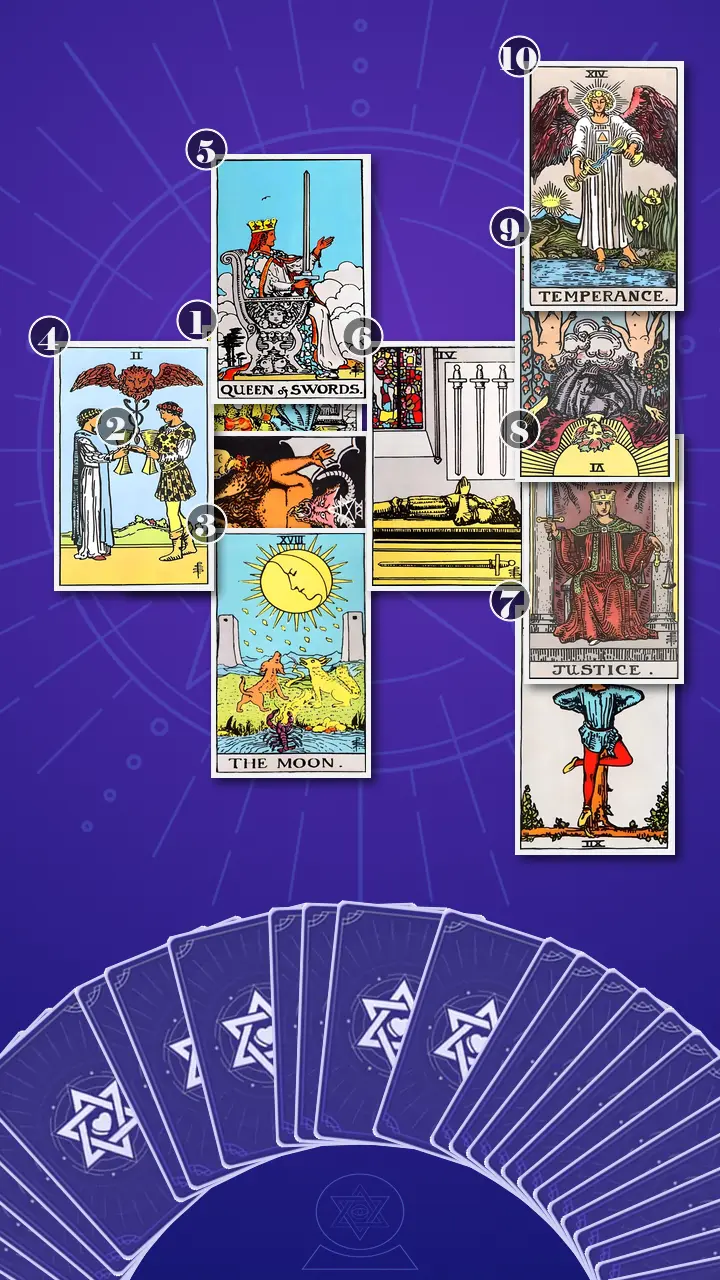
On the table, the layout looked like a knot beside a ladder. Positions one and two formed the knot: memory crossed by attachment. The lower card showed the fear underneath. The cards rising on the right offered perspective—not an escape hatch, and not a verdict, but a series of places where Jordan could recover authorship.
Reading the Knot of Persistent Attachment
Position 1: The Memory That Keeps Reopening
The first card represented the present situation: Jordan’s observable attachment behavior and the contracted pull that sent them back into the chat. I turned over the Six of Cups, reversed.
In the image, a child offers a cup filled with white flowers while the wider village sits at a distance. Reversed, the card showed memory becoming selective and slightly blocked. Instead of letting the past take its proportionate place, Jordan kept lifting one tender scene back into the foreground and leaving the incompatible information outside the frame.
In modern life, this was Jordan reopening the chat after work and scrolling directly to the sweetest exchange—the digital equivalent of replaying a saved voice note because it restored warmth faster than it restored context. The tenderness was real. The distortion began when the remembered tenderness became a legal argument against the dealbreaker: If that moment was real, perhaps the warning can be edited around.
I compared it to reopening a polished Figma frame while leaving the red annotation that changes the whole user flow collapsed. The beautiful screen had not become fake. It was simply no longer the complete decision.
“When you scroll back,” I asked, “what are you trying to return to—the person, the conversation, the future you pictured, or the version of yourself who felt chosen?”
Jordan gave one short laugh, but bitterness caught at the end of it. “That is accurate enough to feel a little brutal.” Their breath paused, their eyes moved away from the card as if replaying the message, and then their fingers released the mug they had been gripping.
“We can slow down,” I said. “The card is not accusing you of inventing the good parts. It is showing us that a good memory and a full compatibility assessment are different objects. Can you let the memory stay good without making it responsible for the entire relationship?”
Position 2: The Browser Tab with Autoplay
The card crossing the first represented the immediate challenge: the attachment, temptation, and bargaining process keeping desire active after the dealbreaker. I placed The Devil, upright, horizontally across the reversed Six of Cups.
The two figures in the card appeared chained, but the chains around their necks were loose. I read this as an excess of attachment energy: not evil, not punishment, and not proof that the connection was destined. It was the point where a strong pull had begun masquerading as an instruction.
For Jordan, The Devil was the moment they checked the person’s profile after promising themselves they would not, then called the check a search for clarity. Each look briefly reduced the fear of losing the connection. That relief trained the loop to repeat. One tap at a time, the behavior felt voluntary; only after several minutes did Jordan realize they were back on the same profile, looking for information that could not answer the compatibility question.
“It is like a browser tab with autoplay,” I said. “You can close it, but the sound catches your attention before you notice your hand returning to the trackpad. The inner line becomes: I can stop whenever I want, but I need one more look to know what this means.”
The Sirens from The Odyssey came to mind—not because the other person was dangerous, but because a compelling call requires structure if it is not going to become the only source of direction. The loose chains preserved the most important part of the image: Jordan still had agency, even if agency currently felt smaller than the urge.
“What does checking promise in that exact second?” I asked. “Relief, certainty, renewed closeness, or another chance to negotiate the dealbreaker?”
Jordan’s hand moved automatically toward the facedown phone, stopped halfway, and returned to the table. “Relief,” they said. “Then I tell myself it was research.”
“That is not a character flaw,” I replied. “It is attachment postponing the moment when the loss becomes emotionally real.”
Position 3: The Moonlit Product Brief
The third card represented the foundation: the fear and limiting belief beneath the checking loop, especially the fear that accepting incompatibility would mean losing belonging. I turned over The Moon, upright.
The dog and wolf faced the moon while a winding path disappeared between two towers. A crayfish rose from dark water, bringing something instinctive and half-formed toward consciousness. Here, Moon energy was excessive in projection and deficient in separation: observable facts, hope, fear, and imagined future change had been blended into one dim landscape.
Jordan had been filling the gaps around the dealbreaker with possible explanations: perhaps the person meant something else, perhaps they might change, perhaps the chemistry meant the available facts were incomplete. It resembled an ambiguous product brief with missing requirements. Their mind generated hypothetical edge cases because naming the known constraint felt more final than continuing to investigate it.
“Let’s divide the path,” I said. “What do you know? What are you imagining? What are you hoping will change?”
Jordan went still. Their gaze lost focus for a moment, then returned to me with less polish in it. “I know what they said. I am imagining that the connection makes us an exception. And I am hoping I misunderstood because… if I didn’t, the quiet after this gets much bigger.”
I heard the fear underneath the research. The real threat was not merely ending contact. It was the possibility that the rare feeling of being understood would vanish with it, leaving Jordan to wonder whether they had lost their best chance at belonging.
“That fear deserves company,” I said. “It does not have to be promoted into evidence.”
Position 4: The Connection Was Not Imaginary
The fourth card represented the recent emotional basis: the genuine exchange Jordan continued to replay whenever longing returned. I revealed the Two of Cups, upright.
Two figures met in the center and raised their cups toward one another. The energy here was balanced: mutual recognition, attraction, humor, and emotional openness had likely been present. This was not a card that required Jordan to rewrite the connection as fake in order to move forward.
Jordan described a conversation in which both people had dropped their usual defenses and seemed to understand one another with unusual ease. That memory had a Fleabag-like tension to it: sharp honesty, undeniable chemistry, and the painful possibility that a powerful connection might still contain a misalignment that affection could not solve.
“The cups meeting in the middle validate reciprocity,” I said. “They do not certify every value match. A real connection can still be wrong for your values.”
Jordan’s lips pressed together. Their chin dipped, and their eyes shone before they looked toward the dark kitchen window. “I think I have been afraid that taking the dealbreaker seriously means admitting none of it meant anything.”
“You do not have to call the good parts fake to take the dealbreaker seriously,” I answered. “Discernment is not retroactive erasure. The scene happened. It mattered. It simply may not be the whole film.”
Position 5: The Sentence Without a Closing Argument
The fifth card represented the conscious influence: the clarity, self-respect, and boundary Jordan wanted to access while still feeling drawn toward the person. I turned over the Queen of Swords, upright.
Her sword stood straight, but her other hand remained open. I read that pairing as balanced sword energy: direct language without cruelty, emotional receptivity without self-negotiation. She did not need to make the other person a villain. She needed to name what the information meant for Jordan’s own participation.
I brought Jordan back to 5:36 PM, when they had unmuted the chat and drafted three versions of a message. Each version had become longer, softer, and more strategically persuasive. The Queen interrupted that scene with one plain sentence: I want relationships that include this value, and the revealed dealbreaker conflicts with that value for me.
“Her inner line is not, I must build an airtight case against them,” I said. “It is, I can say what this means for me without building a case against them. The sword names the standard. The open hand admits that you still care.”
Jordan opened their notes app, then stopped before typing. Their shoulders rose, held, and lowered by a fraction. “I want relationships where this value is shared,” they said slowly, “and what they revealed conflicts with it for me.”
“That is enough for a first draft,” I told them. “No footnotes. No persuasive essay. A boundary can be clear before your feelings become quiet.”
Position 6: One Evening Without New Evidence
The sixth card represented the next available awareness: a reflective pause that could reveal the difference between missing someone and finding the connection compatible. I turned over the Four of Swords, upright.
The resting figure lay beneath three displayed swords. This was not a prediction about what the other person would do. It showed restorative balance arriving where mental rest had been insufficient. Jordan’s mind had been cycling among what happened, what it might mean, and what they hoped would change. The card asked for temporary distance from all three stories.
In practical terms, the Four of Swords was one defined evening away from the chat thread, profile, and activity status. Without feeding the first wave of longing with new details, Jordan could observe whether the urge was asking for contact or simply asking to be felt.
“Try twenty-four hours,” I suggested, “not as a dramatic declaration, but as an observation window.”
Jordan’s eyebrows lifted. “Honestly, twenty-four hours sounds impossible. And if I fail at it, I will turn that into evidence that I have no self-control.”
I adjusted immediately. “Then twenty minutes. Or one TTC ride. The purpose is not to pass a purity test. It is to create enough quiet to notice what becomes visible when the checking loop is not narrating every minute.”
The resistance in Jordan’s jaw softened. We had reduced the pause from a performance of detachment to a small experiment they could revise.
Position 7: The Explanation That Never Arrives Finished
The seventh card represented Jordan’s self-position: remaining suspended while waiting for one final explanation to make the contradiction painless. I revealed The Hanged Man, reversed.
The upright image can describe a willing pause that produces a new perspective. Reversed, the energy was blocked. Jordan had stayed upside down long enough to call the suspension insight, even though it no longer changed the view.
In their daily life, this sounded like: I need one more conversation to know what the dealbreaker means. Yet the missing answer was not entirely about the other person’s explanation. It was also the boundary Jordan wanted to honor if no further information arrived.
The card reinforced The Devil. The checking loop created temporary relief; the wait for perfect clarity allowed the loop to continue. I named this as delayed grieving, not indecisiveness as a personality trait.
“What are you still waiting to learn?” I asked. “And which part of your standard remains yours even if they never provide a better explanation?”
Jordan’s breath caught. Their fingers tightened around the phone, then loosened as they set it farther away. “I am waiting for them to explain it in a way that lets me keep everything,” they said. “But I already know what it conflicts with for me.”
That answer did not make them look triumphant. It left them briefly unguarded, as if the room had grown larger around the chair. Clearer information can bring relief, but it can also remove the shelter of indefinite waiting.
When Justice Put Desire and Fit on the Same Page
Position 8: The Scales Jordan Had Been Avoiding
The eighth card represented reality and relational context: the revealed dealbreaker as information to weigh, without diagnosing the other person or making Jordan’s decision for them. On Jordan’s side of the video call, the refrigerator’s low vibration stopped. In the sudden quiet, I turned over Justice, upright.
The scales were level. The sword was vertical. The seated figure did not look punitive; the posture was controlled because proportion required steadiness. Justice carried balanced energy—discernment, accountability to personal standards, and the ability to place strong feeling beside observable fact without asking either one to disappear.
As an artist, I flashed to an editing timeline. A close-up can be emotionally true and still conceal what the wider shot reveals. Jordan had kept replaying the luminous close-up—the warm message, the voice note, the moment of mutual recognition—while treating the dealbreaker as inconvenient footage that could be cut without changing the story. Justice widened the frame.
I asked Jordan to imagine a product decision log with three items visible on the same page: the actual dealbreaker, the relationship value it conflicted with, and the feelings that remained. Attraction was real data. It simply did not have permission to delete the non-negotiable constraint.
Then I used my Dialogue Loop Auditing method, a tool I normally use to locate the exact phrase that sends two people into a conversational dead end. This time, I turned it inward. Jordan’s trigger phrase was: But I still want them. The moment that line appeared, the dealbreaker went on trial. Jordan generated exceptions, reopened the profile, received a few seconds of relief, and then interpreted the continuing intensity as fresh proof that the dealbreaker might not count. The phrase did not merely describe desire; it launched a script in which desire became defense counsel, the boundary became the accused, and grief never reached the witness stand.
Up to that point, Jordan had been trapped inside one impossible condition: if desire remained, perhaps the boundary was invalid; if the boundary mattered, perhaps the connection had to become meaningless. Justice refused both distortions and asked for proportion instead.
The dealbreaker is information about compatibility, while wanting them is information about attachment. The feeling is real, and the mismatch can be real too; one does not erase the other. You do not have to make the desire disappear before you let your values have an equal voice.
Do not use desire to put the scales away; weigh the revealed dealbreaker alongside the attraction, and let Justice return the decision to your own values.
For one beat, Jordan stopped breathing. Their thumb hovered over the dark phone screen, their eyes lost focus as if the 8:47 PM train had begun moving through the kitchen, and their mouth tightened around an objection. “But if that is true,” they said, their voice suddenly sharper, “doesn’t it mean I was wrong to keep hoping? Doesn’t it mean I ignored something obvious?” Their anger arrived first, hot and protective. Then their shoulders folded inward, and the anger exposed the smaller fear beneath it: that clarity would demand self-punishment. I waited until their eyes returned to mine. “No,” I said. “It means the connection touched you before you knew how all of its information fit together. New information is allowed to change your participation without turning your earlier openness into stupidity.” Their fingers unclenched. A long breath moved out of their chest, their eyes reddened, and their shoulders lowered. Relief came with a brief, almost dizzy blankness—the vulnerable moment when the old argument releases its grip and personal responsibility returns.
“Now, using this new perspective, think back to last week,” I invited. “Was there a moment when this insight could have made the experience feel different?”
Jordan looked toward the facedown phone. “On the train,” they said. “I could have noticed that the warm message proved I felt close to them. I did not have to make it disprove what they told me.”
“Exactly,” I said. “Wanting them is data about attachment, not a verdict on compatibility.”
I set a ten-minute timer and asked Jordan to write two lines: I still want them because… and This dealbreaker matters to me because… They were not to send either line. I asked them to notice their chest, jaw, and urge to reach for the phone while both statements remained visible. I also made the limit explicit: if the exercise became too physically activating, they could stop, put the phone down, choose a neutral activity, or contact someone they trusted. The tool belonged to them; they did not belong to the tool.
This was the central crossing in their Journey to Clarity: a move from treating desire as proof of compatibility toward holding longing, grief, facts, and personal values with steadier self-trust. It was not certainty about the relationship. It was the first restoration of Jordan’s own scales.
Position 9: The Mountain Between Chemistry and Alignment
The ninth card represented hopes and fears: Jordan’s wish to preserve a meaningful connection and their fear that choosing discernment would erase it. I turned over The Lovers, reversed.
The two figures remained in the image, but a mountain rose between them. Reversed, Lovers energy was blocked through misalignment: intimacy and attraction were present, yet a values-based choice could not be outsourced to chemistry.
For Jordan, the card held two simultaneous stories. They hoped the intensity proved the bond was worth preserving. They feared that respecting the dealbreaker would make every meaningful part disappear. The mountain did not label either person as bad. It represented the value conflict that affection had not removed.
“What are you hoping the intensity will prove?” I asked. “And what loss do you fear if it cannot prove that?”
Jordan stared at the card. Their eyes moved from one figure to the other, then settled on the mountain. “I want it to prove this was rare enough to save,” they said. “I am afraid that if I stop trying, I will never feel this awake with someone again.”
I nodded. “Then we let the fear be visible without giving it sole authority. One feeling and one value can remain on the page for ten minutes without fighting to the death. This is not emotion versus integrity. It is your complete experience asking to be held in one frame.”
Position 10: Two Truths Poured Into One Response
The tenth card represented the integration lesson: a balanced way to hold desire, grief, facts, and personal standards without predicting an external outcome. I turned over Temperance, upright.
The angel poured liquid between two cups, one foot resting on land and one in water. The energy was balanced and active. Temperance was not emotional numbness, and it did not promise that the other person would change. It showed Jordan how to create a response from the complete picture rather than from whichever feeling shouted loudest that hour.
In one cup sat: I still want them. In the other sat: This dealbreaker still matters to me. Temperance did not pour one away. It blended longing with discernment, affection with proportion, and grief with enough groundedness to choose a measured boundary.
I compared it to keeping two Figma layers visible instead of hiding one beneath an opaque rectangle. It also resembled a TTC transfer: two lines could connect within the same journey without pretending they were ever the same route.
“Two truths can sit in the same note,” I told Jordan. “I still want them, and this may not fit me.”
Their face softened, though sadness remained around their eyes. “Then my response tonight can be not opening the chat,” they said. “Not because I suddenly do not care. Just because I do not want the strongest feeling of the hour making the whole decision.”
I let that sentence settle. Temperance had not solved their life. It had given them a workable proportion.
The Edit That Put the Pen Back in Jordan’s Hand
I gathered the spread into one coherent story. The Two of Cups showed why the attachment had weight: Jordan had experienced real warmth and reciprocity. The reversed Six of Cups showed the present habit of replaying that warmth without its full context. The Devil turned nostalgia into a checking-and-bargaining loop, while The Moon revealed the fear underneath—the fear that accepting the mismatch would also mean surrendering belonging. The Queen of Swords offered honest language; the Four of Swords offered enough quiet to hear it. The reversed Hanged Man showed how waiting for one perfect explanation had become a form of suspension. Justice separated attachment from compatibility. The reversed Lovers named the values conflict, and Temperance showed that grief and self-respect did not have to cancel each other.
As I looked across the cards, I saw Jordan’s film-editing problem clearly. They had bravely stayed in one beautiful, painful scene for too long, replaying it in the hope that repetition would change the next frame. The cards did not tell them to destroy the footage. They showed them where the footage had been mistaken for the whole script.
The cognitive blind spot was not simply “I still want them.” It was the assumption that wanting them meant the dealbreaker required more negotiation—and that a boundary could not be trusted until the longing became quiet. The shift was more precise: stop asking whether desire cancels the dealbreaker; start asking what the dealbreaker reveals about compatibility and which boundary aligns with personal values.
I offered two deliberately small next steps. Neither required Jordan to announce a permanent decision, demonize the other person, or pretend the connection had meant nothing.
- The Missing Versus Fit Note For the next seven days, whenever the urge to contact them appears—on the TTC, in the condo kitchen, or after seeing an activity dot—open a private note titled Missing Versus Fit and set a ten-minute timer. Write one observable bullet about what you miss and one observable bullet about what the dealbreaker reveals about compatibility. Then add: The feeling proves that I am attached to…, rather than: The feeling proves that we should be together. Keep the note private until the timer ends. Tip: The nostalgia column may feel warmer and more convincing. Do not delete the fit column. If the exercise becomes an argument, return to short facts only, and stop if your body needs grounding rather than more reflection.
- The Pattern Interruption Script Choose one evening and interrupt the known sequence before it reaches the profile check. When the trigger appears, name the old line aloud: I need one more look to know what this means. Replace it with: I can want them and wait twenty minutes; this urge is not a verdict. Move the app off the first screen, then record the exact time, trigger, and body sensation in three short lines. If twenty minutes feels manageable, extend the pause through one commute or up to twenty-four hours. Tip: This is an observation window, not a test of willpower or a dramatic no-contact declaration. If the pause increases distress, shorten it and choose a neutral activity or a supportive conversation. Jordan—and you—retain the right to adjust the boundary.
I called the second exercise my Pattern Interruption Script because it changed the role Jordan played at the exact moment the old scene tried to restart. The trigger remained. The longing remained. What changed was the next line of dialogue, and that single line prevented attachment from automatically directing the next action.
A Week Later: The Draft That Stayed Unsent
Six days later, I received a message from Jordan. At 8:52 PM, after seeing the person active online, they had reached for the chat and stopped. Instead, they opened the Missing Versus Fit note.
They wrote: What I miss: how quickly I felt understood. What fit tells me: what they revealed conflicts with something I need to share with a partner. Then they added: The feeling proves I am attached to the future I pictured. It does not decide whether that future is workable.
Jordan still wanted to send the draft. They used the Pattern Interruption Script, waited twenty minutes, and eventually let the pause run through the night. Nothing cinematic happened. No perfect certainty arrived, and the longing did not evaporate.
They slept through the night. In the morning, their first thought was still, What if I’m wrong? They smiled once, made coffee, and left the chat muted.
I did not credit the cards with that choice. The contextualized Celtic Cross had provided camera angles, language, and enough structure to separate feeling from fit. Jordan had done the harder work: they had allowed affection to remain real without handing it the director’s chair.
That was the quiet proof of their Journey to Clarity. They had not reached emotional indifference. They had moved from compulsively searching for an exception toward observing the attachment loop, weighing the dealbreaker against their own values, and choosing one measured boundary for one ordinary evening. I had only held the scene steady long enough to hand them back the pen.
If tonight your chest tightens and your thumb returns to the warmest message, accepting the dealbreaker may feel like losing the connection that once made you feel chosen. Wanting someone and knowing they may not fit can both be true. Simply noticing those two truths means you are no longer standing at the beginning.
If, for one quiet evening, you let wanting rest in Temperance’s first cup as a feeling rather than a verdict, what small boundary would you place in the second cup—one that belongs to you even before the grief settles?