Deleting the Angry Sentence, Then Letting a Family Boundary Stand

Swallowing Anger on TTC Line 1
When a Toronto junior project coordinator tells me that her family group chat suddenly turns to her to explain, smooth over, or fix the tension, I hear the question, "Why am I always the family peacemaker?" before I notice her jaw tightening.
Jordan (name changed for privacy) is on TTC Line 1 just south of Bloor-Yonge at 8:47 p.m. when she opens the family chat again. Wet coats press around her, brake dust hangs in the warm carriage, and fluorescent lights buzz above her head. Her phone feels hot in her palm. She deletes the sentence that says she is angry, sends a practical update with a reassuring emoji, and watches the next station arrive without saying what she meant.
When she sits across from me, she says, "I can explain everyone else's reaction except my own." She wants to tell the truth and remain the calm person everyone expects. She wants chosen connection, but she is afraid that revising her inherited family role will make her the difficult outsider. Her resentment feels like carrying every open browser tab in a single window until the page she originally came to read disappears completely. The tight jaw, constricted throat, and heavy shoulders are still recording the conversation her polite message erased.
I do not ask her to forgive faster, confront dramatically, or decide the future of the family from one reading. I tell her, "It makes sense that silence has felt safer when belonging seems tied to your usefulness. Today, we can look at the pattern without shaming the way you survived it. Our Journey to Clarity is not about making the cards choose for you. It is about making your own position visible again."

Choosing a Map for the Family Peacekeeper Loop
I invite her to take one slow breath and place both feet on the floor. I shuffle while she holds the question in plain language: Why do I keep swallowing anger to stay in my inherited family role? The pause is a psychological threshold, a way to move from replaying the family call into observing it.
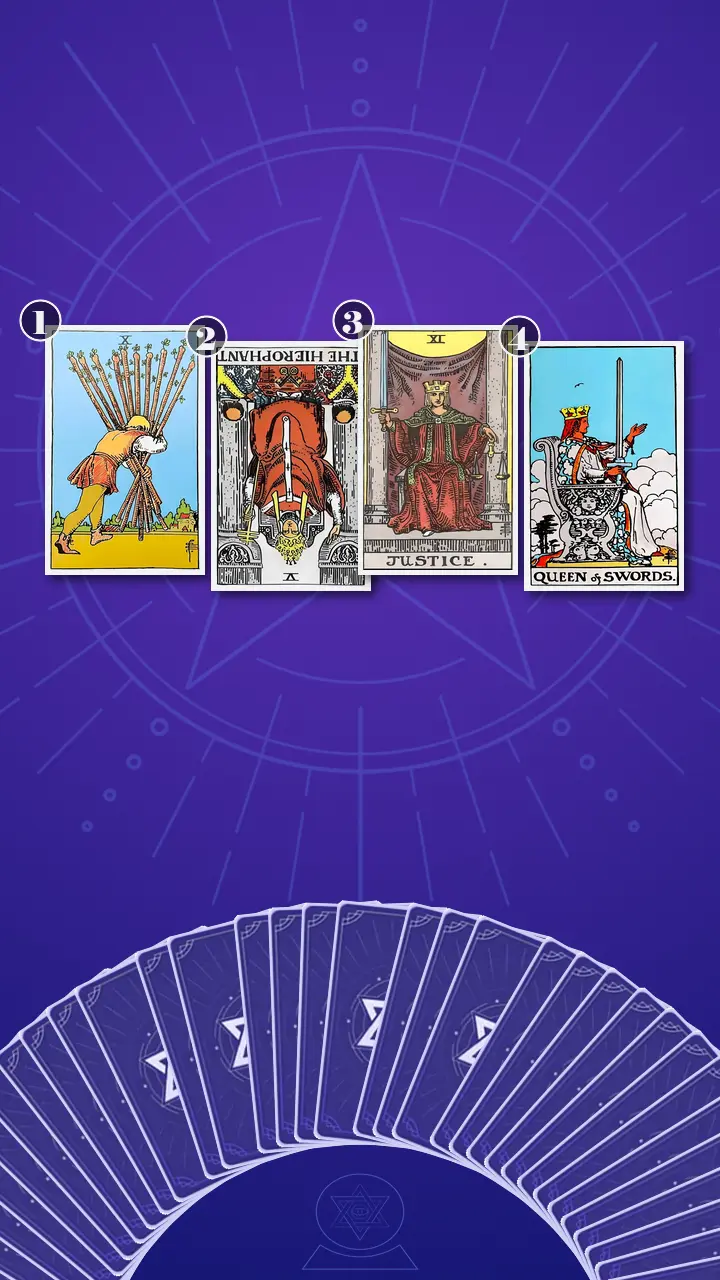
Today I use the Four-Layer Insight Ladder Context Edition, a horizontal four-card spread designed for self-exploration. For anyone wondering how tarot works in a practical reading, I explain that the cards are not a verdict or a promise about how relatives will behave. They give us a structured visual language for separating the visible pattern, the rule beneath it, the turning point, and the next choice.
I chose this spread because the question begins with "Why do I keep..." and describes a repeating relational system. A family tension triggers an inherited rule, the rule makes silence feel safer, silence lowers the visible conflict for a moment, and the resentment returns with even more force. A broad spread would add information without necessarily showing the loop. This four-layer structure gives us the smallest useful map for the burden, the inherited script, honest rebalancing, and a self-authored boundary.
The first card will show the Present burden, the observable family interaction pattern in which she swallows anger and carries the atmosphere. The second will reveal the Inherited script, the internal authority that makes the role feel necessary. The third is the central hinge, Honest rebalancing, where anger can become information rather than punishment. The fourth points toward a Self-authored boundary, a practical sentence she can try without deciding how anyone else must respond.
The Bundle, the Rule, and the Clear Sentence
The Bundle Blocking Her View
Now I turn over the card representing Present burden: the observable family interaction pattern in which the querent swallows anger, performs calm, and carries responsibility for keeping the group comfortable. It is the Ten of Wands, in the upright position.
The figure on the card carries a bundle so large that the road ahead is almost hidden. I see the bundle as every family group-chat update, holiday logistics, apology drafted for somebody else, and objection she carries without naming. This is the family group chat, the shared meal, the practical message that arrives after an emotional disagreement. Like the figure whose view is blocked by the wands, she keeps the inherited role moving by handling every emotional and practical task while losing sight of what she actually wanted from the interaction.
The upright energy is an excess of responsibility and protective fire. Her anger is not absent. It has been compressed into carrying. She becomes useful because usefulness lowers the immediate risk of conflict. She says "It's fine," changes the subject, summarizes everybody's position, or offers to send the follow-up message. The moment gets quieter, but the cost moves into her body and follows her onto the TTC, into work, and through the late-night Notes app draft. Silence can keep the moment calm while making her carry the conflict alone.
I ask, "Which emotional responsibility are you carrying to preserve the role? What would become visible if one part of the bundle were named instead of silently managed?"
She gives a short laugh with a bitter edge. Her thumb freezes above her phone, her eyes flick toward the Notes app as if a deleted sentence has appeared there again, and then her mouth softens around a long breath. "That's too accurate," she says. "Almost rude."
I smile gently. "The card is not calling you weak. It is showing me how much strength has been recruited to keep an old arrangement comfortable. We can respect the strategy and still question its price." She looks down at the card, one hand still resting over her jaw, and the first layer of self-blame loosens.
The Rule Behind the Crossed Keys
Now I turn over the card representing Inherited script: the family rule, belonging fear, and internal authority that maintain the role lock-in and contain the anger. It is The Hierophant, in the reversed position.
In the image, two pillars frame a teacher, crossed keys rest below, and kneeling figures receive an established lesson. Reversed, the teaching has moved inside. It sounds like an old operating system still running a family default setting: "Keep everyone comfortable. A good daughter stays calm. Direct anger is disrespect." No one has to announce the rule for her to enforce it. She hears it before every tense call, edits the message before anyone can object, and becomes helpful before anyone has asked her to absorb the emotional cleanup.
This is the spread's main blockage. The family script has become an internal authority, so acceptance through compliance can feel safer than connection by choice. The crossed keys become a hidden permissions system for belonging. One key seems to say, "Be agreeable," while the other warns, "Do not show the anger that might unlock a different role." She may have admin permissions in her own life, yet still ask an invisible moderator whether she is allowed to disagree.
I return her to the scene before the family call, when she rehearsed saying, "I do not want to be responsible for smoothing this over," then deleted the objection. I tell her about the question behind The Wizard of Oz: does an authority still have power because it reflects a chosen value, or because the performance has been repeated for so long that nobody checks behind it?
She does not nod. Her fingers tighten around the edge of the chair, her gaze goes unfocused as though she is replaying a holiday dinner, and then her shoulders drop by a fraction. "I don't actually hear anyone say it," she says. "So why am I obeying it?"
I answer, "Because repetition can sound like authority, especially when it once helped you stay connected. That does not make the rule permanent. An inherited role is a repetition, not a permanent contract." I do not tell her to reject every family expectation or cut anyone off. I ask her to distinguish the value she genuinely chooses from the compliance she performs because disagreement feels dangerous to belonging.
When Justice Turned Pressure Into a Sentence
The Hinge of Honest Rebalancing
The room grows quieter as I move to the third card. Even the radiator's small metallic knock seems to pause. Now I turn over the card representing Honest rebalancing: the inner conflict between preserving the family role and expressing anger, followed by the cognitive shift that can turn anger into accountable information. It is Justice, in the upright position, the Antidote in this spread.
Justice brings balanced scales, an upright double-edged sword, and a question that is exact rather than dramatic. What happened? What did her body register? What belongs to her? What boundary would restore proportion? The upright energy is balance, not emotional numbness. It turns the warm pressure of the Ten of Wands into the clearer air of discernment. Anger can be information without becoming a weapon. She can own her tone without erasing the event.
I think of my own work across a decade of readings. The most useful tarot insight rarely arrives as a prediction. It arrives when a vague inner signal becomes a sequence that a person can examine. I ask her to hold the family text in front of her as a record, not a trial: "I do not have to prove that they are bad; I do have to stop pretending this did not affect me."
Setup. I ask her to picture 8:47 p.m. on TTC Line 1: wet coats, brake noise, a warm phone, and a draft that says what she meant. She deletes it, sends a practical update, and feels her jaw tighten. The role keeps the peace, but hides her position.
Delivery.
You do not have to swallow anger to preserve an inherited family role. Name the imbalance, own your response, and choose the rule you will continue by choice. Your next honest sentence can be clear without becoming a verdict.
At first, her face goes still. Her breath stops halfway in, and her thumb hovers over the edge of the card. Next, her eyes lose focus; I watch her replay the train, the practical update, and the sentence disappearing from Notes. Then her right hand unclenches one finger at a time, her shoulders drop, and a shaky breath moves all the way through her chest. The relief is not simple. Her eyes redden with anger, grief, and the strange vulnerability of no longer having silence do all the work. "But if I choose the rule now," she says, "does that mean I was wrong before?" I answer, "It means you were protecting belonging with the tools you had. It also means you can choose differently now." I write a ten-minute practice beside Justice: four lines for what was said, what happened in her body, what belonged to her, and what boundary she wanted to try. The note can stay unsent. If her body feels too activated or the situation feels unsafe, she can mute the thread and return only when she chooses.
I let the silence remain for a moment, then ask, "Now, use this new perspective to revisit last week. Was there a moment when this insight might have helped you feel differently?"
She looks at the four cards in a line. The movement I see is small but real: from silence-based belonging and contained resentment toward self-authored boundaries, proportionate honesty, and chosen family connection. The anger does not need to disappear before she can make one deliberate choice. That is the first crossing from feeling contracted and afraid of becoming the outsider toward steadier self-trust.
The Sentence That Can Stand Alone
Now I turn over the card representing Self-authored boundary: the practical communication or action that can embody the insight without deciding how other family members must respond. It is the Queen of Swords, in the upright position.
The Queen sits upright with her sword visible and one hand extended. Her clarity is not a punishment. It is an invitation with terms. I connect her immediately to the sentence that might have been sent on a Wednesday afternoon: "I am willing to discuss the plan, but I will not stay in a conversation where my concern is mocked." It names participation, not a verdict. It leaves connection available by choice, while refusing to use silence, over-explaining, or emotional caretaking as proof of loyalty.
The upright energy here is clear, available air: direct communication shaped by discernment rather than the need to please. The Queen does not ask her to deliver an explosive performance of anger. She asks her to let one accurate sentence exist without attaching her entire family history to it. A boundary is a sentence, not a courtroom closing argument. The raised sword gives Justice a usable form, and the open hand keeps the exchange relational without making the limit negotiable.
I suggest that she choose one "I will" or "I will not" sentence, say it once, and decide in advance what she will do next. She can pause the call, mute the thread, or return later. The boundary describes her participation. It does not control another person's feelings, tone, or understanding.
She reads the sentence aloud. The first attempt comes out too softly, followed by an automatic apology. On the second attempt, she stops after the limit. Her shoulders remain slightly raised, but her throat is no longer working against the words. She looks at me and says, "It feels strange that the sentence is so short." I tell her, "Short does not mean careless. It means the boundary is no longer carrying the burden of proving that you deserve to have one."
From Silence-Based Belonging to a Self-Authored Boundary
When I connect the cards, I see a clear sequence. The Ten of Wands shows her carrying the family atmosphere, along with every unsent objection, until the bundle blocks her view. The reversed Hierophant shows the inherited rule that makes carrying seem like the price of belonging. Justice interrupts the loop by separating the observable event, the bodily impact, her responsibility, and the limit she can choose. The Queen of Swords turns that discernment into a sentence that can stand without appeasement.
The cognitive blind spot is not simply that she has been too quiet. It is that she has treated anger as evidence that she is becoming unsafe for the family, while treating other people's immediate comfort as evidence that the role is working. She has imagined only two choices: swallow the feeling or release it as a verdict. The cards reveal a third path. She can name anger, take responsibility for how she communicates, and still refuse to make silence the price of connection.
I use a personal diagnostic lens here that I call Macro-Orbital Projection. I place the current family-peacemaker pattern against the longer cycles of her life: the old role may have once organized belonging, usefulness, and safety, but a cycle reaching its limit is not a personal failure. It is a pattern becoming visible because it no longer fits the person she is becoming. The cycle is recognizable, not irreversible.
I also identify what I call a Void Phase. There is often a quiet interval between the old role and the new boundary, when the familiar performance has been interrupted but self-trust has not yet become automatic. That empty feeling is not proof that she has lost her place. It is the transitional space in which she can decide what family connection means now. The void is not an instruction to stay or leave. It is a place to observe before choosing the next orbit.
For the week after the reading, I give her my Cosmic Redshift Observation, a simple tracking exercise that turns the transition into evidence. Each evening, she writes two brief columns. Under redshift, she records what is fading: the urge to send a reassuring emoji, the need to explain everyone's reaction, the reflex to check her phone after a small boundary. Under blueshift, she records what is approaching: noticing her jaw before replying, waiting ten minutes, writing one factual sentence, or choosing to participate without mediating. It is not a spiritual scorecard. It is one week of objective observation, so her next choice is based on lived evidence rather than family-boundary guilt.
I keep the next steps small enough to fit into a Toronto workweek. The point is not to redesign the entire family system in one brave conversation. The point is to stop making one moment carry the whole history.
Small Steps for Anger, Choice, and Connection
- Rewrite the inherited rule.After the next family call, or before a low-stakes reply, open the Notes app for five minutes. Write "In my family, I must..." exactly as it appears in your head, then rewrite it as a chosen value with a limit: "I value staying connected, and I will not hide disrespect to prove I care." Use the rewrite privately as a decision filter.Keep it to one rule and one rewrite. You do not have to share the note, announce a new identity, or redesign the whole family system.
- Use the Justice four-line reset.After the next dismissive family message or call, set a ten-minute timer and write four separate lines: "What was said," "What I felt in my body," "What belongs to me," and "What boundary would restore proportion." Use an observable detail rather than a character judgment, then wait at least twenty minutes before deciding whether to send anything.A no-send draft is a complete action. If the exchange feels unsafe or too activating, mute the thread and seek outside support rather than trying to perfect the wording.
- Let one Queen of Swords sentence stand.Draft one boundary beginning with "I will" or "I will not" in no more than twenty-five words. Read it once to a trusted friend or into a voice memo, remove any apology that only makes it easier for someone else to hear, and use it once in the next week if the situation arises. After saying it, mute the family thread for thirty minutes and return to one ordinary task.Choose the smallest delivery you can genuinely support. Pausing a call, returning later, or keeping the sentence prepared is still self-authored participation.

A Week Later, the Quiet Proof
Four days later, I received a message from her. A tense family thread had started over logistics, and she had written, "I am happy to discuss the plan, but I will not stay in a conversation where my concern is mocked." She did not add three paragraphs of context. She muted the thread, finished one item on her project board, and returned to the message only when she had chosen to.
She told me the family response was mixed and unfinished. That mattered. Nothing about the cards had promised instant understanding or a perfect reconciliation. The proof was smaller: she had stayed connected without volunteering to absorb the whole conflict, and she had not treated the first wave of guilt as an instruction to erase the boundary.
She slept through the night after sending the message, then woke with the thought, "What if I got it wrong?" She smiled anyway. The morning was clear but not certain; the boundary had changed her participation, not rewritten the family.
I told her that finding clarity had not meant discovering a permanent answer about everyone else. It had meant seeing the inherited role as a repetition, seeing anger as information, and taking one step toward belonging without self-erasure. The tarot did not speak for her. It helped her hear the voice that had been there before the cards were turned.
Sometimes we keep our jaw clenched and type "no worries" because being the calm one feels safer than finding out whether our real voice still belongs at the table.
If you let one small, honest sentence exist without turning it into a family verdict, what might you want it to say this week?