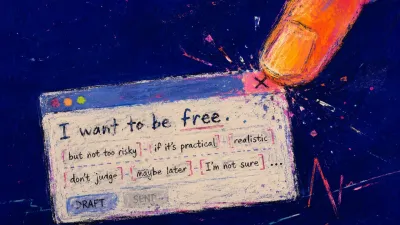
The LinkedIn Career Spiral, Then One Test Without an Audience

The Sunday-Night LinkedIn Spiral at a Career Crossroads
You can be excellent at product strategy and still spend Sunday night adding one more column to a Notion decision matrix because a personal preference suddenly feels like a case you have to win. I know this because I met Jordan, a twenty-eight-year-old product designer renting a small Toronto apartment and standing at the exact point where a sensible career question had become a referendum on their worth.
At 8:42 PM, I watched Jordan rename the hands-on design path so it sounded more senior, then switch from the chart to LinkedIn and back again. The radiator clicked beside the kitchen table. Their coffee had gone cold and bitter, while the phone felt warm from moving between two group chats filled with incompatible advice. Their manager had encouraged them to consider a more visible management role, but Jordan still valued the quiet concentration of making things. The path that might fit an ordinary Tuesday did not seem to produce the cleanest public story.
I heard Jordan say, "I know what I want until I imagine explaining it." They had rewritten the same decision matrix, asked friends and colleagues which option sounded more impressive, and delayed choosing whenever the answers conflicted. Their apprehension was not an abstract cloud to me; it was a browser with thirty tabs open while the one document containing their own criteria stayed minimized underneath them. I could see the tight jaw, the shallow breaths, and the restless hand reaching for the phone whenever the decision became personally exposing.
"I do not think you are failing at decision-making," I told them. "I think your mind has been trying to protect you from being misunderstood. We can respect that protection without letting it run the whole process. Let us use the cards as a structured mirror, then draw a map back to what you can actually live with. That is our Journey to Clarity tonight."

Choosing a Compass for the Crossroads
I asked Jordan to place the phone face down, take a few unforced breaths, and hold the question in a single sentence: What matters more than public approval at this crossroads? I shuffled slowly. The movement was not a supernatural performance; it was a clean psychological transition from scrolling and reacting to noticing. The cards gave us images, sequence, and a shared language for thoughts that had been moving too quickly to examine.
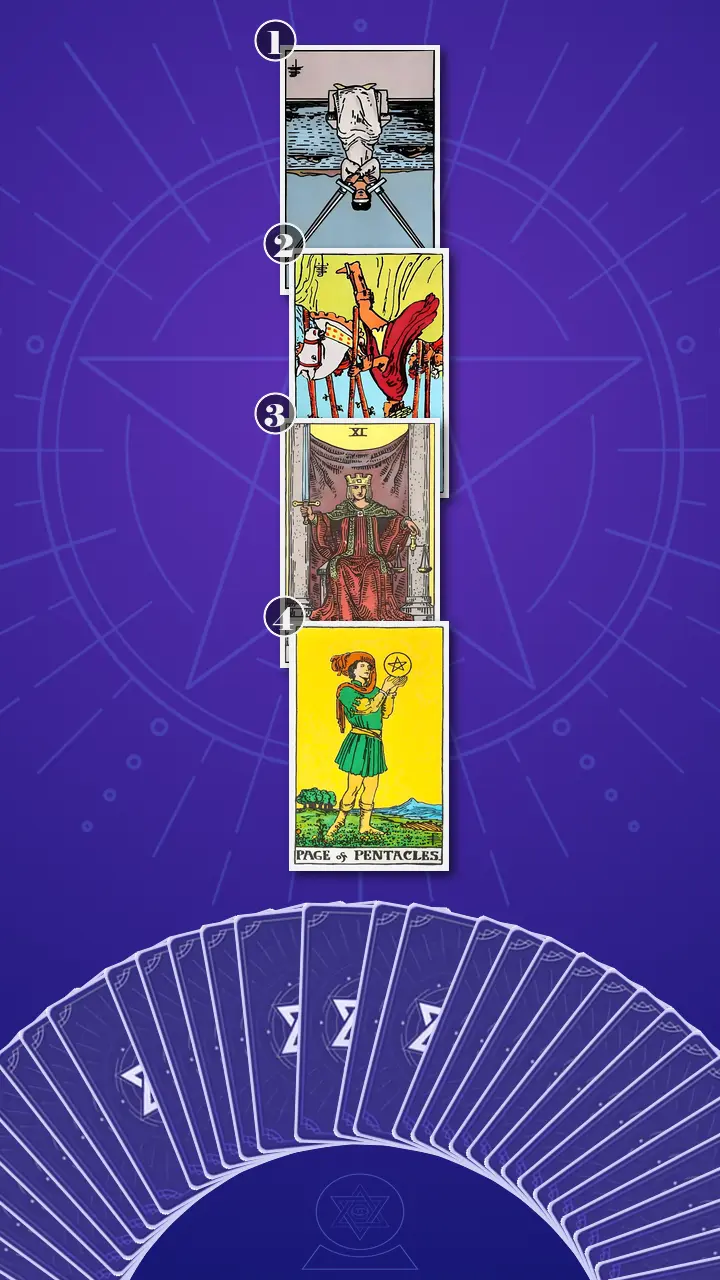
For this reading, I chose the Four-Layer Insight Ladder tarot spread. It is a compact surface-to-root-to-transformation-to-action structure, which makes it useful when someone is caught in approval-driven decision paralysis but has not presented two fully defined external options. A larger spread could add atmosphere without adding decision-relevant evidence. This four-card ladder lets us see what is happening on the screen and in the body, what belief keeps it active, what standard can replace the crowd's verdict, and what small experiment can create firsthand information.
I explained the route to Jordan and to anyone reading along with us. The first position would show the visible state: the comparison, opinion gathering, and delayed action. The second would reveal the root mechanism that makes choosing feel socially dangerous. The third, the center of transformation, would offer a fairer internal standard. The fourth would anchor the insight in a reversible action rather than a polished announcement. The cards would not decide Jordan's future. They would help Jordan see which decision rule had been making the decisions.
Reading the Map Without Asking the Crowd
The Chart That Kept Growing
I began with the card representing the surface state: the repeated comparison, opinion gathering, and delayed action described in the presenting problem. I turned it over and showed Jordan the Two of Swords, in reversed position.
The blindfold and crossed swords immediately connected to the Sunday-night scene. At 8:42 PM, Jordan had eleven Notion columns, twelve contradictory messages, and no named fact that would materially change the decision. They added another criterion, reopened LinkedIn, and called the activity research, even as the private preference that had appeared before the notifications became harder to hear. The card's rocky water seemed to hold the feeling underneath the analysis: unsettled, present, and carefully kept out of the conversation.
Reversed, the Two of Swords shows Air in a contracted and overloaded state. The pause that once protected Jordan from a premature choice was slipping into blockage. Thought had become armor. More information was circulating, but there was no decision rule for knowing when enough was enough. I asked, "What exact missing fact would materially change the choice?" If Jordan could not name one, another opinion might be reassurance rather than evidence.
"One more column, one more reply, then I will know," I said, giving the loop its own sentence. "The difficult part is not comparing. It is the exposure of writing down what you prefer before you know whether anyone else will approve." More opinions cannot answer a question whose criteria are still outsourced.
Jordan did not nod. They let out a short, rueful laugh and rubbed the edge of the phone with one thumb. "That is too accurate. I have absolutely done this. It is almost rude." I let the laugh stand rather than treating it as resistance. "You do not have to agree with the card," I said. "Just notice whether it describes a pattern that is still producing useful information. If it is not, we can stop feeding it." Their shoulders remained high, but the phone stayed face down.
The Applause Jordan Could Already Hear
Next, I turned over the card representing the root mechanism: the fear that a choice without public approval could diminish personal worth. It was the Six of Wands, in reversed position.
I placed the card beside the Two of Swords and asked Jordan to picture the last promotion post they had seen. I watched their eyes move toward the image of the laurel-crowned rider. The imagined LinkedIn announcement arrived before the practical comparison: the title, the congratulatory comments, the people reading the choice as upward progress. In Jordan's mind, the management path became a public win before they had considered its meetings, people responsibilities, reduced creative time, or after-hours load. The hands-on path lost points because fewer people might celebrate it.
Reversed, the Six of Wands is Fire whose confidence has been outsourced to spectators. There is too much energy spent on visibility and too little available for an internally supported choice. I was careful here. Approval-seeking was not vanity. I could see it as a defence against the fear Jordan had named without quite naming: if the quieter option received little applause, perhaps that would prove they lacked ambition or potential. The card showed an attempt to protect worth, not a moral flaw.
"Prestige is data about visibility, not proof of fit," I told them. "An audience can react to your choice; it cannot live your Tuesday afternoons. Who is being asked to award the verdict, and who will actually carry the recurring tasks and consequences?"
Jordan's chest tightened visibly. Their thumb stopped above the group-chat icon, their gaze fixed on the sentence about drafting the announcement before privately deciding, and then they looked down at their hands. "I hate that I can make a career choice into a branding exercise," they said. I answered, "It makes sense that presentation became a safety strategy. We are not going to shame it out of you. We are going to give it a narrower job: sharing useful information after you have chosen your criteria, not choosing the criteria for you."
When Justice Replaced the Scoreboard
The Sword That Cut Through the Title
The room became unusually quiet before I turned over the card representing the key transformation: replacing the crowd's verdict with explicit personal values, fair criteria, and ownership of consequences. This was the key card and the antidote in the Four-Layer Insight Ladder. I revealed Justice, in upright position.
Justice brought the kind of clarity that does not depend on a sudden feeling of certainty. The scales asked us to place weekly tasks, learning, boundaries, money, and consequences in view, while the likes and congratulations stayed outside the frame. The upright sword cut through title language. I invited Jordan to describe both paths without using words such as impressive, strategic, senior, safe, or upward. What would they repeatedly do? What would they accept? What would each path make harder? What would financial stability require?
At that point, I used one of my signature lenses: Fear-Driven Logic Decoupling. I drew two columns beside the chart. In one, I wrote what seemed to come from authentic desire: hands-on craft, sustained focus, and the wish to stay close to making. In the other, I wrote the fear-driven logic: if the choice is not easy to explain, it may reveal wasted potential; if it earns less applause, it may make Jordan count less. Separating those voices did not mean dismissing fear. It meant refusing to let fear disguise itself as objective career analysis.
I added my second diagnostic lens, Hidden Cost Deconstruction. We listed the emotional bills attached to each option instead of pretending that one path was cost-free. The management role might carry a bill of fewer protected design blocks and more people-facing responsibility. The hands-on path might carry a bill of slower public recognition and occasional awkward explanations. Those bills mattered, but neither one was proof that the associated choice was wrong. Quantifying the cost made it possible to compare lived consequences rather than letting an imagined audience turn one social discomfort into a total verdict.
On Sunday night, the Notion table gains another column, LinkedIn adds another success story, and your hand reaches for the group chat. For a few seconds you know what you prefer; then you picture explaining it, and the preference disappears beneath the defense.
You do not need the crowd's verdict; you need criteria you can defend and a choice you can place honestly on Justice's scales.
The choice does not need to win the room; it needs to reflect values and consequences you can actually live with.
Jordan's fingers froze above the phone. Their breath paused halfway in, and I saw their pupils widen as the manager's question, the promotion post, and the carefully rewritten option labels seemed to replay at once. Then their gaze slipped past the card and lost focus. They were no longer debating which title sounded better; they were mentally walking through ordinary Tuesday afternoons. Finally, their jaw worked before they spoke. "But does that mean I have been making every choice wrong?" There was a flash of anger in the question, followed by a smaller, more vulnerable silence. I said, "No. It means your old strategy protected you by optimizing for approval. You are allowed to update the metric." Their clenched hands loosened. The shoulders lowered a fraction, then more. Jordan exhaled with a faint tremor, blinked at the scales, and said, almost to themself, "I could compare what I will actually have to do." I asked, "Now, using this new view, can you remember a moment last week when this insight might have made the moment feel different?"
This was the first felt movement from approval-driven apprehension and analysis paralysis toward values-based discernment. It did not solve the career crossroads or remove the possibility of disappointing someone. It gave Jordan an internal standard that could hold uncertainty without handing authority back to the room. The relief was real, but I could also see the brief dizziness beneath it: once the crowd is no longer the judge, the responsibility for the choice returns to the person who will live it.
Making Room for the Unposted Feeling
Before moving to the final card, I made space for what the spread did not dramatize. There was no Cups card, so I did not invent a hidden emotional answer or ask a bodily sensation to make the whole decision. I asked Jordan to close the chart, release their jaw if that felt comfortable, and notice what appeared when no response had to be posted.
"Before I explain it, I notice..." I offered. Jordan sat quietly while the radiator clicked once and a streetcar bell sounded faintly beyond the window. "I notice I want more hands-on work," they said. Then they added, "And I notice I need the money to be predictable. Both are true." That was enough. Feelings could become information without becoming an oracle. Their private preference had finally entered the meeting without being edited for an audience.
The Apprentice's First Field Note
I turned over the card representing the integration step: a small, reversible experiment that gathers direct evidence without requiring a polished public identity. It was the Page of Pentacles, in upright position.
The Page held the pentacle at eye level, studying one tangible object while an open field and distant mountains remained available behind them. In modern life, this is a beta test before the launch announcement. It is one contained sample of the work, not a permanent identity reveal. I connected it to a sixty-minute hands-on prototype, one facilitated design critique, or one shadowing conversation with a manager. The Page's Earth energy was grounded and curious: enough structure to learn, no demand to declare a final answer.
"I do not need to become this today; I can learn one real thing about it this week," Jordan said. I watched them open their calendar rather than their group chats. Their shoulders lowered. The crossroads shrank from a public announcement to a field note: what held attention, what drained energy, what boundary became visible, and what remained unknown. "You do not need a launch post; you need one honest test," I told them.
I asked Jordan to keep the experiment contained and reversible. Their salary covered rent and ordinary expenses but did not support a reckless leap, and a bounded trial respected that reality. A small test was not cowardice or a consolation prize. It was a practical way to let direct experience become stronger evidence than imagined reactions.
The One-Page Rubric and the 48-Hour Shadow Choice
When I read the four cards together, I saw a coherent story. The Two of Swords reversed showed an intelligent mind using comparison as armour, adding information after the useful information had run out. The Six of Wands reversed revealed why: public recognition had been recruited to certify worth, so the less applauded path felt threatening even before its daily reality was examined. Justice restored thought as a precise tool, asking for transparent personal values and proportionate consequences. The Page of Pentacles brought that clarity down to Earth through a learnable, low-risk experiment.
The blind spot was not a lack of ambition and not a lack of data. Jordan had been treating the absence of consensus as evidence that the decision was not ready, when the deeper issue was that the deciding standard had been outsourced. The shift was from polling for the most applauded option to ranking each path against three self-chosen values and testing one reversible next step. Public approval could remain useful feedback, but it no longer had to be the authority that determined worth.
I gave Jordan three pieces of actionable advice. Each one was deliberately small. None required a resignation, a public announcement, a dramatic career pivot, or certainty that could not honestly exist yet.
- The Audience-Free Values CheckOn Tuesday at 7:00 PM, set an eight-minute timer, put the phone on Do Not Disturb, and create a private note called No Audience. Write three values for the lived week, such as hands-on craft, financial stability, or protected personal time. Duplicate the Notion chart, remove titles, prestige language, and announcement value, then give each value one observable sign and compare both paths by weekly tasks, learning, compensation, boundaries, and consequences.Keep the first version private for twenty-four hours. The minimum version is one value, one observable sign, and one sentence beginning, "This would still be worthwhile without a post or praise because..."
- The Shadow Choice ExperimentFor the next forty-eight hours, use my Shadow Choice Experiment on paper only: intentionally write as if you have chosen the option you fear will look less impressive. Do not send a message, accept a role, resign, or post an announcement. Instead, describe what your ordinary Tuesday would contain, whose reaction you are bracing for, and which emotional bill your mind immediately presents. Then write what defence mechanism appears when the choice is treated as real.This is an exposure exercise for the decision process, not a command to take the feared path. Stop after five minutes if it feels too exposing, or record one uncensored sentence and return later. You remain in charge of what stays private.
- The One-Week Apprentice TestBy Wednesday, ask the manager for one contained information-gathering trial, such as facilitating a single design critique or shadowing one management planning session, while also protecting one sixty-minute calendar block for a hands-on prototype or real product problem. Set a maximum evidence budget of two hours. Immediately afterward, record three facts: energy before and after, the task that felt absorbing or depleting, and one trade-off that became clearer.Call it a trial, not a commitment. On Sunday, review the field notes against the three Justice values before asking anyone for an opinion. Ask for lived details, never a verdict about what you should choose.
I watched Jordan read the list twice. The first pass looked for a perfect method. The second pass stopped at the eight-minute check and the private paper exercise. "I can do that without making it a whole thing," they said. I answered, "Exactly. Earned self-trust is usually built from evidence you collect while living, not from one explanation that finally silences every possible objection."

A Small Proof of Self-Trust
A week later, I received a message from Jordan. They had asked to shadow one management planning session, protected a sixty-minute prototype block, and kept the results out of the group chats. The note was brief: "The hands-on block held my attention longer than I expected. The planning session taught me something useful too. I am not ready to announce anything, but I know what I want to test next."
The change was clear but tender. Jordan slept through the night, then woke with the familiar thought, "What if I am wrong?" This time, they smiled, opened their notes, and wrote one next experiment instead of reaching for LinkedIn. The uncertainty had not vanished. It had simply stopped being the only voice in the room.
I do not read that as the cards choosing a career for Jordan. I read it as Jordan moving from an audience member to a fair evaluator, then to an apprentice willing to gather real evidence. The Four-Layer Insight Ladder had done its work as an objective recognition tool: it made the approval loop visible, gave personal values a usable structure, and returned the next move to the person who would live its consequences.
When you know what you want until you picture the room's reaction, your jaw tightens and your hand reaches for the phone. Choosing the quieter fit can feel less like a career decision than a verdict on whether you still count. It is not a verdict. It is a moment in which you can reclaim the criteria, acknowledge the real trade-offs, and let fear become information instead of authority.
Clarity does not promise that everyone will understand your choice. It gives you an inner pass: criteria you can defend, a Tuesday you can inhabit, and enough courage to run one honest test before you tell the room a polished story. If no announcement were required, what is one small, reversible test you would be curious to run for your own information, and which ordinary-Tuesday value would you place on Justice's scales first?